




Abstract
Near-field electrospinning direct writing of array-nozzle is an efficient method for preparing large-area aligned fibers. However, electric field between the array-nozzle interferes with the stability and uniformity of near-field electrospinning, and little research has been done in this field. To clarify the electric field interference generated by array-nozzle, the experimental results compared with the simulation are discussed. In this work, electric field interference between the five-nozzle linear arrangement near-field electrospinning process was demonstrated by the initial ejection behavior, the electric field distribution of near-field electrospinning environment and the deposition spacing of fibers. In addition, we developed a simple and flexible method serving as a quantitative evaluation index for evaluating the degree of electric field interference. Then, the mapping effects of electric field interference of nozzle structure on the surface morphology and uniformity of aligned fibers were studied, including the number of nozzle, nozzle spacing and nozzle length with linear and toothed arrangement. According to the result of experiment and characterization, suitable arrayed nozzle parameters for stably direct-write aligned array pattern with near-field electrospinning were available, whose geometric parameters are linear two-nozzle with a nozzle spacing of 2 mm and a nozzle length of 6.35 mm. Finally, on the basis of our previous research, a microfluidic channel was successfully prepared on polydimethylsiloxane by two-nozzle cooperation, which verified the rationality of the geometry.
Keywords
Introduction
Nowadays, the traditional single-nozzle electrohydrodynamic printing technology has been receiving extensive attention for its simplicity and high efficiency in preparing nanofibers, but its output is extremely low, which limits its industrialization. To improve the efficiency, the most direct and effective method is to increase the number of jets in the process of electrospinning.1,2 However, electric field interference (EFIF) between array-nozzle will directly affect its stability and uniformity. 3 In recent years, the prepared fiber films or the uniformity of the jets has been used to evaluate the rationality of the nozzle design. Although there is a quantitative analysis of the relationship between EFIF and the prepared fiber structure, 4 this is not suitable for the conditions in near-field electrospinning (NFES). Therefore, how to suppress the NFES of multi-nozzle has become an issue that researchers have intensively studied.5–7
A straightforward way of reducing the EFIF is to increase the nozzle spacing. However, the nanofibers film will be independent and will not form a large uniform area if the nozzle spacing is too large. 8 For example, Angammana and Jayaram 9 explored the double-nozzle electrospinning and verified the conclusions that a larger nozzle spacing will result in a non-uniform and independent nanofibers film, which would lose the advantage of high-intensity multi-jet direct writing aligned fibers due to the size of the electrospinning device and nozzle spacing. Theron et al.10,11 also found that the farther away from the middle of multi-jet, the greater the jet offset. But changing the geometric parameters is still one of the most effective ways to obtain a uniform electric field distribution. Choi et al.12,13 defined the EFIF effect of the multi-nozzle electrospinning environment as the cross-talk effect, and investigated the inclination angle of the jet by changing the nozzle spacing and the liquid supply speed. They found increasing the nozzle spacing or the velocity of liquid supply could weaken the EFIF, but the influence is reduced when they reach a certain value. Park et al. 14 found the average fiber diameter in the linear alignment system was smaller than the triangular alignment system in the far-field electrospinning. However, the uniformity of collecting location in the triangular alignment system was better. Tian et al. 4 quantitatively evaluated the strength of EFIF by proposing the effects of different nozzles number and arrangement on the structure and properties of nanofibers in water bath electrospinning. Liu and Guo 15 considered the EFIF intensity of different nozzle spacing, nozzle lengths and voltages by electric field simulation, and used the plastic sleeve to effectively reduce the EFIF, and obtained the optimal nozzle arrangement. In addition, Zheng et al.16,17 simulated a 19-hole nozzle. The multihole electrospinning system could produce better quality fibers whose electric field was more concentrated than the nozzle-free. Tomaszewski and Szadkowski 18 studied the electrospinning with linear, elliptical and circular multi-jet head arrangement separately, and found that the electric field distribution of the elliptical and circular arrangement was more uniform. Sheath Gas 19 and plastic filters 20 can be applied to suppress the EFIF in multi-jet electrospinning to obtain a stable and uniform fiber.
Furthermore, the addition of the auxiliary electrode is also an effective method for reducing the EFIF between the nozzles due to the limitation of the device size. According to the shape of auxiliary electrodes, they are mainly classified into rings, 9 thin shells, 21 squares and inverted round squares. 22 Moreover, Varesano et al., 23 Kim et al. 24 and Yang et al. 21 confirmed that the addition of auxiliary electrodes can effectively reduce the EFIF between nozzles and obtained a nanofiber with regular shape and concentrated distribution.
It can be seen from the research that the multi-nozzle electrohydrodynamic printing method has been proven to increase the fibers yield. However, there is an EFIF between the multi-nozzle, which affects the uniformity of the spinning. At present, most researchers evaluate the distribution of electric field by simulation and designing the nozzle geometry, collector plate shape or the auxiliary electrodes to reduce the EFIF in the far-field electrospinning. In addition, there is no relevant report on the quantitative optimization strategy for NFES multi-nozzle arrangement. Therefore, a quantitative optimization strategy was proposed in the article to obtain the optimal nozzle arrangement. Under these conditions, microchannel devices combining the polydimethylsiloxane (PDMS) soft lithography technology were prepared.
Materials and methods
Materials and parameters
The solution for the experiment is prepared using polyethylene oxide (PEO,
Experiment device
The experimental device system is shown in Figure 1(a). The multi-nozzle is supplied with solution at a constant flow rate (

Multi-nozzle NFES direct writing aligned fibers: (a) The schematic of multi-nozzle NFES system and (b) array multi-nozzle linear and toothed arrangement.
Characterization
In this work, there are four methods to characterize EFIF. Three macroscopic characterization methods are shown in Figure 3(a) to (h). EFIF between the five-nozzle linear arrangement NFES process is demonstrated by the initial ejection behavior, the electric field distribution of NFES environment and the deposition spacing of fibers. In particular, the axial and radial electric field strengths are calculated on a 100 mm plane under the nozzle with COMSOL Multiphysics. The EFIF of the nozzle is quantitatively characterized by the electric field offset (EI), which is the fourth method as shown in Figure 2(a). To further reduce the impact of EFIF on fiber deposition precision, based on our previous studies, PDMS microchannel is fabricated by NFES in collaboration with multi-nozzle as shown in Figure 2(b) and (c). First, the cooperative multi-nozzle is used to directly write aligned PEO fibers on a conductive glass by NFES, whose direction is parallel to the direction of the fiber traction (Figure 2(b)). Second, the PDMS solution is slowly poured in the direction of the fully dried aligned fibers. Finally, the PDMS microchannel mold can be obtained after curing (Figure 2(c)). In addition, the fiber diameter and surface morphology are analyzed by scanning electron microscopy (SEM, HITACHI TM3030). The deposition distance of aligned fibers is calculated by image analysis software (Image-Pro Plus 6.0) with 5 images


(a) Quantitative characterization of EFIF in nozzle tip during multi-nozzle NFES; (b) and (c) the schematic of PDMS microchannel fabricated by NFES with multi-nozzle cooperative.
The electric field offset (EI) of the nozzle tips are averaged to obtain VEI (EFIF) as equation, where n is the number of nozzles in an array multi-nozzle

To better evaluate the consistency of aligned array fibers, the coefficient of variation is used to evaluate the uniformity of fiber structure features, which can be expressed as


where
Results and discussion
Macroscopic characterization of EFIF in array multi-nozzle
Three methods are used to demonstrate the EFIF between arrayed nozzles macroscopically, as shown in Figure 3. The first method by observing the initial ejection sequence of linear five-nozzle NFES is shown in Figure 3(a) to (f). The second method is verified by simulation of the electric field distribution. Due to the mutual electrostatic interaction between the nozzles, the edge nozzle has a shielding effect on the middle, so that the electric field strength of the edge is stronger than the middle (Figure 3(g)). Therefore, a taylor cone is formed from the edge to the middle droplets in the nozzle arrangement direction, which is eventually larger than the surface tension, causing it to be ejected (Figure 3(a) to (c)). Furthermore, a charged jet deposition process with uneven deviation angle of taylor cone can be observed. With shield effect of surrounding needles, the motion of the central jet is too late to eject and is close to the vertical drop process, while the jet from the edge has the largest deviation angle (Figure 3(d) to (f)). The last method is to characterize the phenomenon that the EFIF between the nozzles leads to uneven deposition spacing (Figure 3(h)). Consequently, it can be macroscopically proven that there is EFIF between the arrayed nozzles.

(a) to (f) Five-nozzle NFES jet initiation behavior; (g) Electric field distribution environment of five-nozzle NFES and (h) Five-nozzle NFES direct writing aligned array pattern.
Effect of multi-nozzle geometry distribution on EFIF
To quantitatively evaluate the influence of the nozzle structure on the degree of EFIF, two to five different geometry nozzles are used to calculate the EFIF of multi-nozzle. The toothed arrangement EFIF is always higher than the linear arrangement under the same conditions. Moreover, as the nozzle spacing increases, the electric field mutual repulsion between the nozzles is significantly reduces. So the EFIF gradually decreases (Figure 4(a)). In addition, due to the longer nozzle length and more production in nozzle numbers, and more electric force effect of each nozzle by the surrounding nozzles, there is an improvement in EFIF (Figure 4(b) and (c)). There is positive correlation with EFIF, where the number of nozzles is more affected.
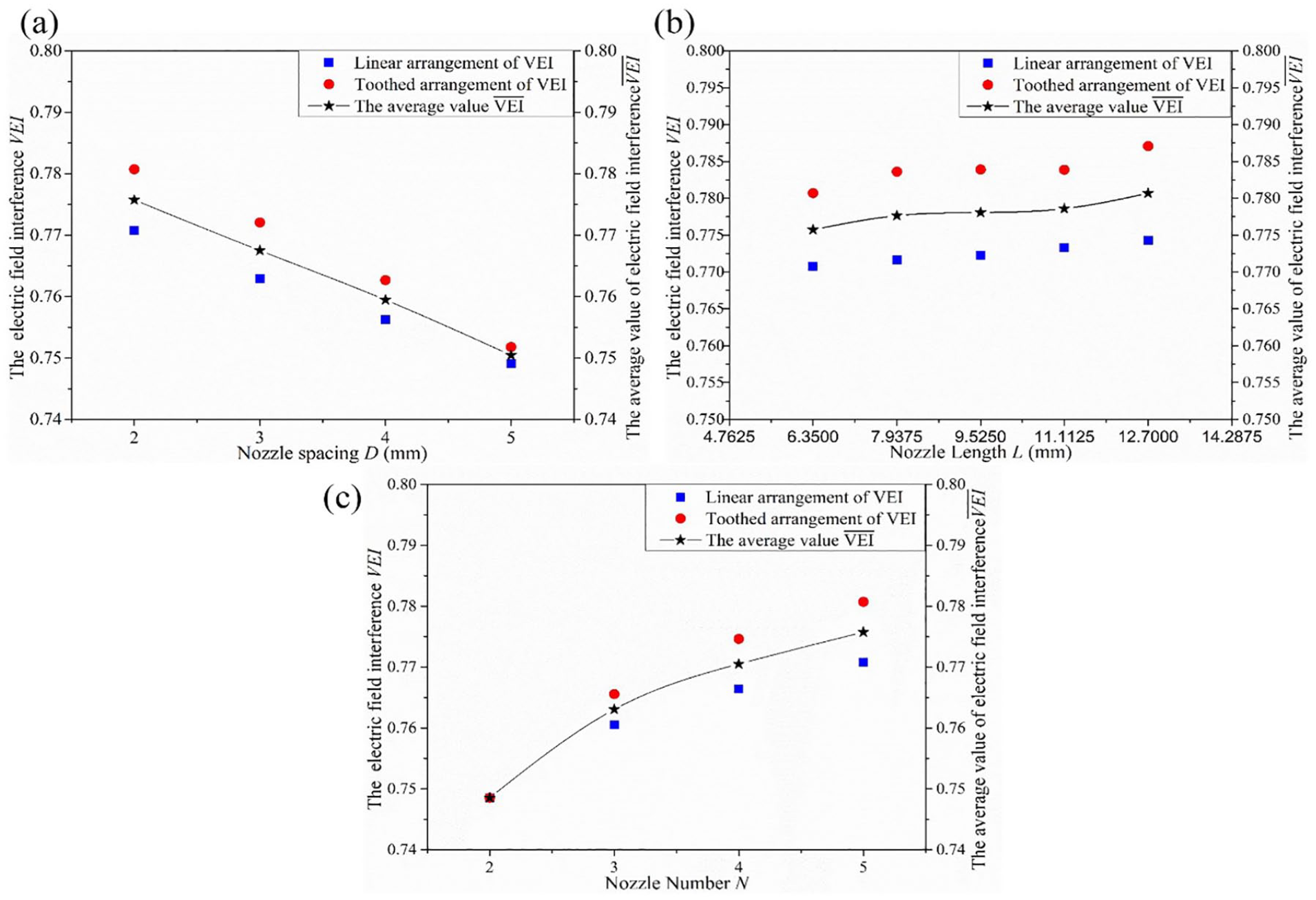
Relationship between multi-nozzle geometry parameters and EFIF: (a) Relationship between nozzle spacing and EFIF. The experiments works in environment as: nozzle length 6.35 mm and five nozzles; (b) Relationship between nozzle length and EFIF. Whose applied voltage is nozzle spacing 2.0 mm and five nozzles and (c) Relationship between nozzle number and EFIF. The environment is nozzle length 6.35 mm and nozzle spacing 2.0 mm.
Effect of EFIF on deposition morphology characteristics
The nozzle number, nozzle spacing and nozzle arrangement have a greater impact than nozzle length on EFIF, as shown in Figure 4. To verify the relationship between the geometry of the proposed nozzle and the morphology of the deposited fibers, the experimental data and theoretical results are analyzed under the conditions of nozzle spacing 2.0 mm and nozzle length 6.35 mm due to collector size and electrospinning device. The average diameter of aligned fibers in linear arrangement and toothed arrangement increases as the number of nozzles increases, as shown in Figure 5(a). The increase in EFIF leads to a decrease in the electric field strength near the nozzle tip and an increase in mutual repulsion. Therefore, the traction effect on the charged jet becomes weak. In a word, the average fiber diameter shows positive correlation with EFIF. In addition, under the same condition, the average fiber diameter of the toothed arrangement is always thicker than the linear arrangement (Figure 5(b) and (c)).

(a) The average diameter of aligned array fiber influenced by nozzles number and nozzles arrangement during multi-nozzle NFES system; (b) Morphology of the fiber with four-nozzle toothed arrangement and (c) Morphology of the fiber with four-nozzle linear arrangement.
The uniformity characterize on fiber and the fabrication of microfluidic channels
As shown in Figure 6(a), the coefficient of variation of the fiber diameter (RCV) on the linear arrangement is positively correlated with the nozzle number and fluctuates around a linear. The three-nozzle and four-nozzle toothed arrangement have the same effect on RCV as the linear arrangement. However, with five-nozzle, the RCV of toothed arrangement is larger than the linear arrangement. Because the strong EFIF of the five-nozzle toothed arrangement, the edge nozzle is more prone to bifurcation and clogging during NFES, resulting in uneven deposition fibers. In a word, the uniformity of the fiber diameter

(a) RCV changes with the nozzles number under linear and toothed arrangement; (b) PDMS microchannel mold and (c) Microchannel observed by SEM.
Conclusion
In this article, three methods are used to prove the existence of EFIF between arranged nozzles macroscopically. In addition, we have developed an easy way to evaluate it. The effects of geometric parameters of arranged nozzles such as nozzle length, nozzle spacing, nozzle number and nozzle arrangement on the EFIF were investigated. According to the result of simulation and experiment, under the same conditions, the EFIF of linear alignment is always lower than the toothed arrangement. The effect of nozzle length on EFIF is not significant. Furthermore, we studied the effect of nozzle number and nozzle arrangement on the average diameter of aligned array fibers in multi-nozzle NFES system. As the number of nozzles increases, the average diameter of deposited fibers increases, the uniformity of fiber diameter, however, gets worse. In addition, the average fiber diameter of the linear arrangement is always thinner and more uniform than the toothed arrangement under the same condition. Therefore, a suitable multi-nozzle, with geometric parameters of linear two-nozzle, nozzle spacing of 2 mm and nozzle length of 6.35 mm, was obtained to produce the thinner and more uniform fibers microfluidic channel devices.
Footnotes
Declaration of conflicting interests
The author(s) declared no potential conflicts of interest with respect to the research, authorship, and/or publication of this article.
Funding
The author(s) disclosed receipt of the following financial support for the research, authorship, and/or publication of this article: This work are financially supported by China Postdoctoral Science Foundation (2018M633010), University Innovation and Entrepreneurship Education Major Project of Guangzhou City (201709P05), Jihua Laboratory Foundation of Guangdong Province Laboratory of China (X190071UZ190), Project of Science and Technology of Foshan City (2015IT100152) and Science and Technology Program of Guangzhou (201803010065).
