




Abstract
This paper studies a micro/nano scale capillary flow in a hollow fiber and its oscillation. The hollow fiber is immersed into a liquid (e.g. water), and the isolated air in the fiber plays as a spring-like oscillation. An oscillation model is established for the fluid vibration in the capillary tube, a simple estimation of its frequency is suggested for practical applications, and the silver ion release from hollow fibers is discussed.
Keywords
Introduction
Nano scale or micro scale flows have been caught much attention due to the fast development of micro-electro-mechanical systems, 1 micro scale devices, e.g., silicon rectangular micro-orifice, 2 micropump,3–5 microfluidics device, 6 three-dimensional integrated circuits,7,8 micro scale heat exchanger, 9 the ion release from hollow fibers,10,11 the drug release from nanoporous fibers,12–15 and nanofiber membranes.16–23 Due to capillary action, water will be sucked into the gap of a micro scale device, which will greatly affect the device’s performance. On the other hand, ions in a hollow fiber and drug in a nanofiber membrane require continuous release. But capillary action forbids a complete release, and the fluid in the tube will be oscillated due to some perturbations. The nano/micro scale fluid oscillation will greatly affect the property of such systems, especially the micro-channel cooling property, heat transfer, and drug release property.
In this paper, we will study the fluid oscillation in a nano/micro capillary tube of a hollow fiber.
Fluid oscillation in capillary tube of a hollow fiber
We consider a capillary tube as illustrated in Figure 1. The tube is immersed in water. The enclosed fluid (blue part in Figure 1) can be considered as a coolant flow, a released solution, and others.
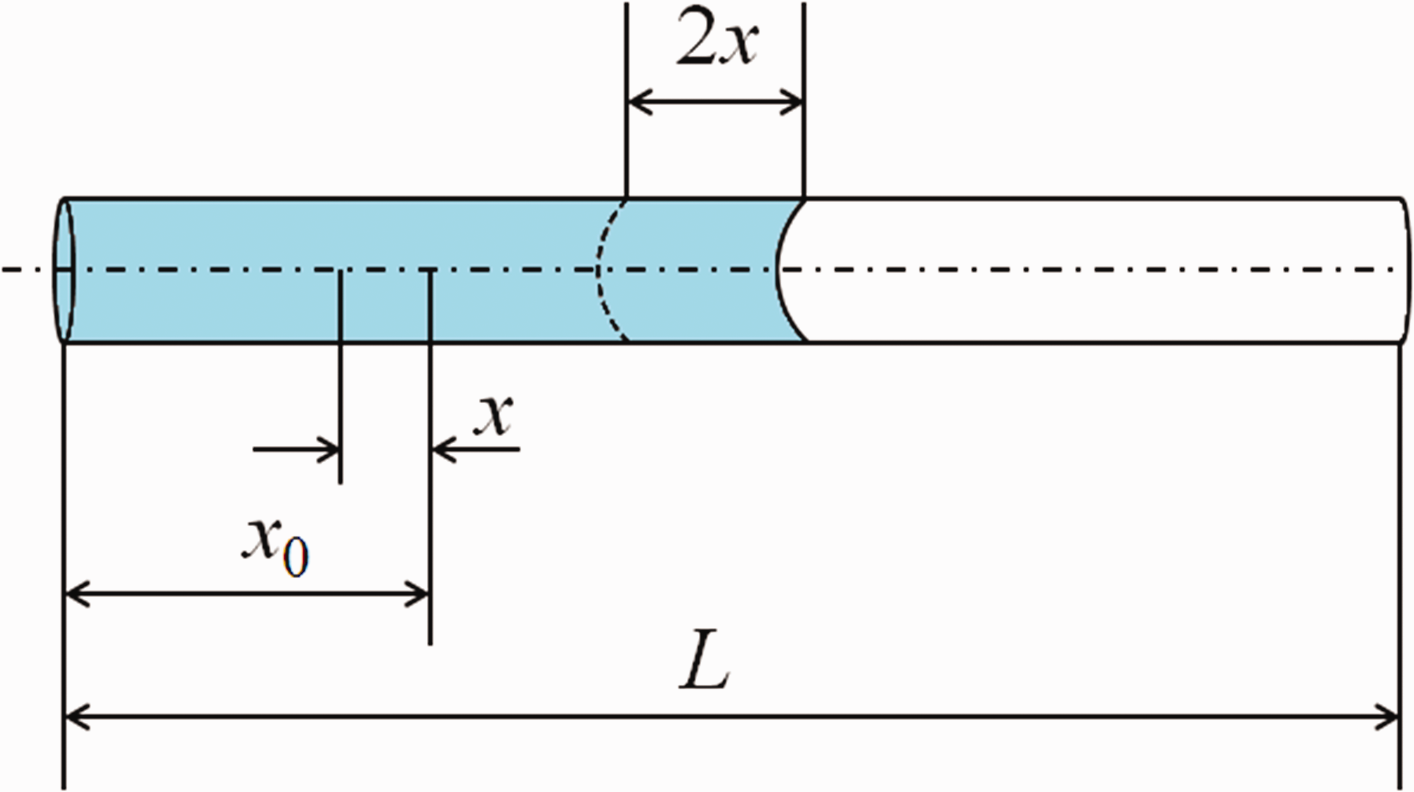
Nano/micro flow in a capillary tube, where
According to Newton’s second law, the free oscillation of the fluid in nano/micro tube can be written as

The fluid mass in the tube can be calculated as

The force F can be written in the form

The isolated air in the tube follows the Boyle's law

Equation (4) is valid for the case when the temperature and the gas involved in the hollow fiber remain unchanged during the release process.
The air volume can be calculated as

The air pressure

The governing equation, equation (1), becomes


The initial conditions are

Frequency–amplitude relation of the fluid oscillator
In this paper, we will suggest two simple but effective approaches to a fast estimation of the solution of the fluid oscillator. One is the Taylor series-based approach 24 and the other is the max–min approach. 25 Other simple methods are available in Tian and Liu, 26 He, 27 He et al., 28 and Ren and Hu. 29
Taylor series-based solution
Following equation (8) and the initial conditions given in equation (9), we have
24

The Taylor series to second order is

Considering the oscillation property, we have
24

Solving the period from equation (12), we have

Its frequency reads


In equation (15) accuracy is not enough, but it can depict the main factors affecting the frequency.
Max–min approach
We write the fluid oscillator in the form
25


The max–min approach is to calculate the square of the frequency in a simple form
25

Choosing location point

Discussion and conclusion
The fluid oscillation will greatly affect drug release from hollow fibers or nanofiber member and micro-channel cooling property in micro devices. In practical applications, we need to improve cooling efficiency in a three-dimensional integrated circuit, to enhance heat transfer in a micro scale heat exchanger and to adjust the drug release ratio from a hollow fiber. So the exact frequency is not necessary, and the approximate one is enough for this purpose. For example, if we want to improve the drug release ratio from a hollow fiber, we should increase the frequency of the fluid oscillation, according to equation (15) or (19), the value of
This paper elucidates the main parameters affecting the frequency in the ion release in a hollow fiber, and the theoretical results can be used to control drug release and heat transfer and other nano/micro tube flows.
Footnotes
Declaration of conflicting interests
The author(s) declared no potential conflicts of interest with respect to the research, authorship, and/or publication of this article.
Funding
The author(s) received no financial support for the research, authorship, and/or publication of this article.