




Abstract
In this article, rice husk fiber/polyvinyl chloride composites were prepared and analyzed. The optimal composition of mixed-particle-size fiber-reinforced composites was determined through orthogonal experimentation. The physical, mechanical, and thermal properties of the mixed-particle-size fiber-reinforced composites were compared to unprocessed (100 mesh) rice husk fiber/polyvinyl chloride composites. The surface microscopic appearances of the unprocessed and final composites were observed via laser microscope. Long-term accelerated soil aging caused micro-cracks to appear on the surfaces of the composites. Interfacial adhesion was observed via scanning electron microscopy. The results indicated that mixed-particle-size fibers can better fill interfacial gaps, leading to strong interfacial adhesion. Furthermore, the addition of mixed-particle-size fibers improves the soil aging resistance of composites. The hardness, flexural strength, impact strength, and first onset pyrolysis temperature (after 0 days) increase from 50 HRR, 35.2 MPa, 3.19 KJ/m2, and 258.5°C to 55 HRR, 39.4 MPa, 3.86 KJ/m2, and 261.2°C, respectively. However, the mass loss rate and thickness expansion rate (after 21 days) decrease from 2.9% and 0.79% to 2.21% and 0.74%, respectively. In general, the addition of mixed-particle-size fibers improves the ultimate properties of composites under soil aging conditions.
Introduction
In recent years, wood–plastic composites (WPCs) have been rapidly developed as standard commercial outdoor materials. The composition of WPCs includes natural fibers, plastics, and additives.1,2 Natural fiber/polyvinyl chloride (PVC) composites have many advantages, such as low water absorption (WA) and excellent humidity resistance.3–5 However, in outdoor applications, these materials often face challenges from moisture,6,7 fungi,8,9 ultraviolet light,10,11 xenon lamps,12,13 seawater, and acid rain,14,15 which attack the surfaces of materials. In addition, composites are often in direct contact with soil, meaning long soil aging can lead to the degradation of mechanical and thermal properties.11,16,17 Various experts have researched the natural soil aging resistance of WPCs. The results have revealed the degradation of mechanical properties, color lightening, weight loss, and weak interfacial adhesion. Therefore, improving the aging resistance of composites is an important goal.
As filler, rice husk fibers (RHFs) have a positive effect on the mechanical and thermal properties of composites. Many scholars have researched the effects of the particle size and filler content of RHFs on composite strength. For example, when comparing the mechanical properties of four different rice straw components (rice husks, rice straw leaves, rice straw stems, and whole rice straws) in reinforced high-density polyethylene (PE) composites, RHF-reinforced composites exhibit the greatest impact strength. 18 It has been shown that 25 wt% RHF-reinforced unsaturated polyester resin composites have the greatest tensile strength. When RHF filler content is 15 wt%, composites show remarkably enhanced Young’s moduli. 19 RHFs can also improve erosion resistance. In Rout and Satapathy, 20 15 wt% RHF-reinforced glass–epoxy hybrid composites exhibited excellent tensile and flexural properties, and three different weight percentages of RHF-reinforced composites exhibited clear improvements in terms of erosion resistance. The characterization of three different particle sizes (150, 500, and 1000 μm) of RHF/PVC composites (RHRC) was performed in Crespo et al. 21 and the results indicated that 150 μm RHRC have the best mechanical properties. However, very few studies on mixed-particle-size fiber-reinforced composites (MSRC) have been reported. Therefore, further analysis of the effects of RHF size on the properties of MSRC is necessary.
This article mainly studies the effect of RHFs on the properties of mixed-particle-size fiber-reinforced PVC composites in simulated soil accelerated aging conditions. The simulated soil accelerated aging experiment is designed, and the best ratio of mixed-particle-size fibers is determined using orthogonal experiment method. The physical (mass loss rate, 24-h WA, thickness expansion rate, and hardness), mechanical (flexural and impact strength), and thermal (thermal degradation and linear thermal expansion coefficient) properties of MSRC have been investigated.
Experiment
Materials
RHFs, H-108 PE wax, and non-toxic 603 Ca/Zn composite stabilizers were sourced from Hebei Pengyue Minerals Trading Co., Ltd, China. SG-5 PVC (100 mesh) was sourced from Wenzhou Zhengbang Chemical Co., Ltd, China. Maleic-anhydride-grafted PVC was sourced from Shenzhen Hai’an Plastic Chemical Co., Ltd, China. Diatomite (20–40- and 200-meshes) was sourced from the Shenzhen Haiyang Powder official flagship store. Chemical reagents (NaCl, Na2SO4, MgSO4, CaCl2, KNO3, and NaHCO3) were sourced from Nanjing Chemical Reagent Co., Ltd, China.
Sample preparation
The dried RHFs, PVC, stabilizer, PE wax, and maleic-anhydride-grafted PVC were mixed at a mass ratio of 100:100:8:5:3. The resulting polymer was placed into an SBH-5L 3D linkage mixer (Nanjing Xinbao Mechanical and Electrical Industry Co., Ltd, China). Mixed polymer samples were produced by an RM200C conical twin-screw extruder (Harbin Hapro Electric Technology Co., Ltd, China), which operated at a speed of 20 r/min in a temperature range of 150°C–165°C. The dimensions of the final samples were 100 × 10 × 7 mm, and samples were mixed in beakers sealed with plastic wrap that were placed in an HH-600 thermostatic water tank (Shanghai Baidian Instrument Equipment Co., Ltd, China).
Accelerated soil aging experiment preparation
The simulated soil accelerated aging experiment was performed according to the ASTMG160 (2012) standard. To simulate natural soil, diatomite was selected as an experimental soil based on its excellent absorption characteristics.22–24 The simulated soil consisted of 20–40- and 200-mesh particle sizes. Based on previous studies on the worst soil aging conditions, the soil temperature, pH, moisture content, and mass ratio of thick and thin particle sizes were set to 65°C, 2.5, 45%, and 3:7, respectively. To accelerate soil aging, the amount of chemical reagents added was five times the amount found in real soil (NaCl: 0.23 g/L, Na2SO4: 0.07 g/L, MgSO4: 0.09 g/L, CaCl2: 0.05 g/L, KNO3: 0.33 g/L, and NaHCO3: 0.07 g/L). The final soil aging solutions were prepared using these proportions. The composite samples were placed into these solutions and monitored for 21 days in 7-day increments. The ultimate properties of the composites decreased by more than half compared to the original properties.
Experimental procedure
To study the effects of soil aging on the biodegradation performance of WPCs, we selected an orthogonal experimental design based on an L9 (34) orthogonal table. Three important factors were identified based on preliminary experiments. These three factors have a significant influence on the aging resistance of composites. The three factors are the particle size ratio of the mixed-particle-size fibers (X1), mass ratio of the mixed-particle-size fibers (X2), and mass ratio of wood and plastic (X3). Table 1 lists three different levels for these three experimental factors. Based on the typical service environment of WPCs (outdoor construction and flooring), impact strength was considered as an important indicator. Therefore, the main purpose of our initial experiments was to evaluate impact strength. In a second set of experiments, biodegradation performance was analyzed under the worst aging conditions for samples with the optimal ratio of mixed-particle-size fibers over three 7-day periods, as mentioned previously.
Factors and levels of orthogonal experiment.

Characterization
Physical and mechanical properties of composites
The flexural and impact strengths of the composites were evaluated according to the GB/T 9341 (2008) and GB/T 1043.1 (2008) standards, respectively. These tests were performed using a CMT6104 electronic universal testing machine (MTS Industrial Systems Co., Ltd, China). The test speed and temperature were 2 mm/min and room temperature, respectively.
Hardness tests were conducted according to the GB/T 3398.1 (2008) standard using an XHR-150 plastic Rockwell hardness tester (Shanghai Joint Seoul Test Equipment Co., Ltd, China). The values of the load time interval, indenter diameter, and unloading time were 5 s, 12.7 mm, and 15 s, respectively.
Water absorption (WA) tests were conducted according to the GB/T 17657 (2013) standard using a HH-600 thermostatic water tank (Shanghai Baidian Instrument Equipment Co., Ltd). Dried samples were immersed in deionized water for 24 h. The dry weight (W0) and weight after immersion for 24 h (W1) were measured. The WA was calculated using equation (1)

The weight loss rate (R) reflected the soil aging resistance. W1 and W2 represented the mass of original and final samples, respectively. The R was determined using equation (2)

The thickness expansion rate (T) explained the soil aging resistance. L1 and L2 represented the length of original and final samples, respectively. The T was determined using equation (3)

Each test was repeated five times and the average results were recorded.
Thermal properties of composites
Thermal degradation tests were performed using an STA449 F3 synchronized thermal analyzer (NETZSCH Scientific Instrument Trading Co., Ltd, Germany), where the mass of each sample was approximately 10 mg. The tests were performed at a temperature range of 30°C–800°C in an Ar atmosphere. The heating rate was 20°C/min.
The linear coefficient of thermal expansion (LCTE) was evaluated by a PCY-D low-temperature expansion tester (Xiangtan Xiangyi Instrument Co., Ltd) according to the Chinese GB/T2572-2005 standard at a temperature range of −30°C to 60°C. The LCTE value was calculated using a TA Instruments analysis software package.
Surface morphology of composites
The surface morphologies of composites were analyzed via scanning electron microscopy (SEM) using an S-4800 microscope (Hitachi, Ltd, Japan). Each sample was subjected to a gold sputtering treatment using an E-1010 ion sputter coater.
The microscopic appearances of the composites were analyzed by a LEXT OLS4100 3D laser scanning microscope (OLYMPUS Co., Ltd, Tokyo, Japan), allowed the aging degree of the samples to be observed clearly.
Results and discussion
Analysis of orthogonal experiment result
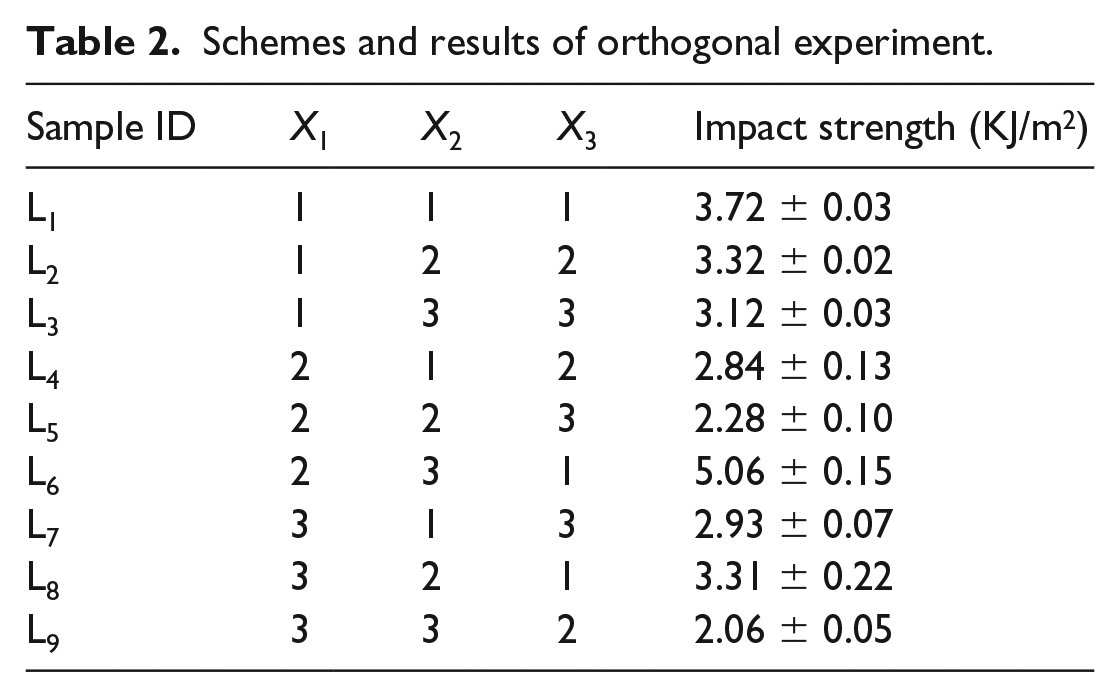
Tables 1 to 3 list the experiment factors, schemes, and variance analysis results for the orthogonal experimentation, respectively. The P-values of the three factors discussed above are all less than 0.01, indicating that all three factors are significant in terms of impact strength. Analysis of the information in Tables 2 and 3 revealed that the sequence of F-values is X3 (416.029) > X1 (101.503) > X2 (38.023). These results demonstrate that the mass ratio of the wood and plastic has the greatest influence on soil aging resistance, followed by the particle size ratio of the mixed-particle-size fibers and the mass ratio of the mixed-particle-size fibers. The optimal MSRC combination is X12X23X31 in terms of increasing impact strength (Table 4). Therefore, this combination was selected as the experimental subject for comparison to an unprocessed RHRC (100 mesh).
Schemes and results of orthogonal experiment.
Variance analysis of orthogonal experiment.

R2 = 0.98 (adjusted R2 = 0.98).
Mean and standard deviation of orthogonal experiment.

Physical properties of composites
The variations in mass loss rate, hardness, WA, and thickness expansion rate are presented in Figure 1. These results indicate that the addition of mixed-particle-size fibers resulted in reductions of 23.8%, 3.9%, and 6.3% in terms of mass loss rate, WA, and thickness expansion rate, respectively, compared to the unprocessed RHRC. With a soil aging time of 21 days, the hardness of the RHRC and MSRC decreased by 48% and 44.4%, respectively. Based on the invasion of water molecules (high temperature and moisture), the water-swelling of fibers led to the appearance of micro-cracks and the PVC matrix was unable to tightly encapsulate the fibers. As more water is absorbed, the micro-cracks become more prevalent. Poor isolation of water from the matrix causes more fibers to absorb water and the presence of micro-cracks limits the stress transfer between the PVC matrix and fibers. Long-term accumulated stress can lead to stress damage, resulting in an increase in WA over 24 h. Reduced hardness may also be a result of the poor interfacial adhesion observed in the SEM images. Micro-cracks make water molecule movement more active. As more fibers gradually escape from the matrix, the internal structure is broken. Air is a poor conductor of heat. Therefore, heat energy cannot transfer from the fibers to the matrix because of weak interfacial bonding, meaning interfacial adhesion cannot impose a thermal limit on the polymer chain during soil aging. In addition, the removal of lignin makes it impossible for cellulose and hemicellulose to crosslink using the covalent and hydrogen bonds of the lignin, 25 which increases the thickness expansion rate. For composites in environments with high temperature and moisture, the aging process is similar to hydrothermal treatment. During this process, weak interfacial bonding causes more fibers to be exposed, meaning the increased mass loss rate may result in the removal of hemicellulose and lignin. The addition of mixed-particle-size fibers improves the physical properties of composites and promotes strong interfacial adhesion.
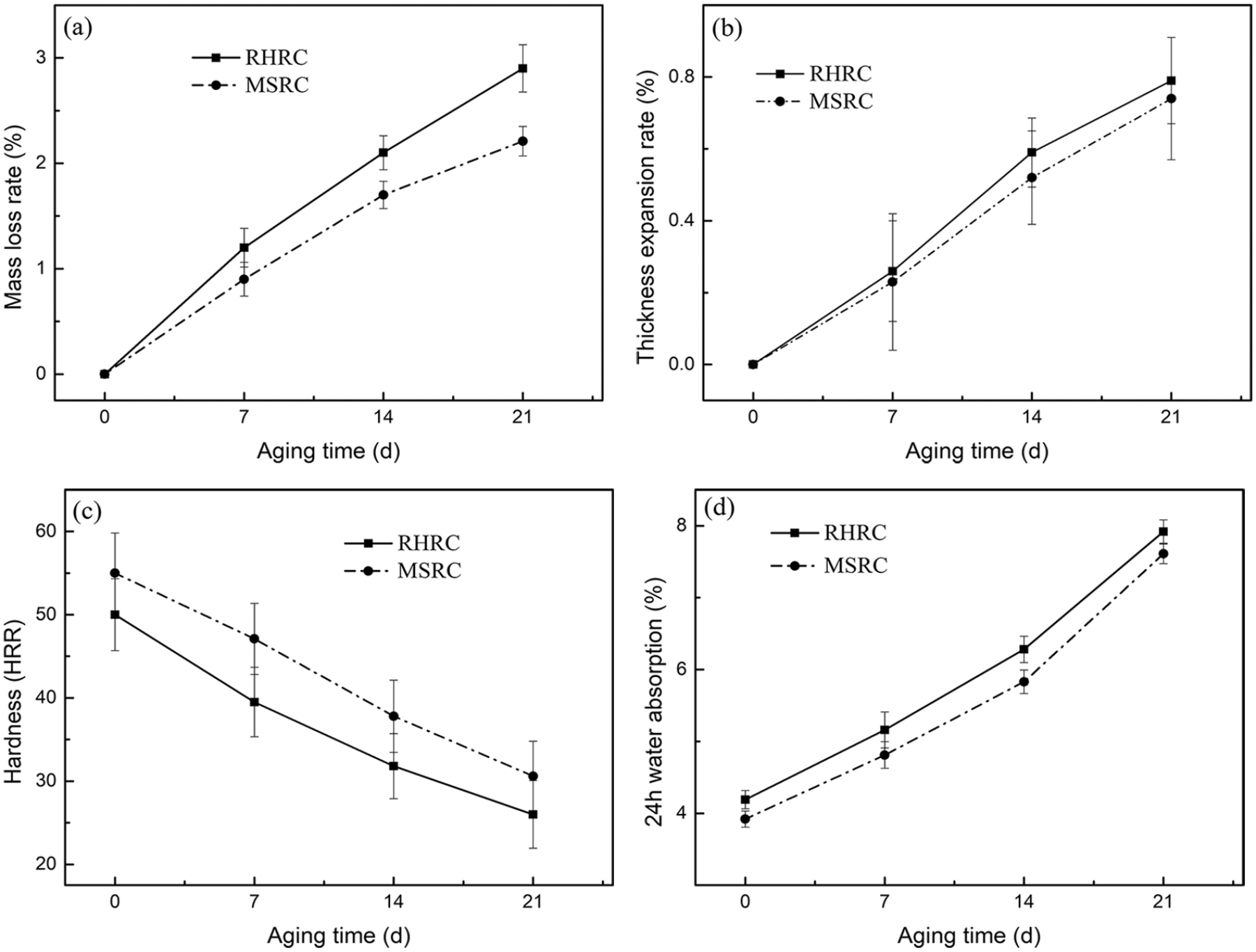
Physical properties of composites: (a) mass loss rate; (b) thickness expansion rate; (c) hardness; and (d) 24h water absorption.
Surface microscopic appearance of composites
Figure 2 presents the microscopic appearance of the RHRC before and after accelerated soil aging. In Figure 2(a), the surface of the composite appears smooth, indicating strong interfacial bonding between the fibers and matrix. Coated fibers cannot easily contact water molecules, meaning better interfacial adhesion promotes the absorption of external energy. However, with increasing aging time, the interface gradually develops micro-cracks, as shown in Figure 2(b), where clear cracks have formed on the surface of the composite. Water molecules attack this weakened interface continuously and enter the interior of the composite. Weak fiber–matrix bonding then increases the mass loss rate, WA, and thickness expansion rate while reducing hardness. These results are supported by the SEM images presented in Figure 3. The appearance of micro-cracks indicates that soil aging leads to weak interfacial adhesion.

Microscopic appearance of RHRC: (a) aging time = 0 days and (b) aging time = 21 days.

The microstructure images of composites: (a) RHRC aging time = 0 days, (b) RHRC aging time = 21 days, (c) MSRC aging time = 0 days, and (d) MSRC aging time = 21 days.
Microstructure of composites
Figure 3 presents microstructure images of the composites. Figure 3(a) presents an SEM image of the RHRC prior to accelerate soil aging. In this state, fibers cannot escape from the matrix and interfacial adhesion is strong. However, after 21 days of aging, obvious holes can be observed where fibers were removed (Figure 3(b)). This indicates that persistent soil aging resulted in poor interfacial adhesion, leading to deterioration of the ultimate behavior of the RHRC. The SEM image in Figure 3(c) confirms that adding mixed-particle-size fibers can improve two-phase interface quality, resulting in superior interfacial adhesion. It is clear that the fibers are tightly encapsulated by the PVC matrix. The addition of mixed-particle-size fibers improved the compatibility of the fibers and matrix, which is the key reason for the enhancement of the physical properties (mass loss rate, thickness expansion rate, hardness, and 24-h WA). Figure 3(d) presents the surface morphology of the MSRC after accelerated soil aging for 21 days. The interface of the MSRC was stronger than that of the RHRC after 21 days. This phenomenon illustrates that mixed-particle-size fibers not only delay the aging process but also improve interfacial adhesion. These conclusions can be proven based on the mechanical and thermal properties of the composites.
Mechanical properties of composites
Figure 4 presents the flexural and impact strength of the composites under accelerated soil aging for 21 days. The results reveal that the addition of mixed-particle-size fibers resulted in 27.9% and 37.1% increases in the flexural and impact strength, respectively, compared to the unprocessed RHRC. The mechanical properties show a decreasing trend with increasing aging time, but the MSRC shows improved flexural and impact strength based on superior interfacial adhesion. The interfacial bonding of the composites can be observed in Figure 3. The increase in flexural and impact strength indicates better stress transfer between the PVC matrix and RHFs,25,26 which alleviates the stress damage caused by accumulating stresses. In addition, the simulated soil (high temperature and moisture) acted as a plasticizer for the cellulose networks of the plant fibers, resulting in more free movement of cellulose molecules and decreased deformation resistance of the cellulose structures. 17 Superior interfacial adhesion improves energy absorbing ability and the best explanation for the energy absorption in this case is the optimal length and distribution of fibers.27,28 Optimally distributed fibers can lead to tight bonding between the fibers and matrix. In addition, fibers cannot be easily attacked by water molecules.

Mechanical properties of composites: (a) flexural strength and (b) impact strength.
Thermal properties of composites
Thermal degradation is often used to investigate the thermal stability of composites because it can represent the mass variation of composites within a certain temperature range. The effect of mixed-particle-size fibers on thermal degradation behavior is presented in Figure 5. The thermal degradation curves of the MSRC and RHRC are slightly different at different aging times, but the curves show similar overall trends. The thermal degradation process is divided into three main stages. First, the evaporation of free water occurs below 100°C and the pyrolysis of hemicellulose, cellulose, and lignin, as well as the elimination reaction of HCl, occur in the temperature range of 250°C–340°C (mass reduction of 48%–51%). Additional pyrolysis of lignin occurs in the temperature range of 340°C–430°C. Second, degradation of the carbon-chain skeleton of the PVC polymer chain occurs in the temperature range of 430°C–480°C (mass reduction of 17%–20%). Finally, degradation of residues occurs above 500°C.29,30

Thermogravimetric (TG) curves of composites.
The pyrolysis characterization data for the MSRC and RHRC are listed in Table 5. These results indicate that the addition of mixed-particle-size fibers resulted in an increase of 1.04% in the first-stage degradation temperature compared to the RHRC. Long-term soil aging can reduce thermal stability, making it difficult for heat to transfer from the matrix (poor heat resistance) to the fibers (good heat resistance) based on the appearance of micro-cracks. Furthermore, pyrolysis temperature, mass reduction, and residual mass decrease with an increase in soil aging time. For composites in environments with high temperature and moisture, the mass variation process of the fibers (disappearance of hemicellulose and lignin) is similar to hydrothermal and acid treatment. 17 However, the addition of mixed-particle-size fibers resulted in stronger interfacial adhesion and fewer micro-cracks (Figure 3(c)), allowing heat to transfer from the matrix to the fibers. Therefore, it can be concluded that the addition of mixed-particle-size fibers is helpful for improving the thermal resistance of composites.
Pyrolysis characterization data of the PVC/RHF composites.

RHRC: rice husk fiber/PVC composites; MSRC: mixed-particle-size fiber-reinforced composites.
The LCTE of composites is affected by the addition of mixed-particle-size fibers (Figure 6). As soil aging time increases, the total LCTE value also increases. The LCTE values of the RHRC and MSRC after 21 days of aging were 29.97 and 34.92, respectively. The presence of mixed-particle-size fibers cannot fully restrain the spread of thermal expansion. This may be a result of the reduction in the proportion of RHFs, and contact area reduction in the matrix, making it difficult for RHFs to fill the matrix. Therefore, the reduction in fiber content led to thermal expansion behavior to deteriorate. 31 We can conclude that the wood/plastic ratio of a composite has a greater effect on the LCTE compared to the two-phase interface.
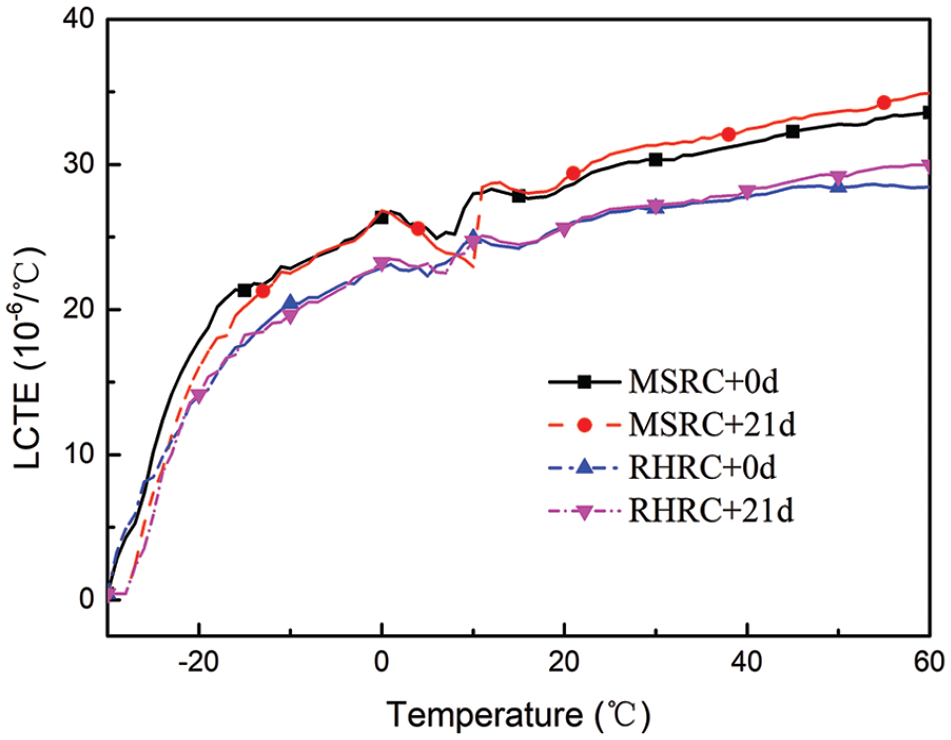
LCTE curves of composites.
Conclusion
In this study, we investigated the effects of mixed-particle-size fibers on the physical, mechanical, and thermal behaviors of composite materials. Three main conclusions can be drawn from the results.
The optimal combination of materials for MSRC is a particle size ratio of mixed-particle-size fibers of 80:120, mass ratio of mixed-particle-size fibers of 7:3, and mass ratio of wood-to-plastic of 4:6.
Microstructural images of the composites indicated that interfacial adhesion is weakened during the accelerated soil aging process. However, the addition of mixed-particle-size fibers improved the compatibility between the fibers and matrix, resulting in fewer micro-cracks and improvement of physical (mass loss rate, hardness, WA, and thickness expansion rate) and mechanical (flexural and impact strength) properties of the composites.
The thermal degradation resistance of the composites was improved by adding mixed-particle-size fibers, and the initial decomposition temperature was improved up to 261.2°C. However, the reduced fiber ratio led to the deterioration of thermal expansion behavior.
Footnotes
Declaration of conflicting interests
The author(s) declared no potential conflicts of interest with respect to the research, authorship, and/or publication of this article.
Funding
The author(s) disclosed receipt of the following financial support for the research, authorship, and/or publication of this article: This work was financially supported by the National Key Technology Support Program (2011BAD20B202-2) and the Fundamental Research Funds for the Central Universities (Y0201800586).