



Abstract
Wool fiber has a complex hierarchic inner structure. However, like most of the natural things, wool fiber does not have an exactly strict self-similar fractal feature. Here, we calculate the fractal dimension of each hierarchic level of wool fiber using the two-scale dimension method. The obtained fractal dimension of wool fiber in different hierarchic level ranges between 1.37 and 1.47, which is close to that obtained according to the traditional fractal geometry. Thermal property of wool fiber is investigated based on the fractal feature of wool fiber. The result shows that the temperature gradient and the rate of the temperature gradient along the fiber is very slow, suggesting that wool fiber has a good thermal retention property.
Introduction
Wool fiber is a precious textile fiber favored by people for a long time due to its fantastic heat and moisture comfort. Its excellent comfort property is partially attributed to its special inner structure. Wool fiber has a complex hierarchic structure from
The fractal geometry introduced by Mandelbrot 7 provides a powerful tool for describing complex irregular shapes. Fractal theory considers a strict self-similarity pattern, but the rigorous fractal patterns are rare in the real world. To solve this problem, the two-scale dimension theory was proposed by He to deal with the practical problems, which lack a self-similarity structure. In this article, the fractal structure of wool fiber is investigated using the two-scale dimension method.8,9
Fractal calculus of wool fiber on the two-scale dimension
Like most natural things, the hierarchic structure of wool fiber does not obey rigorous self-similarity. Fortunately, the two-scale dimension proposed by He and colleagues8,9 provides an effective tool to dealing such a fractal problem that lacks a self-similar structure. The two-scale dimension is defined as

where
The fractal dimension of each hierarchic level of wool fiber was calculated according to the physical model of wool fiber, shown in Figure 1, using two-scale dimension method.

Schematic diagrams of three hierarchic levels of wool fiber: 4 (a) the first hierarchic level. (b) the second hierarchic level. (c) the third hierarchic levels. (Reproduction permission from De Gruyter)
In the original hierarchic level, shown in Figure 1(a), the protofibril with diameter of about 2 nm is composed of four tangent

where
Thus, the fractal two-scale dimension for the original hierarchic level of wool fiber is

where
For the second hierarchic level, there are nine protofibrils which assemble one microfibril, shown in Figure 1(b). The average diameter of protofibril and the microfibril is 2 and 7 nm, respectively.
The proportion between the diameter of the microfibril and the protofibril is

where
Thus, the two-scale fractal dimension for the second hierarchic level of wool fiber is

where
The two-scale fractal dimension for the third hierarchic level of wool fiber should be calculated based on the analysis of the configuration of wool fiber cortex. For merino wool fiber which is the most commonly used wool fiber in textile industry, the orthocortex and paracortex are bilaterally arranged in the cross-section of wool fiber with the area proportion of about 2:1. 10 The arrangement of microfibrils in the two cortex layer are different. In orthocortex, the area ratio between microfibrils to matrix is about 4:1, while in the paracortex, the proportion is 1:1. 11 Thus, the average area ratio between the microfirils and the cortex layer is

The two-scale fractal dimension of the third hierarchic level of orthocortex is

Heat transfer using two-scale dimension laws
Wool fiber are composed of the hierarchic assembled fibrils and the matrix. The fibril phase is the crystal phase in wool fiber, which has a relatively compact structure, serving as the main heat transfer phase. When considering heat transfer in the discontinuous hierarchic fibril network, the fractal calculus has to be adopted, which is an effective tool to deal with the engineering problems in discontinuous space.10–15 The definition of fractal derivative is16,17

with boundary conditions


where

where
By introducing the He-Li transform 18

Equation (8) becomes

The transformation given in equation (13) is an approximate conversion to transform a fractal space to its continuous partner.
The solution of thermal conduction equation is

Incorporating the boundary conditions, we have

Thus, the temperature gradient along the fiber is

And the temperature rate of change is

To make sure a special property of warm retention property requires that

The above fractal analysis suggests that the two-scale fractal dimension in each hierarchic level of wool fiber is less than 2 that implies

To eliminate the contradiction, the coefficient of

From which we can find the effective length of wool fiber
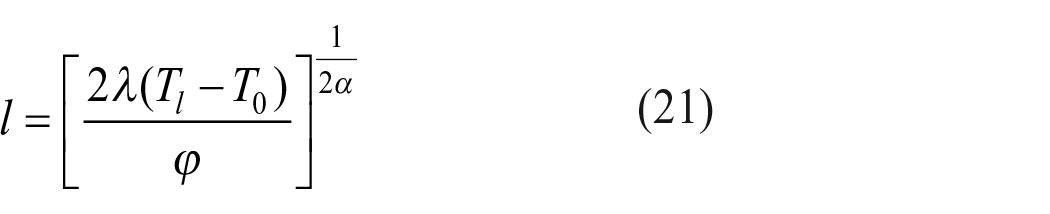
In such a case, the temperature distribution along the wool fiber is

Equation (22) suggests that the temperature along the wool fiber is depending on the fractal dimension of wool fiber’s hierarchic structure. Since the two-scale fractal dimension of wool fiber is between 1.37 and 1.47, it is easy to find that


Equations (23) and (24) suggests that the temperature gradient and the rate of the temperature gradient change along the fiber are very slow, suggesting that wool fiber has a good warm retention property.
Conclusion
In this article, we investigated the fractal dimension of each hierarchic level of wool fiber using the two-scale dimension method. The fractal dimensions of protofibril, microfibril and cortex layer of wool fiber are 1.37, 1.47, and 1.4, respectively, which is close to the fractal dimension obtained by the traditional fractal geometry. Heat transfer analysis based on the fractal dimension of wool fiber suggests that heat transfer along the fiber is extremely slow, indicating that wool fiber has an excellent warm retention property.
Footnotes
Declaration of conflicting interests
The author(s) declared no potential conflicts of interest with respect to the research, authorship, and/or publication of this article.
Funding
The author(s) disclosed receipt of the following financial support for the research, authorship, and/or publication of this article: This work was supported by the National Key R&D Program of China (Grant Number 2017YFB0309100).
