




Abstract
This paper introduces a novel methodology to determine the frequency-amplitude relationship of fractal-order viscoelastic polymer materials using the two-scale fractal dimension transform, the equivalent power-form representation of the conservative restoring forces, and a simple coordinate transformation to eliminate viscoelastic effects. Then, the ancient Chinese algorithm Ying Bu Zu Shu and He’s formulation are used for obtaining the frequency-amplitude relationship. Simulation results obtained from the derived expressions exhibit good agreement when compared to numerical integration solutions. This article elucidates how the molecular structure of polymer chains influences the relaxation oscillations as a function of the fractal parameter values.
Keywords
Introduction
The material damping properties serve to modify the oscillations’ amplitude through energy dissipation. In this sense, polymers are used for energy absorption and vibration damping attenuation in several engineering devices since the damping forces are small compared to the elastic and inertia ones.1,2 The oscillation’s decay in free vibrations can be explained considering damping effects that prevent oscillations by energy dissipation due to the material molecule movement. Of course, factors such as viscoelastic material properties and glass-transition phenomena could influence damping effects. It is also known that when a rubber material vibrates, its molecules adopt new conformations releasing the vibration energy. Recently, Sarkheil 3 identified that the mobility of polymer molecules is an indication of the molecular structure fractal behavior. Schiessel and Blumen 4 found that dynamic processes in polymers such as mechanical relaxation dynamics and cross-linking at the solgel transition exhibit fractal behavior. Based on these findings, Elías-Zúñiga et al. 5 investigated how the fractal molecular structure of polymer materials changes as the oscillation amplitude varies and how this polymer material behavior can be used to identify molecular structure defects and intermolecular cohesion.
It is evident that including damping effects in the mathematical models provides qualitative and quantitative material response behavior that could agree with experimental observations. Furthermore, products such as vibration dampers, bridge bearings, seismic absorbers, and building/engine mounts, to name a few, are designed considering a material’s high damping value to mitigate undesirable vibration effects. 6 As expected, the addition of damping effects in the governing equation of motion in conjunction with strongly nonlinear restoring forces increases the complexity in deriving approximate analytical solutions valid for the whole solution domain. Therefore, one needs to identify which solution technique must be used to get the desired solution. A good overview of some available techniques to get the approximate solution of strongly nonlinear and damped equations such as variational approaches, homotopy techniques, He’s frequency formulation, Taylor series, iteration methods, equivalent power-form approach, energy techniques, simple frequency formulations, and ancient Chinese mathematical methods are given in Refs. 7–34 and references cited therein.
The goal of this article is to introduce a straightforward methodology to solve the fractal and damped differential equation of motion that models the dynamic response of polymer materials using the two-scale fractal dimension transform,35–38 the equivalent power-form representation of the restoring force, and a coordinate transformation to eliminate the damping term. Then, the frequency-amplitude relationship is determined by using the Ying Bu Zu Shu or ancient Chinese algorithm of the Chinese method.39–42
Mathematical model
Before introducing the fractal mathematical model that describes the dynamics of a viscoelastic Langevin polymer chain first, we recall the simple definition of the two-scale dimension transform and its relevance in modeling multiscale phenomena that describe behavior at a given length or time scales, playing a critical role in bridging qualitative and quantitative methods for engineering problem analysis. In fact, the two-scale theory models each phenomenon with a large scale to characterize continuous media with the classic calculus, and on the smaller scale, to elucidate system molecular effects and to reflect discontinuous phenomena. The two-scale dimension transform has been used to study the N/MEMS in a fractal space (porous medium), 43 the Fangzhu water collector from air,44–48 the vibration attenuation and vibration absorption of the porous concrete, 49 the smart receptor system for exact printing of nano/micro devices modeled by a fractal Duffing equation, 50 the rheological properties of SiC-based print paste using a fractal model for predicting the material viscosity, 51 the fractal model of current generation in porous electrodes, 52 the fractal Toda oscillator that describes the intensity fluctuation of Nd:Yag lasers, 53 the nonlinear vibration of the carbon nanotube embedded in fractal medium, 54 the shallow water waves traveling along an unsmooth boundary, 55 to describe the flow of the shallow water of harbor considering an unsmooth boundary, 56 and packaging cushioning systems 57 among others. Furthermore, modeling polymer molecules’ dynamics using fractal derivatives and the two-scale dimension transform aids in identifying molecular structure defects, intermolecular cohesion, and the evolution of the polymer storage modulus as a function of frequency and of the fractal parameter. 5
Considering the relevance that polymers have in engineering applications, there is a need for a better understanding of their network structure behavior that affects physical and mechanical properties; therefore, a mathematical model that takes into account fractal patterns that are formed in the preparation of polymers and their composites is highly desirable.
58
In this article, we use a dynamics mathematical model that can be obtained from the fractal Lagrange equation




Recalling the fractal derivative definition with respect to time


Equation (4) can be written in the form



To find the frequency-amplitude expression for equation (9) using the ancient Chinese algorithm Ying Bu Zu Shu, we first use the approach proposed in Refs.67–74 to find its power-form equivalent representation, and then, we introduce a coordinate transformation to eliminate the damping term.
Power-form equivalent representation
Following the transformation approach introduced in Refs.67–74, equation (7) can be written in the following form



Frequency-amplitude formulation
Before we start with the derivation of the frequency-amplitude formulation of equation (10) using the Chinese algorithm and He’s formulation, it is important to point out some of its advantages over traditional analytical methods. This method does not depend on small or large physical parameters. It has a high convergence rate, and its accuracy is higher when compared to Newton’s iteration method. 76 This ancient algorithm has been also used to derive, by modifying Chun-Hui He’s algorithm, an efficient iterative algorithm that converges to the optimal solution with only a few number of iterations. 77 Furthermore, it has excellent flexibility in choosing the functions needed to identify the trial solutions; it can be used to obtain the frequency-amplitude formulation of nonlinear oscillators without a linear term that makes it harder to find an approximate solution when using perturbation methods. 34 This ancient Chinese algorithm can be also combined with other techniques such as the power-form equivalent representation, Padé approximants, Chebyshev polynomials, Fourier series, to name a few. One possible limitation of this algorithm might be related to the incapacity of getting the transient response of nonlinear forced oscillators. However, the extent of this limitation certainly requires further investigation.
In what follows, we focus our efforts on finding the frequency-amplitude expression for equation (10). One can see that the determination of the frequency-amplitude expression for equation (10) using He’s formulation and the ancient Chinese algorithm is not a straightforward process because of the presence of the damping term. Therefore, to avoid potential complications in the derivation of the frequency-amplitude relationship using this ancient algorithm, the following coordinate transformation
78








By using He’s formula

The following section will address the applicability of equation (23) to obtain the fractal frequency-amplitude response curves of equation (9).
Numerical results
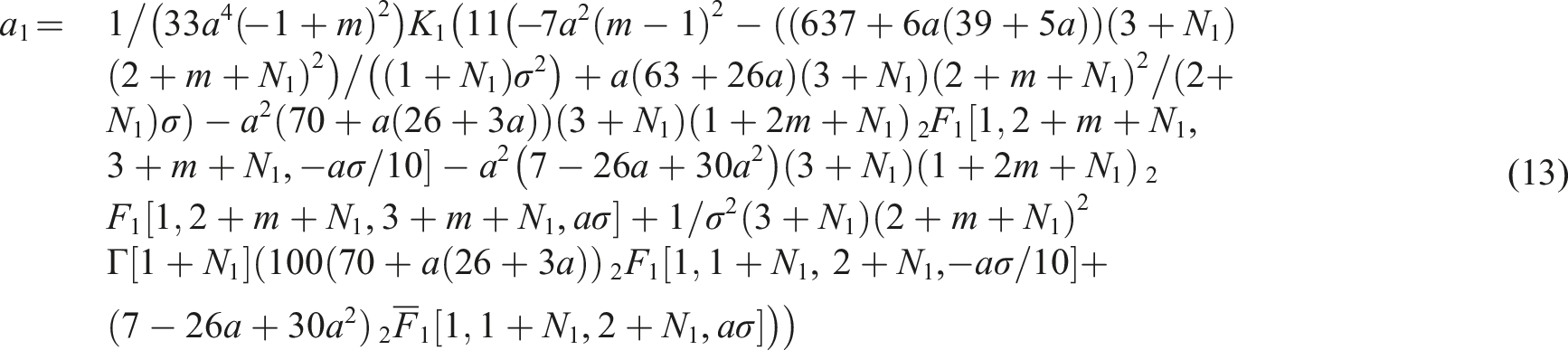
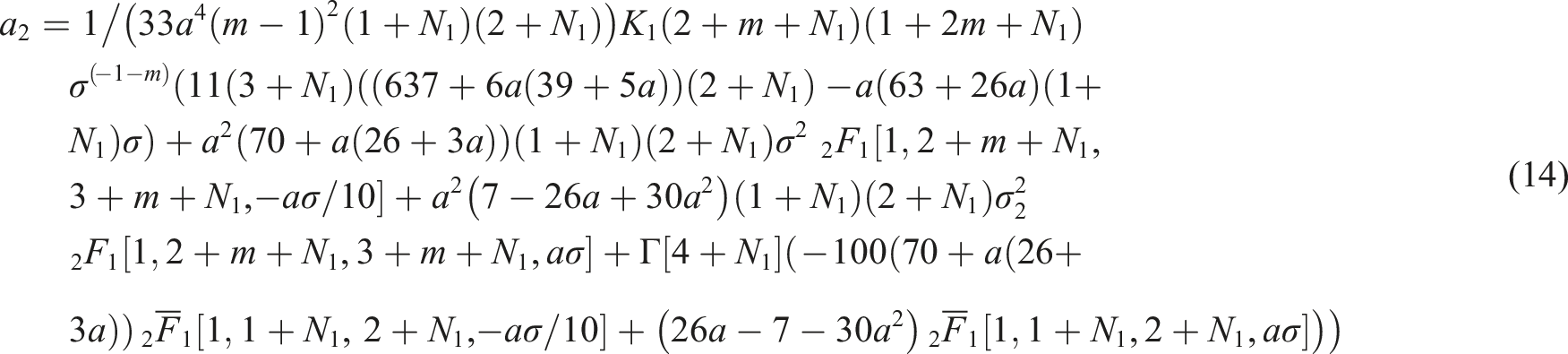
To illustrate the applicability of our proposed approach to obtain the frequency-amplitude response curve of the fractal and damped polymer chain oscillator, let us consider the case for which the parameter values are a = 0.5; ν = 0.1; K1 = 1; and α = 0.9, 1, and 1.1 with y(0) = A = 0.5 and Amplitude-time response curves for a fractal viscoelastic polymer chain obtained by considering the parameter values of a = 0.5, ν = 0.1, K1 = 1, and A = 0.5. Here, the solid lines represent the numerical integration solution of equation (9), while the dashed lines describe the approximate solutions obtained by using equation (24) with a1 = 1.0032, a2 = −0.3113, σ = 1, N1 = −2.9, m = 1.75, and ω
AE
= 0.9265. The discrepancies observed in these plots are mostly due to the replacement of the inverse of the Langevin function by an equivalent power-form representation, and the use of Fourier series to simplify the integration of equation (19). However, the fractal approximate amplitude-time curves given by equation (24) follow numerical integration solutions well. Amplitude-time response curves for a fractal viscoelastic polymer chain obtained by considering the parameter values of a = 0.85, ν = 0.1, K1 = 0.25, and A = 0.9. Here, the solid lines represent the numerical integration solution of equation (9), while the dashed lines describe the approximate solutions obtained by using equation (24) with a1 = 0.2495, a2 = 0.0097, σ = 0.5, N1 = −2.9, m = 2.5, and ω
AE
= 0.5025. These curves indicate a modification of the molecular chain stretching magnitude during motion influenced by the polymer fractal molecular structure.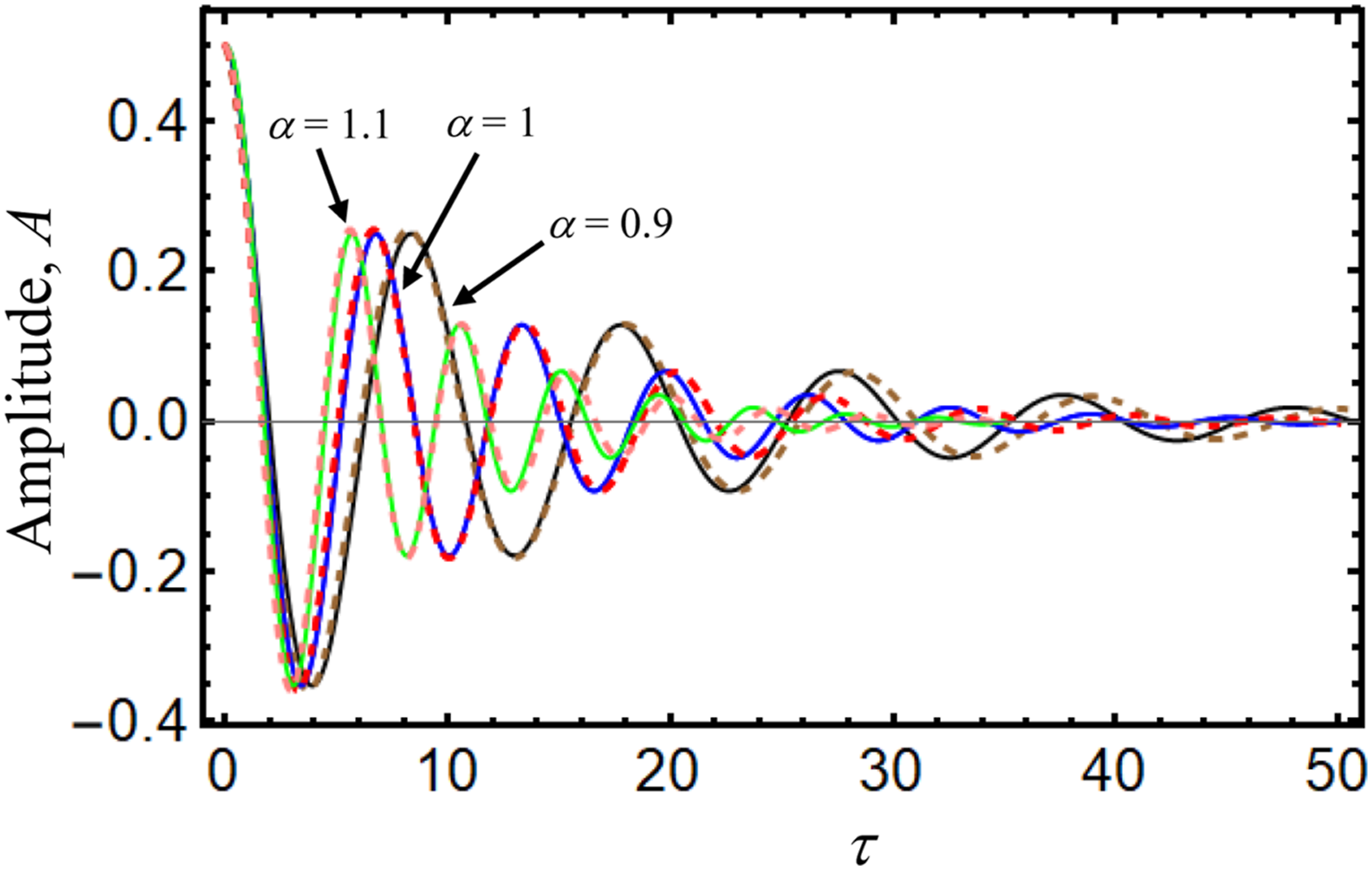
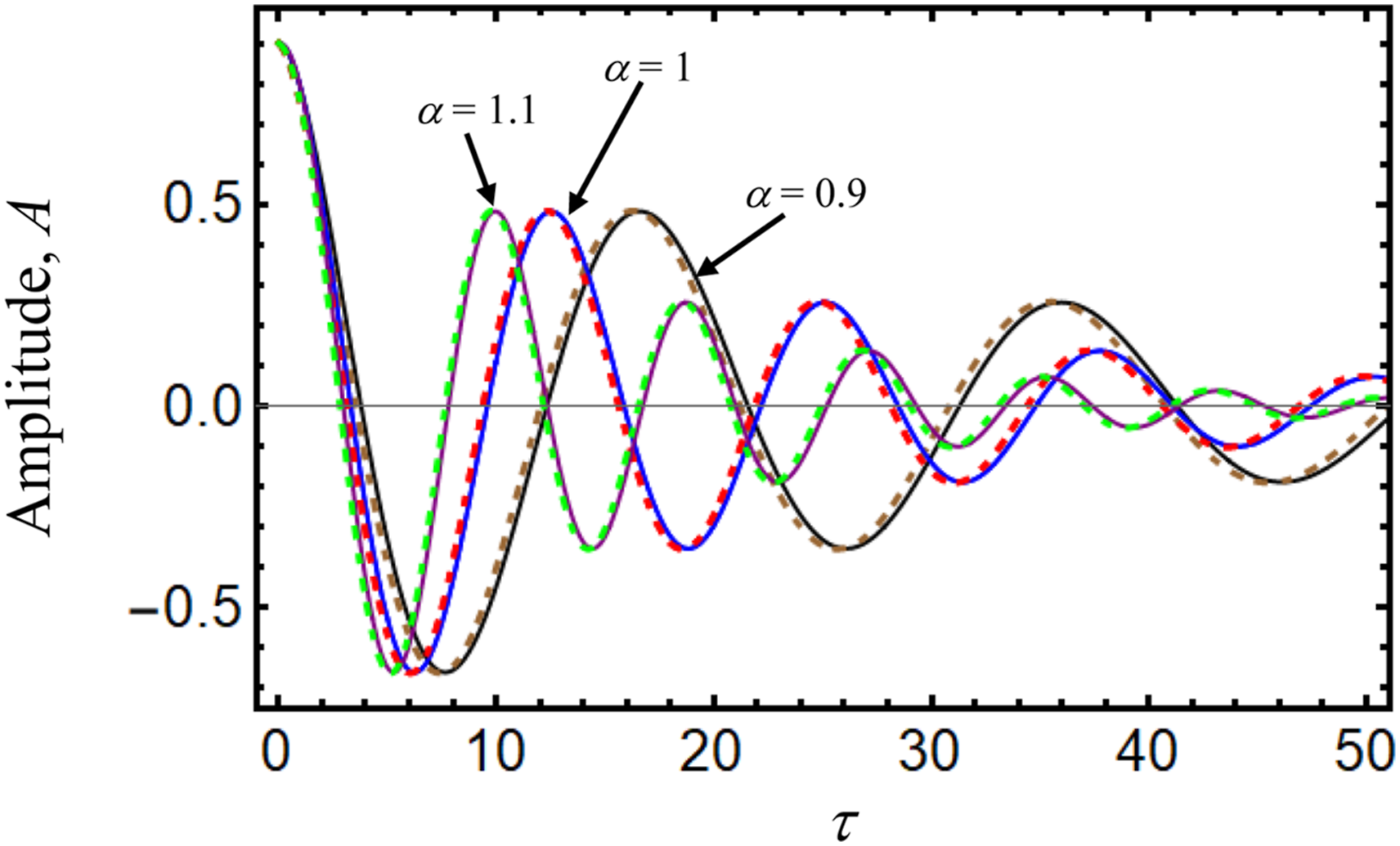

The proposed methodology capture fractal phenomena that occur at the polymer molecular level. In fact, the computed amplitude-time curves indicate that the chain’s mobility is less localized when α < 1 since the polymer molecular structure exhibits fluid-like behavior with steady flow viscosity and low vibration frequency.83,84 Although there is evidence that in polymerfluidgels (PFGs), high energy-dissipation property can be precisely tailored at desired frequencies, 85 one needs to bear in mind that the localized strain accumulation process, that occurs at lower frequencies, could lead to the crack initiation, followed by its propagation, and failure of the polymer part. In other words, the polymer material macroscopic behavior strongly depends on the material fractal structure. 86
When considering α > 1, the polymer material exhibits solid-like behavior due to geometrical changes in the chemical network during gelation because the dynamic properties depend strongly on the material composition and structure. 87 Therefore, understanding the fractal nature of the material molecular structure can help to develop a polymer material with the desired dynamic response that fulfills engineering specifications.
Conclusions
This article elucidates how our proposed solution methodology can be extended to study the relaxation oscillations of a fractal viscoelastic polymer chain oscillator. We have used this methodology to obtain the frequency-amplitude relationship of a mathematical model that describes the dynamics of fractal viscoelastic polymer Langevin chains at the material molecular level. The accuracy of the derived solution is confirmed by plotting the amplitude-time curves that indicate less localized chains mobility when α < 1 because the polymer exhibits fluid-like behavior. For fractal values bigger than one, the material exhibits solid-like behavior which induces the largest decay in the oscillations amplitude of the polymer chain oscillator.
The derived approximate frequency-amplitude relationship sheds new light on understanding how the fractal parameter value correlates with relaxation oscillations of polymer chains. Therefore, understanding the fractal nature of the material molecular structure can help to have polymer materials with the desired dynamic response.
Footnotes
Declaration of conflicting interests
The author(s) declared no potential conflicts of interest with respect to the research, authorship, and/or publication of this article.
Funding
The author(s) disclosed receipt of the following financial support for the research, authorship, and/or publication of this article: Tecnológico de Monterrey funded this research through the Research Group of Nanotechnology for Devices Design, and by the Consejo Nacional de Ciencia y Tecnología de México (Conacyt), Project Numbers 242269, 255837, and 296176.
