



Abstract
The proper assessment of aesthetics and comfort is an important step before launching a new type of apparel. Most current works on this assessment are qualitative and hard to be applied in practical to improve apparel design. In this study, we proposed two quantitative mappings from pattern design parameters to degree of aesthetics and pattern design parameters to degree of comfort for assessing aesthetics and comfort of apparel, and particularly, women’s pants have been investigated. Statistical analysis was employed in the mappings’ development. An experiment was conducted as a validation for the mappings. Two major conclusions are drawn from this study. The first is that these mappings enable to extract a more advanced pattern for apparel design after the iterative pattern revision. The second is that these mappings are able to be digitalized and then the traditional method of observing feedbacks of aesthetics and comfort for an apparel product can be updated into a more efficient and low-cost one.
Introduction
Similar to other product designs, apparel product design (or apparel design) is conducted to meet the requirements of function, aesthetics, and comfort. 1 Function, such as covering the body and keeping warm, has been initially considered since apparel design started, as well as the address of assessing the function of apparel. 2 Nowadays, aesthetics and comfort have been given significant amount of considerations during apparel design, as the sense of aesthetics and comfort of apparel become important factors to influence consuming behavior. 3 However, the absence of a proper assessment for aesthetics and comfort of apparel becomes an obstacle for understanding consuming behavior, and thus, launching apparel to meet customer’s requirements in the aspect of aesthetics and comfort is still up in the air.
Apparel design is determined by three factors, including color, material, and silhouette. 1 Aesthetics of apparel is mainly influenced by color and silhouette, while comfort is mainly influenced by material and silhouette.4–6 Upon reviewing past literature, quite a few works have been found studying on aesthetics and comfort of apparel in terms of silhouette. For example, De Klerk and Lubbe 3 investigated how a proportion of apparel affects aesthetics; Ho et al. 7 studied that shape features of maternity-support apparel influence a wearer’s movement comfort. Similar work has been done by Dunne et al. 8 and Li et al. 9 These studies have showed that silhouette has a great influence in determining aesthetics and comfort of apparel. However, several questions still challenge the research community, such as how much degree of aesthetics and comfort of apparel are influenced by silhouette and how silhouette influences aesthetics and comfort. The reasons for the aforementioned bending issues lie in the following: (1) the description for illustrating the degree of aesthetics and comfort of apparel are absent and (2) silhouette is a generic design parameter, and it should be decomposed into descriptive parameters for conducting an apparel design.
Thus, this study has discussed the representations of the degree of aesthetics and comfort. Moreover, quantitative mappings have been established from pattern design parameters to degree of aesthetics and degree of comfort. The remaining study is organized as follows: the second section is the investigation of major pattern design parameters and representations of degree of aesthetics and degree of comfort. The third section presents the development of the quantitative mappings from pattern design parameters to the degree of aesthetics and to the degree of comfort. The fourth section is the mapping validation. The last section is the conclusion.
Determination of major pattern design parameters and representations of degree of aesthetics and degree of comfort
Apparel is a generic term that describes all types of clothing, such as pants, dresses, suits, and costumes. 9 The apparel is formed in terms of different patterns, which are developed in terms of pattern design parameters. 10 For example, height, waist (waist width), chest (chest width), shoulder width, and sleeve length may be required for developing an upper body pattern, while height, waist, and hip (hip width) may be required for lower body pattern development. 11 It is noted that lower body pattern includes pattern for pants and pattern for skirt, and the pattern design parameters for developing the two of them are various. In this article, only cropped straight leg pants for women was chosen for the preliminary investigating on the mapping from pattern design parameters to degree of aesthetics and degree of comfort.
Generally, the information of length, waist, hip, and crotch length of pants (the distance from back waist to front waist) 12 are used to determine a basic shape of pants’ pattern 13 (Figure 1). Other pattern design parameters, such as knee width (horizontal distance between left and right side of knee) and position of crease line (a vertical line that goes down around the middle of the front-pant leg pattern) are not basic but show significant impact on determining the silhouette of pants. For example, Hulme presented that knee width affects the fit of pants to the legs from the crotch to the bottom—that is, the lesser the knee width, the fitter the pants to the legs. Zhu et al. built a model mapping the position of the crease line to the silhouette of the pants. This mapping shows that changing the position of crease line causes a significant change in the pants’ silhouette. 15 In Pierlot et al.’s work, they pointed out that the position of crease line affects the fit of pants from the waist to the bottom, and the closer the crease line to the side seam line, the fitter the pants to the legs. 16 Based on reviewing existing works, knee width and position of crease line were found as the major pattern design parameters in determining a pattern of pants when a body size is given. However, it is impractical to use position of crease line as a parameter for making a pattern. Instead, position of the side seam of back pants on the knee line, represented by “a” in Figure 1, was introduced. This article mainly focus on knee width and “a” for pattern development and pants production in the context of a given body size. Figure 1 shows the patterns used in this study, and they include a pattern of front pants, a pattern of back pants, and a pattern of waistband.

The pattern of the pants used in the experiment.
Regarding the representations of the degree of aesthetics and degree of comfort, Likert-type scale is commonly used. For example, Chattaraman and Rudd 17 used a 7-point scale for representing the degree of the aesthetics attribute preference of apparel. Morganosky 18 applied a 4-point scale for valuing the degree of aesthetics and comfort of apparel. In this article, the degree of aesthetics and degree of comfort are represented by a 7-level Likert-type scale.
Methodology for assessing aesthetics and comfort
The assessment of aesthetics and comfort of apparel (cropped straight leg pants in this study) was to build mappings from knee width and “a” to degree of aesthetics and degree of comfort, respectively. Two steps were applied for building these mappings: (1) acquisition of data, namely “knee width—“a”—degree of aesthetics” and “knee width—“a”—degree of comfort” and (2) mapping development.
Acquisition of data
The general methodology was to have a test bed in which test samples with their knee width, “a”, degree of aesthetics, and degree of comfort were investigated for their links. The test bed included two systems: (1) pants’ production in terms of pants’ pattern and (2) survey. The first system provided pants’ images for constructing the survey in (2), and these images also offered raw data for image analysis in assessing pants’ aesthetics, which contributed to the mapping development. The surveys were used to link pattern design parameters to degree of aesthetics and degree of comfort. The combination of two systems resulted in acquisition of two types of data, including data from image analysis and data from surveys. The image analysis and one of the surveys were used to link pattern design parameters to degree of aesthetics, while another survey linked pattern design parameters and degree of comfort.
In the experiment of cropped straight leg pants’ production, test samples or pants were produced in terms of the patterns shown in Figure 1. As this figure shows, the basic shape of the pattern can be determined in terms of length, waist, and hip. Parameters such as knee width and position of crease line are more associated with the shape of legs. This pattern was developed under the Chinese standard size of 160/68A by following Chinese criteria of GB/T1335.1-1997. 14 In the experiment, pattern design parameters, such as height, waist, and hip, were standard (i.e. 160/68A) and known, while knee width and “a” were needed for the determination. Knee width was considered to have three levels, including 17, 18, and 19 cm, and “a” was considered to have five levels, including 4, 5, 6, 7, and 8 cm. It is noted that knee width with 18 cm and position of crease line with 6 cm were commonly used in the stretched pants’ development, and thus, they were treated as the mediate levels. Moreover, the selection of these levels also partially depended on authors’ experience in apparel design for about 12 years. These three levels and five levels resulted in 15 combinations of pattern design parameters, and thus 15 test samples were generated. The material of the pants was 3% Lycra and 97% cotton. All pants were made by the same experimenter with the same iron (GC1021, Philips) and sewing machine (NV980K, Brother).
Image analysis
Image analysis is a technique to extract the meaningful information from digital images. 19 In this study, image analysis was used to observe images with emerged wrinkles when models were wearing pants. Models were Chinese women who have Chinese standard size of 160/68A. It is noted that the wrinkle is a major factor in impacting the sense of aesthetics of apparel, 20 and the result of the image analysis will provide scientific data for connecting pattern design parameters with aesthetics of apparel.
The procedure of conducting image analysis for wrinkles was as follows:
To photograph a color image in red, green, and blue (RGB) mode when a model is wearing pants and standing facing the experimenter. Figure 2(a) is one of the images in RGB mode. The tools for photography include Canon 550D, 18- to 55-mm lens, and tripod;
To convert the image from RGB mode to a gray-level mode. Figure 2(b) is one of the images in gray-level mode. This conversion was carried out using a set of homemade code, and the details of the codes are in https://pan.baidu.com/s/1hrZ5MZy; 21
To filter the gray image and make it less noisy for the further analysis. This step was carried out using homemade codes attached in https://pan.baidu.com/s/1hrZ5MZy. 21 Figure 2(c) is the filtered image from Figure 2(b);
To generate a line chart with gray-level intensity and distance along the wrinkle’s profile as vertical axis and horizontal axis, respectively. The experimenter drew a random line at the area of the crotch of pants in the filtered image. With the homemade codes, 21 the wrinkle’s profile along with the random line would be detected and the connection would be made with gray-level intensity. Figure 3 is one of the examples of line charts;
To analyze the line chart using a homemade program called DiagramDataExtractor, attached in https://pan.baidu.com/s/1bphh7XX, 22 and obtain the wrinkles’ characteristics such as the number of wrinkles, the depth of wrinkles, the width of wrinkles, and the roughness of wrinkles.

Three modes of image: (a) image with RGB mode, (b) gray-level image, and (c) filtered image.

Gray-level intensity and distance along wrinkles’ profile.
Surveys
In the survey for linking pattern design parameters to degree of aesthetics, participants were asked to rank four items including front of pants, back of pants, side of pants, and overall. They conducted the rank using the 7-level Likert-type scale when observing 15 pieces of pants worn by models. The 7-level Likert-type scale were very poor, poor, below average, average, above average, good, and very good. A total of 11 participants, representing people to observe pants worn by models, were recruited for the survey purpose in this human factorial experiment. Each model was in charge of wearing three pieces of pants. It must be mentioned that this number or sample size was empirically selected by following the Macefield’s 23 approach that the minimum number of samples for the usability assessment is three, and the validity of this number is worthy of a future study. The criteria for selecting participants were as follows: (1) they must be Chinese residents and (2) have experience in fashion design, such as enrolling in a fashion design program, runway models, and fashion designer. In total, 165 sets of data (15 pieces of pants × 11 participants) in the format of “knee width—“a”—degree of aesthetics” were obtained.
In the survey for linking pattern design parameters to degree of comfort, five models wearing pants were asked to rank the comfort when they were conducting five gestures using the 7-level Likert-type scale. Figure 4 shows the gestures conducted by the models, and they are side step by 30 cm, forward step by 30 cm, step up to 25 cm, natural sit, and natural squat. It is noted that these five gestures were selected out by models themselves through a short survey, and they represent the top frequent gestures done by people in daily life. In total, 75 sets of data (15 pants × 5 subjects) in the format of “knee width— “a”—degree of comfort” were obtained.

Five gestures with wearing pants: (a) side step by 30 cm, (b) forward step by 30 cm, (c) step up to 25 cm, (d) natural sit, and (e) natural squat.
Results and discussion
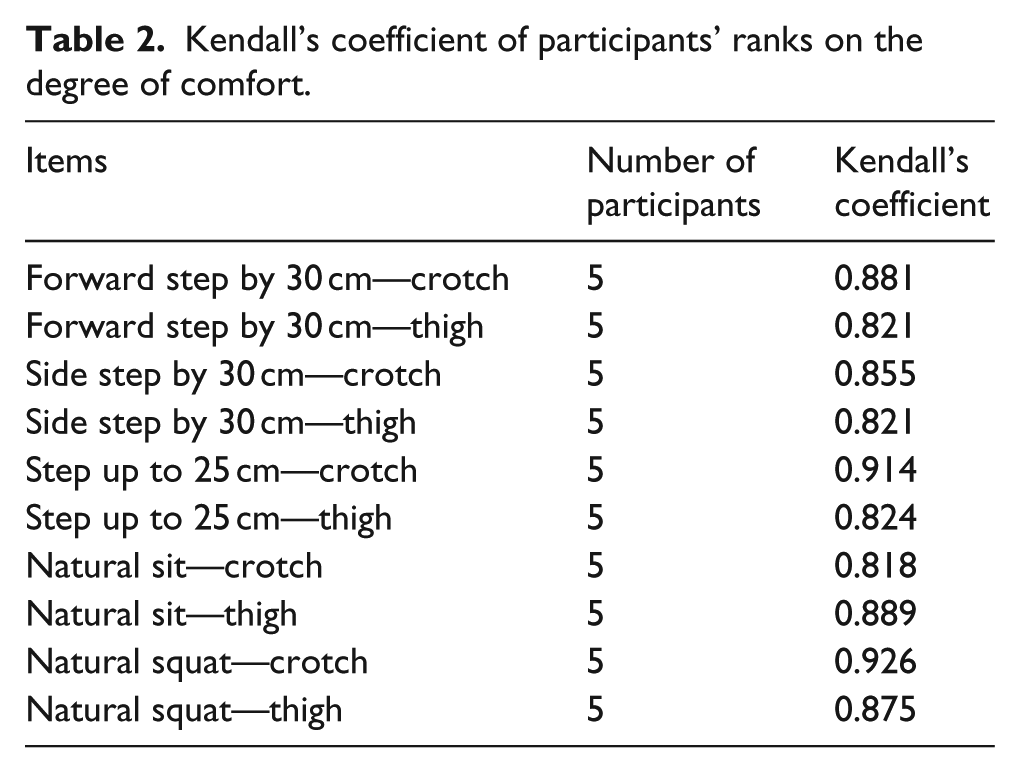
Statistical method was applied for two mappings’ developments, including the one from pattern design parameters to degree of aesthetics and another from pattern design parameters to degree of comfort. Kendall’s coefficient of ranks from 11 participants on the assessment of aesthetics (Table 1) and ranks from five models on the assessment of comfort (Table 2) were first calculated. Kendall’s coefficients from Tables 1 and 2 show that both participants and subjects have been unanimous in their assessments. In Table 3, the mean ranks of aesthetics for each pants were calculated, and standard deviation (SD) for the ranks of pants’ aesthetics was checked. Cluster analysis was applied on the data from image analysis and the first survey linking pattern design parameters to degree of aesthetics. Eventually, 15 pieces of pants were grouped into three categories with two kinds. Table 4 shows that the first three groups were obtained in terms of participant’s ranks and the second one was grouped in terms of wrinkles’ characteristics. It can be found from Table 4 that 12 out of 15 pieces of pants including item 1, 2, 3, 4, 5, 6, 7, 8, 11, 12, 13, and 14 reached an agreement on the degree of aesthetics from both participants and image analysis. For example, item 1, 2, 6, 7, and 11 are grouped into Group 1 by participants and through image analysis. These 12 pieces of pants would be used for building the mapping of pattern design parameters to degree of aesthetics later.
Kendall’s coefficient of participants’ ranks on the degree of aesthetics.

Kendall’s coefficient of participants’ ranks on the degree of comfort.
The standard deviation for assessments of aesthetics and comfort and their mean ranks.

Cluster analysis for participants’ ranks of aesthetics and image analysis.

Linear regression was employed to build the mappings of pattern design parameters to degree of aesthetics and pattern design parameters to degree of comfort after the examination of data. Each mapping showed a correlation between pattern design parameters, degree of aesthetics, and degree of comfort. Their p-values, which were less than 0.05, indicated a linear relationship. The two mappings were developed as follows:
y1 = 13.418 – 0.212 x1 – 0.68 x2.
y2 = –17.452 + 1.236 x1 + 0.489 x2.
where y1 is the degree of aesthetics, y2 is the degree of comfort, x1 is the knee width ranging from 17 to 19 cm, and x2 is “a” ranging from 4 to 8 cm.
In the mapping from pattern design parameters to degree of aesthetics, the knee width and “a” have a negative correlation to the degree of aesthetics. It is reasonable that, as with more knee width, the pants are getting looser. Looser pants usually produce more wrinkles, which affect the degree of aesthetics. 24 Regarding the effect of the crease line in this mapping, it has been found that the larger “a”, the lesser the degree of aesthetics, which may lie in the fact that more wrinkles have been produced when “a” gets larger. Thus, “a” may affect the space between legs and pants.
The mapping of pattern design parameters to degree of comfort shows that the knee width and “a” line have a positive correlation to the degree of comfort. Theoretically, when the material is determined, the comfort is quite associated with space between legs and pants. This positive correlation may lie in the fact that more knee width produces more space between the legs and pants, and thus more comfort is felt by the models. It also can be found through this mapping that “a” contributing to the space between legs and pants reaches an agreement with the findings in the mapping from pattern design parameters to degree of aesthetics.
Mapping validation
In this section, a preliminary experiment was conducted to validate the two developed mappings from pattern design parameters to degree of aesthetics and pattern design parameters to degree of comfort. The general approach for the mapping validation was that the experimenter specified a new size for pants’ pattern and produced it within the same work circumstance. It is noted that the new pants’ pattern followed the Chinese standard size of 160/68A but with different knee width (17.5 cm) and “a” (4 cm). With new knee width and “a” applied to the two mappings, the degree of aesthetics and the degree of comfort were separately obtained, which were accounted for mapping predictions. Furthermore, both participants and models were asked to rank the new piece of pants for the degree of aesthetics and the degree of comfort, and the ranks were accounted for the experimental data. A comparison was then taken between experimental data and mapping predictions.
Table 5 is the comparison of the experimental data and modeling predictions for the assessment of aesthetics and comfort. The absolute errors showed less than 5% confidence interval for both mappings. These absolute errors indicate that there is a good consistency between mapping predictions and the experimental results.
Comparison of the assessment from two mappings and experiment.

These mappings work well in the given context; however, several limitations still exist. The first limitation is that the number of the pattern design parameters is restricted in the mappings and only the major ones are considered. The second one is that the mapping is developed in the restricted context where a straight leg pants’ pattern and stretched fabric are applied. The third limitation is that other factors, such as material and body posture, are associated with aesthetics and comfort of apparel, and these factors’ interactions are ignored in this study. The future work will be focused on increasing the number of pattern design parameters and the dimension of factors in affecting aesthetics and comfort of apparel.
Conclusion
In this article, two mappings, pattern design parameters to degree of aesthetics and pattern design parameters to degree of comfort, have been developed. These mappings enable the assessment of aesthetics and comfort. When given a set of pattern design parameters, in the context of our study, one can get the degree of aesthetics and the degree of comfort. The data for two mappings’ development were obtained through image analysis and two types of surveys. The technique used to develop the two mappings was statistical methods, particularly, linear regression was applied. A case study was carried out to validate the two mappings, which shows the error of the results to be less than 1% by a simplified data analysis method.
The assessment of aesthetics and comfort is the essential step to understand the apparel in the aspect of aesthetics and comfort, such that a proper specification for launching a new apparel to improve the degree of aesthetics and comfort can be developed along with the materials. The traditional method of observing the degree of aesthetics and comfort is based on customer’s feedback, which is manual, time consuming, and low in efficiency.17,18 With the developed mappings, one can get the degree of aesthetics and degree of comfort by the quantitative mappings when given a set of pattern design parameters in the required context. These new assessments are more advanced in the aspect of time saving and efficiency for apparel design.The main contribution of this article in the field of apparel design is the provision of a method to extract a good pattern of apparel in the aspect of aesthetics and comfort before launching a new type of apparel. Figure 5 is the pattern design extraction process. When given a set of pattern design parameters and applied through two mappings, degree of aesthetics and comfort can be detected. When either the degree of aesthetics or comfort is less, pattern revision of apparel can be activated to go back to check and revise the sets of pattern design parameters and then apply to mappings again. It is noted that this process is iterative. When the assessments of aesthetics and comfort reach their threshold, the pattern revision will be stopped, and the final pattern of apparel can be extracted. This process, along with the two mappings, will contribute to the digitalization of the pattern development, where the benefits such as low cost and making pattern design efficient will be eventually realized, and the realization of this digitalization is only the matter of the computing and coding efforts.

The pattern design extraction process.
Footnotes
Declaration of conflicting interests
The author(s) declared no potential conflicts of interest with respect to the research, authorship, and/or publication of this article.
Funding
The author(s) disclosed receipt of the following financial support for the research, authorship, and/or publication of this article: The study was supported by Chongqing Social Science Funds (grant no. 2018QNYS72) and Doctoral Funding of Southwest University (grant no. SWU116034).