




Abstract
Worsted woven fabrics are considered as a prominent sort of outwear garments; the comfort and appearance properties of which have attracted the attention of researchers and producers. The fabric constructional parameters and the characteristics of yarns used for weaving this group of fabrics can affect their efficiency, comfort, and esthetic characteristics. In this regard, 16 sets of worsted fabrics with four various weave structures (plain, twill 2/1, twill 2/2, and hopsack 2/2) and four groups of yarns which were spun in different yarn-spinning systems (Solo, Siro, single-ply ring, and two-ply ring) were studied. The analysis of results revealed that the open structure and the movability of yarns in the fabric can improve the crease recovery angle, flexibility, air permeability, and water vapor permeability of the fabrics, while decreasing the abrasion and pilling resistance. In addition, the yarns that are spun in various spinning systems, due to their different level of compactness and the location of fibers in the yarn structure, can significantly affect the comfort and appearance properties of the fabrics.
Introduction
Consumers instinctively use fabric appearance and comfort to describe and judge fabric quality and its suitability for a specific end-use. Worsted woven fabrics have always been one of the important categories of the outwear clothing and for this group of textiles; besides the efficiency of the fabric during use, comfort and the retention of good appearance during use is essential. Due to the prominence of the comfort and esthetic properties of the fabrics, during the past years, by differing the fiber, yarn, and structural features of the fabrics, their characteristics such as the bending rigidity, permeability, thermal properties, crease, abrasion, and pilling, which are related to the comfort and appearance, have been studied.
Behera et al. compared the fabrics woven from ring-, rotor-, and friction-spun yarns, from the viewpoint of comfort. From the tactile comfort point of view, ring-spun yarn is the best, followed by rotor- and friction-spun yarns. However, from the thermal comfort approach, a friction-spun yarn is the best, and ring- and rotor-spun yarns are similar. Fabrics woven from friction-spun yarns would tend to bag during usage because of the very poor recovery of friction-spun yarns from tensile, shear, and bending deformations. 1 Mori and Matsudaira evaluated the impact of weave density on the fabric handle and appearance. According to the results, higher total hand value (THV) was found for fabrics at the similar warp and weft density; however, the total appearance value (TAV) decreases when warp and weft were similar. 2 Behera and Mishra studied mechanical and thermal comfort characteristics of lightweight worsted suiting fabrics made of various fiber blends. Among different natural-based worsted suiting fabrics, the linen blend had the most suitable mechanical comfort properties. 3 Omeroglu and Ulku investigated the tensile strength, pilling, and abrasion behaviors of the fabrics woven from compact and ring yarns. It was found that fabrics woven from compact yarns had higher tensile strengths and pilling resistance than those woven from ring yarns. 4 Tyagi et al. investigated the effect of spinning conditions, which are spinning system (ring or compact spinning) and spinning variables like twist factor and spindle speed on the comfort properties of fabric. Substantially, ring-spun yarns have higher thermal resistance than compact-spun yarns due to the lower packing coefficient. However, compact yarns have higher air and water vapor permeability due to the increased inter yarn spaces in the fabric. 5 Du and Yu 6 stated that the bending behavior of worsted wool yarns and fabrics plays a crucial role in the handling and performance of end-use textiles. Zupin et al. predicted the air permeability of one-layer woven fabrics using porosity parameters. It was declared that air permeability depends mainly on the fabric structure which can be described by yarn linear density, type of yarn, warp/weft density, and weave. 7 Since the air permeability of fabrics depends on the fabric structure and constituent yarns, Fatahi and AlamdarYazdi tried to predict the air permeability of woven fabric through the multiple regression analysis based on the crossing over firmness factor (CFF) and floating yarn factor (FYF). The results of the model were consistent with the experimental data. 8 In a research by Vimal et al., 9 by introducing the weave pattern parameter such as CFF, FYF, and fabric firmness factor (FFF), it was intended to probe the effect of weave pattern parameters and fabric thickness on the air resistance of cotton woven fabrics. Mirdehghan et al. studied the effect of yarn structure (Solo, Siro, single-ply, and two-ply ring) on the thermal properties of the worsted fabrics. Analysis of the results showed that fabrics made of Siro yarns have the highest thermal conductivity and those made of single-ply ring yarn have the lowest thermal conductivity. 10 Latifi et al. 11 developed a new lighting setup for easy identification and isolation of pills in fabrics using oblique angle illumination that highlights the features raised from the surface and suppresses the fabric surface in order to objectively evaluate fabric pilling. As a result of experiments, Goktepe 12 showed that the pilling tendency of fabrics in the wet state is directly related to the constituent fiber tenacity in the wet state. Zhang et al. 13 developed an objective evaluation method for pilling wool fabrics based on the multi-scale two-dimensional dual-tree complex wavelet transform. In an experimental study by Can, plain fabrics made from 100% cotton ring–carded, ring-combed, and open-end (OE) rotor-spun yarns were produced, and the pilling and abrasion resistance of the fabrics were investigated. The results showed that the arithmetic means of abrasion resistance and pilling performance have a maximum value in fabrics made from OE rotor-spun yarns. 14 A correspondence model was established by Mendes et al. to automatically attribute the equivalent pilling grade to a set of different textile fabrics. Thus, the definition of the correspondence model used a coefficient, the total volume of pilling formation of the fabrics. 15 Sowrov and Ahmed examined the impact of yarn structure on the pilling and abrasion resistance of 100% cotton plain-woven fabrics. According to the results, the structural differences of ring-, compact-, and Siro-spun yarns have significant influence on the fabric properties such that fabrics woven from compact yarns were found to have better pilling resistances than fabrics woven from regular ring-spun and Siro-spun yarns. 16 Kaynak and Topalbekiroglu studied the influence of weave structure on the abrasion resistance of woven fabric. The outcomes showed that weave pattern with a high number of floating yarns and low number of interlacing points was more prone to abrasion. 17
Considering the results obtained from the previous works, it is clear that the yarn and fabric structures determine the worsted fabrics comfort and esthetic characteristics, and with a tradeoff between selective yarn and fabric structures, it is possible to achieve the optimum comfort and appearance properties of worsted fabrics.
Experimental work
Material
In this study, 16 worsted fabrics with various weave patterns were selected, which were made of weft yarns with different structures. Weft yarns were produced by Solo, Siro, and ring (single-ply and two-ply) yarn-spinning systems. For all the samples, two-ply ring-spun yarn with a yarn count of 26 Nm was employed as warp yarn. Although weft yarns have various constructions, all have the same linear density of 26 Nm. Both warp and weft yarns were spun of 45/55 wool/polyester fiber blend. Moreover, weave structures used for this study were as follows: plain, twill 2/2, twill 2/1, and hopsack 2/2. All samples were finished according to the industrial finishing process of worsted fabrics. The specifications of samples are presented in Table 1.
Fabric characteristics.

Test method
In order to explore the impact of yarn structure and weave patterns on the worsted fabrics properties during wear, the experiments were divided into comfort and appearance performance. Tests were accomplished to evaluate fabric comfort properties including fabric thickness, fabric mass per unit area, bending rigidity, air permeability, and water vapor permeability. The fabric’s appearance behavior was validated based on the crease recovery angle, fabric abrasion, and pilling. Test methods that were used to measure fabric properties are summarized in Table 2. All samples were conditioned and tested under standard testing condition at 20°C and relative humidity of
Fabric characteristics.

Results and discussion
The results obtained from various tests were categorized as comfort and appearance performance and were analyzed below.
Comfort performance
Bending rigidity
Bending rigidity is one of the important properties of fabric, which indicates the flexural ability of the fabric and its resistance toward the bending forces, while it is a measure of fabric stiffness. This property has a significant effect on the hand and comfort of fabrics that are used for clothing and other different applications.
Since the characteristics of the tested fabrics mainly changed in the weft direction (Table 1), thus in this section, the bending rigidity of the fabrics in the weft direction is analyzed from two aspects. The bending behavior of the fabrics is clear in Figure 1.

Bending rigidity of various samples.
First, the effect of fabric weave pattern on bending rigidity is investigated. As it is obvious in Figure 1, for all the weft yarn groups, plain has the highest bending rigidity, while the lowest bending rigidity belongs to hopsack. The bending rigidity of twill 2/2 and hopsack are close to each other, and both are lower than twill 2/1.
The mentioned trend can be interpreted by considering the amount of yarn interlacing in each structure. With an increase in the density of the fabric and the firmness of the construction, the bending rigidity of the fabric is anticipated to increase. Since among the tested specimens, plain has the highest interlacing, it has less flexibility. Twill 2/2 and hopsack 2/2 have nearly the same interlacing and thus their bending rigidity is approximately similar.
In order to probe the influence of yarn type (yarn-spinning system), in each weave structure, the bending rigidity of fabrics made of various yarn groups was studied. Among different yarns, fabrics made of the two-ply ring yarn (R2) have the highest bending rigidity. It is known that by increasing the twist and double twisting the yarn, the compactness of the yarn structure, the rigidity of the yarn, and the integration of the fibers improve, so the bending rigidity enhances. On the contrary, since the single-ply yarns’ structure is more open and fibers have more freedom of movement, the bending rigidity reduces. Thus, as it is shown in Figure 1, fabrics made of R1 have the lowest bending rigidity. Due to the better evenness of Solo and Siro yarns, the bending rigidity of the fabrics made of these yarns are better than single-ply yarns. In other words, in fabrics with the same fiber blends, bending rigidity is proportional to fabric and yarn structural properties as equation (1)

where B is the bending rigidity, CEF is the crossing over the firmness factor (Morino et al.),
18

where
Crossing over firmness factor.

Air permeability.
The air permeability of a fabric is a measure of how well it allows the passage of air through the fabric and consequently it affects the comfort of the clothing. In this study, the air permeability of the fabric under the pressure of 75 Pa was measured, and the effect of weave structure and yarn type on this property is investigated. The air permeability of the fabric is mainly influenced by the porosity and voids between yarns and the yarn structure itself, which can act as the air path in the fabric. The flow rate passing through a porous material is expressed by the Kozeny–Carman equation as in equation (3)

where k is the coefficient of permeability, c is the constant, g is the gravitational constant,
Since the tested fabrics are different in terms of weave structure and constituted yarn’s packing density; according to the Kozeny–Carman equation, different void ratio in the tested fabrics affects their porosity and in turn air permeability, considerably. Fabric porosity depends on the weave structure, density, and yarn compactness such that the higher interlacing point and density lead to lower void ratio. Moreover, increasing the yarn compactness reduces the yarn porosity and air permeability.
As it is visible in Figure 2, among various fabrics, which were tested in this investigation, hopsack has the highest air permeability followed by twill 2/2, twill 2/1, and plain, respectively.
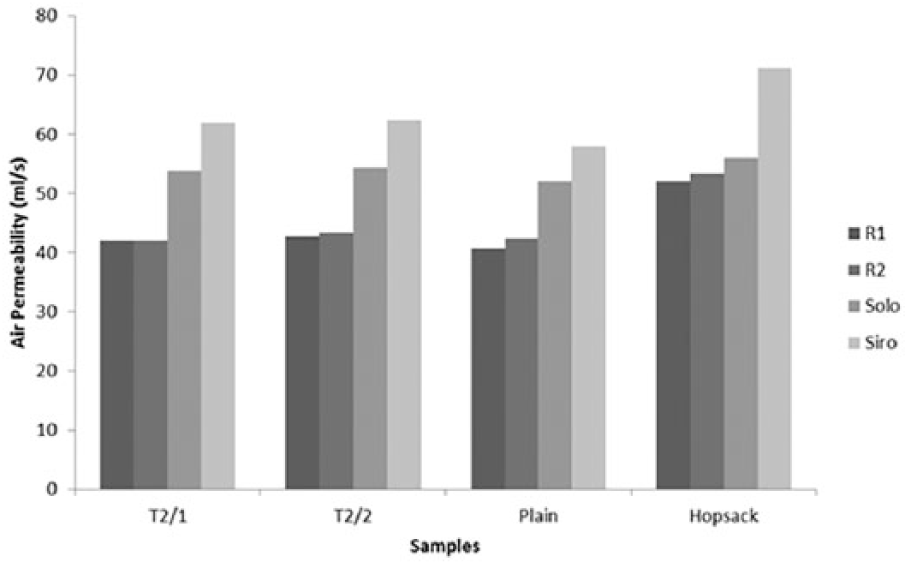
Air permeability results.
It can be concluded that fabrics with more interlacing points and relatively more packed structure, have lower capacity for air passage and circulation. Since the hopsack weave had more porosity, the greatest air permeability was obtained for this structure. Likewise, it should be noted that plain has the lowest air permeability because of its higher firmness and less porosity among other weave patterns.
As it is apparent in Figure 2, among different yarn types which were utilized as the weft, the air permeability of fabrics made of Solo and Siro yarns compared to ring yarns (one-ply and two-ply) is more.
Statistical analysis of results revealed that the significance of fabric structural parameters in relation to the yarn types is more during the investigation of the air permeability of the fabrics. The relation between fabrics air permeability and fabrics structural parameters is as follows

Water vapor permeability
It is known that water vapor permeability is a very important factor in clothing comfort. Hence, it influences the transfer rate of body perspiration to the environment. Otherwise, sweat condensation inside the clothing systems lead to sticky clothing that is undesirable. Water vapor permeability depends on the fiber type and fabric porosity. Since our samples are similar from the viewpoint of fiber type, only the fabric porosity is regarded as the influential factor, which is in turn related to fabric and constituent yarn structure.
Water vapor permeability of samples is shown in Figure 3.

Water vapor permeability.
As it is clear from Figure 3, hopsack and plain weave structures have the highest and lowest water vapor permeability, respectively. Moreover, twill 2/2 has higher water vapor permeability than twill 2/1. Water vapor permeability is calculated as equation (5)

where M is the loss in mass, t is the time between weighting, and A is the internal area of dish. Since fiber blend in all samples is similar, only the factors that affect the internal area of the dish, which is covered by the fabrics, can alter the water vapor permeability. In a way, any parameters that can change the covered area of the dish by the fabric such as fabric porosity that decreases the covered area of the dish will improve the water vapor permeability.
It should be noted that the number of yarn interlacing point and fabric density influences the porosity of each weave structure. The plain weave has the highest yarn interlacing point and it is anticipated to have the lowest porosity. Among the studied samples, as it is expected, the plain has the lowest values of water vapor permeability. Although twill 2/2 and hopsack have the same floating yarns, hopsack has a better performance in transferring the water vapor permeability.
On the contrary, yarns with the same count and different structures have various performances in the water vapor permeability aspect, such that single-ply ring yarn has the highest water vapor permeability and the other yarn structures have lower values that are approximately similar. In fact, in the two-ply ring, Solo and Siro yarns due to the higher yarn compactness, the spaces between fibers in the yarn were reduced which caused lower water vapor permeability. However, single-ply ring yarn has a loose construction in comparison to the others. The fabric water vapor permeability relation with its fabrics structural factors can be summarized as follows

Appearance performance
Crease recovery angle
Crease recovery is considered as an important factor in clothing appearance, mainly outdoor clothing. According to the weave pattern, the greater the loose fabric structure, which means weaves with high floating yarns and low density, higher crease recovery angle is expected due to the greater yarn movability in the fabric structure. The crease recovery angle of samples in the warp and weft direction is presented in Figures 4 and 5, respectively.

Crease recovery angle in warp direction.

Crease recovery angle in weft direction.
This reveals that in both warp and weft directions, plain weave has the most firm weave than other structures; thus, it has the lowest crease recovery angle. Among other weave structures, twill 2/1 has the lowest crease recovery angle because of the lower floating yarns. Although hopsack and twill 2/2 have the same interlacing yarn points, twill 2/2 has higher crease recovery angle.
The effect of yarn construction displays that the samples made of single-ply ring-spun yarn have better crease recovery performance due to the greater mobility of fibers in the yarn structure. However, due to the higher fiber’s contribution in other spun yarns, that is, the result of doubling and twisting, better twist penetration in fibers groups, and smaller spinning triangles in two-ply ring, Solo and Siro spun yarns, respectively, the fibers movability is limited because of the higher yarn’s compactness. In other words, in woven fabrics with the same fiber blends and various fabric and yarn structure, the crease recovery angle is related to fabric structural properties as equation (7)

Abrasion resistance
Due to clothing rubbing during contact with other surfaces, or even fabrics, its abrasion is inevitable. Since abrasion affects clothing appearance and performance, it should also be considered. Undoubtedly, weave and yarn structure has a critical effect on the abrasion resistance.
For 16 fabric samples, the outcome of the abrasion resistance test is shown in Figure 6.

Abrasion resistance.
Based on Figure 6, in weave patterns with more floating yarns, more parts of the yarn are exposed to the abrasive forces, and it would soon be destructed. In the comparison of weave structures, plain has the highest abrasion resistance, followed by twill 2/1. Twill 2/2 and hopsack 2/2 have similar floating yarns; however, twill 2/2 has lower abrasion resistance. It seems that the formation of regular aberrant lines on the fabric surface causes the yarns to encounter more abrasive cycles and lower abrasion resistance is obtained.
Moreover, as it was mentioned above, the yarn structure can affect the abrasion behavior of yarns and fabric. The yarn twist and its spinning method, which determine the yarn compactness and fiber contribution in its construction, determine its abrasion performance. It seems that for all weave structures, abrasion resistance of yarns is as follows: two-ply ring > Solo >Siro > single-ply ring.
Two-ply ring-spun yarn consists of two single-ply yarns that passed the doubling and second twisting after the first stage of twisting. These processes improve the fiber trapping in the yarn structure. However, single-ply yarn has lower abrasion resistance because of the loose structure and low yarn compactness; therefore, the yarn’s structure is easily destroyed after facing the abrasive forces.
However, in Solo-spun yarns, due to the small grooves of Solo-spun rollers and its strand division, each small fiber group was twisted effectively because of the smaller ring spinning triangle that improves yarn compactness. Consequently, yarn is more resistant against abrasion than single-ply yarn. In Siro-spun yarn, feeding two roving, this is a practical method in trapping fibers in the yarn structure, which results in the better abrasion resistance of yarns.
To sum up, it is possible to relate the fabric abrasion resistance to the weave and yarn structure as equation (8)

Pilling
Pilling is another element that negatively affects the clothing appearance. Pilling depends on the fiber type, fabric, and yarn structure, and it is expected to follow the same trend as abrasion resistance for similar fiber types. Based on Figure 7, plain weave has the lowest floating yarn and consequently the best pilling resistance. In other weave patterns, twill 2/1 has the highest pilling resistance.

Pilling grade.
The effect of yarn structure on the pilling resistance is considerable, such that sing-ply yarns have the lowest pilling grade. Due to the loose structure, fibers will easily come out of the yarn during rubbing. However, in case of two-ply ring yarn, because of doubling and two twisting stages, greater pilling resistance is observed. For fabrics made of Solo- and Siro-spun yarn due to modification of the yarn-spinning process, fibers participation in the yarn structure is more; therefore, yarn better resists against rubbing and abrasion forces. Consequently, fabric-pilling resistance is related to the fabric and yarn structure as equation (9)

The comparison of the appearance and comfort properties relation with fabric and yarn structural characteristics reveals that they are not in the matching path. As such, parameters that improve appearance properties reduce the comfort of the clothing. Hence, to achieve a suitable fabric with an optimum appearance and comfort performance, a tradeoff between structural factors is needed.
Conclusion
Clothing appearance and comfort are considered as important factors in expressing clothing quality, especially for outdoor clothing. Since worsted woven fabrics are used for outwear clothing, they are considered to have the optimum appearance and comfort properties. Besides the weave structure, the warp and weft yarn-spinning system can alter the fabric’s esthetics and comfort characteristics.
The outcomes of this study clarify that in fabrics with looser structure that can be obtained with lower yarn interlacement and weave density, due to the yarn’s movability in the fabric structure, can improve fabric’s flexibility. In other words, among tested weave patterns, plain and hopsack 2/2 have the highest and lowest bending rigidity, respectively. Moreover, yarn compactness in turn, affects the fabric flexibility. In this regard, single-ply ring-spun yarn has the lowest bending rigidity; however, two-ply ring-spun yarn owing to the doubling presents the highest bending rigidity. About air permeability property, plain weave has the lowest air permeability; however, the highest air permeability belongs to the hopsack2/2. Besides, among various yarn-spinning systems, the lowest air permeability was obtained for single-ply ring-spun yarn followed by two-ply ring, Solo, and Siro yarns. According to the Kozeny–Carman law, this outcome is the result of fabric’s porosity. In consideration of the effect of weave structure and yarn-spinning systems on the water vapor permeability of the fabric, it was observed that there is a considerable difference between single-ply ring-spun yarn and other yarn structures, and the plain and hopsack 2/2 have the lowest and highest water vapor permeability, respectively. Regarding the mentioned results, it is obvious that on the whole, the comfort aspects of the studied fabrics such as the flexibility, air permeability, and water vapor permeability are inversely related to fabric firmness and yarn compactness.
Considering the appearance feature of the fabrics, the crease recovery angle, abrasion resistance, and the pilling resistance of the fabrics were investigated. Based on the achieved outcomes, it can be declared that the best crease recovery performance was observed for the twill 2/2 weave structure, and it was detected that plain did not show considerable crease recovery angle than the other weave structures. The greatest crease recovery angle belongs to the single-ply ring yarn. In view of the abrasion resistance of samples, it was observed that weave patterns with more floating yarns, encounter more with abrasive loads. Moreover, yarns with loose structure owning to the lower ability to trap fiber inside the yarn structure performs weaker against abrasive forces. Therefore, plain and twill 2/2 showed the highest and lowest abrasion resistance, respectively. Concerning yarn-spinning systems, two-ply ring yarn has the best performance during the abrasion cycles followed by Solo, Siro, and single-ply ring yarn. The pilling resistance of single-ply yarn differs mostly from the other studied yarns, which is due to the looser structure of this kind of yarn and the ability of the fibers to protrude and come out of the yarn construction. This property would reduce the pilling resistance of the fabric.
On the whole, it can be noted that the yarn’s compactness and fabric firmness have significant role in the fabric comfort and appearance performance. Therefore, to obtain a desirable fabric with optimum appearance and comfort performance, a tradeoff between structural factors is needed.
Footnotes
Declaration of conflicting interests
The author(s) declared no potential conflicts of interest with respect to the research, authorship, and/or publication of this article.
Funding
The author(s) received no financial support for the research, authorship, and/or publication of this article.