



Abstract
Compared with natural leather, microfiber synthetic leather has many excellent properties such as chemical resistance and physical and mechanical properties. However, the preparation of high performance microfiber synthetic leather with excellent water vapor transmission rate, moisture absorption, and wearing comfort property still has a great challenge. The aim of this work was to improve moisture absorbent and transfer abilities by mixing polyhydroxybutyrate hydrophilic nanofibers in microfiber synthetic leather base. The effect of polyhydroxybutyrate nanofibers content on the structure and properties of microfiber synthetic leather base were investigated. The results indicated that polyhydroxybutyrate nanofibers with an average diameter of 0.40 μm were evenly distributed in all directions of microfiber synthetic leather base. As the nanofibers content increased from 0% to 20%, water contact angle decreased from 111.64° to 59.31°, resulting in 44% increase in water vapor transmission rate (from 3112.37 g/(m2 24 h) to 4350.53 g/(m2 24 h)) and 22.3% increase in moisture absorption (from 649.12% to 812.92%). Meanwhile, the addition of nanofibers made microfiber synthetic leather base dense, leading to 24.0% decrease in air permeability. In particular, the softness of microfiber synthetic leather base was increased by 42.18%. In addition, the tear strength was also significantly enhanced. Therefore, this study provided a viable method for preparing high performance microfiber synthetic leather base to use polyhydroxybutyrate nanofibers.
Keywords
Introduction
As a mature leather material, natural leather is widely used in our life and production for its excellent hygiene and wearing comfort. However, with the increasing social demands and environmental awareness, the preparation of synthetic leather with excellent performance has become a trend of current research.1–3 Since microfiber synthetic leather has a three-dimensional structure that is similar to natural leather, it has rapidly developed into an ideal substitute for natural leather in recent years. Microfiber synthetic leather base (MSLB) is composed of polyester (PET) or polyamide 6 (PA6). Due to the existence of microfiber in MSLB, microfiber synthetic leather has many excellent properties such as chemical resistance and physical and mechanical properties.4,5 However, MSLB is mainly made of polyamide fibers. PA6 is an inert polymer. The molecular structure of PA6 microfiber is –(HN(CH2)5CO)n–. Only some of the reactive groups of the carboxyl group and the amido group are present at the end of the molecular chain. Consequently, the water vapor molecules cannot be effectively transmitted and absorbed. Therefore, microfiber synthetic leather has a disappointing sanitary performance and wearing comfort.6–9
At present, many researchers concentrate on improving the hygienic properties of leather base. 10 Typically, acid hydrolysis,11–13 proteolytic hydrolysis,14–16 and graft hydrophilic materials17–22 (especially collagen)23,24 are used to modify the MSLB. However, previous studies primarily focused on polyamide modification, and the process was complicated. Although the water vapor transmission rate (WVT) has improved, the mechanical properties have dropped significantly. Therefore, it is necessary to propose a new method to improve the hygienic properties of microfiber synthetic leather.
Polyhydroxybutyrate (PHB) is a natural biodegradable thermoplastic polymeric material composed of multiple D-type β-hydroxybutyric acid units. PHB nanofibers have a large number of carboxyl groups in the molecular chain, which makes them have great hydrophilicity. At the same time, there are literatures that have demonstrated the hydrophilic properties of PHB nanofibers. 25 The physical and mechanical properties of PHB nanofibers are similar to that of polypropylene fibers. And PHB nanofibers have good biocompatibility, biodegradability, high hardness, and good processability. Therefore, it is widely used in the field of biomedicine.26–28
In order to improve the hygienic properties of MSLB, the purpose of this work is to prepare MSLB with PHB electrospun nanofibers. The addition of PHB nanofibers not only increases the reactive groups, but also reduces the fiber diameter. So, natural leather was imitated in terms of structure and fiber composition. The effect of PHB nanofibers content on the morphology and properties of MSLB were discussed.
Experimental section
Materials
PET/PA6 hollow segmented-pie microfiber was supplied by Sanjiang Microfiber Nonwovens Co., Ltd (Ji’an, China). The microfiber was cut it into 50-mm staple fibers and loosened; PHB was purchased from Guoyun Biological Technology Co., Ltd (Tianjin, China); trichloromethane (CHCl3) was purchased from Sailboat Chemical Reagent Technology Co., Ltd (Tianjin, China); N,N-dimethylformamide (DMF) as solvent was purchased from Guangfu Technology Development Co., Ltd (Tianjin, China).
Preparation of PET/PA6 MSLB with PHB nanofibers
The PET/PA6 MSLB with polyacrylonitrile (PAN) nanofibers was prepared by a three-step process. First of all, the PET/PA6 hollow segmented-pie bicomponent fibers were cut into 50 mm. The polymer ratio of PET/PA6 was 70%/30%. Second, PHB nanofibers were prepared by electrospinning. The PHB (2.5 wt%) was dissolved in CHCl3/DMF solvent. And the mass ratio of CHCl3/DMF was 90/10. The solution was stirred at 60°C for 6 h and transferred to the syringe. PET/PA6 hollow segmented-pie microfibers were unfolded evenly on the receiving roller of electrospinning equipment, the spinning voltage was 16 kV, the extrusion flow rate was 2 mL/h, the distance between the spinning needle and the receiving device was 20 cm, and the diameter of the spinning needle was 0.6 mm. The PHB nanofibers were received on the PET/PA6 hollow segmented-pie bicomponent fibers and continuous manual mixing. As shown in Table 1, the content of PHB nanofibers in mixed fibers was 0%, 5%, 10%, 15%, and 20%. At last, the mixed fibers were combed into fiber web. The fibers were intertwined 10 times by hydroentanglement to form the MSLB. The spunlace pressure was 10 MPa, which made PET/PA6 completely split. The MSLB was produced to have a basis weight of 160 g/m2 and a thickness of 0.45 mm. The flow chart of the experiment was given in Figure 1.
The mixing ratio of PHB nanofibers and PET/PA6 microfiber.

PHB: polyhydroxybutyrate; PET: polyester; PA6: polyamide 6.

Experiment flowchart.
Characterizations
Morphology
In order to observe the mixing of nanofibers in the MSLB as much as possible, scanning electron microscope (SEM, TM3030, Hitachi, Japan) was used. The sample was dried in an oven (80°C) and then ion-sputtered. The surface and cross-section of the sample were observed by SEM under a low vacuum with an acceleration voltage of 5/10 KV.
Thermal analysis measurement
In order to prove the existence of PHB nanofibers and analyze the thermal stability of MSLB, the thermal properties of MSLB were tested by thermogravimetric analysis (TGA) and differential scanning calorimetry (DSC). TGA of the samples was tested by a NETZSCH TG STA449F3 under the condition of N2 protection with the heating rate of 10°C/min from room temperature to 600°C. Each sample was about 6–10 mg. DSC of the samples was tested by a NETZSCH DSC200F3. The samples were heated from 20°C to 300°C at a rate of 10°C/min under N2 atmosphere.
WVT
The static WVT of MSLB was tested according to GB/T 12704.2-2009 29 by using a fabric water vapor permeability measuring instrument (YG(B)216-Ⅱ, Wenzhou Darong Textile Instrument Co., Ltd, China). The test environment temperature was 38°C ± 2°C, and the humidity was 50% ± 2%. The formula was as follows

where WVT is the static water vapor transmission (g/(m2 24 h)), m1 is the mass of the sample group after the specified test time (g), m0 is the mass of the experimental group before the specified test time (g), A is the effective test area of permeation (m2), and T is the test time (h).
Moisture absorption
The moisture absorption of MSLB was achieved according to GB/T 4689.21-2008. 30 The temperature of the distilled water is 25°C ± 2°C, and the test was carried out at room temperature. The formula was as follows

where Q is the number of milliliters of water absorbed per 100 g of leather sample, V1 is the volume of water absorbed by the sample (mL), and m is the mass of the sample (g).
Contact angle measurement
The water contact angle of MSLB was determined by using a contact angle measuring device (OCA15pro; DATAPHYSICS, Germany) with video capture. About the contact angle measurement, distilled water was dropped on the air side surface of the MSLB, and the contact angle was measured after 5 s. Each sample was measured at least five times on average to obtain reliable values.
Air permeability
The air permeability of MSLB was measured according to GB/T 5453-1997 by using the fully automatic ventilation instrument (YG461H, Ningbo Textiles Instrument Co., Ltd, China). The test pressure was 100 Pa, and the test area was 20 cm2. Each sample was measured 10 times and an average was calculated to ensure the reliability of the data.
Softness
The softness of MSLB was investigated using a softness tester (YN-L-051, Dongguan YP Testing Equipment Co., Ltd, China) according to IUP 36 standard method.
Mechanical properties
The tensile strength and elongation at break of MSLB were determined in view of GB/T 24218.3-2010 31 by using mechanical performance tester (Instron 5969, America Instron Co., Ltd, USA). The sample size is 30 cm × 5 cm. The gauge is 20 cm, and the tensile speed is 100 mm/min. The tear strength of MSLB was also accomplished using mechanical performance tester in the light of GB/T 3917.2-2009. 32 The sample size is 20 cm × 5 cm with a gauge of 10 cm and tensile speed of 100 mm/min. Each sample was tested five times.
Results and discussion
Morphology
Figure 2 shows the SEM photographs of natural leather and MSLB. The microstructure of natural leather is shown in Figure 2(a). The reticular layer was formed in three-dimensional structure by collagen fiber bundles with different fineness. Obviously, it can be observed from Figure 2(b) and (c) that PHB nanofibers were added in PET/PA6 fibers and well interpenetrated with PET/PA6 fibers to form a three-dimensional structure. Meanwhile, the PET/PA6 hollow segmented-pie bicomponent fibers were completely split by hydroentangling. By adding PHB hydrophilic nanofibers, MSLB imitated the natural leather in terms of structure and fiber composition. Figure 2(d) is a partial enlargement of PHB-PET/PA6 MSLB, and the difference in diameter between the microfibers and the nanofibers can be visually observed. Figure 2(e) and (f) shows the average diameter of microfibers and nanofibers in MSLB. It was shown that the average diameter of microfibers and nanofibers were about 5.55 μm and 0.40 μm, respectively, which were similar to monofilaments and fibrils of natural leather.
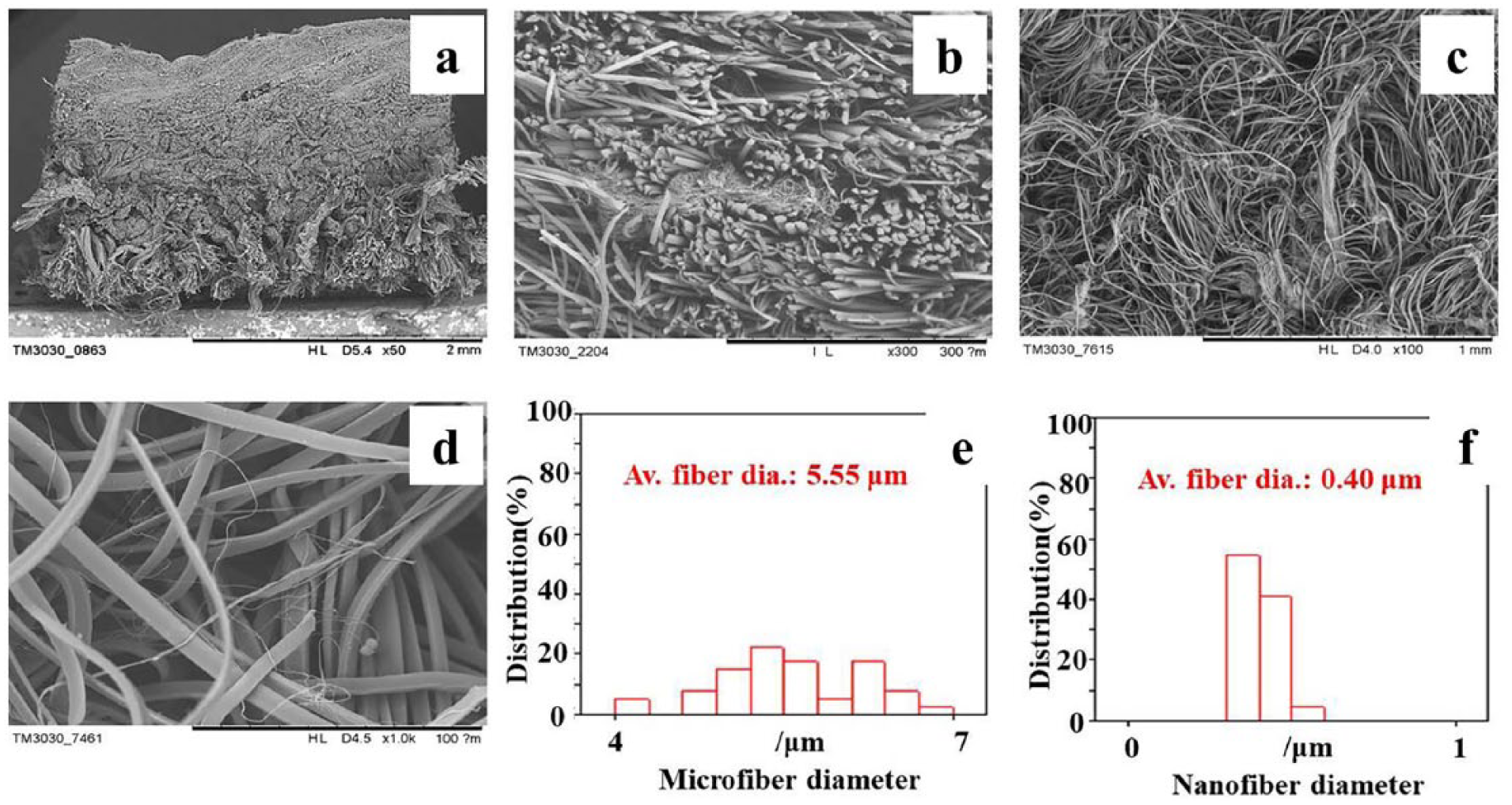
Scanning electron microscopy images of (a) cross section of natural leather, (b) cross section of PHB-PET/PA6 MSLB, (c) surface of PHB-PET/PA6 MSLB, (d) magnified PHB-PET/PA6 MSLB surface, and average diameter of (e) PET/PA6 microfibers and (f) PHB nanofibers.
Thermal analysis measurement
Measuring the glass transition temperature (Tg) with the blend composition is typically used as a measure of the presence of the component. Figure 3 is the DSC curves of the PET/PA6 MSLB and PHB-PET/PA6 MSLB with different content of PHB nanofibers mixed. The DSC curve of PET/PA6 shows the Tg peaks of PA6 at 219.2°C and PET at 261.1°C. After mixing 10% and 20% nanofibers, respectively, the DSC curve showed a Tg peak at 137.8°C, which was the melting peak of PHB. The Tg of PET and PA6 slightly decreased due to the mutual plasticization between polymers. Simultaneously, it further certificated that there are PHB nanofibers in MSLB.

DSC curves of PHB nanofibers with different content of the fabric.
In order to further understand the effect of PHB nanofibers on the thermal stability of MSLB, the thermal behavior of MSLB was analyzed by TGA. Figure 4 is the thermal weight loss of PET/PA6 MSLB and PHB-PET/PA6 MSLB with different content of PHB nanofibers mixed. As shown in Figure 3, it can be seen that the weight of PET/PA6 MSLB begins to lose at 373.79°C, and the PET/PA6 fibers begin to thermally decompose. When 10% PHB nanofibers were added, the fabric lost its weight at 238.06°C. When 20% PHB nanofibers were added, the fabric began to lose weight at 239.43°C. At 500°C, the microfiber decomposition is almost complete. The rest of the material is carbon residue. The final carbon residue is the most important difference in the TGA curves. The coke residues of the final PET/PA6 MSLB, B-PET/PA6 MSLB (PHB10%), and PHB-PET/PA6 MSLB (PHB20%) were 14.95%, 14.76%, and 13.92%, respectively. It can be seen from the DSC and TGA curves that the addition of PHB nanofibers has a certain influence on the thermal properties of MSLB.

TGA curves of PHB nanofibers with different content of the fabric.
Water vapor permeability and moisture absorption
The static WVT and moisture absorption greatly affect the wearing comfort of the microfiber synthetic leather, which is an important index for evaluating the hygienic properties of synthetic leather. Figure 5 shows the effect of the addition of PHB nanofibers on the WVT and moisture absorption of MSLB. Compared with PET/PA6 MSLB, the addition of PHB nanofibers significantly improved the WVT and moisture absorption of leather base. When the PHB nanofibers content was increased to 20%, the WVT was increased from 3112.37 g/(m2 24 h) to 4350.53 g/(m2 24 h), and the moisture absorption was increased from 649.12% to 812.92%, WVT increased by 43% and the moisture absorption increased by 22.3%. PHB was composed of multiple D-type β-hydroxybutyric acid units. PHB nanofibers were added, increasing the number of hydrophilic groups. At the same time, the fiber specific surface area of MSLB was increased because of the addition of nanofibers. It has a positive effect on water absorption and delivery. Therefore, WVT and water absorption of MSLB have been significantly improved.

Effect of different PHB nanofiber content on static water vapor transmission rate and moisture absorption of base.
Water contact angle
Figure 6 shows the water contact angle of PET/PA6 MSLB and PHB-PET/PA6 MSLB after 5 s. As shown in Figure 5, the water contact angle on the surface of leather base without the addition of PHB nanofibers was 111.64°. As the content of PHB nanofibers increased, the water contact angle on the surface of leather base decreased gradually. When the PHB nanofiber content is 20%, the water contact angle was dropped to 59.31°. It showed that there has been a significant improvement in hydrophilicity. This is due to the PHB nanofibers added to improve the hydrophilic surface of the leather substrate. Meanwhile, the transfer of leather fabric to water was also obviously improved. Therefore, the contact angle of water has been significantly reduced after 5 s. It was further proved that the addition of hydrophilic nanofibers greatly improved the hydrophilicity of MSLB.

Effect of different PHB nanofiber content on water contact angle of base.
Air permeability
Air permeability is also an important indicator of the hygienic performance of synthetic leather. As shown in Figure 7, the air permeability of the PHB-PET/PA6 MSLB decreased slightly compared to the PET/PA6 MSLB, and as the content of nanofibers increased, the gas permeability was gradually decreased. When the content of PHB nanofiber reached 20%, the air permeability was decreased by 24.0%.Due to the increase of nanofibers, the leather base has become more dense after the spunlace. Therefore, the air permeability of the leather substrate was slightly lowered.

Effect of different PHB nanofiber content on air permeability of base.
Softness
Softness is an important indicator of the comfort of microfiber synthetic leather. However, compared with the natural leather, the microfiber synthetic leather made of PET/PA6 MSLB still has the problems of poor hand feeling and softness. But, the addition of nanofibers has changed this problem. As shown in Figure 8, it is apparent that the softness of MSLB was 4.68 mm. As the nanofiber content was increased from 5% to 20%, the softness of MSLB was increased by 42.18% (from 4.68 mm to 6.54 mm). The results evidence that the addition of nanofibers has a major influence on the softness of MSLB.

Effect of different PHB nanofiber content on softness.
Mechanical properties
The addition of nanofibers also has a certain impact on the mechanical properties of MSLB. As shown in Table 2, due to the increase of the content of nanofibers, the tensile strength and the elongation at break were decreased, but they all conformed the requirements of GB/T 24248-2009 (tensile strength >100 N, elongation at break >35%). Due to the increase of the content of nanofibers, the PET/PA6 fibers decreased correspondingly. The tensile strength of nanofibers is much smaller than that of microfibers, so the tensile strength of leather base was decreased during the stretching process; however, the tear strength of MSLB was increased. During the tearing process, the single-slit tear method was used. With the addition of nanofibers, the fiber density in the stress triangle was increased during tearing, and the entanglement between the fibers became more and more tight. That is why the tear strength was improved.
Mechanical properties of PHB nanofibers with different content of the fabric.

PHB: polyhydroxybutyrate.
Conclusion
PHB nanofibers were mixed with PET-PA6 hollow segmented-pie microfiber, and PHB-PET/PA6 MSLB was made by combing and spunlacing. Natural leather was imitated in terms of structure and fiber composition. The effect of PHB nanofibers content was investigated. After measurement, the diameter of PA6 microfiber was 5.55 μm, and the diameter of PHB nanofiber was 0.40 μm. The thermal properties of the MSLB were analyzed by DSC and TGA, which further certificated the presence of PHB nanofibers. It has also been demonstrated that the addition of PHB nanofibers has a slight effect on the thermal properties of MSLB. With the increase of nanofiber content from 0% to 20%, MSLB hydrophilicity has been significantly improved. Water contact angle decreased from 111.64° to 59.31°, the WVT was increased by 44% (from 3112.37 g/(m2 24 h) to 4350.53 g/(m2 24 h)), and the moisture absorption was improved by 22.3% (from 649.12% to 812.92%). Meanwhile, the addition of nanofibers made MSLB dense, leading to 24.0% decrease in air permeability. Especially, the softness of MSLB was increased by 42.18%. In addition, the tear strength was also significantly enhanced.
Footnotes
Declaration of conflicting interests
The author(s) declared no potential conflicts of interest with respect to the research, authorship, and/or publication of this article.
Funding
The author(s) disclosed receipt of the following financial support for the research, authorship, and/or publication of this article: This work was supported by National Natural Science Foundation of China (Grant No. U1607117) and by Tianjin Research Program of Application Foundation and Advanced Technology (Grant No. 15JCZDJ38500 and Grant No. 16JCZDJC36400).