




Abstract
Thermocouples are mainly used for accurate temperature measurements, but they can also be used for the generation of electric energy at low voltage and low power. If inserted into wearable garments, these thermocouples can be used to supply the electric energy required by portable electronic devices. The heat from the human body gives rise to a temperature gradient which can be converted into electric power. In this article, we study the possibility to create a thermocouple and thermopile from pure conductive textile yarns. Among the materials tested, nickel-coated carbon fiber in combination with stainless steel yarn, polypyrrole-coated carbon fiber, or carbon fiber has good potential to be a textile-based thermocouple. We also successfully made a 10-pair carbon fiber–nickel-coated carbon fiber junction thermopile from a single nickel-coated carbon fiber yarn by removing the nickel selectively through etching process.
Introduction
Temperature measurements can be performed by a device consisting of a thermocouple. Technically, when there is a temperature difference between hot and cold junctions in the thermocouple, it generates a thermo-voltage which can be used further as a temperature sensor. In 1820, Thomas Johann Seebeck discovered the basics of the thermoelectric effect obtained from joining two dissimilar metals at different temperatures. He had called it “thermomagnetism” before the term “thermoelectricity” was proposed by Professor Hans Christian Oersted afterward. 1 The two dissimilar metals joined together were then called a thermocouple. Multiple thermocouples can be arranged in series to create a thermopile which can be used as a thermoelectric generator. 1
Generally, a thermocouple is made of a pair of different metal wires such as platinum, rhodium, iridium, chromel, alumel, iron, copper, and constantan. 2 Jones, 3 in his master’s thesis, reported the use of metal wires, that is, copper and constantan, to form a type-T thermocouple inserted in woven fabrics so as to obtain a temperature sensor to measure body temperature. In his work, metal wires were used which made the textile less flexible and uncomfortable to wear.
Thermocouples and thermopiles have a great potential to be applied to textile fabric as wearable sensors and thermoelectric generators. If inserted into wearable garments, these thermocouples can be used to supply the electric energy required by portable electronic devices. This is possible because the heat from the human body gives rise to a temperature gradient over the textiles which can be converted into electric power.
Few studies on the potential use of thermocouples in textiles for various applications have been reported. Zhu and Takatera 4 used thermocouples to measure in-plane capillary water flow in the fabrics and temperature changes of cotton and polyester fabrics in wetting and drying process. 5 Other studies used a thermopile principle in the textile fabrics. The researchers used constantan (Cn) metal wire covered with copper (Cu) via electrochemical deposition inserted into the woven fabric and then etched the copper locally to form thermopile Cn-Cu junctions on each surface of the fabric as a textile-based heat flux sensor,6–8 which made the textile fabrics lose their flexibility due to the use of metal wires.
Ideally, the thermocouples used in the fabrics should be flexible and offer a normal textile feel. So, they are preferably created from textile materials such as conductive yarns instead of metal wires. Wang and Chung 9 found that thermocouples from carbon fibers which intercalated with bromine and sodium hydroxide exhibited a good Seebeck coefficient, but the intercalation process was very laborious. Ziegler and Frydrysiak 10 published their research on using several conductive threads such as polyacrylonitrile (Nitril), steel staple fibers, silver-coated polyamide, and graphite, but they found that the thermocouples possessed low accuracy and sensitivity. Another approach has been explained in a review paper by Mecnika et al. 11 According to them, a thermocouple can be created from two different conductive metal yarns by embroidery technique.
Another experimental report to make a flexible thermocouple on a textile fabric was by screen printing organic conductive polymers poly(3,4-ethylene-dioxythiophene): poly(4-styrenesulfonate) (PEDOT: PSS) and polyaniline (PANI) in combination with copper strips on cotton fabrics. The drawback of this experiment was the unstable voltage. 12 A thermoelectric generator made by printing antimony and Bi0.85Sb0.15-alloy pastes on polyimide strip which exhibited good thermo-power has also been reported. 13 Thermopile structures were also fabricated with thin and thick films proposed as a thermoelectric microgenerator 14 and laser power sensor. 15
Nowadays, conductive fibers/yarns are available in the market. Therefore, in this article, we study the possibility to create a thermocouple and thermopile from pure conductive textile yarns. The goal of this work is to find the suitable pure electroconductive textile yarns which can be turned into material for a textile thermocouple. Just for the sake of comparison, some metal wires have also been tested. To avoid any confusion, we will use the word “yarn” for textile and “wire” for non-textile products throughout this article.
Experiments
Materials
In our investigation, eight different materials were tested: five textile yarns and three metal wires: (1) stainless steel yarns (St. Steel), (2 and 3) carbon yarns from two different suppliers (CF 1 and CF 2), (4) nickel-coated carbon yarns (NiCF), (5) polypyrrole-coated carbon yarn (PPYCF), (6) silver-coated copper wire (Cu/Ag), (7) constantan wire (Cn), and (8) copper wire (Cu). All the conductive materials used in this work are shown in Table 1.
Materials used for creating thermocouples.

n/a: not available.
Electroless deposition of polypyrrole
PPYCF yarns were self-prepared from CF by an electroless deposition method. The chemicals used for electroless deposition of polypyrrole on carbon fiber were pyrrole, FeCl3, and benzene sulfonic acid (BSA) which were donated by Sigma Aldrich Belgium. All chemicals were analytical grade. Electroless deposition of polypyrrole was carried out according to the work of Gasana et al. 16 One hundred milliliters of 0.04 molar pyrrole solution was prepared in a glass bottle and circa 1 m carbon fiber tow was immersed in the pyrrole solution and the bottle closed with a lid. The solution was then treated in an ultrasound bath for 20 min and next kept without ultrasound for 40 min at room temperature. One hundred milliliters of pre-prepared mix of FeCl3 and BSA (0.093 and 0.0132 molar, respectively) was transferred and mixed into the pyrrole solution. Mixed pyrrole-FeCl3-BSA solution was then placed in a 3°C fridge for 2 h. After that, the carbon fiber yarn was taken out from the mixed solution and rinsed with distilled water until the rinsing water was clear. Finally, the yarns were dried in an electric oven for 24 h at 40°C.
10-pair CF-NiCF junction thermopile from nickel-coated carbon yarn
In this experiment, we made a 10-pair CF-NiCF junction from NiCF yarn. First, the NiCF yarn was coiled on a wood block with a dimension of 28 cm × 3.3 cm × 3.3 cm. A polymer called Lurapret® D579 from Archroma was put on the yarn using a pipette dropwise covering half of each loop (ca. 6.6 cm) to create the junctions as shown in Figure 1. Then, the wood with the coiled yarn was put in an electric oven at 140°C for 20 min to carry out the polymerization. After that, the yarn was removed from the wood and dipped in the etching solution (37% HCl and 10% H2O2 (1:1)) for 30 min according to our previous work. 17 After rinsing with water, the yarn was dried at room temperature for at least 24 h.

Illustration of the sample preparation to make a 10-pair CF-NiCF junction thermopile.
Voltage measurement
Voltage measurement of the thermocouples and thermopile was done with Nanovoltmeter Amplificator NV 724 from Setaram, Lyon, France. A hot plate “Isotemp” from Fisher Scientific was used to heat the thermocouple junction of two conductive yarns/wires. We placed a piece of paper on the surface of the hot plate and on top of the junction to avoid the measured thermocouple junction touching any electric conductors. A weight made from wood material was placed on top of them to guarantee good contact of the junction with the hot plate. This was the hot junction. The other ends of yarns/wires sample were connected to the Nanovoltmeter, forming the cold junction. The voltage was measured at different temperatures of the thermocouple junction when the hot plate temperature was decreasing. The temperature was measured with a digital thermometer Fluke 52. The voltage measurement setup can be seen in Figure 2.
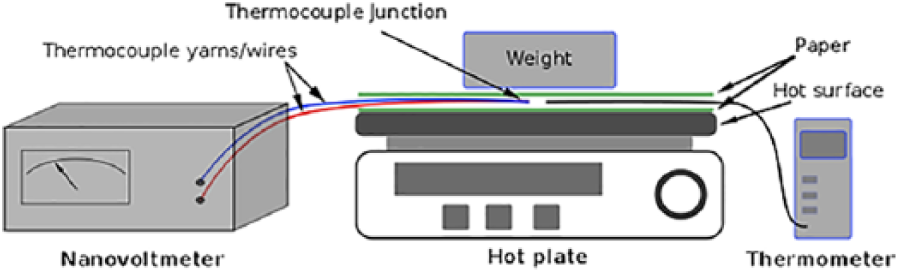
Voltage measurement setup for the thermocouple.
The voltage measurement setup for the 10-pair junction thermopile samples was created by first coiling the yarn on the wood block similar to what we had done as shown in Figure 1 but the uncovered parts was CF (the nickel had been etched) and then put on the hot plate where the hot junctions were underneath the wood block and the cold junctions were on the upside of the wood block. For this temperature measurement, we used thermometer Fluke 54 II B. This setup measurement can be seen in Figure 3.

Voltage measurement setup for the thermopile.
Results and discussion
The Seebeck coefficient was obtained from the slope of the linear graph of the voltage versus temperature difference of the samples. Table 2 gives an overview of all Seebeck coefficients of the samples measured. In this table, there are several columns without values indicated by dash (–) signs. The dash signs can be attributed to either not tested or too low to be able to be measured by our device.
Seebeck coefficients of thermocouples made from (1) stainless steel yarns, (2 and 3) carbon yarns, (4) nickel-coated carbon yarn, (5) polypyrrole-coated carbon yarn, (6) silver-coated copper wire, (7) constantan wire, and (8) copper wire.

The highest value of the Seebeck coefficient from our experiments is the pair of stainless steel yarn and constantan wire. Seebeck coefficients of thermocouples paired with Cu or Cu/Ag have almost equivalent results. According to the supplier data sheets, the silver-coated copper wire contains only 50 g of Ag per kg wire or 5%. 18 Hence, the Ag skin around the copper wire is rather thin. The electric conductivities of Cu and Ag do not differ too much (5.96 × 10⁷ S/m for Cu 19 vs 6.30 × 10⁷ S/m for Ag 20 ). The same can be said about the Seebeck coefficients. To elaborate, with platinum as the reference metal, known Seebeck coefficients are 7.6 µV/K for copper versus 7.4 µV/K for silver, 21 showing also comparable properties like seen by us in the Cu/Ag and Cu columns of Table 2.
In Figure 4, we can see the distribution of the Seebeck coefficient from different classes of materials more clearly. In the class of metal wire versus metal wire thermocouple, Cn versus Cu/Ag gives the highest Seebeck coefficient. In this experiment, the pair of stainless steel yarn and constantan wire provides the highest coefficient in the class of metal wire versus textile yarn and in all class of the materials as well. NiCF versus St. Steel thermocouple gives the highest Seebeck coefficient in the textile yarn versus textile yarn class.

Seebeck coefficient of thermocouple from combinations of different class of materials.
The Seebeck coefficients of our experiment are somewhat different from the references reported elsewhere. For example, from Efunda, 22 it is known that the thermocouple from copper versus constantan has a Seebeck coefficient of 40.6 µV/°C, while we obtained 41.39 µV/°C. The different values between the experiment and the reference data can be caused by several factors such as slightly different tested materials which have different electrical properties and also different setup/condition of the testing method.
From the experiment, we found foremost that it is possible to make an excellent thermocouple from a metal wire and textile yarn combination, as we obtained in this class some which have Seebeck coefficients of more than 20 µV/°C. The Seebeck coefficients obtained from a combination of textile yarn and textile yarn are quite good as well with Seebeck coefficient more than 18 µV/°C such as NiCF versus CF, PPYCF versus NiCF, and NiCF versus St. Steel. Therefore, it is possible to make a good thermocouple from pure conductive textile yarns.
In this article, we focus on the textile yarns and show only the linear graphs of the thermocouples from the class of textile yarn and textile yarn combination in Figure 5. It shows the generated voltage versus the temperature difference. The slope of each characteristic is the most important parameter to characterize a thermocouple. We observe that for the temperature range used in our experiments, all characteristics turn out to be linear.

Voltage–temperature characteristics of selected thermocouple samples (textile yarn vs textile yarn).
The experiment results show that the NiCF with either stainless steel yarns or carbon yarns seems to be very promising as thermocouples made from pure electroconductive yarns. The Seebeck coefficients around 18–19 µV/°C for the combination of NiCF versus PPYCF and CF versus NiCF are very comparable with the Seebeck coefficient of a Chromel-Platinum wire thermocouple at 20°C which is 22.2 µV/°C. 23
From our experiment, the thermocouple from PPYCF versus NiCF has higher Seebeck coefficient (20.14 µV/°C) than the one from CF versus NiCF (18.57 and 19.22 µV/°C). But using PPYCF is economically more expensive due to the cost of the coating process of polypyrrole. After testing several textile-based yarns, we believed that CF and NiCF would be good materials to make a textile-based thermocouple. As CF and NiCF are textile yarns and the Ni can be coated or etched, they can be inserted into a fabric by normal textile machinery, processed, and used as a textile-based thermocouple. It is obvious that the highest coefficient in textile yarn versus textile yarn class was obtained from a NiCF versus St. Steel thermocouple, but in this work we selected the NiCF since we can modify it into a thermopile by removing nickel selectively to create CF-NiCF junctions at the correct locations.
Based on this consideration, we tried to make a 10-pair CF-NiCF junction thermopile from single NiCF yarn by covering the NiCF yarn intermittently by Lurapret® D579 and then removing the nickel layer from NiCF selectively in the etching solution, washing, and drying. After this process, we had a yarn with segmented series of CF and NiCF along the yarn, creating a thermopile.
We measured the Seebeck coefficient of 1-junction CF-NiCF thermocouple from the 10-junction thermopile and we obtained 14.01 µV/°C. The linear graph of the 1-junction CF-NiCF thermocouple can be seen in Figure 6. This result is lower compared with the previous experiment result which has a Seebeck coefficient of around 18–20 µV/°C for a pure CF-NiCF junction. This can be caused by several factors: first, the thermocouple comes from a single yarn (NiCF) where some of the nickel is removed from the yarn surface by hydrogen peroxide and hydrochloric acid. So, the electrical properties of the stripped NiCF are probably affected by the chemicals or alternatively, a small amount of nickel is still on the surface of the filaments. Second, the yarn was covered by Lurapret® D579 polymer to block the etching solution to penetrate and etch the nickel layer. But, there is a possibility that some nickel underneath the polymer is also removed by the etching chemicals causing the different electrical properties of the conductive yarn which in turn lowers the Seebeck coefficient of the CF-NiCF thermocouple. Due to this, the degradation by 25% of the Seebeck coefficient compared to a pure CF-NiCF junction is acceptable.

Seebeck coefficient of 1-junction CF-NiCF thermocouple.
The Seebeck coefficient of the 10-pair junction thermopile was measured to be 144.94 µV/°C as can be seen in Figure 7. Because of 10 pair of junctions, this coefficient yields 10 times the 1-junction thermocouple coefficient confirming the formula of


Seebeck coefficient of 10-junction CF-NiCF thermopile.
where ∆V is voltage difference (V), N is the number of junction pairs, α is Seebeck coefficient (µV/°C), and ∆T is temperature difference (°C) between hot and cold junctions. 8 It also proves again that the thermopile can give higher voltage compared to the 1-junction thermocouple. The results of these experiments confirm that making a thermopile from pure conductive textile yarns is possible, particularly from a single woven, braided, or knitted NiCF yarn.
Unlike the thermocouple mentioned by Mecnika et al., 11 our thermocouple was made from a single conductive yarn etched at specific spots. This allows us to create multiple thermocouples formed in series (thermopile) on a single conductive yarn in order to get a higher voltage. The conductive yarn can be woven in fabric before the etching process.
Conclusion
Finding a suitable pure conductive textile yarns for use in a thermocouple and thermopile is the goal of this work. In this study, we used five textile yarns and three metal wires to evaluate the Seebeck coefficient of the thermocouples made from them.
From the experimental results, we can draw the following conclusions. The pairs of Cn versus Cu/Ag, stainless steel yarn versus constantan wire, and NiCF versus Stainless Steel give the highest Seebeck coefficient for the class of metal wire versus metal wire, metal wire versus textile yarn, and textile yarn versus textile yarn, respectively.
Combination of NiCF and PPYCF produces a coefficient of 20.14 µV/°C. But NiCF versus CF also generates a good coefficient of around 18–19 µV/°C. Considering the possibility to create a thermopile from a single NiCF yarn, we decided to choose this yarn as the thermocouple material, as it might be usable in an industrial setting. As NiCF is a nickel-coated carbon fiber yarn, it can be modified to create CF-NiCF junctions by removing the nickel from the surface of the NiCF filaments selectively.
We successfully made a 10-pair CF-NiCF junction thermopile from NiCF yarn by removing the nickel selectively through stripping process with hydrogen peroxide and hydrochloric acid solution. The 1-junction CF-NiCF thermocouple produced lower Seebeck coefficient (14.01 µV/°C) than that of our earlier experiment (18–19 µV/°C) which used two separate CF and NiCF yarns. However, the 10-pair CF-NiCF junction thermopile generated the expected 10 times higher coefficient (144.94 µV/°C).
For further studies, the CF-NiCF thermocouple will be integrated into a textile fabric and we will evaluate its thermoelectrical properties and possible applications.
Footnotes
Declaration of conflicting interests
The author(s) declared no potential conflicts of interest with respect to the research, authorship, and/or publication of this article.
Funding
The author(s) disclosed receipt of the following financial support for the research, authorship, and/or publication of this article: The first author wants to thank the Indonesian Endowment Fund for Education (LPDP) for the financial support during this study.
