



Abstract
Carding is a common web-forming process used for staple fibers in the nonwovens industry. Carded webs can be produced with bicomponent staple fibers designed to split into fine fibers. Splittable bicomponent fibers offer benefits such as increased surface area, improved hand, decreased pore size, improved cover, and enhanced strength. Splittable bicomponent fibers within carded webs can be split and bonded utilizing high-pressure water jets during the hydroentangling process. Staple fibers may be produced in many different lengths. However, the effect of staple fiber length on the nonwoven carding process and structure–property relationships of carded, hydroentangled nonwoven fabrics composed of splittable bicomponent fibers is not well understood. During this research, polyester/polyethylene 16-segmented pie, bicomponent fibers with lengths ranging from 2.54 to 15.24 cm were produced, carded and bonded by hydroentangling. All fiber lengths used during this research were successfully carded, and no significant challenges were observed during carding. Fabric performance was evaluated with air permeability and burst strength testing. Data sets were statistically evaluated with one-way and two-way analysis of variance to determine whether fiber length significantly affected fabric structure and properties. In general, the solid volume fraction and air permeability of the samples were affected by fiber length. However, fiber length did not strongly affect the burst strength of hydroentangled fabrics.
Introduction
Carding is a nonwoven web-forming process which utilizes a series of machines to open, blend, individualize, parallelize, and lay fibers to form a web. Unlike continuous or extrusion-based processes, such as spunbonding and meltblowing, carding utilizes staple fibers. Staple fibers are defined as fibers with discrete or discontinuous length. In industry, 3.80, 4.80, and 5.10-cm-long synthetic and man-made fibers are typically used during carding. It is commonly believed that shorter fibers can be difficult to card as they often do not doff easily during carding and that longer fiber lengths also present processing issues as a result of card setup. However, the use of 5.10 cm length fibers is not well supported or justified by scientific literature.
Previous research has considered the relationship between carding and fiber length, but researchers primarily focused on the relationship between fiber length and carded sliver for yarns. The effect of fiber length on yarn strength,1–5 quality,1,3,6–8 hairiness, 9 and elongation3,10 are among the relationships that were considered. Also, the relationship between fiber length and fiber processability during carding has been studied by other researchers.11,12 However, these studies typically did not solely focus on the impact of fiber length and did not consider bicomponent fibers.
Hydroentangling is a nonwoven web-bonding process which utilizes high-pressure water jets to entangle and intertwine fibers. The effect of fiber length on hydroentangled fabric properties has not often been researched in the past. However, it was determined that fibers are more easily displaced and bonded within a web when fewer fiber contact points exist. Long fibers form many contact points with neighboring fibers which creates additional friction. It is believed that better fiber displacement is realized when using relatively short fibers which can easily slip past one another. If short fibers are more easily displaced, it would be expected that they can be bonded at relatively lower hydroentangling manifold pressures. 13
Although short-cut fibers hydroentangle quite efficiently, previous studies concluded that a positive relationship exists between fiber length and hydroentangled nonwoven fabric strength.14,15 Researchers concluded that when fiber fineness is held constant, fabric strength increases with fiber length until a maximum fabric strength value is achieved. In one study, maximum hydroentangled fabric strength was achieved when utilizing fibers 5–6 cm in length.16,17 Similarly, another researcher concluded that maximum fabric strength is achieved in fabrics containing fibers 5.10 cm in length. 17 However, Sawhney et al. 18 concluded that fiber length did not significantly affect hydroentangled fabric strength.
The relationship between fiber length and hydroentangled fabrics’ structures/properties was not thoroughly researched and is not well understood. In addition, the effect of fiber length on splitting has not been considered previously.
Materials and methods
The polyester/polyethylene (PET/PE) splittable bicomponent fibers used for this research were produced by FiberVisions. The fibers were provided at two different linear densities (3 and 6 denier per fiber (dpf)) and cut to six different lengths (2.54, 3.81, 5.08, 7.62, 10.16, and 15.24 cm). Table 1 provides an overview of the fibers utilized for this research.
Polyester/polyethylene splittable bicomponent fibers.

dpf: denier per fiber.
Cross-sectional views of these fibers were captured with a variable pressure scanning electron microscope (VPSEM) and are shown in Figure 1. The fibers’ cross sections show the 16-segmented pie configuration. Ideally during splitting, each of the 16 pie segments separate into individual microfibers. Given that PET and PE do not have great affinity for each other, splitting should be easily accomplished.

VPSEM images of polyester/polyethylene splittable bicomponent fiber cross sections.
The splittable bicomponent fibers were carded into fiberwebs which were subsequently crosslapped, pre-needled, and hydroentangled. Carding, crosslapping, and pre-needling were completed at The Nonwovens Institute’s Staple Nonwovens Pilot Facility located at North Carolina State University in Raleigh, NC. This facility includes a fiber feeding device, opening and blending equipment, a Trutzschler High-Speed EWK 413 Card, an Asselin Profile 415-FD Crosslapper, and a Trutzschler Nonwovens ENL (single board) Needle Loom (used for web pre-needling). During pre-needling, sufficiently low forces were applied to avoid fiber breakage.
During the web-forming process, samples were processed with similar settings, although some settings required alteration to achieve the desired basis weight of 125 g/m2. Overall, the carding process ran smoothly for all fiber lengths.
The EWK card is advertised as being limited to handling fibers in the range of 1.5-6.0 cm. It is not, therefore, surprising that some issues arose with the two longest fiber lengths (10.16 and 15.24 cm) sticking to the belts and wrapping around the card’s tambour roll. This is likely because a nonwoven card was utilized for processing rather than a woolen card.
Hydroentangling was completed on the 125 g/m2 carded webs at The Nonwovens Institute’s Pilot Facility located in the Partner’s facility located at NC State University’s Centennial Campus. This line includes a Fleissner Aquajet Hydroentangling Unit, a Fleissner Through Air Dryer, and an ACelli Windy Winder.
The hydroentangling unit located in the Partners’ facility has five manifolds (injectors/jets): one pre-wet manifold, two manifolds on a belt for face entangling, and two manifolds on a porous drum for back entangling. Each of the manifolds used during this experiment were 650 mm wide and contained 1025 orifices. The orifices had a diameter of 130 µm and were organized on the manifold in a single row 600 µm apart from each other. After hydroentangling, the webs were sent through a squeeze roll and a drum drier system to ensure thorough drying.
The 125 g/m2 webs with different lengths of the PET/PE bicomponent fibers were passed through the hydroentangling unit one, two, or three times. A portion of the fabric was removed after each pass for testing. The hydroentangling settings used for the webs containing 3 and 6 dpf PET/PE fibers were identical.
During the web’s initial pass through the hydroentangling unit, the first jet head’s pressure was 20 bar, the second and third jets were set to 50 bar, and the final two jets’ pressures were 70 bar (20, 50, 50, 70, 70 bar). The second pass had jets set to 20, 100, 100, 100, and 100 bar. The third and final pass had jet pressures set to 20, 100, 100, 100, and 100 bar.
Structure–property analysis
Once carding and bonding processes were completed, the fabrics’ structures were analyzed to determine their solidity. Scanning electron microscope (SEM) images were collected to observe the degree of fiber splitting accomplished during hydroentangling. Finally, fabric performance was evaluated with air permeability and burst strength testing.
Solidity or solid volume fraction
A fabric’s solid volume fraction (SVF) is an indication of the packing density of the fabric which plays an important role in nonwoven fabrics’ properties including porosity, pore size, and weight per unit volume. 14 The solid volume of a material influences its moisture absorption, wicking, filtration, and insulation properties. 13
During this research, the fabrics’ (SVF) solid volume fractions (μ) were calculated using equation (1) shown below

where the mass of the fabric, M, and the volume of the fabric, V, were used to calculate the density of the fabric structure, ρfabric, and ρf is the density of the fiber. To calculate the samples’ SVF values, five 100 cm2 areas of fabric were cut and measured.
The basis weight and thickness of the 100 cm2 samples were measured to calculate the volume and density of the samples. Samples’ basis weights were obtained in accordance with ASTM D3776. Similarly, the samples’ thicknesses were measured utilizing ASTM D1777. Finally, the fiber density approximation used for the PET/PE bicomponent fibers was 1.13 g/cm3 since fibers were produced in a 50:50 ratio by mass.
Air permeability
ASTM defines air permeability as the rate of air flow passing through a fabric at a defined air pressure. Fabric air permeability is an important characteristic related to the SVF of the fabric.
During this research, the air permeability of the samples was measured in accordance with ASTM D737-04. TexTest Instruments’ FX-3300 device was used to measure the air permeability of the fabrics. During this testing, the specified pressure drop was 125 Pa and the 38 cm2 FX-3300 head was utilized as required by ASTM. Air permeability testing is non-destructive; therefore, specific sample sizes were not cut for these tests. However, the fabric areas utilized for testing were larger than the machine’s 38 cm2 clamping area.
Normalized burst strength
Burst strength indicates a fabric’s ability to resist rupture when exposed to external forces. To determine a fabric’s burst strength, a circular region of a fabric is subjected to uniformly distributed, unidirectional load with increasing pressure. Often, pressure is applied to the fabric via an elastic rubber diaphragm or a polished steel sphere. 19
When a diaphragm or spherical device applies a unidirectional load to a fabric, the fabric becomes subject to multidirectional forces and the fabric deforms with the pressure-applying object. Eventually, the fabric will rupture due to the applied force. The maximum pressure which causes the fabric to rupture is used to indicate the fabric’s bursting strength. 19
During burst strength testing, the multidirectional forces applied to the nonwoven are transferred to the constituent fibers. Fibers are exposed to forces perpendicular to their plane as well as horizontal forces caused by entanglements with surrounding fibers. These forces eventually cause the constituent fibers to break. Therefore, a fabric’s burst strength is an indication of the amount of frictional force created between bonded fibers within a fabric. The frictional forces created between entangled fibers help fabrics resist rupture. 19
During this research, the burst strength of the fabrics was determined in accordance with ASTM D6797 with the Instron 4400R ball burst testing machine. This machine forces a steel sphere through the sample at a constant rate of extension until the fabric ruptures. Burst strength testing was completed with a 1000-pound load cell at a rate of 305 mm/min.
The burst strength values provided by the Instron were normalized according to each samples’ basis weight to compensate for basis weight variations. The normalized burst strength values (BSnormalized) were calculated utilizing equation (2)

In this equation, BSobserved was the measured or observed burst strength provided by the Instron, BWnominal was the target or nominal basis weight (125 g/m2), and BWobserved was the measured basis weight.
Statistical analysis
ANOVA (analysis of variance) methodology is used in many fields to consider the relationship between experimental factors (independent variables) and responses. The technique is based on the use of sums of squares and the deviation of observations from their respective means. ANOVA performs hypothesis tests of significance to determine whether factor(s) influence the outcome of an experiment. 20 Data sets were statistically evaluated with one-way and two-way ANOVA to determine whether fiber length significantly affected fabrics’ structures and properties.
In section “Results,” ANOVA p-values reported in bold, italicized font with an asterisk (*) are less than 0.05 and indicate that a significant relationship exists between the experimental factor(s) (fiber length or fiber length and number of passes) and the fabric structure or property parameter (SVF, air permeability, or normalized burst strength). p-values reported in bold, italicized font but with no asterisk also indicate significance. However, p-values reported in bold, italicized font but with no asterisk are close to the cut-off significance value, 0.05. Finally, p-values written in standard, black font are greater than 0.05 and indicate that no significant relationship exists between the experimental factor(s) and the fabric structure or property parameter.
One-way ANOVA
One-way ANOVA testing considers the effect of one independent variable on a single response or property. This statistical methodology is used to test the differences between three or more population means. 21 The one-way ANOVA technique utilizes the hypothesis of equal means, or the null hypothesis, H0, which states that all means are the same (H0: μ1 = μ2 = … μI). The null hypothesis is tested resulting in an F-statistic which is used to calculate a p-value. During this research, if the p-value was found to be less than 0.05, the null hypothesis, H0, was rejected and it was concluded that a significant difference exists between at least two of the mean values when different fiber lengths were utilized. 20
One-way ANOVA was completed with the statistical software JMP to determine whether fiber length significantly affected fabrics’ SVFs, air permeability values, and normalized burst strengths. Fabrics were exposed to different levels of specific energy depending on the number of passes completed; therefore, fabric data sets were separated into three different populations (Pass 1, Pass 2, or Pass 3 fabrics) for ANOVA. The one-way ANOVA of the hydroentangled fabric data was completed considering mean values of all fiber lengths. The hydroentangled data sets were also analyzed only considering the mean values measured for fabrics containing fiber lengths greater than and equal to 5.08 cm (2.54 and 3.81 cm fiber length data points were excluded).
Two-way ANOVA
Two-way ANOVA methodology tests the effects of two factors and their interaction on one response variable. 22 During this research, two-way ANOVA was completed with JMP utilizing the hydroentangled fabrics’ SVF, normalized burst strength, or air permeability data. The objective of this analysis was to determine whether a significant interaction exists between the two factors: fiber length and the number of times the samples were passed through the hydroentangling unit. Unlike the one-way ANOVA, the hydroentangled fabric data sets for the different fabric properties were not separated based on the specific energy fabrics were subjected to during bonding. For each fabric property, the Pass 1, Pass 2, and Pass 3 fabric data sets were combined to determine whether a significant interaction exists between the factors when considering the different fabric properties.
The null hypothesis for two-way ANOVA testing is slightly different than one-way ANOVA. In the case of two-way ANOVA, the null hypothesis is that the effect of one factor is not dependent on the level of the second factor. 20 For this research, the null hypothesis was rejected if the p-value was less than 0.05. If the null hypothesis was determined to be false, it was concluded that the effect of fiber length depended on the number of passes through the hydroentangling unit, and equivalently, the effect of the number of passes through the hydroentangling unit depended on the fiber length used.
Results
SEM observations
Figures 2–5 contain SEM images of the hydroentangled fabrics produced with 3 dpf and 6 dpf, PET/PE, bicomponent fibers. Images on the left display Pass 1 fabrics, middle images are Pass 2 fabrics, while Pass 3 fabrics are shown on the right. In addition, the fiber length utilized to produce each sample increases while moving vertically through the images. Fibers appear to become more entangled and further split as the number of hydroentangling passes increases. In all cases, regardless of fiber dpf, the third pass shows almost fully split fibers.

SEM of PET/PE 3 dpf hydroentangled fabrics produced with 2.54, 3.81, 5.08 cm fiber lengths.

SEM of PET/PE 3 dpf hydroentangled fabrics produced with 7.62, 10.16, 15.24 cm fiber lengths.

SEM of PET/PE 6 dpf hydroentangled fabrics produced with 2.54, 3.81, 5.08 cm fiber lengths.

SEM of PET/PE 6 dpf hydroentangled fabrics produced with 7.62, 10.16, 15.24 cm fiber lengths.
SVF
In Figures 6 and 7, the SVF values of Pass 1 and Pass 2 hydroentangled fabrics composed of 3 or 6 dpf PET/PE splittable bicomponent fibers generally increased with increasing fiber length. This is likely because longer fibers formed more fiber entanglements during bonding. When increasing entanglement, the fabric structure becomes denser. Therefore, fabrics produced with longer fibers achieved greater SVFs. However, the increase in SVF with fiber length was not very large. Generally, the fabrics’ SVFs increased from approximately 20% to 25% with fiber length. Although this seems to be a relatively small increase in SVF, small changes in a fabrics’ SVF can significantly affect their performance.

PET/PE 3 dpf bicomponent hydroentangled fabric solid volume fraction versus fiber length.

PET/PE 6 dpf bicomponent hydroentangled fabric solid volume fraction versus fiber length.
At Pass 3, the SVF of the fabrics remained relatively the same regardless of fiber length. These samples were exposed to high levels of specific energy during bonding; consequently, it is likely that fibers entangled sufficiently despite their length. Therefore, the SVF values remained consistent.
Table 2 displays the p-values associated with the SVF values of hydroentangled samples comprising 3 or 6 dpf PET/PE splittable bicomponent fibers. All calculated p-values for Pass 1 and Pass 2 fabrics are less than 0.05. This suggests that fiber length significantly affected the fabrics’ SVFs. This is true when considering data from fabrics comprising all fiber lengths or only data from fabrics comprising fibers ⩾5.08 cm. However, the p-values for Pass 1 and Pass 2 fabrics become larger when only considering fabrics comprising fibers ⩾5.08 cm in length. This means the SVF values of fabrics containing longer 3 or 6 dpf PET/PE splittable bicomponent fibers were more consistent and varied less with changes in fiber length. However, because the p-values are still less than 0.05, the SVF mean values are still considered significantly different.
ANOVA p-values of hydroentangled fabrics containing 3 or 6 dpf PET/PE splittable bicomponent fibers (SVF).

ANOVA: analysis of variance; PET: polyester; PE: polyethylene; SVF: solid volume fraction; dpf: denier per fiber.
p < 0.05.
Pass 3 fabrics’ ANOVA p-values are greater than 0.05. This is true when considering data from fabrics comprising all fiber lengths as well when only analyzing data from fabrics containing fiber lengths ⩾5.08 cm. Insignificant p-values indicate that fiber length did not significantly affect the SVF of the Pass 3 fabrics. In other words, Pass 3 fabrics’ mean SVF values are statistically equivalent despite changes in fiber length.
Both two-way ANOVA p-values are less than 0.05. This indicates that a significant interaction exists between fiber length and the number of passes through the hydroentangling unit when considering the fabrics’ SVFs. In other words, there is statistical evidence that the effect of fiber length on SVF was different depending on the number of hydroentangling passes the fabric is subjected to.
Air permeability
Air permeability results are shown in Figures 8 and 9. In Figure 8, and more clearly in Figure 9, air permeability decreased with increasing fiber length. This is consistent with an increase in SVF discussed above. Fabrics with denser structures display a higher resistance to air flow. Pass 1 fabrics possessed the lowest SVF values in addition to highest air permeability values. Also note that the air permeability values of Pass 2 and Pass 3 fabrics were relatively similar. This indicates that after the structure is sufficiently entangled, additional energy would not result in higher fabric consolidation. The consolidation reaches a maximum and then reaches a plateau.

PET/PE 3 dpf bicomponent hydroentangled fabric air permeability versus fiber length.

PET/PE 6 dpf bicomponent hydroentangled fabric air permeability versus fiber length.
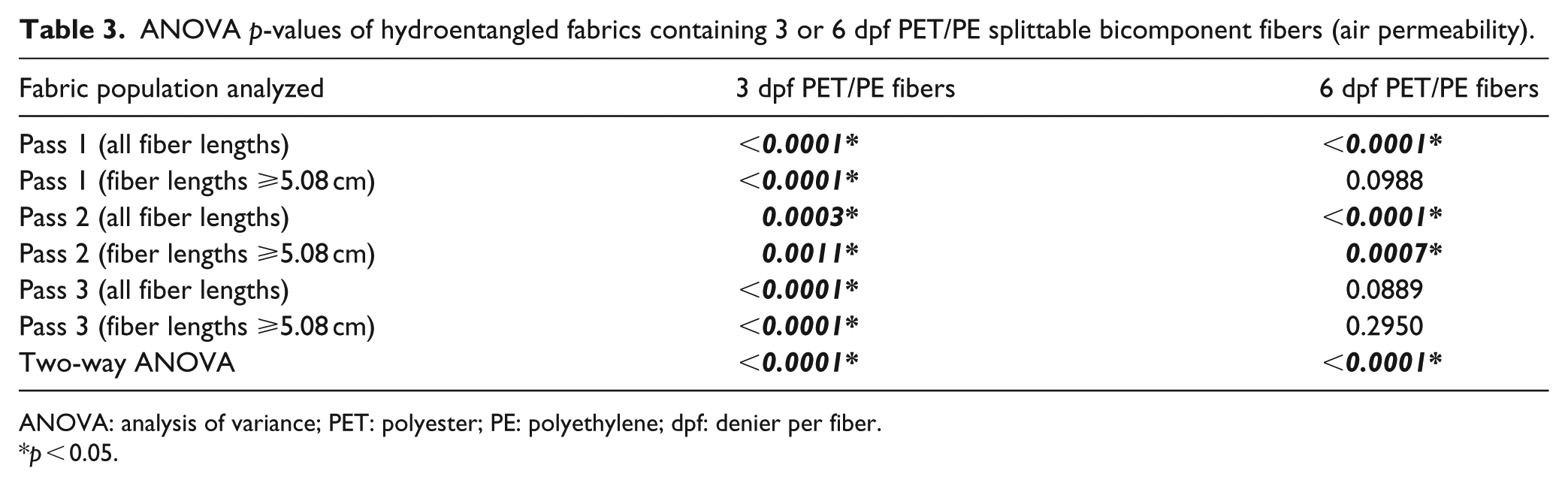
Table 3 displays the p-values associated with the air permeability of hydroentangled samples comprising 3 or 6 dpf PET/PE splittable bicomponent fibers. p-values calculated from 3 dpf PET/PE fabric data are significant in all situations. This indicates that fiber length significantly affects the fabrics’ air permeability values.
ANOVA p-values of hydroentangled fabrics containing 3 or 6 dpf PET/PE splittable bicomponent fibers (air permeability).
ANOVA: analysis of variance; PET: polyester; PE: polyethylene; dpf: denier per fiber.
p < 0.05.
The p-values associated with the air permeabilities of hydroentangled samples comprising 6 dpf PET/PE splittable bicomponent fibers are more complicated. The Pass 1 p-value which considered data from fabrics containing all fiber lengths is less than 0.05 suggesting that fiber length significantly affects the air permeability values. However, when only considering the Pass 1 fabrics which contain fibers ⩾5.08 cm in length, the p-value becomes much larger and insignificant. This means Pass 1 fabrics containing longer fibers possess statistically equivalent air permeability values despite changes in fiber length. The Pass 2 ANOVA p-values are significant when analyzing data from fabrics comprising all fiber lengths and when only considering data from fabrics containing fibers ⩾5.08 cm in length. Finally, the mean air permeability values of Pass 3 fabrics are statistically equivalent when analyzing data from fabrics containing all fiber lengths and when only considering data from fabrics containing fibers ⩾5.08 cm in length.
Both two-way ANOVA p-values are less than 0.05. This indicates that a significant interaction exists between fiber length and the number of passes through the hydroentangling unit when considering the fabrics’ air permeability values. In other words, there is statistical evidence that the effect of fiber length on air permeability is different depending on the number of hydroentangling passes.
Normalized burst strength
In Figures 10 and 11, the normalized burst strength values of hydroentangled fabrics are presented. Generally, burst strength did not change with fiber length, particularly in the range of 5–15 cm fiber length. These results are quite revealing and interesting. First, there is only a slight difference in strength between the number of passes. This indicates that entangling occurs rather quickly. If the structure was not entangled well, there would be little fiber to fiber friction and therefore the fibers would simply pull out of the structure and provide the fabric little strength. When the fiber to fiber frictional forces exceed the fiber strength, the structure will fail due to fiber breakage and the structure itself will burst rather than experiencing fiber pull out. Second, it displays that burst strength is not greatly affected by fiber length. As noted earlier, the structures were not consolidated significantly during the first hydroentangling pass. But even at Pass 1, there was sufficient entangling and fiber to fiber frictional forces to realize sufficient strength like those of Pass 2 and 3.
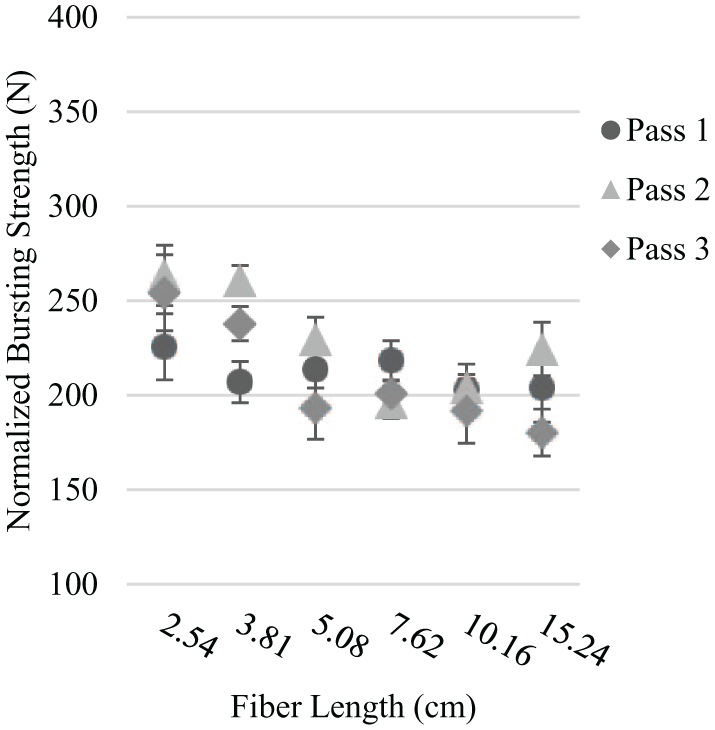
PET/PE 3 dpf bicomponent hydroentangled fabric normalized burst strength versus fiber length.

PET/PE 6 dpf bicomponent hydroentangled fabric normalized burst strength versus fiber length.
Fabrics comprising long fibers (⩾5.08 cm) seem to display particularly similar burst strength values despite changes in fiber length. This observation is supported by the ANOVA p-values shown in Table 4. In most situations, p-values associated with hydroentangled fabrics produced with 3 or 6 dpf PET/PE splittable bicomponent fibers become larger when only analyzing data from fabrics containing fibers lengths ⩾5.08 cm. This suggests that fabrics’ mean burst strength values are statistically more similar when produced with fibers ⩾5.08 cm long.
ANOVA p-values of hydroentangled fabrics containing 3 or 6 dpf PET/PE splittable bicomponent fibers (normalized burst strength).

ANOVA: analysis of variance; PET: polyester; PE: polyethylene; dpf: denier per fiber.
p < 0.05.
ANOVA p-values for Pass 1 fabrics produced with 3 or 6 dpf PET/PE splittable bicomponent fibers are greater than 0.05 indicating that no significant change is exhibited in normalized burst strength of the fabrics due to fiber length changes. Pass 2 fabric p-values are significant when all fiber lengths are considered indicating a significant difference in at least two mean values when fiber length is altered. However, when only considering fabric data from Pass 2 fabrics containing fibers ⩾5.08 cm, the values become larger (insignificant in the case of the 3 dpf fibers and borderline significant for the 6 dpf fibers). Pass 3 fabrics follow a similar trend. The Pass 3 p-values which analyzed data from fabrics comprising all fiber lengths are significant (borderline significant in the case of the 6 dpf fibers). However, when only considering data from fabrics comprising fibers ⩾5.08 cm, the values become insignificant indicating no relationship between burst strength and fiber length.
The two-way ANOVA p-value associated with the normalized burst strength values of hydroentangled samples comprising 3 dpf PET/PE splittable bicomponent fibers is insignificant. This indicates that no significant interaction occurs between fiber length and the number of passes through the hydroentangling unit when considering the fabrics’ normalized burst strengths. However, the two-way ANOVA p-value associated with hydroentangled fabrics comprising 6 dpf PET/PE splittable bicomponent fibers is less than 0.05. This indicates that a significant interaction occurs between fiber length and the number of passes through the hydroentangling unit when considering the fabrics’ normalized burst strengths.
Conclusion
Carded, hydroentangled fabrics were produced with 3 and 6 dpf PET/PE splittable bicomponent fibers. Samples were produced with six different fiber lengths (2.54, 3.81, 5.08, 7.62, 10.16, and 15.24 cm) to determine the impact of fiber length on the carding process and the structure–property relationships of carded, hydroentangled nonwovens. All fiber lengths were successfully carded, although some issues occurred with the two longest fiber lengths (10.16 and 15.24 cm) sticking to the carding line’s belts and wrapping around the card’s tambour roll. Despite these minor issues, consistent webs were produced for hydroentangling.
Structures of the samples were analyzed via SVF calculations. Results indicated that the SVFs of Pass 1 fabrics (fabrics passed once through the hydroentangling unit) and Pass 2 hydroentangled fabrics produced with PET/PE splittable bicomponent fibers were significantly affected by the fiber length utilized during production. This is supported by the small ANOVA p-values which suggested a significant change in SVF with fiber length. Generally, the SVF of the fabrics increased ~5% when fiber length increased from 2.54 to 15.24 cm. This is likely due to greater fiber entanglement with larger fiber lengths. However, SVFs of Pass 3 fabrics appeared to remain consistent despite changes in fiber length. This is supported by the ANOVA p-values which indicated no significant relationship between SVF and fiber length for Pass 3 fabrics.
In most situations, the air permeability of hydroentangled fabrics produced with splittable bicomponent fibers were significantly affected by fiber length. This is supported by most of the calculated ANOVA p-values, suggesting a significant change in air permeability with fiber length. However, hydroentangled fabrics containing 3 dpf PET/PE bicomponent fibers seemed more influenced by fiber length compared to those produced with 6 dpf PET/PE fibers. Generally, the samples’ air permeabilities decreased with increases in splittable bicomponent fiber length. This is likely due to the observed increases in SVFs. As fibers formed more entanglements and the fabric structure compacted, it was more difficult for air to move through the structure.
Generally, it appeared that the normalized burst strength of hydroentangled fabrics produced with 3 or 6 dpf PET/PE splittable bicomponent fibers were not affected by fiber length. This suggested that the hydroentangled fabrics containing bicomponent fibers achieved sufficient entanglement regardless of fiber length and that the fibers were not pulling out from the fabric structure prematurely. ANOVA p-values were primarily larger than or close to 0.05 suggesting that no relationship, or a weak relationship, exists between fiber length and the burst strength of hydroentangled fabrics produced with splittable bicomponent fibers.
In most situations, the two-way ANOVA p-values were found to be less than 0.05. This indicates that a significant interaction exists between fiber length and the number of passes through the hydroentangling unit when considering the fabrics’ SVF, air permeability, and normalized burst strength values. In other words, statistical evidence indicates that the effect of fiber length varies with the number of hydroentangling passes.
Footnotes
Declaration of conflicting interests
The author(s) declared no potential conflicts of interest with respect to the research, authorship, and/or publication of this article.
Funding
The author(s) disclosed receipt of the following financial support for the research, authorship and/or publication of this article: Funding for this research was provided by The Nonwovens Institute and all fibers were produced by FiberVisions. Their support is greatly appreciated.