



Abstract
Polypyrrole/cotton composites have substantial application potential in flexible heating devices due to their flexibility, high conductivity, and thermal stability. In this context, a series of flexible polypyrrole/cotton fabrics were intrinsically prepared using in situ polymerization process with the different Py/FeCl3 concentration ratios. To investigate their structural and morphological properties, thermal stability, tensile strength, conductivity, and heat-generating property, the composite fabrics were subjected to Fourier transform infrared spectroscopy, scanning electron microscopy, X-ray diffraction, thermo-gravimetric analysis, mechanical properties, and resistivity measurements. The results showed that polypyrrole/cotton fabrics exhibited a low resistivity of 0.37 Ω cm. Temperature–time curve showed that temperature of the polypyrrole/cotton fabrics increased very quickly from room temperature to a steady-state maximum temperature of 168.3°C within 3 min at applied voltage of 5 V. Tensile strength of polypyrrole/cotton composites reached to 58 MPa, which far surpassed raw cotton fabrics. Therefore, polypyrrole/cotton fabrics have exhibited high electrical, thermal properties, and mechanical strength, which can be utilized as an ideal flexible heating element.
Introduction
Recently, with the development of science and technology, the demand for conductive fabrics which are lightweight, flexible, and wearable materials has greatly increased.1–5 Conductive fabrics have a wide range of applications, such as flexible supercapacitors,6,7 strain sensors,8–10 electromagnetic shielding,11–14 and biomedical materials.15–17 In this article, conductive fabrics using PPy coated on cotton fabrics were synthesized.
Polypyrrole (PPy) has not been widely studied until Kim et al. 18 produced viscoelastic characteristics of PPy through an in situ polymerization. As inherently conductive polymer, PPy has gathered extensive attention due to its excellent properties such as high electrical conductivity,19–22 facile preparation, 23 and appreciable environmental stability. 24 Unfortunately, it is limited to the development in flexible devices due to poor processing and mechanical properties. Many researchers have turned their attention to polymerize PPy on the textile substrates. Among them, cotton fabrics are topically attractive due to their soft, breathable, moisture-absorbing characteristic. PPy coated on cotton fabrics will have a great development prospect in electrothermal materials because of the following properties: lightweight, wearable, processing performance, high electric conversion efficiency, and eco-friendliness.25,26 Liang et al. 4 fabricated a flexible electrode using PPy coated on cotton fabric, which exhibited a surface resistance per square is 14 Ω. Tsang et al. 27 reported that the strain-sensing with PPy-coated conductive fabrics had a lower initial resistance of 3.10 kΩ cm−2. However, PPy/cotton composites used as electrothermal materials are rarely reported.
Electrothermal materials with an appropriate electrical resistance can be used as electrothermal devices because they can convert electric energy into heat energy via Joule effect. 25 Recently, electrothermal materials have been widely used as heat sources in a variety of applications such as water heating, floor heating, thermoelectric devices, and heating textiles.28–30 Herein, we report the high-quality PPy/cotton composites using in situ polymerization process with excellent mechanical properties, good thermal behavior, and electrical conductivity. The effects of the reaction conditions on the properties of the resulting fabric were systematically studied.
Experiment
Materials
Plain woven 100% cotton fabrics (density: 133 × 72; yarn count: 40 × 40 tex) with the weight of 130 g m−2 was purchased from Baoding Ziguang Textile Co., Ltd. (China). Pyrrole (Py; Sinopharm Chemical Reagent Co., Ltd., China) was sealed in the dark storage containers; storage temperature was 0°C. FeCl3·6H2O (AR-grade, 99%) supplied by Tianjin Sailboat Chemical Reagent Technology Co., Ltd. (China) was used as oxidant. All solvents used in this work are distilled water.
Preparation of PPy/cotton fabrics
A set of PPy/cotton fabrics were fabricated using in situ polymerization method31–35 of pyrrole solution using iron chloride (III) as an oxidizing agent.36,37 First, untreated cotton fabrics (6 × 6 cm2 sample size) were dipped into a pyrrole aqueous solution of 0.5 M at room temperature for 1 h. Then, polymerization was carried at ice bath temperature for 2 h after slowly dropping an aqueous solution of iron (III) chloride hexahydrate (FeCl3·6H2O, 0.25 M). Finally, the obtained PPy/cotton fabrics were thoroughly rinsed with distilled water for several times and dried in an oven at 70°C to constant weight. In this article, the reaction concentration ratios of pyrrole/FeCl3·6H2O was 0.0625 M:0.25 M, 0.125 M:0.25 M, 0.25 M:0.25 M, 0.5 M:0.25 M, 0.75 M:0.25 M, and 1 M:0.25 M, respectively, which can be regarded as 1:4, 1:1, 1:2, 2:1, 3:1, and 4:1, respectively.
Characterization
The characteristic groups of the PPy/cotton fabrics were characterized by Fourier transform infrared spectroscopy (FTIR) in the wavenumber range from 4000 to 400 cm−1. The surface morphology of the samples were observed through a JSM-6510L scanning electronic microscope (SEM), and accelerating voltage was 5 kV. Color parameters L*, a*, and b* were measured with the SP60 Spectrophotometer using D65/10 illuminant evaluated by CIE L*a*b* system. L* values range from 100 (white) to 0 (black). The a* values present redness-greenness and b* values present yellowness-blueness. The X-ray diffraction (XRD) patterns of the composites were tested via Philips X-ray diffractometer using Cu-Kα radiation (λ = 1.5406 Å), and the angle was from 5° to 75° in steps of degrees. The tensile tests were obtained using a WEW-300D tester equipped with a 100 N load cell at a crosshead speed of 100 mm min−1. Rectangle strips with dimensions of 60 × 5 × 0.39 mm3 were used for the mechanical tests. The resistivity of sample specimens was measured by a VICTOR digital multimeter; the widths and lengths of sample strips were kept constant at 10 and 5 mm. The heat-generating properties of the PPy/cotton composites were studied by monitoring the temperature of the fabrics surface upon applying voltage of 1–16 V, which was characterized with an infrared (IR) thermal imager and a direct-current source meter. The length and width of measured spline was 3 cm × 1 cm.
Results and discussion
Electrical properties
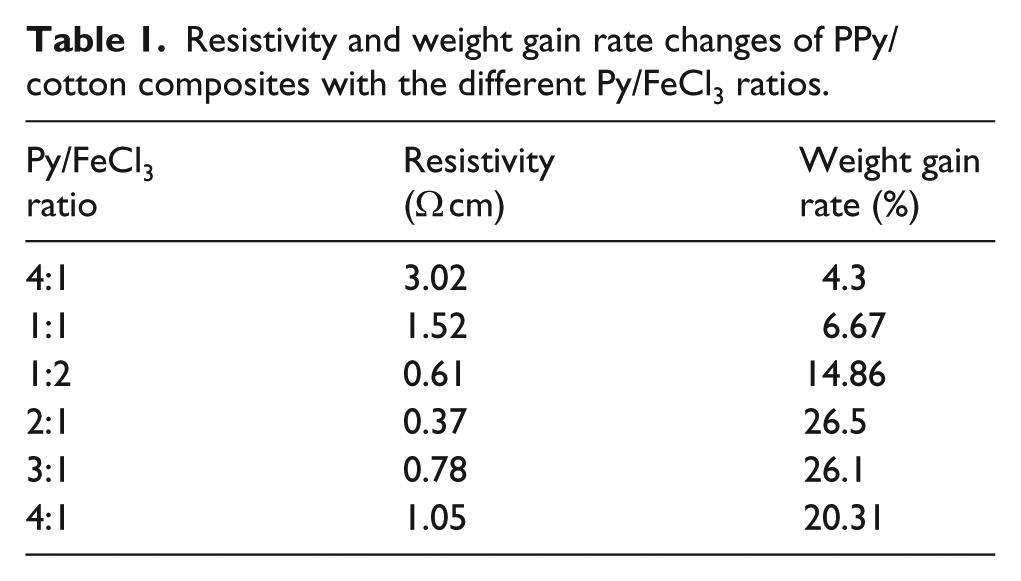
Table 1 shows resistivity and weight gain rate changes of PPy/cotton composites prepared in different Py/FeCl3 ratios. The resistivity decreased steeply with the increase in Py/FeCl3 ratio. When the Py/FeCl3 ratio is 2:1, the resistivity of PPy/cotton composites decreased to 0.37 Ω cm. After that, the resistivity of PPy/cotton composites did not change a lot due to the adhesion of PPy to the cotton fabrics and the increased amount of PPy produced. Simultaneously, the weight gain rate increased sharply as the Py/FeCl3 ratio increased from 4:1 to 2:1. The weight gain rate of composites increased to 26.5% when the Py/FeCl3 ratio reached to 2:1. The decrease in weight gain rate is mainly due to the amount of PPy reached to saturation. Based on the above characteristics of the PPy/cotton composites, the optimal Py/FeCl3 ratio of 2:1 was selected. Naturally, it may be concluded that the electrical resistivity of PPy/cotton composites could be controlled by optimizing the Py/FeCl3 ratio.
Resistivity and weight gain rate changes of PPy/cotton composites with the different Py/FeCl3 ratios.
Structure and morphology
Figure 1 shows the SEM images of the raw cotton and PPy/cotton composites with different Py/FeCl3 ratios. The surface of the raw cotton was smooth and naturally straight (Figure 1(a)). With the increase in Py/FeCl3 ratio, the amount of PPy on the cotton fabric increases. Meanwhile, the amount of PPy on the cotton fabric prepared with Py/FeCl3 ratio of 2:1 is visibly more than the other composites, in agreement with the weight gain rate as shown in Table 1. After that, the amount of PPy on the cotton fabric decreases because of the in situ polymerization reaction sharply and the weak adhesion between the PPy and the cotton fabric. The surface of the composites has become rough. A large amount of PPy (Figure 1(b)–(g)) coated on the surface of the cotton fabrics causes color changes in PPy/cotton composites (Figure 2). The color of surface raw cotton and PPy/cotton composites with different Py/FeCl3 ratios is shown in Figure 2. The color of the PPy/cotton composite sheets has undergone an obvious change according to the different Py/FeCl3 ratios. The color of the PPy/cotton composites became darker with the increase in Py/FeCl3 ratio. In order to identify the color difference between cotton fabrics and PPy/cotton composites, the color parameters of PPy/cotton composites with different Py/FeCl3 ratios using colorimeter are measured and presented in Table 2. The a*and b* values were almost 0, which indicates that the composite fabrics were achromatic. The L* values were found to decrease drastically for the PPy/cotton composites with the increase in Py/FeCl3 ratio. Meanwhile, L* values reached to 9.33 when Py/FeCl3 ratio was 2:1. The color measurement data can be clearly distinguished with the color shown in Figure 2. It coincided with the SEM image, so the optimal condition of Py/FeCl3 ratio is 2:1.

SEM images of the surface of (a) raw cotton and (b–g) PPy/cotton composites with the different Py/FeCl3 ratios.
Color parameters of PPy/cotton composites with the different Py/FeCl3 ratios.


The color of the surface of (a) raw cotton and (b–g) PPy/cotton composites with the different Py/FeCl3 ratios.
FTIR spectrum
The FTIR curves of raw cotton, pure PPy, and PPy/cotton fabrics are shown in Figure 3. The FTIR curves of pristine cotton have the following peaks: peak at 3431 cm−1 indicative of O-H stretching vibration and peak at 2922 cm−1 indicative of C-H stretching vibration. The absorption peak around 1719 cm−1 is the stretching vibration peak of the carbonyl group after partial oxidation of the alcohol OH to the carboxyl group. At the same time, the IR characteristic absorption peaks of raw cotton appeared at 1243 and 1096 cm−1. However, the red shifts are observed from 1719, 1243, and 1096 cm−1 to 1701, 1242, and 1094 cm−1 as shown in Figure 3(b). PPy spectrum shows characteristic peaks attributed to the =C-H wagging at 966, 872, and 792 cm−1 indicative of ring-stretching mode of pyrrole ring and peak at 3432 cm−1 indicative of N-H stretching vibration. However, at 2922–1719 cm−1, the peaks of the PPy/cotton composites increase compared with the cotton. This is due to the increasing water-bound in situ polymerization process. Herein, those group features observed from the graph confirmed the polymerization of PPy onto the cotton fabrics.
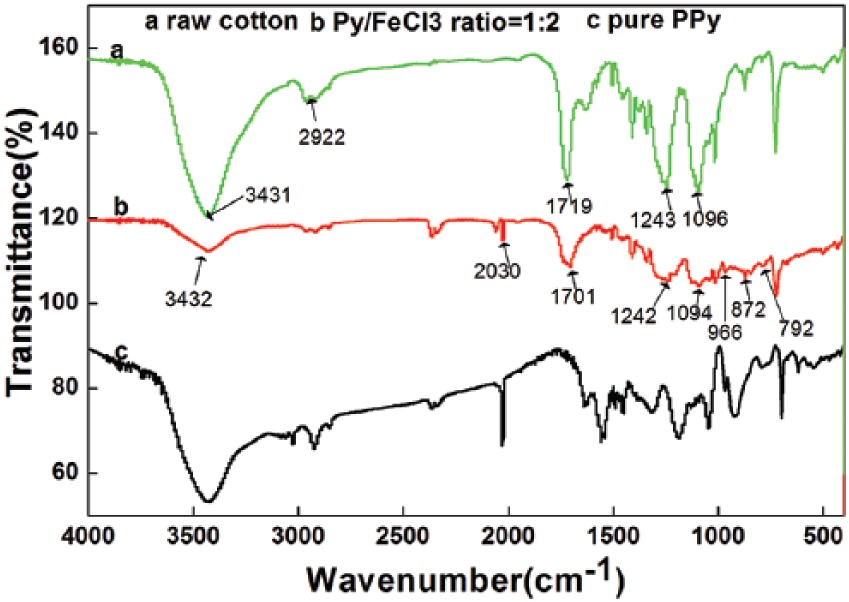
The FTIR curves of (a) raw cotton, (b) PPy/cotton composites with Py/FeCl3 of 2:1, and (c) pure PPy.
XRD analysis
The XRD patterns of raw cotton, pure PPy, and PPy/cotton composites are shown in Figure 4. The diffraction of pure PPy shows a typical broad reflection located in 26.5°, which is the characteristic peak of amorphous PPy. The diffraction of raw cotton shows typical peaks around 17°, 22°, and 25°. The diffraction peaks of PPy/cotton composites are similar to raw cotton, and no obvious diffraction peaks characteristic of PPy appear, due to the fact that the content of PPy in the composite is very small. The diffraction peaks’ intensity of PPy/cotton composites obviously shows a decrease compared with the peaks’ intensity of raw cotton, which owning to the PPy is evenly dispersed in the composite surface.

XRD patterns of raw cotton, pure PPy, and PPy/cotton composites (Py/FeCl3 ratio = 2:1).
Mechanical properties
Tensile properties of the raw cotton and PPy/cotton composites with the different Py/FeCl3 ratios are measured and characterized as shown in Figure 5. It can be seen that the PPy/cotton composites show the highest tensile strength among all composites when Py/FeCl3 ratio is 2:1. The tensile strength of the composites improves from 8.9 MPa in the raw cotton to about 58 MPa with Py/FeCl3 ratio of 2:1. Tensile strength of the composites is not significantly affected by Py/FeCl3 ratio. Compared with the raw cotton, the tensile strength is enhanced when PPy is coated onto the surface of the cotton fabrics. This result is comparable with that of treatment with polycarboxylic acid–reinforced cotton fabrics reported by Sricharussin et al. 38 Meanwhile, the tensile strain of the composites improves from 59% in the raw cotton to about 89% with Py/FeCl3 ratio of 2:1. It can be proved that the attachment of PPy on the cotton fabric has improved mechanical properties.

Tensile properties of raw cotton (warp) and PPy/cotton composites with different Py/FeCl3 ratios.
Electric heating behavior
The deformation ability of PPy/cotton composites are exhibited with a representative digital image, as shown in Figure 6(a) and (b). It clearly shows that we have successfully fabricated bending and spiral shapes of PPy/cotton composites. IR thermal images of PPy coated on cotton substrates before and after applying certain voltage are shown in Figure 6(c)–(f). Figure 6(c) shows that the maximum heating temperature (Tmax) of the composites under optimal condition can be reached to 168.3°C at applied voltage of 5 V. The color of composites’ IR image is divided into three layers: from inside to outside are yellow, red, and blue. At the same time, IR images of the composites exhibited uniform temperature distribution when the maximum temperature of heart-shaped composites displayed 55.6°C, which confirmed that the PPy was well-distributed on cotton fabrics.

Digital image of PPy coated on cotton substrates in (a) bent, (b) spiral, (c) line, and (e) heart-shaped composites. (d and f) Infrared thermal images of PPy coated on cotton substrates after applying certain voltages.
Electric heating behavior of PPy/cotton composites by monitoring temperature changes over time with different Py/FeCl3 ratios under different applied voltages of 1–16 V is shown in Figure 7(a)–(f). The temperature–time curves show that the temperature rises sharply in a few seconds when a certain voltage is applied, and after reaching a peak, the temperature remains almost constant throughout the heating. When the voltage is not applied, the temperature drops sharply. The higher the temperature rises, the slower it drops to room temperature. As mentioned above, temperature–time curve can exhibit three time periods: heating period (0–50 s), stable period (50–600 s), and cooling down period (600–750 s), as presented in Figure 7. The Tmax increased to 27°C–47°C in the applied voltages of 8–16 V, as presented in Figure 7(a); this type of composites can be used for heating textiles. In contrast, the Tmax increased extremely by applying different voltages, as shown in Figure 7(b)–(f); this type of the composites can be used for floor heating and thermoelectric devices. However, the Tmax will be different when applying certain voltage for different Py/FeCl3 ratios. The Tmax obtained at a given applied voltage of 10 V is higher for the composite with the Py/FeCl3 ratio of 2:1. It is observed that the capability of electric heating of PPy/cotton composites is strongly dependent on the high conductivity with certain input voltage. In view of all the above heating properties, PPy/cotton fabrics used as electrothermal materials may have a very broad application prospect.
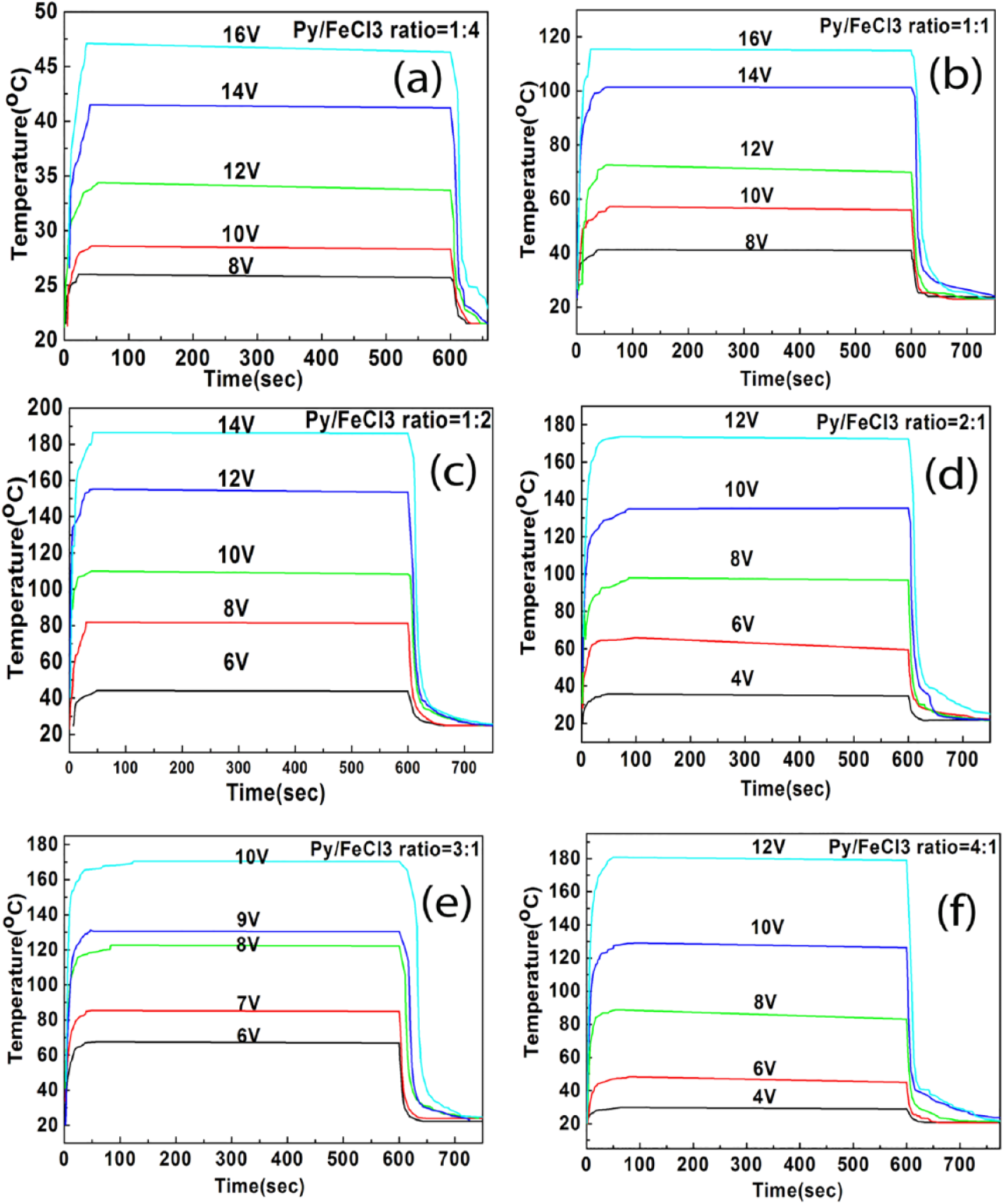
Temperature–time curve changes of PPy/cotton composites with different Py/FeCl3 ratios (a) 1:4, (b)1:1, (c)1:2, (d) 2:1, (e) 3:1 and (f) 4:1 at different applied voltages of 1–16 V.
Conclusion
In this research, PPy/cotton composites were successfully synthesized via in situ polymerization. The effects of the ratio of Py/FeCl3 on the electrical conductivity, mechanical properties, and electrothermal performance were investigated. The results showed that the resistivity of the composite decreased significantly with the increase in Py/FeCl3 ratio; it had much lower resistivity at 0.37 Ω cm with Py/FeCl3 ratio of 2:1. Furthermore, IR and SEM studies were employed to examine the existence of PPy on cotton substrates. The tensile strength of cotton fabrics coated with PPy was higher than raw cotton fabrics; it reached to 58 MPa, which far surpassed the raw cotton fabric (8.9 MPa). PPy/cotton composites had good deformability of bending and spiraling, after stretching is measured. Last but not least, PPy/cotton composites with excellent electrothermal performance were explained by temperature–time curve, which showed that temperature increased very quickly from room temperature to a steady-state maximum temperature of 168.3°C within 3 min at 5 V. In view of the above good performance, PPy/cotton composites would have tremendous potential as an electrothermal material.
Footnotes
Declaration of conflicting interests
The author(s) declared no potential conflicts of interest with respect to the research, authorship, and/or publication of this article.
Funding
The author(s) disclosed receipt of the following financial support for the research, authorship, and/or publication of this article: This work is supported by key research Program of Higher Education of Henan Province (17A540004).