



Abstract
International students are less likely than their domestic peers to participate in campus recreation, despite the well-documented benefits for well-being and integration. While previous research has explored constraints to participation, few studies have examined the gap between intention and behavior, specifically, why students who register for programs do not attend. This qualitative study investigated that question through semi-structured interviews with eight international students at a Canadian university who registered for, but did not attend, a recreation program. While students expressed strong initial motivations, various post-registration factors disrupted follow-through. Using thematic analysis, the study identified three key themes that explain the intention-behavior gap: structural constraints, motivational decline and competing priorities, and interpersonal constraints. These findings offer new insight into how participation can be supported beyond recruitment. Practical recommendations are offered to help campus recreation professionals reduce drop-off and foster more inclusive, accessible programs.
International students face a unique set of challenges when transitioning to university life, including adapting to academic expectations, cultural norms, and language barriers (Gebhard, 2010; Gomez et al., 2014). Campus recreation has been identified as a valuable mechanism to support this transition, facilitating social integration, stress relief, and improved well-being (Gomez et al., 2014; Guo & Ross, 2014). Despite these benefits, research consistently shows that international students participate less frequently in campus recreation compared to their domestic peers (Cho & Price, 2018; Shifman et al., 2012). This disparity persists even as the population of international students grows. In Canada, for instance, international students made up 19% of all new university enrollees in 2020/2021, amounting to approximately 85,000 students (Statistics Canada, 2022). Given their increasing presence and importance within postsecondary institutions, understanding the factors that affect international students’ participation in campus recreation is both timely and necessary.
Previous studies have examined the motivations and constraints influencing campus recreation participation among international students (e.g., Cho & Price, 2018; Hoang et al., 2016; Li & Stodolska, 2006; Selvaratnam et al., 2021; Shifman et al., 2012). While these studies provide valuable insight into participation trends, they often focus on intention formation or participation patterns without examining instances where intention does not translate into action. This phenomenon, known as the intention-behavior gap, represents a critical yet underexplored area in the context of campus recreation. The purpose of this study is to explore the factors that contribute to non-attendance among international students who register for campus recreation programs but do not participate, using the intention-behavior gap and leisure constraints theory as guiding frameworks.
Literature Review
International Students and Campus Recreation
International students, defined as individuals who move to another country for postsecondary education (Biggs, 2003), must navigate new sociocultural environments while adjusting to academic life. These students face distinctive challenges, including language acquisition, cultural adaptation, social isolation, and logistical hurdles such as housing and transportation (Ecochard et al., 2017). These challenges can be exacerbated by unfamiliar institutional structures, a lack of social networks, and systemic barriers that affect both academic and extracurricular engagement (Glass et al., 2014; Leong, 2015).
International students are currently viewed as important to the increasingly globalized post-secondary system and often provide institutions with greater per student revenue than domestic students (Bound et al., 2021). Their growing economic importance to postsecondary institutions has led universities to place greater emphasis on supporting their engagement and retention (Bound et al., 2021). Campus recreation has emerged as one such avenue, often highlighted for its potential to promote health, stress reduction, and a sense of community among international students (Forrester, 2015; Gomez et al., 2014). Participation in recreational programs can enhance physical and mental well-being, improve time management, and provide opportunities for informal social interaction and cultural exchange (Guo & Ross, 2014; Wilson & Millar, 2021).
Research also suggests that participation in leisure activities can foster a sense of belonging and institutional attachment, which is linked to greater student persistence and academic success (Astin, 1993; Tinto, 1997). However, international students may experience recreational spaces differently than domestic students, with motivations that are less oriented around socializing and more focused on personal growth, self-improvement, and safety (Hashim, 2012; Li & Stodolska, 2006). This distinction is important when considering program design and outreach strategies aimed at improving inclusivity and accessibility.
Constraints to Campus Recreation Participation
Research has identified that international students participate less frequently in intramurals and competitive sport than domestic students, and when participation does occur, they find the experience to be less enjoyable (Cho & Price, 2016, 2018). International students often encounter greater constraints to campus recreation participation than their domestic peers (Cho & Price, 2018; Hashim, 2012). These constraints are commonly examined through the lens of leisure constraints theory, which conceptualizes barriers as hierarchical: intrapersonal, interpersonal, and structural (Crawford et al., 1991). The theory posits that constraints are negotiated in sequence, beginning with individual-level factors and progressing toward broader external challenges (Jackson et al., 1993).
Intrapersonal constraints include psychological and cognitive factors that influence personal motivation, such as lack of skill, low confidence, cultural unfamiliarity, or anxiety around performance and social judgment (Park et al., 2015; Sevic & Eskiler, 2020). For international students, these may be tied to unfamiliar norms around physical activity or a perceived lack of “fit” in campus recreation environments (Hoang et al., 2016; Tsai & Coleman, 1999).
Interpersonal constraints, such as a lack of recreational partners or feelings of discomfort in group settings, may further inhibit participation. While these are less frequently cited, they are still relevant, particularly in programs that involve physical contact or gendered group dynamics (Guo & Ross, 2014; Lee et al., 2020). For some international students, cultural norms around modesty, gender segregation, or socializing outside of academic contexts may reduce willingness to participate (Nakamura, 2002).
Structural constraints remain the most consistently reported barrier. These include lack of time, unfamiliar schedules, insufficient facilities, program cost, and poor access to information (Cho & Price, 2018; Guo & Ross, 2014; Hashim, 2012; Hoang et al., 2016; Park et al., 2015; Sevic & Eskiler, 2020; Shifman et al., 2012). Several studies note that international students often arrive on campus unfamiliar with North American terminology such as “intramural” or “drop-in,” and may find registration systems and program descriptions inaccessible or unclear (Hoang et al., 2016; Lee et al., 2020). These issues are compounded by a lack of targeted marketing or culturally inclusive messaging from recreation departments.
While these findings offer a robust understanding of the obstacles international students face, they primarily focus on the formation of intent. Few studies explore what happens after students express interest or register for a program but do not attend. This signals a need to consider a complementary framework: the intention-behavior gap.
Intention-Behavior Gap
Intentions represent an individual's self-endorsed plan to engage in a specific behavior (Sheeran, 2002; Sheeran & Webb, 2016). While often used as a proxy for behavior in studies of health and leisure, the translation of intention into action is far from guaranteed. Meta-analyses suggest that intentions explain only 18% to 50% of variance in behavior highlighting the limits of intention as a predictor (Armitage & Conner, 2001; Hagger et al., 2002; McEachan et al., 2016). This discrepancy, known as the intention-behavior gap, has been widely documented in domains such as exercise, diet, public health, and sustainability behavior (e.g., Armitage & Conner, 2001; McEachan et al., 2016; Sheeran, 2002), but remains relatively underexplored in the context of campus recreation.
In understanding why intentions fail to materialize, researchers have identified two primary domains, including the nature of goals and self-regulation (Sheeran & Webb, 2016). Goals that are framed in promotion-oriented (gain-seeking), autonomous (self-directed), and mastery-driven (learning-focused) terms are more likely to lead to action than those based on avoidance, control, or performance comparison (Elliot & Church, 1997; Higgins, 1997; Ryan & Deci, 2000). Moreover, specific and realistic goals tend to outperform vague or overly optimistic ones (Locke & Latham, 2013; Myrseth et al., 2009).
The degree to which a goal is prioritized and free from conflict with other obligations also matters. When individuals face competing demands, such as academic pressures, the likelihood of following through on lower-priority intentions diminishes (Conner & Norman, 2022; Rhodes et al., 2019). These dynamics are particularly relevant in campus contexts where multiple goals constantly vie for attention.
Self-regulation refers to the cognitive and behavioral processes that help individuals initiate, sustain, and complete their goals. Failures at any of these stages can result in behavior that does not align with intention (Gollwitzer & Sheeran, 2006). Students may forget to act, miss opportunities due to poor planning, or fail to prepare adequately. Even after initiating goal pursuit, intentions can falter due to competing goals, distractions, low willpower, or lack of progress monitoring (Sheeran & Webb, 2016; Webb et al., 2013). Notably, reminders, social accountability, and progress tracking have been shown to mitigate these pitfalls (Harkin et al., 2016).
Bridging the Gap in Campus Recreation
Although the intention-behavior gap has not been widely applied to campus recreation, it offers a compelling lens to examine students who register but fail to attend. While leisure constraints theory identifies barriers to initial participation, intention-behavior theory develops understandings related to the post-intent drop-off. Integrating these perspectives helps illuminate the full arc of student engagement, from awareness to registration to attendance. Thus, it highlights the need to support students not only in forming intentions but in acting on them; through better planning tools, supportive environments, and follow-up communications that reduce friction between registration and participation.
International students may face unique self-regulatory challenges due to academic pressure, cultural adjustment, and limited social capital (Ecochard et al., 2017). The absence of reinforcement, reminders, or supportive design may cause even highly motivated individuals to disengage. As such, examining the intention-behavior gap in campus recreation settings is a timely step toward improving student participation in these programs. To advance this goal, the present study investigates the following research question: What factors explain the intention-behavior gap among international students who register for, but do not attend, campus recreation programs?
Method
Study Context and Participants
This study was conducted at a large university in Ontario, Canada. The focus was on international students who registered for, but did not attend, two campus recreation programs: the Learn to Swim program and the Women's Wen-Do Self-Defense course. For the Learn to Swim program, 24 international students who registered but did not attend were identified through campus recreation records. These programs were selected as the research was conducted in partnership with campus recreation, and these were two programs that they wanted to understand further. All 24 were contacted via email and invited to participate in the study. Of these, three students responded and agreed to participate. The study was approved by the authors’ Research Ethics Board.
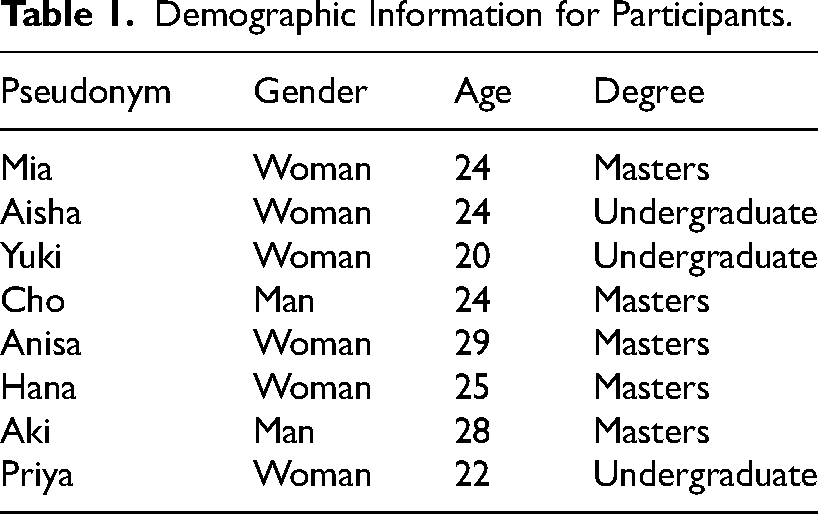
For the Women's Self-Defense program, 38 registrants were invited to participate through email. According to data from the campus recreation department, 28 students opened the email and five clicked the embedded participation link. A reminder email was sent 10 days later. Ultimately, five students who had registered but did not attend this program participated in the study. The final sample consisted of eight international students and the participants received a small token of appreciation for their time. Demographic information for the participants can be found in Table 1. Pseudonyms were used for participants to assist in protecting confidentiality.
Demographic Information for Participants.
Data Collection
Semi-structured interviews were conducted by one author. All interviews took place via Zoom at times convenient for them. Interviews lasted between 30 and 60 minutes (the average interview lasted 45 minutes) and were audio-recorded with consent. Recordings were transcribed verbatim for analysis. The interview guide focused on participants’ motivations, expectations, and reasons for non-attendance. The interview guide was developed based on literature related to the intention-behavior gap and constraints theory. Sample questions included: “What were your goals when signing up for the program?” “Can you describe what impacted your decision to not attend the program?” and “Were there any specific barriers or circumstances that prevented your participation?” This flexible approach allowed for the emergence of unanticipated themes while ensuring coverage of key areas related to the intention-behavior gap.
Data Analysis
Data were analyzed using thematic analysis (Braun & Clarke, 2006, 2013). In doing so, the researchers were able to identify common themes and patterns in the data. First, transcripts were examined and re-examined by the researchers to become familiar with the data and develop a comprehensive understanding of the interviews. Following this step initial coding took place where the researchers assigned codes to specific components of the data. As identified by Clarke and Braun (2017), “codes are the smallest units of analysis that capture interesting features of the data (potentially) relevant to the research question” (p. 297). These codes, which serve as the building blocks for themes, were then grouped together based on shared meanings. The themes were then reviewed and refined where necessary by the researchers to ensure they accurately represented the data. Next, the researchers defined and named the themes prior to writing the findings.
Findings
This study explored why international students registered for but did not attend campus recreation programs at a Canadian university. Interviews with eight participants revealed that while initial intentions were strong, a combination of structural, motivational, and intrapersonal factors contributed to non-attendance. Three key themes emerged to explain the intention-behavior gap in this context, which highlight the complexity of the intention-behavior gap and point to both program-level and individual-level interventions to improve participation.
Initial Motivation and Intent
Despite eventual non-attendance, participants consistently expressed genuine and well-considered reasons for registering for campus recreation programs (n = 8). Intentions were not passive or spontaneous; rather, they were based on perceived personal benefit, convenience, and, in some cases, deeper emotional or safety-related motivations.
Many students were drawn to programs because of their relevance, accessibility, or alignment with personal goals. Mia explained: “It seemed like something I should know, like a basic life skill. Plus, it was free and on campus, so it felt doable.” Aisha similarly shared: “I’ve always wanted to try something like this. It sounded empowering and useful.” Both participants emphasized that cost, location, and utility made the decision to register feel obvious.
For others, registration was linked to longstanding or meaningful goals. Yuki described wanting to overcome a childhood fear: “My parents took me to swim lessons when I was really young, and I screamed the whole time… I wanted to finally get past that.” Cho who had prior swimming experience, hoped to reconnect with a valued activity: “It felt like a way to get back into something I used to enjoy.”
Some participants were motivated by broader concerns for personal safety or empowerment. Priya shared that a friend's experience with street harassment prompted her to sign up: “I felt like I needed to know how to protect myself, just in case.” Similarly, Mia noted: “It's important for women to know this stuff. I thought it could be useful if I’m ever in a bad situation.” In both cases, recreation was seen not just as leisure, but as a form of self-preservation and preparedness.
Even where participants lacked a concrete goal, they viewed registration as a chance for personal development. Aisha, who had previous martial arts experience, described her interest in the self-defense course: “It invites women to become a little bit stronger or more empowered. Maybe build a stronger character.” Aki explained that he saw the swim class as a way to learn something he never had the chance to before: “Back home it was too expensive… here it was free, and I thought I could finally learn.”
Although mentioned less frequently, environmental and psychological comfort were also motivating factors, especially in programs like Wen-Do Women's Self-Defense. Anisa recalled: “It was an all-women workshop, so I felt like I wouldn’t be judged. That made it easier to register.” Hana added: “It sounded like a safe space, especially as someone who's never done anything like this before.”
These reflections demonstrate that international students approached registration with clear intentions, meaningful goals, and openness to new experiences. Intentions were shaped by both practical considerations (e.g., timing, cost, location) and more personal aspirations (e.g., overcoming fear, developing strength, gaining safety skills). This challenges the notion that non-attendance stems from weak or impulsive interest and reinforces the need to examine what intervenes between intention and action. The next three subsections describe themes that explain the intention-behavior gap for study participants. “I Signed up … and Then Kind of Forgot”
Structural barriers that emerged after registration, including timing conflicts, a lack of reminders, vague follow-up communication, and physical accessibility, were the most commonly cited explanations for non-attendance (n = 6). These barriers did not prevent registration but became decisive obstacles during the window between sign-up and participation.
Several participants discovered scheduling conflicts only after they had registered. Aisha reflected, I thought I would be able to make it, but then I realized I had a lecture at the same time. I just forgot to double-check … I wasn’t really familiar with my schedule yet. I thought I’d be able to make it, but once midterms started, it got hard.
Another common issue was the lack of follow-up communication from the recreation department. Mia described: “I signed up and then kind of forgot. No one sent a reminder or anything, so it slipped my mind.” Aki echoed this sentiment: “If there had been a follow-up email or text, I probably would have remembered to go. But after registration, it just went quiet.” Hana similarly explained, “There was no notification or anything. If something popped up on my phone, I probably would have gone.”
For some, logistical challenges like timing and location further compounded the problem. Cho noted, It was across campus, and I had a class just before… I couldn’t make it on time and didn’t want to show up late…the class was in the middle of the day, and I wasn’t sure I could make it work between lectures.
These examples reveal how even minor logistical obstacles can disrupt participation, especially when communication from organizers is minimal. Registration often reflected a real interest in attending, but the absence of nudges, reminders, or flexible scheduling made it easy for students to lose track or re-prioritize. In this way, small breakdowns in structure had a disproportionate effect on whether intentions translated into action. “It Just Didn’t Feel Like the Right Time Anymore”
A decline in motivation due to competing academic and personal demands emerged as a common theme among participants (n = 5). Although students initially intended to participate, they often deprioritized recreation as other obligations became more pressing. As Hana explained, “I was just really overwhelmed that week. Assignments piled up, and I didn’t have the mental energy to go.” Similarly, Aki said, “I wanted to go, but it just didn’t feel like the right time anymore. I was tired and had other things to do.”
This sense of emotional depletion was echoed by Anisa, who recalled: “I had signed up when I was feeling really excited… but when it came close, I was like, maybe not this week. I didn’t have the energy to go alone.” For Aisha, this motivational drop was linked to shifting academic priorities: It was once a week, so I thought I could make it, but then I had assignments and midterms. I kind of decided I should focus on those instead…It felt like I needed to be more ‘in the mood’ to go, and I just wasn’t.
Yuki also reflected on how the initial excitement faded with time: “I was excited when I registered, but then school started and I just… lost steam. It didn’t feel as urgent anymore.” Priya noted that recreation felt less essential when compared to safety and performance in academics: “I had midterms coming up, and it felt selfish to go do something for fun.”
These accounts illustrate how recreation can be quickly deprioritized in high-pressure academic environments, even when intentions were initially strong. While registration often occurred during periods of relative calm or optimism (e.g., at the start of term), the follow-through on participation clashed with evolving personal bandwidth. Emotional fatigue, academic stress, and shifting mental priorities undermined otherwise sincere intentions. “I Got Nervous”
Intrapersonal barriers such as self-doubt, anxiety, and fear of embarrassment played a central role in explaining non-attendance for several participants (n = 5). Even when programs were structurally accessible and intentions were strong, these internal constraints led students to second-guess their decision to follow through.
Yuki, who registered for the Learn to Swim program, described a longstanding desire to learn but became overwhelmed by fear as the date approached: “I’ve always wanted to learn, but I got nervous thinking about being in the water with people watching.” Cho expressed a similar hesitation: “I used to swim back home, but I felt out of practice and didn’t know if I’d be able to keep up.”
Other participants pointed to a lack of confidence stemming from uncertainty about the class structure or their own preparedness. Aisha said: “They didn’t say much about what the class would look like. I was scared I’d show up and be completely out of place.” Hana also described a fear of judgment: “Even though it was beginner level, I kept thinking, ‘What if I’m the worst one there?’ That stopped me from going.”
Anisa echoed these concerns in the context of social comparison and vulnerability: “I didn’t want to be the only one who didn’t know what to do. It made me feel exposed just thinking about it.” Similarly, Hana noted that not knowing what to expect made her uneasy: “I kept wondering what if I’m the only one who's never done it before? What if it's obvious?”
These narratives suggest that for many international students, the intention-behavior gap is not simply a matter of time or energy, it is deeply tied to perceived social risk, unfamiliarity, and internalized doubt. The safe and inclusive framing of programs, such as beginner-friendly descriptions or all-women spaces, sometimes helped participants register but was not always sufficient to overcome these internal barriers when it came time to attend.
Discussion
This study explored why international students registered for, but ultimately did not attend, campus recreation programs. While previous research has identified constraints to participation (e.g., Cho & Price, 2018; Hashim, 2012; Selvaratnam et al., 2021; Shifman et al., 2012), little is known about what happens after a student expresses interest and registers. By focusing on this underexamined stage, that is, the gap between intention and action, the findings help explain why strong intentions sometimes fail to translate into behavior. Participants described meaningful reasons for signing up, yet they still encountered various challenges that prevented follow-through. These challenges included structural constraints, motivational decline, and intrapersonal concerns.
Reconsidering Constraints Theory
The findings reaffirm that structural constraints continue to shape international students’ experiences with campus recreation (Guo & Ross, 2014; Hashim, 2012; Hoang et al., 2016; Lee et al., 2020; Park et al., 2015; Sevic & Eskiler, 2020; Shifman et al., 2012). Many participants pointed to issues that only became clear after they had registered, such as unclear timing, forgotten commitments, or confusion about where to go. While these constraints may seem minor on their own, they often stacked up in ways that made participation feel difficult or uncertain. This complicates the traditional hierarchical model of leisure constraints (Crawford et al., 1991), which assumes that structural constraints mostly prevent initial intent. In the current study, these constraints came into play after the decision to participate was already made. This supports calls for a more flexible understanding of how constraints operate over time (Schneider & Wilhelm Stanis, 2007), especially in transitional periods like the start of a semester or academic year.
Understanding Why Intentions Fall Apart
Participants in this study often had strong, thoughtful reasons for signing up. They wanted to feel safer, learn new skills, or engage with campus life. Yet despite these motivations, follow-through did not always happen. Several students described being overwhelmed by schoolwork or simply feeling too tired to attend. These experiences reflect broader research on the intention-behavior gap, which shows that goals often get derailed by shifting priorities, lack of structure, or emotional fatigue (Sheeran & Webb, 2016). It was not that students did not care, they just could not always follow through when the time came for participation. Some students had hoped that signing up would be enough to carry them through. When it was not, there was little to help them bridge that gap.
The participants also identified subtle signs of prevention-focused motivation (Higgins, 1997), particularly among students who worried about failure, embarrassment, or being out of place. In these cases, the desire to avoid a negative outcome may have outweighed the hope of gaining something new. This was especially true in skill-based programs like swimming, where unfamiliarity and visibility can raise self-consciousness.
Practical Implications
While much of the focus is on what went wrong, it is also worth noting what drew students in. Many spoke positively about the initial design of the programs, especially the beginner-friendly tone and the safe, gender-specific space of the Wen-Do self-defense course. These aspects helped reduce some of the typical constraints that international students face, and they played a clear role in motivating registration. Despite this, however, a welcoming design was not always enough.
Based on the experiences of the students, what appears to be missing is consistent support after registration such as reminders, encouragement, and clear communication that help students stay on track. This is consistent with research that has identified that intentions can falter due to competing goals, distractions, low willpower, or lack of progress monitoring (Sheeran & Webb, 2016; Webb et al., 2013). Importantly, the use of reminders, encouragement and clear supportive communication has been found to assist in aligning intentions with behaviors and mitigating these difficulties in previous research (e.g., Harkin et al., 2016) and could serve as a fruitful avenue to increase engagement. Campus recreation departments may need to think not just about recruitment, but about how to guide students from interest to action in order to increase engagement in programming.
Some targeted strategies could help convert students’ initial intentions into actual attendance. One approach is to send reminder messages that are not just functional, but motivational and personalized. Rather than simply confirming times and locations, these messages could include words of encouragement, affirming the student's decision to register and reinforcing the value of follow-through (e.g., “You’ve taken a great step, can’t wait to see you tomorrow!”). These messages could be delivered through the same platform used for registration, or through opt-in text or email reminders. Several participants described simply forgetting they had registered or losing momentum as their week progressed, suggesting that brief, encouraging follow-ups at the right time, ideally 24 to 48 hours before the session, could reignite intention.
Another strategy involves sharing short preview videos or photos of the class setting, equipment, and expected activities. These previews could be embedded in confirmation emails or linked in follow-up messages. Many students expressed nervousness about not knowing what would happen during the class, or whether they would feel out of place. A short, informal video walkthrough of the space or a message from the instructor outlining what to expect could help reduce those fears and foster psychological comfort. If showing real participants is not feasible due to privacy, animated or instructor-narrated visuals could still provide clarity.
In addition, creating small-group communication channels or optional buddy systems could be valuable for students who are reluctant to attend alone. This might involve grouping participants by program or time slot and inviting them into a shared chat space (e.g., WhatsApp, Discord, or Microsoft Teams), facilitated lightly by a peer leader or student staff member. Some participants mentioned they would have felt more confident if they had someone to walk in with or talk to beforehand. These low-commitment social bridges can increase accountability and reduce the anxiety of navigating an unfamiliar environment solo.
Finally, scheduling programs in ways that align with the academic calendar may also improve participation. Participants frequently described feeling overwhelmed by coursework or skipping sessions due to deadlines. Program coordinators might consider avoiding the first two weeks of term (when students are still settling in) and steering clear of midterm and exam-heavy periods. Additionally, scheduling shorter program blocks (e.g., 3–4 weeks rather than 6–8) or offering single-session options could appeal to students who are hesitant to commit over a longer term. When participation is framed as manageable and responsive to student workloads, the likelihood of follow-through may increase.
Beyond implementing supportive strategies, campus recreation departments could benefit from collecting their own data to better understand where and why the intention-behavior gap occurs within their specific context. Simple follow-up surveys or opt-in feedback forms sent to registrants who do not attend could help with this process. Additionally, analyzing trends in registration versus attendance over time by program type, time of semester, or student demographics could provide valuable insight into which offerings are most susceptible to no-shows. This kind of internal assessment would not only help tailor interventions to the realities of a given campus but also demonstrate a commitment to student engagement beyond initial recruitment. Managing the issue of non-attendance requires not just front-loaded promotion, but also ongoing responsiveness to the evolving needs, constraints, and circumstances of students as they navigate university life.
Reflections on Generalizability
Although this study focused specifically on international students, the findings raise important questions about how their experiences compare to those of domestic students. Some constrains (e.g., academic overload, weak follow-up communication, shifting motivation) are likely shared across both groups. However, other patterns observed here may reflect distinct aspects of the international student experience. Many participants described unfamiliarity with Canadian recreation norms, heightened fear of being judged or standing out, and a strong desire to feel safe or included. These concerns often intersected with broader challenges of cultural adjustment, campus belonging, and navigating new environments. While the intention-behavior gap is not unique to international students, the emotional and contextual stakes of participation may differ in meaningful ways. Future research would benefit from comparing these dynamics across student populations to better understand which aspects of the gap are shared and which are shaped by cultural and social context.
Limitations and Future Research
This study was based on a small sample of eight students from one university, and while the goal was exploration and depth rather than generalization, broader patterns may exist. It is also possible that students who chose to participate in interviews were more reflective or engaged than others. Future research might take a larger-scale approach, perhaps using questionnaires to explore how widespread these patterns are. It would also be valuable to explore differences by program type, cultural background, or gender identity. For example, motivations and barriers may differ between physically active programs and more skill-based or educational ones.
Conclusion
For international students, registering for campus recreation is often a hopeful act, one rooted in a desire to grow, connect, and feel safe. But hope alone is not always enough. This study identifies that between registration and attendance lies a vulnerable space where things can go off track. If campus recreation professionals can learn to support students during that gap, by reinforcing commitment, reducing friction, and providing reassurance, they may not only boost participation rates, but also help more students feel that they truly belong on campus.
Footnotes
Declaration of Conflicting Interests
The authors declared no potential conflicts of interest with respect to the research, authorship, and/or publication of this article.
Funding
The authors received no financial support for the research, authorship, and/or publication of this article.
