



Abstract
Student employment in campus recreation allows students to gain transferable skills. Previous studies show that students employed in specialized program areas have different experiences. Addressing the gap in research, the purpose of the study was to (a) understand the relationship between leadership development, effective communication, and meaningful interpersonal relationships of student group fitness instructors and (b) investigate if student instructors’ leadership development was associated with their work experience and demographics. A total of 111 student group fitness instructors from 17 different NIRSA institutions completed an electronic questionnaire in the fall of 2021. The results of multiple regression showed both building meaningful relationships and gaining communication skills were significant predictors for students’ leadership development, while the interpersonal relationship was a stronger predictor than communication skills. The study also indicated that student group fitness instructors perceived similar leadership development, regardless of their demographics and working experience in campus recreation.
Keywords
Introduction
Within higher education, divisions within student affairs, including campus recreation, provide students with support and professional development that prepare them for success after graduation (Becker, 2009; Bower et al., 2005; McFadden & Carr, 2015; Toperzer et al., 2011). As employees within campus recreation, students have the opportunity to gain work experience, connecting classroom work to practical settings, enhancing students’ growth and development, and bridging the gap between skills gained in and outside of the classroom (Bolton & Rosselli, 2017; Hall, 2006; Flosdorf et al., 2016). Student employees can experience growth and success within their positions, which can be beneficial academically and transfer to their professional roles especially with consistent hours and scheduling (Burnett & Taylor, 2023; Dundes & Marx, 2006; Toperzer et al., 2011).
Most campus recreation program areas employ undergraduate students, who are often responsible for managing and facilitating programs even while professional staff are not present (Bower et al., 2005; Daprano et al., 2005; Johnson et al., 2012; Kellison & James, 2011). Student employees in campus recreation usually receive on-boarding training and continuing educational opportunities, utilizing a learning-by-doing or “learn as you go” approach to gain hands-on experiences and develop transferrable skills (Bolton & Rosselli, 2017; McFadden & Carr, 2015). The most common transferrable skills that have been discussed in the campus recreation literature are leadership skills (Anderson et al., 2018; Boettcher & Gansemer-Topf, 2015; Komives et al., 2005; Tingle et al., 2013), communication skills (Bolton & Rosselli, 2017), and teamwork and collaboration skills (Bolton & Rosselli, 2017; Hall, 2013).
Moreover, additional studies have shown that it is vital for student employees to build meaningful relationships. Establishing relationships with peers, supervisors, staff, and faculty on campus fosters a sense of community and enhances transferable skill development in student employees (Griffith et al., 2011). A positive and strong relationship with a supervisor emerges as a pivotal factor influencing job satisfaction among student employees (Johnson et al., 2012; Kellison & James, 2011). Tulchinsky (2018) further emphasized the importance of healthy relationships and social interactions for college student recreation employees to their social and emotional well-being as well as the sense of belongingness and meaningful connections. Encouraging mentorship is a common practice between campus recreation professionals and student employees (Healy et al., 2012).
Student Employees in Specialized Program Areas
Current studies on student employment in campus recreation tend to be broad in scope rather than focusing on specific positions (Hall, 2013). Several specialized areas in campus recreation, such as intramural sport, aquatics, outdoor programs, and fitness, necessitate specialized training and certification for student employees to guarantee program safety and quality; therefore, it is essential to provide continuous training and development opportunities to assist students in building upon skills required for the position. Among these specialized programs, most existing studies of student employees have primarily focused on intramural (Buzzelli, 2017; Faircloth & Cooper, 2007; Gaskins et al., 2002; Schuh, 1999), outdoor adventure (Boettcher & Gansemer-Topf, 2015), and aquatics (Avramidis, 2009; Griffith et al., 2011; Yarger & Ogoreuc, 2009).
Existing research highlights the significance of training, developmental processes, and personal growth for student employees in campus recreation, particularly within specialized program areas. For example, intramural officials face high expectations set by professional staff in campus recreation (Gaskins et al., 2002), who actively engage in delivering comprehensive training and development programs for these officials (Faircloth & Cooper, 2007). Seasoned students are afforded the chance to contribute to the training and mentorship of new officials, fostering mutual growth for both mentor and mentee (Gaskins et al., 2002) and often assuming supervisory roles for newcomers (Schuh, 1999). Officials have mentioned they are impacted by mentorship, and because of their experience, they were able to successfully mentor new officials (Burnett & Taylor, 2023). These growth-oriented developmental processes not only provide student employees with opportunities for personal advancement, but also facilitate the establishment and strengthening of relationships with their peers and professionals.
Within an aquatic setting, a distinct area of specialization in campus recreation, lifeguards assume the critical responsibility of overseeing swimming activities, averting drowning incidents, responding to emergencies, and ensuring a secure environment for facility users (Griffith et al., 2011). Student employees engaged in aquatic roles, particularly as lifeguards, must maintain up-to-date certifications (Yarger & Ogoreuc, 2009). Additionally, soft skills, such as effective communication and leadership skills, play a pivotal role in the successful operation of a safe program, requiring collaborative teamwork, especially in stressful and emergency situations (Bolton & Rosselli, 2017; Griffith et al., 2011). Head or lead lifeguards are also suggested for aquatic settings to assist in prevention, emergency scenarios, and treatment (Avramidis, 2009).
Moreover, outdoor recreation programs prioritize student leadership development through meaningful engagement and reflective learning (Boettcher & Gansemer-Topf, 2015; Komives et al., 2005). Essential for leading travel programs and fostering group dynamics in outdoor settings, team building, establishing connections, and honing effective communication skills are integral components for student employees (Boettcher & Gansemer-Topf, 2015). Burnett and Taylor (2023) summarized that outdoor recreation student employees must be able to “shift gears” quickly to be successful in their role. In essence, each specialized program within campus recreation furnishes student employees with analogous experiences in leadership development, employing hands-on approaches to enhance communication skills within a supportive work environment, fostering both professional and personal growth in the campus recreation setting.
Group Fitness and Student Fitness Instructors in Campus Recreation
Group fitness, also known as group exercise, refers to exercise programs conducted by a collective of individuals under the guidance of an instructor or fitness professional. Group fitness exists in various formats, including aerobic dance, strength, indoor cycling, aquatic activity, kickboxing, bootcamp, and mind/body (Wing, 2014). Group fitness classes are predominantly offered by commercial providers in the private sector, including health clubs, boutique studios, and leisure enterprises, as well as public agencies such as parks and recreation departments (Crabbe, 2018). Often, fitness instructors design and create their own programs, while “packaged” exercise programs, usually choreographed with music (e.g., Zumba, Les Mills), are popular for group fitness instructors to receive structured training protocols and specific techniques through paying a certification, licensing, and/or membership fees (Benham et al., 2013; Parviainen, 2011). Diverse fitness programs are provided in campus recreation usually mixing self-created and packaged programs. Campus recreation provides a free (included in tuition) or affordable avenues (paying a small fee per academic semester/year) for college students to cultivate healthy and active lifestyles during their formative years as young adults (Danbert et al., 2014). Group fitness classes on campus offer students a valuable opportunity to explore various exercise programs, allowing them to discover and develop their fitness preferences and interests.
Although some campus recreation fitness classes are taught by professional instructors, many campus recreation divisions actively recruit and train students to be group fitness instructors (Buzzelli, 2017). Student fitness instructors play a crucial role in fostering engagement among their peers, encouraging active participation in fitness and group exercise. Training and hiring students as group fitness instructors not only contributes to the skill development and growth of the student instructors, but also enhances the overall fitness experience for their fellow students taking these classes. Unlike the commercial fitness industry, which focuses on customer satisfaction and for-profit operation (Dunay, 2015; Miller & Fielding, 1995), student fitness instructors in campus recreation develop transferable skills and focus on learning outcomes and growth while delivering service to the campus community through practical experiences in a fitness setting. Therefore, it is essential to further explore student fitness instructors’ experience in learning, teaching, and training in campus recreation and how these experiences foster professional development and transferable skills.
Group fitness in campus recreation exhibits a unique dynamic, where some are led by professional instructors while others actively involve the recruitment and training of students as fitness instructors. The integral role played by student fitness instructors in fostering engagement among their peers and encouraging active participation in fitness and group exercise cannot be overstated. This approach not only contributes to the skill development and growth of the student instructors, but also significantly enhances the overall fitness experience for fellow students participating in these classes (Buzzelli, 2017). Unlike the commercial fitness industry, which primarily prioritizes customer satisfaction and operates on a for-profit basis (Dunay, 2015; Miller & Fielding, 1995), campus recreation treats student fitness instructors as valuable student employees. This distinction is notable for its emphasis on developing transferable skills and focusing on students’ learning outcomes and growth, all within the context of delivering services to the campus community through practical experiences in a fitness setting.
However, limited attention has been paid to group fitness (Andersson & Andreasson, 2021; Buzzelli, 2017), one of the most established, highly demanded, and rapidly growing programs in recreation across campuses (Buzzelli, 2017). Buzzelli (2017) further pointed out that most job descriptions in group fitness instruction emphasize the word “leadership.” For example, instructors are relied on to lead a class of participants through choreographed exercises. Instructors have the opportunity to acquire and develop transferable skills that they can carry forward into their future careers. Students engaged in specialized program areas are positioned to gain well-rounded leadership experiences that prove advantageous in their postgraduation futures (Daprano et al., 2005). This is attributed to the ongoing training and acquisition of specialized skills within these roles. For instance, fitness instructors undergo rigorous training and attain certifications, necessitating a profound understanding of exercise and the development of effective teaching abilities, including instrumental approaches and motivation strategies, all crucial components for success in their roles. Some universities may even require an instructor to hold a fitness certification before starting their role. Yet, the current literature has a scarcity of studies on student employees as fitness instructors in campus recreation and the transferable skills they learn, as well as the relationships they build in the position.
To gain a deeper understanding of the student fitness instructors’ experiences in learning, teaching, and training within campus recreation, it is essential to explore how these experiences contribute to their professional development and foster transferable skills in group fitness settings. Leadership development and communication skills are the most vital skills fitness instructors need to have for teaching and leading group exercises (Buzzelli, 2017), while building meaningful relationships could foster and embrace students’ growth and skill development (Burnett & Taylor, 2023; Lower-Hoppe et al., 2019). Therefore, the purpose of the study was to: (a) understand the relationship between leadership development, effective communication, and meaningful interpersonal relationships of student group fitness instructors within a campus recreation setting and (b) investigate if student instructors’ leadership development was associated with their work experience and demographics. This exploration will provide insight on the unique aspects of student-led fitness classes within the campus recreation framework, providing valuable insights for both academic research and practical applications in fitness education and programming. Specifically, we put forth two research questions.
Do student fitness instructors’ communication and interpersonal relationships affect their leadership development in campus recreation?
Are student fitness instructors’ leadership development affected by their work experience and demographics in campus recreation?
Methods
Research Participant and Data Collection
An online self-administered questionnaire was used to recruit group fitness instructors through NIRSA-affiliated institutions in the United States in November 2021. The first author gathered contact information, including names and email addresses, of 104 directors from the universities’ campus recreation staff directories. Directors were asked to distribute the questionnaire directly to their student group fitness instructors or through their professional staff who oversee these student employees. A total of 111 fitness instructors, who self-reported as students and had worked for at least one semester as group fitness instructors within their campus recreation department, were included in this study. Those who self-identified as non-students could not complete the remainder of the survey and responses were not included in this study. The research procedure and survey instrument were approved by the university's Institutional Review Board.
Measurements
The questionnaire was developed based on previous studies of campus recreation student employees’ working experience and demographics (Anderson et al., 2018) and adapted the Council for the Advancement of Standards in Higher Education's (CAS’s) Framework for Assessing Learning and Development Outcomes (FALDO; Strayhorn et al., 2006) for student instructors’ leadership development, relationship building, and communication skills. The first draft of the questionnaire was sent for experts’ review, including three campus recreation supervisors and three university faculty in recreation and sport-related disciplines. The authors incorporated reviewers’ suggestions, primarily for question clarity and content in the final questionnaire. First, student employees’ leadership was measured by seven self-report items on a 5-point scale, including four items for the frequency of applying leadership (1 = never to 5 = always) and three items for how students perceived the accuracy of utilizing the skill (1 = strongly disagree to 5 = strongly agree). The researchers adapted and modified seven communication-related statements from FALDO (Strayhorn et al., 2006), focusing on public speaking abilities, non-verbal communication, and the ability to articulate instructions and new ideas. Similarly, seven items were used to measure communication skills on a 5-point scale, four for the frequency of use and three for students perceived the accuracy of utilizing the skill. Achieving meaningful interpersonal relationships entails a student's ability to connect, listen to others’ perspectives, and treat others with respect (Strayhorn et al., 2006). It also consisted of seven items on a 5-point scale, four for frequency and three for perceived accuracy. For further analysis, three mean scores were computed as summative variables: Leadership (Cronbach α = .75), effective communication (Cronbach α = .88), and interpersonal relationship (Cronbach α = .89).
Moreover, information about participants’ employment in campus recreation and demographic details were collected to gain insights into their backgrounds and to serve as covariates for subsequent analysis. Students were asked to report their years in college, how many terms they have been an instructor (fall, spring, and summer), the number of classes they teach per week, and whether they have a fitness-related certification (yes or no). Participants’ demographics were collected as well, such as gender (men, women), age (18–20, 21–23, and 24+ years old), and race (White, non-White).
Data Analysis
Descriptive analysis and correlation were applied to show the demographic distribution and relationship among variables. Multiple regression analysis was used to examine the association between student employees’ leadership development with their communication skills and meaningful relationship-building in campus recreation. Campus recreation-related working experience, including the number of terms working in campus recreation, the number of fitness classes per week on average, and obtain a certification or not, were included as independent variables in the regression analysis.
Demographics, including age, gender, and race, were included as covariance in the regression model. The three demographic variables were dummy-coded: gender (0 = women, 1 = men), race (0 = non-White, 1 = White), and age (0 = 18–20 as reference for 21–23 and 24+ age group) for multiple-regression analysis. No multicollinearity concerns among independent variables for multiple regression analysis, as all independent variables had a tolerance greater than .40 and variance inflection factor (VIF) of less than 10 (Vaske, 2019). The statistical significance level was at the .05 level (p-value).
Results
Participants consisted of 105 women (94%) and 6 men (6%), while no participants selected gender-diverse options (e.g., agender, genderqueer, etc.) in the current study. The participants’ ages ranged from 18 to 27 years and academic year from freshman to graduate students: Freshman (4%), sophomore (20%), junior (25%), senior (35%), and graduate students (16%). Five percent of participants identified as Hispanic or Latino (5%). Approximately 89% of students self-identified as White and 11% with other race groups, including Black (4%), Native American (2%), and Asian (5%). The majority of participants (71%) were at universities in the Midwest. Approximately 66% of student group fitness instructors had been teaching from one to five semesters and teaching two classes per week (43%) on average. Of those class occurrences, instructors taught strength/cardio (76%) and mind/body (16%) formats. Approximately 5% of participants indicated they teach within multiple class categories.
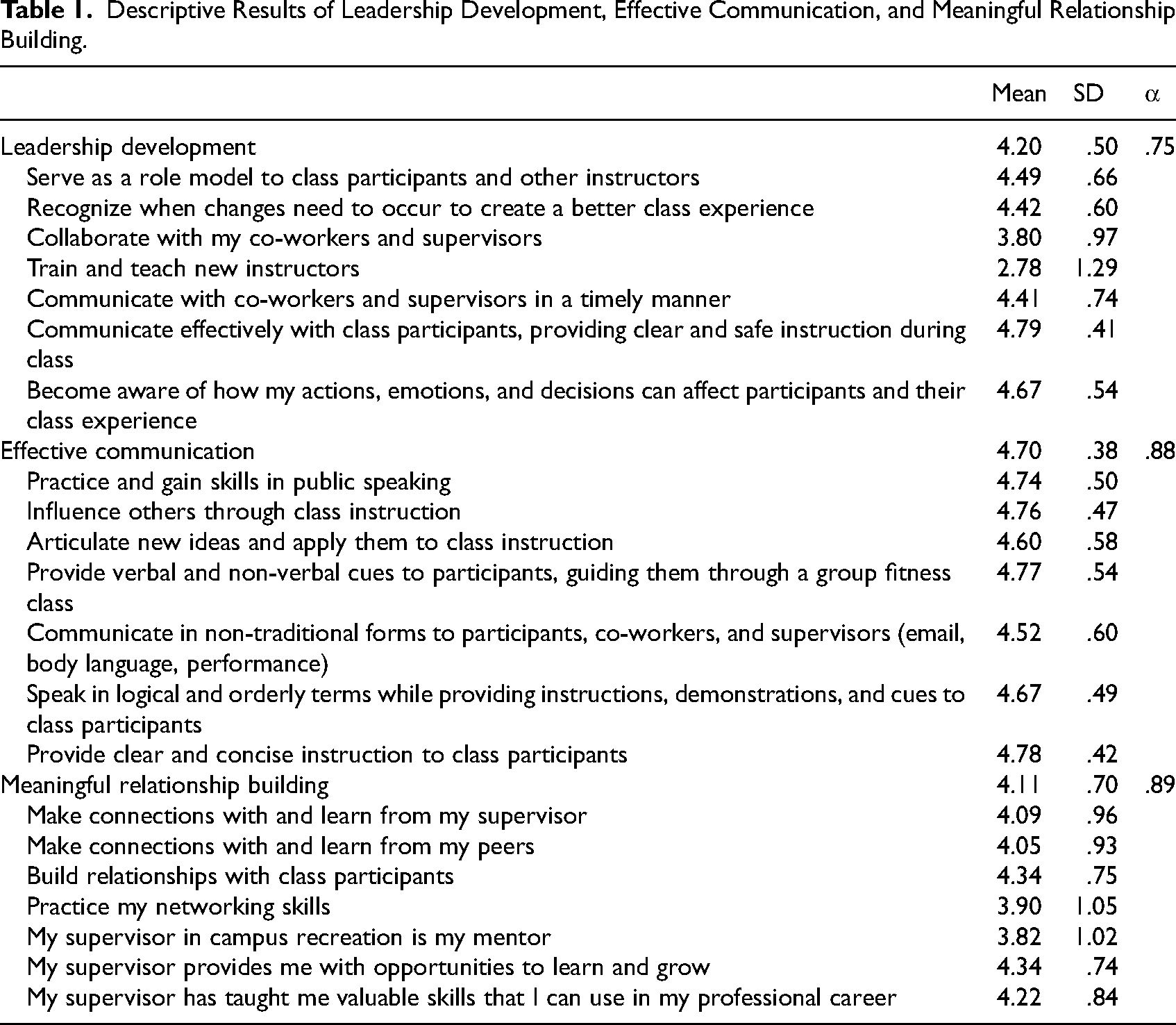
The overall descriptive results of student employees’ transferrable skills (Table 1): leadership development (M = 4.20, SD = .50), effective communication (M = 4.70, SD = .38), and meaningful interpersonal relationships (M = 4.11, SD = .70).
Descriptive Results of Leadership Development, Effective Communication, and Meaningful Relationship Building.
Pearson's R correlation showed several statistically significant correlations between variables (Table 2). Students’ leadership development was positively associated with their communication skills (r = .54, p < .01) and relationship-building experiences (r = .69, p < .01). Communication skills and relationship-building also showed a positive correlation (r = .47, p < .01). Between students’ teaching experience as a fitness instructor, the number of academic terms was positively associated with the number of classes they teach per week (r = .41, p < .01).
Correlations Among Dependent, Independent, and Control Variables in the Regression.
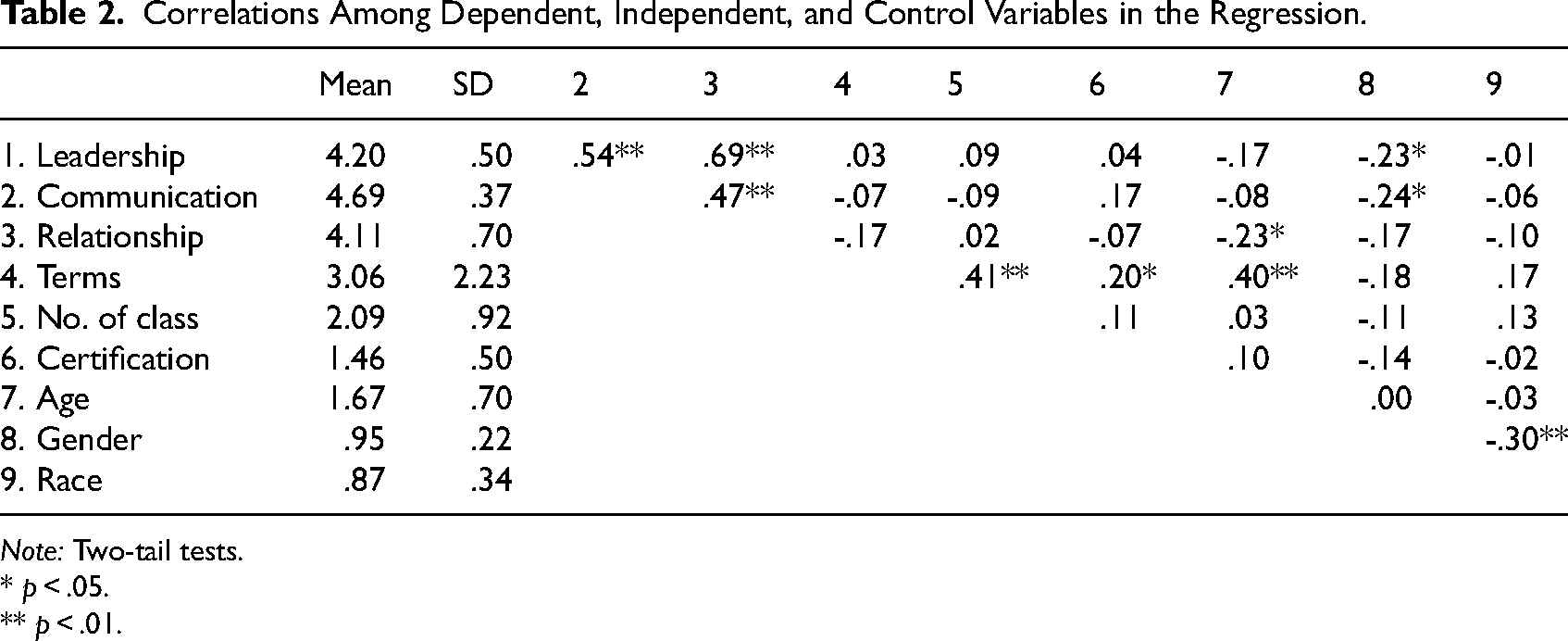
Note: Two-tail tests.
* p < .05.
** p < .01.
The multiple regression model (Table 3) is significant and indicates the dependent variables (communication skills, relationship building, and experience in campus recreation) with demographics (e.g., age, gender, and race) as covariances accounted for 57.2% of the variance of the independent variable (leadership) [R = .756, R2 = .572, F(9, 102) = 15.008, p < .001]. Students’ leadership development was predicted by building meaningful relationships (β = .558, p < .001) and communication skills (β = .287, p < .001) in campus recreation settings. On the other hand, in the regression, students’ teaching quantity and experience (academic terms and class per week), obtained a fitness certification or not, and demographic variables were not significant for developing their leadership skills. Therefore, our findings support Research Question 1, that student fitness instructors’ communication and interpersonal relationships affect their leadership development in campus recreation. Yet, the results did not support Research Question 2, that students’ work experience and demographics in campus recreation student fitness did not impact on their leadership development in the current study.
Regression Predicting Leadership Development From Communication Skill, Relationship Building, and Experience With Controlled Variables.
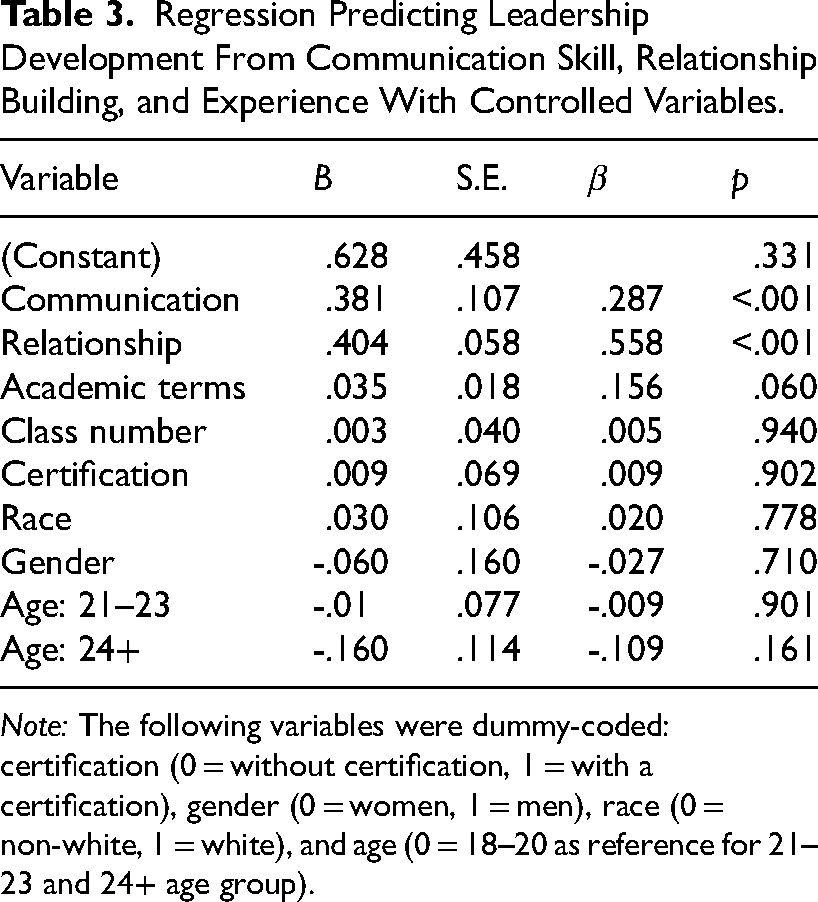
Note: The following variables were dummy-coded: certification (0 = without certification, 1 = with a certification), gender (0 = women, 1 = men), race (0 = non-white, 1 = white), and age (0 = 18–20 as reference for 21–23 and 24+ age group).
Discussion
Research on student fitness instructors in campus recreation is limited, and the current study addresses this gap in research (Anderson et al., 2018; Buzzelli, 2017). More specifically, this study aimed to examine the relationship between skill development and student group fitness instructors, with a focus on leadership development, effective communication, and meaningful interpersonal relationships. Campus recreation has been recognized as an environment conducive to student learning and personal growth (Bolton & Rosselli, 2017; Hall, 2013; Toperzer et al., 2011). Student employees acquire skills through hands-on experience (Bolton & Rosselli, 2017) and develop transferable skills applicable not only in college but also in their future endeavors (Hall, 2013).
Our results indicated that student instructors reported high levels of competency in effective communication (M = 4.70), leadership development (M = 4.20), and relationship building (M = 4.11) on a 5-point scale. These results may explain the distinctive qualities of student group fitness instructors, who exhibit high levels of competency in communicating and leading groups through effective interaction, instruction, and communication during workouts and classes. Buzzelli (2017) pointed out that the unique experience of being a fitness instructor in campus recreation involves developing soft skills, including public speaking, leadership, conflict resolution, and overcoming introversion. Student fitness instructors can apply these transferable skills beyond their university years in a professional setting (Strayhorn et al., 2006; Toperzer et al., 2011).
Our findings further contribute to the existing literature by showing that meaningful relationships with mentors and supervisors emerged as a predictor of leadership growth. This was a more significant predictor than communication skills, even though both transferable skills (effective communication and meaningful relationships) were significant predictors of leadership development in our regression analysis. The development of meaningful and positive relationships provides students with a supportive and encouraging environment, enabling them to make connections, find a sense of belonging, and gain confidence in their ability to lead in campus recreation (Tulchinsky, 2018). Moreover, students’ teaching experience and demographics were not significant for developing student fitness instructors’ leadership skills. Our findings indicated some differences in the current literature. For example, Anderson et al. (2018) found the length of employment and age could affect students’ transferable skills. Therefore, our finding implies future research efforts are needed as current literature showed limited studies and inconsistent findings on student employees’ working experience and their continuous growth of various transferable skills, especially in specialized program areas in campus recreation.
Although our findings are supported by existing studies and offer unique contributions, specifically for student fitness instructors in campus recreation settings, some limitations should be acknowledged. First, the current number of student group fitness instructors employed on college campuses across the United States is unknown. Women and individuals identifying as white constituted the predominant demographics of our research participants. This may not entirely represent the entire student fitness instructor population. Therefore, it is important to interpret the broad generalization of results with caution.
The present study adopts a cross-sectional design, employing an online self-report survey to capture a snapshot of students’ perceptions regarding skill development. It is acknowledged that these perceptions may be influenced by biases, such as social desirability bias. To address this, future research could integrate both students’ and supervisors’ measures in assessing skill development, facilitating a comprehensive comparison. As for survey design, the current study only included one question about certification (whether they held a certification or not), which provides limited information on their development stage and progression. Therefore, future studies should include fitness training and certification questions, such as the number of participated trainings, type of certification, and level of certification. In addition, other than demographics, students’ educational background (e.g., major and career interests) might be helpful to predict student fitness instructors’ skill and professional development. We also suggest comparing the group's differences (e.g., experience working in campus recreation, level of certification, etc.) in leadership, communication, and interpersonal relationships to further the potential training and retention of campus recreation staff. Additionally, to gain a more nuanced understanding of students’ growth and development over time, future studies may explore further by conducting multiple interviews throughout their experiences working on campus recreation. This would also shed light on how this experience prepares them for postgraduation, career, and life skills.
The CAS set the standard and created guidelines for student learning and development to be used by higher education professionals (Bresciani, 2007). Later, CAS added an additional resource, the FALDO. This additional resource helps higher education professionals evaluate student development within its 16 learning and development domains. Within the 16 domains, includes core, or “soft skills” that students can gain while completing their degree. These skills can transfer into the workforce and help with lifelong career success National Association of Colleges and Employers (Anderson et al., 2018). The current study focused on the application of specific “soft skills” or core skills, building relationships, leadership, and communication. These skills are included under the NACE, under core competencies for career readiness. The current study used three developmental domains within FALDO, meaningful interpersonal relationships, effective communication, and leadership development. Future studies could include both “hard skills” (e.g., computer skills, report writing abilities; Anderson et al., 2018) and soft skills (domains listed in FALDO) to broaden the understanding of students’ growth and development in campus recreation. Additionally, research could further study other transferrable skills, such as collaboration, independence, and self-esteem, and professionalism/work ethic, all of which are important skills for preparing college students for a successful transition into the workplace or career readiness (Anderson et al., 2018; Peck, 2017). Furthermore, based on the career readiness competencies, Townsend (2020) suggested focusing on teamwork, self-efficacy, adaptability, mentoring, unity, respect, and excellence to prepare students for future career.
Application to Practice
The current study on student group fitness instructors provides insight into group fitness programming within a campus recreation setting, allowing student instructors to gain valuable transferable skills in the areas of leadership development, effective communication, and meaningful interpersonal relationships. Therefore, the campus recreation professional shall continue the effort to assist students in gaining transferable skills, aligning with one of the core values of NIRSA. Students working in specialized programs in campus recreation, such as group fitness, may require additional financial support to obtain the necessary certifications. These certifications could open up different growth opportunities, but also enhance their experiences and help gain knowledge, skills, confidence, and problem-solving abilities (Walker et al., 2018). Furthermore, offering support for fitness instructors (e.g., paid training time, paid certifications, and acknowledgment of effort) to participate in classes or workshops focused on teaching various groups and cross-training in different exercise formats can greatly benefit their instructional effectiveness. This approach could diversify the range of fitness programs available but also enhance scheduling flexibility for the overall service to the campus community.
The results of this study offer valuable insights for the field of campus recreation and may be particularly compelling for professionals. A prominent recurring theme in the findings of this study revolved around the significance of meaningful interpersonal relationships. Meaningful relationships, including mentorship, aid students in clarifying their purpose and involve them in professional development opportunities (Buzzelli, 2017; Healy et al., 2012; Wittman, 2005). Within the study, student group fitness instructors indicated that they are connecting with their peers, class participants, and supervisors within their position. As student group fitness instructors are exposed to and practice effective communication and cultivate meaningful interpersonal relationships, their leadership skills will experience a positive boost, contributing to their overall development. The following are proposed implications for student fitness instructors:
First, campus recreation professionals should increase exposure to on the job experiences that foster growth and development for instructors. In-house training for new instructors could lay a solid foundation to begin their role. Then, requiring newcomers to teach classes to their instructor peers could increase their relationship with their co-workers, mentors, and supervisor; potentially, building confidence in their role. This could be done during in-service/continuing education meetings. Supervisors should attend their student employee's classes, taking note of general areas of development for future in-service topics. In-services should be seen as educational, not just an opportunity to share administrative updates. Diving deeper into continuing education topics that are meaningful to the group may help student instructors value the importance of their role and show that their supervisor cares about their development.
In addition to the supervisor attending student instructors’ classes, instructor peers should attend classes regularly, with opportunities to share peer feedback directly with the instructor, or anonymously through the supervisor. Additional tasks, like this, provides peer leadership experiences without holding a leadership title. Campus recreation departments could support fitness supervisors by expanding/adding student program assistants, lead, and/or internship roles to create a fitness leadership team, allowing student instructors to see more leadership involvement in the classes that they teach.
Footnotes
Declaration of Conflicting Interests
The authors declared no potential conflicts of interest with respect to the research, authorship, and/or publication of this article.
Funding
The authors received no financial support for the research, authorship, and/or publication of this article.
