



Abstract
Integration lies at the heart of mixed methods research, but it has primarily been considered from a practical rather than a conceptual or theoretical perspective. In this paper, I develop a contextually situated, parsimonious conceptual model of the substantive dimensions that constitute integration. I conclude that integration between heterogeneous components in mixed methods research is constituted by interdependence that is connected, transactional, transformative, coherent, and dynamic. This conceptual model is presented here in the expectation that it will prompt researchers to think more deeply about the phenomena they study and the integration of the methods they use to study those phenomena.
In mixed methods studies, components of different methodological approaches to research are integrated so that they become interdependent in reaching a common theoretical understanding or investigative goal. Integration lies “at the heart of the mixed methods enterprise” (Fielding, 2012, p. 126). It describes a process that leads from diverse study components to “nuanced and comprehensive understandings” in response to often complex questions (Plano Clark, 2019, p. 107).
When phenomena are understood as being multifaceted and multidimensional, then using multiple sources and types of data to explore and understand them, to see their fullness in a holistic way, is a natural choice. The whole is dependent on all parts being present, connected, and fitting together within a common epistemological or theoretical framework: In reaching a common theoretical or research goal, the parts cannot stand alone and are not viewed separately again within that context. The key to this is not to see division in the first place, and not to allow binary thinking to limit one’s understanding of and approach to designing and conducting research. Single dimensional and even binary thinking lead to “impoverished” and possibly inadequate understanding (Mason, 2006, p. 10). It is this interdependence between the different components in a study that defines integration and is a critical characteristic distinguishing mixed methods from a monomethod or even a multimethod approach to research (Bazeley, 2023).
By asking: “Why do researchers integrate/combine/mesh/blend/mix/merge/fuse quantitative and qualitative research?” Alan Bryman (2008) rather cheekily pointed to the multiplicity of terms that have been used by mixed methods researchers to describe integration. Finding a mismatch between the rationale given by researchers for mixing methods and their practice, he suggested that lack of a clear language for or even understanding of what is involved in integrating qualitative and quantitative research impeded the practice of mixing methods. Most of the mixed methods literature reports empirical studies or addresses ways of doing mixed methods. But what does it mean to integrate different methodological approaches to research?
In this paper, I set out to “unpack” integration in mixed methods research, primarily by identifying the dimensions that constitute integration—those things that make it what it is when seen within the context of mixing methods. It is hoped that this conceptual analysis will prompt researchers to think more deeply about the phenomena they study and assist them in designing and conducting productive research. It is derived from intensive reflection on 5 decades of reading, exploring, doing, and advising on mixing methods. As a first attempt, however, it is unlikely to be the final word on the subject!
The Context for Integration
Two contextual conditions set the scene for integration in mixed methods to occur: heterogeneity and intentionality. Heterogeneity is an assumption inherent in the term “mixed methods”—the mixing, combination, or merging of research approaches or components of them that differ in some way. Selection of these diverse components for inclusion in a project could be serendipitous or planned, but ensuring that integration of relevant aspects of them eventuates is intentional.
Heterogeneity of Contributing Components
Differences in the methodological approaches to be integrated are usually evident in varied data sources or types of data and/or varied methods of analysis. There might be other sources of heterogeneity—in investigators, or in contexts for the research, but it is likely that heterogeneity in these other aspects will prompt corresponding variations in choice of data and/or analysis strategies.
Heterogeneity of the methodological components being combined contributes to the reason for and success of mixed methods as a research approach. Those diverse components will, nevertheless, be aligned in some way that is related to the research purpose or question(s). Perhaps a dialog can be set up between them where each contributes because they share a common set of constructs, or the choice of sample for the different forms of data will allow those data to be integrated into a larger whole.
Intention to Integrate
Using a combination of methods in a research project—almost any project—is natural for someone who is open to possibilities (or is an opportunist!). One can engage in a project involving varied data and methods without labeling it as mixing methods. At some stage, however, a decision to bring together the data generated, to integrate it, will be needed to ensure a cohesive outcome, even without a conscious engagement that one is “doing mixed methods.”
Projects sometimes develop serendipitously, but the reality—especially in today’s academic world—is that projects require careful planning to meet governance, funding, and ethical requirements. In such circumstances, the researcher makes an intentional choice to use components of more than one methodological approach to answer their research questions. Planning follows to ensure coordination of these and an integrated outcome. This kind of integration, under these circumstances, doesn’t just happen (Plano Clark, 2019, p. 108).
This does not mean that flexibility is lost—indeed, anticipating a need for flexibility and the capacity to manage surprises is part of that planning process. Very few projects run exactly to plan, especially those that involve mixed methods. Keeping the overall (substantive) goal in focus, even if the specific questions being asked or the methods to answer them are modified, is critical to ensuring integration.
The Range and Scope of Integration
Structurally, integration is described by its range and scope. In everyday language, the range of a concept (integration, in this case) is defined by its end points, potentially allowing for assessment (if not measurement) of the extent to which that concept is present. The scope of a concept refers to what items or elements or aspects of them are included within a consideration of that concept.
The Range of Integration
Two ways of thinking have developed within mixed methods research practice that defines the poles marking the range of integration. At the low end, researchers link or combine the different approaches used within a study only at one particular point of time. In contrast, a fully integrated (high range) design has points of connection between the different strands occurring at every stage of the study. As an early proponent of full integration, Robert Yin (2006) illustrated procedures that would aid in integrating multiple methods into each stage of the mixed methods research process, from the formulation of research questions through to the analysis of findings. He argued this was more likely to produce an integrated study rather than parallel studies using different methods.
Building on earlier models, Elizabeth Creamer (2018, p. 12) defined full integration as an intentional approach to mix or integrate the different strands of a study throughout each stage of the research process, including planning and design, data collection, sampling, analysis, and drawing inferences. Creamer used images of arches to prompt consideration of innovative ways to integrate the different approaches contributing to a study. In “a perfect arch,” the building of the supporting sides is coordinated so that each side will be able to take equal weight and to ensure they harmonize. The wedge-shaped pieces above those are held in tension by the single keystone at the top, with each piece reliant on the others to stay in place. In mixed methods, the keystone represents the [meta]inferences drawn through intentionally bringing together what has been learned from the strategies used at each stage. The arch with a keystone is more durable than an arch with a horizontal beam laid across two separately constructed supports.
The Scope of Integration
Fetters & Molina-Azorín (2017: 293) sought to create an “overarching conceptualization” of integration “to inform an all-encompassing mixed methods research approach.” Their mixed methods research (MMR) integration trilogy comprised philosophical, methodological, and methods dimensions as they relate to mixed methods. They then listed 15 further dimensions to provide more detail, with explanations of how researchers can integrate different approaches within each. These were: philosophical basis, theoretical basis, researcher experience, orchestrated team, basis in literature, rationale for integrating, overarching research purpose, research design, sampling, data collection, data analysis, interpretation, rhetorical coherence, dissemination, and research integrity. While they might have achieved their goal of greater breadth, the elements listed read more like sites describing where integration might occur in a mixed methods study, rather than being dimensions that characterize or define the nature of integration itself.
Implications of Range and Scope for Integration
Do range and scope matter? Does full integration across a broad scope of study components necessarily mean better integration? Lynam et al. (2020, p. 344) remind us that our choice of what to integrate depends on the goal and desired outcome of the research. Perhaps “sufficiency,” viewed in terms of meeting those goals and desired outcomes, is all that is needed. “Full” integration or “full use of data” could reveal more, but if it goes beyond current goals, it could also be an unnecessary use of resources.
“Unpacking” the Substantive Concept of Integration
In recent years, we have seen more frequent reference to and writing on integration—and yet this “heart and soul” of mixed methods research (Guetterman et al., 2020, p. 430) remains “not well developed or practiced’’ (Guetterman et al., 2015, p. 561; Morgan, 2023). When researchers think (and write) about integration, they consider it primarily in terms of the practical strategies that are involved, rather than about what constitutes integration as a concept and what is happening when we integrate data.
Dimensions describe the essence of a concept—those aspects that make the concept what it is, by which it can be distinguished from other (perhaps related) concepts (Goertz, 2006). For example, reciprocity and trust are regarded as two dimensions of social capital. Mathematical dimensions of a physical object (such as length, width, and height) are delineated by their end points (their poles). The task of specifying relevant dimensions and end points is more complex with social objects and methodological concepts such as integration; there can be arguments over what is included, how they are defined, and which are essential (if any).
The sections that follow are designed to redress the undertheorising of integration in mixed methods research by proposing a conceptual model of integration. Its substantive dimensional content is proposed as a prompt to deeper thinking and further discussion about what it means to integrate data.
Dimensions of Integration
One basic with four secondary substantive dimensions and one descriptive dimension constitute the concept of integration outlined here. It will be shown that integration between components of the methodological approaches in mixed methods research is constituted by an interdependence that is connected—through linking, joining, and combining; transactional—through transfers and exchanges; transformative—as parts are fused or blended and reconfigured; coherent—as components fit together; and dynamic in character.
Integration as Interdependence
Interdependence as the basic theoretical dimension constituting integrated mixed methods means that each approach taken relies upon input from or connection to another to effectively contribute to the goals of the research. Interdependence between approaches could, conceivably, exist even if they are linked at only one point, but an increased level of interdependence between approaches could mean even greater potential to generate useful or novel solutions to the problem at hand. At an extreme level of interdependence, components of the approaches taken become fused, creating new methods and/or new understanding in the process. If approaches taken remain separate, then the added value of working interdependently is lost.
Each secondary dimension captures a distinct aspect of interdependence in integration. At the same time, each demonstrates a further level of complexity which can lead to a degree of overlap in their outcomes, but this does not take away from the uniqueness of the contribution of each dimension.
Connection in Integration (Discrete <–> Connected)
Connection is critical to interdependence. Conjunctions or linkages across different approaches taken in a project are created to build on a sense that this goes with that, works with that, matches that, leads to that, provides resources for that, or that these things share something. These connections might be between elements from different methods, contexts, or samples, between core and periphery, or between researchers and participants. Through bringing together discrete parts of a project, connection contributes to the creation of a coherent view of the studied phenomenon. Such connections have been likened to those that occur in an integrated transport network in which a passenger can purchase a single ticket that allows them to transfer effortlessly (ideally!) from bus to train to plane, to reach their destination (Moran-Ellis et al., 2006, p. 50).
There is a dynamic cognitive component to connection as well. Concepts and processes from different strands of the research are brought together to be compared and contrasted. Cognitive links built through this integrative process mean that relationships and discordances are identified from similarities and differences in those components, and fresh understanding is gained based on the combined input from both sides of each connection—including that gained when differences are resolved (not all will be, and integration could fail in those cases).
Connected components retain their original identity—a train remains a train when it connects with a bus at a point of integration in the system; compared ideas can be traced to their source. Nevertheless, the connected components need to function and be used interdependently to create a holistic entity revealing the integrated phenomenon of study. The absence of connection means that the strands remain discrete and integration has failed, while connecting in a more dynamic way makes possible more active transfers and exchanges.
Transfer and Exchange in Integration (Adjacent <–> Transactional)
Transfer involves the passing of data, information, ideas, or other “goods” between different components of the research. Communication between the parties involved—a “conversation”—is needed to facilitate the transfer. Transfers, such as are found in sequential studies, build on but go further than connections between components, and, by making an additional contribution to their interdependence are also central to integration. When the transfers become two-way, perhaps even reciprocal, they are better described as exchanges, with exchange being a special case or extension of transfer. In practice, in methodological writing, exchange tends to be used to describe both one-way and two-way transfers—and indeed, some feedback is likely to occur even when the exchange is notionally unidirectional. Exchange, then, is understood to be the transactional movement of information (broadly defined) occurring at conjunctions between different components in mixed methods research.
Exchange between methods (or other components in a study) has been illustrated by analogy to processes within the double helix of DNA (e.g., Mendlinger & Cwikel, 2008). The double helix of DNA comprises a sense and an antisense strand that twist around each other, unwind, reorganize, or mutate through a process of protein transfer between the strands, and rewind to reform, in an iterative process of reconstruction … as the different strands come together to create a cohesive organism (Bazeley & Kemp, 2012: 67).
Transfers or exchanges in mixed methods research might be of data, information learned, or insights gained. Like a constant uncoupling and recoupling, these might occur iteratively throughout a project or at growth points when regular linkages are broken and specific new connections made. “Our spiraling logic and methods are comparable to the ‘abductive’ reasoning that moves between deduction and induction in sequential designs … a spiraling process that repeatedly introjects one research approach into the other” (Mendlinger & Cwikel, 2008, p. 290).
Reconfiguration through Fusion (Preserved <–> Transformed)
Reconfiguration comes about through a dynamic and perhaps more extreme form of combination or exchange—a binding together through fusion that can generate new functionality or greater power of discernment. Contributing components are transformed and/or consolidated to create an inseparable new whole, with a new identity. “Fractals” of the input data or methods may be discernible (Knappertsbusch, 2020), but they can no longer be separated and still retain value.
Depending on the extent of reconfiguration, it can be possible to differentiate which separate parts have become fused, yet neither part remains complete or functional within itself and both are necessary to ensure the functioning of the whole. For example, the structure of the original bones might still be discernible within a fused joint, but now it is working as a single entity. When cells fuse, chromosomes from both parent cells can be identified within the nucleus of the new cell, but what grows from it will have a different, albeit related, identity from either contributing source.
Reconfiguration of integrated data and methods can be seen in the creation of new variables or modified theories, or in a new understanding, model, or process that provides a fresh perspective on the original data. It may result from a single action, or come about as strands from each approach evolve in response to the other, in much the same way as shared participation in sense-making evolves into shared social construction of knowledge (Patton, 2011).
Coherence in Integration (Disjointed <–> Fitting)
When mixed methods researchers are developing inferences from the mass (or “mess”) of data, findings, and ideas they have constructed from their multiple sources, they are looking to achieve “fit”—a coherent result that makes sense (Fetters et al., 2013, p. 2143). Fit describes the level of synergy reached through bringing different aspects of the investigation together into an interdependent relationship. Do those different aspects converge, complement, or build on each other in a holistic and beneficial way, or is there diversity, dissonance, or even outright conflict?
Assuming a focus on the study of a single phenomenon, it is reasonable to expect coherence across the knowledge and insights gained from an integrated study of that phenomenon, even when fresh perspectives are gained through taking different “cuts” (Uprichard & Dawney, 2019). Coherence is likely to be enhanced also when an entire project is underpinned by a consistent philosophical stance, where methods serve a common purpose, where design and interpretation of data are informed by a shared theoretical or conceptual framework, and where there is an ongoing “conversation” between the different strands of the research as the study progresses. In mixed methods integration, the nuances of different methods that have contributed to the results are rarely lost, but the resulting knowledge and understanding become the focus, rather than the specific data items or methods used to generate them.
Integration is Dynamic (Static <–> Proactive)
A primary rationale for using mixed methods in a research study has always been that it will add quality and strength to the conclusions drawn from the study, maximizing the potential for insightful understanding or innovative development. This was expressed in Fetters and Freshwater’s (2015: 116) classic 1 + 1= 3 model showing the added value resulting from integration of methods. But perhaps the integrative function would be better expressed as a union rather than an addition, as 1 U 1 ≥ 3, to emphasize the dynamic nature of the interdependent relationship between different approaches in integrative research?
Many of the real-world situations—both the everyday and the complex—that researchers find they are investigating are dynamic and ever-changing. Hence, proactive integrative research is called for – but the outcome of integration is not always predictable. Mixed methods are dynamic specifically because different things are interacting with each other to create added, innovative value—or friction. Data from different sources might complement each other, but they do not always converge (Uprichard & Dawney, 2019), creating a dynamic that can lead the researcher along unintended paths (Vogl et al., 2019). Provocation, contradiction, and paradox are to be welcomed; however, as “it is in the tension that the boundaries of what is known are most generatively challenged and stretched” (Greene & Caracelli, 1997, p. 12). Complexity demands the kind of flexibility and adaptability that can work with interrelated systems and capricious environmental influences (Poth, 2018). Integration that dynamically explores, interrogates, and builds on the interdependent relationship between methods that are nonlinear and which can be unpredictable is needed for the potential it offers to find solutions.
Conclusion: Modeling Integration
A conceptual model of integration is proposed, based on a parsimonious list of its essential constitutive dimensions. The dimensions describing integration are ontological in that they define the essence of what integration is (Goertz, 2006), but they are also causal in that they act as contextually mediated mechanisms to generate the kinds of outcomes and benefits sought by those using mixed methods. Thus, the precise “shape” of how each dimension functions in the integration of methods will be influenced by the context in which it occurs, with some being more or less evident than others in any particular project.
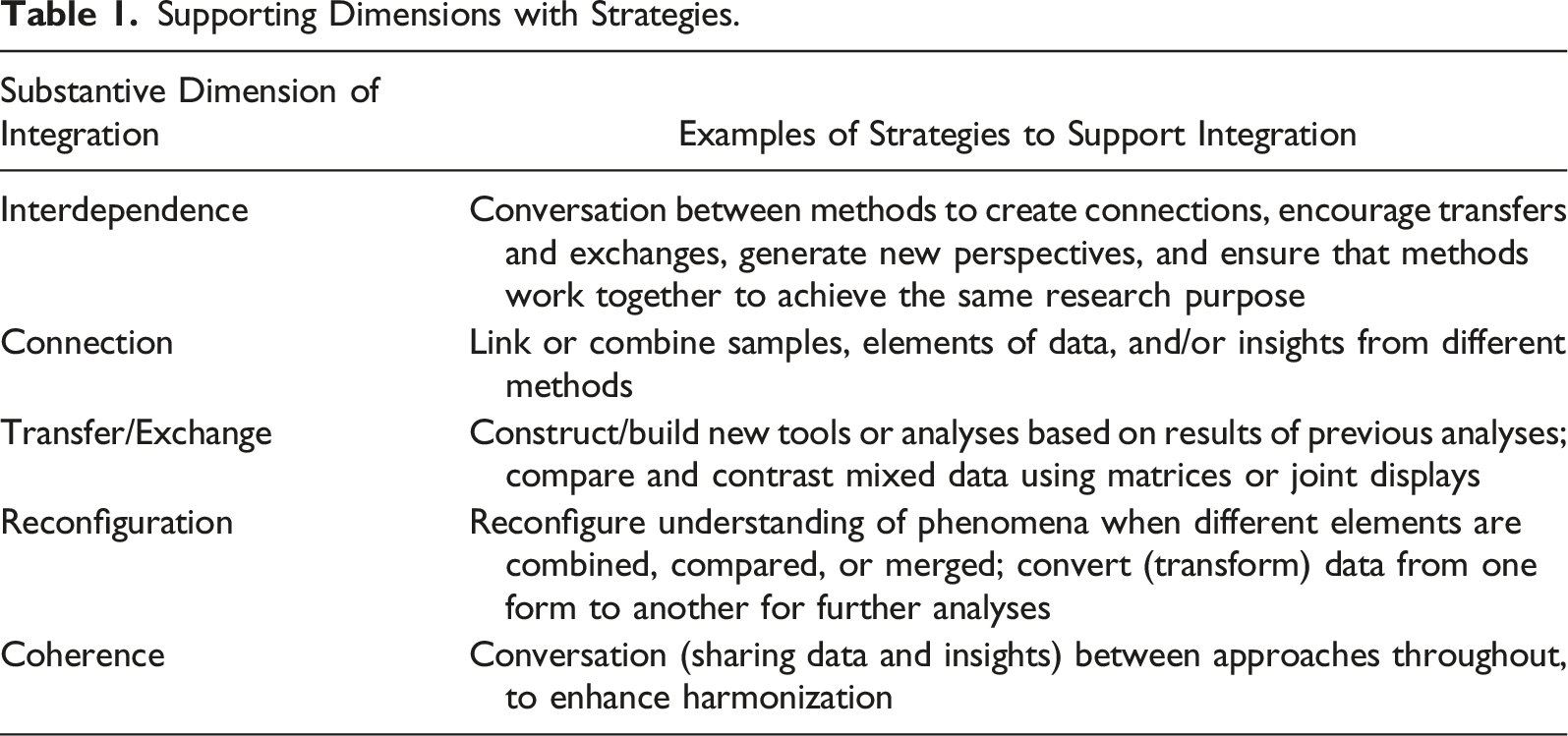
Interdependence, as the basic-level substantive dimension defining integration, has four secondary dimensions: connection, transfer/exchange, reconfiguration, and coherence. Integration is also dynamic, qualifying the way in which interdependence and each of its secondary dimensions function (Figure 1). These six dimensions together constitute the substantive essence of integration. They sit within a context provided by two pre-conditions (heterogeneity and intentionality) and two structural dimensions (range and scope). Thus, as a core feature of mixed methods research, integration is defined (briefly) as dynamic interdependence between components of different methodological approaches to research. It can be described more comprehensively as dynamic interdependence, evident in a connected, transactional, transformative, and coherent relationship between components from different methodological approaches to research. A conceptual model of integration in mixed methods research.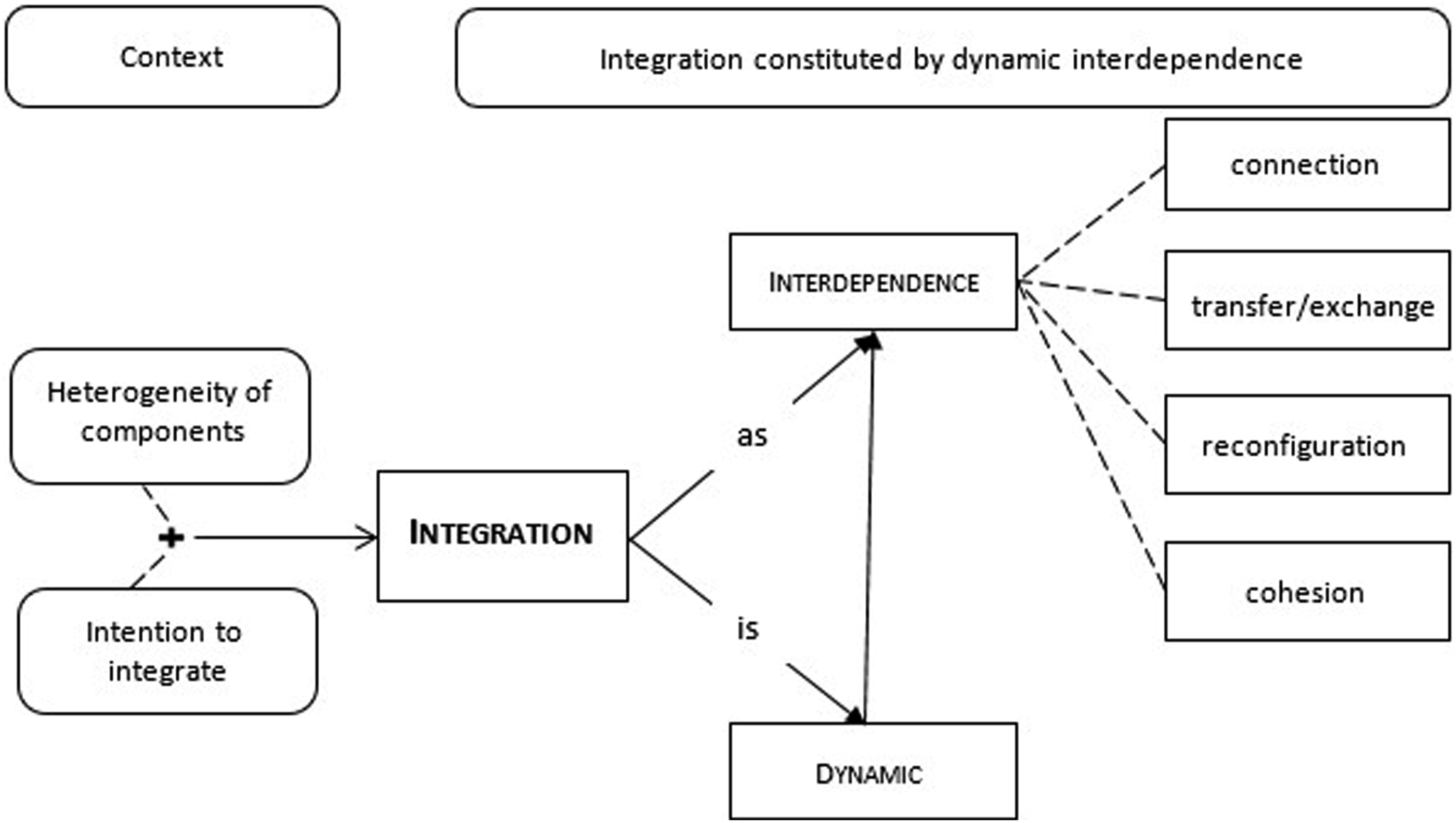
Contribution to Mixed Methods Research
All too often, reference to integration has been little more than a superficial or non-specific note about how different conclusions come together or support each other, where “clarity about the explicit [aspect] of integration addressed is lacking” (Fetters & Molina-Azorín, 2017, p. 293). This “unpacking” of the dimensional components of integration is designed to prompt researchers to reflectively build on the integrative potential of their research, thus enriching their analysis and the conclusions they draw from it. Potentially, also, this analysis will prompt further discussion amongst methodologists and practitioners, with ensuing development and clarification of ideas about what it means to integrate diverse data and methods.
Supporting Dimensions with Strategies.
Footnotes
Acknowledgments
I appreciated Mike Fetters’ positivity, can-do attitude, and enthusiasm, and his significant contribution to highlighting the importance of integration in mixed methods research. My thanks, also, to Dr. Susanne Vogl for her constructive comments on an earlier version of this paper.
Declaration of Conflicting Interests
The author(s) declared no potential conflicts of interest with respect to the research, authorship, and/or publication of this article.
Funding
The author(s) received no financial support for the research, authorship, and/or publication of this article.
