



Abstract
Inductive/deductive hybrid thematic analysis offers significant opportunities for researchers, but its application within integrative mixed methods research has yet to be fully explored. Firstly, this article contributes by demonstrating the compatibility of inductive/deductive hybrid thematic analysis with quantitative work in a mixed methods approach to research. Secondly, the article then innovates by highlighting the value of this approach within a critical realist meta-theoretical perspective. Here, the critical realist concepts of abduction and retroduction are crucial, both in terms of facilitating the convergence of methods and in the generation of new theory. This article will be of relevance to researchers interested in integrating inductive/deductive hybrid thematic analysis with quantitative methods within a coherent and enabling philosophical paradigm.
The question of analysis in mixed methods research is an important topic of contemporary debate. For example, Onwuegbuzie and Johnson (2021) note “data analysis in mixed methods research [can be]…the most difficult step of the mixed methods research process” (p. 1) and there is a “lack of methodological guidance in the extant literature on these topics” (p. 16). Yet within mixed methods analysis, Hatta et al. (2020) have already demonstrated the specific value of “dynamic switching back and forth between…inductively and deductively driven analysis” (p. 104). The present article thus takes up Hatta et al.’s (2020) invitation for “further dialogue on the dynamic analytical possibilities in convergent designs” (p. 105) by demonstrating the value of combining inductive and deductive reasoning in a hybrid approach to thematic analysis. Briefly, this approach entails the use of pre-ordinate themes, through the application of an explicit theoretical framework developed through engagement with the literature: this is the deductive element. However, the approach also entails the generation of themes from the data: the inductive element. Crucially, these themes are then hybridized or combined, mutually enhancing one another. The present article then shows how this approach can be synthesized with quantitative analysis, thus seeking to illustrate “advanced analytical procedures that promote integration” (Creamer, 2022, p. 264). Finally, while Hitchcock and Onwuegbuzie (2020) assert “mixed analyses necessitate the mixing or combining of paradigmatic assumptions and stances” (p. 72), the present article will demonstrate the compatibility of an inductive/deductive hybrid thematic approach within a coherent critical realist paradigm.
The intent of this article is thus to articulate the methodological possibilities offered by inductive/deductive hybrid thematic analysis within integrative mixed methods research. The validity of inductive/deductive hybrid thematic analysis as a method in isolation has been demonstrated (Fereday & Muir-Cochrane, 2006), but a gap in knowledge exists in regard to how this method can be effectively integrated with quantitative methods, which this article seeks to address. Likewise, while work has examined how inductive/deductive hybrid thematic analysis might be positioned in relation to paradigm (Roberts et al., 2019), there has not been a consideration of how this method might be effectively integrated with quantitative methods within a critical realist paradigm, which this article also addresses.
The approach delineated will therefore be of value to researchers’ intent on exploring layered and complex problems which might necessitate both a more open and inductive approach to theme generation and yet at the same time would also benefit from the theoretical rigor offered by the deductive application of themes derived from an existing framework. Crucially, the present article demonstrates how this qualitative thematic approach can in turn be complemented by quantitative analysis and will therefore be of interest to readers investigating research problems which merit the synthesis of qualitative thematic analysis with similarly theory-informed quantitative methods. This article may also appeal to researchers looking to apply existing theoretical frameworks, but in a theory-generative, rather than confirmatory fashion, or where existing theory might offer a helpful but incomplete fit for a given research problem. Here, the critical realist notions of abduction and retroduction are crucial to the generation of new or enriched theory and will be explicated and commended to researchers. By extension, given the emphasis upon complementary mixed methods within a coherent paradigmatic stance, this article also provides a helpful illustrative example of the integrative approach to mixed methods called for by many (Åkerblad et al., 2021; Creamer, 2018; Fetters & Molina-Azorin, 2019; Mertens et al., 2016) and thus may also be of interest to researchers on this basis.
It is important first to delineate briefly the field from which inductive/deductive hybrid thematic analysis originates. This approach arises from developments in the field of qualitative research related to thematic analysis more generally. Braun and Clarke (2006) note that, in essence, “thematic analysis is a method for identifying, analyzing, and reporting patterns (themes) within [qualitative] data” (p. 6) and differentiate between inductive and deductive thematic analysis, with these being the “inductive or ‘bottom up’ way...or...a theoretical...‘top down’ way” (p. 12). This is a broad distinction similarly articulated by others, notably Boyatzis (1998). Thematic analysis in its separate inductive and deductive forms continues to be a commonly employed approach across multiple disciplines (Nowell et al., 2017). However, crucially for the present article, Fereday and Muir-Cochrane (2006) sought to demonstrate the combined use of inductive and deductive approaches to the same qualitative data in a hybrid approach to thematic analysis, arguing for the greater rigor such mutual reinforcement could offer. The article thus begins by articulating the validity of inductive/deductive hybrid analysis as in itself an effective approach. This combined approach helps to ensure that the voices of the participants are valued, while simultaneously allowing for more theory-led analysis. It is argued such an approach carries real merit and could be more commonly deployed.
Second, this article seeks to contribute methodologically by demonstrating the compatibility of an inductive/deductive hybrid analysis with an important form of quantitative inquiry: factor analysis. The specific example is drawn from an ordinal exploratory factor analysis (Basto & Pereira, 2012; Lorenzo-Seva & Ferrando, 2015). In other words, this article seeks to demonstrate the value of inductive/deductive hybrid analysis in a mixed methods approach to research. Such an integration of inductive/deductive hybrid analysis with exploratory ordinal factor analysis seeks to meet Bazeley’s (2018) goal of “purposeful interdependence between the different sources, methods or approaches used” (p. 7). However, while the value of integrative analysis strategies for mixed data sources is clear (Bazeley, 2012; Jang et al., 2008), the article must also be positioned in relation to contemporary work on broader integrative strategies in mixed methods research.
Fetters and Molina-Azorin (2017) define “integration [as the] linking of qualitative and quantitative approaches and dimensions together to create a new whole or a more holistic understanding than achieved by either alone” (p. 293). Åkerblad et al. (2021) likewise note “the very broad meaning of integration,” arguing this might encompass “how researchers are able to integrate qualitative and quantitative thinking on philosophical and theoretical levels” (p. 153). This notion of integration in the broader sense (paradigm, theory, analysis, and interpretation) has been similarly articulated by others (Creamer, 2018; Fetters & Molina-Azorin, 2019; Mertens et al., 2016). The present article seeks to illustrate how such a broader integrative strategy might operate when employing inductive/deductive hybrid thematic analysis, in line with the view such clear exemplification of the process of integration is important (Fetters & Freshwater, 2015; Lynam et al., 2020).
Thus, the article now moves to discuss a final area of contribution: the integration of inductive/deductive hybrid thematic analysis in a mixed methods design within a critical realist paradigm. The general importance of articulating a coherent philosophical stance in mixed methods research has been emphasized by Coates (2021). Similarly, the broad relevance of critical realism within the social sciences has been highlighted (Danermark et al., 2019), as has the specific value of a mixed methods approach within a critical realist paradigm (Maxwell & Mittapalli, 2010; Shannon-Baker, 2016; Sommer Harrits, 2011; Zachariadis et al., 2013). This has included the utility of such a stance in respect to methods such as exploratory factor analysis within a mixed methods design (Brown et al., 2021; Pratschke, 2003). In the field of medical research, Roberts et al. (2019) have also shown how critical realism and inductive/deductive hybrid thematic analysis might be aligned. By way of particular contribution, the present article identifies the merits of critical realism in a mixed methods approach to educational research which is specifically inclusive of inductive/deductive hybrid analysis.
In sum, this article seeks to demonstrate the value of inductive/deductive hybrid thematic analysis within integrative mixed methods research in three stages. Firstly, the article introduces inductive/deductive hybrid thematic analysis in its own right, with reference to an illustrative example. Next, the article demonstrates and discusses the use of inductive/deductive hybrid thematic analysis in synthesis with quantitative methods, in this illustrative instance in the form of an exploratory factor analysis. Thirdly, the article articulates the case for the integration of inductive/deductive hybrid thematic analysis with quantitative methods within a coherent paradigm, namely critical realism.
The Case for Inductive/Deductive Hybrid Thematic Analysis
Fereday and Muir-Cochrane (2006) demonstrate the greater rigor that can be achieved in thematic analysis when a hybrid approach is taken. In practice, this constitutes a combination of inductive and deductive thematic analysis, with the aim of harnessing the advantages of each. The use of pre-ordinate categories involves application of an explicit theoretical framework developed through engagement with the literature. However, in parallel, the approach entails the generation of themes from the data, and so includes an inductive element. In other words, deduction entails a pre-determined theoretical pattern “tested against observations, whereas induction begins with observations and seeks to find a pattern within them” (Babbie, 2010, p. 52). Yet while there is a clear and useful analytical difference between induction and deduction, it is apt to first acknowledge the caveat there may be some blurring—for example, pure induction, where all pre-conceptions and/or prior knowledge are entirely excluded is not possible; similarly, pure deduction in the sense of entirely objective logical inference is not feasible either. Therefore, in respect to the sequencing of the analytical process, the example follows the approach set forward by Fereday and Muir-Cochrane (2006), which is “presented as a linear, step-by-step procedure” for the purposes of written clarity, though is in fact “an iterative and reflexive process” (p. 83).
Inductive/Deductive Hybrid Thematic Analysis in Practice: An Illustrative Example
To illustrate, this article draws upon empirical work which employs both inductive and deductive thematic elements. Briefly, this is a mixed methods teacher motivation study investigating teachers’ motivational responses to performance management and professional development. The broader educational context of the teacher motivation study can be summarized by reference to the concept of New Public Management, through which teachers are subject to “comparative-competitive frameworks” and “test-based accountabilities” (Wilkins et al., 2019, p. 147). Ryan and Weinstein (2009) offer the crucial observation that New Public Management represents “a motivational approach” (p. 225) because of the emphasis on reward/punishment for improvement or development. Carr (2015) articulates a “pressing need to consider...motivational constructs” (p. 1383) to understand teachers’ impetuses to develop professionally and the extent to which they are incentivized or (disincentivized) to improve. Thus, the teacher motivation study sought to explore the perspectives of working teachers in respect to their motivations to develop or improve professionally.
Figure 1 presents the procedural structure of the teacher motivation study. Progressing vertically downwards, Figure 1 describes the types of data collection, followed by the forms of analysis to which the data were subject, leading in turn to the synthesis of these quantitative and qualitative strands. Figure 1 also shows the stages of abduction and retroduction, which will be discussed in relation to critical realism latterly. The qualitative strand of Figure 1 will be considered here first. Procedural diagram of the stages for the teacher motivation study: Illustrating data collection, analytical convergence, synthesis and retroduction. Note. Whilst presented in linear fashion for clarity, this article acknowledges points by Chew (2020) and Danermark et al. (2019) as to the complexity involved in disaggregating abduction and retroduction (discussed more fully below). *The circular arrow indicates the iterations of analysis which occur as the quantitative and qualitative strands of the data elucidate one another in a cyclical way.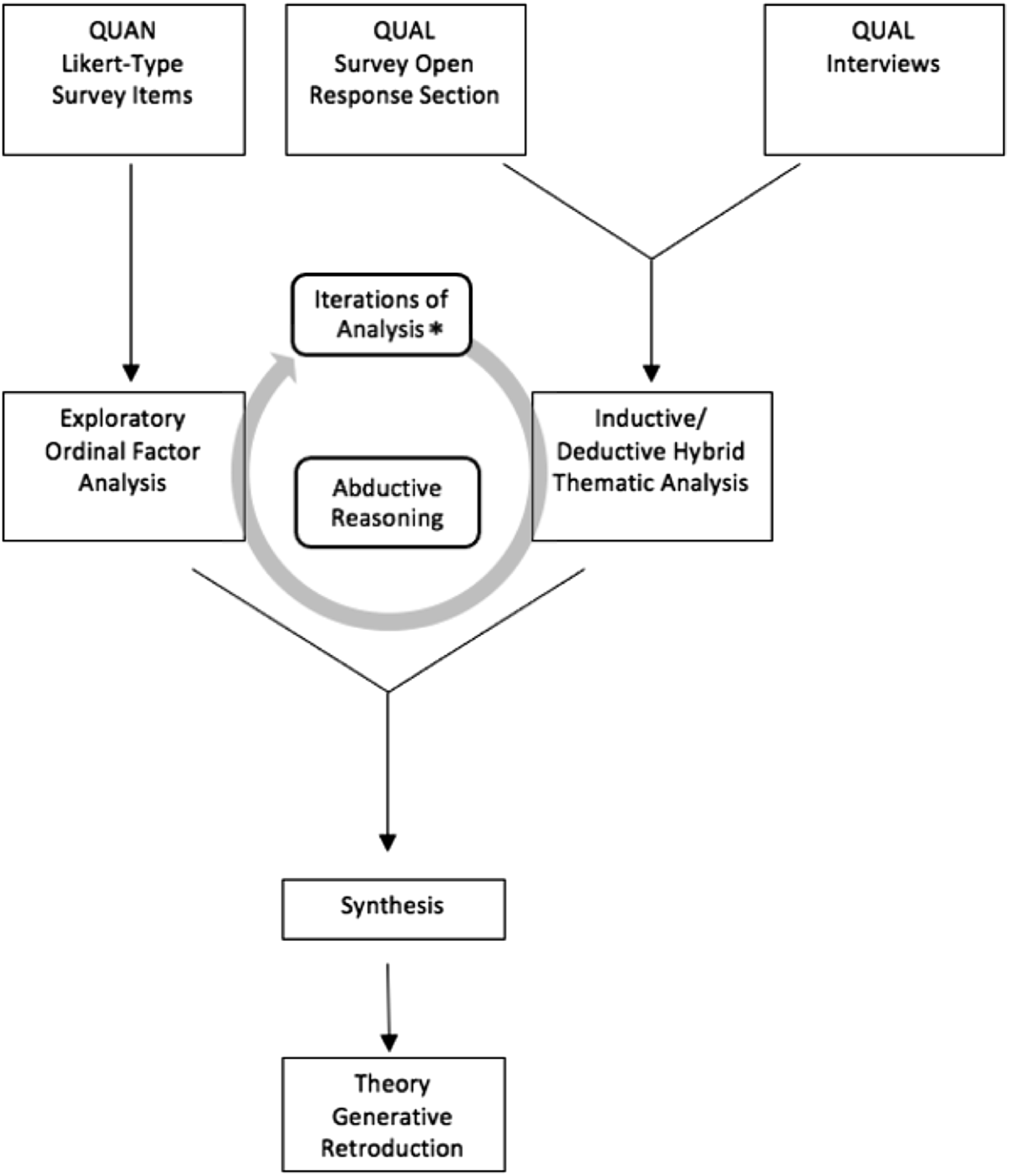
For the qualitative element of the teacher motivation study, data were collected through survey open responses and semi structured interviews. Nowell et al. (2017) emphasize the importance of meeting trustworthiness criteria when conducting thematic analysis. An important criterion is dependability, where the approach to data collection is carefully documented, hence the following summary of survey open response and interview data collection. As a first data strand, a survey was distributed through an alumni email database garnering views on teacher performance management. This was regarded as the most ethical and practical approach, given the performance management-related nature of the survey, as it bypassed school hierarchies. This survey had 323 respondents, 59 of whom elected to complete the open response section analyzed qualitatively here. This prompt was phrased as: “Please use the box below to add any other thoughts that you wish.” Participants were invited to share certain characteristics, such as years’ service, gender and age phase (while maintaining due anonymity).
As a second data strand, seven teachers were interviewed from primary and secondary age phases, had differing years’ service and varied school type (see Courtney (2015) for reference to school types). These teachers were approached through informal networks (again due to the performance-related nature of the inquiry). As Gill et al. (2008) note, semi-structured interviews facilitate “discovery or elaboration of information that is important to the participant” (p. 291), thus enabling participant teachers to explore those aspects of performance management they wished to discuss. By way of initial structure, Brenner (2006) describes a funnel shape, moving from generality, through to specifics, in this case opening with “What makes you want to develop further as a teacher?,” followed by “To what extent are your motivations to develop shaped by the school you work in?” and closing with, “Does performance management motivate you to be a better teacher?”. Importantly, this was sufficiently flexible to allow for the “contents to be reordered, digressions and expansions made, new avenues to be included” (Cohen et al., 2007, p. 182).
Inductive (Bottom-Up) Thematic Analysis
These qualitative data (semi-structured interviews and survey open responses) were then analyzed inductively to generate themes using a well-established six-stage approach (Braun & Clarke, 2006), the steps of which can be summarized as: familiarization with data; generation of initial codes; searching for themes; reviewing themes; defining themes; final analysis. Nowell et al. (2017) recommend debriefing and external checking to ensure the robust critique and justification of themes generated; in the present teacher motivation study, this was achieved in part through peer critique by research team members. However, in the interests of additional rigor, “confirmability” (Nowell et al., 2017) is further demonstrated through examples of coding.
Data triangulation is also of value for assuring mutual validity; in this instance, data collection and analysis of both survey open responses and interviews occurred in parallel and were then merged. However, a pertinent caveat is that such procedures involve iterations of analysis entailing some interaction between the two data strands, so while clean linearity is valuable for explanatory purposes, enacted reality is inevitably more complex (as expressed, e.g.,, by Law’s (2004) notion of “mess” (p. 2) in social science research).
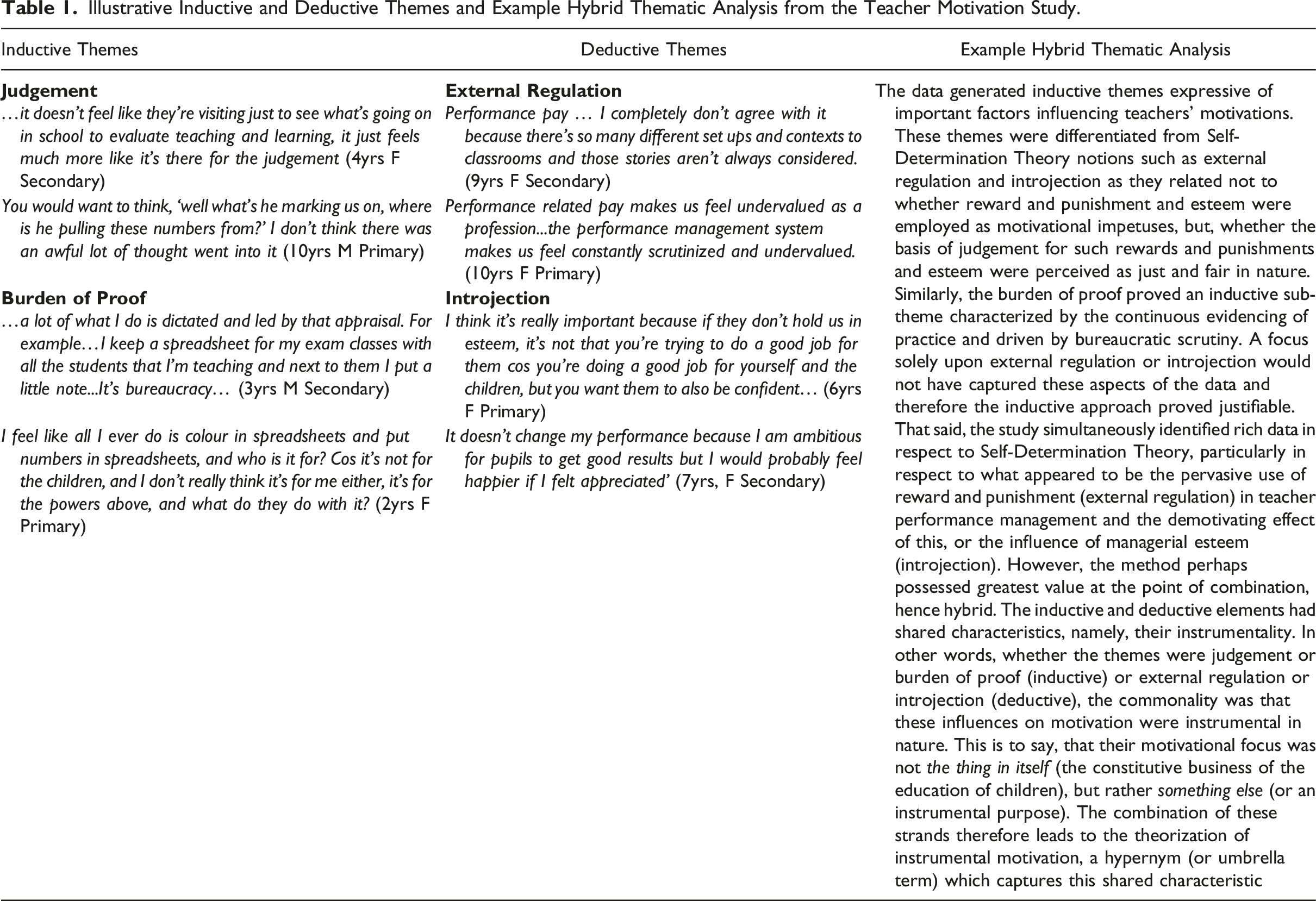
The inductive analysis identified two key themes across the interviews and survey open responses: sense of professionalism and experiences of managerialism, including five and three sub-themes, respectively. In the case of professionalism, these were autonomy, collegiality, professional trust, sense of vocation, and professional wellbeing. For managerialism, these sub-themes were judgement, burden of proof, and managerial class.
Illustrative Inductive and Deductive Themes and Example Hybrid Thematic Analysis from the Teacher Motivation Study.
Deductive (Top-Down) Thematic Analysis
In this instance of deductive (top-down) analysis, motivational categories were taken from the Self-Determination Theory framework, illustrated by Figure 2. Concisely, Self-Determination Theory entails six categories of motivation (Ryan & Deci, 2000): amotivation (the absence of purpose or impetus), external regulation (reward and punishment), introjection (ego, self-worth, the esteem of others), identification (motivation through increasingly shared values), integration (a more fully internalized form of identification), and intrinsic motivation (inherent pleasure and satisfaction). These are on a continuum, from more controlled to more autonomous motivations, progressing from left to right in Figure 2. The deductive theoretical framework for the teacher motivation study: Self-determination theory. Adapted from Ryan and Deci (2000).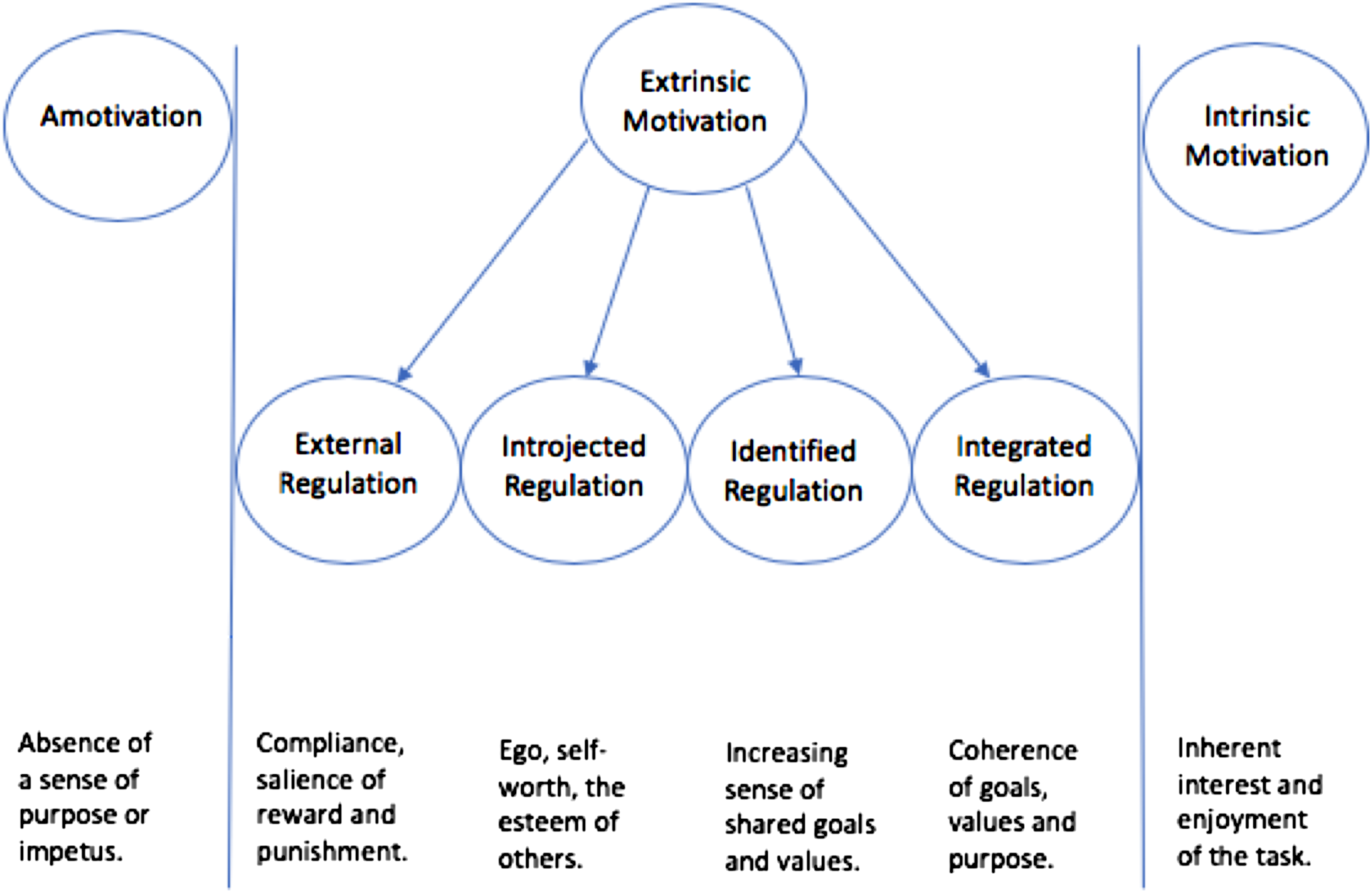
Movement along this continuum is informed by three core psychological needs (Ryan & Deci, 2000) which influence how motivation is internalized: autonomy, competence (feeling effective and capable), and relatedness (a sense of belonging through shared goals and values). Examples of coded data are given in Table 1 for external regulation and introjection (again, chosen as they relate to the illustrative example).
For the theory-led element of the thematic analysis, the three-stage approach recommended by Boyatzis (1998) was employed. Boyatzis (1998) delineates three stages: (1) to establish the themes “through reading and contemplation [of] the theory,” (2) to check the “compatibility with the raw information” through pilot coding and (3) “to determine the reliability of the coder” (p. 36) through inter-rater reliability testing. Inter-rater reliability was established at 93% between two raters and further corroborated by Cohen’s Kappa as 0.874, which indicates a robust level (O’Connor & Joffe, 2020).
Combining Inductive and Deductive Themes
The aim of the combined qualitative analysis was to provide a rich sense of teachers’ perspectives on how performance management affects their motivation to develop professionally. The use of an inductive thematic analysis was important as this entailed the generation of codes from the data itself, meaning the teacher motivation study valued teacher voice as fully as possible (acknowledging researcher reflexivity). Meanwhile, the deductive analysis provided a structured analysis of data with a well-established and rigorously theorized conceptual framework.
Crucially, what enables this hybrid approach is that these inductive and deductive patterns can be overlain upon one another to identify similarity and difference. This is where notions of abduction and retroduction can then begin to be brought to bear, in the form of identifying the unexpected or surprising gaps in explanation or theory (abduction) and reformulating theory to account for this (retroduction) (Danermark et al., 2019; Meyer & Lunnay, 2013). However, such processes of abduction and retroduction would not be confined to the inductive/deductive qualitative analysis, as the next section will argue.
Inductive/Deductive Hybrid Thematic Analysis and Quantitative Methods
The value of inductive/deductive hybrid thematic analysis can also be seen in a mixed methods approach to inquiry when synthesized with a quantitative data strand which has shared theoretical underpinnings. In this instance, an example is given of an approach commonly used in educational research, namely exploratory factor analysis.
Sequencing and Convergence
With the integration of qualitative and quantitative methods, the sequencing of data collection and analysis should first be stated. As Creswell and Plano Clark (2018) note, “convergent design” has been referred to by various related terms such as “parallel study (Tashakkori & Teddlie, 1998); convergence model (Creswell, 1999) and concurrent triangulation (Creswell et al., 2003)” (p. 68). To use the helpful notation offered by Creswell and Plano Clark (2018), the teacher motivation study in this instance employs a “QUAN + QUAL” convergent design, where “both strands had equal emphasis, and the results of the separate strands were converged” (p. 62–3). Clearly, this does not exclude the possibility that inductive/deductive hybrid thematic analysis cannot be employed in a mixed methods approach in a differently weighted fashion (e.g., QUAL+Quan) or sequenced in an alternative way (QUAN → Qual). In other words, it may be possible that inductive/deductive hybrid analysis can be employed in a versatile way within mixed methods design. However, the present article argues convergent design is particularly apt, given the emphasis this approach has on synthesis (which is particularly important when the ideas of abduction and retroduction are brought to bear—to be discussed more fully). Similarly, in respect to the integration of qualitative and quantitative data, the clean, parallel process offered by Creswell and Plano Clark (2018) is valuable as it offers clarity and organizational structure. Yet following Bazeley (2018) and Law (2004), it is apt to acknowledge the reality of mixed methods research is somewhat more complex in practice.
An Illustrative Example: Inductive/Deductive Hybrid Thematic Analysis and Ordinal Exploratory Factor Analysis
A survey instrument was designed using Self-Determination Theory as an underlying construct, administered to qualified teachers (with 323 respondents). Items were devised which related to each of the categories of motivation referred to in Figure 2, using well-established Self-Determination Theory approaches relating to phraseology, item response range and number of items (Gorozidis & Papaioannou, 2014).
The specific mode of factor analysis also warrants pause. There is robust debate as to the appropriate treatment of Likert data. The present article contends a Likert-type item should be regarded as ordinal in nature. For example, one person’s Disagree, may be another’s Disagree Somewhat (Shearman & Petocz, 2012). Similarly, it is not possible to argue that Disagree is at an exact distance apart from Agree for every individual. This absence of homoscedasticity has significant implications for any multivariate statistical analysis, leading some to believe Likert data can never be appropriate for analysis parametrically, as parametric analyses are predicated on mathematical assumptions such as equal variance (Basto & Pereira, 2012; Shearman & Petocz, 2012). Similarly, regarding normal distribution, as Jamieson (2004) observes, many Likert scales tend towards a skewed/polarized distribution, for instance, where a high concentration of Agree and Strongly Agree might be observed on a more emotionally charged topic. It was deemed prudent on the basis of these arguments to employ an ordinal factor analysis (Basto & Pereira, 2012; Lorenzo-Seva & Ferrando, 2015). This also has some relevance to the relationship between quantitative work and a critical realist paradigm; this will be explored more fully in respect to the work of Pratschke (2003), who argues modern statistical models in the social sciences do not assume positivist rigidity.
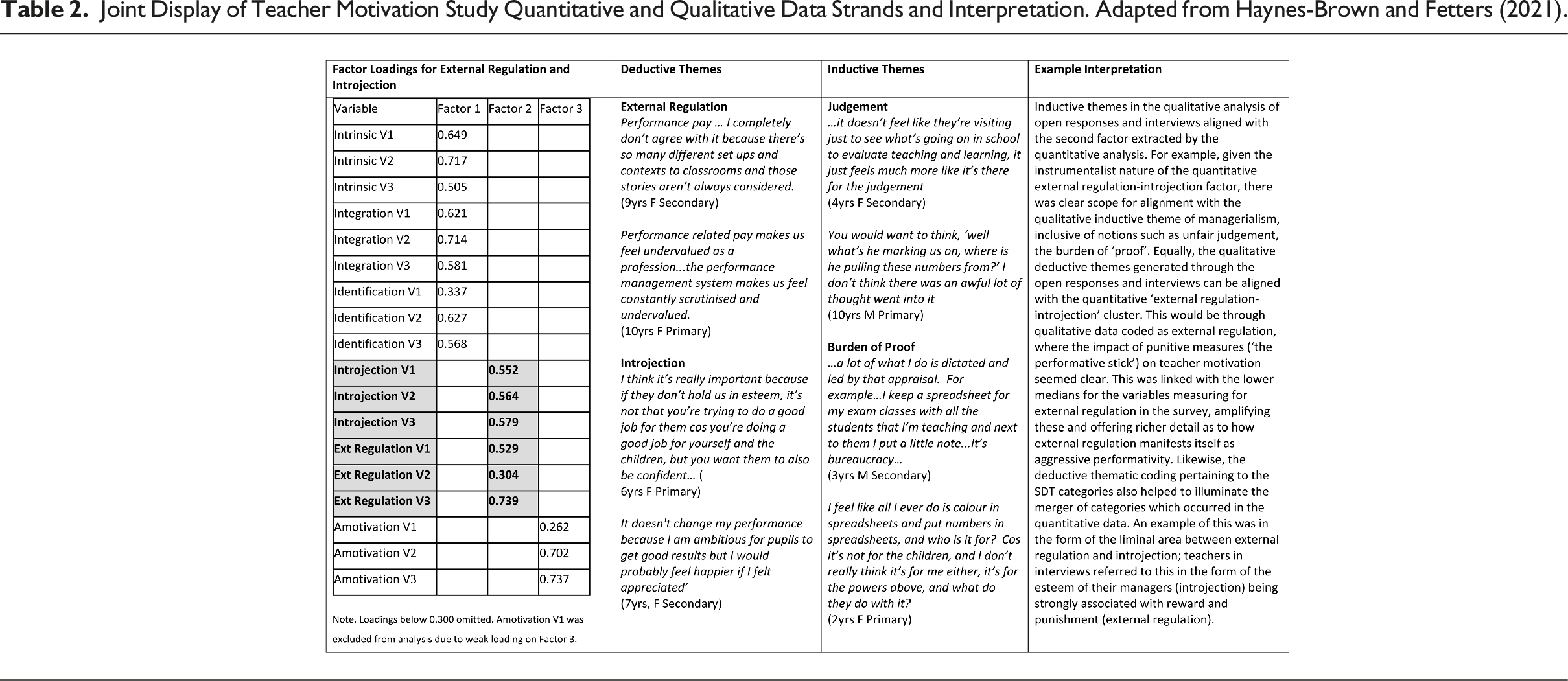
Initial indicators for the viability of a factor analysis proved very encouraging, with ordinal alpha: 0.792,125, Bartlett’s test of sphericity = 1636.5 (df = 153; p = 0.000,010) and the Kaiser–Meyer–Olkin (KMO) test = 0.79,263. Parallel Analysis recommended the extraction of three factors when real-data % of variance with the random % of variance (31.1/14.8; 20.0/13.5; 13.1/12.3). In respect to robustness of fit, the subsequent factorization reported strong goodness of fit indices for a three-factor model: RMSEA = 0.038; NNFI = 0.977; CFI = 0.985; GFI = 0.985; RMSR = 0.0433. One variable with a weak loading (0.262) was eliminated from the analysis in the interests of rigor. Taken together, this represented a plausible factorization.
In common with other studies employing such quantitative instruments, there proved to be a clustering of teachers’ motivational responsiveness to Identification and Integration, occurring alongside a strong association with Intrinsic Motivation. This finding was replicated by Wilkesmann and Schmid (2014) who found an “empirical merger between intrinsic and identified motivation” (p. 14). Similarly, there emerged a contrasting motivational cluster characterized by externality, performance, and control: an association or merger of Introjection and External Regulation, also noted by other studies (e.g., Fernet et al., 2008). This blurring of motivational categories was characterized by external control, instrumental activity and a sense of performance.
Qualitative/Quantitative Synthesis
Joint Display of Teacher Motivation Study Quantitative and Qualitative Data Strands and Interpretation. Adapted from Haynes-Brown and Fetters (2021).
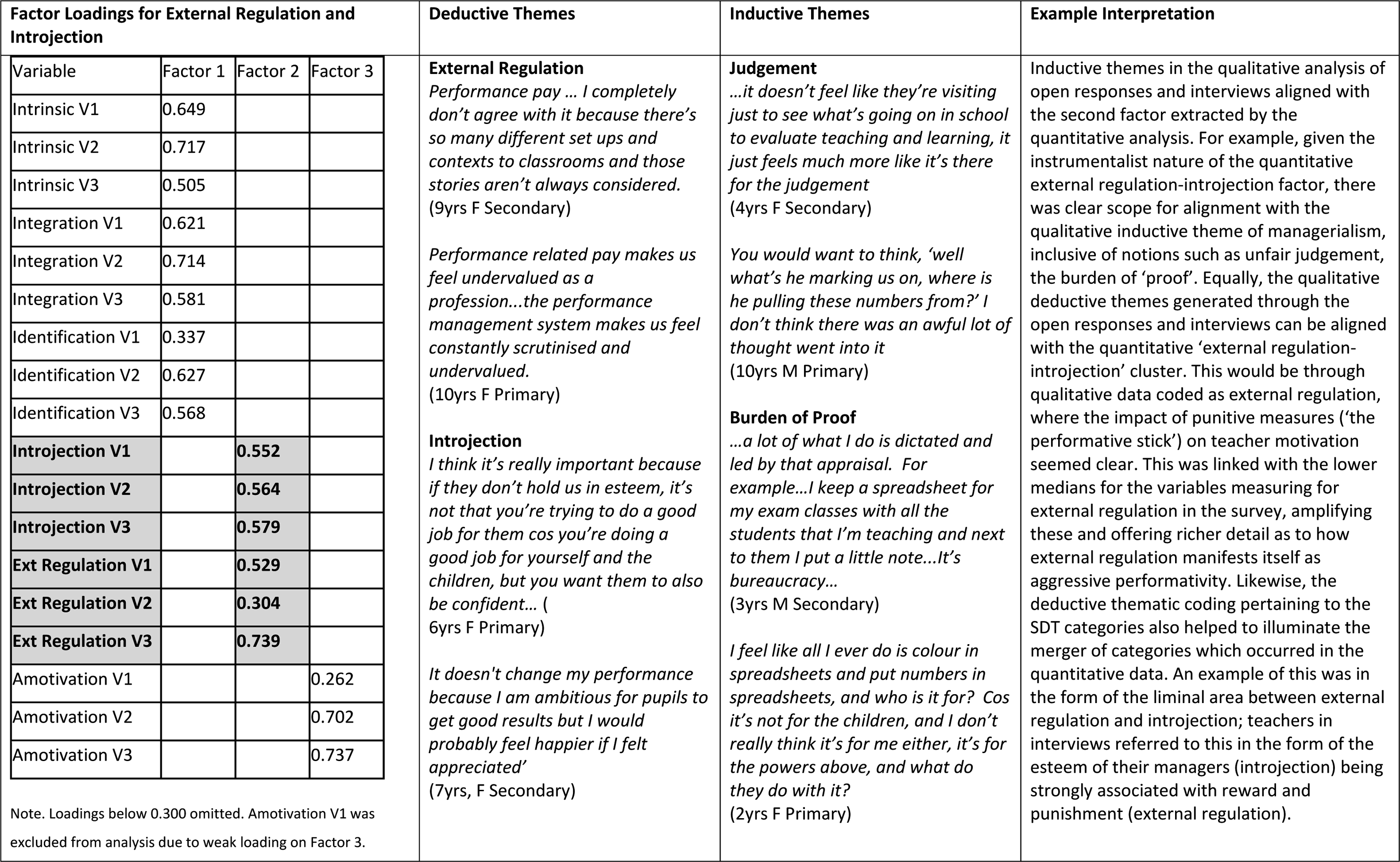
However, Creswell and Plano Clark (2018) rightly identify a particular challenge with the convergent approach as “the need to explain divergence when comparing results” (p. 72). When viewed from the perspective of abduction and retroduction, such divergence can represent real opportunities for the generation of new ideas. An example of this related to a distinctive and interesting point of divergence: quantitative findings and open responses from the survey ranged from very negative to only mildly positive on performance pay, while some of the interviews indicated it might possess more considerable motivational potency. However, this unexpected variation proved to be accounted for by the notion of an emoluments. The distinction between an emolument (a just reward for services already rendered) and an incentive (a future-orientated inducement) was important, as some teachers interviewed appeared more in favor of an emolument, as differentiated from an incentive. In respect to incentivization, the data strands were much more closely aligned overall. The difference here appeared to be the capacity of the interviews as a research method to enable more subtle and detailed discussion of the notion of performance pay, leading to more explicit differentiation between performance-related and performance-enhanced pay, whereas the survey was more orientated towards the notion of pay as incentive. It was the comparison of the qualitative and quantitative data which lead abductively to the generation of the idea of an emolument to explain an unexpected variation with the synthesis, and by extension, this led to greater complexity in the retroductive theorization of instrumental motivation more broadly.
One key facilitator to also note is the use of qualitative survey open responses as a hinge between quantitative survey data and the larger body of qualitative interview data. Inductive/deductive hybrid thematic analysis of survey open responses can act to gauge comparatively the sense of conceptual or theoretical continuity/similarity between the different data strands. This process of synthesis between an inductive/deductive hybrid thematic analysis and its quantitative partner can in turn lead retroductively to new theorization, in this case with the emergence of a composite conceptualization of teachers’ developmental motivations.
In sum, this example illustrates how inductive/deductive hybrid thematic analysis can offer rich scope for partnership and interaction with a range of theory-informed quantitative data.
Critical Realism and Inductive/Deductive Hybrid Analysis in Mixed Methods Research
A final area of consideration relates to the compatibility and mutual relevance of inductive/deductive hybrid thematic analysis with an important meta-theoretical perspective: critical realism. Critical realism offers a fully articulated ontological and epistemological position, but with many of the methodological virtues of pragmatism (Scott, 2007). This has obvious relevance to the immediately preceding section of the present article as it relates to the synthesis of numeric and non-numeric data. However, it also has relevance in relation to the philosophical reconciliation of the concepts of induction and deduction solely within thematic analysis, as recently demonstrated by Roberts et al. (2019).
To explain why, it is important that critical realism is defined. Bhaskar (1975) delineates basic realism as the idea “perception gives us access to things…that exist independently [my italics] of us” (p. 30). However, crucially, for critical realists: “ontology (the way things are) determines epistemology (the way things are known)” (McGrath, 2004, p. 107). This would be distinct from a stance such as Kantian transcendental idealism (Kant, 1781), whereby knowledge comes from experience, but where our minds impose what that experience is (i.e., the real does not exist independently of the mind). Rather, for critical realism, the real nature of things (though ultimately not completely knowable) exerts an influence on how we perceive them.
A key concept which then arises within critical realism is that of stratification or ontic depth (McEvoy & Richards, 2006; Olsen, 2009) which recognizes the complex realities researchers engage with, implying the many and layered ways of attempting to know a thing. This leads in turn leads to epistemic relativism, which is embraced by inductive/deductive hybrid thematic analysis. From this, a logical consequence is methodological pluralism; if there are many and sometimes changing ways in which an object can manifest itself, this implies that it can be viewed in multiple ways methodologically. For example, Danermark et al. (2019) describe how mixed methods research within a critical realist paradigm can employ intensive and extensive approaches at the same time: “intensive…is characterized by focusing on a particular case or…cases” while “extensive…uses quantitative methods to describe…demi-regularities, frequencies, patterns” (p. 178). In this case, there is an intensive element (the focused interviews and associated analysis) and an extensive element (a survey to a wider group and ordinal factor analysis), with a bridging component between these (the survey open responses).
Abduction and Retroduction
Companions of ontic depth and epistemic relativism are the critical realist concepts of abduction and retroduction (Danermark et al., 2019; Meyer & Lunnay, 2013). These concepts concern the analytical recognition of data beyond an immediate theoretical framework (abduction) and the reconceptualization of theory on the basis of such analysis (retroduction). Importantly here, this implies a theoretical framework is not simply proved or disproved in the sense of deductive logic, but rather evaluated, revised and reconceptualized on the basis of the findings. Therefore, such an approach should be theory-generative, rather than simply theory-confirmatory. To acknowledge such theoretical influences explicitly, while also being critically minded as to their utility, offers an arguably more valid and transparent approach. At the same time, this has the advantage of being tempered by the inductive element as a counterbalance to the imposition of theory. Inductive/deductive hybrid thematic analysis lends itself sympathetically to these processes of abduction and retroduction. Teddlie and Tashakkori’s (2009) definition of abduction is a “third type of logic” (p. 89) which seeks to acknowledge the unexpected and then make “inferences about best possible explanations” (Teddlie & Tashakkori, 2009, p. 329) for this surprising data. The inductive/deductive approach enables the generation of the unexpected while also supporting the inferential explanatory process. Likewise, retroduction, or the formation of new theory, occurs at the point of synthesis. Blaikie and Priest (2017) have articulated the value of employing induction and deduction together to generate retroduction. This can be an iterative process, whereby the inductive and deductive are shuttled between to generate re-conceptualizations. Crucially, however, this article would contend such an approach can include multiple points of reference—not solely the juxtaposition of qualitative inductive and deductive strands, but also, and importantly, synthesis with quantitative data.
A caveat should also be noted here in respect to the discussion of abduction and retroduction. For the purposes of this article, the four logics of induction, deduction, abduction, and retroduction have been present as distinct and to some extent sequential for the purposes of analytical and conceptual clarity. However, as Chew (2020) has described, all of these logics can be simultaneously in play, with the one or more being particularly prominent in a given inquiry (or stage of inquiry). Danermark et al. (2019) have described how the reality of abduction and retroduction is such that sharp differentiation between the two can be challenging (because the identification of data out with a theoretical framework and the resultant reconceptualization of theory can occur in close unison). Importantly, however, they argue explicit and conscious use of these terms is therefore all the more appropriate.
Another complexity relates to abduction itself. Clearly, abduction would not be confined to mixed methods studies. Charmaz (2008) has illustrated how interactions might occur between the individual logics of induction and abduction alone, without the additional catalysts of a qualitative-deductive or a quantitative strand, noting there can be an inductive/abductive process whereby “grounded theory starts with an inductive logic but moves into abductive reasoning…to account for surprises, anomalies, or puzzles” (p. 157). By the same token though, within a mixed methods approach, it may also be possible that an instance of abduction could be derived prior to synthesis or convergence.
Critical Realism and Quantitative Methods
Some specific controversies in respect to the use of a critical realist paradigm with the quantitative element of mixed methods research should also be addressed. Pratschke (2003) notes a historical “objection that critical realists…made to…assumptions…[like] homoscedasticity and multivariate normality” (p. 22) (with the issue being these imply a positivistic sense that reality is truly knowable), but goes on to argue this is now less relevant, due to modern statistical methods which can account rigorously for issues around equality of variance and non-normal distribution, such as the ordinal factor analysis employed in the present article (Basto & Pereira, 2012; Lorenzo-Seva & Ferrando, 2013). Secondly, Pratschke (2003) also notes the tendency of early critical realists to regard quantitative work as occurring within a reductively closed system whereby analytical closure can be achieved (i.e., that a question can be definitively and conclusively answered). Yet classic critical realists also believe that in an open system it is possible for demi-regularities to occur, which are defined as “partial event regularities which prima facie indicates the occasional, but less than universal, actualization of a mechanism or tendency” (Lawson, 1998, p. 149). Pratschke (2003) argues persuasively “covariances between variables can be interpreted as equivalent to ‘demi-regularities'” (p. 25); in other words, statistical analyses such as ordinal factor analyses readily align with critical realist thinking when properly understood. It is important to note Pratschke (2003) is referring to correlation rather than causation (the latter would be especially problematic for critical realists). At this point, it is also possible to return to the main focus of inductive/deductive hybrid thematic analysis, because such arguments relating to analytical closure or knowability could also be associated with the deductive element of a thematic approach and this has been addressed in the preceding paragraph on abduction and retroduction (Danermark et al., 2019; Meyer & Lunnay, 2013). Therefore, in sum, if appropriate quantitative methods are employed, these can readily work in partnership with inductive/deductive hybrid thematic analysis within a critical realist paradigm.
Critical Realism and Pragmatism
It is also worth acknowledging that such a mixed methodological approach might be viewed as compatible with another philosophical paradigm, namely pragmatism. For example, Timmermans and Tavory (2012) position abduction in relation to Peirce’s (1931) definition of this concept, within the pragmatist paradigm. Yet the conceptual slippage noted earlier in respect to Danermark et al. (2019) and Chew (2020) is relevant here. As Blaikie (2018) notes, “a careful reading of Peirce reveals that what he had in mind [in respect to abduction] is almost identical to the use of retroduction in Bhaskar’s (1979) critical realism” (p. 638). This could be illustrated by Timmermans and Tavory (2012), whose conception of abduction as “producing new hypotheses and theories based on surprising research evidence” (p. 167) is very readily comparable to a critical realist conception of retroduction. However, while Blaikie’s (2018) point is perhaps valid that the processes associated with Peirce’s (1931) idea of abduction and Bhaskar’s (1979) notion of retroduction might be very similar, it should be observed that the underlying philosophical assumptions of pragmatism and critical realism would continue to be divergent.
Limitations
Although this article argues for the effectiveness of inductive/deductive hybrid thematic analysis (Fereday & Muir-Cochrane, 2006) and contends this approach augments the rigor of an otherwise solely inductive or solely deductive procedure, it is worth noting the general limitations of thematic analysis (such as bias or replicability) would still be applicable and could not be excluded entirely. Another related limitation can be noted here, applicable to mixed methods studies more generally: that the sequencing of the data analysis and the potential consequent influence of one data strand on another must be acknowledged, ensuring the process surrounding this is transparent (Creswell & Plano Clark, 2018). This can carry an additional complexity with inductive/deductive hybrid thematic analysis because of the iterations described above.
Secondly, it is important to acknowledge alternative philosophical perspectives might also encompass mixed methods approaches which enable abduction and retroduction, such as realist pragmatism (Lipscomb, 2011). Therefore, future work exploring the relationship between pragmatism and inductive/deductive hybrid thematic analysis within a mixed methods design would also be recommended.
Contribution to the Field of Mixed Methods Research
This article sought to address gaps in methodological knowledge in respect to how inductive/deductive hybrid thematic analysis might be synthesized effectively with quantitative methods and within a coherent critical realist paradigm. This has been explored in three stages: firstly, the merit of inductive/deductive hybrid thematic analysis in its own right; secondly, the complementary synthesis of inductive/deductive hybrid thematic analysis with quantitative methods, and thirdly, the coherence of such an approach with a critical realist paradigm. Thus, the article now identifies a contribution to the field that is principally twofold in nature.
Firstly, in respect to the case for the compatibility of inductive/deductive hybrid thematic analysis with quantitative methods, it would be maintained this has been clearly demonstrated. This is perhaps considered most pronouncedly of value when there is a synthesis of inductive/deductive hybrid thematic analysis partnered with quantitative work which uses the same theoretical construct(s), therefore leading to a more complementary analysis. Thus, such an approach is commended to researchers for productive use in the examination of similarly multifaceted research problems which would benefit from qualitative thematic analysis in partnership with quantitative methods. Similarly, while the quantitative illustrative example was an ordinal exploratory factor analysis, this article recommends future exploration of inductive/deductive hybrid thematic analysis with other theory-informed quantitative work, such as the suite of methods associated with structural equation modelling. When combining inductive/deductive hybrid thematic analysis with quantitative work that is survey-driven, another practical recommendation for researchers would be to consider the inclusion of qualitative survey open responses as a valuable facilitator which supports the interaction between the data strands.
Secondly, in respect to the alignment of this approach within a critical realist paradigm, the article also makes a fresh contribution to the field. The coherence of this approach with a critical realist stance has been demonstrated, and not solely in terms of its philosophical reconciliation, but also in terms of the practical and productive application of this paradigm and it would thus be recommended to researchers when employing inductive/deductive hybrid thematic analysis. Particularly, the critical realist concepts of abduction and retroduction are key to the understanding of the value of inductive/deductive hybrid thematic analysis and its effective synthesis with quantitative analysis and these are commended to researchers as important logics to consider when employing such an approach. Likewise, abduction and retroduction can be seen to be have clear value when examining layered and complex problems in a responsive and theory-generative way. By extension, the article also makes a supportive contribution to the broader literature related to integrative mixed methods research, by offering an illustrative example of how such integration can occur at the paradigmatic, theoretical, analytical, and interpretative levels.
In conclusion, inductive/deductive hybrid thematic analysis employed with theory-informed quantitative analysis within a coherent critical realist paradigm is commended for broader use in integrative mixed methods research. It has been demonstrated that inductive/deductive hybrid thematic analysis is highly compatible with quantitative work driven by the same theoretical framework. At the same time, it is in strong alignment with a critical realist stance, being particularly conducive in respect to abduction and retroduction. Thus, inductive/deductive hybrid thematic analysis can be seen as highly facilitative of a truly integrative approach to mixed methods research.
Footnotes
Acknowledgments
I would like to express my heartfelt gratitude for the guidance, patience and wisdom of the editorial team and reviewers.
Declaration of Conflicting Interests
The author(s) declared no potential conflicts of interest with respect to the research, authorship, and/or publication of this article.
Funding
The author(s) received no financial support for the research, authorship, and/or publication of this article.
