



Abstract
The purpose of this study is to investigate the effects of combined carbohydrate (CH) and caffeine (CAF) supplementation on the sports performance of basketball players. A randomized crossover controlled experimental design was employed. A total of 32 collegiate-level basketball players were randomly assigned to one of the four groups: placebo (PLA), CH (30 g/h glucose solution) group, CAF (3 mg/kg body mass) group, and CH + CAF (combined intervention) group. Participants underwent a series of tests, including the countermovement jump (CMJ), 20-m sprint (20 m), change-of-direction and acceleration test (CODAT), Yo-Yo intermittent recovery test level 1 (Yo-Yo), free throw (FT) test, and straight-line dribbling speed (SLDS) test. Heart rate (HR) and blood lactic acid (BLA) levels were also monitored during the tests. The results revealed that, in the CMJ, 20 m, and CODAT tests, the CAF and CH + CAF groups outperformed the PLA group significantly (p < .05). In the Yo-Yo test, both the CH and CH + CAF groups demonstrated significantly better performance compared with the PLA group (p < .01). However, no significant differences were observed among the groups in the FT and SLDS tests (p > .05). Notably, the BLA levels in the CAF group were significantly higher than those in the PLA and CH groups 1-min postexercise (p < .05), and also significantly higher than in the CH + CAF group (p < .01). Three min after exercise, BLA levels in both the CH + CAF and PLA groups increased significantly (p < .05), with the CH + CAF group showing a greater increase compared with the CH group (p < .01). During exercise, the HR in the CH group was significantly lower than in the PLA group (p < .01), while the HR in the CAF group was significantly higher than in the PLA group (p < .01). Furthermore, the HR in the CH group was significantly lower compared with the CAF group (p < .01), and the HR in the CH + CAF group was significantly higher than in the CAF group (p < .01). After exercise, the HR in the CH group remained significantly lower than in the CAF group (p < .01). In conclusion, the combined supplementation of CH + CAF can effectively improve the overall sports performance of basketball players, with a certain recovery effect on physiological responses, but has no significant impact on professional skills. Overall, joint supplementation has not shown significant synergistic effects, but it can still be used as one of the nutritional strategies, with flexible selection of usage based on actual needs.
Introduction
With the advancement of competitive sports, the overall capabilities of athletes have gradually become a crucial factor in determining the outcome of competitions. In this context, sports nutrition has gained increasing attention as a key means to enhance sports performance (McArdle, 2018). In recent years, carbohydrate (CH) and caffeine (CAF) have been recognized by both sports nutrition scholars and athletes as two of the most common and effective supplements (Keane et al., 2020). CH enhances athletes’ endurance and performance by providing a steady energy supply, which helps delay fatigue during physical activity (Coyle et al., 1983; Ramos-Campo et al., 2024). CAF, on the other hand, stimulates the central nervous system, increases neural excitability, and enhances explosive power and responsiveness in short bursts (Abian-Vicen et al., 2014; Raya-González et al., 2021). As a result, their potential benefits in sports training and competition are increasingly acknowledged, particularly in high-intensity, intermittent sports such as basketball, where both aerobic and anaerobic energy systems are engaged to help athletes meet the demands of competition. However, the combined effects of CH and CAF in basketball remain underexplored, and our study aims to fill this gap.
The individual effects of CH and CAF on exercise performance have been confirmed by numerous studies. Naderi highlighted that CH, as a vital source of energy, can significantly delay fatigue during endurance exercises and improve the ability to sustain activity (Naderi et al., 2023). In addition, the role of CH in high-intensity, intermittent sports has gained increasing attention. Research has shown that CH intake during events such as basketball helps maintain an athlete’s energy levels while enhancing both explosive strength and endurance throughout the game (Baker et al., 2015). Similarly, the effects of CAF are widely acknowledged. Tan et al. systematically reviewed the effects of CAF on basketball players that it can significantly enhance sports performance, including jumping, sprinting, and agility, while also improving physical reaction speed in short bursts (Tan et al., 2022). Grgic and Heydari et al. further found that CAF not only enhances an athlete’s explosive power but also boosts aerobic capacity, particularly in sports that require rapid movement transitions and speed (Grgic, 2022; Heydari et al., 2025).
Although numerous studies have demonstrated the combined effects of CH and CAF in sports such as cycling, football, and rugby (Gant et al., 2010; Roberts et al., 2010), research specifically focused on basketball performance remains limited. Existing research has primarily focused on the effects of single supplements. While the impact of CH and CAF on various types of sports has been extensively studied, systematic research specifically addressing sports like basketball is still lacking. Despite the significant effects of CH and CAF in different sports, there is no consensus regarding the benefits of their combined intake (Lopez-Seoane et al., 2024). Some studies suggest that the combined use of CH and CAF may have synergistic effects, as they target different energy systems and complement each other (Campbell et al., 2013). However, other studies indicate that the combined intake may not significantly surpass the effects of individual supplementation, and in some cases, the effect may be diminished due to inappropriate dosing or metabolic interference (Campbell et al., 2013).
Research on the effects of combined CH and CAF intake on basketball players’ performance remains limited. Basketball, a sport that heavily relies on short-term explosiveness, responsiveness, and specialized skills, requires athletes to perfectly integrate their fitness and skills in rapid transitions (Karjalainen, 2021). Existing studies have primarily focused on routine fitness tests, with insufficient attention given to the impact of actual game techniques on basketball players’ performance. Although some studies suggest that the combined use of CH and CAF may enhance overall sports performance, there is a lack of quantitative analysis specifically addressing the sports performance of basketball players who combine different supplements(Douligeris et al., 2023).
To investigate the effect of combined CH and CAF intake on the sports performance of basketball players, a randomized crossover experiment was conducted. The study included four groups: PLA group, CH group, CAF group, and the CH + CAF group. A range of fitness and skill tests were performed, including jump, sprint, directional agility, and endurance tests, as well as technical assessments for free throw (FT) shooting and ball speed. In addition, heart rate (HR) and blood lactic acid (BLA) concentrations were monitored to assess the impact of the supplements on the athletes’ resilience, while exploring the physiological mechanisms and recovery effects of the supplementation.
The primary aim of this study is to examine the effects of combined CH and CAF intake on basketball players’ performance, providing valuable insights for nutritional interventions in basketball training. In addition, physical fitness indicators (CMJ, 20 m, CODAT and Yo-Yo) as primary outcomes, and technical performance (FT, SLDS), HR and BLA as secondary outcomes.
This study presents the following hypotheses: combined intake of CH and CAF will significantly enhance basketball players’ performance, particularly in short-term explosive, agility, and endurance tests. However, in terms of specialized techniques, such as FT shooting and ball speed, the effects of the supplements may be limited, primarily due to the inherent stability and psychological factors influencing the technical actions.
Methods
Research Design
This study adopted a randomized crossover controlled experimental design involving 32 participants, who were randomly assigned to one of the four groups: A Group, B Group, C Group, and D Group. A total of 32 basketball players were randomly divided into four groups using allocation sequences generated in SPSS 27.0 by independent researchers who did not participate in data collection. The study adopted a randomized crossover design, where each participant underwent four different interventions, spaced 1 week apart. To maintain double-blind conditions, neither the participants nor the outcome assessors knew which intervention was being administered. All supplements were provided in identical, unmarked bottles to ensure the blinding process was properly followed.
All participants received four different interventions (PLA, CH, CAF, and CH + CAF) according to the random cross design, and group labeling (A–D) was used only to schedule the test sequence; Each participant completed the full test 1 week between each intervention. Among them, Group A received artificial sweeteners (placebo), Group B glucose solution (30 g/h), CAF intake in Group C (3 mg/kg), Group D receives CH + CAF joint intervention (Krings et al., 2016; Puente et al., 2017). The design of the crossover trial was illustrated in Figure 1. One week prior to the experiment, all participants were introduced to the laboratory environment and familiarized with the testing procedures and equipment. Two days before the trial, participants’ height and weight were recorded using a standardized height and weight measuring device.

Sample Cross-Over Experiment.
Participants
The power calculation was based on a repeated-measures ANOVA design using G*Power software (version 3.1.9.7, Franz Faul, University of Kiel, Germany) (Faul et al., 2007). The following parameters were applied for the calculation: α = .05, statistical power (P) = .85, effect size = .20. The effect size was derived from prior studies on similar crossover designs (Heydari et al., 2025). The unit of randomization and analysis was the individual, as each participant completed all four conditions. The study design included four groups and three measurements. The calculated minimum sample size was 68, however, 128 samples were selected to ensure data reliability. As a result, 32 male basketball students from Xi’an Physical Education University were chosen as participants. Descriptive statistics for the basic demographic information were presented as mean ± standard deviation, as shown in Table 1. All participants provided informed consent, and the study was approved by the Ethics Committee of Xi’an Medical University (No. XYLS2025353), in accordance with the principles outlined in the Helsinki Declaration.
Basic Information of Experimental Subjects.

To ensure the scientific rigor and accuracy of the research, strict inclusion and exclusion criteria were established for the study. The specific criteria are as follows:
Inclusion criteria Age: Between 18 and 25 years old and with more than 3 years of basketball training experience. Level: College Competitive Level Men’s Basketball Players; Intake Criteria: Excessive coffee consumption should be avoided for 1 to 2 weeks, and no CAF-containing food or beverages should be consumed within 24 hours prior to each experiment. Physical health: No chronic disease or medical condition (e.g., cardiovascular disease, diabetes, and neurological diseases); Physical activity: At least 4 times a week, 360 min a week or more; Informed Consent: Participants who voluntarily agreed to participate and provided written informed consent.
Termination Criteria
To prevent potential confounding factors, participants in the following situations were excluded from the study: Medical condition: Had a history of cardiovascular disease, metabolic disease (such as diabetes or hypertension), neurological disease, or other chronic diseases; Drug use: Used any drug, stimulant or substance (such as alcohol, nicotine, or drugs) is being used; Allergic reactions: Individuals with known allergic reactions to any substance used in the study, such as artificial sweeteners, glucose, CAF or their combination; Non-compliance with the experimental program: Participants who were unwilling or unable to comply with the experimental program; Recent Injury or Illness: Individuals with motor injury or illness during the past month.
Exercise Procedures
Warm-up Preparation
On the day of the experiment, participants arrived at the laboratory by 8:40 a.m. for check-in, completed the basic information form, and had their height and weight measured and recorded. At 9:00 a.m., the participants ingested the corresponding supplements based on their assigned group: the CH group consumed 30 g of glucose solution, the CAF group will ingested a CAF solution (3 mg/kg of body mass), the CH + CAF group took a combination of both supplements, and the PLA group received an energy-free artificial sweetener solution (CPT sucralose-based formulation, primarily containing sucralose). Compound CH supplements are also purchased from CPT, mainly composed of glucose and malt dextrin. The CAF powder (99% anhydrous CAF) was purchased from CPT, and batch certificates were provided. All supplements were ingested with 500 mL of water. After supplement ingestion, the participants sat and rest for 40 min. During this period, baseline data such as resting HR and BLA were recorded.
In addition, all supplement solutions (CAF, CH, and PLA) were prepared by a member of the research team who was not involved in data collection or result assessment. The timing and dosage of supplementation were strictly controlled. Supplements were ingested 40 min prior to the testing session to allow for adequate absorption, ensuring that the nutritional intake aligned with the experimental design. To deal with possible taste differences between CAF, glucose, and artificial sweeteners, we implemented a masking strategy to maintain the blind method. CAF solutions are carefully prepared to reduce their natural bitterness, often by adding neutralizing ingredients or spices to minimize taste differences with glucose and placebo solutions. Each solution was dissolved in a standard volume of water according to a pre-set random coding table and stored in uniform containers, which were labeled only with participant numbers to ensure blinded intervention.
Warm-up
Participants performed a 5-min steady-state warm-up on a stationary bike at a constant power output of 100W. This warm-up aims to activate all major muscle groups and increase flexibility and responsiveness. In addition to the bike warm-up, dynamic stretching and muscle activation exercises were incorporated to improve range of motion and ensure participants were physically prepared for the high-intensity testing ahead.
Main Test
Participants first completed the CMJ, followed by a 20m and the tester recorded the completion time using a stopwatch to evaluate speed performance. Following the sprint, participants underwent an agility test (CODAT: Multi-Angle Directional Transform) to assess responsiveness, flexibility, and directional switching ability. The next test was the Yo-Yo endurance test, where the maximum completion distance was recorded to assess aerobic endurance. After the Yo-Yo test, participants entered the recovery phase. During this phase, BLA concentration and HR were measured at 1 min and 3 min postexercise to evaluate the metabolic response and recovery. The final tests included a FT shooting test and 24-m straight dribbling test. In the FT test, participants attempted a specified number of FT, with the shooting accuracy serving as the evaluation metric. The dribbling test involved a 24-m full dribble, with the completion time recorded to assess ball handling speed and focus under fatigue.
Rest
All physical fitness tests were conducted in indoor basketball halls under relatively stable environmental conditions. Although temperature and humidity were not actively controlled, the tests were scheduled at similar times each day, during which the ambient temperature ranged from 20 to 24 °C.
Indicators Measurement
Basic Information
Participants’ basic information, including name, age, gender, height, and weight, was collected. Height measured by a portable height meter (Seca 213), weight measured by electronic scales (Omron HN-289, Japan Omron Medical), both of which were calibrated prior to testing. During measurement, participants were asked to stand barefoot at the center of the scale, remain still, and wait for the height and weight data to appear on the electronic display before being recorded.
Physical Fitness
Countermovement Jump(CMJ) With Arm Pendulum
The countermovement jump (CMJ) with arm pendulum utilizes the Tapeswitch ControlMat™ longitudinal jump test pad for vertical jump assessment. This pad measures the flight time between takeoff and landing to evaluate jump height. Participants begin in a standing position, ensuring uniform weight distribution between their feet, and then perform a jump. In the squat jump with an arm pendulum, participants are allowed to swing their arms freely, squat down, and exert maximum effort to jump as high as possible (Stojanović et al., 2019). The highest jump height recorded during the test reflects the participant’s vertical jump ability and is commonly used to assess the jump performance of basketball players (Wen et al., 2018).
20Meter Sprint (20 m)
To evaluate dash speed, participants begin from a standing position and make their best effort to complete a 20-m sprint. This test is used to assess the sprinting speed and responsiveness of basketball players (Delextrat & Cohen, 2008). During the test, timing is done using a stopwatch, and participants start 20 cm ahead of the starting line. The timer begins when the signaling officer issues the start signal, and stops when the participant completes the sprint. Each participant performs three 20-m sprint, with a 30-s rest between trials, and the fastest time recorded is used for evaluation (Stojanović et al., 2019).
Change-of-Direction and Acceleration Test (CODAT)
CODAT tests are designed to assess the performance of basketball players, particularly their ability to execute lateral movements, sliding, and backward running, all of which are essential for effective defensive play. A commonly used test is the T-test, which measures the speed at which basketball players can change direction. During this test, the athlete begins at point A and sprints forward to point B. Upon reaching point B, the athlete immediately slides to the left toward point C, then moves from point C to point D. Next, the athlete returns laterally from point D to point B, and finally runs backward from point B to point A. The test is timed from the moment the athlete starts at point A and continues until they complete the backward run and return to point A. The time taken to complete the test reflects the athlete’s ability to change direction quickly, providing valuable insight into their agility and responsiveness in shifting position during a basketball game (Sugiyama et al., 2021).
Yo-Yo Intermittent Recovery Test Level 1(Yo-Yo IRL1)
The Yo-Yo IRL1 test is designed to evaluate an athlete’s aerobic capacity, particularly for intermittent sports like basketball (Gottlieb et al., 2022). In this test, the athlete runs back and forth over a 40-m distance, with the running speed progressively increasing at each stage. The test starts at a speed of 10 km/h, with an increment of 0.5 km/h at each subsequent stage. After each stage, the athlete is allowed 10 s to recover, typically by jogging. The test continues until the athlete either voluntarily stops due to fatigue or fails to complete two consecutive runs within the allotted time. The final score is determined by the maximum stage the athlete completes, and aerobic capacity is calculated using the following formula: VO2max(mL/min/kg) = IR1 distance (m)×0.0084+36.4 (Stojanović et al., 2022). In this study, however, the total distance (in meters) covered during the Yo-Yo test was used as the primary analytical indicator, with VO₂max reported only as supplementary information.
Specialized Technology
Free Throw (FT)
In the shot test, the participant stood begins by standing behind the FT line and attempted 20 shots. For each shot, it was recorded whether the attempt was successful. Afterward, the total number of successful shots was counted. The hit rate was calculated by dividing the number of successful shots by the total number of attempts and multiplying the result by 100 to obtain the percentage of successful shots. Finally, the total number of shots, successful shots, and the calculated hit rate were recorded (Liu et al., 2024).
SLDS
To evaluate dribbling speed, participants started from a standing position and make their best effort to completed a 24-m dribbling sprint. This test is used to assess the dribbling speed and responsiveness of basketball players (Delextrat & Cohen, 2008). Timing was done using a stopwatch, with participants starting 20 cm ahead of the starting line. The timer begins when the signaling officer issues the start signal and stops when the participant completes the run. Each participant performed three 24-m dribbling sprints, with a 30-s rest between trials. The fastest time recorded was used for evaluation (Stojanović et al., 2019).
Other Relevant Indicators
BLA
The BLA test was conducted using the EKF Lactate Scout 4 (Germany) portable BLA analyzer (Douligeris et al., 2023). During the test, the participants’ left earlobes were disinfected with an alcohol swab, and blood samples were taken for BLA measurement. BLA levels was tested 1 and 3 min after the completion of the Yo-Yo test. After recording the BLA values, a clean cotton ball was gently pressed onto the puncture site to stop the bleeding (Faude et al., 2009).
Heart Rate (HR)
HR was monitored in real time using the Polar H10 remote HR monitor (Finland). The monitor strap was positioned midway between the participant’s chest and abdomen to prevent slippage and maintain stable skin contact throughout the exercise. Notably, HR measurements are synchronized with BLA sampling, taken at 1 and 3 min after the completion of the Yo-Yo test. In subsequent records, this data is referred to as “During Exercise and Post-Exercise.”
Statistical Analysis
The experimental data were analyzed using SPSS 27.0 software, with all results presented as mean values ± standard deviations. To assess normality, the Shapiro-Wilk test was applied, followed by Mauchly’s test for sphericity. A two-way repeated measures analysis of variance (Group × Time) was conducted for BLA and HR. The results of CMJ, 20 m, CODAT, Yo-Yo, FT, and SLDS were analyzed using one-way analysis of variance. When significant main effects or interactions were identified, further analysis was performed using simple effects. Post hoc analysis was carried out with the Bonferroni minimum significant difference test. Statistical significance was set at p < .05.
Results
Physical Fitness
One-way ANOVA was used to analyze the results of the CMJ, 20M, CODAT, and Yo-Yo tests, with the specific results displayed in the following figure.
For the physical fitness tests presented in Figure 2, one-way ANOVA revealed significant differences between the various supplements in the CMJ, 20M, CODAT, and Yo-Yo tests (p < .05). In the CMJ, 20M, and CODAT tests, the F values were F(3,124) = 3.96, p < .05; F(3,124) = 4.21, p < .01, p < .01; and F(3,124) = 4.72, p < .01, respectively. Post hoc multiple comparisons showed that the CAF group and the CH + CAF group jumped higher in the CMJ, ran faster in the 20 m and CODAT compared with the PLA group (p < .05). In the Yo-Yo test, F(3,124) = 20.14, p < .01. Post hoc multiple comparisons indicated that the CH group and the CH + CAF group were significantly covered greater distance than the PLA group (p < .01).

Effects of Different Supplements on Physical Fitness Performance: (a) CMJ (cm), (b) 20 m (s), (c) CODAT (s), (d) Yo-Yo (m).
Specialized Technology
Similarly, in the specialized basketball skills tests shown in Figure 3, one-way ANOVA indicates that there are no significant differences among the different supplements in the FT and SLDS tests. In the FT test, F(3,124) = 2.05, p = .11>.05; in the SLDS test, F(3,124) = 0.12, p = .95>.05.
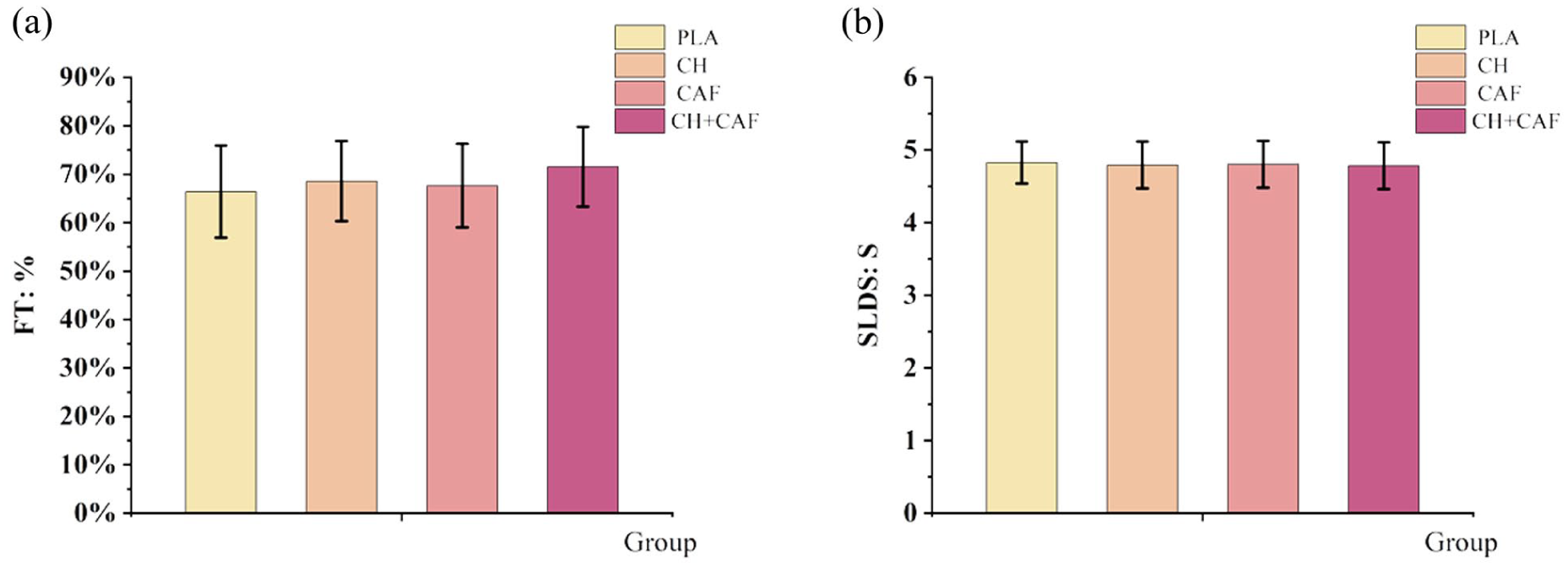
Effects of Different Supplements on Specialized Technology Performance: (a) FT (%), (b) SLDS (s).
Other Relevant Indicators
To examine the changes in BLA and HR of basketball players before, during, and post exercise, a two-way repeated measures ANOVA was conducted, as shown in Figures 4 and 5.
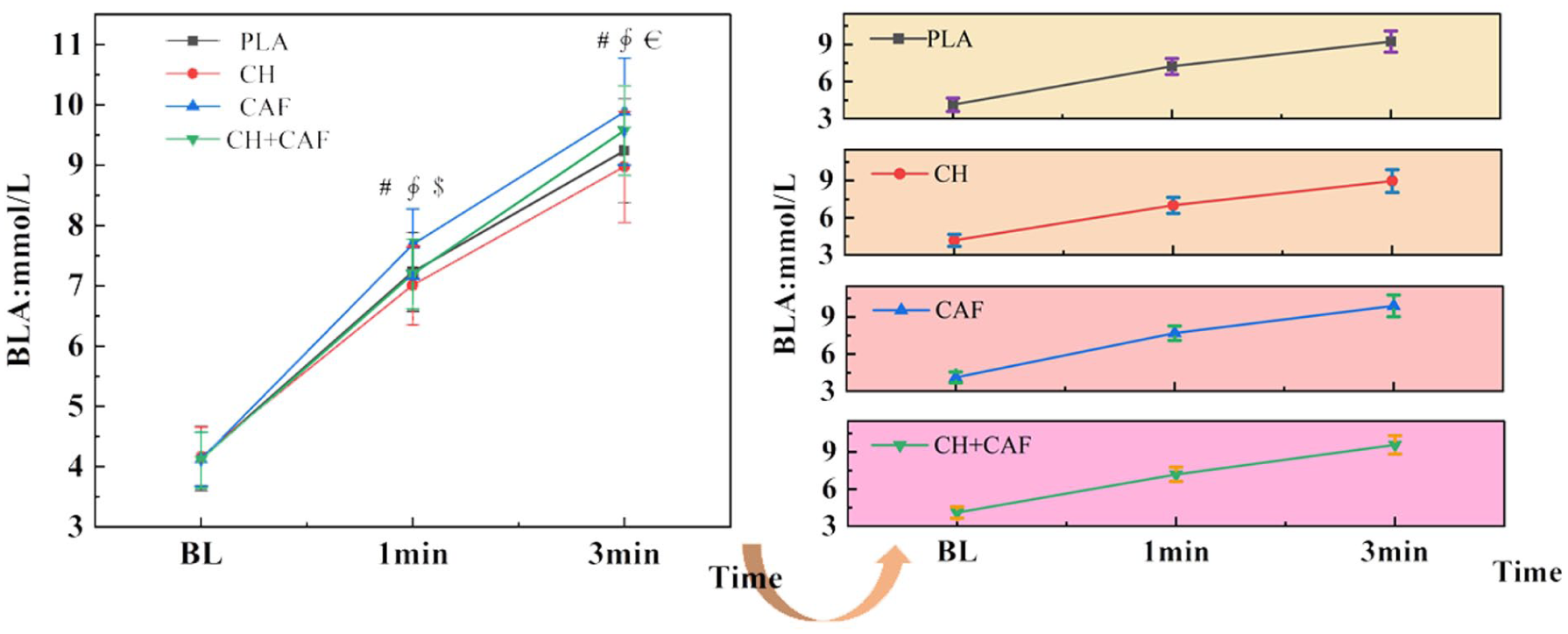
Trend of BLA.

Trend of HR.
The results (Fig. 4) showed that the main effect of BLA was significant at the time point, F(3,124) = 2120.45, p < .00, η2partial=0.95. The main effect of BLA was also significant across different supplements: F(3,124) = 6.89, p < .00, η2partial=0.19. In addition, the interaction effect between time and different supplements was significant, F(3,124) = 9.36, p < .00, η2partial=0.19.
Blood lactate levels were measured at baseline, 1 and 3 min post-Yo-Yo. At 1-min postexercise, BLA increased significantly (p < .05) in the CAF group compared with the PLA and CH groups. Compared with the CH + CAF group, BLA also increased significantly (p < .01). At 3-min postexercise, the CAF group showed a significant increase in BLA compared with both the PLA and CH + CAF groups (p < .05). Furthermore, the CH + CAF group exhibited a significant increase in BLA compared with the CH group (p < .01).
Similarly, the results (Fig. 5) showed that the main effect of HR was significant at the time point, F(3,124) = 1,237.44, p < .00, η2partial = 0.91. The main effect of HR was also significant across different supplements: F(3,124) = 22.30, p < .000, η2partial = 0.35. However, no significant interaction between time and different supplements was observed, F(3,124) = 1.6, p = .19, η2partial = .04.
During exercise, the HR in the CH group was significantly lower than in the PLA group (p < .01). Compared with the PLA group, the HR in the CAF group increased significantly (p < .01). Compared with the CAF group, the HR in the CH group decreased significantly (p < .01). The HR in the CAF group was significantly higher than in the CH + CAF group (p < .01). Compared with the CH + CAF group, the HR in the CH group showed a significant decrease (p < .01). Postexercise, the HR in the CH group decreased significantly compared with the CAF group (p < .01).
Discussion
Increased sports performance is critical for basketball players, particularly in executing endurance, explosive power, agility, and technical actions during a game. Previous studies have shown that individual CH or CAF supplements may enhance sports performance (Tan et al., 2022; Vandenbogaerde & Hopkins, 2011), but the potential synergies of their combined use have not been fully validated. Therefore, this study compares the effects of CH, CAF, and their combined supplementation on basketball players across a range of sports tests. The results showed that both and CH + CAF supplementation significantly improved the performance of jump, sprint and agility tests compared with the PLA group. However, no significant differences were observed between the individual supplement groups (CH or CAF) and CH + CAF group. In endurance testing, both the CH and combined groups outperformed the PLA group, highlighting the positive impact of CH on enhancing athletic endurance. However, no significant differences were observed between groups in specialized technical tests such as penalty shooting and dribbling speed. In addition, the BLA and HR monitoring results demonstrated that combined CH and CAF supplementation plays a crucial role in regulating postexercise recovery, particularly in lactic acid accumulation and HR responses.
Physical Fitness
The results of this study in physical fitness testing showed that the CAF group and CH + CAF group performed significantly better than the PLA group in the CMJ, 20 m sprint, and CODAT tests (p < .05). In the Yo-Yo endurance test, the CH group and CH + CAF group performed significantly better than the PLA group (p < .01). These findings are consistent with previous studies, which have shown that CAF improves athletes’ strength, explosiveness, and agility(Abian-Vicen et al., 2014; Raya-González et al., 2021), while CH supplementation enhances endurance and sustained performance (Coyle et al., 1983; Ramos-Campo et al., 2024). Importantly, no significant differences were observed between CH + CAF and CAF in explosive performance tests, nor between CH + CAF and CH in endurance performance. Therefore, the findings of this study further validate the positive effects of CAF and CH on the fitness of basketball players.
First, the CAF and CH + CAF groups outperformed the PLA group in the CMJ test. This result can be attributed to the excitatory effect of CAF, which increases the excitability of the nervous system, enhancing explosive power and reaction time in athletes(Szerej et al., 2024). By stimulating the central nervous system, CAF increases muscle contraction, thereby producing greater explosive power in a short time(Kaviani & Salari, 2025). Consequently, the CAF and combined groups performed better in the CMJ test (Stojanović et al., 2022). Second, both the CAF and CH + CAF groups significantly outperformed the PLA group in the 20 m sprint and CODAT tests. This can be attributed to CAF’s role in improving muscle endurance and responsiveness in athletes. CAF reduces muscle fatigue accumulation, helping athletes maintain higher intensity over short periods, thereby improving sprinting and agility performance (Bougrine et al., 2024; Lorino et al., 2006).
However, in the Yo-Yo endurance test, the CH group and CH + CAF performed significantly better than the PLA group. This result is closely related to CH’s role in supporting endurance activities. As the primary source of energy, CH effectively replenishes glycogen stores depleted during exercise and helps delay fatigue onset (Krings et al., 2016). Specifically, during prolonged and high-intensity exercise, CH supplementation provides a continuous energy supply that significantly enhances athletic endurance (Vitale & Getzin, 2019). No significant difference was found between CH and CH + CAF in this endurance outcome.
Overall, the CAF and CH + CAF supplementation provides an additional boost in short-term explosive power, agility, and speed, while CH and CH + CAF supplementation alone is more effective in enhancing endurance. These results reflect the different mechanisms of action of these supplements on athletes’ physical fitness and provide valuable insights into sports nutrition.
Specialized Technology
In basketball, specialized technical actions, such as FT and SLDS, directly impact the outcome of the game. In key moments, the accuracy of FT and the ability to dribble quickly and effectively often determine the direction of the game (Olteanu et al., 2023). Therefore, understanding the effects of CH, CAF, and their combination on these technical actions is essential. Although the combined supplementation performed significantly better than the other groups in physical tests, the results did not show significant inter-group differences in the specialized technical tests.
In the FT test, although the hit rates among the groups were different, the results of one-way ANOVA showed no significant difference among the four groups (p > .05). This result is consistent with findings from other studies(Abian-Vicen et al., 2014; Ramos-Campo et al., 2024), which indicated that supplementing with CH or CAF did not significantly improve the FT accuracy of basketball players. FT performance is influenced by various factors, including mental state, skill level, and contextual pressure (Maher, 2018). Although CAF helps increase a player’s concentration and responsiveness, the immediate effect of the supplement may not be significant, as the FT action primarily relies on stable technical control and psychological stability. In addition, CAF side effects such as hand shaking or tension may weaken fine motor skills, especially in precision-type actions such as FT, which may counteract their potential benefits.
Next, the SLDS test, which evaluated the speed and responsiveness of the athletes, also showed no significant differences between the different groups (p > .05), which is consistent with other studies (Scanlan et al., 2019). CAF supplementation helps enhance an athlete’s explosive power and reaction time, but in tests such as dribbling, which require greater control and technical skill, the effect of the supplement was not significant. The speed of a basketball dribble depends not only on the athlete’s speed but also on their technical finesse, ball control, and adaptability during the game (Krause & Nelson, 2019). Therefore, while supplements may improve an athlete’s responsiveness over a short period, their impact on increasing dribbling speed is limited, particularly when it comes to the control of technical movements.
Interestingly, by comparing the test results of the SLDS and the 20 m sprint, we can observe significant differences between the two. While both tests assess the speed and responsiveness of the athlete, the 20 m sprint primarily relies on the player’s explosive power and reaction speed over a short distance, whereas the SLDS involves greater technical control and flexibility. In the sprint, CAF is effective in increasing explosive power and reaction time, leading to a significant improvement in performance. However, in the dribble test, the effects of the supplements were influenced by the player’s technical movements and coordination, which resulted in no significant differences between the groups.
Other Relevant Indicators
In sports performance studies, changes in physiological indicators such as BLA and HR provide valuable information for assessing athletes’ performance and resilience. The effects of supplemental CH, CAF, and their combination on BLA and HR responses were further investigated to gain a better understanding of the physiological impacts of these supplements on athletes.
Based on the monitoring results of BLA, the study found that 1 min after exercise, the BLA level in the CAF group was significantly higher than that in the PLA and CH groups (p < .05), while the BLA level in the CH + CAF group was significantly higher than that in the CH group (p < .01). This result suggests that while CAF can increase short-term explosive strength and reaction rate in athletes, it may also lead to an increase in BLA accumulation (Mahdavi et al., 2015). The accumulation of BLA is often closely related to energy metabolism during high-intensity exercise, and excessive BLA can cause muscle soreness and fatigue, which can hinder the athlete’s recovery process (Cairns & Lindinger, 2025). Further analysis revealed that BLA levels in the CAF group remained significantly higher (p < .05) than in the PLA and CH + CAF groups 3-min postexercise. These findings suggest that although CH + CAF results in elevated BLA levels compared with the use of CH alone, it does not exceed the effect of using CAF alone, suggesting that there is no significant synergy in joint supplementation.
In the HR monitoring results, the study found that during exercise, the HR of the CH group was significantly lower than that of the PLA group (p < .01), while the CAF group showed a significantly higher HR compared with the PLA group (p < .01). This result may reflect the stimulatory effect of CAF, which increases HR by activating the central nervous system, thereby enhancing sports performance (Lima-Silva et al., 2021). In contrast, CH supplementation may help maintain a more stable HR by preventing fluctuations caused by energy deficiencies (Eckstein et al., 2022). Therefore, HR changes can reflect the distinct physiological effects of different supplements on athletes. Further observations revealed that 3 minutes after exercise, the HR in the CAF group remained significantly higher than in both the PLA and CH groups (p < .01). However, the HR of the CH + CAF group is not significantly higher than the CAF group, indicating that adding CH does not enhance or decrease the HR effect of CAF. This suggests that CAF may delay HR recovery during the postexercise period, thereby increasing the physiological burden after physical activity. This finding is consistent with the BLA test results, indicating that while CAF supplementation can improve sports performance, it may also compromise recovery efficiency to some extent. Overall, these results do not support the critical role of CH + CAF combined supplements in enhancing lactic acid or HR responses, not just CAF alone. In general, BLA and HR serve as valuable indicators of the effects of CH and CAF supplements on sports performance, providing important insights into athletes’ physiological load and recovery.
Although this study examines the effects of combined CH and CAF supplementation on basketball performance, several limitations should be acknowledged. One key limitation is related to the participants’ performance levels. The participants were young male college students, who may differ significantly from elite athletes in terms of physiology. Elite athletes typically possess higher baseline fitness, greater endurance, and superior neuromuscular coordination, all of which could influence their response to supplementation. Given their advanced fitness levels, elite athletes might show a more subtle or less pronounced response to carbohydrate and caffeine supplementation. In contrast, younger athletes with less training may experience more noticeable improvements in endurance and recovery. These differences in responses based on athletic experience and performance level limit the ability to generalize the findings to other populations, particularly elite or recreational athletes with different training backgrounds. Overall, the extrapolation of the findings is limited by the fact that all participants in this study were young male university students. The results observed in this population may not be fully generalizable to elite or recreational athletes, whose performance levels and physiological responses could differ substantially. Future studies should therefore include a more diverse cohort of participants, particularly elite athletes, to better understand how varying performance levels influence the effects of supplementation. Moreover, researchers could consider tailoring supplementation strategies to athletes’ developmental stages to ensure that intervention effects are optimized across different levels of fitness and training experience. Second, the study did not formally assess the effectiveness of the blind method, although efforts have been made to ensure that the placebo and intervention supplements are consistent in terms of appearance. Finally, individual tolerance to CAF was not controlled during the experiment, and CAF sensitivity or tolerance may significantly affect the supplementation’s effectiveness. Second, the technical action tests in this study primarily focused on FT and straight-line dribbling, with limited evaluation of complex tactical coordination and actual in-game performance.
Conclusion
The study found that CH + CAF supplementation were effective in improving the explosive, speed, agility and endurance performance of basketball players, but had no significant effect on specialized technology such as FT rate and ball speed. Joint supplements do not significantly outperform single supplements in physical indicators, nor do they show synergistic enhancement in physiological indicators such as BLA accumulation and HR response. Taken together, while joint supplementation has a buffer effect on some recovery indicators, the overall benefit does not exceed a single supplement, and it is recommended that CH or CAF supplemental strategies be rationalized based on actual training or competition needs.
Based on these findings, we offer the following recommendations for coaches, athletes, and sports scientists:
1. For Coaches and Athletes:
CH Supplementation: Athletes should consider consuming 30 g of glucose solution approximately 40 min before exercise or competition to optimize performance in high-intensity, intermittent activities such as basketball.
CAF Supplementation: A dose of 3 milligrams per kilogram of body weight should be consumed approximately 40 min before training or competition to maximize performance in short-term, high-intensity activities.
2. For Sports Scientists and Researchers:
Further Research on Synergistic Effects: Additional studies should explore the potential interactions between CH + CAF across different sports populations, including professional and recreational athletes.
Exploring Complex Performance Indicators: Future research should incorporate more complex performance indicators, such as tactical coordination and game decision-making, to better understand how supplementation influences basketball performance.
Footnotes

Author Contributions
Xiaodong Cheng and Naichun Ji are responsible for article writing, data collection, and processing. Weilong Zhu and Liangzhi Zhang contributed to proofreading and editing the manuscript. Bao Jia supervised the article writing process and also provided proofreading for the manuscript. All authors reviewed the final version of the manuscript.
Funding
The authors disclosed that they received the following financial support for the research, authorship, and/or publication of this article: This study was supported by Xi’an Medical University’s school-level scientific research project (Effects of Carbohydrate Combined with Caffeine on the Sports Performance of Basketball Players, No. 2025BS27), collaborative project (Study on the Effect of Taekwondo Exercise on Improving Cognitive Function and Body Composition in Adolescents, No. 2025HXSK23), and Xi’an Medical University’s Sports and Medical Integration Promotion Science and Technology Innovation Team (No. 2021TD10).
Declaration of Conflicting Interests
The authors declared no potential conflicts of interest with respect to the research, authorship, and/or publication of this article.
Data Availability Statement
The datasets used and/or analyzed during the current study are available from the corresponding author on reasonable request.