




Abstract
Lower-limb explosive power is crucial for sprinters and jumpers, directly influencing performance in speed and jumping ability. Traditional strength training approaches often fail to maintain explosive power in the long term, particularly after periods of detraining. Investigating training methods that can both enhance and sustain lower-limb explosive power is important for improving athletic performance. This study aimed to examine the effects of a 6-week plyometric training program on enhancing and maintaining lower-limb explosive power in sprinters. Forty male sprinters were randomly assigned to either an experimental (plyometric training) or a control (traditional strength training) group (age: 20.2 ± 1.6 years, height: 182 ± 6.2 cm, weight: 72.1 ± 5.3 kg). Training was conducted three times per week for 6 weeks, followed by a 2-week detraining period. Lower-limb explosive power was assessed using the mean power in the squat jump and countermovement jump, 30 m sprints, 100 m sprints, standing long jumps, and standing triple jumps at baseline, post-training, and after the detraining phase. A significant group-by-time interaction effect was observed for key performance indicators, including squat jump power (η p 2 = .173, p < .001) and 30 m sprint time (η p 2 = .315, p < .001). Post-training, the plyometric group significantly increased squat jump power by 28.5% (p < .001) and was faster than the control group in the 30 m sprint (p < .05). After the 2-week detraining period, the plyometric group’s performance in vertical jumps and the 100 m sprint remained significantly higher than baseline (p < .01), an effect not observed in the control group for sprint performance. Plyometric training significantly enhanced lower-limb explosive power and demonstrated strong retention of these gains after a 2-week detraining period. These adaptations appear more longer-lasting than those from traditional strength training, particularly for the specific demands of sprinting. These findings provide valuable insights for designing training regimens to achieve lasting improvements in explosive performance for athletes.
Introduction
Lower-limb explosive power plays a critical role in the performance of sprinters and jumpers, directly influencing speed, agility, and jumping ability (Bellinger et al., 2021; Chen et al., 2023a; Li et al., 2025). Traditional training approaches have focused on improving strength, but the long-term maintenance of explosive power remains a challenge, especially after periods of detraining (Janusevicius et al., 2017; Loturco et al., 2024; Winwood et al., 2015). For example, research has demonstrated that performance gains achieved through traditional resistance training, such as in vertical jump height, can significantly decline after only a few weeks of inactivity, highlighting the issue of poor retention (Janusevicius et al., 2017). Explosive strength is also essential not only for peak performance but also for sustaining high-intensity efforts in competitive settings (Chaabene et al., 2017; Karahan et al., 2024; Ma et al., 2024). This is particularly evident in events requiring repeated explosive actions with minimal recovery, where an athlete’s ability to consistently generate high power output is a key determinant of success (Karahan et al., 2024). Investigating training methods that can both enhance and preserve lower-limb explosive power is crucial.
Plyometric training has consistently demonstrated significant effects on enhancing lower-limb explosive power, which is critical for performance in sprinting and jumping (Clemente et al., 2022; Hasan, 2023; Heywood et al., 2022). Numerous studies have highlighted the benefits of explosive exercises such as jump squats and box jumps in improving vertical jump height, sprint acceleration, and overall explosive strength. Research involving elite athletes, such as basketball players and soccer players, indicates that plyometric training leads to substantial gains in muscle power and speed, with both short- and long-term improvements (Huang et al., 2023; Rubley et al., 2011). Comparative studies between plyometric and resistance training have revealed that while both methods contribute to explosive strength, plyometric training tends to be more effective in promoting rapid force development (RFD) due to its emphasis on stretch-shortening cycle (SSC) mechanisms, which are vital for explosive movements (Huang et al., 2023). The theoretical basis for these improvements can be attributed to neurophysiological adaptations, where plyometric exercises enhance neural recruitment and motor unit synchronization, thereby improving the RFD and jump performance (Laffaye et al., 2014; Meylan et al., 2012; Requena et al., 2011; Sakugawa et al., 2019). These findings underline the pivotal role of plyometric training in enhancing lower-limb power, particularly for athletes who rely on explosive movements in their sports performance.
While numerous studies have demonstrated the positive effects of plyometric training on lower-limb explosive strength, significant gaps remain in understanding the long-term retention of these benefits (Valadés Cerrato et al., 2018; Yang et al., 2018). There is insufficient evidence on whether the performance gains achieved through plyometric training are maintained following a detraining period. Existing literature, such as that by Fathi et al. (2019) and Santos and Janeira (2009), primarily focuses on the immediate effects of plyometric training, with limited exploration of how detraining may affect the decline of training adaptations and the potential strategies to mitigate such effects. These studies suggest that while improvements in explosive strength can be observed during the training period, the long-term retention of these adaptations after a period of reduced or no training remains underexplored. Additionally, although studies like those by Herrero et al. (2006) and Newman (2024) highlight the differential effects of plyometric training on various performance measures, such as sprinting and jumping, the specific impact of plyometric training on different types of athletic performance has yet to be sufficiently addressed. Furthermore, the current body of research is constrained by short-term study designs and small sample sizes, which fail to capture the dynamic nature of training effects over time and the factors influencing their persistence or decline (Fathi et al., 2019; Santos & Janeira, 2009). Thus, this study aims to fill these critical gaps by providing a more comprehensive understanding of the long-term retention of plyometric training effects, including the influence of detraining, and by exploring the differential outcomes of plyometric training across various sports disciplines.
This study aimed to investigate the long-term effects of plyometric training on explosive strength and performance in sprinters, with particular focus on the retention of training adaptations following a detraining period. The study involved a 6-week plyometric training program for the experimental group (Exp) and a traditional lower-limb resistance training program for the control group (CG). The novel approach of this study lies in its inclusion of a detraining phase, which allows for assessment of the sustainability of training effects over time. It was hypothesized that plyometric training would result in superior improvements in explosive strength, and that these effects would be better maintained than those of traditional strength training during a detraining period. The results of this study will provide valuable insights into the long-term benefits and sustainability of plyometric training for sprint performance.
Methods
Participants
Forty male sprinters from (Capital University of Physical Education and Sports) were recruited for this study (age: 20.2 ± 1.6 years, height: 182 ± 6.2 cm, weight: 72.1 ± 5.3 kg). Inclusion criteria required a minimum of 3 years of athletic experience with prior strength training, a barbell squat load of at least 1.5 times body mass, no lower-limb injuries in the 6 months preceding the experiment, and absence of disease or psychological conditions. The participants were allocated randomly into two groups of equal size (Exp and CG), each with 20 participants. Training sessions were conducted three times per week and lasted 90 min per session. This study was approved by the Ethics Committee of the Academic Council of (Capital University of Physical Education and Sports).
Assessment Protocols
Mean power outputs in the squat jump (SJ) and countermovement jump (CMJ) were evaluated, along with performance in the 30 m sprint, 100 m sprint (crouch-start), standing long jump (LJ), and standing triple jump (STJ). Pre- (Pre) and post-intervention (Post) tests were conducted 48 hrs before and after the training program. A follow-up test (2-week detraining time [2WDT]) was administered 2 weeks after training cessation. All assessments were scheduled to ensure stable physical and mental status in participants. The assessment protocols selected for this study are standard tests in sports science. Previous research has demonstrated that these tests possess high test–retest reliability in athletic populations (Booysen et al., 2018; Bremer & Cairney, 2019; Makaruk et al., 2021; Slinde et al., 2008).
Training Program
The Exp underwent a 6-week plyometric training program designed to enhance lower limb explosive power. This program followed a progressive load-intensity model, increasing gradually from lower to higher levels, in accordance with established guidelines for plyometric training (Capric et al., 2022; Lockie et al., 2012; McQuilliam et al., 2020). Key parameters for intensity were based on ground contact time, contact area, and jump height after landing. Shorter ground contact times, smaller contact areas, and higher jump heights indicated higher training intensities (Chen et al., 2023b; Chimera et al., 2004; Dallas et al., 2020; Dick et al., 2007; Ebben et al., 1999; Houghton et al., 2013; Kubo et al., 2007; Kurt et al., 2023). Specifically, the depth jump heights in the Exp began at 40 cm during the first 2 weeks, progressed to 50 cm in weeks 3 and 4, and reached 60 cm in weeks 5 and 6 (Table 1). Exercises such as SJ, LJ, and barrier LJ were also included, with their intensity progressively increased based on the participants’ individual performance (Bedoya et al., 2015; Ho et al., 2022; Johnson et al., 2014; Sugisaki et al., 2013; Waller et al., 2009).
Plyometric Training Plan in the Exp.

Note. The “Distance” column indicates the total length of the course for barrier and bounding exercises, or the total distance to be covered during a set of horizontal jumps.
In contrast, the CG followed a traditional lower-limb resistance training regimen aimed at enhancing strength through exercises such as back squats, deadlifts, hang cleans, and leg presses. This regimen was designed according to traditional sprint strength training protocols, with intensity adjustments based on individual performance (Crenshaw et al., 2024; Kibele & Behm, 2009; Orange et al., 2022). During the initial 2 weeks, the CG engaged in adaptive resistance training to minimize the risk of injury. Starting in the third week, the load was progressively increased by 5% each week, with modifications made if participants could not maintain the prescribed load with proper technique (Table 2; Miller et al., 2010; Sousa et al., 2024).
Lower-Limb Resistance Training Plan for the CG.

Note. CG = control group.
Statistical Analysis
A repeated-measures analysis of variance was performed in Python using the pandas, pingouin, seaborn, and matplotlib libraries. Group served as the between-subjects factor, and time served as the within-subjects factor. The significance level was set at p < .05. When the interaction effect was significant, simple main effects and pairwise comparisons were conducted with either Bonferroni corrections. Main effects were analyzed for significance, and post hoc tests were executed when indicated. Pairwise effect sizes were calculated using Cohen’s d to determine the magnitude of the differences.
Results
The performances of all six variables (mean power outputs in SJ, CMJ; 30 and 100 m sprint, LJ, and STJ) at the three time points (Pre, Post, 2WDT) followed a normal distribution and exhibited homogeneity of variances, as confirmed by the Shapiro–Wilk test.
Lower Body Power Assessment
The Mean Power Outputs in the CMJ
The mean power outputs in the CMJ for both groups at Pre, Post, and 2WDT were assessed (Figure 1). A repeated measures ANOVA revealed a significant interaction effect between group and time (F = 7.285, p < .01, partial η2 = .161). Simple main effects analysis showed significant effects within both the CG and Exp, as detailed in Table 3.

The mean power outputs in the CMJ.
Simple Main Effects Analysis of CMJ Performance by Group and Time.

Note. CG = control group; CMJ = countermovement jump.
As can be seen in the Table 4, pairwise comparisons for the Exp group revealed that CMJ performance at Post was significantly higher, showing an 11.4% increase from Pre (p < .001; a medium-to-large effect with d = 0.66) and a 6.8% increase from 2WDT (p < .001; a small-to-medium effect with d = 0.37). Performance at 2WDT also remained significantly elevated compared to Pre, with a 4.3% gain (p = .004), representing a small effect (d = 0.26). The CG also showed significant improvement, with Post performance increasing by 7.3% compared to Pre (p < .001; a medium effect with d = 0.55), and 2WDT performance showing a 5.6% gain over Pre (p < .001; a small-to-medium effect with d = 0.40).
Pairwise Comparisons of CMJ Performance in the Two Groups Across Time Points.

Note. CG = control group; CMJ = countermovement jump; 2WDT = 2-week detraining time.
The Mean Power Outputs in the SJ
The mean power outputs in the SJ for both groups at Pre, Post, and 2WDT were assessed (Figure 2). A repeated measures ANOVA revealed a significant interaction effect between group and time (F = 7.935, p < .001, partial η2 = .173). Simple main effects analysis showed significant effects within both the CG and Exp, as detailed in Table 5.
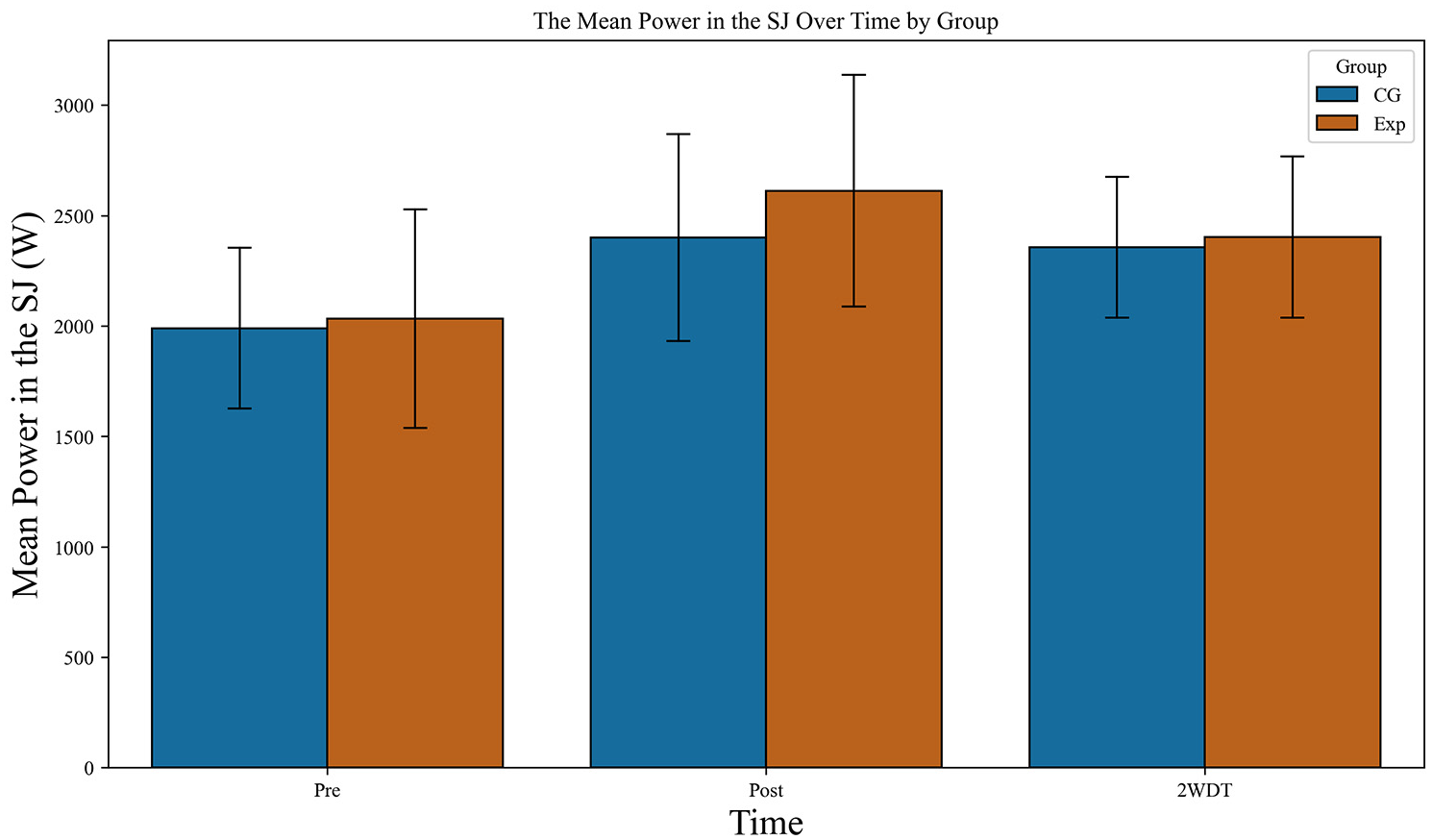
The mean power outputs in the SJ.
Simple Main Effects Analysis of SJ Performance by Group and Time.

Note. CG = control group; SJ = squat jump.
For the Exp group, pairwise comparisons in Table 6 show significant and substantial improvements in SJ performance. The gain from Pre to Post, a 28.5% increase, was particularly pronounced, demonstrating a very large effect (p < .001, d = 1.11). Performance at 2WDT, showing an 18.2% improvement over Pre, was significantly higher and corresponded to a large effect (p < .001, d = 0.83). Post performance remained 8.7% higher than 2WDT performance, a significant difference with a small-to-medium effect (p < .001, d = 0.45).
Pairwise Comparisons of SJ Performance in the Two Groups Across Time Points.

Note. CG = control group; SJ = squat jump; 2WDT = 2-week detraining time.
The CG also experienced significant gains with large practical importance. The improvement from Pre to Post, an increase of 20.6%, was significant with a very large effect (p < .001, d = 0.96). Similarly, the 18.4% improvement from Pre to 2WDT was also significant and represented a very large effect (p < .001, d = 1.05). The change between Post and 2WDT was not statistically significant for this group.
Sprint Performance Evaluation
30 m Sprint Performance
A repeated measures ANOVA revealed a significant interaction effect between group and time (F = 17.439, p < .001, partial η2 = .315). Simple main effects analysis indicated significant effects for both time and group, with significant differences observed at Post, for both the CG and Exp (Table 7). Pairwise comparisons (Figure 3) showed that the Exp outperformed the CG at Post (p < .05).
Simple Main Effects Analysis for 30 m Sprint Performance.

Note. CG = control group.

Pairwise comparisons of 30 m sprint performance between groups at three time points.
The analysis of 30 m sprint performance, detailed in Table 8, revealed significant changes for the Exp group. The improvement from Pre to Post, a 5.2% reduction in sprint time, was substantial and supported by a very large effect (p < .001, d = 0.99). Interestingly, performance at Post was also significantly faster, by 4.7%, than at 2WDT, with this difference also representing a very large effect (p < .001, d = 1.18). However, the slight 0.5% reduction in sprint time at 2WDT compared to the initial Pre measurement was not statistically significant (p = 1.000), showing only a negligible effect.
Pairwise Comparisons of 30 m Sprint Performance in the Two Groups Across Time Points.

Note. CG = control group; 2WDT = 2-week detraining time.
For the CG, a significant improvement was noted, with a 2.2% reduction in time from Pre to Post, corresponding to a medium effect (p < .001, d = 0.60). Similar to the Exp group, the Post time was 1.7% faster than the 2WDT time, a significant difference with a small-to-medium effect (p < .001, d = 0.47). The difference between Pre and 2WDT was not statistically significant for this group.
100 m Sprint Performance
A repeated measures ANOVA revealed a significant interaction effect between group and time (F = 8.911, p < .001, partial η2 = .190). Simple main effects analysis showed significant effects within both the CG and Exp (Table 9).
Simple Main Effects Analysis for 100 m Sprint Performance.
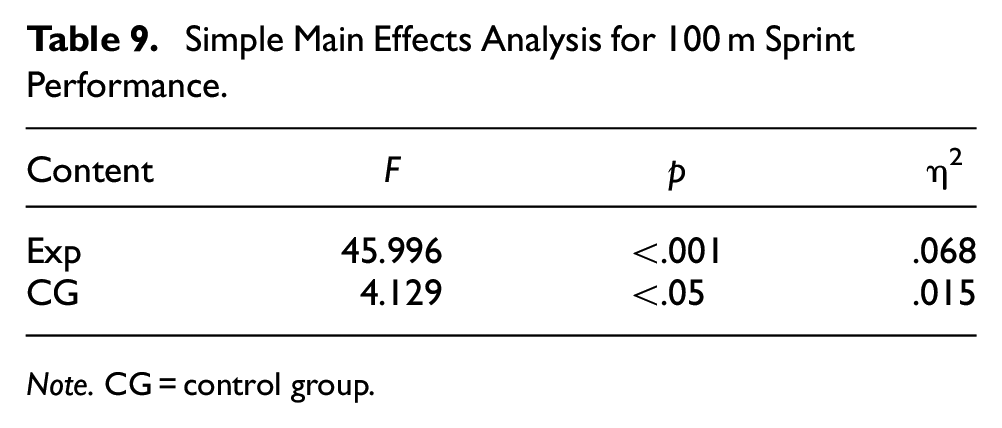
Note. CG = control group.
For the Exp group, the analysis in Table 10 indicates significant improvements in 100 m sprint times. The change from Pre to Post, a 2.8% reduction in time, was substantial and showed a medium-to-large effect (p < .001, d = 0.61). Furthermore, the 1.4% improvement in performance at 2WDT compared to Pre was also significant, representing a small-to-medium effect (d = 0.36). The sprint time at Post was also 1.4% significantly faster than at 2WDT (p < .001), with a similar small-to-medium effect (d = 0.29).
Pairwise Comparisons of 100 m Performance in the Two Groups Across Time Points.

Note. CG = control group; 2WDT = 2-week detraining time.
In contrast, the CG demonstrated a less pronounced improvement. While a statistically significant 0.9% reduction in time was observed from Pre to Post (p = .028), it represented only a small effect (d = 0.23). No other significant differences were found between time points for this group.
Horizontal Jump Performance Analysis
LJ Results
LJ performances for both groups at Pre, Post, and 2WDT were assessed (Figure 4). Repeated measures analysis of variance revealed no significant interaction effect but did show a significant main effect of time (F = 23.627, p < .001, partial η2 = .383). Subsequent pairwise comparisons on the main effect of time showed that performance at Post was significantly better than Pre, with a small-to-medium effect (p < .001, d = 0.37). Performance at Post was also significantly better than at 2WDT, though this represented a small effect (p < .01, d = 0.18). Finally, 2WDT performance remained significantly better than Pre, also with a small effect (p < .01, d = 0.24).
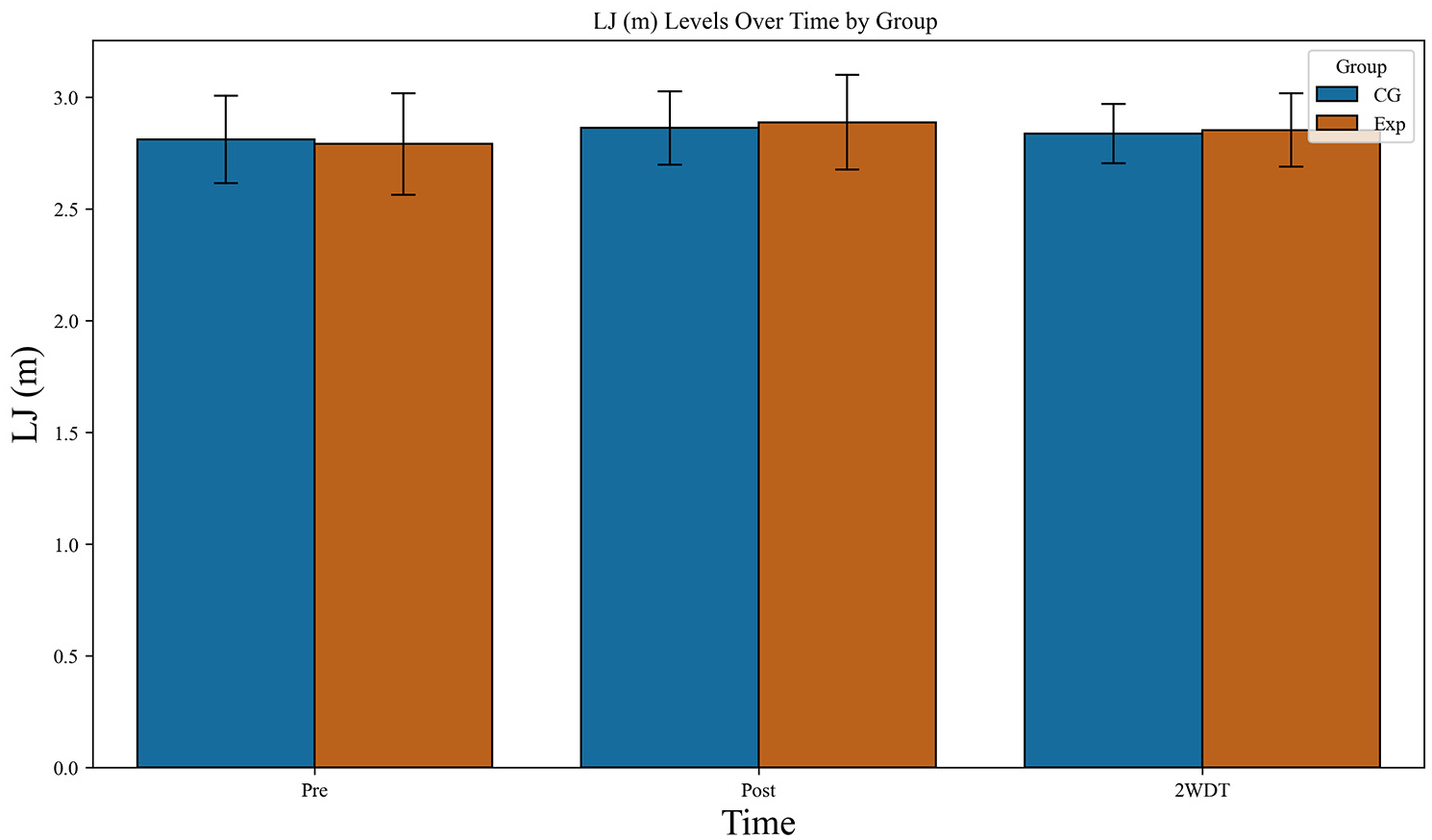
The LJ performance between groups at three time points.
STJ Results
STJ performances for both groups at Pre, Post, and 2WDT were assessed (Figure 5). Repeated measures analysis of variance revealed no significant interaction effect but did show a significant and large main effect of time (F = 82.676, p < .001, partial η2 = .685). Subsequent pairwise comparisons on the main effect of time indicated that performance at Post was significantly better than Pre, with a medium-to-large effect (p < .001, d = 0.65). Performance at Post was also significantly better than at 2WDT, corresponding to a small-to-medium effect (p < .001, d = 0.37). Finally, 2WDT performance also remained significantly higher than Pre, representing a small-to-medium effect (p < .001, d = 0.31).

The STJ performance between groups at three time points.
Discussion
The 6-week plyometric training program produced superior enhancements in lower-limb explosive power over traditional strength training. The plyometric group achieved a 28.5% increase in SJ power and a 5.2% reduction in 30 m sprint time, gains that were substantially larger than the 20.6% power increase and 2.2% time reduction observed in the CG.
This outcome aligns with findings from Meszler et al. (2019), whose research showed that adding plyometric exercises to an 8-week strength program selectively improved CMJ force. In their study, as in ours, the group performing only strength training did not achieve comparable gains in explosive metrics. The primary mechanism explaining this difference is the enhanced efficiency of the SSC; plyometric training specifically conditions the muscle-tendon unit to store and reuse more elastic energy, a distinct adaptation from that of traditional resistance training, which primarily increases maximum muscle force (Meszler et al., 2019). However, training adaptability is highly dependent on the population. Our results in trained adults contrast with those of Kurt et al. (2023), who reported no significant improvements (p > .05) in jump or sprint performance in adolescent soccer players after a similar 6-week program, suggesting neuromuscular maturity is a key factor. Ultimately, these findings indicate that plyometric training offers a more longer-lasting adaptation, making it particularly valuable for enhancing and maintaining performance in sports reliant on explosive power.
The superior performance is rooted in specific neuromuscular adaptations that elevate the RFD. Exercises like the depth jump, central to our experimental protocol, are known to generate exceptionally high RFD (Ebben et al., 2010). Research by Ebben et al. (2010) confirms that depth jumps produce a significantly higher RFD than other training modes, including squats. An improved RFD is critical for explosive movements, enabling athletes to generate maximal force within the minimal ground contact times characteristic of sprinting. This relationship is further clarified by Pedley et al. (2022), who linked good SSC function directly to shorter ground contact times and greater takeoff forces, both of which are fundamental to sprint speed. Such functional improvements originate from profound neural adaptations. Plyometric training is known to facilitate these adaptations, including enhanced motor unit recruitment and synchronization, as well as improved intramuscular coordination (Piirainen et al., 2014; Swanik et al., 2002). For instance, Swanik et al. (2002) found that plyometric activity improved proprioception and kinesthesia, leading to more efficient neuromuscular output. Therefore, the greater gains in the plyometric group can be attributed to a combination of superior elastic energy utilization and more efficient neural control.
A key finding of this study is the superior retention of complex motor skill performance following plyometric training. After a 2-week detraining period, the plyometric group maintained a significant 1.4% improvement in 100 m sprint time over baseline. In contrast, the gains in the same metric for the CG completely dissipated. This preservation of performance, particularly in metrics of explosive strength, mirrors findings in other studies, even over longer detraining periods. For instance, the 18.2% retention in SJ power observed in our plyometric group is remarkably similar to the 18% retention in half-squat strength reported by Colliander and Tesch (1992) after a much longer 12-week detraining period. However, the duration of detraining remains a critical factor determining the extent of performance decay. While our 2-week period showed high retention, Kannas et al. (2015) documented a significant 11.8% decrease in drop jump height after 4 weeks of detraining, demonstrating that performance benefits erode as the untraining period extends.
The greater durability of plyometric-induced adaptations is likely attributable to the persistence of neural adaptations, which decay more slowly than morphological changes (Houston et al., 1983). The high retention rates observed in our study are consistent with this theory. Jubeau et al. (2006) quantified this phenomenon, showing that even after 4 weeks of detraining, maximal voluntary contraction torque remained 17.2% above baseline (down from a 19.4% peak gain), a preservation they attributed to lasting neural changes. The strong eccentric component inherent in plyometric training is thought to be particularly effective at inducing these long-lived neural adaptations, such as improved motor unit synchronization and reflex potentiation (Colliander & Tesch, 1992). These persistent neural improvements provide a longer residual training effect for plyometrics (Hellard et al., 2005), explaining why athletes can maintain a higher level of explosive capacity, especially in coordinated skills like sprinting, after a short break from training.
A notable finding was the differential impact of the training protocols across various performance tests. While plyometric training demonstrated clear superiority in enhancing vertical jump power and sprint performance, both training regimens proved equally effective at improving horizontal jump distance. This pattern aligns with the principle of training specificity. The biomechanics of sprinting and vertical jumping are dominated by a rapid, vertically oriented SSC. The plyometric exercises in this study, particularly depth jumps, directly mimic this movement pattern, leading to a more direct and potent training transfer. A meta-analysis by Wang et al. (2024) supports this observation, reporting larger training effects for plyometrics on vertical jumps (Effect Size [ES] = 1.17–1.33) and short sprints (ES = −1.12) compared to horizontal jumps (ES = 0.83). In contrast, the LJ relies more heavily on a combination of explosive power and maximal strength to displace the center of mass horizontally from a static start. This dual-dependency explains why the maximal strength gains from the CG’s training were as beneficial as the reactive strength from the plyometric group for this specific task. The importance of maximal strength in horizontal jumping is corroborated by Plesa et al. (2025), who found a significant correlation between maximal isometric strength and horizontal jump distance. Therefore, the lack of a group difference in horizontal jump improvement is not an indication that plyometrics were ineffective, but rather that the task itself is less reliant on the unique SSC adaptations that drove the superior sprint and vertical jump results.
In practice, these findings provide a valuable framework for coaches and practitioners. The demonstrated durability of plyometric-induced gains suggests that this training modality is not only a potent tool for enhancing explosive performance but also a strategic asset for maintaining it through periods of reduced training, such as during a competitive season or transition phase. Integrating plyometric training can help build a more resilient foundation of explosive power that is less susceptible to short-term decay. Despite these implications, this study has limitations that open avenues for future research. The 2-week detraining period was relatively short; future studies should investigate longer durations to map the full decay curve of plyometric adaptations. These results were obtained from trained male sprinters and may not be generalizable to female athletes or those in other sports. Finally, while this study infers neuromuscular mechanisms, future work should employ direct assessments such as electromyography to explicitly confirm the neural adaptations responsible for the superior performance and retention observed.
Conclusion
This study aimed to investigate the effect of a 6-week plyometric training program on the maintenance and enhancement of lower-limb explosive power in sprinters and jumpers. Forty male sprinters were randomly assigned to either an Exp, which underwent plyometric training, or a CG, which followed a traditional lower-limb resistance training regimen. The training program lasted for 6 weeks, with sessions conducted three times per week, progressively increasing in intensity. Performance in various explosive power measures, including the mean power in the SJ and CMJ, 30 and 100 m sprints, and horizontal jumps, was assessed before the training, after the training, and 2 weeks after the cessation of training.
The plyometric training program produced significant enhancements in explosive power, with key performance gains maintained after a 2-week detraining period. While traditional strength training proved effective, its benefits were less pronounced for sprinting and showed lower retention after the training cessation. These results indicate that plyometric training fosters more longer-lasting adaptations, likely due to superior neural optimization and enhanced use of the SSC. Future research should examine these effects over longer detraining durations, across diverse athletic populations, and with direct neuromuscular measurements to confirm the underlying mechanisms.
Footnotes

Ethical Considerations
This study was approved by the Ethics Committee of the Academic Council of Capital University of Physical Education and Sports (Approval Number 2025A005).
Author Contributions
Chang Shuai and Wang Xiangyu: Conceptualization, Methodology, Investigation, Writing – Review & Editing. Li Zihao: Data Curation, Formal Analysis. Ji Xinqi*: Supervision, Writing – Review & Editing, Project Administration.
Funding
The author(s) received no financial support for the research, authorship, and/or publication of this article.
Declaration of Conflicting Interests
The author(s) declared no potential conflicts of interest with respect to the research, authorship, and/or publication of this article.