



Abstract
Support for abortion is comparable between men and women in the United States; one in five reproductive age men reports abortion involvement. Yet, societal focus on abortion as a uniquely women’s issue minimizes men’s involvement in abortion. We conducted a secondary analysis of survey (n = 203) and interview data (n = 30) on male partner’s experiences accompanying abortion recipients at two family planning clinics in Chicago, Illinois. Respondents identified reasons for abortion from a prepopulated 14-item list. We correlated reasons with respondent’s abortion preference and decision satisfaction, characterizing this relationship via thematic analyses of interview transcripts. Nearly all men (97.5%) identified multiple reasons for abortion (median: 6/14), including: mistimed pregnancy (80%), impact on his/his partner’s education/career (75%–80%), and finances (71%). Neither individual reasons nor number of reasons was significantly associated with abortion decision preference or decision satisfaction. While 41% would not have chosen abortion, only 10% reported dissatisfaction. Men’s perception of decision concordance with their partner was significantly linked to their satisfaction (p < .01). Thematic analysis highlighted complex partner involvement, including shared and deferred decision-making and tension amid demonstrated support. Many abortion-accompanying men preferred to continue the pregnancy, yet very few reported dissatisfaction with the ultimate decision, which may be related to perceived decision concordance with their female partner. Men’s decisions for abortion are complex and include varying degrees of male partner involvement and/or decision deferral to female partners.
Introduction
Based on survey data from the Pew Research Center in 2022, most adults in the United States agree that abortion should be legal in all or most cases. Notably, support for abortion is not markedly different between U.S. men and women (58% vs. 63%) (Mitchell, 2022). Survey data from the National Opinion Research Center in 2022 reported that approximately half of men disapproved of the Supreme Court of the United States’ decision to overturn Roe vs. Wade and reverse federal protections for abortion (AP-NORC Center for Public Affairs Research, 2022). Nevertheless, men have seldom responded to legal threats to abortion access in the same way that women have, possibly because abortion remains a comparably abstract issue for men (Heimlich, 2012).
Based on the frequency with which it occurs, abortion should not be an abstract idea for men. Approximately one out of five reproductive age men in the United States reported involvement in an abortion based on data from the National Survey of Family Growth (Li et al., 2022). Several studies remark on men’s attachments to pregnancy decision-making and varying narratives on how abortion can fulfill or frustrate their perceived roles as men (Naziri, 2009; Newton et al., 2020; Reich, 2008). Societal labeling of abortion as a “woman’s issue” and the stigmatization of abortion may prevent some men from disclosing and talking about their involvement in an abortion (Maddow-Zimet et al., 2021), thereby contributing to misguided perceptions that abortion is uncommon or of lesser importance in men’s lives.
As women are most impacted by having to carry an unwanted pregnancy, those who choose abortion are frequently able to cite several reasons for their decision, not limited to feeling financially unprepared, wanting to prioritize their education/career, having to prioritize their current family, and being concerned about the state of their relationship (Biggs et al., 2013; Finer et al., 2005). Some women’s decisions to have an abortion may run counter to the parenting preferences and preparedness of their male partner or may stem from a poor relationship with their male partner (Chibber et al., 2014). Faced with the potential loss of role, masculinity, and relationship, some male partners may face difficulty understanding their female partner’s reasons for the abortion, may misdirect their frustration toward abortion (Kelly & Gochanour, 2019), and may overlook the ways in which the abortion could positively impact their own lives. For example, one longitudinal study of adolescent men involved in a pregnancy noted that men whose pregnancies ended in an abortion were more likely to graduate from college (Everett et al., 2019).
While men may share similar reasons for wanting an abortion as their female partners, these reasons are seldom identified and discussed. Few studies directly query men’s attitudes about their partner’s abortion and their reasons for ultimately supporting the decision. Regardless of their preference for abortion, characterizing men’s independent reasons to support an abortion may broaden men’s perspectives on abortion, help society move beyond labeling abortion as a “women’s issue,” and facilitate men’s involvement in abortion advocacy. We thus conducted a mixed methods study of male partners in the abortion clinic setting to better characterize their reasons for pursuing and/or supporting an abortion.
Materials and Method
Study Design
We conducted a secondary analysis of data collected in a mixed methods study of men recruited from the waiting rooms of two abortion-providing clinics in Chicago, Illinois. Details on the design and conduct of the study are available in previous publications (Newton et al., 2020; Nguyen et al., 2018). In summary, all English-speaking male partners above the age of 18 years who were present in the clinic waiting rooms were screened and invited to participate. All male partners self-identified as biologically involved in the pregnancy being aborted. Thirty in-depth interviews were conducted from April to August of 2015, exploring men’s abortion experiences and attitudes. Findings from the interviews informed the development of a subsequent survey given to 210 men from February to May of 2016. This secondary analysis focuses on characterizing and estimating the prevalence of men’s reasons for abortion, and their influence on men’s preference for and satisfaction with their female partner’s abortion decision.
Regarding the qualitative portion of the study, interviews were conducted by B.T.N., an abortion-providing physician who introduced himself as a research assistant with no clinical role. Interviews followed a semistructured interview guide. Interviews lasted approximately 1 hr and were conducted on the phone and in person per interviewee availability. Interviewees received a $40 gift card upon completion.
For the quantitative portion, respondents completed the survey in private, using a tablet computer. They received a $10 gift card upon completion. The survey included a qualitatively informed, prepopulated list of 14 reasons for abortion from which men chose as many responses as applied (e.g., not wanting any(more) children, wanting to wait longer before having another child, doubts about the partner/relationship, needing to focus on career/education, partner needing to focus on her education/career, unable to afford a baby right now, “it’s her decision no matter what”). Men’s desire for abortion was assessed with two 4-point Likert-type items; one asked if participants would choose abortion if entirely their decision, and the second asked how much participants wanted to continue the pregnancy.
The survey additionally included demographic factors (e.g., age, race/ethnicity, education level, employment status) and reproductive characteristics which were examined for associations with abortion decision preference and satisfaction. Reproductive characteristics included relationship status (just met, going out occasionally, steady/living together, engaged/married), number of pregnancies in which the respondent had been involved, number of children, history of prior abortion, and estimated gestational age of the pregnancy at the time of abortion (<13 weeks, >13 weeks, don’t know).
Data Analysis
In-depth interviews were analyzed independently by B.T.N. and J.H. for themes arising both deductively and inductively (Green & Thorogood, 2013). Deductive analysis was performed via coding data based on motivation (reasons) for abortion. Inductive analysis was performed via reflexivity journals which resulted in coding patterns of engagement and disengagement from decision-making processes.
Survey data are presented via simple descriptive statistics where respondent abortion and pregnancy attitudes were collapsed into binary responses. We then conducted bivariate analyses (i.e., chi-square) to examine for associations between respondent characteristics and their preference for abortion and desire to continue the pregnancy. We additionally created a measure of concordance between men’s desires to continue the pregnancy with their perception of their female partner’s desires to continue the pregnancy, examining the association of concordance and decision satisfaction via bivariate analysis. Associated characteristics and reasons for abortion were included in a logistic regression model evaluating independent associations with abortion decision desires and decision satisfaction.
All quantitative analyses were performed with Stata version 13.1; qualitative analyses were performed using ATLS.ti version 9.0. We present the qualitative data after the quantitative data to offer additional dimension to the survey findings.
Results
Quantitative: Survey Results
Of 318 men screened, 46 did not meet eligibility criteria and 60 declined to participate. Of those declining to participate, 35 did not give a reason, 7 reported discomfort with participating or talking about the situation, and 18 were not interested. Two respondents later asked to retract their data because their female partner did not want them to participate. The analytic sample included 210 men (response rate = 77.2%).
With respect to preference, 41% of respondents would not (probably or definitely not) have chosen abortion if entirely their decision, and 59% would have chosen abortion (probably or definitely) if entirely their decision. 12% of men highly desired to continue the pregnancy, 55% somewhat or minimally wanted to continue the pregnancy, and 34% of men did not want to continue the pregnancy at all. 10% of men were dissatisfied or very dissatisfied with the decision to abort, 44% of men reported that they were neither satisfied nor dissatisfied with the decision, and 46% reported they were satisfied or very satisfied with the decision for abortion.
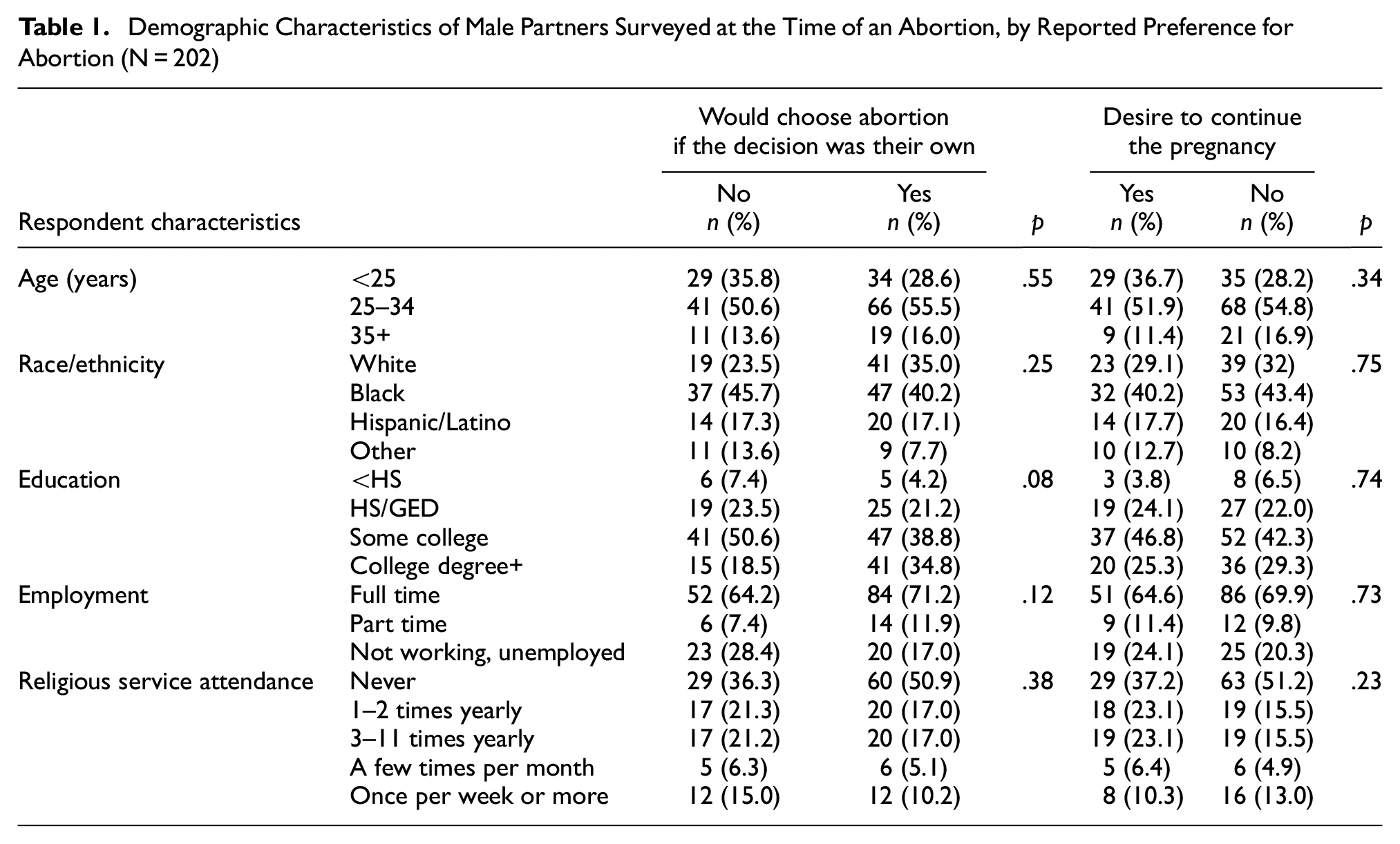
Overall, neither demographic characteristics nor reproductive history demographics were associated with men’s desire for abortion (Table 1), with two exceptions: a history of a prior abortion was associated with higher likelihood of not choosing abortion if it was entirely the man’s decision, and the desire to have more children was significantly associated with the desire to not continue a pregnancy (Table 2). Desire to continue the pregnancy was significantly associated with satisfaction with the decision for termination. 69% of those very satisfied with the decision for abortion also stated they did not at all desire to continue the pregnancy, and of the 11% of respondents who highly desired to continue the pregnancy, 86% reported being either unsatisfied or very unsatisfied (p < .01).
Demographic Characteristics of Male Partners Surveyed at the Time of an Abortion, by Reported Preference for Abortion (N = 202)
Reproductive Characteristics of Male Partners Surveyed at the Time of an Abortion, by Reported Preference for Abortion (N = 202)

*p < .05
75% of men reported a concordant desire with their partner to continue or end the pregnancy, with 25% reporting discordant pregnancy desires. There was moderate correlation between men’s desire to continue a pregnancy and their perception of their female partner’s desire to continue a pregnancy (R2 = 0.44). There was a significant relationship between a man’s perception of concordant desire and satisfaction with the decision for abortion: among those who reported they were satisfied or very satisfied, 83% perceived concordant desires with their female partner. Conversely, among those who reported they were unsatisfied or very unsatisfied, 67% perceived discordant desires for the pregnancy (p < .01).
Most participants (97.5%) chose more than one reason for abortion from a prepopulated list. On average, men selected six reasons, which did not significantly differ when accounting for whether they would have chosen to terminate the pregnancy if the decision was their own. Most common reasons included not the right timing (80.7%), interference with current opportunities for the respondent or their female partner (74.6%, 79.0%), and financial unpreparedness (71.9%). Almost one quarter of respondents reported uncertain paternity as a reason for abortion. Notably, 68.5% of men selected that it was their partner’s decision regardless of their opinion. Table 3 lists survey results of reasons that men chose abortion by desire for abortion. Desire for abortion was not associated with any of the listed reasons for abortion, with the exception that concern about what family/friends would think was significantly associated with not desiring to continue the pregnancy. There was no association between the number of reasons picked for abortion and satisfaction with abortion.
Reasons Why Male Partners Reported Not Wanting to Have a Child at the Time of an Abortion and Relationship to Desire for Abortion

*p < 0.05
Qualitative Results
The majority of interviewees were non-Hispanic Black (n = 13), followed by non-Hispanic White (n = 8), Hispanic (n = 4), other (n = 4), and Asian (n = 1). Thematic analysis further characterized the reasons for abortion, including most chosen answers of financial difficulties, interference with other opportunities, having other dependents, and being “not ready.” Often these reasons overlapped and intertwined, as highlighted in one interviewee’s response: I want to get our lives right before we bring another one into it. Right now, our lives are not right. She does a little work, I do my little side jobs—to try and deal with a child at the same time, it’s not going to work out for us. Can’t pay for a sitter while I’m trying to pay for rent, phone bills. We are just weak. (long-term partner, age 25, supportive, abortion-neutral)
Financial Instability
A common theme in interviews was the financial difficulty of having a(nother) child. Men expressed difficulty providing for a(nother) child, particularly an inability to provide for current children simultaneously, as reason to pursue abortion: That’s only the hard thing to do because we already had kids, and I love them, but right now financially I know for a fact that we can’t fend for another child. (committed partner, age 29, supportive, pro-abortion)
Men also expressed that finances were a barrier to child-rearing despite desires for more children: I’ll be happy raising the kid; I’m just not at that financial stage yet. Everything else, mentally, physically I am, but the financial stage I’m not. If I had at least more money, if I was financially ready, I would have went totally against [the abortion], but I’m not financially staged for it. It was out of the question. (long-term partner, age 18, supportive, against abortion)
Other interviewees used phrases like: once we got better jobs, once I am financially ready, later on down the line when we got jobs, and one day it’ll happen, I’ll be financially able. Together, these quotes indicate that for many men, financial instability was a temporary yet important reason to pursue abortion.
Interference With Other Opportunities
Having a(nother) child interfered with men’s current or next opportunities, namely education and employment opportunities. Interference with education was a major focus for men: I wanted to finish college first at least, not work minimum wage job at some retail store like I’ve been doing since I was 18. I don’t want my child on a stroller on a bus, on the CTA. I want a less anxiety lifestyle especially if I’m going to be a parent. (long-term partner, age 22, supportive, anti-abortion)
Men were also concerned with the impact a(nother) child would have on their job opportunities, saying “I was just barely started on my job” and “we’re just both in a climb right now” about his a female partner. The same interviewee as above concluded: I’m wrapping up a college degree. I have tuition to pay off. I have a job to get started, and I’m trying to take my life off and have a career. There’s just no way I can take care of another life. I’m just barely starting mine.
Commitment to Other Dependents
Men cited the number of children they have or care for, ages of their children, and activities their children partake as reasons not to have a(nother child). One man explained his emotional processing of the abortion in relationship to his commitment to his other children: We’re moving on because we’ve got kids. I knew that it would be ridiculously tough on us if we had another one. The decision was difficult, but I knew it was something that we had to do. (committed partner, age 30, supportive, anti-abortion)
Time was an additional resource that men reported needing to devote to their current dependents and undergirded their reasons for abortion. This was best described by one male partner in relationship to his current children’s activities: To add a child to what we’re both trying to accomplish right now, it’s a lot. It’s too much to try to add. Our two boys are in football, basketball, baseball. My daughters are in gymnastics, cheerleading, swimming. We just don’t have the time. For me, that’s basically what it comes down to. (long-term partner, age 31, supportive, pro-abortion)
Wrong Time/Not Ready
Men cited multifactorial reasons for abortion, which corroborated the survey findings of a mean of six reasons elected for abortion. These multifactorial reasons contributed to an overall sense that the unintended pregnancy came at the “wrong time” to have a(nother) child. Interviewee language revolved around the idea of not being ready for a(nother) child: I was stressed about it because I already didn’t want any more children right now, because I’m not established in life where I want to be. I would like another child but not now [. . .] the money, the cost of it. I guess we decided what was right. That’s for the time being. (long-term partner, age 29, supportive, pro-abortion)
As in the above example, being “not ready” was often couched in the disclaimer that men may desire a child in the future but not at the current moment. One man articulated that though desiring children in the future, currently a child would cause unhappiness: If we were to keep the baby, it would be forcing me into a life that I don’t necessarily want. I don’t want to be forced into this life and regret it for the rest of the time and not be happy. (single, age 19, supportive of decision, pro-abortion)
Age, whether too young and too old, was additional timing reason for abortion. Some men expressed feeling too young to have a child, expressing concerns like, “I can’t even teach my child, because I’m too young” and “we need to get a little more wisdom in our systems before we do all that.” On the other end of the spectrum, an older interviewee said, “Lockdown for another 18 years, [. . .] what’s it going to be like at almost sixty years old trying to take care of teenagers?” (long-term partner, age 40, supportive, pro-abortion)
Complex Partner Involvement: Shared Decision-Making Versus Deference to Female Partner
Men articulated a variety of roles in the decision for abortion which ranged from heavily involved in decision-making to deferring the decision to their female partner.
Many men articulated significant involvement in decision-making. Phrases like “we both said we agreed,” and “we’re at peace with where we’re at,” or “coming together on the same page,” were all used by men to describe their mutual roles and decision concordance with their female partners. Several men articulated the dynamic yet mutual process of decision-making: We sort of played out both scenarios, what would happen if we did and didn’t keep it. Ultimately, I told her that I was supportive of her, and I wanted to make this decision together. We sort of talked about it over the next couple of days. That’s ultimately the way we ended up going. (short-term partner, age 30, supportive, pro-abortion)
In this way, men situated themselves as equal shareholders in the decision, seeing their role as a mutual decision maker. This was true both when men expressed concordance with their partner in terms of desires, but also when the desires were perceived to be discordant: I wanted to have a baby, she didn’t want to have it. I didn’t get mad at her. I didn’t say, “Oh you want to kill my baby?” I didn’t do all that. We sat down and talked. “I want to have a baby, you don’t want to have the baby. Let’s just cut it loose right now and we can try again.” We young, we got our whole life to live. We got a lot of time ahead of us. (long-term partner, age 32, supportive, anti-abortion)
One male partner was able to situate his role as a mutual decision maker while also acknowledging the nuance of the unequal burden on his female partner’s body: I feel, ultimately, it’s her [decision] because it’s her body and she’s the one that has to deal with being sick. She’s the one going through it herself. I feel in the end it was her decision, but I think that when we actually made the decision it was a mutual decision, for sure. (long-term partner, age 23, supportive, pro-abortion)
Some men not only articulated involvement in the decision, but saw themselves as the ultimate decision maker in relation to their female partner. When asked whose decision the abortion was ultimately, several men stated that it was their decision even more so than their female partners: In a way it’s ultimately my decision because she is scared. (single, age 19, supportive, pro-abortion) I would say that it was my decision. She really wanted to have it. It’s also half her decision. I would definitely say that it was more swayed in my opinion. (long-term partner, age 22, supportive, anti-abortion)
Only one man expressed significant sadness over the decision for the abortion, particularly that he didn’t share more of his opinion at the time of the decision which he attributed to his style of conflict management with his partner. He ultimately concluded that his role should have included more control: “Not stepping up and changing her mind about getting the abortion—that’s something I could have done” (long-term partner, age 24, not supportive, anti-abortion).
Other men were less involved in the decision-making process. Few men felt entirely excluded from the decision-making process, but many men deferred all decision-making to their female partner, regardless of their desires for the pregnancy. As evidenced by their presence at the abortion center or willingness to take a call with interviewers, deferral to female partners was not associated with absence from the experience of abortion itself. Men frequently provided logistical, emotional, and financial support, but limited their involvement in the actual decision-making process through expressing deference to their female partner in the decision-making: I think for the most part I was just supplemental. She made the decision on her own, and I agreed with that. From there, she went on her own to find what kind of service she wanted to do, what she was most comfortable with. I agreed with whatever that was. The rest of the decision, she had it all set in place. The rest of the process, I was just there to help her along in any way that I could. (single, age 23, supportive, anti-abortion) The entire time it’s up to her. It’s totally up to her what she wanted to do, and she knows I feel that way, but I could have gone either way with it. But with three kids, it’s a handful, but not so much that it’s undoable, but I think at the end it was other considerations for her about things that she wanted to do. She felt like this would set her back, and so that she made the choice. (committed partner, age 44, supportive, pro-abortion)
Deference to female partners happened irrespective of desire for abortion. Despite his unease with the situation, one interviewee expressed his support for his partner’s decision: It really wasn’t my decision. I told her I would support her and I would go with her if she wanted to do that, but it really wasn’t something that I would suggest. [. . .] I supported her through that, even though it wasn’t a good thing for me to experience. (committed partner, age 27, supportive, anti-abortion)
Deference of decision-making to female partners was usually not accompanied by hostile feelings or absence from the decision in our subset of men, even when they disagreed with the decision. Instead, most men described a variety of forms of support for their female partners, including buying pads and ibuprofen, providing rides to and from clinics, paying for the abortion, and providing emotional support. Notably, deference to a female partner was sometimes accompanied by articulated repression of emotion. For example, after asserting that the decision was entirely his partner's, when asked about his own emotion one interviewee said, “To be honest, I cut my mind off of it [. . .] I wasn’t as emotional as her” (single, age 23, supportive, anti-abortion). Other men articulated the need to be “strong” for their female partners, one respondent going so far as, “I’ll sacrifice my emotions to keep her emotions in check” (committed partner, age 37, supportive, neutral on abortion) and another articulating, “Women are a ball of emotions, regardless, you got to try to keep tending on their needs, at the same time not suffocating your own needs” (committed partner, age 25, supportive, neutral on abortion).
Tension in Decision-Making
Almost all interviewees expressed that there was some degree of difficulty in making the decision to terminate a pregnancy. Men called the decision “extremely difficult,”“really hard,”“not an easy thing,” and “10/10 in difficulty.” One man called the experience “traumatizing”, and one interview concluded with the interviewee in tears, stating: “This is not something I enjoy talking about. It doesn’t bring me great joy at all” (long-term partner, age 21, supportive, anti-abortion). Yet in the midst of expressing difficult decision-making, many men expressed satisfaction with their decisions. For example, the partner who described the experience as traumatizing also arrived at this conclusion: These are things that you can sort of get over. The way I thought about it, yes it is a traumatizing, painful experience. I don’t wish it upon anybody. [But] if we were to keep the baby, it would be forcing me into a life that I don’t necessarily want. I don’t want to be forced into this life and regret it for the rest of the time and not be happy. I am not just like, “It’s over we’re done.” It’s still a rough thing, it’s still something that happened and I have to live with. I know I can walk past it so that when the time comes to have a child I can be happy and not be forced into it. (single, age 19, supportive, pro-abortion)
Another man similarly expressed:
The main thing that I was saying is, “It’s tough now, but we’ll move past this. We just got to do, what we got to do.” We always will look back at it and see how tough it was. In the end, like I said, we realized that’s what was best. (committed partner, age 30, supportive, anti-abortion)
Discussion
Almost all men involved in abortions have multiple and interrelated reasons for pursuing abortion. Despite initially not desiring abortion, most men in these Chicago outpatient clinic were not dissatisfied with the decision for abortion, which may in part be explained by their perception of congruence with their female partner, as well as the complex decision-making surrounding termination of pregnancy. Our data show that men are deeply implicated in abortion decisions, which should profoundly shape research, policy, and narratives surrounding reproductive care.
Other studies have shown that female reasons for abortion include finance, wrong timing, and interference with future opportunities; women also frequently have multiple reasons for abortion (Biggs et al., 2013; Finer et al., 2005). Our study shows men have similar reasons for pursuing abortion. The benefits of abortion for men are under investigation, though currently the negative effects of unintended pregnancy are better characterized than the benefits of abortion: several studies have shown that men whose female partners continue unintended pregnancy described higher financial burdens than expected, difficulty continuing education, diminished partner relationships, and decreased personal health (Jackson et al., 2011; Kavanaugh et al., 2017; Sassler et al., 2008). One study showed financial benefits to men whose partners had abortions; however, a positive association between abortion and personal income was only noted in men who did not reside with their children during adolescence (Everett et al., 2019). Further research is needed to elucidate the full benefit of abortion for men’s quality of life and any correlation to the reasons men pursue abortion.
Our data demonstrate that men are emotionally and logistically involved in abortion experiences. Survey responses show a mean number of six reasons given for pursuing abortion, which our qualitative data further revealed were interrelated and overlapping, creating a complex web of motivation for abortion. One of the major findings from this study is that despite initially not wanting an abortion, some men will accompany and support their female partners to an abortion clinic; quantitative survey results indicate that very few of these partners are dissatisfied with the decision for abortion. This seeming contradiction can be partially explained through qualitative data illuminating the complex decision-making process that men undergo in pursuing abortion. Though men may initially report not wanting an abortion, they can provide multiple reasons for it and articulate a decision-making process, and most are ultimately not dissatisfied with the result.
Finally, our data support prior work indicating that many men provide substantial support at the time of abortion (Nguyen et al., 2018) and directly contradicts widely held narratives of men as uninvolved or uninterested in abortion decisions. Men have preferences, life circumstances, and family planning desires that all factor into decision-making surrounding unintended pregnancy, underscoring men’s role as independent subjects in the decision for abortion. As such, men exist as a population with significant potential for mobilization to advocacy in abortion spaces.
This study should be evaluated in light of its limitations: namely, that the participants were isolated to a single geographic location, and that the participants included in the analysis accompanied their female partners to the abortion clinic, thus potentially demonstrating a level of support that is different than male partners who either refused or were unable to accompany their female partners to the clinic.
Finally, in pursuit of inclusive research and policy, it is important to note the difficulties of studying abortion outcomes. Our data offer analysis of the discrepancy between many men not desiring abortion, yet so few being dissatisfied with the result. Said simply, men say that they do not want abortion, yet their lack of dissatisfaction suggests that they acknowledge that they need abortion. Future projects should account for the fact that despite perhaps not initially wanting an abortion, men decide to have abortions for many reasons and undergo complex decision-making to arrive at that conclusion.
Conclusions
Men who accompany their female partners to abortions have multiple, often interrelated reasons for pursuing abortion. While many of them would not initially choose abortion, very few are dissatisfied with the decision for abortion. Our data do not show any relationship between decision satisfaction and demographics or reasons chosen for abortion; however, there was a significant relationship between men’s perceived decision concordance with their female partner and their own decision satisfaction. Qualitative data reveal complex decision-making processes, as well as men articulating support for their female partner regardless of decision concordance or discordance.
Footnotes
Declaration of Conflicting Interests
The author(s) declared the following potential conflicts of interest with respect to the research, authorship, and/or publication of this article: B.T.N. provides consultation for Sebela Pharmaceuticals and Sumitomo Pharmaceuticals, the products of which are not relevant to this research.
Funding
The author(s) disclosed receipt of the following financial support for the research, authorship, and/or publication of this article: This work was supported by grants from the Society of Family Planning and UL1TR001855 from the National Center for Advancing Translational Science (NCATS) of the U.S. National Institutes of Health.
Publication Disclosure
The manuscript has never been published in any peer-reviewed journal.
Ethical Statement
All authors contributed equally to this research and manuscript. All participants provided written informed consent prior to participating in the study, and all data were collected and analyzed in accordance with the ethical guidelines of our institutional review board, ensuring participant anonymity and confidentiality.
