



Abstract
This explanatory sequential mixed-methods study investigates the factors influencing Thai fathers’ involvement in early childhood Childcare. In the quantitative phase (n = 230), fathers’ involvement in Childcare was assessed using a Childcare involvement scale to identify key contributing factors. The qualitative phase (n = 20) further elaborated on these quantitative findings through content analysis. Stepwise multiple regression analysis demonstrated that fathers’ perceived Childcare skills, division of Childcare responsibilities, and marital satisfaction explained 53% (p < .001) of the variance in paternal involvement. The qualitative phase expanded on these findings, identifying fathers’ involvement experiences, and revealing three central themes: responsible involvement, father–child interaction, and discipline training. These results offer valuable insights for health care professionals into the support needs of Thai fathers engaged in Childcare, facilitating better strategies for encouraging active fatherhood.
Introduction
Children are fundamental to developing a nation and its future human resources, and early childhood is a pivotal time when habits are formed. This period of early childhood, especially the first 6 years, is characterized by rapid development, particularly in the central nervous system (Meriem et al., 2020). During this stage, family routines undergo significant adaptation, with mothers typically assuming responsibilities related to daily care, such as food preparation, housekeeping, and personal hygiene. Fathers, however, often engage in activities encourage their children’s exploration and play, helping them navigate the outside world.
Research underscores the importance of high-quality early childhood care and education for healthy development (Melhuish, 2014). Once considered secondary to maternal care, father involvement is now recognized as vital to family’s well-being and positive developmental outcomes in children (Cabrera et al., 2018; Rollè et al., 2019). A lack of father involvement has been linked to various psychological issues in children, including depression, antisocial behavior, and an increased risk of behavioral disorders (Sanjaya et al., 2022).
In recent decades, socioeconomic changes, such as the rise in women’s workforce participation and evolving family dynamics, have heightened interest in the role of fathers within the family (Diniz et al., 2021). These shifts have challenged traditional beliefs about gender roles, particularly regarding fatherhood. Fathers now face increasing expectations to balance their roles as both financial providers and active caregivers. The pathways to father involvement and its impact on child development are shaped by an intricate interplay of individual, social, cultural, and ecological factors (Cabrera et al., 2018).
Research on father involvement reveals that it is multifaceted, influenced by the father’s characteristics, the mother’s role, the family context, and co-parenting dynamics, and the child’s needs (Diniz et al., 2021; Sanjaya et al., 2022). Fathers who actively participate in Childcare contribute significantly to their children’s social, cognitive, and emotional development, fostering resilience and problem-solving skills (Lamb, 2010; Pleck, 2010). Organizational support, through family-friendly policies and leadership, also plays a role in balancing work and family responsibilities, thereby improving fathers’ engagement in Childcare (Žnidaršič & Bernik, 2021).
Shifting gender norms and the evolving roles of fathers in Childcare are also shaped by economic, cultural, and social changes (Connell, 2005; Pleck, 2010). Active participation in parenting, alongside shared family responsibilities, has been shown to enhance parental satisfaction and emotional well-being (Shoshani & Yaari, 2021). Although traditional gender roles, with fathers primarily seen as financial providers, still persist, there is an increasing trend toward more involved fatherhood (Crespi & Ruspini, 2015; Höfner et al., 2011). Government policies, such as paid parental leave for both parents, are crucial in reducing gender disparities and promoting fathers’ engagement in Childcare, though the success of these policies depends on factors, such as wage replacement rates and workplace culture (Yang et al., 2022).
Theoretical Framework
Lamb (1995, 2010) introduced one of the most significant models of father involvement, which differentiates father involvement into three key components: (a) engagement, referring to direct interactions with the child, such as caregiving and play; (b) accessibility, which relates to the father’s availability to respond to the child’s needs; and (c) responsibility, encompassing indirect involvement, such as decision-making regarding the child’s schooling or scheduling medical appointments.
Pleck (2010) later refined this model to further clarify the qualitative dimensions and operationalization of father involvement. The updated model highlights three core components: (a) positive engagement, focusing on interactions that promote child development; (b) warmth and responsiveness, which are fundamental to the father’s positive engagement; and (c) control, involving supervision of the child’s activities and participation in decision-making. In addition, two supplementary components were introduced to expand on the original idea of responsibility: (d) indirect care, referring to tasks that do not involve direct interaction with the child, such as purchasing items or managing the child’s social environment, and (e) process responsibility, which includes the father’s proactive role in overseeing the child’s needs and well-being, ensuring appropriate actions are taken.
This study integrates both models to provide a thorough analysis of father involvement. By examining fathers’ engagement in direct interactions, and their overall sense of responsibility for Childcare, the study aims to offer a more comprehensive understanding of contemporary fatherhood.
Current Study
The evolving social norms and increased awareness of the benefits of active fatherhood are reshaping the role of fathers and their involvement in Childcare in Thailand (Sriyasak et al., 2015, 2018, 2021). In response to these changes, the Childcare system is adapting to meet the needs of modern families by placing greater emphasis on formal Childcare services and early childhood education (Office of the Education Council, 2013). Previous research in Thailand has examined fathers’ experiences in various contexts, including postnatal care, breastfeeding, early childhood care, caring for sick newborns, and the challenges of being a teenage or first-time father (Khamaurai et al., 2019; Ragsakun et al., 2019; Sarapa & Pongjaturawit, 2023; Sriyasak et al., 2015, 2021). These studies have identified both facilitators and barriers to paternal involvement, suggesting that cultural differences at the micro and macro levels may influence findings.
There remains a need for deeper insight into father involvement during early childhood, particularly across different aspects of child-rearing. This study addresses that gap by employing an explanatory sequential mixed-methods design to explore the factors influencing Thai fathers’ participation in Childcare. By combining quantitative and qualitative approaches, this method offsets the limitations inherent in relying on a single research strategy. The mixed-methods approach allows for a more comprehensive and nuanced understanding, providing a richer dataset that leads to more practical and applicable findings (Bryman, 2006).
The integration of both qualitative and quantitative data occurred during the interpretation and reporting phases. Rather than treating the two phases as distinct, the study’s conclusions and insights were drawn from the combined analysis of both (Creswell & Vicki, 2017). The findings from this research will inform the development of future initiatives and programs to support father involvement in Childcare. The study sought to answer the following research questions: (a) What factors predict fathers’ involvement in Childcare? (b) How do Thai fathers participate in Childcare activities during early childhood?
Method
Study Design
This study used a sequential explanatory mixed-methods design (Creswell & Vicki, 2017). The quantitative phase involved a cross-sectional survey of fathers whose children attended Childcare centers (CCs). In this phase, participants completed six self-reported questionnaires. The qualitative phase comprised in-depth interviews with a subset of the survey respondents, focusing on how fathers navigated concerns related to their involvement in Childcare, following a descriptive qualitative approach (Marshall & Rossman, 2016).
In Thailand, early childhood education covers children from infancy to 6 years of age, with institutions catering to specific age groups. Although approximately 75% of children aged 3–5 years participate in these programs, only 15%–20% of children below 3 years are enrolled, reflecting disparities between urban and rural areas (National Statistical Office of Thailand, 2023).
The study was conducted across eight provinces in Thailand’s western region, including Ratchaburi, Kanchanaburi, Suphan Buri, Nakhon Pathom, Samut Songkhram, Samut Sakhon, Phetchaburi, and Prachuap Khiri Khan, collectively part of Health Region 5. This region, with a population of about 5.4 million, provides a diverse backdrop for studying father involvement due to its mix of rural and urban areas, a variety of economic activities (including industry, tourism, agriculture, and fishing), and rich cultural heritage. The majority of the population practices Thai Buddhism, although some provinces have significant minority communities. Although traditional gender roles persist, particularly in rural areas, father involvement in Childcare is becoming more prevalent, especially in urban settings. The Thai Ministry of Public Health coordinates health care services through both public and private institutions across the region.
Quantitative Phase
A multi-stage random sampling method was used to select 230 participants from Health Region 5. The process involved four steps: (a) stratified sampling was applied to categorize the eight provinces, from which four were randomly selected; (b) two districts were randomly chosen from each selected province, resulting in eight districts; (c) cluster sampling was used to select one sub-district from each district proportionally; and (d) simple random sampling was performed to select four CCs from each sub-district, for a total of 32 CCs, resulting in 230 participants (Figure 1). The inclusion criteria for participants were (a) being a biological father of a child aged 3–5 years; (b) living with their child; (c) living with the child’s biological mother; and (d) having a child with no congenital diseases or serious health conditions.

Flowchart of the Data Collection Process
The first author met with the directors of the selected CCs to explain the study procedures and obtain permission to conduct the research. Nurses or teachers helped identify potential participants who met the inclusion criteria and provided them with verbal and written information about the study. Once participants agreed to join, they signed an informed consent form. The questionnaire was administered either at the CCs or, if preferred, at the participants’ homes, and took about 20–30 min to complete. Completed questionnaires were sealed in envelopes and placed in a locked box for collection.
Sample size for the multiple regression analysis was calculated using G*Power version 3.1.9.4 software, with a significance level of .05, a power of .95, five predictor variables, and an effect size (f2) of .10 based on previous research (Sriyasak et al., 2021). The minimum required sample size was 204. To account for an anticipated 13.2% dropout rate (Hoerger, 2010), data were collected from 230 participants.
Measurements
The study’s questionnaires consisted of two main sections. The first section gathered demographic information about the fathers, including age, occupation, income, partner’s employment status, children’s age and gender, and the number of children in the family. The second section addressed six dimensions of father involvement in Childcare. To ensure accuracy, the six questionnaires were translated from English to Thai and validated using a back-translation method. Face validity was confirmed through a pilot test with three fathers. The six key self-reported measures of father involvement are outlined below.
Father’s Perceived Skill in Childcare
Originally developed by Crouter et al. (1987) and modified by Sanderson and Thomson (2002), this scale comprises 14 statements assessing fathers’ perceived competence in caregiving and play activities. Participants responded to items, such as “Dress my child/assist with dressing” on a four-point Likert-type scale ranging from 1 (I do not do a good job) to 4 (I do a very good job). Scores range from 14 to 56, with higher scores indicating greater perceived Childcare skills. Previous studies reported Cronbach’s alpha values between .85 and .93, while the current study obtained a Cronbach’s alpha of .77.
Father’s Gender Role Orientation
This scale, developed by Bem (1974) and translated into Thai by Kuldoang (2008), consists of 60 items measuring personality traits associated with gender roles. Participants rated items such as “Masculine” on a seven-point Likert-type scale from 1 (never or rarely true) to 7 (always or almost always true). Two key scores—femininity and masculinity—were calculated, with reported alpha coefficients ranging from .86 to .91 for masculinity and .82 to .86 for femininity. In this study, both scales had Cronbach’s alpha coefficients of .90.
Father’s Marital Satisfaction
Assessed using a modified version of the Dyadic Adjustment Scale (DAS) by Spanier (1976) and Soomlek (2000), this 27-item scale measures fathers’ satisfaction and happiness in their marital relationship. Items like “You help share the burden of household chores with your spouse” were rated on a five-point Likert-type scale from 1 (not true) to 5 (completely true). Scores range from 27 to 135, with higher scores indicating greater marital satisfaction. Previous research reported Cronbach’s alpha values between .72 and .74, while this study reported an alpha of .74.
Father’s Self-Identity
Developed by Sanderson and Thomson (2002), this five-item scale assesses the importance of fatherhood to the participant’s identity. Items such as “How important is being a father in your family” were rated on a four-point Likert-type scale from 0 (not important) to 3 (very important). Scores range from 0 to 12, with higher scores reflecting a stronger fatherhood identity. The scale had previously reported Cronbach’s alpha values between .72 and .74, and this study obtained a value of .81.
Division of Responsibility in Childcare
This 25-item scale, developed and modified by Sanderson and Thomson (2002), measures the extent to which fathers share responsibility for managing Childcare tasks. Participants rated items, such as “Playing active games with your child, like ball games or running” on a five-point Likert-type scale from 1 (the mother does almost all) to 5 (I do almost all). Scores range from 25 to 125, with higher scores indicating greater paternal responsibility in Childcare. Previous studies reported Cronbach’s alpha values between .84 and .91, with this study reporting an alpha of .76.
Father’s Involvement in Childcare
This scale, developed by Klein (1983) and later modified by Sanderson and Thomson (2002), includes 22 items measuring father involvement across caregiving, recreation, emotional support, religious or ethical education, and school-related activities. Participants rated items, such as “Spending time alone with your child” on a five-point Likert-type scale from 1 (not at all) to 5 (daily). Scores range from 22 to 110, with higher scores indicating greater father involvement in Childcare. Reported Cronbach’s alpha values range from .84 to .88, while this study found a value of .76.
Analysis
Descriptive statistics were used to summarize the demographic characteristics of the participants. Stepwise regression analysis was then employed to identify the most significant predictors among multiple variables. This method was chosen to manage the complexity of the data and isolate the key factors influencing the outcome measures (Kutner et al., 2005). To address the research question, a stepwise multiple regression was performed, with the following assumptions evaluated:
All independent and dependent variables were quantitative, either continuous (i.e., variables with infinite possible values within a specific range) or discrete (i.e., variables with finite values within a set range and increment). Fathers with high masculinity and femininity (androgynous) were assigned a score of 1, while those with high masculinity, high femininity, or low levels of both traits (undifferentiated) received a score of 0.
Each independent variable demonstrated a linear relationship with the dependent variable.
The distribution of the dependent variable was normal across all values of the independent variables (X).
The variance of the dependent variable (Y) remained constant across all X values.
The predictive error (residuals) displayed homoscedasticity, meaning equal variance at all points along the regression line (Keith, 2019).
Ensuring that these assumptions were met helped minimize the risk of Type I and Type II errors, thus enhancing the validity of the findings.
Qualitative Phase
Fathers who had completed the survey were invited to participate in in-depth interviews. Maximum variation sampling (Patton, 2014) was used to ensure a diverse sample in terms of age, geographical location, socioeconomic status, and education level. Recruitment continued until data saturation was reached (n = 20).
Interview Guide
The interview guide was designed to align with the study’s objectives. After conducting three pilot interviews with a similar sample group, minor adjustments were made to the questions. The first author conducted semi-structured interviews in a private room at CCs, each lasting approximately 45 min. All interviews were audio-recorded and transcribed verbatim. Participants were asked questions, such as: “What responsibilities do fathers have in Childcare?” “What activities do you engage in with your child?” and “How do you support your partner in raising your children?” Field notes were taken, and regular debriefing sessions were held with the principal investigator.
Qualitative Analysis
To explore fathers’ experiences with Childcare, the interview transcripts underwent content analysis (Krippendorff, 2013). Each Thai-language transcript was read multiple times to ensure a thorough understanding, while keeping the study’s aims in mind. NVivo 10 software (QSR, 2010) was used to organize the data. Meaning units—keywords, phrases, and paragraphs that reflected participants’ core responses—were identified (Holloway & Wheeler, 2010; Streubert-Speziale & Carpenter, 2011). These meaning units were then translated from Thai to English by the second author, an expert in qualitative research. Coding was performed independently by the first and second authors and cross-checked by the research team to minimize translation distortion (Squires, 2008). The meaning units were condensed to preserve their content and restructured based on the participants’ concepts. Finally, codes were compared and grouped into subthemes, which were organized into overarching themes.
Trustworthiness
Data trustworthiness was established based on the criteria outlined in the work by Lincoln and Guba (1985), which include transferability, confirmability, credibility, and dependability. To enhance credibility, the first author independently coded the data after thoroughly reading the transcripts, and the codes and preliminary themes were reviewed and agreed on by the second research team member, an expert in qualitative research. The third and fourth authors, specialists in Thai pediatric care, contributed to refining the findings. Discussions among the co-authors helped improve dependability by reducing inconsistencies and ensuring agreement on the final themes. To further enhance confirmability, three external individuals were invited to validate the results. In addition, original text citations were provided under each theme to substantiate the participants’ statements. The research team retained all raw data and analysis to ensure confirmability.
Ethical Considerations
The study received approval from the Research Ethics Committee of the One Hospital Ministry of Public Health (RECHH No.025/2023). Participants were informed of the voluntary nature of their participation and their right to withdraw from the study at any time, without any effect on their access to services. To safeguard participants’ confidentiality, names and locations were anonymized, and all data were securely stored to prevent unauthorized access. Participants were also assured that their personal information would remain confidential.
Data Integration
A thorough approach to data integration was used, with qualitative and quantitative findings reported separately (Fetters et al., 2013). Descriptive and comparative analytical techniques were applied to the quantitative data to characterize the sample and examine participants’ experiences, preferences, and challenges related to father involvement in Childcare. These analyses provided a deeper understanding of the factors that facilitated or hindered their involvement and their pursuit of support.
Results
Quantitative Phase: Factors Affecting Father Involvement in Childcare
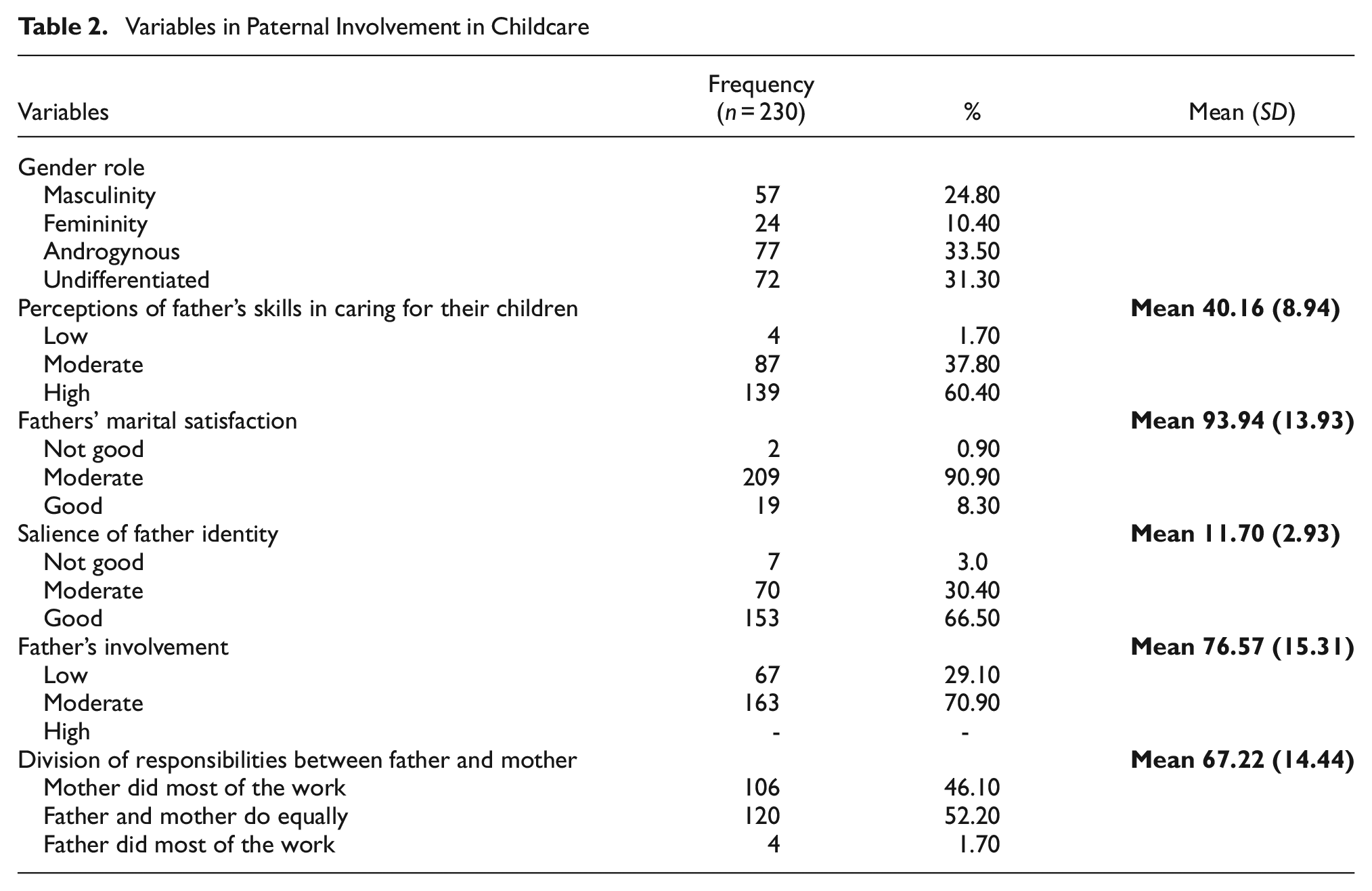
The average age of the participants was 36.36 ± 7.48 years. Their mean monthly income was US$3,807.55 ± 480.92. On average, participants had lived with their partners for 9.45 ± 4.97 years. Fathers worked outside the home on an average of 5.86 ± 0.89 days per week, while mothers worked 5.63 ± 1.05 days per week. The mean number of children in each family was 1.72 ± 0.76 (Table 1). Table 2 details the variables measuring paternal involvement in Childcare, including gender roles, perception of caregiving skills, marital satisfaction, fatherhood identity, level of involvement, and division of responsibilities between parents.
Sociodemographic Characteristics of the Participants (n = 230)

Variables in Paternal Involvement in Childcare
The stepwise regression analysis identified three significant predictors, which together explained 53% of the variance in paternal involvement, adjusted R2 = .524, df (3, 226), F= 35.336, p < .001, as shown in Table 3. The regression equation is as follows: Father Involvement = 0.503 (Perceived Skill at Child care) + 0.386 (Division of Responsibility) + 0.358 (Fathers’ Marital Satisfaction). Each of these factors was positively correlated with paternal involvement, indicating that higher levels of perceived caregiving skill, division of Childcare responsibilities, and marital satisfaction contributed to greater involvement in Childcare.
Stepwise Regression Analysis Predicting the Paternal Involvement in Childcare

p < .001.
Qualitative Phase: Fathers’ Experiences With Childcare
Responsible Involvement
Shared Responsibility for Providing Resources
Fathers contributed to their families by providing financial support for Childcare needs, such as food and supplies. One participant shared, “As a father, my main responsibility is providing for the family, so I can buy what my child needs.” (F-02-2)
Taking Responsibility for Daily Activities
Fathers also assumed daily responsibilities, often sharing household chores and caregiving tasks. One father explained, “Since both of us work, we share responsibilities. Sometimes I cook for the children. . . usually, the mother prepares their clothes, but sometimes I do it, and I don’t feel embarrassed. It’s part of my role too.” (F-04-1)
Father–Child Interaction
Choosing Gender-Appropriate Activities
Fathers often selected activities that aligned with their children’s gender. For boys, these activities typically included more physically demanding games, such as climbing, swimming, cycling, and boxing. One father described, “I spend most of my time playing extreme activities like climbing, football, and boxing” (F-01-5). Another said, “I took my son to the coconut garden to develop skills similar to a farmer’s child.” (F-02-3)
For daughters, activities were typically more creative, such as playing fantasy roles, painting, or storytelling. “My daughter enjoyed playing games like selling, painting, and storytelling with me.” (F-04-3)
Promoting Father–Child Bonding
Fathers created strong emotional connections with their children through play, affection, and daily interactions. One father remarked, “Living with my children feels like being siblings; when they face problems, they come to me. I designed my role to be both a friend and a father” (F-02-1). Another shared, “The best time is when we shower together, laugh, hug, and smell each other’s cheeks.” (F-03-2)
Discipline Training
Fathers contributed to discipline by setting boundaries for activities, such as phone use and managing their children’s emotions. “I taught my children discipline, such as limiting screen time to 2 hours before bed” (F-01-3). Another father recounted, “When we said no to buying a toy at the fair, he cried but calmed down on his own after a while.” (F-02-4)
Discussion
This mixed-method study on father involvement in Childcare during early childhood found that fathers’ perceived Childcare skills, the division of responsibilities between parents, and marital satisfaction together accounted for 53% of the variability in paternal involvement in the multiple linear regression model (F = 82.68, df = 220, p < .001). The qualitative analysis revealed three key themes in fathers’ experiences: responsible involvement, father–child interaction, and discipline training.
In line with Lamb’s (2010) conceptualization of father involvement, which includes engagement, accessibility, and responsibility, our findings on the three predictive factors are consistent with this framework. The high perception of fathers’ caregiving skills (60.40% reporting high competence) highlights their capacity for direct interaction, which aligns with the engagement dimension. Similarly, Pleck’s (2010) revised model, which emphasizes positive engagement, warmth, responsiveness, and control, is reflected in our qualitative findings, where fathers reported fostering strong father–child bonds and promoting discipline. The perception of Childcare skills emerged as the strongest predictor of involvement, underscoring the link between fathers’ confidence in their abilities and their positive engagement with children.
Most participants were adult fathers (mean age = 36.45 years), living with their spouses (58.70%). These findings suggest that the majority of participants were mature and prepared for parenthood, which aligns with studies showing that adult fathers are more capable of adapting to their role and performing parenting responsibilities effectively (Christopher et al., 2015; Sriyasak et al., 2015). According to the qualitative data, fathers displayed emotional maturity and a strong sense of responsibility for parenting. Fathers’ confidence in their parenting skills is an internal factor influencing their ability to fulfill the fatherhood role, as self-confidence is closely tied to perceived competence (Ferketich & Mercer, 1995).
The equal division of parental responsibilities (70.90%) reflects the responsibility dimension in Lamb’s theory (2010), where fathers ensure their children’s needs are met through active caregiving. The qualitative findings supported this, as many fathers reported sharing resource provision and daily caregiving tasks. Fathers engaged with their children through gender-appropriate activities, strengthening father–child bonds, and promoting positive child development through discipline and interaction, consistent with Pleck’s (2010) model. This shared responsibility aligns with the egalitarian approach, where parents contribute equally to family caregiving and provision (Gerson, 2011). Fathers who embrace this modern gender-role perspective are more likely to engage in Childcare activities (Damaske et al., 2014; Sriyasak et al., 2015).
Marital satisfaction (reported at moderate levels by 90.90% of participants) plays a crucial role in facilitating fathers’ accessibility by creating a supportive co-parenting environment. The participants had been in relationships for an average of 9.45 years, and nearly all expressed satisfaction with their marital relationships. Marital satisfaction, which includes elements, such as dyadic consensus, satisfaction, cohesion, and affectional expression, ranged from 93.94 to 135 points. A positive marital relationship encourages shared responsibilities, as demonstrated by fathers who enjoyed engaging with their children and helping with household tasks. Satisfied fathers were more likely to devote themselves to parenting (Han et al., 2023). A healthy marital relationship enables mothers to encourage fathers’ continued involvement in Childcare (Bogdan et al., 2022). These findings are consistent with previous studies that report a positive relationship between marital satisfaction, co-parenting, and father involvement (Christopher et al., 2015; Han et al., 2023; Ragsakun et al., 2019; Sanjaya et al., 2022). Marital satisfaction can have a direct impact on children’s development through its influence on father involvement.
Interestingly, gender role and the salience of fatherhood identity were not significant predictors of father involvement in this study. The proportion of participants with androgynous (33.50%) and undifferentiated (31.30%) characteristics was relatively balanced. Based on qualitative findings, most fathers did not perceive involvement in Childcare or household tasks as a threat to their masculinity. It is possible that the sample of participants, who willingly engaged in the study, held diverse views on gender roles. This is consistent with Sanderson and Thomson’s (2002) findings, which suggest that father involvement is related to fatherhood identity in complex and multifaceted ways. It is important to recognize that father identity is nuanced, multidimensional, and evolving.
Strengths and Limitations of the Study
This study on Thai fathers’ involvement in early childhood care has several notable strengths. The use of a mixed-methods approach provided a comprehensive understanding by integrating both quantitative and qualitative data. This approach enriched the findings and allowed for a more nuanced exploration of father involvement. In addition, focusing on Thai fathers adds valuable insights to the predominantly Western-centered body of research on parenting, offering a culturally relevant perspective. The study’s emphasis on early childhood involvement addresses a critical stage of development, making the findings particularly useful for informing early childhood programs and policies in the Thai context.
However, there are limitations to consider. Since the study was conducted in Thailand’s Health Region 5, the findings may not be generalizable to other settings, as variability at the center level was not explicitly modeled. The sample comprised fathers who volunteered to participate, which may not be representative of the broader population, potentially introducing self-selection bias. Furthermore, the study may not fully capture the complexity of Thai family dynamics, such as the influence of extended family members or diverse family structures, which could affect the comprehensiveness of the results.
Conclusion
This study highlights the important aspects of Thai fathers’ involvement in Childcare during early childhood, addressing key factors that influence paternal engagement. The findings indicate that fathers’ perceived Childcare skills, division of responsibilities within the family, and marital satisfaction were significant predictors of their involvement in Childcare. Fathers played an active role in providing resources and participating in day-to-day caregiving activities. In addition, fathers engaged with their children by selecting gender-appropriate activities, fostering strong relationships, and promoting discipline.
These insights provide health care professionals with a deeper understanding of father involvement and underscore the importance of supporting fathers in their parenting roles. Recognizing the positive impact of paternal involvement on children’s development, it is essential for health authorities to offer resources and guidance to encourage and sustain active fatherhood.
Relevance of Clinical Practice
The findings of this study suggest that school nurses can collaborate with local communities to implement health promotion strategies within CCs, thereby enhancing the well-being of individuals, families, and the school environment. Health care providers, educators, and human service professionals can play a crucial role by advocating for policies that promote work–life balance, offering resources and educational programs to support positive parenting practices, and establishing community-based support systems. By addressing these key factors, stakeholders can encourage greater paternal involvement, leading to healthier, more equitable family environments and improved outcomes for children.
Supplemental Material
sj-docx-1-jmh-10.1177_15579883241301830 – Supplemental material for Thai Fathers’ Involvement in Childcare During Early Childhood
Supplemental material, sj-docx-1-jmh-10.1177_15579883241301830 for Thai Fathers’ Involvement in Childcare During Early Childhood by Atcharawadee Sriyasak, Chularat Howharn, Phatcharee Chookunhom, Varunee Ket-in and Atiya Sarakshetrin in American Journal of Men's Health
Supplemental Material
sj-docx-2-jmh-10.1177_15579883241301830 – Supplemental material for Thai Fathers’ Involvement in Childcare During Early Childhood
Supplemental material, sj-docx-2-jmh-10.1177_15579883241301830 for Thai Fathers’ Involvement in Childcare During Early Childhood by Atcharawadee Sriyasak, Chularat Howharn, Phatcharee Chookunhom, Varunee Ket-in and Atiya Sarakshetrin in American Journal of Men's Health
Footnotes
Acknowledgements
The authors thank all the fathers who voluntarily participated in this study. Their contribution was invaluable, and this research would not have been possible without their willingness to participate.
Author Contributions
A.S. contributed to conceptualization, methodology, formal analysis, writing—original draft, visualization, funding acquisition, and resources. C.H. involved in investigation, data curation, writing—review and editing, and supervision. P.C. involved in conceptualization, methodology, writing—review and editing. V.K.I. participated in writing—review and editing and project administration. A.Sa. performed supervision and funding acquisition.
Declaration of Conflicting Interests
The author(s) declared no potential conflicts of interest with respect to the research, authorship, and/or publication of this article.
Funding
The author(s) disclosed receipt of the following financial support for the research, authorship, and/or publication of this article: This work was supported by the Science, Research, and Innovation Promotion Fund for fiscal year 2023 (180336-6621020000060001October 2023).

Supplemental Material
Supplemental material for this article is available online.
References
Supplementary Material
Please find the following supplemental material available below.
For Open Access articles published under a Creative Commons License, all supplemental material carries the same license as the article it is associated with.
For non-Open Access articles published, all supplemental material carries a non-exclusive license, and permission requests for re-use of supplemental material or any part of supplemental material shall be sent directly to the copyright owner as specified in the copyright notice associated with the article.
