




Abstract
Compared with resident fathers, nonresident fathers are more likely to be unemployed or underemployed and less likely, when they are employed, to have access to flexible work arrangements. Although lack of employment stability is associated with lower levels of father involvement, some research shows that increased stability at work without increased flexibility is negatively related to involvement. Using data from the Fragile Families and Child Wellbeing Study (N = 895), the authors examined the relationship between nonresident fathers’ employment stability, workplace flexibility, and father involvement. Results indicate that workplace flexibility, but not employment stability, is associated with higher levels of involvement. Policy and practice implications are discussed.
Living in poverty puts children at risk for poor outcomes on a range of behavioral and developmental measures (Anderson et al., 2003). Father involvement can serve as a protective factor against a variety of threats to children’s well-being, enhancing their cognitive and socioemotional development, socioeconomic status, academic achievement, and family and peer relations (Cabrera, Tamis-LeMonda, Bradley, Hofferth, & Lamb, 2000; Lamb, 2004; Tamis-LeMonda & Cabrera, 1999). Nonresident fathers (fathers who do not live with their children), however, are more likely than resident fathers to have low income, be unemployed, and have low levels of education (Nelson, 2004), all of which are associated with lower levels of paternal involvement (Cheadle, Amato, & King, 2010). Because they are more likely to live in poverty and less likely to have an involved father, children of nonresident fathers are at increased risk for poor developmental outcomes. In response to such research, social service programs target father involvement as a strategy for improving child well-being (Burwick & Bellotti, 2005). Because of the positive relationship between paternal employment and father involvement, programs often focus on fathers’ employment status as a means for changing parenting behavior (Bronte-Tinkew, Bowie, & Moore, 2007). Paternal employment, however, has both positive and negative relationships to father involvement; not only can it give fathers economic and social capital that enables them to fulfill their financial obligations to their children but can also create structural barriers that hinder their ability to engage in hands-on parenting activities (Russell & Hwang, 2004).
The relationship between paternal employment and nonresident father involvement is not well understood, in part, because much of the research on work and parenting has been conducted with fathers who are married, living with their children, employed full-time, and earning a middle-class income (Woldoff & Cina, 2007). Research specifically addressing nonresident fathers’ employment and father involvement is limited in that it has focused on fathers’ fulfillment of child support obligations, with less attention to the relationship between fathers’ employment and their ability to fulfill other parenting roles, such as visitation and caregiving (Spaulding, Grossman, & Wallace, 2009). Furthermore, much of this research conceptualizes employment dichotomously, wherein the father is either employed or unemployed, thereby minimizing the impact of chronic and acute unemployment, underemployment, unstable employment, and lack of flexible work arrangements, on fathers’ involvement with their children (Coley & Chase-Lansdale, 1999; Coley & Hernandez, 2006; Landale & Oropesa, 2001; Perry-Jenkins, Repetti, & Crouter, 2000). In response to such limitations, this study uses an ecological framework and a multidimensional measure of employment to better understand the relationship between nonresident fathers’ parenting behaviors and employment.
Theoretical Framework
Ecological systems theory is interested in the interaction between individuals and a layered system of environmental features, ranging from personal relationships to workplace conditions and cultural norms, within which the person lives and functions (Bronfenbrenner, 1979). Belsky’s (1984) process model of parenting identifies systems of relationships that are important to individual’s well-being and development as parents. Lerman and Sorensen (2000) contend that relationships between systems are reciprocal: A father’s employment status may increase his motivation to parent and his parenting status may influence his motivation for work. By considering the interaction between systems, specifically between nonresident fathers’ employment and familial relationships, we can better understand their fathering behavior and the circumstances that make it more or less possible for them to fulfill their parenting roles and responsibilities.
Literature Review
Nonresident Fathers
In the United States, a significant and increasing proportion of fathers are marginal or transient members of their children’s lives. Of the estimated 67 million U.S. fathers, as many as one third report that they do not live with any of their biological children (Emens & Dye, 2007). In 2007, more than 25% of all U.S. children younger than 21 years ived with only one parent, usually their mother (Cabrera et al., 2000; Kreider & Elliott, 2009). The literature suggests that nonresident fathers often have significantly different work histories than resident fathers. Nonresident fathers are less likely than resident fathers to be employed (Lerman & Sorensen, 2000), and when they are employed they are more likely to work in the service and construction industries than in managerial and professional positions (Martinson, 1998; Urban Institute, 2010). Furthermore, the work is often inadequate: minimum wage, part-time, seasonal, or temporary (Devault et al., 2008; Hernandez & Brandon, 2002); without benefits or opportunity to advance (Feely, 2000); and consisting of unconventional, unpredictable, or rigid schedules (Summers, Boller, & Raikes, 2004; Urban Institute, 2010). Nonresident fathers often have lower levels of education when compared with resident fathers (Nelson, 2004), which negatively affects their ability to secure and maintain employment and their ability to access the types of jobs that allow for schedule flexibility at work (Golden, 2001, 2008; McMenamin, 2007).
Father Involvement
As the result of changing cultural expectations concerning family structure and the role of fathers, the conceptualization of father involvement continues to evolve (Pleck & Masciadrelli, 2004). Although initially focusing on simple measures such as fathers’ absence or presence in a child’s household, father involvement has become a multidimensional construct that includes affective, cognitive, and behavioral components. Research on nonresident fathers, however, has lagged behind research on resident fathers, often conceptualizing involvement simply as fulfillment of financial obligations (Doherty, Kouneski, & Erickson, 1998). For this study of nonresident fathers, we draw on Lamb, Pleck, Charnov, and Levine’s (1985) model of involvement, and focus on fathers’ direct engagement with their young children, defined as hands-on activities such as playing games, singing, or eating.
Within an ecological framework, father involvement is conceptualized as the product of individual, relational, and contextual factors that serve as both barriers and supports for involved parenting. Pleck (1997) and Parke (1996) identify intradependent characteristics (internal motivation, skills, and self-confidence) and interdependent characteristics (familial, social, and institutional factors) that influence fathers’ parenting behavior. Doherty et al. (1998) contend that institutional practices, such as fathers’ workplace policies, can affect father involvement directly—placing constraints on temporal availability for engaged parenting—and indirectly, via the effect on individual and relationship factors. Fathers’ relationships are particularly important in shaping their parenting behaviors: Fathers who live with their child (Fagan, Palkovitz, Roy, & Farrie, 2009; Johnson, 2001), are married to their child’s mother (Nelson, 2004), or have a positive or romantic relationship with their child’s mother (Pleck, 1997; Roy, 2004; Ryan, Kalil, & Ziol-Guest, 2008), have higher levels of involvement. Fathers’ individual characteristics are also related to their interactions with their children: Fathers with less income and education (Nelson, 2004), who are unemployed (Coley & Chase-Lansdale, 1999), and who are in poor physical or emotional health (Wilson & Brooks-Gunn, 2001), have lower levels of involvement. Contextual factors related to involvement include supportive social networks of family, friends, and community members (Cooksey & Craig, 1998; Johnson, 2001; Ryan et al., 2008) and institutional policies, such as access to flexible work arrangements (Tanaka & Waldfogel, 2007), both of which are positively related to involvement.
Nonresident Fathers’ Employment and Father Involvement
Much of the research on paternal employment and father involvement has focused on resident fathers and suggests that employment acts as a barrier to involved parenting because it interferes with the amount of time a father has to spend with his children (Baxter, 2007; Russell & Hwang, 2004). Unemployed, resident fathers have higher levels of involvement than those who are employed and fathers who live with their children often increase their level of caregiving activities in response to job loss (Roy, 2004; Waller, 2009), supporting the idea that fathers’ work interferes with involvement because it decreases the amount of time fathers have to spend with their children. In contrast to resident fathers, nonresident fathers are less involved with their children when they are unemployed (Bronte-Tinkew, Moore, Matthews, & Carrano, 2007; Coley & Chase-Lansdale, 1999; Danziger & Radin, 1990; Rettig & Leichtentritt, 2001), which suggests that there are different pathways between employment and involvement for resident and nonresident fathers.
The research offers a range of explanations for the differential impact of work on resident and nonresident father involvement. Nonresident fathers who are employed may be more involved because of the positive effect of employment on their motivation to parent; such an interpretation is supported by literature showing that fathers who pay child support, thereby fulfilling a provider role, are also more likely than unemployed nonresident fathers to fulfill a caregiving role with their children (Landale & Oropesa, 2001; Tach, Mincy, & Edin, 2010). Paternal employment may also be positively related to nonresident fathers’ involvement because of its effect on fathers’ relationships with their child’s mother; the provision of financial support may reduce parental conflict, which is especially important for nonresident fathers, who often depend on the child’s mother for access (Cabrera, Ryan, Mitchell, Shannon, & Tamis-LeMonda, 2008; Waller, 2009). Both of these explanations for the relationship between employment and involvement focus on nonresident fathers’ personal and relationship characteristics. Fathers’ individual characteristics, however, may be related to contextual factors. Lack of education and stable work history makes fathers less employable and therefore more likely to be unemployed; those characteristics also increase the likelihood that fathers will work in industries, such as construction, that are less likely to provide access to flexible work arrangements and less likely to provide stability in terms of schedule and income (McMenamin, 2007).
Employment stability is an important variable to consider when looking at father involvement because of its impact on fathers’ income and economic status, seniority at work and associated benefits, and psychological well-being, all of which may affect father involvement. Research on nonresident father involvement has often conceptualized employment dichotomously—the father is either employed or unemployed—although Fagan et al. (2009) found that chronic stress, including persistent unemployment, had greater negative impacts on father involvement than short-term stress, suggesting that employment stability, rather than simply employment status, is related to levels of nonresident father involvement. Coley and Hernandez (2006) found that employment stability was associated with higher levels of father involvement for nonresident fathers but lower levels of involvement, though not at statistically significant levels, for resident fathers. Waller (2009) noted that many nonresident fathers perceived stable work as both a prerequisite and a barrier to involved parenting: with steady work, long hours, and multiple jobs allowing them to fulfill a “breadwinner” role but inhibiting their ability to spend time with their children. Roy (2004) describes a tension for nonresident fathers who have stable jobs, which allow them to provide financially for their children but do not give them the flexibility to be physically present and care for their children.
Workplace flexibility arrangements, which can include scheduling options, such as flextime, working part-time, or working alternative or irregular shifts, have the potential to increase parents’ involvement with their children because they give parents the freedom to rearrange their work schedules to accommodate caregiving responsibilities. Although the availability of such arrangements to U.S. workers has generally increased in recent decades, there are disparities between which employers offer such benefits and which employees have access to flexible and alternative scheduling. Younger workers, those without a high school diploma, and Hispanic and African American workers are less likely to work in occupations where they can vary their schedules (McMenamin, 2007). Flexible scheduling is more likely to be available to workers in managerial or professional positions and those with seniority within an organization (Golden, 2001). Fathers in manual labor occupations are less likely than fathers in nonmanual labor occupations to have access to flexible work arrangements (Urban Institute, 2010) or to make use of flextime and reduced-hours arrangements even when they are available (O’Brien & Shemilt, 2003) and men are less likely than women to use flextime (Galinsky, Bond, Sakai, Kim, & Giuntoli, 2008).
Most research looking at the relationship between workplace flexibility and fathers’ parenting behaviors has focused on married, resident fathers earning a middle-class income (Urban Institute, 2010). The lack of workplace policies that allow for flexibility in scheduling is associated with lower levels of father participation in caregiving activities (Baxter, 2007; Tanaka & Woldfogel, 2007). Although there is very little research on the relationship between workplace flexibility and father involvement for nonresident fathers (Urban Institute, 2010), a study of low-income, resident fathers showed a correlation between lack of flexible work arrangements and less engaged and less sensitive parenting by fathers (Goodman, Crouter, Lanza, & Cox, 2008).
Thus, although labor market research has long been concerned with the impact of employment on families (Russell & Hwang, 2004), research on the relationship between paternal employment and father involvement is limited in several ways: (a) it does not explain the relationship between parenting and employment for nonresident fathers, (b) it does not consider the relationship between chronic unemployment and underemployment and nonresident father involvement, and (c) it does not consider the relationship between workplace flexibility and nonresident father involvement. This study attempts to address gaps in the literature by using a sample of nonresident fathers and a multidimensional measure of employment. This study hypothesizes that (a) nonresident fathers in the sample who have greater employment stability will have higher levels of involvement with their children than nonresident fathers who have less employment stability and (b) nonresident fathers in the sample who have greater access to flexible work arrangements will have higher levels of involvement with their children than nonresident fathers who have less access to flexible work arrangements.
Method
Data
The data used in this study were taken from the Fragile Families and Child Wellbeing Study (Fragile Families Study hereafter), which is a national, longitudinal study examining the consequences of nonmarital childbearing in low-income families. There are 20 cities in the full Fragile Families Study sample, of which 16 were selected, via a stratified random sample, to comprise the national sample. For each wave of data and unit of analysis the data are weighted up to two different populations—the national or city level. Applying the national weights makes the data from the 16 randomly selected cities representative of births occurring in the 77 U.S. cities with populations more than 200,000 and applying the city level weights makes the data from all 16 cities in the sample representative of births in their particular city (Carlson, 2006; Reichman, Teitler, Garfinkel, & McLanahan, 2001). The final sample for this study consists of 895 fathers who indicated that they did not reside with their children and whose children ranged in age from birth to 1 year.
Measures
Dependent Variable
Father involvement
A father involvement scale was created to examine engagement between fathers and their child. Fathers were asked to identify the number of days in a given week they participated with their child in each of the following eight activities: played peek-a-boo, sang songs or nursery rhymes, read stories, told stories, played indoors, visited relatives, showed physical affection, and supervised bedtime routines. These values were converted to dummy codes identifying whether or not the fathers participated in the given activity with their child. This resulted in a scale score ranging from 0 to 7 numbers of days per week a father participated in any of these eight activities with his child. The scale was then reverse-coded so that the distribution of scores from the sample would match the statistical distribution (i.e., positively skewed) used in the analyses (Poisson, to be discussed later). Higher scores represent less father involvement and lower scores represent more father involvement. Analyses of the scale indicated adequate reliability (Cronbach’s α = .825).
Independent Variables
Employment stability
Coley and Hernandez (2006) used a multidimensional construct to measure fathers’ employment stability over time: Fathers were asked to report on the amount of full-time work they had when they were 16 years old and researchers compared those numbers with the amount of full-time work fathers had in their current job. Using a similar construct, we compared fathers’ employment in the year after their 20th birthday with fathers’ current employment, because those were two points in time for which we had data on employment within the Fragile Families Study. The first two items asked fathers about their employment in the year after their 20th birthday: (a) whether they had a full-time job that year, with response categories of no = 0 and yes = 1 and (b) the number of months they worked full-time that year, with response categories of 0 to 12 months. The third and fourth items asked fathers about their current employment: (a) the number of hours they usually worked per week at their current jobs, with response categories of 1 to 60 hours per week and (b) the number of weeks they worked in the past 12 months, with response categories of 1 to 52 weeks.
Workplace flexibility
Three items from the Fragile Families Study were included in this analysis. The first item asked fathers if their work schedule was flexible enough to handle family needs. The second item asked fathers if their work schedule caused extra stress. The third item asked fathers if they worked different times each week and if they worked nights and weekends. A variable measuring the number of different shifts that fathers worked was created from items that asked fathers if they worked mornings, afternoons, and/or evenings. Because overlap could exist among fathers working all of these different shifts, a variable measuring the number of different shifts was created with 0 = not working different shifts and 3 = working three different shifts.
Control Variables
Fathers’ social characteristics
Previous research suggests that father involvement is related to a variety of paternal and contextual variables, including age, income, race and ethnicity, and educational status (Cheadle et al., 2010). We controlled for the impact of those variables on fathers’ level of involvement with their children. Fathers’ age was treated as a continuous variable and measured in years. The remainder of the variables were treated categorically and converted to a series of dummy variables: race and ethnicity, educational attainment, and income.
Analytic Strategy
Given the count nature of the outcome measure (i.e., number of activities father participates in with his child in a week), linear models with outcome measures were deemed to be inappropriate and count regression models, namely the Poisson and negative binomial regression models, were used (Gardner, Mulvey, & Shaw, 1995). The Poisson and negative binomial models were compared to determine which was a better choice for the father involvement outcome measure. This comparison was warranted because the Poisson model relies on the assumption of equal mean and variance in the father involvement measure; this assumption was violated with these data. The negative binomial model adjusts for overdispersion or underdispersion (i.e., differences between the mean and variance) in the data. The negative binomial model was implemented based on the initial analyses indicating differences between the mean and variance of the data. In the analytic model, fathers’ involvement with their children was regressed on fathers’ social characteristics, employment stability, and workplace flexibility.
Results
Descriptive Analyses
Table 1 provides a summary of the sample. The average age of fathers in the sample was approximately 26 years, with fathers ranging in age from teens to mid-60s. The majority of fathers in the sample were African American and nearly 40% had not completed high school. The distribution of the income variable was similar across categories, with the highest percentage of fathers falling in the $35,000 to $49,999 category and the lowest percentage falling in the $75,000 or greater category. A total of 62% of the fathers were employed—construction (23%), service (23%), and laborer (16%) industries.
Sample Demographic Characteristics of Nonresident Fathers (N = 895)

Of the 895 nonresident fathers, 707 (79%) responded to one or more of the items used to create the father involvement scale. A mean of 4.00 was reported across the entire sample (SD = 1.76), indicating that fathers spend an average of 4 days out of a week not engaged in activities with their children (the range is 0 to 7). Results show stability in fathers’ employment over time: Nearly 80% reported being employed full-time in the year after their 20th birthday and 95% worked more than 40 hours per week at their current job, although nearly 80% worked only 40 weeks per year at their current job. This latter finding suggests that fathers were without work for almost 3 months of the current year. Fathers reported relatively little work stress due to scheduling (M = 0.61, SD =0.89, range = 0-3) and relatively high levels of workplace flexibility (M = 2.00, SD = 1.09, range = 0-3). Almost 60% of the fathers in the sample reported working one or two shifts whereas only 40% reported either not working or having worked three different shifts. Given the central role of employment stability and workplace flexibility in father involvement models, they form the conceptual basis for the remainder of the discussion.
Regression Analyses
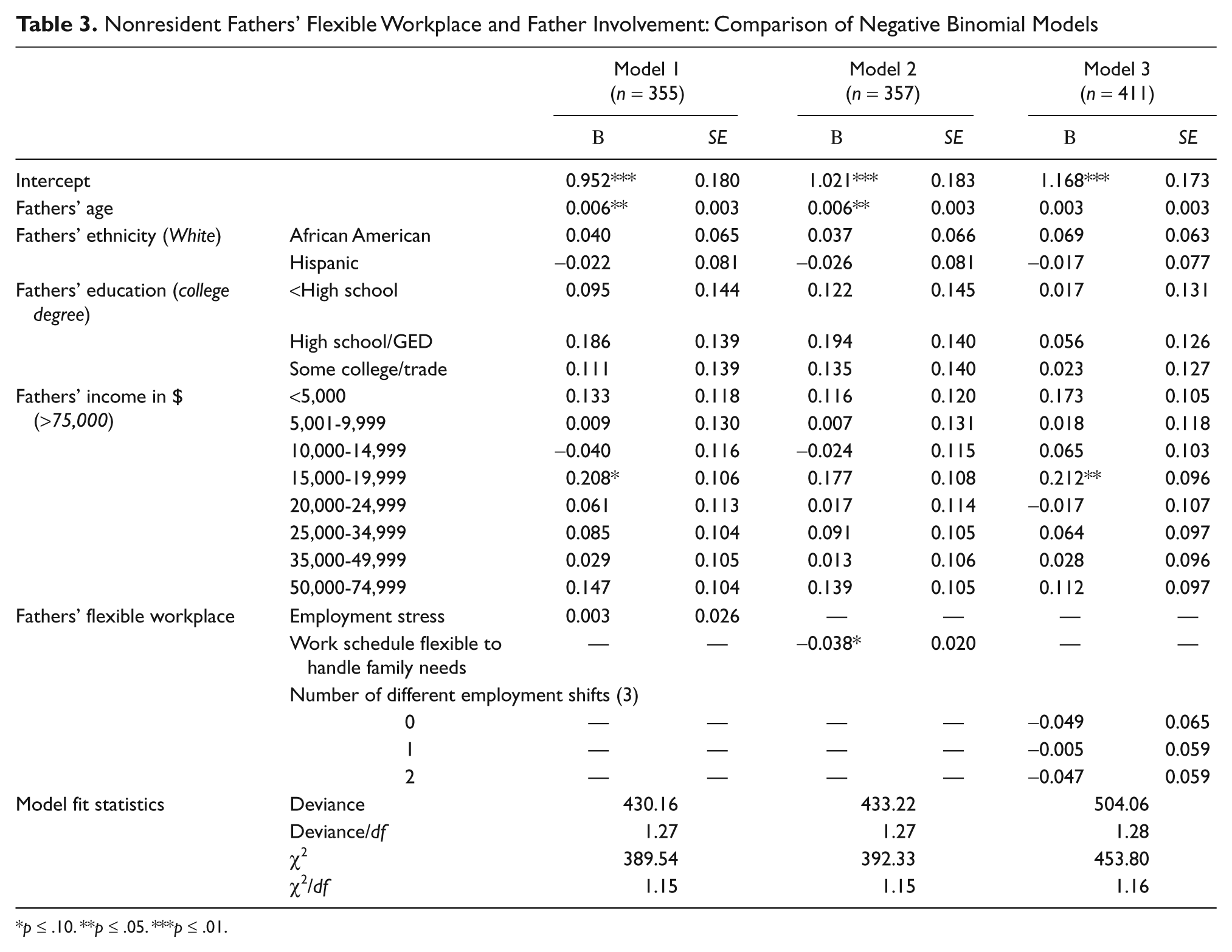
Because of the count nature of the father involvement outcome measure, Poisson and negative binomial regression models were used. The Poisson model assumes that the mean and variance of the outcome measure are equal, an assumption that was violated with the father involvement outcome measure. In this case, the variance is less than the mean (mean = 4.00, variance = 3.10), so the data are more variable than the Poisson distribution predicts, which is called underdispersion. Under these circumstances, the negative binomial model is more appropriate because it provides a different probability model that yields a better fit to the data than the Poisson regression model. The results of the negative binomial models are on display in Tables 2 and 3. These tables provide estimates of regression coefficients and standard errors as well as estimates of model fit, which were used to compare the fit of the negative binomial models.
Nonresident Fathers’ Employment Stability and Father Involvement: Comparison of Negative Binomial Models

p ≤ .10. **p ≤ .05. ***p ≤ .01.
Nonresident Fathers’ Flexible Workplace and Father Involvement: Comparison of Negative Binomial Models
p ≤ .10. **p ≤ .05. ***p ≤ .01.
A separate model was fit for each of the seven predictors (not including covariates) included in this study. Table 2 provides results for the hypothesis that nonresident fathers with greater employment stability will have higher levels of involvement with their children than nonresident fathers with less employment stability. Many similarities were observed across the four models examining the employment stability predictors. First, none of the employment stability predictor variables were significant after controlling for the covariates. Of the covariates, fathers’ age was significant in Model 4 but not in any of the other models. Certain categories within fathers’ income variable were also significant in one or more models. Fathers in the lowest income category (<$5,000) had significantly lower levels of involvement with their children than fathers in the highest and second highest income categories (>$75,000 and $55,000-74,999), respectively. These results held in Models 1 and 2 only. Fathers in the $15,000-to-$19,999 income category had significantly lower levels of involvement with their children than fathers in the highest income category (>$75,000) across all four of the models. In Model 2, fathers in the $10,000-to-$14,999 category and fathers in the $25,000-to-$34,999 income category had significantly lower levels of involvement with their children than fathers in the highest income category.
Table 3 provides results for the hypothesis that nonresident fathers with greater access to flexible work arrangements will have higher levels of involvement with their children than nonresident fathers with less access to flexible work arrangements. Many similarities were observed across the three models. Model 2 supported the hypothesis by indicating that greater access to a flexible work schedule was positively and significantly related to father involvement. Age was a significant predictor in Models 1 and 2. The results for age suggest that as a father gets older his involvement with his children decreases. As with the employment stability models, certain categories within fathers’ income variable were significant in one or more models. This was limited to Models 1 and 3, where fathers in the $15,000 to $19,999 category were found to be significantly less involved than fathers in the highest income category.
Discussion
Research with low-income, resident fathers suggests that they are engaged in multiple, daily activities with their young children (Berger, Carlson, Bzostek, & Osborne, 2008; Mikelson, 2008), whereas the nonresident fathers in our study were not involved in any activities with their children for an average of 4 days per week. Given the benefits of father involvement to children’s developmental outcomes, many programs and policies seek to remove barriers preventing nonresident fathers from fulfilling their parenting obligations (Bronte-Tinkew, Bowie, et al., 2007). The results of this study, in which one of two hypotheses were supported, builds on existing literature with the finding that nonresident fathers with greater access to flexible work arrangements had higher levels of involvement with their children than nonresident fathers with less access to flexible work arrangements. Fathers who felt that they could adjust their work schedule to attend to family matters had significantly higher levels of father involvement, which confirms Roy’s (2004) finding that rigid work schedules interfere with fathers’ ability to be engaged parents. Our results are consistent with previous research suggesting that flexible scheduling and leave policies are positively related to the quality and quantity of resident father involvement (Goodman et al., 2008; Tanaka & Waldfogel, 2007) and extends those findings to nonresident fathers. Fathers whose work allows flexibility in terms of hours worked per week tend to spend less time at work and more time with their children (Tanaka & Waldfogel, 2007). Although workplace flexibility is important for all fathers, flexible work arrangements may look different depending on fathers’ occupations. Flexible workplace policies in the professional and managerial sectors are often designed to benefit the employee and include the ability to choose start and end times, work from home, and work a compressed week (Galinsky et al., 2008). Because of staffing requirements in the service and construction industries, however, workplace flexibility in those sectors is often driven by organizational need and can create instability for employees (Urban Institute, 2010) because they fear job loss or reduced income if they leave work to tend to family obligations. Flexible programming arrangements in this sector might address the fact that employees often have no control over scheduling their breaks, have no access to paid leave, and cannot refuse to work overtime (Golden, 2008; Urban Institute, 2010).
Contrary to expectations, we found no relationship between stable employment history and father involvement. Our findings contradict Coley and Hernandez (2006), who found a positive relationship between nonresident fathers’ employment stability and father involvement, although that relationship was mediated through parental conflict. Our findings support the work of Waller (2009) and Roy (2004), who found that employment opportunities, characteristics, and constraints often force nonresident fathers to choose between fulfilling different conceptualizations of their role as father. Stable employment, which may increase fathers’ capacity and motivation for fulfilling a provider role, may also require fathers to accept long hours and inflexible schedules in exchange for higher pay and thereby decrease the amount of time they have to fulfill a caregiving role. Taken together, our findings—that workplace flexibility is associated with higher levels of involvement but employment stability is not—support the use of an ecological approach for increasing nonresident father involvement; strategies may be more effective when they target fathers, in terms of job skills and placement, and also employers, especially in the service and construction industries, and their willingness and ability to offer flexible work arrangements.
The lack of finding with regard to employment stability may reflect the fact that fathers in the sample had relatively stable employment, with more than three quarters employed at both points in time. Our results offer support for Bronfenbrenner’s (1979) contention that the relationship between individuals and environmental systems is reciprocal: in this case, that the relationship between fatherhood and employment is bidirectional (Lerman & Sorensen, 2000). More recent research supports such an interpretation: Percheski and Wildeman (2008) found that the transition to fatherhood was a motivating factor for men’s employment trajectory; in order to fulfill financial and parental obligations to their child, nonresident fathers, in particular, increased the number of hours worked per week and weeks worked per year after becoming parents. As such, our hypothesis that employment stability will be positively related to father involvement may not capture the bidirectional nature of the relationship; future studies may want to also consider the impact of fatherhood on nonresident fathers’ employment trajectory.
Our study included several control variables that were expected to correlate with fathers’ involvement with their children. Both age and income were positively and significantly related to father involvement. The findings on income are consistent with previous literature, which shows a positive relationship between fathers’ income (Seltzer, McLanahan, & Hanson, 1998) and father involvement. Fathers with higher income may have higher levels of human, social, and cultural capital, all of which may contribute positively to men identifying as fathers and fulfilling their fathering responsibilities. The positive relationship may also be a function of the fact that higher income would allow nonresident fathers to provide financially for their child, which may reduce parental conflict and thereby facilitate involvement because nonresident fathers often depend on their child’s mother for access to their child (Cabrera et al., 2008; Coley & Hernandez, 2006; Waller, 2009). Jobs that pay more are also more likely to provide access to flexible work arrangements (Golden, 2008), and our findings may reflect the fact that fathers with higher incomes also had more control over their work schedule and therefore were better able to balance work and family responsibilities.
Nonresident fathers’ involvement with their children decreases as they get older, which contradicts the expectation that older fathers are in a better position than younger fathers to meet the needs of their children (Lamb, 2004; Parke, 2002). This finding may confirm the findings of several studies, which suggest that there is a strong motivation among young fathers to be present in the lives of their children and spare their children the inconsistent fathering that they themselves may have experienced (Allen & Doherty, 1996; Dallas, Wilson, & Salgado, 2000; Young & Holcombe, 2007). Danziger and Radin (1990) also found that younger fathers had higher levels of involvement than older fathers and hypothesized that older fathers were more likely than younger fathers to have more than one child and therefore had competing claims on time available to spend with their nonresident child. Our finding may reflect differences between the relationships of older fathers and younger fathers. Fathers’ involvement with a nonresident child often decreases when they, or their former partner, enter into new romantic relationships, especially if the father has additional children with whom he lives (Ryan et al., 2008). The presence of new romantic partners for either the father or his former partner may generate conflict between them, may negatively affect nonresident fathers’ perception of the salience of the parenting role for a child they do not live with, or may result in a move, which places geographical distance between a father and his nonresident child (Cheadle et al., 2010; Tach et al., 2010).
Limitations
This study has several limitations. Because the sample consisted of fathers with young children who lived in one of the 16 cities included in the national sample, our findings cannot be generalized to all fathers or fathers with children who are older than 1 year. A longitudinal study would be beneficial to examine how fathers’ employment stability and workplace flexibility are associated with fathers’ involvement with their children throughout infancy, early childhood, and adolescence. The father involvement measures available within the Fragile Families Study capture fathers’ engagement with their children (Lamb et al., 1985) and assume that fathers are physically present during the interaction. Although our results may be different with the inclusion of measures that capture other ways that nonresident fathers may interact with their children, such as speaking with them on the phone, this seems less relevant given the age of children in the sample, who were 1 year old or younger at the time data were collected. The inclusion of such measures would be very important when measuring the involvement of fathers with older children. Father involvement was measured using fathers’ self-reports, which may vary from accounts provided by mothers. The results may also reflect the characteristics of the sample, which may consist of those fathers who were more motivated to fulfill parenting obligations, including financial support. Nearly one quarter of fathers did not provide data on the employment variables, suggesting that those fathers who did not answer were more likely to have less stable employment. Our results might be different with the inclusion of data from those fathers. Flexible work arrangements are often conceptualized as formal policies available in the workplace. However, data collected in the Fragile Families study did not allow us to make a distinction between formal leave policies available to fathers and fathers’ perception that their employer would allow them to adjust their schedule to fulfill familial obligations. Russell and Hwang (2004) contend that workplace environment must be conceptualized as a function of both formal policies (work schedule, leave policies) and informal arrangements (supervisor’s attitudes toward employees taking time off to attend to family matters, perceived supportiveness of colleagues). Our results demonstrate a positive relationship between access to flexible scheduling and father involvement, and future research should consider the relationship between formal policies, informal arrangements, and father involvement.
Policy and Practice Implications
Policies and programs intended to increase nonresident fathers’ involvement with their children have tended to focus on fathers’ ability to pay child support and therefore emphasize job placement over job readiness training. Initiatives that help fathers find work quickly, however, without attention to income level and workplace characteristics may inadvertently create barriers to fathers’ involvement with their children. Fathers with little education or job skills are more likely to secure employment in low-wage, service sector positions (Spaulding et al., 2009), which means they may have to work multiple jobs in order to fulfill their financial responsibilities and will therefore have less time to spend with their children and increased difficulties juggling multiple work schedules. Compounding these difficulties, such jobs are often less likely than managerial and professional positions to provide fathers with flexible work arrangements so that they can balance work and parenting duties (Galinsky et al., 2008). As our results suggest, stable work in such an environment will not increase the amount of time a father spends with his child.
In light of such findings, programs aimed at increasing nonresident father involvement must adopt an ecological approach that addresses both fathers’ individual characteristics (e.g., their employability in terms of education and job skills) and larger institutional practices (e.g., workplace policies). Program initiatives should be directed at employers as well as fathers, taking into account the structure and culture of the service and construction industries, which have the lowest rates of flexible work arrangements (20%) for their employees, almost twice as low as the financial industry (U.S. Department of Labor, Bureau of Labor Statistics, 2005). Flexible scheduling that is available is often a response to organizational needs and cost savings, rather than employee needs, and can actually create instability for workers in the form of reduced hours, less income, and unpredictable schedules (Golden, 2008). Because employers cannot always predict the number of workers they will need on a given day, they are often uncertain about the economic feasibility of flexible work arrangements (Urban Institute, 2010). Such uncertainty could be met with legislative initiatives that incentivize workplace policies that allow fathers to consistently predict and adjust their work schedules and thereby better fulfill their parenting responsibilities. Examples of possible changes include but are not limited to the following: giving employees control over when they schedule their breaks; moving to 10-hour work days, with 3-day weekends, and allowing for optional Saturday work days; and allowing predetermined and preapproved shift work.
Workplace flexibility can have positive benefits for both fathers and employers, because increasing workers’ control over their schedule has a greater impact on employee retention, productivity, and quality of customer service for low-income workers than those in any other job sector (Urban Institute, 2010). Recognizing the importance of healthy families to the short- and long-term sustainability of the nation, the current administration has repeatedly expressed the need for businesses and employers to change policies and practices that affect the manner in which parents balance work and family. By offering nonresident fathers flexible work arrangements, employers may give them the opportunity to fulfill their responsibilities as both employees and parents. Given the impact of father involvement on children’s well-being, public and workplace policies should aim to give nonresident fathers the opportunity to contribute positively to their children’s cognitive and socioemotional development, socioeconomic status, academic achievement, and family and peer relations.
Footnotes
The contents of the article are solely the responsibility of the authors and do not necessarily represent the official views of the National Institute of Child Health and Human Development.
The authors declared no potential conflicts of interest with respect to the research, authorship, and/or publication of this article.
The authors disclosed receipt of the following financial support for the research, authorship, and/or publication of this article:The Fragile Families and Child Wellbeing Study was supported by Grant Number R01HD36916 from the National Institute of Child Health and Human Development.