



Abstract
Yoga is a holistic form of physical activity taken up for various reasons, including physical and mental health, and sometimes spirituality. Despite the growing popularity of yoga as a form of health-enhancing physical activity, data show the uptake among men to be consistently low compared to women. To gain an understanding of barriers and facilitators for yoga uptake and adherence among men, four focus group discussions (three male groups, one female group) and three individual interviews were undertaken. Using thematic analysis, three themes were developed: (a) encouragement, advice, and support from trusted others, (b) confronting gender-related perceptions and issues, and (c) getting to the benefits. The findings suggest that men are more likely to take up yoga when encouraged by trusted others and male role models. Men face gender-related challenges that can be overcome by educating them about yoga, focusing on its physical benefits, and experiencing the benefits of yoga firsthand. To encourage more men into yoga, yoga teachers need to create an inclusive environment that welcomes men and caters to their needs. These findings provide valuable insight into the unique challenges experienced by men in pursuing and practicing yoga regularly. They may be used to develop targeted recruitment and marketing strategies to draw more men into yoga and encourage them to stay, which is essential for experiencing the many long-term health benefits of yoga.
It is generally understood that promoting preventive health behaviors among men can be difficult. However, research has shown that men are more receptive to health promotion programs that include a physical activity component delivered in male-specific contexts (e.g., sporting clubs; Gavarkovs et al., 2016). Nevertheless, not all men are attracted to these settings, underscoring the need to explore other types of physical activity programs or settings (Seaton et al., 2017). Given its holistic approach to health, yoga can be a promising option for men. Yoga is a holistic form of physical activity, including physical, mental, and sometimes spiritual components (Vergeer et al., 2021). Yoga’s potential to promote health and well-being in the general population is increasingly evidenced (Cramer et al., 2018; Hendriks et al., 2017), and qualitative studies involving men who practice yoga have reported regular yoga practice to be beneficial for men’s physical and mental well-being (M. Kidd & Eatough, 2017; McIver et al., 2022). Despite yoga’s potential benefits, yoga participation rates among men are relatively low compared to women (e.g., 8.3% vs. 18.8% in the United States [Zhang et al., 2021]; 2.0% vs. 10.9% in Australia [Sports Australia, 2023]), possibly because yoga is heavily marketed toward women (Vinoski et al., 2017). Although some yoga communities have started initiatives to encourage more men into yoga (e.g., Izzon, 2019), the extent to which these have been successful remains unknown.
Various yoga characteristics have been suggested as barriers to yoga uptake by men (Cagas et al., 2021; Spadola et al., 2017). These characteristics include the perception of yoga as a gentle, non-competitive, and mindful activity, which may not suit men’s preferences for more vigorous and competitive physical activities that require strength and skill mastery. Furthermore, yoga’s heavy marketing toward women leads to perceptions of yoga being a feminine and female-dominated activity (Cagas et al., 2021), which can be problematic for men, especially if they hold strong traditional beliefs about masculinity (Courtenay, 2000a). These suggestions imply that the low yoga uptake among men may stem from societal norms concerning masculinity. One study found that men who adhere strongly to traditional masculinity norms, specifically heterosexual self-presentation, had lower intentions of practicing yoga in the future (Motzkus & Jarry, 2024). Nevertheless, research on gender-specific facilitators and barriers to taking part in yoga and other holistic movement practices is limited (Vergeer et al., 2021).
That there are men who practice yoga is not in question, and they may do so for similar motives as women (e.g., mental health; Sports Australia, 2023), though research suggests that they are more likely than women to do yoga as a supplementary fitness activity or therapeutic exercise (Cagas et al., 2021, 2022), for competition and social recognition (Cagas et al., 2022), or when they are pressured by their partners (Brenton & Elliott, 2014). Moreover, men do not feature strongly in yoga research, including research on barriers and facilitators for participation (Cagas et al., 2023). As factors influencing men’s participation in yoga are understudied, the aim of this study was to explore the facilitators and barriers for men’s yoga participation from the perspective of yoga-participating men. It was expected that such men, drawing from personal experiences, could provide valuable insights concerning factors facilitating or hindering men’s yoga uptake and continued participation. Such insights are an essential first step to supporting wider uptake of yoga among men.
Method
We used a qualitative description approach (Bradshaw et al., 2017) to analyze data from four focus group discussions (three male groups and one female group) and three interviews (two follow-up interviews with two male yoga teachers who participated in the focus groups and one separate interview with a male participant who could not participate in any group sessions). Qualitative description uses straightforward and low-inference descriptions of participants’ accounts (Bradshaw et al., 2017; Sullivan-Bolyai et al., 2005) and is deemed particularly useful for gaining preliminary insights into participants’ views and experiences of a phenomenon of interest (Colorafi & Evans, 2016; Kim et al., 2017). The findings of such studies can offer possibilities to improve practice and promote access to health-related programs (Sullivan-Bolyai et al., 2005). This study aimed to answer the question: what are the barriers and facilitators to yoga uptake and continued participation among men?
Participants
A maximum variation sampling strategy was used to recruit 15 participants (11 males, 4 females) with varying levels of yoga experience from the Greater Brisbane region in Queensland, Australia (Table 1). Advertisements were posted on social media accounts of yoga studios and fitness centers where the lead author had personal access and contacts. Individuals who expressed interest in participating in the study were then invited to attend one of the scheduled focus group sessions. An effort was made to ensure that each group included participants with diverse yoga experience to elicit multiple viewpoints and generate rich discussions (Braun & Clarke, 2013). Although the original intention was to include only male participants, a separate female-only focus group was later conducted to provide a female perspective, allowing a form of data triangulation that could potentially lead to a more complete and nuanced picture (Breitmayer et al., 1993). As yoga-practicing women are likely to come across yoga-practicing men in their yoga space and may have male life partners who may or may not be interested in yoga, we wanted to explore whether they had additional insights to offer on the barriers and facilitators for men to take up and continue yoga.
Participant Characteristics a

Note. We used pseudonyms and altered some identifying details to maintain confidentiality.
Interview participant.
The 11 male participants self-identified as White European, with ages ranging from 20 to 53 years (M = 37.7; SD = 10.5), and years of yoga practice ranging from 3 months to 28 years (Median = 3.0 years). Most attended yoga classes 1–3 times per week, practicing Vinyasa, Yin, general Yoga, and Ashtanga. Four (36.4%) considered yoga their primary form of physical activity. The four female participants had been practicing yoga for 3–4 years, with three (75.0%) identifying yoga as their primary physical activity. They listed general Yoga, Yin, Gentle Yoga, and Vinyasa as their practice styles, attending classes an average of three times per week. At the time of data collection, most participants (82% males and 100% females) reported also engaging in other physical activities for longer than 6 months. Additional participant characteristics are summarized in Supplementary File 1.
Data Collection
A face-to-face focus group method was used to encourage open-ended discussion and elicit a wide range of views of the research topic (Braun & Clarke, 2013; P. S. Kidd & Parshall, 2000). A focus group guide developed by the authors was pilot-tested on a small group of yoga-practicing men and finalized with minimal changes (Supplementary File 2). Each focus group began with general introductions and warm-up questions to make participants feel comfortable and build rapport with the other participants. The discussion started with a sharing of what made one first take up yoga. Discussion topics then focused on factors that helped participants maintain a regular practice, their views on why other men do not practice yoga, and what would help in encouraging these men to try yoga.
Procedure
The University of Southern Queensland Human Research Ethics Committee approved the study protocol (Approval No. H18REA217). Advertisements were posted on social media accounts of local yoga studios and fitness centers. Individuals who expressed interest in participating were then invited to attend one of the focus group sessions. An effort was made to ensure that each group included participants with diverse yoga experience to elicit multiple viewpoints and generate rich discussions (Braun & Clarke, 2013). Several days before each session, personal information sheets and consent forms were emailed to the participants for completion. A list of discussion topics was also sent to allow participants to reflect on the subject (Oliffe & Mróz, 2005). Each focus group discussion took place in a meeting room on a university campus, was audio-recorded, and lasted between 1.5 and 2 hr. Each participant was offered a US$25 grocery voucher to compensate for their time. J.Y.C. moderated all group sessions and was assisted by either I.V. or S.J.H.B. After each question, J.Y.C. provided a summary to allow the participants to confirm or clarify their responses. Following each focus group, J.Y.C. and the assistant moderator reflected on the discussion and noted relevant points, common themes, and challenges. J.Y.C. also facilitated the additional and follow-up interviews. Data were collected in February and March 2019.
Data Analysis
Qualitative research, including the qualitative description approach (Bradshaw et al., 2017), is inherently subjective and may be influenced by the researchers’ background and experience. The primary author, J.Y.C., led all data collection and analysis. He is an Asian male yoga practitioner and instructor in his 40s with considerable experience in university lecturing and handling group discussions. His knowledge of yoga and years of teaching experience in a multicultural environment enabled him to communicate effectively with the participants, allowing them to express their thoughts freely. The second author, S.J.H.B., is an experienced senior academic and research supervisor in exercise psychology and public health, the third author, O.C. has expertise in psychology and behavior change, while the fourth author, I.V., is a senior sport and exercise psychology researcher, experienced in qualitative methods, and with research expertise in holistic movement practices, including yoga. All co-authors have experience of yoga.
Using NVivo 12 (2018), an inductive and essentialist form of thematic analysis was followed to examine semantic features of the data and provide a summary and descriptions of participants’ views and ideas expressed in the discussions (Braun & Clarke, 2012). The analysis involved a six-phase analytical approach to thematic analysis (Braun & Clarke, 2012), and was guided by recommended guidelines for establishing rigor and trustworthiness in thematic analysis (Nowell et al., 2017). First, J.Y.C. transcribed the audio recordings verbatim to familiarize himself with the data, read the transcripts thoroughly, noting down initial thoughts and observations of potentially relevant data items. Identifiers were removed from the transcripts, which were then checked for accuracy by O.C. Second, codes were developed from semantic content of data segments, using a combination of broad-brush (i.e., coding exchanges between group members) and fine-grained (i.e., coding lines spoken by one participant) coding (P. S. Kidd & Parshall, 2000). Third, codes containing similar ideas were grouped and interpreted to generate several candidate themes. Acting as “critical friends,” O.C. and I.V. reviewed these candidate themes independently and offered alternative interpretations and additional points for reflections (B. Smith & McGannon, 2018). Fourth, actual data under each theme were revisited to ensure coherence and consistency. Fifth, each theme was defined and assigned a name derived from the data. Finally, illustrative quotations were chosen to accompany the written report. All authors agreed on the final interpretation of the themes.
Throughout the process, J.Y.C. monitored his own biases and limitations through reflective journaling and regular debriefings with co-authors to enhance the trustworthiness of the analysis (Nowell et al., 2017; Oliffe & Mróz, 2005; B. Smith & McGannon, 2018). In addition, a summary of the themes and their descriptions were emailed to all male participants for member reflections, a step allowing exploration of similarities and contradictions in data interpretation between researchers and participants, potentially generating additional data and insight (B. Smith & McGannon, 2018). The men were asked to reflect on the report and share any additional thoughts, including how they handled the barriers themselves or advice they might have for other men to overcome those obstacles. Notably, 5 out of 11 (45.5%) male participants responded, and all agreed to the themes developed from the data. No new data were generated from the member reflection, indicating data saturation.
Findings
We identified three overarching themes, each with several subthemes (Figure 1): (a) encouragement, advice, and support from others; (b) confronting gender-related perceptions and issues; and (3) getting to the benefits. These themes represented data drawn primarily from the male focus groups and interviews. Much of what the men discussed was also evident in the female group’s discussion, and no separate themes were identified for the female group. Data from the female group are mostly presented when they provide a complementary or contrasting perspective within a theme.
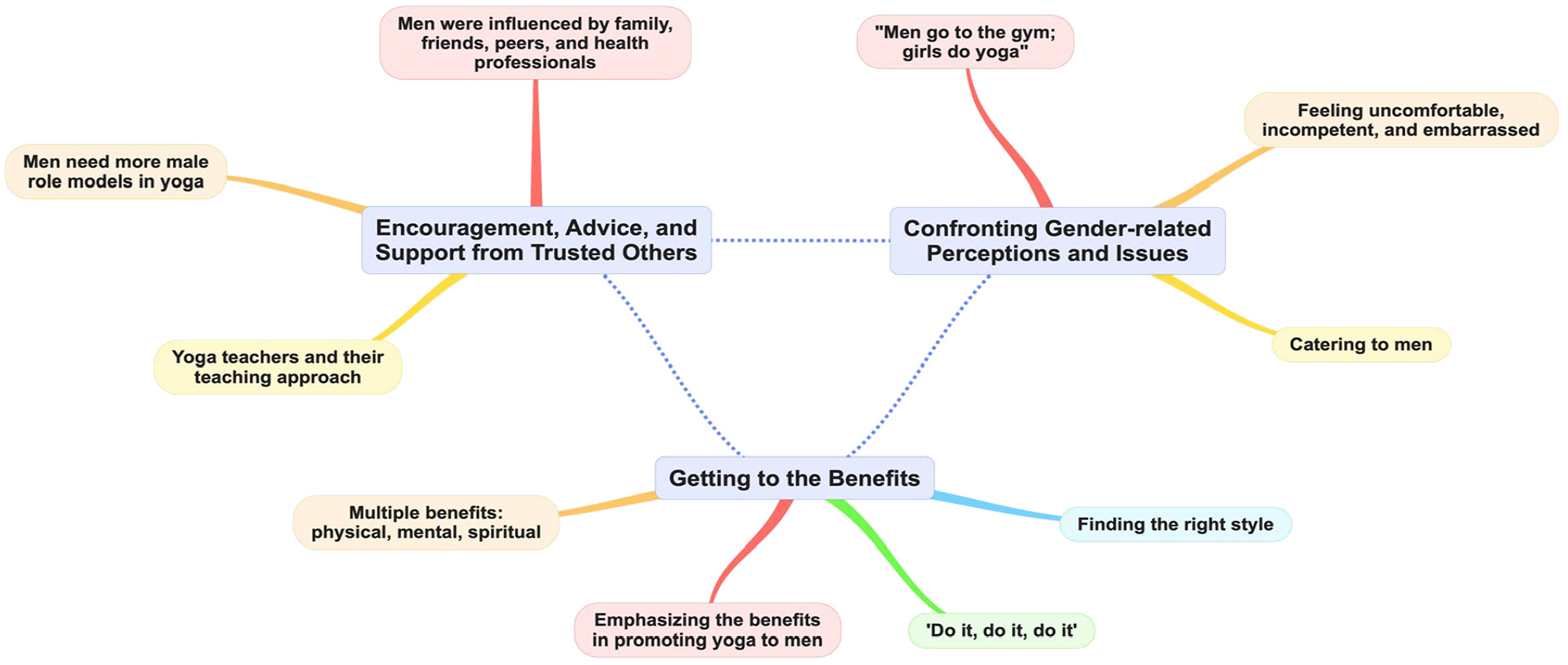
Thematic Map of Facilitators and Barriers for Yoga Among Men
Theme 1: Encouragement, Advice, and Support From Trusted Others
This theme encapsulated comments on the facilitating, and sometimes impeding, role of social agents in influencing men to take up yoga. The theme suggests that encouragement and advice from trusted others are vital in facilitating yoga uptake among men. Participants recognized that yoga is predominantly practiced by females and felt that having more visible and diverse male role models could inspire other men to take up yoga. The crucial role of yoga teachers in facilitating continued participation among men was also highlighted, although participants sometimes described instances when yoga teachers could become barriers to men’s participation in yoga.
Men Were Influenced by Family, Friends, Peers, and Health Professionals
Several men recalled how they only considered yoga beneficial after being repeatedly encouraged to do it by their partners, family members, friends, or colleagues: . . . things got to a point where you almost have to go. People were telling you, you needed this. (William) already said that you wouldn’t naturally consider (yoga) as part of your fitness. You needed someone to tell (you), “Hey, you need to do this.” (Oliver, 36)
Recommendations from health professionals were also common as several men were advised by their physiotherapists to take up yoga for pain and injury management.
Men Need More Male Role Models in Yoga
Participants pointed out the lack of diversity in male representation in yoga, noting that most yoga-related media and marketing are primarily targeted toward women, or men who are lean, flexible, and athletic: What are the predominant images and messaging that men are receiving about yoga? It’s feminine. It’s women. It’s Lululemon. It’s leotards. It’s hot chicks with beads doing dancer’s pose on a beach with crashing waves. If the imagery is towards men, it’s people like Dylan Verner, your muscle guy covered in tattoos doing one-armed handstands. That’s more like Cirque du Soleil. . . The messaging is really imbalanced. (John, 51)
Some participants, including women, mentioned that they did not know any other men who did yoga except those they had met in class. In general, participants believed there is a need for more diverse male representation and role models in yoga to encourage uptake. Several men recalled memories of other men who served as role models, such as fathers or male friends who did yoga, and how they had fostered their interest in yoga. For some participants, seeing other men in the class was motivating. “I have actually pushed myself more seeing like a couple of other guys in the group going, damn it, if they can do this, I have to do this (too). It does push you.” (Jack, 40)
Oliver recounted how a friend got inspired to try yoga because of Joe Rogan, a famous and very masculine podcaster who is a strong advocate for yoga. He believed that not many male yoga ambassadors tell other men to do yoga: “(Men) need role models who openly practice yoga and promote its benefits. Men need to see masculine counterparts participating, or for all body types. Examples would be NRL football players, military, firefighters, personal trainers, boxing/MMA fighters, tradies.”
Yoga Teachers and Their Teaching Approach
Participants emphasized the importance of finding a teacher whose teaching style matches what men seek from yoga to keep them engaged. Yoga style, class content, delivery approach, and personal characteristics were all associated with the teacher and their approach to teaching. Oliver explained, “It all depends on the instructor. Whoever is instructing really need to pair well with them (men) in order for it (yoga) to work well.”
Participants discussed how teachers could make men lose interest in yoga when they do not create the atmosphere that men prefer or introduce elements that men did not anticipate: There are styles that I just couldn’t click with. Because they were not what I went there for. I didn’t go for relaxation, for example. I didn’t go to just to hear somebody’s ideas about breathing and why we breathe, you know. To open up your (chakra). . . (Jack, 40)
Men who practiced yoga for physical reasons did not resonate with the chanting of mantras. These men believed that such practices did not belong in a “fitness” class or Western culture. However, most participants understood that these elements are integral to some teachers’ teaching styles and continued to attend these classes because the teachers created other experiences that met their needs. Nevertheless, participants acknowledged that these aspects of yoga might be off-putting to other men, especially if introduced in the early stages of involvement.
There were mixed views on teacher gender. Although some participants did not consider it important, others preferred male teachers, who were seen as having a more pragmatic approach to teaching, using less metaphysical or spiritual language, and offering more structured and challenging classes. Stephen shared, “We have both male and female teachers in the studio. . . so, for myself, I like to have a guy as an instructor. It’s a bit more challenging. . . his class is very well-structured.”
Theme 2: Confronting Gender-Related Perceptions and Issues
Often linked with the lack of understanding surrounding yoga, especially among men, this theme included comments and discussions on how yoga is often stereotyped as a feminine and female-dominated flexibility exercise, leading to feelings of vulnerability and embarrassment in men in a yoga class.
“Men Go to the Gym; Girls Do Yoga”
All three male groups agreed that men are typically competitive and prefer higher-intensity workouts. Unlike weights and interval training, yoga is often perceived as not challenging enough for men to consider it a physical activity: It is perceived as being too passive. Men want something much more amped up, much more vigorous. They wanna sweat, they wanna huff, they wanna puff. [ ] They wanna break a sweat (and) lift heavy things. . . . they wanna feel like they’ve really done something. (John, 51)
Participants pointed out that yoga is often viewed as a feminine activity because yoga classes are usually dominated by women and yoga studios are typically run by women, creating the impression that yoga is only for them. James noted, “I guess there is also the perception that it’s a thing that girls do. It’s not something for men. Men go to the gym; girls go to the yoga class. That’s how things go.” The female participants voiced similar impressions that yoga could be perceived as a female domain because the community created around yoga is typically female-oriented.
Feeling Uncomfortable, Incompetent, and Embarrassed
Participants noted that being in a room full of women might make men feel uncomfortable and embarrassed. These unpleasant feelings could arise from realizing that yoga is not as easy as they thought. Noah explained, “It’s a place of vulnerability. If you don’t feel like you belong there or if you feel like you’re the wrong gender, it could be a barrier to continuing.”
Participants discussed how men might worry about embarrassing themselves, not being good at yoga, or other people’s opinions. Comparing themselves to the more flexible women or any athletic men who might be present in the class may further lead to feelings of incompetence and vulnerability. Some female participants mentioned they had been unsuccessful in motivating their spouses to take up yoga regularly, possibly due to these fears: I’ve been trying to get my partner to do yoga for years, and I’ve successfully only got him to get a couple of classes. The very first time we went, he thought that it was going to be easy. So, it was a little bit of a shock to the system that it wasn’t because I think he thought it was like a girl thing. . . I think once he got past the idea that it’s gonna be easy, I think he felt very embarrassed that he was so incompetent at it. (Grace, 49)
The women discussed how yoga provides a quiet personal space to focus on the self, which they thought could be confronting, particularly to the stereotypical man who is not in touch with his emotions and does not enjoy being alone with his thoughts: . . . maybe it’s going to bring up things. Being alone with your thoughts that they don’t wanna have brought up, and especially in public. So, I can see that it can be quite confronting. And Australian men, in particular (it’s like). They’re not allowed to have emotions! They have beer! (Grace, 49)
When asked to reflect on these barriers, the men mentioned several strategies to overcome these obstacles. These included commitment to their health and fitness, trusting the recommendations of others, having a strong sense of self, and personally experiencing the benefits of regular participation. Thomas shared, “I certainly experienced all these barriers in my first two years. I pushed through as I am quite disciplined with my health and fitness and trusted the gentleman who introduced yoga to me.” Liam admitted, “I didn’t try yoga earlier as I didn’t feel comfortable going to yoga as the only man in the studio. . . Resilience and a strong sense of self ensured that I disregarded the perception and attended yoga practice.”
Oliver pointed out that feeling a little vulnerable is normal when trying something new. He suggested that “men are unlikely to try something new on their own without a friend/partner with them.” For Liam, having a class in the workplace with familiar faces and a welcoming yoga environment made it easier to feel more comfortable in yoga.
Catering to Men
When asked to comment on men-only classes, some participants stated that offering these regularly may not be necessary. Men will eventually realize that yoga is a personal practice, and sharing space with women should not be an issue. Some thought a men-only introductory workshop could provide an opportunity for men to try yoga in a safer environment and build confidence before easing into the female-dominated yoga space. The women believed more men should do yoga but cautioned not to accommodate men too much to the point of losing the true message and values of yoga.
Theme 3: Getting to the Benefits
This theme captured the discussions on the variety of anticipated and experienced benefits of yoga for men and includes the recommendations of male participants for other men to find a way to experience these benefits, such as not giving up after only one session and finding a style that suits their needs. Although anticipated benefits motivated men to take up yoga, experiencing benefits was crucial for their continued participation.
Multiple Benefits: Physical, Mental, and Spiritual
Various anticipated and experienced benefits were mentioned, including (re)gaining mobility and flexibility, coping with physical and mental health issues, and supporting personal or spiritual development. Men who played sports or danced in their youth were particularly receptive to yoga, sharing that they took up yoga to restore the mobility and flexibility they once had. For them, this was one of the advantages of yoga, especially when aging and no longer able to play sports: When I was younger, I did gymnastics. Then at a certain age, went to the gym to maintain the physical strength. After all the years of being in the gym, I started feeling more and more sore, and having less mobility. That’s why I was interested in doing yoga, to gain the flexibility and the mobility again. (Stephen, 37)
The view that yoga is good for stretching and relieving pain was common across all groups. Some men particularly enjoyed the stretching aspect of yoga, as it relieved them from pain associated with injuries. James shared, “. . .I had a torn ACL. I was getting a lot of pain and problems on the side that was compensating. . . I tried Yin and it was really good for relieving tension. I’m getting rid of all the pain.”
The benefits of yoga for mental health, particularly for stress and anxiety, were discussed across all groups. For some men, anticipated benefits such as managing nervousness or coping with work-related stress were what attracted them to yoga. William disclosed, “I was pretty stressed last year at work. I wasn’t having a very good, easy time with my mental issues. . . I eventually attended and realized its capability. It’s a tool to be able to get a better headspace.”
Several men acknowledged the potential of yoga in fostering personal growth, recounting how their regular yoga practice helped them develop self-confidence, self-awareness, non-judgmental attitudes toward themselves and others, and a sense of gratitude. Although some men associated yoga more with fitness than with spirituality, they valued the contemplative aspects of yoga, mentioning these as reasons they kept returning to class. Stephen noted, “What I experience at the end of yoga class is some kind of gratitude. [ ] Sometimes I can really feel gratitude after a practice. I think that yoga makes us or makes me a nicer person.”
There was an implicit understanding that some individuals may view yoga simply as a physical practice, while others may find it to be more than that, supporting personal growth and spirituality. Among the participants, four men, two of whom were yoga teachers, saw yoga as a spiritual pursuit, and engaged in its psycho-philosophical underpinnings and other more esoteric elements (e.g., chanting). One teacher believed that men without a spiritual inclination would merely do yoga for exercise but those with a spiritual inclination would “find it natural, easy, fulfilling, and rewarding as the lifestyle manifest.” (John, 51)
Emphasizing Benefits in Promoting Yoga to Men
With respect to promoting yoga to men, the women’s group thought that highlighting yoga’s physical benefits and potential for injury rehabilitation could be an effective strategy. Although they acknowledged the potential of yoga for mental health, they also thought it might be more challenging to market than physical rehabilitation. This was echoed by Jack: You could sell (yoga) to me in two ways. One, (is to) build muscle. The other one, you could (emphasize) the relaxation. Have you got back aches? Do you need to see a chiropractor? Why don’t try yoga first? Because that’s another thing yoga has healed me. I stopped having backaches. Because of all these stretching and everything. . . . If you sold it any other way to me, I probably won’t go.
However, several men implied emphasizing the “feel-good” effect of yoga. When asked how they would encourage other men to try yoga, they mentioned phrases, such as “(they will) feel good after it,” “they can feel better,” and “(they will) feel better when they finished.” Oliver said that the “feel-good” effect was what kept him going: “Because you’re moving enough, you feel the relief more often. Like every time we forward fold, I’m like, ‘Ahhh, this feels so good.’ (If it is) just stretching, I’d probably get bored and wouldn’t keep on going.”
“Do It, Do It, Do It”
A recurring suggestion across all participant groups was for men to give yoga a try and do it more than once to experience its many potential benefits. Several male participants admitted they were initially skeptical about the value of yoga until they attended a few classes and experienced its benefits. William explained that this skepticism could be due to a lack of understanding of yoga and how it could benefit men. When asked to share their message to men who have not done yoga, James emphasized that men just “have to give it a go.”
. . . try a few times and trust me, it’s gonna work your muscles really well. And stretch and all that. Ignore the other stuff but I’d say, give it a go. Like give it a good go and make a decision after a few classes… [. . .] you’d be surprised how much energy you will use and how much beneficial it is to be. (Jack, 40)
Participants discussed the importance of seeing the results for men but advised other men to avoid the “quick fix” mentality and understand that, like gym training, results in yoga take time and require regularity of practice. The men stressed it would take more than one session for men to understand yoga and experience its many potential benefits: It could probably help if you tell them that it’s something like going to the gym, you don’t just quit after one gym because you don’t get anything out of the first session, really. Just your kind of. . . you get there, the first introduction. So just like anything else, to persist for at least a few sessions and to really understand if it’s something that resonates with you. Because otherwise, you don’t get anything done. (James, 28)
Oliver pointed out that men need to overcome their tendency to be competitive and to want to master a skill immediately. He further implied that experienced male practitioners could help by sharing their own experiences and being supportive and encouraging: I guess that’s probably a male thing as well. Like you wanna go in there, be good at it straight away. . . You got to overcome that. I tried to give him words of encouragement that first day where I said I couldn’t touch my toes, because like you do need someone to tell you to keep coming. (Oliver, 36)
Finding the Right Style
Most male participants did not realize the existence of many different yoga styles when they started. For example, Liam recalled how he did not realize that some styles of yoga can be physically demanding, initially thinking that “yoga would be more relaxing, and you wouldn’t pick up a sweat.” The participants encouraged men to explore different yoga styles and find the one that meets their needs and matches their interests. John commented, “people should be encouraged to know that there’s a huge diversity and variety (of yoga) out there. They can shop around, and they can explore different styles.” This reinforces the notion that it is important for men to realize that it may take experiencing several different styles and teachers before they find one that suits them.
Discussion
This study explored the barriers and facilitators associated with men’s uptake of and continued participation in yoga. Through four focus group discussions and three interviews with 11 yoga-practicing men, we captured a wide range of perspectives, from men who were relatively new to yoga to those who had been practicing it for decades. In addition, some complementary perspectives were derived from a focus group discussion with four yoga-practicing women. Overall, we identified three main themes: (a) encouragement, advice, and support from trusted others; (b) confronting gender-related perceptions and issues; and (c) getting to the benefits.
Uptake of Yoga
Similar to previous findings (Cagas et al., 2021, 2023), men may be hesitant to consider yoga as a suitable activity for themselves because of the perception of yoga as a feminine and female-dominated activity. This may be particularly true for men who adhere strongly to traditional masculine norms endorsed in most Western societies (Motzkus & Jarry, 2024). In Australia, for example, these social expectations include having sporting prowess, being competitive, being heterosexual, and bearing physical strength (Coles, 2008). Men may feel that their masculinity is compromised when they participate in activities perceived as feminine. They avoid placing themselves in situations where they are vulnerable to social evaluation or where they might demonstrate a lack of physical ability (Hunt et al., 2016). In addition, men may feel insecure and anxious about encroaching on a female domain. Overcoming these threats to masculinity and insecurity is essential for men to feel comfortable engaging in yoga. The findings of this study suggest that receiving encouragement and advice from trusted others, having male role models, and offering male-only classes can be helpful.
Consistent with previous studies (Brenton & Elliott, 2014; Scarapicchia et al., 2016), we identified social support and influence as critical facilitators for yoga uptake and continued participation among men. For most men, yoga was not an activity that they considered until someone recommended it to them. McIver et al. (2022) also reported that male yoga participants were typically introduced to yoga by their partners, yoga-practicing family members, or health care professional. Promoting yoga through significant others and health care practitioners may thus be an important strategy to encourage more men to try yoga (Cagas et al., 2021). Medical and health care practitioners recommending yoga may help give men a “scientifically” legitimate reason to try yoga, aligning with men’s preference for science and logic (Brenton & Elliott, 2014).
Several studies on the use of complementary and alternative medicine indicate that pressure from female partners is one justification men often cite for engaging in feminine-stereotyped activities (Brenton & Elliott, 2014). The female participants in our study noted they had been unsuccessful in motivating their male partners, suggesting this may not necessarily be an easily implementable strategy. Perhaps men may need a certain degree of receptivity for such persuasion to work, or some persuasion approaches may work better than others (Craddock et al., 2015). Providing occasional and introductory men-only classes could lower barriers for some men by providing an environment where men will be less likely to feel vulnerable and embarrassed (Cagas et al., 2021). These classes may need to emphasize the physical benefits of yoga to increase men’s engagement.
Having male role models can be a significant facilitator for yoga uptake and continued participation among men. Male role models can inspire other men by sharing their own experiences and demonstrating that it is possible to overcome gender-based barriers and stereotypes in yoga. Previous research has shown that men tend to emulate other men’s health behaviors (Mahalik et al., 2007), especially in fields dominated by the opposite gender (Lockwood, 2006). To break down the stereotype that yoga is an activity that is exclusively for women, the media could showcase men who practice yoga in typical male settings, such as the military and professional sports, providing role models for other men. It is important to note, however, that male role models may need to match men’s age, life status, and perceived abilities to be relatable and inspiring (Deneau et al., 2023).
Continued Participation
Once men are ready to give yoga a try, their initial experiences are crucial to their decision whether or not to continue their participation. We identified several potential barriers that men may encounter during this stage, along with several facilitators that the men in our study recommended or experienced themselves. Barriers included the discomfort of entering a female-dominated space, not connecting with the teacher and their teaching style, and a lack of knowledge about different yoga styles. Facilitators included finding the right style and teacher, overcoming uneasiness (through resilience), seeing and experiencing personal benefits, and persevering—not giving up after one session and giving it a go for at least several sessions.
Being in a room filled with women and being a beginner are challenges that men face when they enter a typical yoga class for the first time. Overcoming the feelings of insecurity and discomfort stemming from these challenges is essential for men to return and continue their yoga participation. Men may feel like they are encroaching on a space that is not meant for them, leading to social evaluation concerns (Atkinson & Permuth-Levine, 2009), while being a beginner and not being good at an activity—particularly, if they anticipated that yoga would be easy and not physically demanding—can negatively affect men’s self-efficacy beliefs. The men in our study pointed out that personal attributes such as commitment to their health and fitness and having a strong sense of self helped them overcome these barriers.
Experiencing the benefits of yoga firsthand is crucial for men to continue with their yoga participation, as such experiences can improve self-efficacy beliefs—important determinants of exercise adherence (Beauchamp et al., 2019). Our participants shared that personally experiencing the benefits of yoga outweighed their initial concerns about being the only male in the class, which consequently led to their continued participation. Participants reported various benefits from yoga, including regaining mobility and flexibility, coping with stress and anxiety, injury rehabilitation, personal growth, and experiencing spirituality. When asked how to make yoga more attractive to men, especially those who are not physically active, they suggested highlighting the “feel-good” effect of yoga as a potential strategy.
The male participants in this study strongly recommended that men simply “do it, do it, do it,” not give up after one session, persist through at least several sessions, and search for a suitable teacher or style. These are all important strategies to help men experience the positive benefits of yoga, which could then motivate them to continue. Yoga can be a self-directed and individualized practice that requires self-responsibility and determination (S. Smith & Atencio, 2017). These traits, including having a strong sense of self, were key in helping the men in our study overcome gender-related barriers. Trusting the recommendations of others also helped them to persevere, emphasizing the value of social support (Scarapicchia et al., 2016). Perhaps similar to men who engage in other feminine-stereotyped activities, such as veganism (Mycek, 2018), men could rationalize their yoga participation by focusing on the practical benefits they gain, and in the process downplay the femininity attached to yoga.
Educating Men About Yoga
Managing men’s expectations about what they can experience in a yoga class can be an important strategy in preventing men from feeling discouraged and giving up after just one session. Informing them of the many different styles of yoga may be helpful (Mandlik et al., 2023). For example, men who want to focus on physical health and fitness would benefit from more strenuous yoga styles, while those who want to practice yoga for relaxation and meditation would benefit more from traditional and therapeutic styles. To increase awareness and help men see the benefits of yoga, providing brief information sessions (Cagas et al., 2021) coupled with decisional balance strategies (Nigg et al., 2011) can be a good starting point.
Yoga Teachers
Yoga teachers play a significant role in providing men with initial positive experiences in yoga (Atkinson & Permuth-Levine, 2009; Cagas et al., 2023). Teacher qualities, such as being relatable, compassionate, and attentive to students, communicating clearly, and providing safe instructions and appropriate modifications, have been shown to encourage yoga adherence (Spadola et al., 2017). Therefore, teachers who embody such qualities and provide encouragement and positive feedback during or after class may support men’s self-efficacy and continued participation (Scarapicchia et al., 2016).
McIver et al. (2022) recommended finding a yoga teacher who focuses on the physical aspect of yoga. However, the participants in this study emphasized finding a match between what men seek and the teacher’s teaching style, and with the yoga style itself, as crucial in the early stages of men’s yoga participation. Classes that align with men’s expectations regarding content, delivery, and experience may help shift their focus to yoga’s benefits, overcoming any barriers related to feminine perceptions about yoga (Cagas et al., 2021). However, a mismatch may lead men to give up yoga. As previous studies had predominantly female participants (Spadola et al., 2017), future studies need to examine what men perceive as desirable yoga teacher behaviors. In addition, the role of teacher gender also deserves further study, as men had mixed preference for male teachers.
Although our male participants did not discuss this as an issue, it is worth nothing that if men strongly believe that men need to be self-reliant and dominant, they may find it challenging to relinquish control of their “exercise” to an instructor, especially if it is a woman or a man of subordinate status (Courtenay, 2000b; Mahalik et al., 2003). Perhaps men’s concerns regarding the suitability of the teacher may reflect some of this type of undercurrent. Future work needs to explore gender differences in teaching styles and how adherence is affected by the interaction between these and men’s participation motives.
Strengths and Limitations
This study used a qualitative description method to identify factors that facilitate or hinder men’s participation in yoga. The results, therefore, could be useful in developing strategies to promote yoga among men. Nevertheless, some limitations must be considered. First, although we attempted to recruit men with varying degrees of yoga experience and practice styles, the participants in this study were mainly from middle-to-high socioeconomic backgrounds, typical of yoga practitioners in Western countries (Cartwright et al., 2020; Vergeer et al., 2018; Zhang et al., 2021). In addition, there was a lack of racial diversity as all male participants self-identified as White. Despite this, the results were similar to a previous study involving low-income adults (Spadola et al., 2017). Given the current demographics of yoga in Western countries (Cartwright et al., 2020; Vergeer et al., 2018; Zhang et al., 2021), it may be challenging to find non-White and low-income men involved in yoga. Interviewing such men, however, may provide valuable insights as they may hold different values or beliefs surrounding the practice. Male yoga participants living outside predominantly White societies may also have a different perception and experience of yoga. For instance, a study from India reported that the percentage of male yoga participants is almost the same as females (Mishra et al., 2020), suggesting that in such societies, men value yoga as much as women. Second, the male participants were eager to participate in the study and share their experiences of practicing yoga with other men. This provided us with rich and valuable qualitative data. However, the focus group format kept us from exploring individual issues in depth. We overcame this limitation to some extent by asking male participants to reflect on the findings and conducting follow-up interviews with male yoga teachers who took part in the focus groups. Nevertheless, future studies should use other forms of inquiry, such as interpretive phenomenology, to gain a deeper understanding of men’s experiences in yoga. Third, we did not assess conformity to traditional masculine norms. Our impression is that some men, by doing yoga, discovered that it did offer options for meeting traditional masculinity standards, such as sweating, and using their muscles, thereby reinterpreting yoga as suitable for men according to these standards. Other men, perhaps similar to men who meditate (Lomas, 2013; Lomas et al., 2016), may have embodied a less traditional form of masculinity that allowed them to appreciate the holistic aspects of yoga, embrace vulnerability, and foster emotional openness with other people. According to the work by Lomas (2013), men who learn to reinterpret (e.g., embracing softness as part of being a man) or resist (e.g., citing pragmatic reasons for taking up yoga) traditional masculine norms are able to participate in feminine activities without experiencing gender conflict. Interpretations and expressions of masculinity by yoga-participating men would be an interesting topic for future studies. Fourth, we did not ask participants about their sexual orientation. One of the participants was personally known to the lead author to be gay; some others spoke of female partners. Thus, there may have been a mix of orientations. Some research suggests non-heterosexual men are more likely to take part in activities typically associated with women, such as dance (e.g., Doull et al., 2018), and use complementary health approaches (e.g., Upchurch et al., 2016). However, whether this also applies to yoga is not known. Sexual orientation was not discussed by either the men or the women in our focus groups, which suggests it was not perceived as a relevant barrier or facilitator. The role of sexual orientation in yoga uptake could nevertheless be an interesting topic for future study. Finally, while most men in our study had experienced different styles of yoga, they only considered either restorative (e.g., Yin Yoga) or dynamic (e.g., vinyasa or Ashtanga) styles as their primary practice, and practiced in either gym or multistyle studio settings. We did not recruit men who practiced yoga styles not typically offered in these settings (e.g., Iyengar) or those who practiced in other venues (e.g., martial arts clubs). Future research could explore how yoga barriers and facilitators vary across styles and settings.
Conclusion
This study provides insights into yoga-practicing men’s perspectives on facilitators and barriers for uptake and continued yoga participation among men. The study found that men are more likely to take up yoga when encouraged by trusted others and when they have access to male role models. However, men face gender-related challenges that can be overcome by educating men about yoga, focusing on the physical benefits of yoga, and experiencing the benefits firsthand. To encourage more men into yoga, educating them about the different styles of yoga may be necessary. Furthermore, yoga teachers may need to create an inclusive environment that welcomes men and caters to their needs. This study can serve as a starting point for understanding the facilitators and barriers of yoga participation for men, adding to the small but growing body of literature on men’s experiences in yoga. Given that yoga attracts men with varying interests, promotional messages may need to be diversified, emphasizing different aspects of yoga to appeal to a broader group of men. This could draw more men into yoga and encourage continued participation, which is important for gaining the long-term benefits of yoga.
Supplemental Material
sj-docx-1-jmh-10.1177_15579883241298663 – Supplemental material for “Men Need Role Models”: Exploring the Facilitators and Barriers for Yoga Participation Among Men
Supplemental material, sj-docx-1-jmh-10.1177_15579883241298663 for “Men Need Role Models”: Exploring the Facilitators and Barriers for Yoga Participation Among Men by Jonathan Y. Cagas, Stuart J. H. Biddle, Oscar Castro and Ineke Vergeer in American Journal of Men's Health
Supplemental Material
sj-docx-2-jmh-10.1177_15579883241298663 – Supplemental material for “Men Need Role Models”: Exploring the Facilitators and Barriers for Yoga Participation Among Men
Supplemental material, sj-docx-2-jmh-10.1177_15579883241298663 for “Men Need Role Models”: Exploring the Facilitators and Barriers for Yoga Participation Among Men by Jonathan Y. Cagas, Stuart J. H. Biddle, Oscar Castro and Ineke Vergeer in American Journal of Men's Health
Footnotes
Declaration of Conflicting Interests
The author(s) declared the following potential conflicts of interest with respect to the research, authorship, and/or publication of this article: J.Y.C. is a yoga practitioner and teacher affiliated with some yoga studios in the Philippines and Australia. He declares these as potential conflicts of interest. The other authors declare no potential conflict of interest.
Funding
The author(s) disclosed receipt of the following financial support for the research, authorship, and/or publication of this article: This article is part of J.Y.C.’s PhD thesis completed in 2022, supported by the UniSQ (Physical Activity and Health PhD Scholarship), the UP System (Faculty, REPS, and Administrative Staff Development Grant), and the UP Diliman PhD Incentive Grant (Project No. 232303 Y1).
Ethical Approval and Informed Consent Statements
The study was approved by the Human Research Ethics Committee of the University of Southern Queensland (Approval No. H18REA217). All participants provided written informed consent prior to participating.

Supplemental Material
Supplemental material for this article is available online.
References
Supplementary Material
Please find the following supplemental material available below.
For Open Access articles published under a Creative Commons License, all supplemental material carries the same license as the article it is associated with.
For non-Open Access articles published, all supplemental material carries a non-exclusive license, and permission requests for re-use of supplemental material or any part of supplemental material shall be sent directly to the copyright owner as specified in the copyright notice associated with the article.
