




Abstract
Stress is a key factor that helps explain racial and gender differences in health, but few studies have examined gendered stressors that affect men. This study uses an intersectional approach to examine the sources of stress in African American men’s lives from the perspectives of African American men and important women in their lives. Phenomenological analysis was used to examine data from 18 exploratory focus groups with 150 African American men, ages 30 years and older, and eight groups with 77 African American women. The two primary sources of stress identified were seeking to fulfill socially and culturally important gender roles and being an African American man in a racially stratified society. A central focus of African American men’s daily lives was trying to navigate chronic stressors at home and at work and a lack of time to fulfill roles and responsibilities in different life domains that are traditionally the responsibility of men. Health was rarely mentioned by men as a source of stress, though women noted that men’s aging and weathering bodies were a source of stress for men. Because of the intersection of racism and economic and social stressors, men and women reported that the stress that African American men experienced was shaped by the intersection of race, ethnicity, age, marital status, and other factors that combined in unique ways. The intersection of these identities and characteristics led to stressors that were perceived to be of greater quantity and qualitatively different than the stress experienced by men of other races.
On average, African American men die over 7 years earlier than women of all races and all other groups of men except Native American men in the United States (Gadson, 2006; Warner & Hayward, 2006). African American men are more likely than other segments of the population to have undiagnosed or poorly managed chronic conditions (e.g., diabetes, cancers, heart disease; Jackson & Knight, 2006; Warner & Hayward, 2006). Although a number of factors have been hypothesized to account for these differences—health care access (Addison et al., 2007), poverty, and socioeconomic conditions (Young, Meryn, & Treadwell, 2008)—stress has been implicated as a key determinant of African American men’s health (Braboy Jackson & Williams, 2006; Williams, 2003; Xanthos, Treadwell, & Holden, 2010). Few studies, however, have explored the sources of stress in African American men’s lives.
Stress is a socially patterned and contextual phenomenon affected by cultural, economic, and social factors and structures (Aldwin, 2007; Fletcher, 1991; Meyer, Schwartz, & Frost, 2008) that shapes the social gradient in health (Orpana, Lemyre, & Kelly, 2007; Turner, 2009; Turner & Avison, 2003). Much of the literature on stress and coping builds on an interactional model of stress that highlights the social and cultural context of stress and coping (Lazarus & Folkman, 1984) and argues that perceptions and physiological experience of stressors are the primary determinants of behavior and health status (Jackson & Knight, 2006; Skinner, Edge, Altman, & Sherwood, 2003). Stress directly and indirectly contributes to high rates of unhealthy behaviors, chronic disease diagnoses, and premature mortality among men (Williams, 2003). Psychological research on men’s health and masculinity often presents stress as an acontextual, psychological construct with universal mechanisms and pathways (Skinner et al., 2003); yet characteristics (e.g., race, ethnicity, life stage) that are socially meaningful in their societal context (Griffith, 2012; Snow, 2008) shape what aspects of life are deemed stressful. Although studies of women’s health often use an intersectional approach to understand how socially meaningful dimensions of women’s identities interact to influence stressors, responses to stress, and related health outcomes, this approach has not been used extensively in research on men in general or African American men in particular (Griffith, 2012; Griffith, Metzl, & Gunter, 2011).
The goal of an intersectional approach is to simultaneously examine the social and health effects of key characteristics, aspects of identity, and context (Bowleg, 2008; Mullings & Schulz, 2006; Weber & Parra-Medina, 2003). This approach suggests that socially defined and socially meaningful characteristics are inextricably intertwined and cannot be fully appreciated as factors that operate independently or additively (Cole, 2009; Warner & Brown, 2011). Accordingly, stressors that arise from one’s unique position in social systems with unequal distributions of resources, opportunities, life chances, power, privilege, and prestige are best examined with an intersectional lens (Cole, 2009; Warner & Brown, 2011). Thus, to understand the sources of stress in African American men’s lives, it is critical to recognize how gender, race, social class, economic position, life stage, and other factors form new and dynamic social and cultural expectations that provide an important context for men’s daily lives and health (Griffith, 2012).
An important source of stress is how men define themselves as men and the gendered roles they play in their families and communities. Role strain is a theoretical framework that describes how social norms and cultural expectations regarding gender-typed roles and goals can function as stressors for men and men’s personal and social coping strategies for managing and mitigating this stress (Bowman, 1989, 2006; Levant & Pollack, 2003). Theories of role strain suggests that there may be systematic, social causes of stress and psychological and physiological aspects of strain that vary by race, socially meaningful characteristics, and other social determinants of health (Aldwin, 2007). Particularly during their middle-adult years, men’s evaluations of how well they feel they are fulfilling the traditionally gendered roles of provider, husband, father, employee, and community member are fundamental aspects of men’s identities (Bowman, 1989; Hammond & Mattis, 2005). From approximately ages 34 to 60 years, fulfilling the provider role is men’s primary focus (Bowman, 1989; Cazenave, 1979, 1981; Erickson, 1980; Newman & Newman, 2009). Despite the changes and flexibility in gender roles over time, the family provider role continues to be a salient aspect of men’s identity and the primary way that middle-aged and older men define themselves as men (Bowman, 1989; Griffith, Gunter, & Allen, 2011; Hammond & Mattis, 2005).
African American men often face significant challenges in seeking to fulfill the role as an economic provider for their families. At every level of education, African American men earn lower levels of income than White men (Isaacs, Sawhill, & Haskins, 2007). Middle-class African Americans have markedly lower levels of wealth than middle-class Whites and are less likely to be able to translate similar levels of income into desirable housing and neighborhood conditions (Williams, 2003). Moreover, as African American men’s socioeconomic status (SES) improves, they are likely to endure more stress, though SES is inversely related to stress for African American women and other groups of men (Watkins, Walker, & Griffith, 2009; Williams, 2003). Given the challenges African American men face in achieving economic success, those who define their worth as men by their economic success or conflate economic success with manhood may face considerable stress (Neal, 2005). Because historically manhood has been conflated with economic success in most industrialized nations, it is critical to recognize how central economic success is to gendered stressors in men’s lives (Connell, 1995; Summers, 2004).
Women, particularly spouses who are key actors in men’s daily lives, have unique perspectives on sources of stress in men’s lives. They are often important confidants to whom men express their struggles, fears, and concerns, particularly those related to health (Helgeson, Novak, Lepore, & Eton, 2004). Spouses and other women who are close to men observe men moving through the intimate and mundane aspects of their daily lives and have insight about men’s habits and activities, sometimes with greater awareness than the men themselves. These women also are attuned to, and help men to pay attention to, men’s health issues and often assume responsibility for their husbands’ health (Allen, Griffith, & Gaines, 2012; Lyons & Willott, 1999; Umberson, 1992).
This article explores how African American men, and key women in African American men’s lives, conceptualize sources of stress experienced by African American men. Our key study question is, “What are the main sources of stress faced by African American men?” Gendered social norms and cultural expectations intersect with socially meaningful characteristics—such as race, SES, and life stage—to shape the priorities, lives, identities, and health of African American men (Bowleg et al., 2011; Griffith, 2012; Griffith & Johnson, 2012; Griffith, Metzl, et al., 2011). Therefore, we use an intersectional approach to examine the sources of stress that affect the lives, health, and well-being of African American men.
Method
Study Design
We conducted exploratory focus groups with African American men and important women in their lives as part of the Men 4 Health study (Griffith, Gunter, & Allen, 2012). The goal of these focus groups was to examine African American men’s and women’s perceptions of the social, cultural, and environmental factors that affected African American men’s healthy eating, physical activity, and stress; our findings related to eating practices and physical activity are reported elsewhere (Allen et al., 2012; Griffith, Ellis, & Ober Allen, 2012; Griffith, Gunter, et al., 2011; Griffith, King, & Allen, 2013; Griffith, Wooley, & Allen, 2012). In addition, we were interested in better understanding stress and stressors in African American men’s lives, both in general and as they affected these two health behaviors. Separate groups were held for men and women because we wanted to capture two perspectives on men’s health: the perspectives of men themselves and the perspective of key people (women) in their lives. We felt these vantage points were important to capture insights about sources of stress and other determinants of health. The groups were led by facilitators matched by gender and race/ethnicity. Participants in the women’s focus groups answered questions about a specific middle-aged or older African American man such as a husband, boyfriend, brother, or father. Women were asked to share information about men that was similar to the information collected directly from men.
The University of Michigan Institutional Review Board reviewed the study, protocols, and materials. The focus groups were held at conveniently located community venues with private rooms and lasted 2 hours. Participants received a meal and completed written informed consent and brief demographic forms prior to starting the in-depth group discussion. Unique identifiers were assigned to each participant to ensure anonymity.
The focus group guide was designed using a phenomenological approach, which is appropriate when the goal is to explore the meanings and perspectives of research participants (Creswell, 1998). Phenomenological inquiry includes individuals who have experienced the phenomenon of interest and asks individuals to describe the topic of interest in the context of their everyday lived experience (Creswell, 1998). The goal of a phenomenological approach is to develop a composite description of “what” and “how” people experience a particular phenomenon (Creswell, 1998). In this study, we were interested in exploring similarities and differences between what men identified as sources of stress for themselves and what women who were close to men in this population identified as sources of stress for these men. The gender-stratified, guided, semistructured focus groups proceeded from general to specific questions, with extensive probing for additional detail. The interview guides included questions on stress such as: How does stress affect eating or physical activity for African American men in your age group (men’s groups)? What role does stress play in the in the lives of African American men in general (women’s groups)? How does stress influence the man you’re talking about today (women’s groups)?
Participants
We recruited African American men and important women in their lives from three southeast Michigan cities: Detroit, Flint, and Ypsilanti. These cities are the first, fourth, and fifth largest metropolitan statistical areas in Michigan, respectively (U.S. Census Bureau, 2010). All three rank below the state and the country on most socioeconomic indicators (U.S. Census Bureau, 2010; U.S. Department of Labor, Bureau of Labor Statistics, 2011). African American men in these cities experience elevated rates of chronic disease and obesity compared with men of other racial or ethnic groups in the same counties and to state and national averages (Michigan Department of Community Health, 2008, 2010; Miniño & Murphy, 2012).
Men were eligible to participate if they self-identified as African American men, reported being 30 years or older, and identified their current primary residence as being within the Flint, Ypsilanti, and Detroit metropolitan areas of southeast Michigan. Women were eligible to participate in the study if they reported having a close relationship with the men meeting these criteria. In the focus group, the women were asked to discuss a specific middle-aged or older African American man such as a husband, boyfriend, brother, or father. Participants were recruited by snowball sampling via word-of-mouth, fliers, presentations at appropriate venues, and social network connections of outreach staff and the partner organizations of a university-based research center on men’s health. The outreach staff was composed of African American men who live in the cities of interest; they have experience and reputations of being actively involved in addressing men’s health in their communities. The outreach staff strategically attended events and contacted organizations, groups, and informal social networks serving the population of interest to raise awareness about the study and recruit a diverse sample of men and women who met our eligibility criteria to participate in the study. Incentives included a meal and either a $20 gift card or an electric grill valued at $20.
Between July 2008 and March 2010, 150 African American men participated in 18 focus groups and 77 African American women participated in 8 focus groups. We conducted this number of focus groups to allow us to reach saturation in each of the three community contexts separately, and to allow us to capture unique and common determinants of eating behavior and physical activity. Table 1 summarizes the demographic and health characteristics of the male focus participants and the men discussed by the female participants.
Selected Demographic and Health Characteristics of Men.

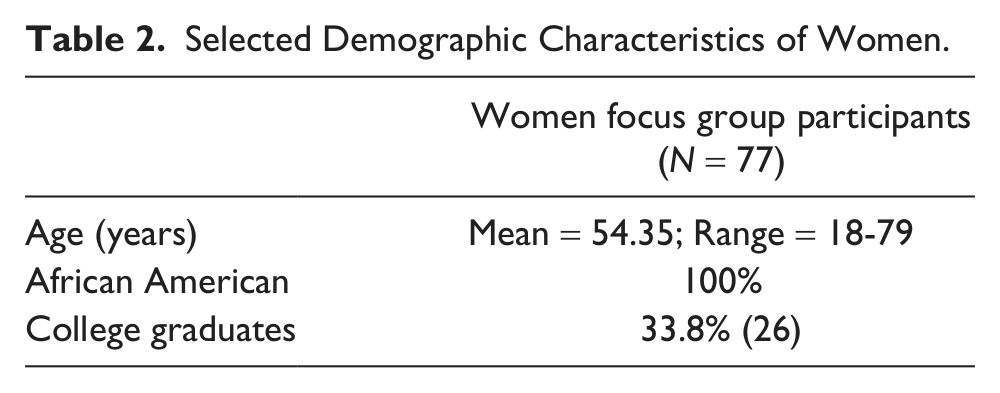
The average age for men in the focus groups was 55 years and most of the men discussed by women in the focus groups were between the ages of 50 and 64 years. A majority of the men were married or in a relationship, and the average household size was approximately three people. Male focus group participants reported slightly more children in the household compared with the men described by the women (32.6% vs. 24.7%). A majority of the men owned their home. More male focus group participants than women reported difficulty paying bills (56.9% vs. 27.6%). Table 2 summarizes the characteristics of the women who were study participants. The average age of women was 54 years (range = 18-79). All the women were African American and approximately one third of the women had a college degree. The majority of the women discussed a spouse or partner (63.6%), but some talked about other male family members (son, brother, father, son-in-law) or friends.
Selected Demographic Characteristics of Women.
Data Analysis
The systematic data organization and analysis process we used was similar to the methods used by Griffith, Allen, and colleagues (Allen, Alaimo, Elam, & Perry, 2008; Griffith, Allen, & Gunter, 2011; Griffith, Ellis, et al., 2012; Griffith, Gunter, et al., 2011; Griffith et al., 2007; Griffith, Wooley, et al., 2012). The focus group interviews were audio-taped, transcribed verbatim, and entered into the qualitative data software package, ATLAS.ti, 5.6 (Scientific Software Development). Each transcript was “chunked” into segments of text that represented distinct quotes that conveyed their original meaning apart from the complete transcripts. Each segment of text was linked to the unique identifier of the speaker, the geographic location and date of the focus group, the interview guide question, and any other stimuli (prompts, comments of other participants) that appeared to influence the individual’s statement. Selected transcripts were reviewed to inductively identify recurring patterns and topics. This yielded a book of codes chosen to enhance the ease and reliability of code assignment. University-based researchers trained in qualitative research methods assigned codes to each text segment. An intercoder reliability measure was calculated by comparing the percent agreement between the original and recoded transcripts and achieved 75% agreement.
To examine issues related to stress and coping in African American men’s lives, we examined text associated with three codes: stress, health behaviors, and norms. Table 3 provides the definition and criteria for applying each code. Due to the breadth and comprehensiveness of data captured with these codes, we felt that examining text with these codes was adequate for a thorough analysis of how men and women discussed stress and coping among African American men. To ensure broad representation, we analyzed the number of men and women who discussed the topic across focus groups and geographic locations. The most central code for this analysis, the stress code, was one of the most commonly applied codes and was discussed by 66.7% of the men and 99.5% of the women. We report these findings to illustrate that this was a frequently discussed theme across the groups that varied by gender and geographic location.
Code Definitions.

Because the goal of this study was to explore what this specific population of men (and key women in similar men’s lives) identified as stressful for them and why they thought these experiences were stressful, a phenomenological approach was appropriate (Creswell, 1998). We examined the text segments associated with these codes and used highlighting and margin notes to summarize and document potential questions, connections, and implications of the text for further analysis. We used comparison analysis to ensure consistent interpretation of the statements. These notes were summarized into a larger document organized according to four themes that emerged from this analytic process: sources of stress, coping strategies, noncoping effects of stress on behavior, and consequences of stress on men’s health. This article presents men’s and women’s perceptions of sources of stress in African American men’s lives. Findings on other stress and coping topics are presented elsewhere (Griffith, Ellis, & Allen, 2012).
Two member checking groups were conducted with men from our population of interest to confirm that our interpretation of the data accurately captured the major themes salient to our population of interest. The setting, incentives, and recruitment process was similar to that of the focus groups, but within this process we invited men who participated in earlier groups who seemed to be particularly insightful about men’s lives, lifestyles, and behaviors. Thematic differences between cities were not detected, thus geographic comparisons are not included in the results. Similarities and differences between focus group data from the men and women are discussed. Quotes presented were selected to reflect the diversity of perspectives and opinions that emerged from the data.
Results
Many of the focus group participants, both men and women, asserted that middle-aged and older African American men had more stress than men of other racial and ethnic groups. Although focus group participants identified an array of explanations for why African American men experienced such a great deal of stress, two prominent themes emerged from the data: (a) African American men were under a great deal of pressure, both external and self-imposed, to fulfill many roles and responsibilities in their families, jobs, and communities, which was stressful and (b) factors unique to being an African American man in the United States made fulfilling those responsibilities particularly challenging.
Stress of Responsibilities
Work stress
According to both the men’s and women’s focus group participants, stress related to employment was the most commonly described type of stress that African American men faced. Several men described job responsibilities (i.e., being a manager or having to resolve conflicts), working overtime, long commutes, and interactions with coworkers or clients as stressful. The shrinking workforce also was noted as a source of stress for employed men. As one 46-year-old man noted,
Times have changed in terms of our work force. . . . We are taking on more responsibilities. . . . The workforce is dwindling, so it places a lot of pressure on the individuals that are [still] there. . . . There’s stress.
Both men and women discussed the stress of being unemployed and men’s fear of unemployment, which was common in the three economically struggling cities where we conducted our study. One woman explained how difficult it was for men to adjust to unemployment:
We’re talking about men who will be out of work, who used to work at Ford . . . and could afford a T-bone steak . . . [They’re] now going to be hustling for some beans. . . . This thing is going to really hurt: when men who have been making money and having three or four cars in the house, lose their home. . . . The stress is going to be a humdinger.
Women also identified retirement as stressful for older African American men. One woman shared that her father’s forced retirement from his primary career was stressful for him. He ended up getting a new job as a greeter at a local store just so he could get out of the house, stay active, and “work” again.
Stress in family life
Stress related to family was fairly common among the men. Men cited marital problems, family situations, conflict at home, and the death or illness of a spouse as sources of stress. For some men, the magnitude of family-related stress was minor (e.g., when a “[family member] got on my nerves”). On the other hand, losing a spouse or becoming the caretaker of an ill spouse or other family member was described by men and women as a major stressor in the lives of some African American men.
Busy schedules
Men described an overall sense of being very busy and “burning the candle at both ends.” Many of the men described themselves as committed to a number of different time-consuming activities. After commuting, working full time or more, spending time with their families, and being involved in their community, many of the men described having little time for anything else and were exhausted. Individually, these commitments were identified as distinct sources of stress, and the effort to simultaneously find time to meet all these commitments represented a significant amount of stress for men.
Multitude of roles and responsibilities
Both men and women drew attention to the stress African American men experienced when trying to fulfill a number of social roles and obligations at work, in the family, and in the community. In addition to the time commitments involved, men described feeling a great deal of pressure to fulfill many roles and responsibilities. One man described men’s efforts to fulfill all these roles as being in “survival mode.” Men in the groups seemed concerned about the stress they personally experienced and also the stress experienced by other African American men. One man explained,
Some people [are] in a stressful situation. They are stressed about how they’re gonna pay their rent or how they’re gonna eat the next day . . . how they’re gonna feed their kids. You have a lot of that going around.
For many of the men and women, being a provider and the primary breadwinner was a core expectation of these men, despite changes in the economy and societal gender roles. Women acknowledged that this was a particularly difficult source of stress for men to deal with:
I think stress plays a large part in African American men’s lives because they are constantly trying to keep their heads above water and maintain themselves as heads of households. With the way the economy is, it could be a real difficult thing . . . not being able to measure up to society’s standards of what a man should be.
One woman commented that being the single source of income for the household was stressful for men, but another woman pointed out that some men did not want their wives to work because they wanted to prove their capacity to be the sole provider. Men were said to attempt to do this, “even as times get harder.”
Health issues
Men in the focus groups rarely mentioned their own health status as a source of stress, though a couple of men reported being stressed out about an upcoming medical visit. Women, on the other hand, talked about health issues as a source of stress for men more frequently.
Women stated that men found it difficult to accept changes in their body due to aging, especially when those changes affected their functioning, ability to meet commitments, or independence. A woman whose husband had complex health problems explained:
When illness sets in, they [African American men] have to change their whole lifestyle. It’s age-related. It’s very stressful when they can’t do the things that they used to do . . . when they have to have the patience to wait until someone can come and do these things for them . . . especially with two or three health problems. Lots of problems on top of problems.
Additional Strain of Being an African American Man: Race, Racism, and Society
Being an African American man was also identified by both men and women focus group participants as a source of stress in and of itself. Men described the stress of “trying to make it in the Black community” or the stress of “being a Black man.” This was described by the men as a chronic, “everyday” stress that they had to deal with on a daily basis and that permeated every aspect of their lives.
Racism, history, and society
One male participant stated that the pressures that African American men face are unreasonable. He commented, “I think the pressures of society have caused an unreasonable amount of stress on us. We’re the target for everything bad.” Many of the men commented that they felt they, and other African American men, were treated differently because of their race. Men described experiences of racism and discrimination in their daily interactions. A 65-year-old man shared his experiences of being an African American man in different parts of the country and the discrimination he faced:
Down in Carolina, [there was] a lot of stress being Black man. I knew [where I couldn’t go] and didn’t worry about it. . . . I got up here [to Michigan], and I’m supposed to be able to go anywhere I want to go, but they treat me so bad. . . . I can go anyplace, but they see me sitting there and pass me by and won’t wait on me. . . . That’s stress.
Several women made the connection between African American men’s current treatment in society, which they also identified as appalling and stressful, and the history of institutional racism in the United States. One woman described how her former fiancé felt he would never be successful and happy in life because he seemed to be caught in a cycle of “I’m never gonna have” that stemmed from a family history of such a belief. Another woman explained that for African American men:
. . . in the job, if he’s in corporate America, how he’s viewed or discriminated against for who he is. . . . There’s the tradition of that that goes all the way back to slavery. He’s always been demeaned . . . and with that comes stress within himself, constantly trying to fight against the bureaucracy of the man and the world and fighting for his own identity.
Racism and career
Both men and women described the stress associated with African American men’s experiences of racism and discrimination in the workplace. In addition to racist interactions with coworkers and clients, a number of the men described discriminatory hiring, firing, and career advancement practices. A 52-year-old man explained, “Just being Black in the workplace. That’s a whole lot [of] stress, because I mean, we are the last ones put there and the first ones to be gone.” Men shared examples of how they had being passed over for promotions and felt that being an African American man was the reason for this. A number of men commented that they had to work twice as hard as their colleagues who were not African American men, just to move up in their career, and sometimes even this dedication did not prove fruitful, resulting in disappointment and frustration. One of the women said, “There are stressors of not being able to obtain the American dream, no matter what he does.”
Societal expectations of African American men
The participants in the women’s focus groups discussed the intersection of being a man and African American in relation to societal stress. Women believed that African American men were often judged by others and this was stressful. One woman explained:
Stress is very prevalent because [African American men] have to prove themselves to everybody, not just to their wives or sisters, but everybody’s judging them. . . . They have such big egos . . . [They have to] prove their self-worth. You know, the color of their skin . . . everybody’s judging them, white society, everybody’s judging them.
African American men’s perceived failure to meet certain standards of conduct was associated was a source of stress for some of the men. A minority of men and women believed that African American men brought stress on themselves for not taking care of their responsibilities. Several of the men indicated that they experienced stress observing younger African American men not meeting their expectations. One participant was saddened that the aspirations held by younger African American men were often limited.
There were a small number of women who did not see any distinction between the stress experienced by African American men and men of other racial groups. Instead, these women believed that there were differences in how men coped with stress across racial groups.
Discussion
In this study, African American men and key women in their lives identified two primary sources of stress in African American men’s lives: (a) men’s desires, efforts, and struggles to fulfill socially and culturally important roles; and (b) being both African American and men in a racially stratified society. With the exception of discussing the death of a spouse, these African American men and the women in their lives talked about chronic sources of stress. A central focus of men’s daily lives was trying to navigate the various roles and responsibilities they have in different life domains, but this occurred in the context of societal forces that tended to constrain men’s choices and make it more difficult for them to successfully fulfill these roles and responsibilities.
Although the perspectives of men and women were often similar, it is important to note that there were some differences. Health was rarely mentioned as a source of stress by men, though women noted that men’s aging and declining health and physical vitality were sources of stress. Men often expect and appreciate their wives’ involvement in managing their health (Rook, August, Stephens, & Franks, 2011), and women, particularly wives, may have a unique and critical role in men’s health. More research is needed to explore the novelty and importance of the perspective women offer on men’s health. The discrepancy between men’s and women’s perspectives on the extent of men’s health as a source of stress may be similar to the literature that describes how men tend to focus on their ability to use their bodies to complete daily tasks, particularly work outside of the home (Robertson, 2006). Prioritizing success in fulfilling key social roles at the expense of one’s health is consistent with the notion of John Henryism (Griffith, Gunter, & Watkins, 2012; James, Hartnett, & Kalsbeek, 1983).
In the fable of the “steel driving man,” John Henry was an African American railroad worker in the late 1800s. His fame emerged from his participation in a steel-driving contest in which he defeated a steam-powered drill and then died. Epidemiologist Sherman James coined the term John Henryism—the psychological and behavioral pattern of active coping with chronic life stressors—to help explain African Americans’ high rates of heart disease and premature mortality through both men’s physiological and behavioral response to stress (Bennett et al., 2004; Bonham, Sellers, & Neighbors, 2004; James, 1994). One of the underappreciated aspects of the concept of John Henryism is that it highlights that African American men often perceive that there is a limited range of strategies for achieving success in key life roles and often the limits come from the ways African American men define and perform manhood, particularly in ways that are congruent with traditional cultural ideals of masculinity (Courtenay, 2000).
Men’s focus on using their bodies as tools to fulfill obligations associated with key social roles may obscure their efforts to recognize deleterious changes in their physical bodies that may be the result of stress (Robertson, 2006, 2007). Health is often considered a low priority for men until poor health impairs some aspect of their lives (e.g., sexual relationships, job) or roles (e.g., provider, father, spouse) that is considered a higher priority (Bird & Rieker, 2008; Bowman, 1989, 2006). As was illustrated in these focus groups, women in men’s lives, but not men themselves, recognized declines in men’s physical functioning, pain, and mobility that made fulfilling goals, aspirations, and roles more difficult for men. Thus, the role of key women in men’s lives to help men recognize these issues and bring them to the attention of the men and health professionals may be a key to promoting men’s health and healthy behavior.
In general, participants in this study reported that there were unique and more stressors experienced by African American men than experienced by White men, who were often viewed as the point of comparison. “African American” tends to be used as both a racial and ethnic category, which helps highlight how men’s sources of stress may come from environmental constraints, particularly economic environmental challenges, that are associated with race (e.g., race-based residential segregation; Williams & Collins, 2001), and cultural traditions, beliefs, habits, and practices that tend to be associated with ethnicity (Griffith, 2012). Race is a particularly important determinant of health because it is associated with access to economic and social resources and stressors (Griffith, Johnson, Ellis, & Schulz, 2010; Schulz, Williams, Israel, & Lempert, 2002) and race influences social class and economic position in society (Kawachi, Daniels, & Robinson, 2005). Ethnicity encompasses aspects of culture, social life, and personal identity that socially defined groups tend to share (Ford & Harawa, 2010). African American men’s lives and sources of stress are shaped both by the economic and social resources available in their neighborhoods, the cultural norms and expectations of other African Americans, and the expectations of people from other racial/ethnic groups (Griffith & Johnson, 2012).
Participants discerned a connection between being African American and a man in U.S. society. Although the men and women describe how race and racism acted both as stressors and exacerbated other sources of stress in the lives of African American men, there was a strong sense that the type and intensity of the men’s racial experiences were greatly affected by the fact that they were both African American and men (Pieterse & Carter, 2007). African American men may experience more intense discrimination than African American women and men of other racial and ethnic groups because they tend to be assessed and interacted with on the basis of a range of negative race- and gender-based stereotypes (Pieterse & Carter, 2007). Racism was a term used to help explain many of the types and sources of stress that African American men experienced. Racism was operationalized by study participants as a component of U.S. cultural norms and expectations, an explanation for inequitable access to opportunities and resources at work and in their daily lives, and as a source of motivation for men to demonstrate the inaccuracy of many sociocultural expectations and assumptions. Racism shapes the types of masculinities that men are able to embody because the environments where men live are influenced by the global, national, and local meaning of race for social expectations and opportunity structures (Courtenay, 2002; Ford & Harawa, 2010; Pease, 2009).
Men and women discussed stressors in African American men’s lives as a result of characteristics and identities that could not be fully understood by examining each dimension alone. This study focused on men who primarily shared the following characteristics: male, African American or Black, middle-aged or older adult, and were married (or had a female partner). These characteristics represent key aspects of African American men’s lives that are relevant to their sources of stress. An intersectional approach helps identify how each of these factors is relevant to men’s lives and helps put the sources of stress that African American men experienced in context.
Men simultaneously sought to fulfill norms and expectations of masculinity while reinforcing the interdependent, gendered division of roles and responsibilities within their relationships with spouses, girlfriends, and other key women in their daily lives (Courtenay, 2000). Men’s health behaviors can be influenced by their efforts to consider how their choices may affect their partners and their relationships (Lewis et al., 2006) and the pressure and strain to fulfill the roles of a provider, spouse, and father (Griffith, Gunter, et al., 2011).
Because the fundamental meaning of masculinity and the salience of different aspects of masculinity change over the life course, it is critical to recognize how age shapes men’s notions of manhood and the salience of various roles and life stressors. The men in the current study highlighted the need to consider phase of life-appropriate pressures and strains to fulfill salient roles to understand the sources of stress in these men’s lives (Griffith, 2012; Griffith, Gunter, et al., 2011; Griffith, Gunter, & Watkins, 2012). Consistent with role strain theory (Griffith, Gunter, et al., 2011), the difficulty middle-aged African American men faced in seeking to fulfill provider role obligations compromised men’s psychological health and overall well-being (Bowman, 1989). Employment-related stress seemed to be the primary source of stress for these middle-aged and older men because it challenged their role as a provider, which is a central aspect of manhood. Economic and social changes have diminished the likelihood that men are the sole partner working outside of the home or providing economically for the family, but men’s gender and class role performance is so tied to their identities and the expectations of others that it remains an especially salient source of stress (Haynes, 2000; Summers, 2004; Tucker & Mitchell-Kernan, 1995). In addition, when men become widowers or become caretakers of an ill spouse, these men begin to fulfill more traditionally feminine roles. These changes in men’s roles and responsibilities at home are important sources of stress for older men who may be more at risk for poor nutrition and other unhealthy behaviors as a result of assuming these unfamiliar roles (Wham & Bowden, 2011).
Limitations
Although participants involved in this study provided some unique insights into key sources of stress, several limitations of this article should be noted. The primary goal of this study was to refine theories that seek to explain sources of stress in the lives of mid-life and older African American men; thus, the findings may not be generalizable to other groups of men or women. Aspects of our findings, therefore, may be more salient to some groups of men (e.g., those with chronic diseases; men who are married or have a girlfriend, especially those who live with their partner) than others; however, this study was designed to identify key trends and not compare men with different characteristics. The large proportion of men in our study with chronic diseases may, in part, account for the prominence of women’s attention to men’s health as an important stressor. Exploring why women recognized men’s health as a stressor but men did not would be a valuable topic for further research.
Although level of chronic disease in these communities is discussed, we did not collect data on men’s or women’s SES. We therefore cannot discuss the potential implications that the participants’ economic status may have on their sources of stress nor can we discuss the potential intersection between poverty and stress. Discussing economic status, therefore, is an important direction for future research. Given the wealth gap between African Americans and Whites, the positive relationship between income and stress for African American men, and the difficulty that African American men face translating similar levels of income into desirable housing and neighborhood conditions for themselves or their families (Williams, 2003), it is critical to look beyond income to other measures of social class and economic status.
Although our procedures captured the strongest and most prevalent themes, topics that were not probed in greater depth during the focus groups and perspectives voiced by a minority of respondents are not always included in this article. Because of the group data collection format, some men may have opted not to share sensitive information related to this topic. The member checking groups (Creswell, 1998) we conducted with men from our population of interest, however, increased our confidence that we identified key sources of stress in men’s lives.
Conclusions and Implications
Identifying the sources of stress that African American men face may be a key to understanding and addressing their poor health. The types and sources of chronic stress that people face are not equally distributed; by virtue of being an African American man, there are stressors that are most accurately understood through the lens of an intersectional approach that considers myriad, multilevel factors that shape men’s health and well-being. Interventions to improve African American men’s health behaviors and health outcomes should consider how chronic life stressors are important barriers to positive health behaviors and overall health. Paradoxically, without first understanding how efforts to fulfill admirable and positive social roles may be contributing to the poor health of these African American men, we cannot understand where and how to effectively intervene to improve their health.
Footnotes
Declaration of Conflicting Interests
The author(s) declared no potential conflicts of interest with respect to the research, authorship, and/or publication of this article.
Funding
The author(s) received following financial support for the research, authorship, and/or publication of this article: This manuscript was supported in part by grants from the American Cancer Society (MRSGT-07-167-01-CPPB), the National Institutes of Health (7R21DK095257-02), the Michigan Center for Urban African American Aging Research (5P30 AG015281), the Cancer Research Fund of the University of Michigan Comprehensive Cancer Center, the Horace H. Rackham School of Graduate Studies at the University of Michigan and the Vanderbilt University Institute for Research on Men’s Health.