



Abstract
The use of tailored language, which involves a clinician’s ability to adapt communication styles and employ accessible terms and concepts, has long been touted as key to engaging men with mental health services. Metaphors are one communication device that can provide men with ways through which to meaningfully express themselves and communicate their mental distress experiences. Using qualitative photovoice research, the current study examined how New Zealand-based men (n = 21) communicatively constructed their meaning of mental distress through metaphors. Analysis of interview data was used to derive three metaphor groupings men consistently drew on to articulate their lived experiences: metaphors of emotions (darkness and weight), metaphors of survival (battle and entity), and metaphors of disembodiments (debility and entrapment). The findings highlight the power of metaphors as a tool for men in communicating their experiences of mental distress and are valuable for health professionals to contemplate across an array of contexts. The implications and importance of a metaphor-enriched perspective for engaging men in professional health care settings and services are discussed.
Introduction
Depression and anxiety disorders are the most prevalent mental health conditions among men and a leading burden of illness globally (GBD Mental Disorders Collaborators, 2022; Gottert et al., 2022). New Zealand is no exception; the 2022/2023 New Zealand Health Survey found that 10.2% of men experienced high to very high psychological distress in the previous 4 weeks (Ministry of Health, 2023). While the number of men accessing mental health services is increasing (Harris et al., 2015), and men will and do seek help in some circumstances, their premature disengagement from therapy remains an issue (Seidler et al., 2021). These high lost to follow-up trends indicate that existing psychological therapy practices may not be engaging or adequately meeting men’s mental health needs (Seidler et al., 2024). An increased understanding of factors involved in men’s interactions with mental health services is especially important given many men who die by suicide have had contact with mental health care in the year prior to their death (Walby et al., 2018).
An important body of clinical literature includes recommendations regarding what may attract and retain men in psychological treatments (Englar-Carlson & Stevens, 2006; Rochlen & Rabinowitz, 2013), but much of this work lacks empirical weight to muster specific changes in services (Seidler et al., 2018). The precise factors which assist men’s uptake and engagement with professional services are debated (Seidler et al., 2018), but important inroads to teaching clinicians about working with men has recently been made. The Men in Mind program, an online training for clinical practitioners focused on developing gender competencies related to engaging and supporting men in therapy, has been effective at increasing practitioners’ self-reported efficacy to work with men (Seidler et al., 2022, 2024).
Another strategy touted as key to engaging men in mental health care, but in need of additional investigation, is the adaptation of language using metaphors. Metaphors—words that compare one thing with another (Lakoff & Johnson, 1980)—provide a powerful language tool that enables individuals to conceive and make sense of their lived experiences. As Lakoff and Johnson (1980) famously argued, metaphors are fundamental to the way we live because they enable us to draw on our understandings of physical and social experiences, and to comprehend and articulate complex or abstract experiences. The use of metaphors has been reported to be particularly prevalent when men are talking about challenging, new, or emotionally charged experiences such as illness, pain, loss, and trauma (Foley, 2015; Stanley et al., 2021). Metaphors can connect with men’s interests to facilitate nonthreatening avenues of communication and assist men in understanding vulnerable emotional content and therapeutic concepts (Genuchi et al., 2017; Seidler et al., 2018). Metaphors may provide important avenues for men to meaningfully express themselves and communicate their experiences of mental distress (Coll-Florit et al., 2021; Shinebourne & Smith, 2010), with potential for idiosyncratic shared metaphors to be co-constructed by therapists and men in therapy (Mathieson et al., 2015). Examining the metaphors employed by men in emotionally challenging situations is especially crucial due to the gendered nature of mental illness, wherein men’s distress might be communicated in a manner not readily understood by health care providers (Cleary, 2012; Ridge et al., 2011). These communication difficulties have repercussions for men’s utilization of mental health services. For instance, mental health care providers might face difficulties when suicidal men express distressing symptoms without displaying corresponding emotions (Strike et al., 2006).
There have been a limited number of studies where researchers have employed metaphors as a perspective to explore the lived experiences of men impacted by mental illness. In their study of depression, Charteris-Black (2012) identified metaphors of descent, containment, and constraint as central in men’s language of depression. Men conceptualized themselves as a container of sad emotions, and depression as a container within which they sat. Biong et al. (2008), in their interviews with men receiving treatment for substance use and suicidal behavior, reported that metaphors provided men tools to communicate experiences of isolation, turning points, and a shift in sense of self. Clinician recognition of men’s subjective comprehension of their suicidal path facilitated both their recovery and involvement in treatment. In the context of online forum postings, Campbell and Longhurst (2013) highlighted how men with obsessive-compulsive disorder rescripted their own recoveries by using metaphors to reframe their struggles, affording men a sense of agency which in turn supported recovery. Finally, Ridge et al. (2021) in interviews with men who had chosen not to proceed with a suicide attempt reported men often employed military metaphors such as “waging war” and “fighting back” to convey their internal struggle with suicidal ideation. The authors highlighted the fact that military metaphors portray suicide as a masculine battle ground underpinned by beliefs of cowardliness and heroism, success and failure (Ridge et al., 2021).
Sontag (2001) proposes there is potential for such military metaphors to propagate harmful stereotypes and stigmas. Reisfield and Wilson (2004, p. 4025) argue the battle metaphor is “inherently masculine, power-based, paternalistic and violent” and fails to acknowledge that aggression and conflict are not always a favored method of coping with an illness. Men’s health scholars, on the contrary, propose the mobilization of some hegemonic masculine characteristics and ideologies might actually offer legitimate ways for men to express their challenges (Oliffe, 2023). For example, military or battle metaphors can be strong counterpoints to the powerlessness and passivity associated with illness, imbued with resiliencies for moving away from illness or suicide. Battle metaphors can offer something toward “recovery” in that they afford a sense of agency, a perspective highlighted in the Canadian media’s representation of men coping with prostate cancer (Halpin et al., 2009). By emphasizing masculine norms of courage, stoicism, and a competitive attitude in dealing with prostate cancer, a “good fight” metaphor was narrative and sold to (and bought by) many men (Halpin et al., 2009). Football as a metaphor has been used to reframe mental health group interventions, providing a “way in” for men to discuss mental health challenges in a safe, accessible, and comprehendible way, norming vulnerabilities and fostering competency (McArdle et al., 2012; Spandler et al., 2013). While the metaphorical use of a masculine-dominated sport re-enforced prevailing masculine identities through heterosexuality and gender binaries, it permitted transgression of normative masculinity in the form of therapy talk (Spandler et al., 2014). These studies highlight that by analyzing the metaphorical language men employ to talk about their illness as well as their responses to metaphors used in the public domain, there is scope for improving men’s engagement in mental health care settings.
Metaphors are not only present in the way individuals talk about their illness experiences, but they can also be conveyed through physical images, such as photographs (Elliot et al., 2017; Kantrowitz-Gordon & Vandermause, 2016). As a participatory action research methodology, photovoice can help to unearth the subjective realities of individuals’ health and illness by enabling participants to share their experiences visually and verbally (Wang & Burris, 1997). In the context of mental illness, participants are invited to reflect on and photograph their experiences and then interviewed to discuss their photographs highlighting the issues most relevant to them (Han & Oliffe, 2016). Photovoice is a powerful method for incorporating visual images to generate discussions and men’s rich narratives around their photographs (Oliffe & Bottorff, 2022). Photographs offer a way to create distance from discussing and depicting painful experiences, while providing an avenue for metaphors and meanings beyond what words alone can convey (Han & Oliffe, 2016). This is particularly important in the context of qualitative research with men who might find articulating their personal experiences challenging (Affleck et al., 2013; Creighton et al., 2017). The combined use of visual and narrative data can aid the development of new perspectives, providing powerful communication to a variety of audiences on the untold significance of an individual’s experience (Kantrowitz-Gordon & Vandermause, 2016). The current study aims to bridge the gap between men’s subjectivities and clinicians’ recommendations for tailoring language by exploring how men communicate their experiences of mental distress using metaphors. By analyzing the metaphors men used to communicate mental distress, this article provides a reflexive space for researchers and mental health professionals to critically examine the interconnections of men’s lived experiences of, and clinical pathways for treating their mental distress.
Method
A social constructivist gender framework was used to explore how men communicated their experiences of mental distress. Specifically, masculinities, as a plurality of men’s alignments to masculine ideals, were described in the context of mental distress (Connell, 2005; Courtenay, 2000). Combined with a discourse dynamics approach to analyzing metaphors (Cameron et al., 2009), the findings derived were dynamic, emergent, open to change, and a means through which men described their social realities (Cameron & Maslen, 2010).
Sample
Twenty-one men ranging in age from 23 to 62 years (M = 37 years) were recruited in total. Men self-identified as New Zealand European (N = 9, 42.8%), Māori (indigenous peoples of New Zealand) (N = 7, 33.3%), British (N = 2, 9.5%), Australian (N = 2, 9.5%), and European (N = 1, 4.8%). Twelve participants identified as heterosexual, eight gay, and one bisexual. Most participants (N = 17, 80.9%) reported a history of suicidal ideation, with almost half (n = 9, 42.9%) reporting at least one suicide attempt. Most participants (N = 19, 90.5%) had attended consults with mental health professionals and over half (N = 13, 61.9%) had been prescribed medications.
Recruitment
Following approval by the University of Otago Human Ethics Committee (Health study approval number: H21/075), participants were recruited by advertisements disseminated online through social media platforms (Facebook, Twitter) and community newsletters. Potential participants contacted one of two interviewers (one female, one male) by email or telephone who discussed the study objectives, screened for eligibility, and emailed the information sheet and consent form. Criteria for inclusion were self-identified men aged 18 and over, English-speaking residents of New Zealand, who identified as having current or previous experience of anxiety and/or depression, and/or suicidal thoughts, plans, and/or attempts. As an exclusion criterion, men who self-disclosed current suicidality were ineligible to participate in the study and were referred to mental health services.
Data Collection
Following initial contact, eligible participants met twice with the researcher. The purpose of the first meeting (conducted via telephone or Zoom) was to obtain written consent, provide demographic details and for the researchers to explain the photographic assignment to participants. Participants were reassured that they could withdraw from the study at any time without repercussions. For the photovoice assignment, participants were asked to take a series of digital photographs to illustrate their experiences of living with anxiety and/or depression, and/or suicidal thoughts, plans, and/or attempts. Participants were invited to take their photographs within a 2-week period in preparation for a second interview focused on discussing the photographs with the researchers.
Participants were emailed a list of mental health resources after the initial meeting which included services which could be accessed if they experienced distress after their participation. A safety protocol for handling suicidality was designed prior to recruitment and followed by the interviewers if a participant disclosed active suicidality during the interview (Hawk et al., 2021). Interviewers comprised one female researcher and one male Māori researcher experienced in undertaking qualitative interviewing in sensitive research topics.
Prior to the second meeting, participants were asked to email their photographs to the researchers. During the interview, men were invited to tell their stories using their photographs as a guide, the interviewer only interjecting with questions for clarification or elaboration on the motivations and meanings behind each photograph (e.g., “what aspects of your distress are represented in this photo” and “what does this photograph mean to you?”). Interviews lasted 40 to 150 min and participants submitted between three and 16 photographs each (M = 11 photographs). Interviews occurred during 2021–2022 (the majority over Zoom due to COVID-19 restrictions with two interviews conducted in person; Oliffe et al., 2021). Interviews were digitally recorded, transcribed verbatim, and the photographs inserted into transcripts at the point in which participants discussed them. Identifying information including names and places were removed and pseudonyms assigned by the researchers.
Data Analysis
Data for analysis included transcripts and corresponding photographs. We focused on identifying the metaphors men used in narrating their experiences of living with anxiety, depression, and suicidality which we have collectively termed mental distress. Data were analyzed using the Discourse Dynamics Framework which focuses on identifying metaphorically used words or phrases, known as metaphor vehicle terms, which emerge in the flow of talk (Cameron & Maslen, 2010). The Discourse Dynamics Framework comprises a bottom-up approach, consisting of multiple phases, from identification of metaphorical vehicle terms, to investigating patterns and finally identifying systematic metaphors (Cameron & Maslen, 2010). A systematic metaphor is an emergent grouping of closely connect idiosyncratic metaphors that are used in talking about a particular topic, or closely connected topics (Cameron et al., 2009). Because this form of inquiry assumes the meaning associated with the metaphor can only be understood by keeping terms within their evolving discourse context (Cameron & Maslen, 2010), the focus is on stretches of talk that are metaphorical, rather than single words. The data analysis included the following five steps:
Step 1. The researchers familiarized themselves with the transcripts and then began identifying instances of metaphorically used language. The metaphors were checked for (a) their meaning in the discourse context; (b) the existence of another, more basic meaning (checked using Collins online dictionary); and (c) whether the word or phrase was justified as somehow incongruent, anomalous, or “alien” to the ongoing discourse and used in a context different from its basic meaning (Cameron et al., 2009). For example, men’s distress described with a movement metaphor in a context explaining how men felt: “I was feeling down”—the word down has a basic meaning which is the down direction and a contextual meaning which is feeling sad. In this example, the direction down is equated with feeling sad. The literal direction down allows for the inference of feeling down as feeling bad within the context of the phrase. “Down” is coded as metaphor in this context. In connection with this initial stage, the researchers discussed criteria for inclusion and exclusion: only participant generated metaphors were included, prepositions and phrasal verbs such as “make,” “give,” and “over” were included and coded whereas words “do,” “as,” “have,” and “get” were excluded as metaphors.
Step 2. Each potential metaphor vehicle was underlined and annotated, describing what the contextual word or phrase was being compared to. Two researchers individually coded each transcript through a recursive, multistep process. Across several meetings, the two researchers compared coding, discussed discrepancies, and revisited the list of preliminary codes in an iterative process. Three hundred and twenty-eight metaphorical instances (with the sentence context) were extracted into Excel using a coding template (Cameron et al., 2009).
Step 3. After this initial coding, patterns in metaphors across transcripts were discussed and closely connected metaphor vehicle terms were assigned to emergent vehicle groupings (Cameron & Maslen, 2010). Twelve vehicle groupings were initially identified along with the topics of the metaphors. For example, metaphors such as “like a weight” and “a crushing thing” were grouped “distress as weight” and could be unique to the individual or shared across participants. If a metaphor instance fit in more than one grouping, the metaphor instance was copied and placed under all applicable groups. From these groupings, four initial systematic metaphors were developed: “distress as distorted vision and darkness,” “distress as weight,” “distress as being stuck,” and “distress as an entity.”
Step 4. At this stage, a third researcher who had prolonged engagement and knowledge of the field and had conducted the interviews reviewed the metaphor coding and initial groupings to ensure they reflected the discourse topics within the data, to check for misrepresentation and discuss ambiguous cases (Cameron et al., 2009). During this analytic process, we frequently went back to the transcripts to check the specific context of each metaphor listed. These checks and revisions ensured greater rigor and reliability of the findings (Cameron et al., 2009). Multiple rounds of metaphor development, review, and refinement resulted in the construction of six systematic metaphors.
Step 5. Concurrently, matching participant photographs for each metaphor were identified by the researchers and interweaved into the findings using Elliot et al.’s (2017) classification of visual metaphors as either informative or symbolic. Informative photographs contain explicit, factual details intended to mirror reality and enhance the narrative being conveyed during an interview. By contrast, symbolic photographs represent a concept or experience whose significance only emerges within the context of the narrative. We identified instances in the transcripts where the participants’ metaphorical language aligned with the purpose for which the photograph was captured. The participants’ accompanying photographic captions further elucidated visual metaphors and explicitly conveyed the meaning of the participants’ experiences. This triangulation between discourse data, photographs, and captions aided our reading and interpretation of the visual images selected to complement each metaphor presented in the findings (Elliot et al., 2017).
Findings
Our analysis resulted in the identification of six systematic metaphors which men consistently drew on to articulate their lived experience: “darkness,” “weight,” “battle,” “entity,” “debility,” and “entrapment” (see Table 1). The metaphors are organized into three themes as follows: (1) metaphors of emotions, (2) metaphors of survival, and (3) metaphors of disembodiments.
Systematic Metaphors Identified in the Dataset
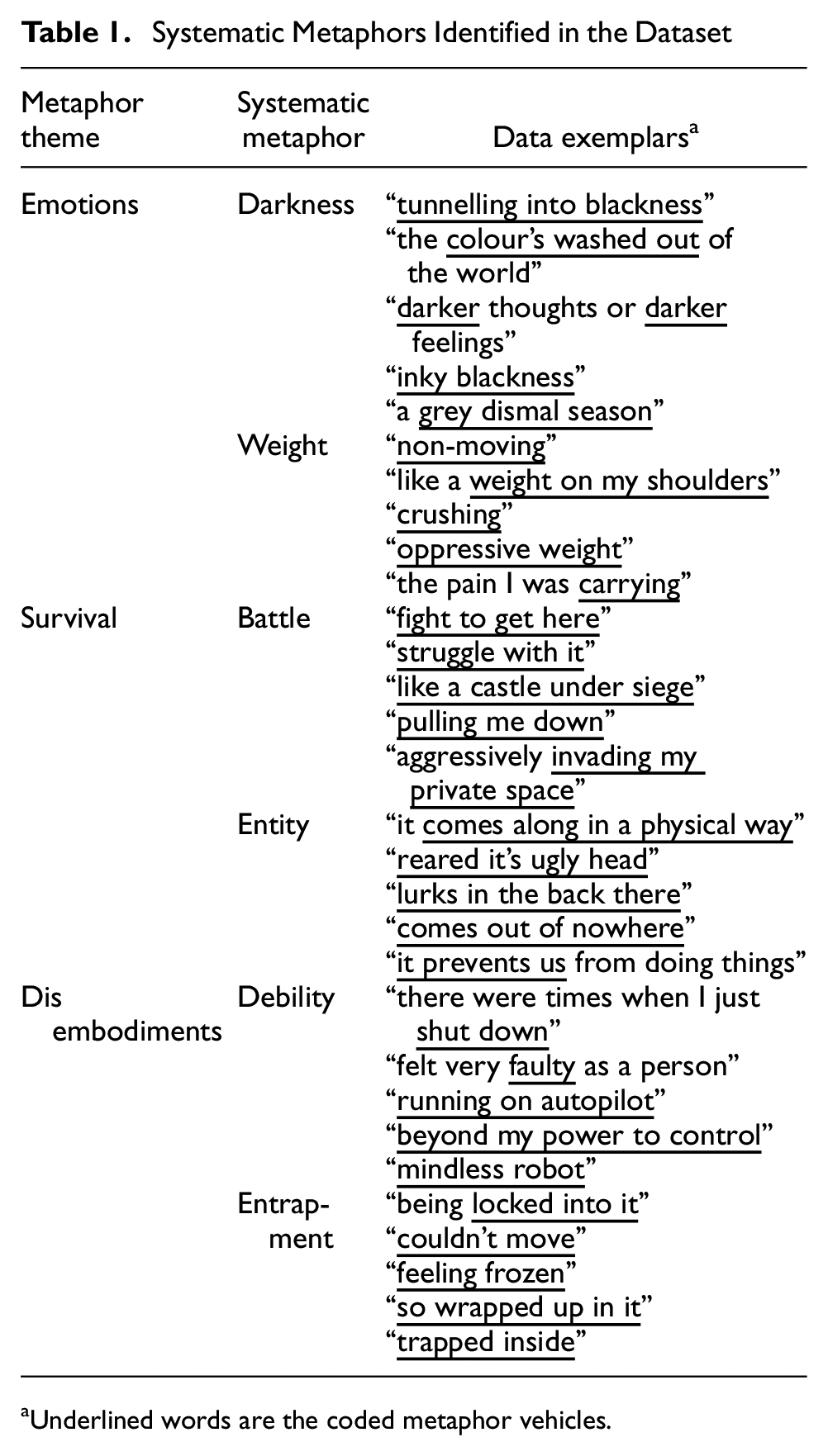
Underlined words are the coded metaphor vehicles.
Metaphors of Emotions: Darkness and Weight
While participants did not directly name specific emotions in describing their distress, their emotions were vividly expressed through their use of metaphors of darkness and weight. In the darkness metaphors, participants mapped emotional states which were intense, prolonged, and riddled with uncertainty. Participants used words such as “bleak,” “blackness,” and “gray” and phrases including “darker thoughts,” “dark ideas,” “darker feelings,” and “darkest moments” to describe embattled emotional states along with shades of darkness (e.g., distress is “black” was similar to but less intense than distress is “grey”). The darkness portrayed was profound and revealed when men spoke about the worst times during their experiences of living with mental distress. This darkness overwhelmed them, resulting in a lack of visibility of the problem, and by extension of a remedy or respite. Dark thoughts and ideas contributed to a broader sense of obscurity or negativity, both in terms of their literal context and their emotional effects and affects. Color, light, and brightness were often likened to thoughts or moments considered happier, whereas a lack of color and shades of darkness were likened to an emotional state that was melancholic, sad, stressed, and shutting down. For example, Andrew described his distress as an “inky blackness heading inwards.” Indeed, participant narratives were saturated with metaphors of darkness and a lack of color or light to depict numbness and negative emotions. Rhys used the phrase “absolute rock bottom black” to express how he descended into a hard, dark, and low space with no way out. Others used the darkness metaphor to describe how their distress eliminated joy and happiness in their everyday lives using phrases including “the colours washed out of the world,” “it’s just a fog,” and “grey dismal season.” The darkness metaphor was best illustrated symbolically in a photograph taken by Sam (Figure 1) who recalled the day of his most recent suicide attempt. Sam described finding out he had been “scammed” by someone close to him. He submitted the photo captioned, Darkness, representing the “pain” he experienced and “going through the motions in my head of whether or not life was worth it.”

Darkness
Sam situated himself as the viewer—and the image is dark and somewhat distorted with his gaze downward, revealing a meld of shapes—all somewhat suggestive of a hard landing spot should a fall or descent be taken. The metaphor of enveloping darkness indicated an end or ending was drawing his contemplation—to the point where no escape route could be seen. Comparing his emotional state to the bad weather and lack of sunlight, Sam described how “everything kind of reflected how I was feeling internally, with the darkness and the rain and that oppressive feeling that you get.” Sam’s visual metaphor of hard darkness speaks to the hopelessness and despair he and many of the men experienced.
Metaphors of weight were used by men to depict their emotional states as heavy. For some men, this weight was framed as a burden, for others as baggage which exerted a physical load keeping them down, implying a subordinate or debility state wherein the burden was omnipresent and oppressing. This metaphor included words and expressions such as “heavy,” “crushing,” “weighing you down,” and “non-moving” where distress was a weighty object the men were carrying around. Sean described his mental distress as being “like a weight on my shoulders” and something that would “weigh heavy on my mind,” suggesting a physical and psychological weight or obstruction that could not be seen but forever felt. Brian explained how his distress was “a crushing thing” to live with, particularly when others did not understand his experience of living with mental illness. The extent of participants’ mental distress was represented on a continuum of weightiness, with heavier weights cumulating the longer they had lived with their distress.
The contributor of the weight differed across participants. Andrew described the weight as a mountain, positioning himself as being in a dark tunnel under it, “there’s the oppressive weight of the mountain above you, so there’s that kind of immeasurable weight.” Conrad described the weight as a huge void, linking his survival to carrying the weight, “all of existence is just this thin veneer and behind this is just this huge void and I’m alone kind of holding this up with my existence, like my hands.” The use of the weight metaphor highlights the tiring and endless burden of mental distress the men experienced. The weight metaphor was similarly used to conceptualize mental distress as baggage which participants were unable to “get rid off.” This baggage constituted past traumas which remained ever-present. These experiences had profoundly affected the men’s lives, which many believed were the “roots” of their psychological pain and where their distress “stemmed” from. Sam, who had recently disclosed a history of being abused as a child to his therapist, explained how his past trauma was just one example of “the pain I was carrying.” While participants expressed wanting to move past their trauma and distress, they often used the weight metaphor to depict how their insurmountable baggage made it difficult to move on—they were bound and ladened.
Brian noted how he had “never quite managed to let go of my original trauma” others described being “unable to let go” of their weighty baggage. This metaphorical weight was illustrated by Rupert (Figure 2), who shared a photograph of a tire swing to convey the burden of childhood abuse and growing up in a strict religion which he carried around with him.

Childhood Chains
The image is a tire swing suggestive of happy childhood memories. For Rupert, the image was tethered to childhood traumas, his adult shadow allegorically overlaying the burdens that persisted and weighed him down. Rather than providing stability and safety, he was trussed to the injuries and unending distress that flowed from trauma, his concealments, as well as the vulnerabilities for latently revealing them. For many men, employing the weight metaphor emphasized the sensation of being compelled to bear an emotional burden against their will.
Metaphors of Survival: Battle and Entity
The challenge of living with and navigating mental distress was framed as a struggle to survive using metaphors of battle and entity. The battle metaphor was used by men to describe how they had to “defend” themselves against something that was overpowering them. Participants used words such as “war,” “fight,” “invading,” and “struggle,” and expressions including “under siege,” “pulling me down,” and “pushing me down” to frame the battle to survive. The battle metaphors were often combined with metaphors of descent to describe falling or descending slowly into their demise. Andrew described how he “had no compass on how far down I was sloping” and Daniel stated, “it really pulls me right down.” Thus, the battle was portrayed as a pulling force summonsing an uphill fight to invoke their agency to quell all that challenged them. Conrad utilized the analogy of a “huge black castle” to describe how he worked to “build a thick wall” to shield himself and stop the distress seeping into every facet of his life. Despite retreating to a secure and personal sanctum, distress was still “aggressively invading” his private space and he was under attack. Conrad used the battle metaphor to describe the fight to conceal his depressed and anxious state, believing that “showing any kind of dent in your armour is seen as being vulnerable and people just don’t want this.” Everyday life became a struggle to manage painful emotions, feelings of despair, and the increasing belief they would never be free from their distress. Similarly, Stuart described putting on a “hard exterior” and Rupert shut himself away from others as a “defense mechanism,” protecting their vulnerability states from further attack. Here, the metaphors converge to convey both the enormity of the battle for men living with distress and the entity struggles for securing a manly defense and resilience. As such, this battle was often as much with themselves as it was to overcome the effects of distress on their everyday lives. The challenge was to find a way to live with the effects of distress, but this proved a difficult undertaking, and along with battle metaphors men often talked about entity metaphors to situate finding and defending themselves. In terms of visual metaphors, Keith shared Figure 3 which he captioned “survival through the cracks.”

Survival Through the Cracks
Keith’s photograph symbolized his perseverance to survive. The weed as a metaphor captured his resiliencies—but it is the rodent of plants, unwanted, without beauty, or harvest potential—forever burdensome and without purpose. Keith had fought to survive in a hostile environment and against all odds he had found a way to grow. Adapting to adversity and challenging circumstances, he kept going, and that battle in and of itself became his entity.
The specific characteristics of the metaphorical entity varied. Sean described its bodily effects and how “it comes along in a physical way” giving him headaches and tight muscles. Jason referred to it as a creature rearing “its ugly head” and Andrew called it a “beast.” For some men, distress had “a face,” but for many it was faceless—an invisible, physical identity that had invaded their mind and bodies—working by stealth, with some participants unsure when they had become that object. Andrew described how it “lurks in the back there . . . percolating away in the background.” For Stuart, it had “always been there,” whereas for Kai it had arrived suddenly from an unknown location: “it comes out of nowhere; it just comes and hits you from nowhere.” By personifying their distress as a living thing, participants assigned physical characteristics suggestive of a dual entity in which their distress appeared on its own terms to “prevent us from doing things.” As such it enabled men to explain and make sense of the physical and social effects of their distress. This entity was often invisible, meaning it could be felt by men internally in the form of suffering and pain, but externally, there was no evidence. Some used general referents to describe intrusive thoughts as an entity. For example, “those thoughts come in and I visualize this fly swat going ‘nope’ and just swatting it away, like no annoying insects, not today.” Kai noted how this entity gained momentum to maintain its presence by continually moving and morphing, “one thing that creates the other thing, and then the other keeps it going.” The men’s use of the entity metaphor positioned distress as something beyond the men’s control or agency, a third party—both outside and inside them—but able to permeate those boundaries. As Rupert explained, distress was “this feeling that you really struggle with but no matter how hard you try to get rid of your anxiety you just can’t.” Others, like Will tried to ignore the entity, “if you reinforce it, then it gets stronger” with little success. Understanding mental distress by giving it an identity illustrates how men attempted to grasp its nature, yet highlighted is the profound impact it had. This metaphorical entity was depicted by Ben (Figure 4) with a photograph taken out his office window.

The Rain Can Come at You
Ben used the rain to symbolize the unpredictable, distorting nature of his distress, the changeable nature of the weather synonymous with his lack of control. Just as the rain could create unfavorable conditions, Ben’s negative thoughts appeared unexpectedly dampening his mood, limiting his ability to engage and obscuring his outlook on the world.
To fully understand the connections between struggle and men’s battle and entity metaphors, the emotional outcomes were especially helpful. Brian explained how his distress forced him to “sit in [his] unhappiness,” others referred to being “back in this place” or “in a crap place.” Jason described how his distress “was still there, every time I sort of came home or you know was left with my thoughts I was still in this dark depression.” For others, this emotionality reverberated in their head rather than being anchored to geographies. Mind as a metaphorical place had specific embodied physicalities—for instance, Peter placed his negative thoughts “in the back of my mind.” Others referred to getting in a bad “head space,” where negative thoughts would intrude beckoning them to “chase thoughts and play scenarios.” For many men, the battle and entity metaphors comprised vehicles for making sense of an illness that was invisible but physically felt.
Metaphors of Disembodiments: Debility and Entrapment
The participants employed metaphors of debility and entrapment as a strategy to express how they experienced distress invoked disembodiments. The debility metaphor drew on masculine body-as-machine metaphors, where performativity, disablement, and potential fixabilities entwined. Participants employed mechanical phrases such as “shut down,” “broken,” “faulty,” “running on autopilot,” or “a fuse” at risk of blowing to articulate the ways in which distress hindered their functionality. Several men compared themselves to “robots,” depicting life as an auto performance but not engaging emotionally with their distress. For example, Conrad labeled himself a “mindless robot” who could only “eat, sleep, work, repeat, without emotions.” This disembodiment gave rise to his machine analogy, a distress state that left many men feeling emotionally detached, incomplete, and no longer fully in control of their actions. An overwhelming, numbing sense of despair which characterized many men’s distress both invoked and signaled debilities.
Alongside this, many men conceded their lack of agency through metaphors which conveyed a sense of being overwhelmed and constrained. Men spoke of feeling “out of control” of their lives as their distress escalated and became unmanageable or “out of hand.” Conrad described metaphorically standing in an autumn forest and “watching everything that was just leaving and falling apart, and you can’t do anything.” Brian spoke about an isolator switch on his hot water cupboard which had been turned “off” to depict how his debility state was “beyond my power to control.” Jason described how medication had made him feel “very faulty as a person,” characterizing himself as someone who had failed to meet societal norms and standards. This debility metaphor was illustrated by Pete who shared Figure 5, to convey his sense of powerlessness and being faulty.
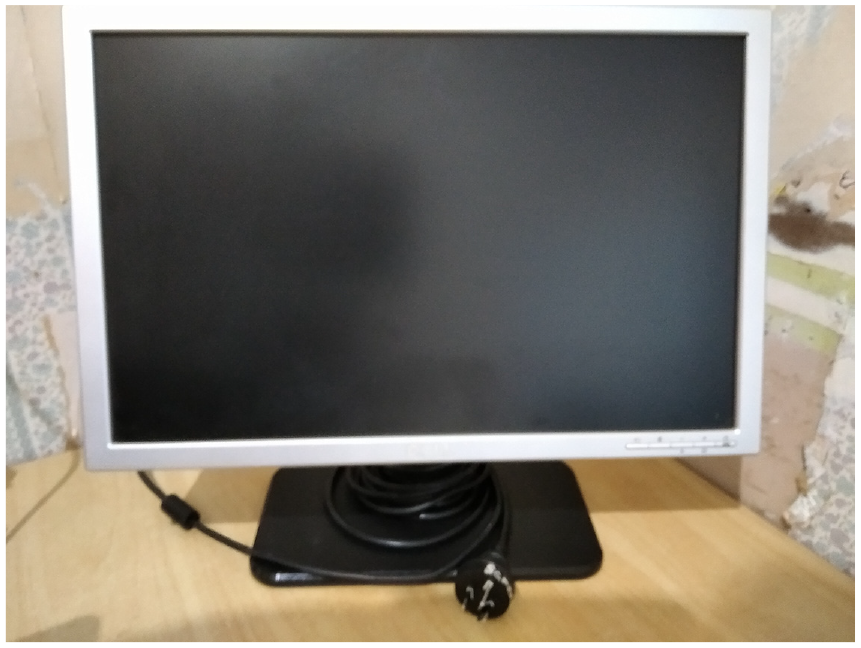
Blank Screen
Pete positioned himself akin to an unplugged blank screen, unable to connect or communicate, a debility state that called into question the worth of his material being. The blank screen and its failure to compute metaphorically represented his disembodiment and inability to function, with the finality of that state represented by the power plug being removed from the socket. As Pete said his mind decided to “close everything down, feelings aren’t going to be there because they’re too much.” Pete’s visual metaphor of protective stoppages speaks to the disconnection and incapacity to operate that reinforced men’s debility states.
The second way in which participants described the embodiment of distress was using metaphors of entrapment, where men were surrounded and encased by their distress. This metaphor included phrases such as “being locked into it,” “couldn’t move,” “stuck inside,” “feeling shackled,” and “frozen” by their distress. This language implied being acted on and contained by an external force rendering their incapacity fixed. The entrapment metaphors took different forms, with some participants connecting the embodied experience of being trapped with the experience of descent or falling, to become slowly trapped. Distress was akin to “falling into oblivion,” or something they would “slip into” and couldn’t get out of. As Andrew explained, “it is the sense that the feelings that you’re having now are the feelings that you’ve always will and there’s no way out of this.” For example, Levi spoke to the disembodied experience of entrapment as being confined “inside a concrete box” and “there’s a lid with a tiny little hole . . . and I’m not quite there enough to get through the gap yet.” Rupert described being in a long corridor with a metaphorical “light at the end of the tunnel” amid conceding that he “can’t reach it.” For these men, there was little sense of optimism or expectation of relief.
For others, entrapment was being struck in circumstances that hindered them from moving forward or making progress in life, distress acted as a barrier. Levi described feeling like a “headless chicken” acting in a chaotic, disorganized manner without clear direction or purpose. Others used metaphorical expressions of circular motion such as going “round and round in circles,” “couldn’t get out of this cycle” suggesting that their distress “rises and sets everyday” to confirm their disembodied state. Many echoed the sentiment of feeling “caught in a rut” and unable to “see a path in front.” This metaphor mirrors the belief of numerous participants that they would be eternally bound to endure their distress and there was a sense of hopelessness. Pete similarly explained, “there’s no way out, its so overwhelming,” and Rupert spoke to Figure 6, titled “Locked in.”

Locked in
Attached to a dumpster, Rupert’s padlock symbolized being contained and additionally constrained by his distress, “it’s almost like a claustrophobia type feeling.” The padlock is locked, without a key, confirming Rupert’s distress state as fastened, with the backgrounded outside world and its potential for and promise of activity, visible but inaccessible. The debility and entrapment metaphors underscored men’s lack of control and agency, highlighting distress as all consuming. Grappling with their disembodiment and its effects for diminishing their ability to evade or move beyond their distress, most men conceded that they had waning hopes for breaking free.
Discussion
Our findings highlight how metaphors of emotions, survival, and disembodiments are used by men in their efforts to make sense of their lived experiences in ways that are both personally relevant and understandable to others. By using metaphorical language and images, men constructed shared understandings of their distress, transcending clinical depictions of illness, and vividly capturing the lived experiences of those affected by it. As is the case with many metaphorical expressions used in talking about health and illness, men relied on multiple metaphors to meaningfully depict their understanding of distress more fully. Some of the metaphors men used such as darkness, weight, war, and containment have been reported in the context of men’s depression (Charteris-Black, 2012) and suicidal behavior (Ridge et al., 2021). Metaphors of darkness, weight/burden, war/battle/enemy, and containment/bounded space have also been reported more widely in the existing mental health literature to describe the experience of suffering from depression (Coll-Florit et al., 2021), addiction (Shinebourne & Smith, 2010), post-traumatic stress disorder (PTSD; Foley, 2015), trauma (Rechsteiner et al., 2020), grief after suicide (Overvad & Wagoner, 2020), and anxiety (Woodgate et al., 2021; Yu & Tay, 2020).
Our results highlight the use of metaphors to describe men’s intangible emotional experiences, for example, metaphors of darkness and weight provide insight to the realness of sadness, despair, suffering, and vulnerability. The message being conveyed is mental distress is an intense experience which is underpinned by overwhelming and unmanageable emotions that are felt but difficult to explain to others. This restraint reflects men’s alignments to masculine norms of restrictive emotionality and/or challenges for rationally articulating what is felt (Genuchi et al., 2017).
To date, little research has touched on men’s use of metaphors as a means of communicating the emotional content associated with their mental distress (Genuchi et al., 2017; Ridge et al., 2021). Discussions around men’s emotions and mental health suggest some men withhold information about their emotional experiences out of fear of revealing their vulnerability, whereas others may be unable to adequately verbally articulate them (Gough, 2018). In this study, men used few emotional terms to describe their distress, rather their emotions were vividly expressed through verbal and visual metaphors. Kovecses (2008) contends there are no “emotion-specific metaphors,” rather metaphorical expressions saturate the language people use to describe emotions, playing a crucial role in understanding the expression of men’s emotional experiences. Metaphors can convey a nuanced blend of emotions even when individuals may not intentionally use them for that purpose. Our findings suggest metaphors used in this way were crucial in understanding men’s emotional subjectivities, which might otherwise be overlooked. For some there was pain and anguish that was carried as a heavy dark weight when at their most distressed (e.g., suicidal), for others there was numbness and void of emotion due to the enduring state of depression and anxiety.
Our study illuminated how men drew on military metaphors to narrate distress as a fight or battle to survive, externalizing distress from self, setting it up as an adversary, or external entity that must be fought and battled with. The battle metaphors evoked an image of distress as a confrontation, with men fighting for survival. For some, their determination to win the battle reflected resilience, yet for others they felt defeated because their struggle was futile and fatiguing, heightening their vulnerability and personal failures. This connection between men’s struggles and the resulting failure, defeat, and increased risk of hopelessness is significant given many participants had a history of suicidal ideation and/or attempts. According to Jansen and Sabo (1994), military metaphors, like sporting metaphors, are crucial rhetorical resources in Western cultures for mobilizing ideals which construct and maintain hegemonic forms of masculinity. As such, the metaphorical language of military and sport can explicitly or implicitly marginalize other forms of masculinities. Members of minority groups (e.g., sexual minority men who practice subordinated masculinities) may be forced to borrow metaphors which may not necessarily reflect their own experience (Littlemore, 2019). However, our findings suggest that in the context of mental distress, some of these masculine norms may offer men helpful ways to communicate their challenges. For example, men’s narration of struggling to survive in this study was actively supported by participants’ use of military metaphors, suggesting this language may be used by and useful for men whose distress experiences reflect a range of diverse masculinities.
Finally, metaphors of disembodiment give importance to the lived experience of mental distress (and not just an abstract concept of “distress”) with men’s talk illustrating a close metaphorical relationship between mental distress and the physical experience. Men used these metaphors to conceptualize themselves as disconnected and powerless, no longer fully functioning, along with a loss of agency and control over their lives. Feeling entrapped was not simply about being psychologically trapped by intrusive and dark thoughts, but symbolically understood as being physically trapped in their daily lives, unable to fully function.
Implications for Practice
The findings of this research have important implications for mental health practitioners who work with men. Attending and responding to the metaphoric language men use and bringing it into the relationship between a clinician and client could be beneficial for therapy alliance (Mathieson et al., 2017). Although alliance is created by the work the practitioner and the client do together, that is, it is dyadic; research evidence suggests that the benefits of alliance are mostly due to the practitioner’s contribution (Wampold & Flückiger, 2023). This includes practitioners’ interpersonal skills, emotional expression, warmth, understanding, and empathy (Wampold & Flückiger, 2023). The ability to convey a sense of empathy, understanding another person’s emotions and perspectives and offering a response that reflects understanding (Nembhard et al., 2023), is arguably one of the most important skills in the repertoire of the caring professional (Smith, 2012). Empathy is also central to person-centered approaches and can provide the basis for therapeutic change (Moudatsou et al., 2020). For practitioners working with men, paying close attention to the meanings men create and narrate around their mental distress using metaphors can be a route to signaling empathy to complement existing therapeutic modalities.
The meanings men give to their distress likely offer valuable insights that move beyond biomedical discourses and may provide guidance on how to effectively meet men’s needs through person-centered care. Metaphorical descriptions of distress may allow listeners (e.g., therapists, psychiatrists) to construct an account of what it must be like to be the person experiencing mental distress, which enhances interpersonal empathy for what the sufferer is going through. Metaphorical language can communicate more emotional intensity to listeners than literal language (Kovecses, 2008), an important point when engaging men who align themselves with masculine norms of not expressing feminine emotions.
Our findings provide a knowledge base for clinicians to effectively listen, empathize, and engage with men, which may facilitate alliance and treatments. While there is a lack of empirical evidence and consensus for how therapists should handle client metaphors (Malkomsen et al., 2022), our research suggests that there are several ways in which practitioners could support men in treatment. Practitioners could invite clients to think about their distress in metaphorical ways with questions such as “what colour is your distress?” or “what is your sadness like?.” Metaphors could be used in problem solving, for example, the metaphor of distress as weight could be used to encourage men to strategize lightening their load. Similarly, the metaphor of being entrapped could be used to work toward freeing themselves. Metaphors could map pathways to address past traumas in a safer way as a means for lightening the load and emancipating themselves: for example, therapists could encourage men to unpack their weighty baggage, to deconstruct and discard their burdens. Metaphors could provide a rationale for activity tracking (e.g., “what adds a dash of colour to your world?”) to build activities that progress men’s healthy self-management. Finally, practitioners exploring the meaning of the metaphorical language men use could insert alternative perspectives through substituting and/or positively reframing metaphors.
It is important for practitioners to critically examine when and how metaphors could be non-helpful or even harmful for clients. For example, battle and war metaphors are powerful and widely used in many fields, but they can be contentious (Benzi & Novarese, 2022). For people with cancer, battle and war metaphors can increase perceptions of difficulty which prompt “surrender” to cancer and encourage fatalistic attitudes (Hauser & Schwarz, 2020). In the context of mental illness, these metaphors can also be counterproductive in terms of recovery and sustaining long-term challenges. Practitioners framing mental distress with battle and war metaphors can problematize recovery and treatment to discourage men from engaging in therapy. For men with military experiences, the use of these metaphors can be especially triggering, and practitioners need to be sensitive to these risks.
Our findings suggest that there is a need for metaphor-based initiatives to support therapists to effectively engage men in treatment and explore emotionally difficult material. Initiatives geared specifically toward improving therapists’ literacy based on the metaphorical language men use, as well as the language avoided. Indeed, a need exists for clinicians to read between the lines of men’s metaphors and to learn that language as gendered and sometimes coded. Therapists learning the language and being cognizant of co-constructing metaphors with men might aptly provide tailored approaches in the broadest sense to garner therapeutic benefits.
Limitations
A limitation of the current study is the reliance on the New Zealand context. Metaphors may be culturally determined; thus, the findings are in a local and cultural context and may not represent other men’s metaphorical language. Second, while the Discourse Dynamics Framework provides a robust criterion for metaphor identification, the clustering of metaphors into systematic metaphors remains subjective and is a (albeit purposeful) construct of the researchers created to help synthesize the metaphorical ways of expressing ideas (Cameron & Maslen, 2010). Third, our use of the term mental distress for pragmatic reasons may have missed nuances in mental illness–related metaphors. That said, our study has made use of innovative participant-generated visual data and verbal accounts to provide much needed gendered insights into men’s discourses of living with and expressing their mental distress. Finally, the gender of the interviewers (one female and one male) may have impacted participants and the relational co-construction of the data. That said, the participant photographs were brought to the interviews, and many of the narratives were built around those images. While the participant-researcher relations may have influenced what was shared and discussed, the interviewer role was more facilitatory in nature and participants had typically thought about their photographs in advance of the interview. Future research might explore whether some metaphors can be attributed to the researcher-participant dyad and use metaphor methods to sample men in other locales, across different groups and illness categories to build on the insights shared in the current study.
Conclusion
This study explored the metaphors men used when talking about living with mental distress to inform improvements in men’s mental health services. Our findings bridge the gap between men’s subjectivities and clinicians’ recommendations for using tailored language, highlighting the importance of metaphor-enriched perspectives for engaging men in professional health care settings. Metaphors played a crucial role in offering men a tool to craft meaningful narratives of their distress, serving as a potent avenue for mental health professionals to gain insight into men’s firsthand experiences of distress, potentially enriching their comprehension and communication.
Footnotes
Declaration of Conflicting Interests
The author(s) declared no potential conflicts of interest with respect to the research, authorship, and/or publication of this article.
Funding
The author(s) disclosed receipt of the following financial support for the research, authorship, and/or publication of this article: Funding to support this research was received by the first author, from The Royal Society of New Zealand, Marsden Fast-Start Fund (project no. UOO1838). The last author is supported by a Tier 1 Canada Research Chair in Men’s Health Promotion.
