



Abstract
There is a growing concern about mental health issues in new fathers, such as postpartum depression (PPD). Factors associated with PPD in men include personality traits and perceived stress. This study examined a set of hypothesized paths using perceived stress, neuroticism, and psychological inflexibility to predict depressive symptoms. A total of 189 participants took part. The mean age of these first-time fathers was 36.12 years (SD = 2.39). Perceived stress, neuroticism, and psychological inflexibility positively predicted new fathers’ depressive symptoms (B = 0.13, 0.37, and 0.31, respectively). These predictors explained 48% (R2 = 0.48) of the variance in the measured outcome of depressive symptoms in these new Chinese fathers. The total standardized direct effects of the three variables on depressive symptoms were 0.47 (95% CI [0.38, 0.53]). In conclusion, this study provides novel information about the chain mediating role played by neuroticism and psychological inflexibility in the relationship between perceived stress and PPD. Perceived stress significantly predicted neuroticism and psychological inflexibility, which in turn significantly predicted depressive symptoms in new Chinese fathers. The relationship between perceived stress and depressive symptoms was also mediated by each of psychological inflexibility or neuroticism alone.
Keywords
The transition to fatherhood can be both joyful and stressful. Although much attention has been paid to mothers’ transition experiences (Biebel & Alikhan, 2016), limited research to date has focused on the adjustment of men during the transition to fatherhood or their stressful experiences over this period (Pedersen et al., 2021). As modern fathers tend to play a more active role in the care of their infants than those in previous generations (Kamalifard et al., 2018), there is a need to take their mental health into account.
There is a growing concern about the mental health of new fathers in terms of depression or depressive symptoms at postpartum. The prevalence of paternal postpartum depression (PPD) is estimated to range from 11.7% (Kamalifard et al., 2018) to 27.5% (Alghamdi et al., 2020). A recent study reported that nearly a quarter (24.1%) of first-time new fathers had depressive symptoms in China (Cui et al., 2020). The impact of PPD includes distress, sleep difficulties, poor marital relationship, increased suicide risk, and high risk of the child developing behavioral and emotional problems (Alghamdi et al., 2020; Markos & Arba, 2020 Kamalifard et al., 2018; Nishimura et al., 2015).
Factors associated with PPD include personality traits (Cui et al., 2020; Goldstein et al., 2020). Personality traits, especially neuroticism, robustly predict depression (Goldstein et al., 2020; Kotov et al., 2010). Besides neuroticism, perceived stress is another key predictor of PPD (Kamalifard et al., 2014), as the transition to paternity involves taking care of the newborn and balancing work and life responsibilities, which increases overall levels of perceived stress (Leonard et al., 2020). In turn, such high levels of perceived stress may exacerbate new fathers’ negative mental health outcomes such as depressive symptoms (Ansari et al., 2021; Ghaedrahmati et al., 2017).
Psychological inflexibility, as manifested by approaches such as experiential avoidance, has been hypothesized to play an important role in the modification of various forms of psychopathology, particularly in depression (Chawla & Ostafin 2007; Hayes et al., 2004; Mohammadkhani et al., 2016). Research evidence indicates a mediating role for neuroticism and psychological inflexibility in predicting depressive symptoms (Mohammadkhani et al., 2016). In another study, Stotts et al. (2019) reported that enhancing psychological flexibility may be a promising potential intervention in reducing depressive symptoms at postpartum. Therefore, this study proposes a model (Figure 1) for the mediating role of neuroticism and psychological inflexibility on the relationship between perceived stress and depressive symptoms among new Chinese fathers.

The proposed chain mediation model to explain the association between perceived stress and depressive symptoms.
Given that the transition to paternity may be complex and have negative impact on new fathers’ mental health (Markos & Arba, 2020), there is a need to explore the factors contributing to PPD symptoms among new fathers. The objectives of this study were to examine a set of hypothesized paths using perceived stress, neuroticism, and psychological inflexibility to predict depressive symptoms. It is hypothesized that perceived stress, neuroticism, and psychological inflexibility may independently predict depressive symptoms, or that perceived stress may operate in conjunction with neuroticism and/or psychological inflexibility in contributing to such outcomes.
Methods
Research Design
This cross-sectional study investigated new Chinese fathers’ personality, perceived stress, psychological inflexibility, and depressive symptoms within 6 weeks postpartum. All research participants were recruited at two Obstetric Clinics affiliated two university teaching hospitals at Guangzhou, China. Two researchers invited new fathers to participant in this study.
Study Participants
According to Wang et al. (2016), the highest prevalence of paternal PPD is found 5–6 weeks postpartum. Hence, the inclusion criteria for this study were being an adult (aged over 18 years) Chinese male who was a first-time father to a child born within the previous 6 weeks. Exclusion criteria were having a history of mental illness or having a baby older than 6 weeks. In terms of sample size calculation, this study used the formula for survey design: n = Z2pq/d2 (Kish, 1965). This study took a Z-value of 1.96 for a 95% confidence level (CI), and a d = 0.05, to achieve the precision expected at the 95% CI level. A systematic review and meta-analysis reported that the overall prevalence of Chinese fathers’ postnatal depression is 13.6% (Wang et al., 2016). Hence, p = .136, q = (1-p) = 0.864, and around 180 new fathers were needed for this study.
Study Measures
Outcome measures in this study consists of five parts: a self-designed information sheet to collect new fathers’ sociodemographic information, and four validated scales to collect their personality, perceived stress, psychological inflexibility, and depressive symptoms. The general information sheet was designed to collect study participants’ age, education level, employment status, and monthly family income.
Eysenck Personality Questionnaire (EPQ)
The Neuroticism subscale of the EPQ was used to assess study participants’ personality traits (Eysenck et al., 1985). The Neuroticism subscale consists of 23 items reflecting the tendency toward negative emotions such as moodiness and worry (Eysenck et al., 1985). Each item is scored either 0 (no) or 1 (yes), with the total score ranging from 0 to 23. Higher scores indicate greater neuroticism. The full version of the EPQ scale has been validated in the Chinese population with acceptable reliability and validity (Qian et al., 2000). In this study, the internal consistency of the neuroticism subscale of the EPQ was 0.76 using Cronbach’s α.
Perceived Stress Scale (PSS)
The PSS is a validated tool used to measure the extent of stressful life situations experienced in the previous month. This scale consists of 10 items, each of which is scored along a range from 0 (never) to 4 (often) (Cohen, 1994). The 4th, 5th, 7th, and 8th questions are reverse-coded. Higher scores indicate higher levels of perceived stress (Cohen, 1994). The Chinese version of the PSS has been validated in an adult population and has demonstrated good psychometric properties (Zhang, 2001). In this study, the Chinese version of the PSS had an acceptable level of reliability, with a Cronbach’s α of 0.82 denoting good internal consistency.
Acceptance and Action Questionnaire-II (AAQ-II)
The AAQ-II was used to assess participants’ psychological inflexibility. This scale consists of seven items scored using a seven-point Likert scale ranging from 1 (never true) to 7 (always true) (Bond et al., 2011). Higher scores indicate a greater tendency toward psychological inflexibility, reflecting experiential avoidance such as feeling negative, not accepting things, and trying to escape from unwanted thoughts (Bond et al., 2011). The Chinese version of the AAQ-II has been validated in Chinese college student samples and reported acceptable reliability and validity (Zhang et al., 2014). In this study, the internal consistency of the Chinese version of the AAQ-II was 0.79 using Cronbach’s α.
Edinburgh Postnatal Depression Scale (EPDS)
The EPDS was used to screen depressive symptoms in new fathers. This scale consists of 10 items scored using a four-point Likert scale ranging from 0 to 3, giving a total score of 0 to 30 (Cox et al., 1987). The Chinese version of the EPDS has been validated in Chinese postpartum men (Cui et al., 2020). In this study, a cutoff score of 10 was used to categorize the participant as having depressive symptoms or not, based on the suggestions of previous studies (Cui et al., 2020; Edmondson et al., 2010). Depressive symptom severity was classified based on a large population study of maternal depressive symptoms (Luppatelli et al., 2018): “no depressive symptoms (EPDS score = 0–9), mild to moderate (EPDS score = 10–16), moderate to severe (EPDS score = 17–21), and very severe (EPDS score = 22–30).” While the classifications of paternal depressive symptom severity was based on maternal depressive symptoms, a recent systematic review reported that paternal depressive symptoms showed positive correlations with maternal depressive symptoms across the perinatal period (Thiel et al., 2020).
Data Collection
Data were collected from July to December 2017. Ethical approvals (approval numbers: ELS#2016229 & ELS#2017104)) were obtained from the ethical review committees of both hospitals at South China involved in the study. All participants took part voluntarily and provided written informed consent.
Data Analysis
The data were analyzed using SPSS 23.0. Descriptive statistics were computed for the sociodemographic characteristics, and the mean scores of key variables were obtained. Pearson’s correlation was used to explore the relationships among neuroticism, perceived stress, empirical avoidance, and depressive symptoms. Mediation analysis was conducted using Hayes’s PROCESS model 6, which allows up to four mediators to be chained in sequence (Hayes, 2018). This chain mediation model of the total as well as indirect effects used a sample of 5000 for bootstrapping with a 95% CI (Hayes, 2018). The absence of zero indicates the significance levels of direct and indirect effects among these four variables and chain mediating effects. Other statistical tests were conducted using p < .05 as a significance level.
Results
A total of 200 new Chinese fathers were approached, of whom 189 agreed to join the study. Their mean age was 36.12 years (SD = 2.39). More than half of the participants had a university degree or higher (n = 96; 50.79%), with the remainder having attended high school or professional school. In terms of finances, 53.97% (n = 102) of the participants had a monthly family income of less than USD 2000 (almost 12,800 in Chinese currency), with the remainder having income equal to or above this figure. Almost all participants were working, with only three unemployed at the time of data collection. All the participants were married. The median age of their newborns was the fourth postpartum week. The mean scores of the key study variables are presented in Table 1. Percentages of depressive symptoms among Chinese new fathers are presented in Table 2. Of 189 participants, a total of 45 new fathers reported depressive symptoms but a majority at a mild to moderate level (n = 35, 18.53%).
Mean Scores of Key Study Variables.

Note. PPS = Perceived Stress Scale; EPQ = Eysenck Personality Questionnaire; AAQ = Acceptance and Action Questionnaire; EPDS = Edinburgh Postnatal Depression Scale.
Percentages of Depressive Symptoms Among New Chinese Fathers.

Note. EPDS = Edinburgh Postnatal Depression Scale.
As presented in Table 3, four of the variables indicate positive correlations with one another (all p values < .01). For example, higher EPDS scores (indicating more depressive symptoms) are positively associated with higher levels of perceived stress, higher tendency to neuroticism, and psychological inflexibility (r = 0.50, 0.62, and 0.55, respectively).
Correlations of the Key Study Variables.

Note. PPS = Perceived Stress Scale; EPQ = Eysenck Personality Questionnaire; AAQ = Acceptance and Action Questionnaire; EPDS = Edinburgh Postnatal Depression Scale.
p < .01.
Table 4 presents the results of the regression analysis. The dependent variable was depressive symptoms at postpartum, while the independent variables were perceived stress at postpartum, neuroticism, and psychological inflexibility. Neuroticism and psychological inflexibility were then treated as mediating variables using Hayes’ SPSS-process 2.15 model 6 to examine the chain mediation effect. From Table 4, it can be seen that perceived stress, neuroticism, and psychological inflexibility positively predicted new fathers’ depressive symptoms (B = 0.13, 0.37, and 0.31, respectively). These predictors explained 48% of the variance (R2 = 0.48) in depressive symptoms in this sample of new Chinese fathers.
Results of the Chain Mediating Effect Analysis in the Regression.
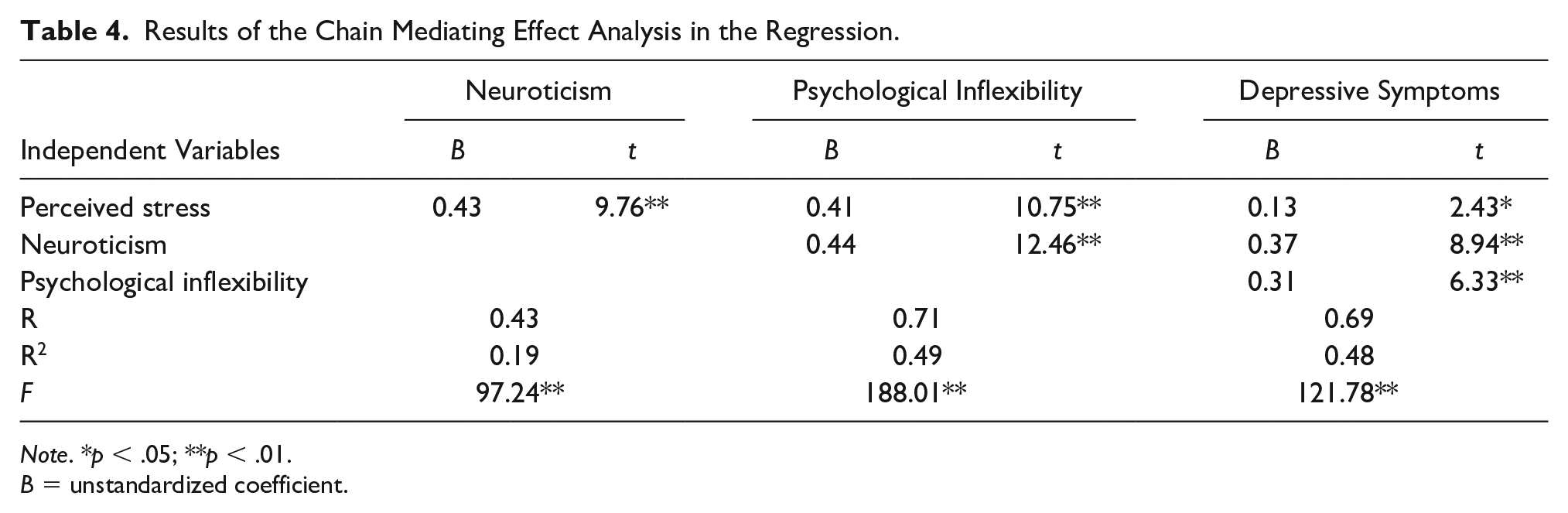
Note. *p < .05; **p < .01.
B = unstandardized coefficient.
After standardization of all variables, postpartum depressive symptoms were retained as the dependent variable with perceived stress as the independent variable and each of neuroticism and psychological inflexibility as the mediating variables. The total standardized direct effect of the three variables on the outcome variable of depressive symptoms was 0.47 (95% CI [0.38, 0.53]).
The deviation-corrected nonparametric percentile bootstrap test was used with the sampling repeated 5000 times; the mediation effect test and CI estimation were carried out on each of the three paths. Table 5 presents that all the direct and indirect effects on the outcomes of depressive symptoms reached statistical significance, as the 95% CI of the direct and indirect effects did not include zero. From Table 5, it can be seen that the total standardized indirect effect was 0.34. Three paths accounted for 31.91% (Path 1), 25.53% (Path 2), and 14.89% (Path 3) of the total effect, respectively. All the key paths hypothesized in the proposed model (Figure 1) reached statistical significance (Figure 2).
Results of the Deviation-Corrected Percentile Bootstrap Method Analysis.

Note. CI (l) = lower bound of a 95% CI; CI (u) = upper bound.
Path 1: Perceived stress → neuroticism → depressive symptoms; Path 2: Perceived stress → psychological inflexibility → depressive symptoms; Path 3: Perceived stress → neuroticism → psychological inflexibility → depressive symptoms.
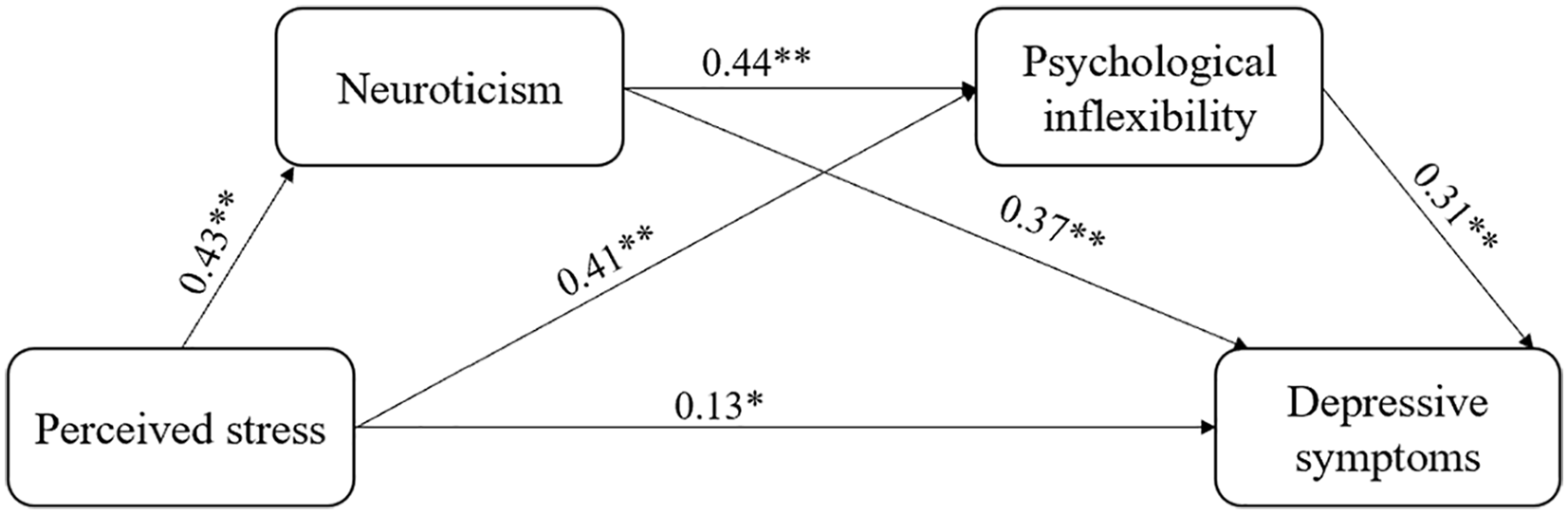
Diagram of the final model to explain the association between perceived stress and depressive symptoms.
Discussion
This study aimed to explore three processes potentially underlying perceived stress and depressive symptoms in new Chinese fathers. As expected, perceived stress, neuroticism, and psychological inflexibility were significantly associated with depressive symptoms. This study found that the prevalence of depressive symptoms of new Chinese fathers was 23.81%, which is higher than the 13.6% prevalence observed in a previous meta-analysis of Chinese fathers (Wang et al., 2016). And the prevalence of depressive symptoms among Chinese fathers in the present study is also higher than the most recent study including 1187 Chinese fathers by Sun et al. (2021), who reported the prevalence of paternal depression as 13.82%. It may be partially due to the small study sample and fathers with higher educational attainments. In the present study, more than half of Chinese fathers had tertiary attainments, but only 18% of adults in China hold a tertiary degree based on education statistics in 2018 (OECD, 2019).
Mediating Role of Neuroticism Between Perceived Stress and Depressive Symptoms
According to explanatory models of personality and depression (Klein et al., 2011), personality characteristics and stress play an important role in the development and process of depression (Kamalifard et al., 2014; Roman et al., 2019). Consistent with previous studies (Goldstein et al., 2020; Paulus et al. 2016), this study found that neuroticism was a robust predictor of PPD. Individuals who score high on neuroticism tend to feel negative emotions (fear, sadness, shame, or anger); have low stress coping capability; and exhibit poor adaptability to various life changes such as the critical transition to fatherhood (Ghaedrahmati et al., 2017; Klein et al., 2011). Other depression models, such as the dynamic stress-vulnerability model of depression, suggest that factors such as stress affect individuals’ personality characteristics (Goldstein et al., 2020; Klein et al., 2011; Li et al., 2019). Perceived stress can lead to increased neuroticism, which in turn increases PPD.
Mediating Role of Psychological Inflexibility Between Neuroticism and Depressive Symptoms
In line with previous research, psychological inflexibility plays a mediating role between neuroticism and depression (Paulus et al., 2016). Individuals who score high on neuroticism tend to be emotionally unstable; to feel under more psychological pressure; to experience unrealistic thoughts, excessive demands, and impulses; and to be more likely to experience negative emotions such as depression (Costa et al. 1992). According to the Acceptance and Commitment Therapy model of psychopathology (Hayes et al., 2006), individuals often adopt psychologically inflexible approaches such as empirical avoidance strategies to cope with negative emotions; that is, they are unwilling to tolerate their own negative experiences and instead try to control or avoid them (Hayes et al., 2006). As a result, psychological inflexibility can exacerbate the negative health outcomes of PPD (Mohammadkhani et al., 2016; Stotts et al., 2019). New fathers scoring high on neuroticism may tend to adopt psychologically inflexible positions such as empirical avoidance strategies to cope with their negative emotions. In consequence, relevant psychological interventions are needed to improve new fathers’ psychological flexibility by accepting their own negative experiences and thus adjusting their personality trait of neuroticism, which will enable prevention of PPD.
Neuroticism and Psychological Inflexibility as Chain Mediation Between Perceived Stress and Depressive Symptoms
Despite the empirical links between perceived stress, neuroticism, psychological inflexibility, and depressive symptoms at postpartum, this study also advances the literature in relation to the chain mediation effect of personality traits and psychological inflexibility by explaining the correlations between perceived stress and depressive symptoms at postpartum. The cognitive behavioral model of PPD proposes that perceived stress affects PPD through cognitive distortions or dysfunctional beliefs (O’Hara et al., 1982). These may cause new fathers to perceive themselves as suffering from more stress and to produce more negative thoughts, which in turn increase their psychological inflexibility and tendency toward experiential avoidance (Bond et al., 2011). According to the psychological rigidity model, although experiential avoidance seems to have a short-term protective effect, in the long term it elevates the frequency of negative experiences, causing depressive symptoms to develop or increase (Hayes & Strosahl, 2005). Hence, perceived stress can affect postpartum depressive symptoms by increasing neuroticism and psychological inflexibility.
Limitations of This Study
This is a cross-sectional study, so it is not possible to draw conclusions about causal relationships in the hypotheses. Further longitudinal research should be conducted to explore the causal relationships between perceived stress, neuroticism, psychological inflexibility, and postpartum depressive symptoms. In addition, self-report measures were used in this study, which may indicate a potential distortion of the findings. Furthermore, this study sample is not representative of first-time Chinese fathers. This study sample was recruited in two medical centers located in South China. This study sample has an average age of 36 years and about half have university degrees, but this is consistent with a recent study by Sun et al. (2021). This recent study included 1187 Chinese fathers in Wuhan and 71% Chinese fathers aged 30 years or older. This study also found that older age (aged 35 or above) of fathers is a risk factor of depressive symptoms: OR = 1.74 (95% CI [1.03, 2.94]) (Sun et al., 2021). Hence, more research is needed to explore whether older age (aged 35 years or above) is a risk factor for paternal depression or not. Last but not least, the sample size of this study is relatively small; future studies using a larger sample should be conducted to examine the concurrent predictive and mediating effects of perceived stress, neuroticism, and psychological inflexibility on the mental health outcomes for new Chinese fathers, including depressive symptoms.
Implications of This Study
Despite these limitations, the findings of this study have important theoretical and practical implications. Understanding how new fathers’ perceived stress levels relate to their depressive symptoms at postpartum via their personality traits of neuroticism and psychological inflexibility can help to develop relevant psychological interventions that can be tailored to increase the likelihood of a positive postpartum period. In addition, this study provides empirical evidence for how personality traits might foster a positive transition to fatherhood throughout the postpartum period. Consequently, the findings of this study can be used to develop psychoeducational and psychosocial interventions aimed at the prevention and treatment of PPD symptoms in new fathers.
Conclusion
This study provides novel information about the chain mediation role played by neuroticism and psychological inflexibility in the relationship between perceived stress and PPD. Perceived stress was identified as significantly predicting neuroticism and psychological inflexibility, which in turn significantly predicted depressive symptoms in Chinese new fathers. The relationship between perceived stress and depressive symptoms was also mediated by each of psychological inflexibility and neuroticism alone. Taken together, the findings of this study indicate that personality traits such as neuroticism and psychological inflexibility should be considered when examining the link between perceived stress and PPD symptoms.
Footnotes
Declaration of Conflicting Interests
The author(s) declared no potential conflicts of interest with respect to the research, authorship, and/or publication of this article.
Funding
The author(s) disclosed receipt of the following financial support for the research, authorship, and/or publication of this article: This research was supported by the Research Project of the Traditional Chinese Medicine Bureau of Guangdong Province (20202059).
