




Abstract
This study aimed to investigate how individuals form impressions about the self-esteem and life satisfaction of a male who engages in muscle talk on Facebook. The study examined (a) how a target’s body build and peer-generated comments influence observers’ impression of him, and (b) how such influences might be moderated by the cultural backgrounds of observers (Asian Americans and European Americans). A mock-up Facebook profile page was created in which two factors were manipulated: the target’s body build (muscular, average, and overweight) and peer-generated messages (muscle encouraging and muscle discouraging), creating six different conditions. Male college students (N = 508) were randomly assigned to one of the conditions. After viewing a mock-up Facebook page online, participants completed an online questionnaire assessing their impressions of the target’s self-esteem and life satisfaction. Results showed that a muscular target was perceived as possessing higher levels of self-esteem and life satisfaction. Observers rated the target as having higher self-esteem when the target received muscle-encouraging messages than when the target received muscle-discouraging messages. No cultural differences were identified. Findings suggest the existence of weight bias when forming psychological impressions of others online. Findings also confirmed the important role of peer-generated messages in the impression formation process online.
Impression formation and management is a central process in human interactions (Berger & Calabrese, 1975). The Internet provides spaces in which individuals form impressions about others based on different types of cues available, such as user-generated cues (i.e., sources that a profile owner has a control over, such as posting photos and information about the self) and other-generated cues (i.e., cues on the target user’s profile that come from others, such as messages left by the profile owner’s friends; Walter, Van Der Heide, Hamel, & Shulman, 2009).
Research identified that individuals form impressions online about a target’s personal attributes, such as credibility, extraversion, and friendliness (Walther, Van Der Heide, Hamel, & Shulman, 2009; Walther, Van Der Heide, Kim, Westerman, & Tong, 2008). Even though a great deal of scholarly attention has been paid to how individuals form impressions of others’ personal attributes, less is known about online impression formation of others’ psychological characteristics, such as their level of self-esteem and life satisfaction. Examining how individuals evaluate another person’s psychological characteristics is an important topic of inquiry because such evaluations can have important implications for that person’s interpersonal and professional life (Strauss, 2005). For example, those who are presumed to have low self-esteem might be evaluated less favorably in hiring situations (MacGregor, Cameron, & Holmes, 2010).
In examining online impression formation about others’ psychological characteristics, this study considers a specific context that involves “muscle talk” conversations. This study defines “muscle talk” as conversations regarding the desire or need to build muscle, muscle-building techniques, and opinions about one’s own muscles or the muscles of others. Evidence exists that boys and young men engage in this type of conversation (Engeln, Sladek, & Waldron, 2013). Up to 25% of male college students reported they thought their college peers frequently engage in talk related to the body, particularly about muscles (Engeln et al., 2013). Given that social networking sites (SNSs) are popular mediums of communication among young adults, including college students (Dhir & Tsai, 2016), muscle talk can take place on SNSs and thus will be the focus of this study.
To explore online impression formation in the muscle talk contexts, the current study examines a specific context in which a male profile owner engages in muscle talk on Facebook. Such a post typically includes a picture of the profile owner’s body as well as peers’ comments in response to the post. The current study aims to illuminate how individuals form impressions about a target based on his picture posed on Facebook. In particular, this study examines if observers form different impression as a function of the target’s body build type (e.g., a muscular, an average, or an overweight body). Peer-generated messages can be also an important source of information used to form impressions of a target online (Walther et al., 2008). This study examines how these two factors (the target’s body build and peer-generated comments) can impact the observers’ impression formation of the target’s self-esteem and life satisfaction. This study examines the aforementioned aspects from a cross-cultural perspective by comparing Asian Americans and Caucasian Americans. Asian Americans are one of the fastest growing minorities in the United States (Colby & Ortman, 2015). The effect of muscle talk and impression formation online might differ depending on the observers’ cultural background.
Impression Formation Online
Social networking websites allow users to publicly or semipublicly share information about themselves using a preformatted profile page and to maintain and display connections with other users (Boyd & Ellison, 2007). Facebook is among the most popular SNSs, especially among college students (Knight-McCord et al., 2016). Approximately 70% of adult Internet users (age 18 years or older) are on Facebook (Duggan et al., 2015) and over 88% of college students use Facebook (Sponcil & Gitimu, 2013). Facebook allows users to post information about the self, share photographs, and post and exchange messages with other users. Previous studies have demonstrated that individuals can and do form impressions of a person based on the person’s Facebook profile page (Tong, Van Der Heide, Langwell, & Walther, 2008). Observers formed impressions of an individual’s physical attractiveness based on photographs and messages his or her peers left on the profile owner’s “wall” (Walter et al., 2008).
Impression formation based on the profile owner’s body build
Individuals often make assumptions of others’ characteristics based on their body build. Studies on male body stereotypes have reported that positive personality traits (e.g., attractive, happy, intelligent) were assigned to mesomorphic body types (i.e., well-proportioned body with low fat and high muscle mass). On the contrary, negative personality traits were assigned to endomorphic body types (round and soft body; Hemingson, Shim, & Choi, 2013; Namatame, Saito, & Sawamiya, 2016). Larger individuals are often stereotyped as lazy, less motivated, unfriendly, boring, sloppy, and lacking in self-discipline (Bento, White, & Zacur, 2012; O’Brien, Latner, Ebneter, & Hunter, 2013). Negative attitudes toward overweight people are also reflected in the media (e.g., Puhl & Heuer, 2009). Overweight people are underrepresented and stigmatized in the media (e.g., Ata & Thompson, 2010). Larger male characters on American prime-time TV programs were depicted as being less helpful, having fewer interactions with romantic partners and friends, talking less often about dating, being less likely to date and have sex, and eating more often than underweight and normal weight males (Greenberg, Eastin, Hofschire, Lachlan, & Brownell, 2003).
Such weight stigma is often translated into the real world. Larger people commonly face discrimination in various settings, including educational, medical, and employment settings (Puhl & Heuer, 2009). Obese individuals are disadvantaged in terms of hiring decisions and performance evaluations (Rudolph, Wells, Weller, & Baltes, 2009). It is not surprising that experiences with weight stigma are consistently associated with poor mental health, including depressive symptoms (Bucchianeri, Eisenberg, Wall, Piran, & Neumark-Sztainer, 2014; Puhl & Brownell, 2006), low levels of self-esteem (Vartanian & Novak, 2011), and lower life satisfaction (Jackson, Beeken, & Wardle, 2015). Further, obese individuals tend to respond to weight bias by internalizing negative attitudes toward overweight and obese people, which is related to poor psychological function (Durso et al., 2012). Being a victim of prejudice and discrimination due to weight status might contribute to poor psychological outcomes above and beyond the contribution of the weight condition alone (Papadopoulos & Brennan, 2015). Regardless of whether overweight people actually possess certain psychological characteristics described earlier, one might, consciously or subconsciously, assume that they possess lower levels of self-esteem and life satisfaction because of their weight status and the weight bias and discrimination they experience.
Less is known about how a target’s body build can impact individuals’ impressions of the target in the context of SNSs. Though limited, available research among young women has demonstrated that an overweight female profile owner was evaluated as possessing poorer psychological well-being than an underweight counterpart (Taniguchi & Lee, 2015). It is reasonable to expect similar patterns of weight bias to be observed among men. Overweight males might be evaluated as having poorer self-esteem and lower life satisfaction than average-sized males. Muscular males might be perceived as possessing greater levels of self-esteem and life satisfaction than average-size males because the former possess bodies that society favors. Therefore, the following hypothesis is formulated:
Impression formation based on peers’ comments
Besides the profile owner’s body build, comments he receives from his peers can be an important source of information that observers use when forming impressions about the profile owner. Previous research has demonstrated that peer-generated comments on Facebook affect observers’ impressions of the target person (Walther et al., 2008, 2009). Walther et al.’s (2008) experimental study demonstrated that comments left by the profile owner’s peers had a significant influence on the observers’ ratings of the social attractiveness and credibility of the profile owner. Walther et al. (2009) further found that peer-generated statements predicted the observers’ judgments of the profile owner’s extraversion.
Because muscularity is central to a man’s body image (Cafri & Thompson, 2004), muscle talk can revolve around a man’s desire to build muscle and is motivated by his peers’ comments. Such comments from peers can be muscle promoting (encouragement to build muscle) or muscle discouraging (discouragement to build muscle). Peers’ comments, depending on their content, can have a different effect on the impression formation of observers in regard to the target’s self-esteem and life satisfaction. There are at least two opposing predictions regarding such effects. The first prediction is that a profile owner receiving muscle-discouraging comments from peers will be perceived as having higher levels of self-esteem and life satisfaction than a profile owner receiving muscle-promoting comments. This is because muscle-promoting messages can be viewed as disconfirming since they imply that the receiver of the message is not worthy and valuable and is, therefore, in need of change. Muscle-discouraging messages, on the other hand, might be seen as confirming, implying that he does not have to alter his body because he is worthy and valuable enough as he is. Confirming messages show that individuals are endorsed, acknowledged, and recognized as valuable by others (Cissna & Sieburg, 2006). Confirming messages have been reported to be beneficial to the receivers’ self-esteem (Dailey, 2009). Individuals might assume that those who receive confirming comments from peers would benefit from such comments and, thus, experience higher levels of self-esteem and life satisfaction.
Literature on the nature of males’ body-related conversations leads to another prediction that opposes the previous one. Women’s body-related talk generally centers around negatively talking about their own bodies, often involving a woman insisting she is fat while denying her peer is fat (Engeln et al., 2013). In contrast, when men share their body concerns or complaints with their peers, such concerns and complaints are often validated by their peers (e.g., peers agreeing with a man that he needs to build more muscle or lose weight; Engeln et al., 2013). If agreeing with a peer’s body concerns is normative among men, muscle-promoting messages might not be seen negatively. Responding with encouragement to build muscle to a peer expressing his desire to build muscle might even be seen as a form of empathy rather than a form of criticism. If this is the case, discouragement of muscle building might be seen negatively because it does not comply with the expectation. Given that there are two opposing predictions, the following research question has been posited: RQ1: How, if at all, do the comments of the profile owner’s peers impact the observers’ impressions of the profile owner’s self-esteem (RQ1a) and life satisfaction (RQ1b)?
Differences in impression formation between Asian Americans and European Americans
The aforementioned process of forming an impression of the target’s self-esteem and life satisfaction might be different depending on the observers’ cultural backgrounds. Western societies have long placed emphasis on fitness and muscularity as a measure of masculinity, as suggested by ancient Greek and Roman artwork (Pope, Phillips, & Olivardia, 2000; Yang, Gray, & Pope, 2005). However, for some Asian societies, such as China, muscularity is a less central measure of masculinity relative to Western societies (Louie, 2002; Louie & Low, 2005). For instance, the Chinese definition of masculinity and the “ideal man” is more cerebral—mental superiority, such as morality and intelligence—rather than muscular (Louie, 2002). Due to a stronger emphasis on muscularity in the West, biases associated with body build might be stronger among European Americans than their Asian American counterparts. The prediction addressed in H1 might be even more pronounced among European Americans than among their Asian American counterparts. The difference between the perceived self-esteem and life satisfaction of a muscular profile owner and that of an overweight profile owner might be even more salient among European Americans than among Asian Americans.
There is a possibility that the opposite is the case—the difference between a perceived self-esteem and life satisfaction of a muscular target and that of an overweight target might be less pronounced among European Americans than among Asian Americans. Asian Americans have lower percentages of overweight and obese individuals than Caucasian Americans (Palaniappan, Wong, Shin, Fortmann, & Lauderdale, 2011; for a review, see Wang & Beydoun, 2007). Overweight people might stand out more among Asian Americans than among European Americans. For European Americans, the more normative nature of being overweight might lead them to assume that overweight people’s self-esteem and life satisfaction might not be so strongly influenced by their weight status. Taken together, it is not clear how cultural background moderates the effect of the profile owner’s body build on the observers’ ratings of his self-esteem and life satisfaction. The following research question is posited:
RQ2: How, if at all, does cultural background moderate the impact of a profile owner’s body size on observers’ assumptions about the profile owner’s self-esteem (RQ2a) and life satisfaction (RQ2b)?
In addition to the effect of the profile owner’s body build, the effect of peer-generated messages on impression formation might also be moderated by cultural background. At least two predictions are plausible. The first is that peers’ comments have a more pronounced effect on perceived self-esteem and life satisfaction among Asian Americans than among European Americans.
In general, those with East Asian cultural contexts tend to construe the self as collectivistic, relational, and interdependent in relation to those around them (Heine, Lehman, Markus, & Kitayama, 1999). Due to such interdependent construal of the self, Asian Americans might be more attentive to surrounding contexts, including what others think and say. In the context of the current study, Asian Americans may assume that the target is also concerned with and influenced by the responses of his peers. In contrast, European Americans tend to possess independent self-construals and their conception of self tends to be that of a bounded entity that is relatively separate from surrounding contexts (Markus & Kitayama, 1991). This could suggest that European Americans are more likely than Asian Americans to assume that individuals, in general, are not as concerned with or influenced by others’ comments. If this were the case, the effect of peer-generated messages on the perceived psychological states of the profile owner (as explicated in RQ1) might be more salient among Asian Americans than among European Americans.
The opposing prediction is that the impact of peer-generated messages on perceived self-esteem and life satisfaction of the profile owner might be less pronounced among Asian Americans than their European counterparts. Saving face is an important aspect of Asian culture (Ting-Toomey & Kurogi, 1998), and literature suggests that Asian Americans have strong face concerns (Zane & Yeh, 2002). Asian Americans might perceive their peers’ muscle-discouraging comments as a reflection of their peers’ desires to be polite and not to threaten the target’s face rather than as the true acceptance of the target’s body as it is. Asian Americans may assume that the profile owner, who is aware of the true intentions of such muscle-discouraging comments, would not be so influenced by these comments.
European Americans, on the other hand, tend to use more open and direct communicators (Park & Kim, 2008) and are less concerned with face than Asian Americans are (Zane & Yeh, 2002). European Americans might perceive their peers’ muscle-discouraging comments as a reflection of the true acceptance of the target’s body. European Americans may assume that the receiver, who assumes the authenticity of the peers’ comments, might be more influenced by these comments. Based on the two contradicting possibilities above, the following research question is developed:
RQ3: How, if at all, does cultural background moderate the impact of peer-generated messages on the observers’ assumptions about self-esteem (RQ3a) and life satisfaction (RQ3b)?
Method
Participants
After the study procedures were approved by the Human Studies Programs of the University of Hawai’i at Manoa and the University of Texas at Austin, males (N = 508, age M = 20.41, SD = 2.55, range = 18–41) were recruited from communication courses at these universities in the United States. Before taking part in this online study, participants had to click a checkbox indicating that they agreed to conditions in the informed consent form. Demographically, participants were 58% Asian (n = 295) and 42% Caucasian (n = 213) and all reported their nationality as American. All participants were asked to report their height and weight. The mean score of the body mass index (BMI) of participants was 24.03 (SD = 3.77, range = 15.06–44.93). According to the standard set by the World Health Organization (2006), 79% of the participants (n = 401) were within a normal rage of BMI (18.5–25.59), 17 % (n = 86) were overweight or obese, 3% (n = 15) were underweight, and 1% (n = 6) did not report their weight and/or height.
Design
This is an online experimental study with a 3 (body size of a profile owner: muscular, average, and overweight) × 2 (message: promotion and discouragement of muscle building) × 2 (participant cultural background: Asian and Caucasian) between-subject design. Because Facebook is the most popular SNS in the United States (Adler, 2017), it is a potential place where young individuals exchange and witness appearance-related conversations. Facebook was used as a medium of muscle talk exchange. Participants were randomly assigned to one of the six conditions. After viewing mockup Facebook pages online, participants were asked to fill out an online questionnaire accessing various psychological variables.
Stimuli
Stimuli were mockup Facebook pages of an imaginary college male student named “John Taylor.” Mockup pages contained two factors: (a) the picture of the profile owner’s body (muscular, average, or overweight), and (b) messages from peers (muscle promoting or discouraging), producing six conditions in total (please see Appendix A, B and C, for examples). A muscular, an average, and an overweight body in the pictures were from the same male, who anonymously posted his body change online. Since men tend to focus on the waist up—including arms, chest, and shoulders (McCabe & Ricciardelli, 2004)—the profile picture included only the upper part of the body without the face. Because the stimulus image included only the upper body without his face, the profile owner’s racial/ethnic background was not clearly identifiable to participants. This method was intended to minimize the potential effect of participants’ preference for a certain ethnicity.
Regardless of the body type of the profile owner, the picture was accompanied by his wall post expressing his desire to gain more muscle (“I wanna build more muscle!”). Each condition had comments allegedly left by his peers as a reply to the original comments. These comments were either muscular promoting or discouraging. Muscle-promoting messages included, “Eat protein before and after your weight training!” and “My trainer is great. Would u like to work out with me?” Examples of muscle-discouraging comments are, “No need! Why are ppl so obsessed with muscles?” and “Not everybody thinks a lot of muscle looks sexy, just sayin.” Abbreviated words were used to reflect the colloquial language common in online posts.
Measures
For means and standard deviations of the main variables, please see Table 1.
Means and Standard Deviations.
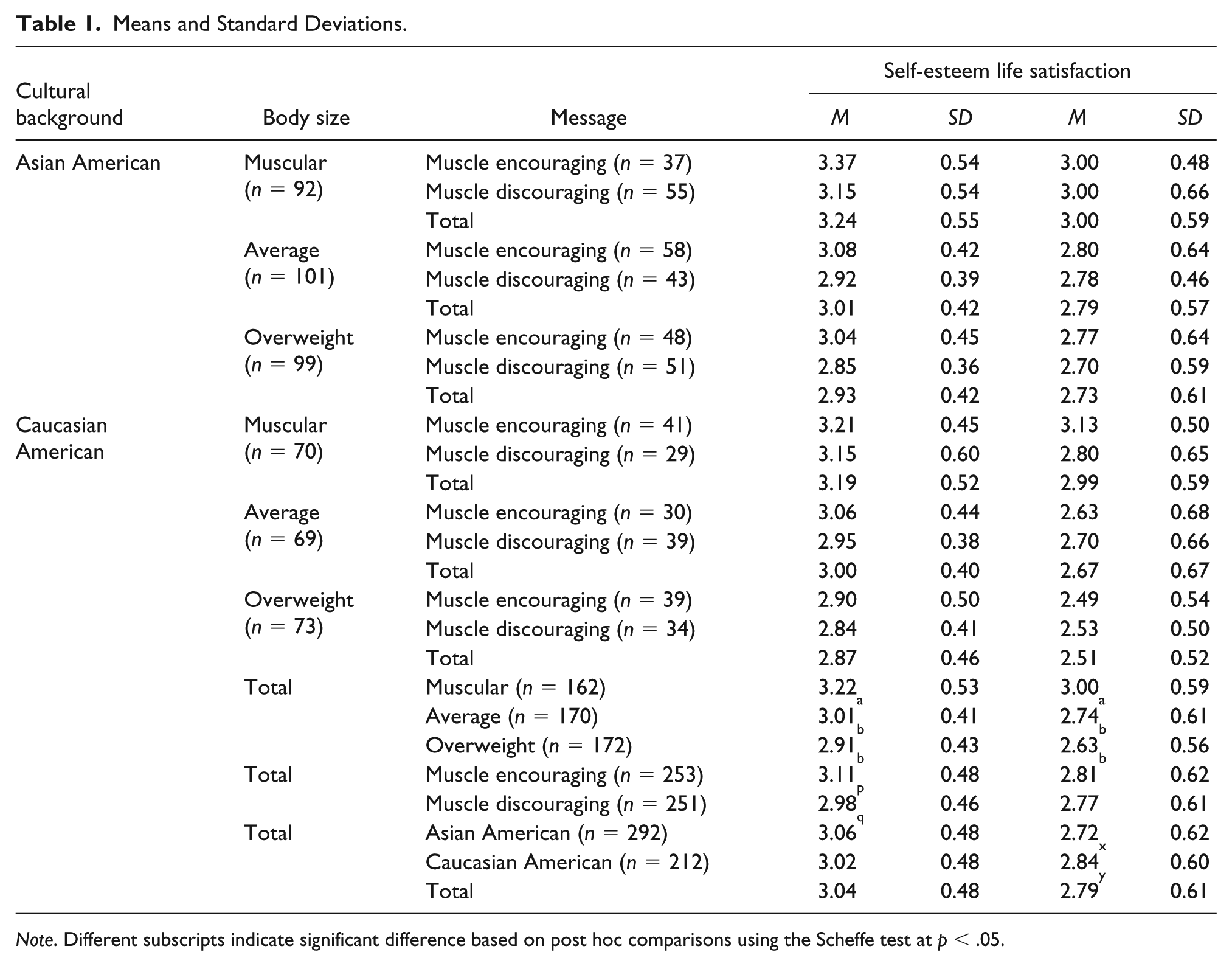
Note. Different subscripts indicate significant difference based on post hoc comparisons using the Scheffe test at p < .05.
Manipulation check
Participants responded to three statements regarding the profile owner’s body shape using 5-point Likert scales ranging from 1 = strongly disagree to 5 = strongly agree. An example item is “I think John is muscular.”
Perception of others’ self-esteem
To measure participants’ perceptions of the profile owner’s self-esteem, the Rosenberg self-esteem scale (RSES; Rosenberg, 1965) was slightly modified. Participants responded to 10 statements regarding the profile owner’s general feelings about himself (e.g., “On the whole, John is satisfied with himself”) with 5-point Likert scales ranging from 1 = strongly disagree to 5 = strongly agree. Reliability (Cronbach’s α) was .79.
Perception of others’ life satisfaction
The first four items of the Satisfaction With Life Scale (SWLS; Diener, Emmons, Larsen, & Griffin, 1985) were used to access participants’ perceptions of the profile owner’s life satisfaction. Participants responded to each item (e.g., “John is satisfied with his life”) using 5-point Likert scales ranging from 1 = strongly disagree to 5 = strongly agree. Reliability (Cronbach’s α) was .79.
Data Analysis
The data were analyzed using SPSS version 24. The effects of the profile owner’s body size, the messages, and participants’ cultural background on outcome variables were evaluated using a three-way analysis of variance (ANOVA) between-subject design. When significant differences were detected (p < .05), a Scheffe post hoc test was utilized. Effect size for each factor was evaluated by eta-squared (η²).
Results
Manipulation Check
Participants reported perceiving the degree of muscularity differently among the three body types, F (2, 501) = 315.21, p < .001. Participants reported that a muscular body was more muscular (M = 3.96, SD = 0.72) than an average body (M = 2.56, SD = 1.01) and an average body more muscular than an overweight body (M = 1.71, SD = 0.70). Similarly, participants reported perceiving that an average body (M = 3.06, SD = 0.95) and an overweight body (M = 3.33, SD = 0.85) needed to be toned to a greater degree than a muscular body (M = 2.46, SD = 0.72), F (2, 501) = 54.79, p < .001.
Perception of the Profile Owner’s Self-esteem
A 3 (body size of a profile owner) × 2 (message) × 2 (participant cultural background) ANOVA showed a significant main effect of body size, F (2, 491) = 19.84, p < .001, η2 = 0.02. H1a stated that an overweight profile owner would be perceived as having the lowest self-esteem, followed by an average profile owner and a muscular profile owner. Post hoc tests using Scheffe’s method showed that a muscular profile owner (M = 3.22, SD = 0.53) was seen as having significantly higher self-esteem than an average profile owner (M = 3.01, SD = 0.41), p < .01, as well as an overweight profile owner (M = 2.91, SD = 0.43), p < .05. There was a nonsignificant difference in perceived self-esteem between average and overweight profile owners, p = .31. H1a was partially supported.
RQ1a asked how the comments of the profile owner’s peers influence the observers’ rating of the profile owner’s self-esteem. There was a significant main effect of messages, F (1, 491) = 10.46, p < .01, η2 = 0.00. A profile owner who received muscle-promoting messages was perceived as having significantly higher self-esteem (M = 3.11, SD = 0.48) than a profile owner who received muscle-discouraging messages (M = 2.98, SD = 0.46). RQ2a posed a question regarding an interaction effect between body size and cultural background. There was a nonsignificant interaction effect, F (2, 491) = 0.40, p = .67, η2 = 0.00. RQ3a asked if cultural background moderates the effect of messages. Again, the interaction between messages and cultural background was nonsignificant, F (1, 491) = 1.75, p = .19, η2 = 0.00.
Perception of the Profile Owner’s Life Satisfaction
A 3 (body size of a profile owner) × 2 (message) × 2 (cultural background) ANOVA showed a significant main effect of cultural background, F (1, 492) = 5.71, p < .05, η2 = 0.00. Compared to Caucasians (M = 2.72, SD = 0.62), Asian participants (M = 2.84, SD = 0.60) reported perceiving the profile owner as having greater life satisfaction. There was also a significant main effect of body size, F (2, 491) = 15.44, p < .001, η2 = 0.02. To test H1b, which predicted that an overweight profile owner would be perceived as having the lowest life satisfaction, followed by an average profile owner and a muscular profile owner, post hoc tests using Scheffe’s method were conducted. The results showed that a muscular profile owner (M = 3.00, SD = 0.59) was perceived as having significantly higher life satisfaction than an average profile owner (M = 2.74, SD = 0.61) and an overweight profile owner (M = 2.64, SD = 0.58). The difference in perceived life satisfaction between an average and an overweight profile owner was nonsignificant, p = .26. Therefore, H1b was partially supported.
RQ1b asked how the messages of the profile owner’s peers impact the observers’ impressions of the profile owner’s life satisfaction. The results showed a nonsignificant main effect of the messages, F (1, 492) = 0.94, p = .33, η2 = 0.00. RQ2b asked if and how cultural background moderates the impact of body size on life satisfaction. A nonsignificant interaction between cultural background and body size was found, F (2, 492) = 1.03, p = .36, η2 = 0.00. RQ3b asked if cultural background moderates the effect of the messages on life satisfaction. There was a nonsignificant interaction effect between cultural background and messages, F (1, 492) = 0.14, p = .71, η2 = 0.00.
Discussion
Using Facebook as a medium of communication, this study investigated how a muscle talker’s body build and peer-generated messages impact observers’ impression formation of his self-esteem and life satisfaction from a cross-cultural perspective. Even though there is ample evidence demonstrating weight bias in the domain of personal attributes, such as laziness (Bento et al., 2012), little is known about weight bias in the domain of psychological characteristics. The current results add a novel finding to weight bias literature: Individuals indeed assume that muscular males possess greater self-esteem and life satisfaction than average or overweight males. The current study demonstrates that peer-generated messages also influence how observers perceive the target’s self-esteem.
Effect of Body Build on Impression Formation
This study found that the body build of a muscle talker influenced the observer’s evaluation of his self-esteem and life satisfaction. A muscular target was judged as having higher levels of self-esteem and life satisfaction than a target with an average or overweight body. This is consistent with previous research by Taniguchi and Lee (2015), which demonstrated that Korean females evaluated an overweight female target as possessing lower self-esteem than a thin counterpart. Given that muscular bodies are depicted as ideal for males in Western societies (Ricciardelli, Clow, & White, 2010), it makes sense that observers assumed that muscular targets would feel positively about both themselves (high self-esteem) and their lives (life satisfaction). Observers might have also assumed that a muscular male enjoys favorable treatment from others, leading them to believe that he possesses higher levels of self-esteem and life satisfaction.
There was no difference in perceived self-esteem and life satisfaction between a normal weight target and an overweight target. One potential reason for this nonsignificant finding is minimal manipulation. Even though manipulation was successful, an overweight target might not have been seen as large enough to elicit the expected effects with this one-time observation. Considering the prevalence of obesity and being overweight in the United States (Ogden, Carroll, Fryar, & Flegal, 2015), the overweight target might not have been perceived as large enough. If the overweight target had been created to represent an even larger body, this study might have observed expected differences in perceived self-esteem and life satisfaction between an average and an overweight target.
Effect of Peer-Generated Messages on Impression Formation
This study also showed that peer-generated messages did in fact influence how observers formed impressions about the target’s self-esteem. Compared to the target who received muscle-discouraging messages from his peers, the target who received muscle-promoting messages was perceived as possessing higher self-esteem. This finding aligns with the previous results that female observers formed a more positive psychological impression (e.g., higher self-esteem) of a female target expressing her desire for weight loss when she received thinness-encouraging messages from peers than when she received thinness-discouraging messages (Taniguchi & Lee, 2015).
There are a few interpretations as to why the target who received muscle-promoting messages was seen as having higher self-esteem than the target who received muscle-discouraging messages. First, when a male expresses his desire to build muscle, it is normative to validate his body concerns and complaints rather than to deny them (Engeln et al., 2013). Validating friend’s muscle-related concerns and supporting his desires so that he can attain what he wants might be perceived as a sign of empathy, which is an important component of a successful friendship (Chow, Ruhl, & Buhrmester, 2013). Observers may have thought that the target was surrounded by empathic peers and, therefore, had a higher level of self-esteem. In contrast, observers might have assumed that the target who received muscle-discouraging message did not have empathetic friendships and, therefore, had poor self-esteem.
Building on self-determination theory (SDT; Deci & Ryan, 1985), muscle-promoting messages might have been perceived as highly autonomy supportive. Autonomy support refers to behaviors that nurture one’s sense of self-determination and has consistently been associated with well-being in general (Ryan & Deci, 2001). Because muscle-promoting messages acknowledge the target’s feelings and concerns, support his initiative to build muscle, and provide relevant information and options/strategies for him to build muscle, observers might have thought that the target was surrounded by friends who were highly autonomy supportive of his motivation. By contrast, muscle-discouraging messages could be seen as somewhat controlling, in that they aimed to change the target’s attitude so that he would not engage in muscle-building behaviors. Based on their personal experiences, observers might have, knowingly or unknowingly, recognized the benefit of autonomy support on psychological function. They might have assumed that the target receiving muscle-promoting messages had high levels of self-esteem and life satisfaction.
Cultural Differences
Observers’ cultural backgrounds did not moderate the impact of body build or peer messages on perceived self-esteem and life satisfaction. One reason for this result might be related to the nature of the Asian American sample in this study. The current study used Asian Americans in the United States, rather than Asian nationals residing in Asian societies. Some Asian Americans in this study might have been acculturated into mainstream American culture. If this study were to be replicated using Asians residing in Asian countries, the moderating role of cultural background may have been observed as intended.
A main effect of cultural background on perceived life satisfaction was observed: Asian Americans, in general, assumed that the target has a higher level of life satisfaction than their Caucasian counterparts did. This pattern is similar to a previous study in which Asians (Japanese living in Japan) reported perceiving the target on Facebook as having a higher level of psychological well-being than Americans did (Taniguchi & Lee, 2015). One potential interpretation of why Asian Americans assumed a higher level of life satisfaction in the target than European Americans did may be related to cultural differences in attitudes toward social support seeking. Research demonstrates that Asian Americans are less likely to seek support than their Caucasian counterparts (Leong & Lau, 2001). Given the relative rarity of support seeking among Asian Americans, Asian observers might have perceived the target’s willingness and ability to openly express his appearance-related concerns and desires in a way that successfully elicits responses from peers as an indicator of a person who is comfortable being himself. This may have led Asian observers to assume that the target had a higher level of life satisfaction than their European counterparts assumed.
Implications
First, even though some interventions against weight bias have been created (Gloor & Puhl, 2016; O’Brien, Puhl, Latner, Mir & Hunter, 2010), the results of this study further call for intervention and prevention programs against weight bias. It would be meaningful to devise a program to reduce the likelihood that overweight and obese people are assumed to possess poor psychological characteristics. There is a stigma of low self-esteem that can lead to discrimination against those who are believed to possess low self-esteem (Cameron, Stinson, Hoplock, Hole, & Schellenberg, 2016; MacGregor et al., 2010). Possessing low self-esteem is often considered a “deal breaker” when forming a new romantic relationship (Jonason, Garcia, Webster, Li, & Fisher, 2015). Given these real-life implications, further initiatives are needed to curtail negative bias based on an individual’s body size.
Second, observers in this study were exposed to the target’s profile page only for a short period of time (less than 1 min), and yet it was enough for the observers to from impressions about the target. In reality, individuals are exposed to Facebook much longer and more frequently. About 70% of Facebook users check the site daily and 45% do so several times a day (Duggan & Smith, 2013). Further, Asian Americans have been reported to check Facebook more frequently than European Americans (Charmaraman, Chan, Chen, Richer, & Ramanudom, 2018). This implies that the effect of the target’s body build and peer-generated messages on impression formation might be even greater in real life, particularly for Asian Americans. Given the prevalence of social networking websites, it is not uncommon for employers to engage in cybervetting—the practice of viewing SNSs to obtain information about job applicants or to monitor current employees (Berkelaar & Buzzanell, 2015). It is advisable that users be aware that the images and peer-generated comments posted on their SNSs can impact how their current and potential employers form impressions about their self-esteem and life satisfaction.
Limitations and Future Research
This research involves several limitations. First, this study treated Asian Americans as a single category, rather than differentiating each ethnic group constituting the Asian American category (e.g., Chinese, Filipino, Japanese, Vietnamese). Research demonstrates that there is heterogeneity within the glossing label of “Asian Americans.” In terms of body size, Filipino American men tend to have higher BMIs than Vietnamese American men (Lauderdale & Rathouz, 2000). Larger individuals might not be perceived as negatively by Filipino Americans because such bodies are relatively more normative. Future research might benefit from examining if there are any differences among various Asian American groups in terms of the effect of body build on impression formation online.
This study did not examine how observers perceived the peers’ comments. As speculated earlier, muscle-encouraging comments might have been perceived as more empathetic, validating, and/or autonomy supportive than muscle-discouraging comments. It is useful for future research to investigate observers’ perceptions of peers’ messages based on relevant theoretical frameworks, such as SDT (Deci & Ryan, 1985).
Future research should also examine if and how individual characteristics of observers impact the impression formation process online in muscle talk contexts. For instance, the strength of weight stigma is influenced by such individual factors as one’s own weight status (Schwartz, Vartanian, Nosek, & Brownell, 2006) and weight locus of control, which refers to the degree to which individuals believe they have control over their weight (Elison & Çiftçi, 2015). Such individual factors might interact with not only the effect of body build but also the content of the comments. For example, when observers hold external weight locus of control (a belief that weight is largely a result of external factors that are beyond one’s control), they might perceive peer-generated messages discouraging muscle building—and thus accepting the target’s current body build—as more conducive to the target’s self-esteem and life satisfaction. Identifying potential individual characteristics that moderate the impact of muscle talk would deepen understanding of weight bias and the impression formation process.
The current study focused on impression formation in the context of muscle talk where a target expresses his body concerns. Future research might benefit from examining impression formation in the context of “body positive” talk. The body positive movement refers to an initiative that aims to challenge the dominant norm of the ideal body and instead promote self-acceptance of bodies of any size, shape, or appearance. Such a movement is gaining momentum on various social media platforms, such as Instagram, especially among females (Cwynar-Horta, 2016). Even though it is considerably less common, such a movement has slowly started to become accepted among some male users (Montgomery, 2016). Given this, there is a potential likelihood that users see other users’ pictures accompanied by body-accepting messages posted on SNSs. It would be interesting to examine how a target’s body-accepting comments might interact with the role of his body build in observers’ impression formation processes. For instance, observers’ impressions toward an overweight target might differ depending on whether the target expresses body acceptance or body concerns.
Conclusion
This study represents the first research on impression formation in the context of muscle talk on Facebook. The results confirmed the existence of weight bias as well bias against a person who received peer messages discouraging him from building muscle. Additional research that further examines the impression formation of individuals with various body builds accompanied by various appearance-related messages on Facebook and other SNSs will help to further understanding of addressing and hopefully redressing negative bias and discrimination associated with body build.
Footnotes
Appendix
Declaration of Conflicting Interests
The author(s) declared no potential conflicts of interest with respect to the research, authorship, and/or publication of this article.
Funding
The author(s) disclosed receipt of the following financial support for the research, authorship, and/or publication of this article: This work was supported by the Core University Program for Korean Studies through the Ministry of Education of the Republic of the Korea and Korean Studies Promotion Service of the Academy of Korean Studies (AKS-2015-OLU-2250005) and the National Research Foundation (NRF) of Korea (NRF-2018R1D1A1B07049693).
