




Abstract
Hookah smoking has increased worldwide, especially among youth, and has been identified as an emerging threat to public health. The aim of the present study was to estimate the prevalence and transition rates in hookah smoking statuses and predictors of transitions among a representative sample of Iranian high school students. In this longitudinal study, a representative sample (n = 5197) of students in the northwest of Iran was assessed thrice with a 6-month interval in 2010 and 2011. A self-administered questionnaire was used to measure hookah smoking, demographic characteristics, and personal and environmental factors. In total, the prevalence of hookah use (at least once a month) in this study was 6.0% (95% confidence interval [CI] = 5.1, 6.9). Results indicated that 44.9% (95% CI = 43.0, 46.7) of the students in the sample at least tried hookah smoking. During 1 year, 18.5% and 1.5% of students who have never used hookah before had transitioned to experimenter and regular hookah smoking, respectively, and notably, 7.8% of experimenters had transitioned to regular hookah smoking. Adjusted for other factors, being male, regular cigarette smoking, and positive attitude toward smoking were factors associated with students’ transition to hookah smoking status. The incidence rate of hookah smoking in adolescents is notable. The findings identified the co-occurrence of risky behaviors that support programs aimed at reducing or preventing high-risk behaviors simultaneously.
Introduction
Tobacco use is an important and preventable risk factor for developing diseases and increases related morbidity and mortality and leads to premature death (Alwan, 2011). Most of the studies and policies focus on cigarette smoking control, while hookah smoking (aka water pipe, shishah, arghile, nerghile, qalyan, and hubble-bubble) has increased worldwide, especially among youth, and has been identified as an emerging threat to public health (Knishkowy & Amitai, 2005). Evidence indicates that hookah smoking may be more harmful than cigarette smoking (Akl et al., 2010). Analysis of hookah smoke ingredients has identified high concentrations of carbon monoxide, nicotine, tar, arsenic, chromium, and heavy metals (Shihadeh, 2003; Shihadeh & Saleh, 2005).
Despite the decline in smoking prevalence in the developed countries in recent years (Center for Disease Control and Prevention, 2007), many young people still experience different forms of tobacco use, becoming vulnerable to initiation and, consequently, to tobacco dependence (Knishkowy & Amitai, 2005; Smith et al., 2011). The results of a cross-sectional survey of a representative sample of New Jersey high school students reported that 9.7% of students are current hookah users (Jordan & Delnevo, 2010). Data from 41,886 students from Grades 7 to 12 in Canada reported that 2.7% of students were classified as current users of hookah (Chan, Leatherdale, Burkhalter, & Ahmed, 2011).
In developing countries, including Iran, the rates of smoking continue to rise especially in adolescents (Mayor, 2009; Mohammadpoorasl, 2013; Sussman et al., 2007). Overall, the prevalence of hookah smoking across Iran is 5.3%, and in the south cities it is 8.2% (Baheiraei, Mirghafourvand, Nedjat, Mohammadi, & Mohammad-Alizadeh Charandabi, 2012; Sarrafzadegan et al., 2010). The results of two national surveys in 1991 and 1999 reported that hookah smoking is increasing among the age-groups of 15- to 24-year olds in Iran (Mohammad, Nourbala, & Madjdzadeh, 2001). A study on students in Tehran reported that 63% of boys and 47% of girls had experienced hookah smoking (Azizi, Mirmiran, & Azadbakth, 2004).
Unfortunately, there is little information regarding hookah smoking among adolescents in Iran. The aim of the present study is to estimate the prevalence and transition rates in hookah smoking statuses and predictors of transitions among a representative sample of high school students in Tabriz City.
Method and Materials
Study Sample
In this cohort study, a representative sample of 10th-grade students in Tabriz (northwest of Iran) was assessed thrice. Participants completed a self-administered multiple-choice anonym questionnaire during November and December of 2010. Six months and 1 year later the same questionnaire (after excluding the unnecessary parts) was distributed to the same students in order to study changes in hookah smoking behavior. The reason for limiting the representative samples to 10th-grade students was for a better possibility to track them in the subsequent phases of the study.
Three specific factors safeguarded the validity of students’ self-reports in this study: (a) participants were assured of strict confidentiality of their responses, (b) they were informed about the voluntary nature of their participation and their rights to refuse or skip questions, and (c) tracking of students was done by giving specific codes, and they were assured that they could not be recognized by their answers.
One hundred and ninety-six classes (of 82 boys and 114 girls classes, respectively) were randomly selected by considering the type of school, the number of students in each school, and the education major. All the students of these classes were invited to participate in the study. Out of 5,395 sampled students, 5,192 students participated in the study and filled out the questionnaire (response rate = 96.2%). From those who did not complete the questionnaire, 196 (3.6%) students were absent and 7 (0.13%) students did not participate in the study. After a 1-year follow-up, 1,182 (22.7%) students dropped out of study. Comparing some of the key variables such as gender, attitude toward smoking, having smoker friends, and cigarette smoking status—that strongly associated with cigarette smoking—of these students with other students indicated no significant differences between the two groups (lack of bias). More details about the sampling method of the study can be found elsewhere (Mohammadpoorasl et al., 2012).
Study Tools
The questionnaire had been designed to gather information about the demographic characteristics, socioeconomic status, hookah smoking status, cigarette smoking behavior, general risk-taking behavior, substance abuse, self-esteem, self-injury, and attitude toward smoking. More details about the validity and reliability of the questionnaire and definition of variables have been presented elsewhere (Mohammadpoorasl et al., 2012).
In this study, hookah smoking was measured by using a multiple-choice question including the following answers: never use, only tried, occasionally use, at least once a month, and at least once a week. The prevalence of hookah smoking according to these answers was calculated. However, to consider the transition in hookah smoking status and to study its related factors, the respondents were classified in three statuses of hookah smoking as represented below:
Never Smoker: Adolescents who have never smoked hookah (even a puff)
Experimenter: Adolescents who have tried hookah smoking (even a puff) or have smoked occasionally
Regular Hookah Smoker: Students who use hookah at least once a month
Statistical Analysis
The sampling method used in this study was cluster sampling, and it could affect the confidence intervals. So survey analysis has been used in all analyses, and 196 randomly selected classes were considered as clusters. Because of the difference between the number of girls and boys and the hookah smoking prevalence between the two genders, hookah smoking for the whole student sample was calculated using the direct standardization method. Chi-square test (or Fisher’s exact test) and independent-sample t test were used in univariate form for studying transition in the hookah smoking status related factors. Besides, for multiple analyses of transition in the hookah smoking status factors, the survey logistic regression model was used. Analyses were conducted by using Stata-10 software.
Ethics Consideration
The respondents were assured about the voluntary nature of the participation in the study and the confidentiality of the information before distributing the questionnaire; furthermore, they were asked not to provide their personal information in the questionnaire. This study and the relating questionnaire had been approved by the Eastern Azerbaijan Province Education Organization and the Ethics Committee of Tabriz University of Medical Sciences.
Results
The mean age of participants in the study was 15.7 ± 0.7 (14 to 19 years old age range). Of the total student sample, 2,240 (43.1) were boys, and 2,952 (56.9) were girls. Table 1 reports the frequency distribution of the hookah smoking youth by gender. As it can be seen in this table, 2.9% of the students have smoked hookah at least once a week, and hookah smoking is more prevalent among boys than girls. After merging the hookah smoking statuses in boys, 52.3% of the participants were experimenters (95% CI = 50.2, 54.3) and 10.4% were regular hookah smokers (95% CI = 9.2, 11.7); among girls, 37.1% were experimenters (95% CI = 35.3, 38.8) and 1.4% were regular hookah smokers (95% CI = 1.1, 1.9). In total, using direct standardization and considering cluster sampling, 44.9% of the participants were experimenters (95% CI = 43.0, 46.7) and 6.0% were regular hookah smokers (95% CI = 5.1, 6.9).
Prevalence of Hookah Smoking by Gender.

Prevalence of hookah smoking and transition percentages matrix in three times is presented in Table 2. As reported in the table, the prevalence of hookah smoking increased over time. During 1 year, 18.5% and 1.5% of never users had transitioned to experimenter and regular hookah smoking, respectively, and notably, 7.8% of experimenters had transitioned to regular hookah smoking.
Prevalence of Hookah Smoking and Transition Percentages Matrix in Three Times Points.

Number (%).
Diagonal transition probabilities in bold to facilitate interpretation.
Table 3 presents the percentage of transition in hookah smoking status by key qualitative variable of the students, and Table 4 reports mean and standard deviation of age, self-esteem, and attitude toward smoking in student with and without transition in hookah smoking status.
Percent of Transition in Hookah Smoking Status by Key Variable of the Students.

Note. NE = never smoker; ES = experimenter; RS = regular hookah smoker.
Mean and Standard Deviation of Age, Self-Esteem, and Attitude Toward Smoking in Student With and Without Transition in Hookah Smoking Status.
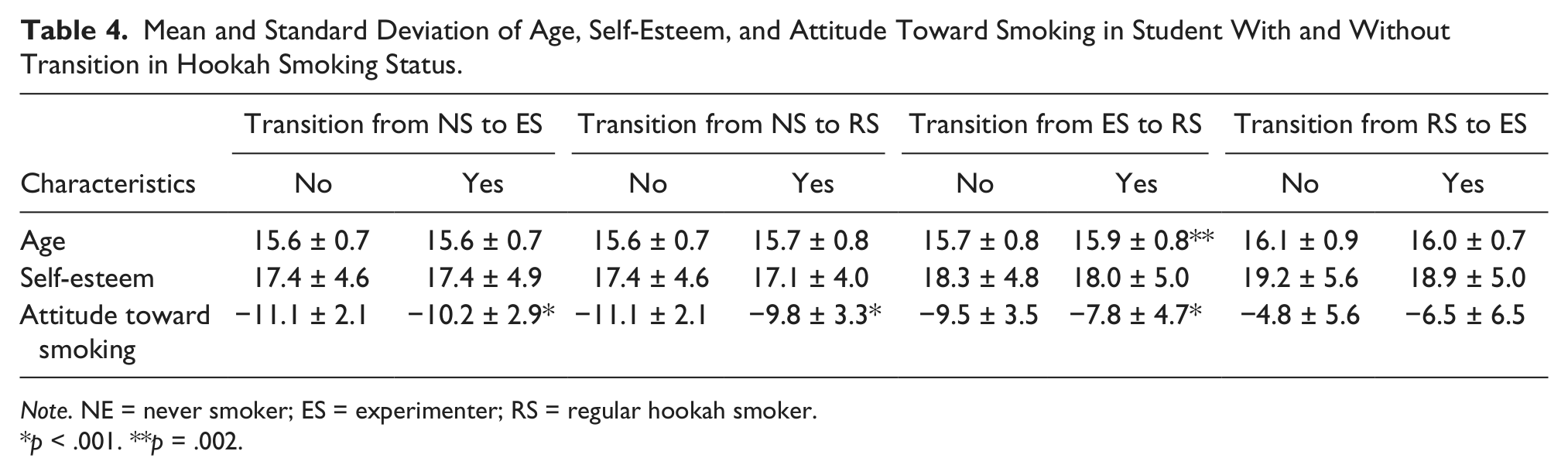
Note. NE = never smoker; ES = experimenter; RS = regular hookah smoker.
p < .001. **p = .002.
Four survey logistic regression models were used to evaluate the association of all significant variables at the level of 0.2 in the bivariate analysis (Table 5). The results of these analyses indicate that after adjusting for other factors, gender (male/female) (odds ratio [OR] = 2.29), having smoker friend(s) (OR = 1.35), having general risk-taking behavior (OR = 1.42), being experimenter (OR = 2.29), and regular smoker in cigarette smoking (OR = 3.53) in comparison with never smoker and positive attitude toward smoking (OR = 1.07) were factors associated with student’s transition from never hookah smoking to experimenting with hookah smoking. Gender (male/female) (OR = 7.52) and being experimenter in cigarette smoking (OR = 5.42) in comparison with never smoker and positive attitude toward smoking (OR = 1.12) were factors associated with student’s transition from never hookah smoking to regular hookah smoking. Gender (male/female) (OR = 6.02), having general risk-taking behavior (OR = 1.79), being experimenter (OR = 1.87), and regular smoker in cigarette smoking (OR = 4.04) in comparison with never smoker were predictors of transition from experimenter status of hookah smoking to regular hookah smoking. Being boys (OR = 0.37) and being experimenter (OR = 0.27) and regular smoker in cigarette smoking (OR = 0.24) in comparison with never smoker were preventive factors associated with student’s transition from regular hookah smoking to experimenting with hookah smoking.
Survey Logistic Regression Analysis of the Predictors of Transition in Hookah Smoking Status.

Note. NE = never smoker; ES = experimenter; RS = regular hookah smoker.
Odds ratio (95% confidence interval).
These variables not entered in the final model.
p < .05.
Discussion
The prevalence of hookah use (at least once a month) in this study was obtained as 6.0%. Also, results reported that 44.9% of student samples at least tried hookah smoking. The results of a cross-sectional study on 4,361 intermediate and high school students in Tehran reported that the prevalence of lifetime hookah smoking was 56.9% (60.6% in boys vs. 53.1% in girls) and the prevalence of current hookah smoking was 25.7% (30.7% in boys vs. 20.6% in girls; Momenan, Sarbandi Zaboli, Etemadi, & Azizi, 2007). Another study of Iranian students reported that 63% of boys and 47% of girls had experienced hookah smoking (Azizi et al., 2004). Findings of available studies reported that the prevalence of the current (past month) hookah smoking range was from 6% to 34% among Middle Eastern adolescents and from 5% to 17% among American adolescents (Maziak, 2011). In Poland, 38% of high school and college students have smoked a hookah at least once in their life, and 22% have smoked it during the past 30 days (Zielinska-Danch, Czogala, Adanczyk, & Danch, 2012).
Because of a historical background of hookah smoking and traditions of the Middle East (including Iran), accessibility to hookah smoking in adolescents in this region of the world is higher than in others places (Mohammadpoorasl, Heydarpour, Maleki, Rostami, & Sahebihagh, 2013). So the prevalence of hookah smoking experience in Iranian students is high. But because of the implausibility of cigarette smoking in Iranian families’ culture (especially in adolescents) and harsh parental disapproval of adolescents smoking, the prevalence of regular hookah smoking is low.
It is important to note that during 1 year, 18.5% and 1.5% of never hookah users had transitioned to experimenter and regular hookah smoking, respectively, and notably, 7.8% of experimenters had transitioned to regular hookah smoking. A longitudinal study among first-year female college students in New York reported that lifetime prevalence of hookah use increased from 29% at college entry to 45% at 1-year follow-up (Fielder, Carey, & Carey, 2012). There is no longitudinal study about hookah smoking in Iran. However, a few studies reported that incidence rate of cigarette smoking is high among Iranian adolescents (Mohammadpoorasl, 2013; Mohammadpoorasl, Fakhari, Shamsipur, Rostami, & Rashidian, 2011).
Findings indicate that hookah smoking prevalence is much higher in males than in females (10.4% vs. 1.4%). The results also reported that the rate of transition from never hookah smoking to experimenter and regular use and transition from experimenter to regular use were higher in males than in females. But the rate of transition from regular hookah smoking to experimenter was higher in males than in females (64.7% vs. 36.5%). The results of logistic regression models indicated that these results are correct after controlling for other relevant variables. These results are similar to previous study results in Iran that reported that cigarette smoking and hookah smoking is more prevalent in men than in women (Baheiraei et al., 2012; Mohammad et al., 2001; Sarrafzadegan et al., 2010).
The current study indicated that adolescents who are experimenter or regular smokers were more likely to transition from never hookah smoking to experimenter and regular use and transition from experimenter to regular use. These findings are consistent with existing research that indicated that youth who are current smokers were more likely to use or have used hookah compared with nonsmokers (Barnett, Curbow, Weitz, Johnson, & Smith-Simone, 2009; Chan et al., 2011). Numerous studies have emphasized on the co-occurrence of risky behaviors (Chan et al., 2011; Mohammadpoorasl, Ghahramanloo, & Allahverdipour, 2013). Considering co-occurrence, co-changing is one of the most effective approaches in the prevention of high-risk behaviors. Co-occurrence of risky behaviors in the present study further highlights the importance of implementing comorbid substance use prevention programs in students.
Andrews and Duncan (1998) have reported that the adolescents who have never smoked but who have a high attitude to cigarette smoking experience smoking more than those with less attitude, and this group of the students pass the cigarette smoking stages faster than the other group. Also, numerous studies identified the relationship between the attitude toward smoking and cigarette smoking (Andrews & Duncan, 1998; Ayatollahi, Mohammadpoorasl, & Rajaeifard, 2005; Hill, Boudreau, Amvot, Déry, & Godin, 1997; Mohammadpoorasl et al., 2011). There is no study about the relationship between attitude toward smoking and hookah smoking. The results of our study reported that after adjusting for other factors, positive attitude toward smoking was associated with student’s transition from never hookah smoking to experimenting with hookah smoking (OR = 1.07) and transition from never hookah smoking to regular hookah smoking (OR = 1.12).
Several aspects of this study can limit the application of the findings: first, despite using quite a satisfactory methodology and sampling method, generalization of the study results is limited because of the study itself being limited to 10th-grade students of Tabriz city; second, the study relied on self-report data—although the current study went to great lengths to ensure confidentiality and anonymity, we had no way of assessing the underreporting of hookah smoking; and third, the predictors were evaluated at the beginning of the study, and they could change during the period of the follow-up.
Conclusion
Our results report low prevalence of hookah smoking in Iranian high school students, especially in girls. But the incidence rate of hookah smoking in adolescents is notable. Also, findings indicate the co-occurrence of risky behaviors, which support programs aimed at reducing or preventing high-risk behaviors simultaneously.
Footnotes
Acknowledgements
We wish to thank all the students, teachers, and head masters of Tabriz high schools for their valuable collaboration with this study.
Declaration of Conflicting Interests
The author(s) declared no potential conflicts of interest with respect to the research, authorship, and/or publication of this article.
Funding
The author(s) disclosed receipt of the following financial support for the research, authorship, and/or publication of this article. This article is a part of PhD thesis supported by Tehran University of Medical Sciences. We would like to thank the Deputy of Research and Technology of Tehran University of Medical Sciences and Deputy of Research of Tabriz University of Medical Sciences for financial support of this study.