




Abstract
Few studies have examined correlates of heavy drinking among rural immigrant Latino men. This analysis identified correlates of typical week drunkenness and past 30-day heavy episodic drinking, within a sample of immigrant Latino men in rural North Carolina (n = 258). In the bivariate analyses, Mexican birth, entering the United States as an adult, and year-round employment were associated with increased odds of typical week drunkenness, and higher acculturation and affiliation with a religion with strict prohibitions against drinking alcohol were associated with lower odds of typical week drunkenness. Being older, Mexican birth, entering the United States as an adult, and lower acculturation were associated with increased odds of heavy episodic drinking, and affiliation with a religion with strict prohibitions against drinking alcohol and completing high school were associated with decreased odds of heavy episodic drinking. In multivariable modeling, only religious affiliation was associated with typical week drunkenness. Mexican birth, entering the United States as an adult, and lower acculturation were associated with increased odds of heavy episodic drinking, and affiliation with a religion with strict prohibitions against drinking alcohol and completing high school were associated with lower odds of heavy episodic drinking. The health of minority men in the United States has been neglected, and immigrant Latino men comprise a particularly vulnerable population. This analysis provides initial data on some factors associated with heavy drinking within a population about which little is known. Future studies should examine moderating or mediating factors between age, acculturation, religiosity, and heavy drinking that might be targets for behavioral interventions.
Many infectious and chronic diseases as well as physical health problems can be attributed to heavy drinking. Such drinking contributes to infectious and chronic diseases, including HIV, cancers, and liver disease (Rehm et al., 2009; Rehm, Gmel, Sempos, & Trevisan, 2003; Wen, Balluz, & Town, 2011). Heavy drinking has been associated with several behaviors related to HIV diagnosis, including not using condoms, having multiple casual-sex partners, and having sex with risky partners (e.g., partners who have multiple sex partners and partners whose HIV serostatus is unknown). Heavy drinking is also associated with physical injury (e.g., traffic- and nontraffic-related injuries and violence-related injuries; Centers for Disease Control and Prevention [CDC], 2010, 2012; Cherpitel, 1993; Hingson & Howland, 2002; Hingson, Zha, & Weitzman, 2009).
Nationally, about 17.1% of adults age 18 to 48 years report heavy episodic drinking (HED; five drinks consumed in a row for men and four for women at least once in the past month; Kanny, Liu, Brewer, Garvin, & Balluz, 2012). According to 2010 data from the U.S. Behavioral Risk Factor Surveillance System, 15.1% of all adults surveyed reported past 30-day HED. However, among men the prevalence was higher—20.2% of men reported past-month HED (CDC, 2012).
Generally, Latinos drink less frequently than Whites but more per occasion (CDC, 2012; Neff, Hoppe, & Perea, 1987; Perez-Stable, Marin, & Marin, 1994; Worby & Organista, 2007). Latino men are also more likely to report alcohol abuse and to experience more negative alcohol-related consequences than White men (Mulia, Ye, Greenfield, & Zemore, 2009). Among men who have fewer instances of HED, Latinos are more likely than Whites to experience alcohol-related social consequences (e.g., higher likelihood of arrest and victimization from violence; Mulia et al., 2009). Furthermore, among Latinos, second-generation Latinos report higher rates of alcohol abuse, negative consequences due to alcohol use, and alcohol dependence than first-generation Latinos, which may contribute further to health disparities (Caetano, Ramisetty-Mikler, & Rodriguez, 2009). Although there are few data regarding the drinking habits of Latino men in rural areas, a recent study reported that in a sample of farmworkers in North Carolina about one in four men abstained from drinking; however, a slightly higher number (27%) reported frequent HED, defined as HED two or more times per month, and 39% of the men interviewed showed signs of alcohol dependency (Grzywacz, Quandt, Isom, & Arcury, 2007).
Psychosocial Predictors of Heavy Drinking Among Latino Men
Several factors related to being a Latino male may predict heavy drinking. Acculturation and educational attainment play complex roles in drinking for Latino men, with less acculturated men and those with lower educational attainment reported to drink more alcohol (Neff et al., 1987). Furthermore, taken together, low levels of acculturation, higher acculturative stress, and younger age have been shown to predict better heavy drinking than acculturation alone among Latino men (Neff et al., 1987; Vaeth, Caetano, & Rodriguez, 2012).
Religiosity has been linked to alcohol abstention and lower risk drinking, most often among adolescents and college students (Brown, Parks, Zimmerman, & Phillips, 2001; Chawla, Neighbors, Lewis, Lee, & Larimer, 2007; Patock-Peckham, Hutchinson, Cheong, & Nagoshi, 1998). In a national study, Michalak, Trocki, and Bond (2007) identified that type of religion or religious denomination (e.g., Mormon, Seventh-Day Adventist, and Evangelical) predicted abstention from alcohol and that increased religiosity interacted with religious type to predict lower drinking levels. In a sample of Mexican American college students, religiosity was inconsistently associated with drinking (Zamboanga, 2005), but in a sample of African Americans and Latinos, identifying with a religion significantly reduced the odds of having drunk alcohol prior to seeking treatment at an emergency room (Bazargan, Sherkat, & Bazargan, 2004).
Stressors have been linked to increased drinking, usually in college students or in relation to work stress or demand (Cooper, Russell, & Frone, 1990; Crum, Muntaner, Eaton, & Anthony, 1995; Kjeerheim, Haldorsen, Andersen, Mykletun, & Aasland, 1997; Landsbergis et al., 1998; Perkins, 1999; Richman, Rospenda, Flaherty, & Freels, 2001), and social support is thought to buffer the link between stress and negative health behaviors such as heavy drinking (Pascoe & Smart Richman, 2009; Steptoe, Wardle, Pollard, Canaan, & Davies, 1996; Thoits, 2010). However, among Latinos, little research has been conducted on the role of stress in predicting drinking behavior. The Hispanic American Baseline Alcohol Study identified a link between increased discriminative stress and increased drinking (Vaeth et al., 2012), and Loury, Jesse, and Wu (2011) found that Mexican immigrant men who reported HED also reported lower levels of perceived social support. However, the perception of discrimination tends to differ by immigrant generation; first-generation Latinos tend to perceive less discrimination than do second-generation Latinos (Viruell-Fuentes, 2007; Viruell-Fuentes & Schulz, 2009). For Latino men, several of these psychosocial factors may be at play at the same time and affect likelihood of heavy drinking.
Purpose
Overall, there is little research identifying the predictors of drinking among Latino men, despite noted disparities related to heavy drinking and associated negative health outcomes compared to other groups such as White men. Furthermore, most public health research with Latinos in the United States has been conducted with samples in established Latino communities, including those in California, New York, and Texas (Elder, Ayala, Parra-Medina, & Talavera, 2009); it is not clear how generalizable findings from these established communities are to Latino communities in the southeastern United States. Research to understand Latino heavy drinking predictors and correlates, especially among men who live in rural areas of the United States with newly emerging Latino communities, is warranted. This region of the United States has one of the fastest growing immigrant Latino populations in the country (Kochlar, Suro, & Tafoya, 2005; Passel, Cohn, & Lopez, 2011). Moreover, immigrant Latinos in this region differ from established communities; they tend to be younger and more recently arrived, have lower educational attainment, and come from more rural communities in southern Mexico and Central America (Painter, 2008). In addition, compared to other groups (college students and Whites), Latinos’ drinking patterns and predictors have been largely ignored. Thus, we sought to explore demographic and psychosocial correlates of heavy drinking (i.e., typical week drunkenness [TWD] and past 30-day HED) within a community-based sample of Latino men in North Carolina.
Method
Sample
Data used in this analysis came from a study of Latinos participating in a lay health advisor HIV prevention intervention study of men’s soccer teams in rural North Carolina, titled The Latino Partnership in North Carolina (Rhodes, 2012). The Latino Partnership study is based on an ongoing community-based participatory research (CBPR) partnership based in North Carolina. Members of the partnership include community members, organizational representatives, and academic researchers who have been working together in an authentic colearning and power-sharing partnership for more than a decade (Rhodes et al., 2011). At the beginning of the study, data were collected from lay health advisors (known as a navegantes [navigators]) and a sample of their soccer teammates, members of their social networks with whom they would be promoting sexual health. Inclusion criteria for participation were self-identification as Latino or Hispanic and greater comfort speaking in Spanish (as opposed to English or other indigenous languages), being 18 years of age or older, and providing informed consent. Data were collected from a sample of 262 participants. However, 4 participants were subsequently excluded because it was learned that they were younger than 18 years at the time of recruitment, for a final sample of 258. Each participant was compensated $30 for completing the baseline assessment.
The study was conducted with the approval of the Wake Forest School of Medicine Institutional Review Board.
Measures
The assessment used for data collection included 170 items comprising demographics (e.g., age, education, income, employment, country of origin, migration age, religious affiliation, and relationship status), psychosocial constructs (e.g., acculturation, religiosity, social support, perceived unfairness, and discrimination), and behavioral constructs (e.g., condom use, STD testing, alcohol, and drug use). Dependent behavioral variables were TWD and past 30-day HED.
Age, education, income, employment, and country of origin were measured using self-report items used in other studies in this population (Knipper et al., 2007; Rhodes et al., 2012; Rhodes, Hergenrather, Bloom, Leichliter, & Montaño, 2009). Migration age was calculated from the participant’s response to the question “How old were you when you first came to live in the United States?” Migration age was dichotomized as those who came to the United States before age 18 (minor migration) and those who came at age 18 or older (adult migration). Religious affiliation was assessed with the following question: “What religion do you practice currently?” The variable was dichotomized into religions/denominations with strict prohibitions against drinking alcohol (i.e., Evangelical/Christian, Protestant/Pentecostal, Muslim, La Luz Del Mundo, and Seventh-Day Adventist) and religions with less strict views on alcohol use (e.g., Catholicism and Judaism). Because few participants indicated that they had no religious affiliation (n = 24; 9%), they were included in the category of those with less strict views on alcohol use. Participants were dichotomized into currently married/partnered (whether currently living together or not) and single, based on responses to an item that has been successfully used in previous studies of Latino heterosexual men to assess relationship status (Rhodes et al., 2009).
Acculturation was measured using the 12-item Short Acculturation Scale for Latinos (Marin, Sabogal, Marin, Otero-Sabogal, & Perez-Stable, 1987). Religiosity was measured using the Santa Clara Strength of Religious Faith Questionnaire (Plante & Boccaccini, 1997).
Social support was measured using the 18-item Index of Sojourner Social Support (Ong & Ward, 2005; Rhodes, Daniel, & Reboussin, 2013). The items were translated into Spanish from the original English. The first 9 items measured perceived emotional support, and the second 9 items measured perceived instrumental support. An example of the perceived emotional support items is “Tell me if you know persons in North Carolina or outside North Carolina with whom you are maintaining some form of regular contact, who would comfort you whenever you feel homesick.” An example of perceived instrumental support items is “Tell me if you know persons in North Carolina or outside North Carolina with whom you are maintaining some form of regular contact, who would provide necessary information to help orient you to your new surroundings.” The response options for the scale were as follows: 0 = no one would do this, 1 = someone would do this, 2 = a few would do this, 3 = several would do this, and 4 = many would do this.
Perceived unfairness was measured using the following item: “Since coming to the United States, I often have the feeling that I am being treated unfairly because of my ethnicity.” This item was adapted from the Whitehall II study (De Vogli, Ferrie, Chandola, Kivimaki, & Marmot, 2007). Perceived discrimination was measured using the item “Since coming to the United States, have you ever experienced discrimination or been the victim of violence due to your race?” (Krieger, Smith, Naishadham, Hartman, & Barbeau, 2005). Both items used a 4-point response format from strongly disagree (1) to strongly agree (4).
This analysis used two single-item measures of heavy drinking: TWD and HED. The TWD measure has been used recently with Latino men in North Carolina (Rhodes et al., 2012) and the HED is a common measure for national studies (Naimi et al., 2003). TWD was measured using a single question (“In a typical week how many days do you get drunk?”) that has been found to be accurate (O’Brien et al., 2006) in identifying drinking levels associated with higher than normal risk of injury in college students and Latino men (Rhodes et al., 2012). Past 30-day HED was measured using the following standard item from the Behavioral Risk Factor Surveillance System Survey: “Considering all types of alcoholic beverages, how many times during the past 30 days did you have five drinks or more on an occasion?” Although response options for both items were open-ended, they were dichotomized for this analysis, which is common for use with alcohol consumption data (i.e., any drunkenness vs. none; any HED vs. none).
Analyses
Sample demographics were explored using descriptive statistics, including frequencies and percentages or means, and standard deviations (SDs). Subsequently, each scale was assessed for reliability in this sample using standardized Cronbach’s alpha. Covariates were compared using a bivariate logistic regression, first with TWD as a dependent variable and then with HED, to identify variables that contributed to drinking. Variables that were significantly associated (p < .05) with either drinking variable were retained in a multivariable regression model. To assess collinearity, a correlation matrix was produced with all of the variables that were significantly associated with the dependent variables.
To test the effect of each variable on the drinking measures, a mixed-effects logistic regression model was used. The team each participant belonged to was entered as a random effect, with participants nested within the team. The random effect adjusts for the potential within-soccer team correlation of responses that may exist because participants from the same soccer team may be more alike than participants from different teams. From this modeling, adjusted odds ratios (AORs) were calculated and confidence intervals (CIs) estimated. All analyses were performed in Stata 12 (Stata Corp LP, College Station, TX).
Results
Sample
In this sample of Latino men (N = 258), 82% were born in Mexico. The average age of participants was 27 years (range: 18-54). Participants had entered the United States at a mean age of 17 years (SD = 6.53) and reported having been in the United States for an average of 9.61 years (SD = 5.52). Most participants were employed year-round (70%) and had less than a high school education (78%), and more than half earned less than $2,000 a month (52%). In the past year, most worked in construction (n = 123; 49%) or factory jobs (n = 56; 22%). Nearly half of the participants reported TWD (n = 109; 45%); however, of the men who reported drinking (n = 188; 73%) in the past 12 months, 64% (n = 109) reported TWD. Slightly more than half of the men reported past 30-day HED (n = 122; 54%). Of the men who reported drinking in the past 12 months, 78% reported past 30-day HED. The majority of men (n = 200; 68%) belonged to a religion/denomination without strict prohibitions against drinking or no religion, and 58 (22%) belonged to a religion/denomination with strict prohibitions against drinking. Demographic characteristics are presented in Table 1.
Respondent Characteristics (N = 258).

Scale Reliability
The Index of Sojourner Social Support scale comprises two factors, each with high reliability: instrumental support (α = .96) and socioemotional support (α = .94). Acculturation included three domains: preferred language (α = .81), media (α = .84), and social network (α = .74). The three domains were strongly correlated with one another and were combined into a single acculturation measure (α = .88). Religiosity showed strong reliability (α = .89).
Bivariate Analysis
Table 2 displays the odds ratios (ORs), 95% CIs, and significance levels between TWD and past 30-day HED and each independent variable.
Predicting Typical Week Drunkenness and Past 30-Day Heavy Episodic Drinking: Bivariate Logistic Regressions.

Note. OR = odds ratio; CI = confidence interval; CMNI = Conformity to Masculine Norms Inventory; ISSS = Index of Sojourner Social Support.
p < .01. *p < .05.
Odds for TWD were higher for men who were born in Mexico, entered the United States as an adult, or were employed year-round. Odds for TWD were lower for men who were more acculturated or reported an affiliation with religions/denominations with normative prohibitions against drinking alcohol.
Odds for past 30-day HED were higher for men who were older, born in Mexico, or entered the United States as an adult. Odds for past 30-day HED were lower for men who had less education, were more acculturated, or reported an affiliation with a religion/denomination having normative prohibitions against drinking alcohol.
Multivariable Logistic Regressions
The variables significantly associated with TWD (born in Mexico, entered the United States as an adult, employment, acculturation, and religious affiliation) and HED (age, born in Mexico, entered the United States as an adult, education, acculturation, and religious affiliation) were included as covariates in multivariable regression models. Age was moderately correlated with coming to the United States as an adult (r = .47) and was removed to reduce possible collinearity.
Typical Week Drunkenness
In the multivariate model (Table 3), only religious affiliation was significantly associated with TWD. Participants who reported an affiliation with a religion/denomination with prohibitions against drinking alcohol had lower odds of reporting TWD (AOR = 0.40; 95% CI [0.19, 0.87]).
Predicting Typical Week Drunkenness and Past 30-Day Heavy Episodic Drinking.
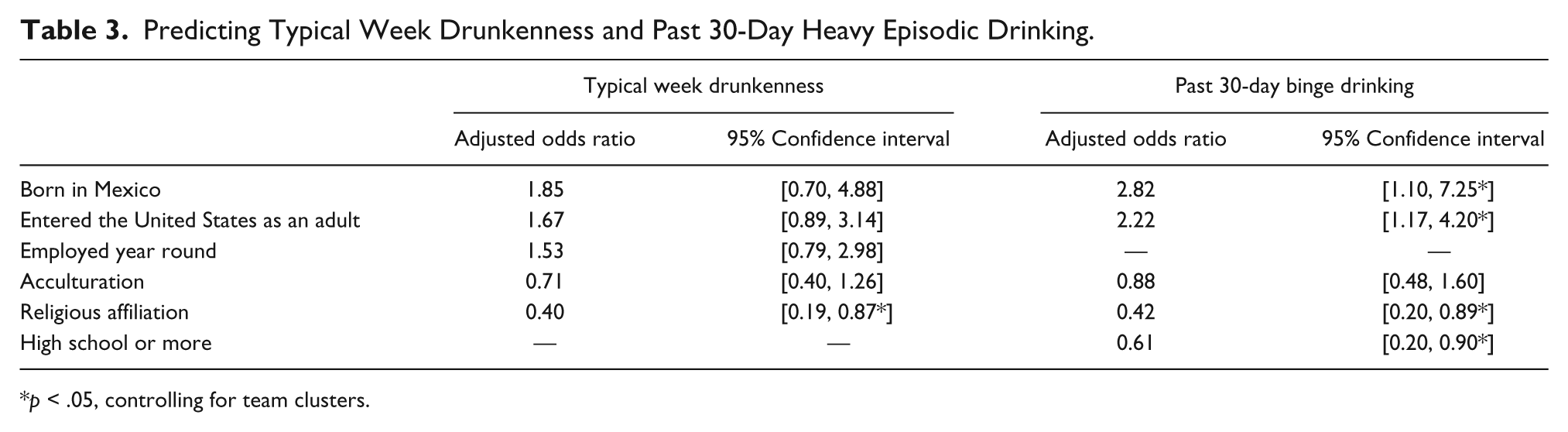
p < .05, controlling for team clusters.
Heavy Episodic Drinking
In the multivariate model (Table 3), being born in Mexico (AOR = 2.82; 95% CI [1.10, 7.25]) and entering the United States as an adult (AOR = 2.22; 95% CI [1.17, 4.20]) were both associated with higher odds of past 30-day HED. Having at least a high school education (AOR = 0.61; 95% CI [0.20, 0.90]) or being affiliated with a religion/denomination with prohibitions against drinking alcohol (AOR = 0.42; 95% CI [0.20, 0.89]) were associated with lower odds of reported past 30-day HED.
Discussion
This analysis was conducted to explore associations between select demographic and psychosocial constructs and two measures of alcohol use among a rural sample of immigrant Latino men. A high prevalence of both TWD and HED were found in this sample of Latino men, 45% and 53%, respectively. The national average for HED is approximately 20% to 23% in men according to national data sets (Kanny, Liu, & Brewer, 2011; Kanny, Liu, Brewer, Garvin, & Balluz, 2012). In a separate Latino sample taken in North Carolina of Latino men who have sex with men, the TWD prevalence was 17.4% and the HED was 30.0% (Rhodes et al., 2012), both lower than observed in this analysis. In a small cross-sectional survey of North Carolina Latino men, 48% of the sample reported binge drinking, which is closer to the 53% observed in this study (Loury et al., 2011). In multivariable modeling, TWD was associated with affiliation with a religion/denomination that does not have a prohibition against drinking alcohol. Higher odds of past 30-day HED was associated with being born in Mexico, coming to the United States as an adult, affiliation with a religion/denomination that does not have a prohibition against drinking alcohol, and lower educational attainment.
The results of this analysis suggested that religiosity did not by itself predict TWD or past 30-day HED. However, affiliation with a religion/denomination that has a prohibition against drinking alcohol was associated with lower odds of reported TWD and past 30-day HED. This finding may suggest the need to work with leaders of churches that do not prohibit alcohol use to establish community norms for less heavy drinking, similar to work done in churches to adapt other health behaviors (Campbell et al., 2007). Because previous work has shown that minority men suffer greater drinking-related consequences than White men (Mulia et al., 2009), reducing drinking among minority men may have a positive impact on social and health disparities.
Results also showed that men immigrating to the United States as adults were more likely to report TWD and past 30-day HED than were men who immigrated as children or youth. Immigrant men likely face a host of possible stressors that might contribute to increased drinking. Acculturative stress, being away from family, fear of deportation, and having to take low-paying jobs in harsh conditions are among the stressors that immigrants to the United States may experience (Cavazos-Rehg, Zayas, & Spitznagel, 2007; Farley, Galves, Dickinson, & Perez, 2005; Hiott, Grzywacz, Arcury, & Quandt, 2006; Rhodes et al., 2009; Smart & Smart, 1995). Communities that include immigrant Latino men might consider ways to buffer stress, or provide activities to provide some relief from stress, including offering access to English or Spanish classes; increasing spaces available for recreational activities such as soccer, volleyball, and fishing; and providing job skills development and medical care. However, for these activities to be safe and widely used among Latino men, communities should consider how these programs might place Latino men at risk for deportation, arrest, and family disruption due to the immigration status of the men or their spouses, and affect their physical and mental health.
There is often a link between discrimination-related stress and heavy drinking (Pascoe & Smart Richman, 2009; Steptoe et al., 1996; Thoits, 2010); however, this analysis did not show such a relationship, perhaps because perceptions of discrimination differ by immigrant generation (Viruell-Fuentes, 2007; Worby & Organista, 2007). First-generation immigrants, who comprised our sample, may not perceive discrimination because they may be more likely to remain within ethnic enclaves and less likely to interact with other ethnicities/races. Another possible explanation is that Latinos have been shown to use denial as a coping strategy (Farley et al., 2005). However, because second-generation Latino men may be more likely to endorse drinking as a coping mechanism (Neff et al., 1987), we conducted a post hoc analysis of the interaction between migration as a minor (i.e., younger than 18 years of age) versus as an adult on the relationship between perceptions of discrimination or being treated unfairly and heavy drinking (i.e., TWD and past 30-day HED). Although there was no difference between perceived discrimination and drinking by age of immigration to the United States, there was a significant interaction between entering the United States as a minor and perceived unfairness (p < .05). Among those who came to the United States as minors, higher levels of perceived unfair treatment were associated with higher odds of reporting TWD (OR = 1.82; 95% CI [1.11, 2.97]). This relationship may be due, in part, to younger immigrants being less able to remain in ethnic enclaves—for example, they may be exposed to discrimination at school—or it may be due to differences in coping styles (i.e., drinking to reduce stress).
This analysis used two measures for heavy drinking, TWD and HED. TWD asks the participant to consider his typical level of drinking to drunkenness, and HED asks the participant to consider how often they drink a particular number of drinks per occasion. Neither measure is without limitations, including asking participants to assess their own drunkenness or asking them to count their own drinks. By including the two items, some of the limitations in one item could be countered by the other item. Used together, these items assess two levels of risk; HED represents a lower level of risk (at least one episode in the past 30 days), than reporting being drunk at least once a week. During multivariable analyses, more factors were associated with HED than TWD, the only overlap being religious affiliation. There are many possible explanations for the difference. It is possible that HED is more sensitive to the listed risk factors, or these factors are not associated with more frequent drunkenness. From this analysis it seems clear that religion does play a part in heavy drinking, however. It is also possible that a larger sample would have provided more power to detect significant associations between TWD and these risk factors.
Problems with drinking, whether among men who came to the United States as adults or among men who came as minors, should also be addressed at a community level. Immigrant Latino men in the southeastern United States have reported that discrimination against immigrant Latinos is common (Rhodes et al., 2009) and have identified how discrimination affects their feelings about themselves and its potential effects in terms of alcohol use and misuse. Although discrimination against minority populations is known to affect health and well-being (Cavazos-Rehg et al., 2007; Rhodes et al., 2009; Smart & Smart, 1995; Smedley & Stith, 2003), little has been done to develop sociopolitical or cultural interventions to transform communities (Guerin, 2005; Smedley & Syme, 2001).
This examination of factors associated with drinking among a sample of immigrant Latino men in North Carolina helped identify a need for better and more culturally congruent measures in Spanish of important psychosocial factors. Several psychosocial factors linked with drinking in men were not included in this analysis: mastery, self-esteem, and masculinity or machismo. This analysis was planned to include measures of self-esteem (Martín-Albo, Nunez, Navarro, & Grijalvo, 2007), mastery (Pearlin & Schooler, 1978), and masculinity (Mahalik et al., 2003); however, problems were observed with the internal reliability of these scales and with reverse-scored items. Of the scales used, only the Acculturation Scale was developed specifically for Spanish-speaking individuals (Marin et al., 1987). The self-esteem scale was validated in Spanish but with a university sample in the Canary Islands (Martín-Albo et al., 2007). Taken as a whole, it is likely that although the scales were translated into Spanish, self-esteem and mastery may not be appropriate or meaningful within this unique sample of immigrant Latinos in the southeastern United States. Furthermore, in the reliability analysis of a subset of the Conformity to Masculine Norms Inventory, many items were not positively associated with the overall scale as they should have been—items that in English had double negatives and required reverse coding. It may be that the double negatives in Spanish did not translate as easily as they do in English. The typical use of reverse-coded items to detect user-driven bias has come under scrutiny even for scales administered in English (Barnette, 2000) and may not function as intended in Spanish, a language that often uses double negatives. It is clear that simpler items must be developed and validated in Spanish. This may be best accomplished using a CBPR approach to include the perspectives and insights of community members with whom the constructs are to be used.
Finally, the parent study successfully recruited immigrant Latino men within communities where local officials worked publicly to deport immigrant Latinos and where public health department records had been used in deportation proceedings, contributing to general distrust among many immigrant Latinos (Rhodes et al., 2012; Vissman et al., 2011). Within this sociopolitical context, men in these communities were very distrustful and typically difficult to reach. However, the trust that our CBPR partnership had gained within the community allowed us to overcome these challenges.
Limitations
Study limitations include design issues, such as cross-sectional design and nonrandom selection of participants, a modest sample size, and poor internal consistency reliability for some scales. Furthermore, because the demographics in the parent study represent Latinos immigrating to the southeastern United States and participating in soccer leagues, generalization of the findings to other Latino populations or contexts may not be appropriate. Recruiting men from soccer leagues may not represent all Latino men; however, it does add to the literature, especially considering what little is known about immigrant Latino men in the southeast United States. This is a first step in gathering exploratory data on alcohol use within this vulnerable and neglected population.
We did not measure all factors that contribute to heavy drinking, particularly factors related to social drinking norms (Caetano & Mora, 1988). Given that social norms around alcohol use influence drinking behavior among other populations (e.g., college students; Borsari & Carey, 2001; Locke & Mahalik, 2005), further research is warranted to explore how immigrant Latino men are influenced by one another.
Conclusion and Implications
The results from this analysis should be viewed as exploratory. The predictors of heavy drinking for rural Latino men living in the southeastern United States are complex and are likely to change as immigration demographics evolve over time (e.g., as immigration communities become more established and mature). TWD and past 30-day HED are difficult to measure due to the ongoing life events that may increase or decrease prevalence of drinking.
Several conclusions can be drawn from this analysis. First, about half of the men reported either TWD or HED. If this finding generalizes, efforts to reduce drinking in this population could have a significant public health impact. Furthermore, given the high prevalence of TWD and HED identified, it is important to screen immigrant Latino men for alcohol problems when they are seen at local or community clinics, and these clinics must have the resources to provide bilingual and bicultural services. Third, churches might be important allies in reducing drinking within the Latino community. Fourth, issues of discrimination and unfair treatment based on ethnicity must be addressed to avoid increased drinking among future generations of Latino men. Fifth, researchers must involve community partners in developing short, understandable, acceptable Spanish-language measures of factors associated with drinking (as well as other measures that may influence Latino health). Finally, future work would benefit from using CBPR in partnership with immigrant Latino men to understand better drinking within this population and how best to intervene.
Future research must also focus on further exploring other psychosocial differences and effects on health behaviors that may differ by age at migration. This may be particularly true for states in which discrimination against Latinos is more visible. Further research within this context on the health and wellbeing of Latino men, a particularly vulnerable group that has to date been neglected, is clearly warranted.
Footnotes
Author Note
The findings and conclusions in this report are those of the authors and do not necessarily represent the official position of the Centers for Disease Control and Prevention.
Declaration of Conflicting Interests
The author(s) declared no potential conflicts of interest with respect to the research, authorship, and/or publication of this article.
Funding
The author(s) disclosed receipt of the following financial support for the research, authorship, and/or publication of this article: This study was supported by Cooperative Agreement No. 1-U48DP001902-01 from the Centers for Disease Control and Prevention. Funding was also provided by the National Institute of Minority Health and Health Disparities (R24MD002774).