




Abstract
Recent studies suggest that body hair may be of increasing importance in men’s overall body image. Body depilation is a relatively new area of clinical and research inquiry among men with much of the documented evidence of the phenomenon split between mass media accounts and descriptive scientific investigations. This study was undertaken to further our understanding of this behavior by examining the relationship between depilation and other dimensions of body image in a nonclinical sample. A total of 364 men completed measures assessing self-reported hair growth, body depilation, drive for muscularity, gender role conflict, body dysmorphia, and social comparison. The correlates of body depilation included a drive for muscularity, gender role conflict, and physical appearance social comparison. Significant differences were identified among men who depilate, compared with those who do not, on measures of social comparison and a drive for muscularity. These findings lend support for the idea that body hair, and its reduction or removal, is a key aspect of men’s body image that translates into some challenges in assessment and prevention among health care practitioners.
The appearance of hair on the human body is celebrated by some while despised by others. During ancient times, both Egyptian and Greek cultures placed a premium on the appearance of a hairless body and ancient Egyptian men often shaved their body hair with pumice stones and razors (Luciano, 2001). What followed was a cultural sanction whereby depilation was prescribed for women and proscribed for men for much of the past half century (Basow & Braman, 1998; Hope, 1982; Tiggemann & Kenyon, 1998; Toerien & Wilkinson, 2003, 2004). Body depilation is operationally defined as the reduction or removal of hair from the neck down, and findings from recent studies suggest that men have joined women in this behavior (see Boroughs, in-press, 2012; Boroughs, Cafri, & Thompson, 2005; Martins, Tiggemann, & Churchett, 2008a; Smolak & Murnen, 2011; Terry & Braun, 2013).
Though it is not clear as to why depilation norms have changed to include men, researchers hypothesize that men have hitherto not engaged in depilation because the presence of body hair was indelibly associated with masculinity and men’s attractiveness and virility (Basow, 1991; Basow & Braman, 1998; Lewis, 1987; Tiggemann & Kenyon, 1998). This change in norms was first documented by popular press accounts that suggested a new hairless ideal among men often achieved through depilation (see Gomes, 2001; Schuler, 2000; H. Smith, 2000; Stein, 1999; Stuever, 2000). Though Lewis (1987) reported that men’s masculine identity was not affected by the presence or absence of body hair, only natural hair growth was examined in that investigation, and so a question remains as to whether men who engage in this, until recently, “female-only” behavior may experience gender role conflict.
Two recent Australian studies, where six dimensions of men’s body image were investigated, revealed that gay (Martins, Tiggemann, & Churchett, 2008b) and heterosexual (Tiggemann, Martins, & Churchett, 2008) men were dissatisfied with their body hair (preferring less), and muscularity (preferring more). For example, body hair was a common appearance concern for 51.6% of heterosexual men, preceded only by head hair (64.5%) and penis size (61.3%), and followed by height (48.4%; Tiggemann et al., 2008). These body image concerns were consistent with those identified among American men (McCreary, Hildebrandt, Heinberg, Boroughs, & Thompson, 2007). New research conducted in Aotearoa/New Zealand documented similar findings (Terry & Braun, 2013), with depilation widely prevalent, though more so by women than men. Findings have been similar among Europeans as well with a recent study reporting that 70% of men removed armpit hair and a high percentage pubic hair (Brähler, 2011).
Given the cross-cultural evidence for the diffusion of depilation behaviors among men, it is important for researchers to gain a better understanding of how concerns about the appearance of hair relates to men’s depilation, the pursuit of a muscular and emerging hairless body ideal, and the integration of this behavior into men’s masculine identity. Furthermore, an important clinical consideration for health care providers is, are there health concerns associated with this behavior that may be addressed during patient visits?
Health Implications of Body Depilation
The potential for physical and psychological problems have been reported with relation to body depilation. Men, like women, report using razors as the primary instrument with which to remove their body hair (Boroughs et al., 2005; Boroughs & Thompson, 2002; Martins et al., 2008a). Compared with hair reduction techniques, such as the use of an electric razor with a plastic guard, use of a cartridge razor can compromise the health of human skin. This may explain the documented increases in methicillin-resistant Staphylococcus aureus (MRSA) infections identified among men who depilate.
Shaving has been the most frequent modus operandi for women’s body depilation (Basow, 1991; Tiggemann & Hodgson, 2008; Tiggemann & Kenyon, 1998; Toerien et al., 2005). A variety of injuries have been reported as a result of body depilation including razor burn, nicks and cuts to the skin, and in-grown hairs. Related to the latter of these injuries are the epidemiological studies that have identified clustered outbreaks of treatment-resistant Staphylococcus infections in athletes both in college (Begier et al., 2004) and professional sports (Miller et al., 2007). These infections are directly associated with depilation and subsequent “turf burns” or the use of towels or whirlpools that athletes share in the course of their practice and/or games (Begier et al., 2004; Miller et al., 2007). Body depilation also enhances the risk of contracting or transmitting the herpes simplex or human papilloma viruses in both men and women (Porche, 2007; Trager, 2006). Studies suggest that shaving body hair with a razor leaves the skin more susceptible to these diseases because of skin irritation, nicks or cuts, abrasions, and folliculitis. Health care providers may be able to intervene by assessing men for body depilation practices and by providing health education about the risks of infection (Porche, 2007).
In addition to the physical injuries noted in the literature, psychological sequelae have been reported by men who depilate. For example, the appearance of body hair has been reported to be a concern among individuals presenting with body dysmorphic disorder (Perugi et al., 1997; Phillips, Menard, & Fay, 2006). Boroughs et al. (2005) reported that 16% of participants said that it would disturb them if they were hypothetically unable to depilate, and an additional 18% rated their anxiety to be in the moderate to extreme range when asked how they would feel if they refrained from depilation for a few weeks. These findings indicate that, for at least a subset of men, depilation is critical in maintaining positive feelings and lowering anxiety about their body image and overall appearance (Boroughs et al., 2005; McCreary et al., 2007).
Appearance concerns vary across groups of men, but often, men share similar concerns. For example, in their study, Martins et al. (2008a) reported sexual orientation differences between groups such that body hair was of greater concern for gay men relative to heterosexual men. Nevertheless, body hair was a key concern for men’s body image regardless of sexual orientation. Given the cross-cultural evidence for the diffusion of depilation behaviors among men, and the associated physical and psychological health ramifications, it is important for researchers to gain a better understanding of how depilation relates to the pursuit of a muscular and emerging hairless body ideal while simultaneously integrating the behavior into masculine gender norms. A theoretical model that might explain the genesis and maintenance of body depilation by men is social comparison theory.
Theoretical Model and Hypotheses
In the context of body image research, the use of social comparison may serve as a framework to explain why people look to “like” others (i.e., others similar to themselves) to gauge how they look and are perceived in social contexts. This theoretical paradigm may aid in a better understanding of the motives for the initiation and maintenance of body depilation among men. Social comparison theory (Festinger, 1954) posits that humans strive for accurate feedback from others in their environment in order to understand themselves better in context. This is accomplished through comparison with like others and thus, one learns about how they should appear based on the appearance of the others around them.
Taken together, a review of the findings in this area suggest that depilation may be related to concerns involving the appearance of hair on the body, up to and including dysmorphic concerns, a drive for muscularity, and possibly gender role conflict—given the previous association of body depilation as a female-only behavior. In previous studies, researchers have not attempted to measure natural body hair growth among men and so it is unclear what role greater hirsuteness may play in men’s feelings or concerns about their body image. Other limitations that have emerged include widely variable depilation prevalence rates. These limitations identified in the literature were addressed in this study, with an additional goal to examine the relationship between hirsuteness and empirically inspired correlates of body depilation, such as the drive for muscularity and dysmorphic symptomatology.
Our research questions were the following: (a) what is the prevalence of body depilation among a diverse sample of college age men, (b) why do men depilate; (c) what methods are used to reduce or remove body hair, (d) how frequently do men depilate, (e) is hirsuteness associated with dysmorphic concern, and (f) how is body depilation associated with dysmorphic symptomatology and gender role conflict. These research questions were generated with an interest focused toward equipping health care providers with guidance toward assessing and intervening to help men who depilate by providing information on the known health risks. Given the previous literature, and the theoretical model being tested, we hypothesized that men who depilate will have increased frequency of social comparison, and a greater drive for muscularity when compared with those who do not.
Method
Participants
The study included a sample of 364 men from a large university in the southeastern United States. Participants’ ages ranged from 18 to 44 years (M = 20.92 years, SD = 3.99), with a modal age of 18 years (24%); 80% of the sample was aged 18 to 22 years. It should be noted that the age range was large given the source of the sample. There were 72 participants older than 22 years. All analyses were conducted two times; first including all participants and then excluding all participants older than 22 years. No significant differences were observed between these groups; therefore, all analyses included participants older and younger than 22 years. The majority of the sample was single (94.2%), grew up in the United States (92.2%), and identified as heterosexual (87.9%). European American was the largest reported ethnicity (61.1%), followed by Latinos (14.5%), African Americans (12.2%), Asian Americans (10.5%), and Native Americans (1.7%; see Table 1).
Participant Characteristics (N = 364).

Procedure
Data were collected via the Internet using a secure web-based system. After being given informed consent, participants completed the measures and were debriefed. The system prohibited participation in the study more than once, responses were confidential, and participants were remunerated with extra credit that could be used toward an eligible course. The study was designed to use a university-based Internet questionnaire because when researchers have compared Internet-based versus lab-based studies, particularly when related to sensitive issues such as hair removal among men, they have reported that the relative benefits, that is, greater diversity in the samples measured and more truthful responding on taboo issues, outweigh the potential problems (Dillman, 1999; Gosling, Vazire, Srivastava, & John, 2004; Reimers, 2007; Schmidt, 1997; M. A. Smith & Leigh, 1997).
Measures
Body Depilation Questionnaire
The Body Depilation Questionnaire (BoDeQ; Boroughs et al., 2005), a 17-item checklist style instrument, was used to collect descriptive information about men’s depilation. The measure included a subjective scale for participants to report their hair growth (i.e., hirsuteness) at 12 body sites. The question read, “Using a scale of 1 = no hair (or very little hair) to 5 = very hairy, please indicate the amount of hair that grows on the following body sites.” The observed Cronbach’s alpha for the hirsuteness subscale was .88. After describing their level of natural body hair growth, participants were asked if they removed or reduced hair from the neck down; those that responded in the affirmative were included in the prevalence estimate. The depilation methods included regular razor, electric razor, electric clippers, waxing at home, Nads, depilatory creams, chemical depilatories, scissors, electrolysis, laser hair removal, no hair at this site, or other.
Drive for Muscularity Scale (DMS;)
The Drive for Muscularity Scale (DMS; McCreary & Sasse, 2000), a 15-item scale, was designed to assess attitudes toward muscularity. Items were rated on a 6-point scale ranging from 1 = always to 6 = never, and then reverse scored so that higher scores indicated a greater drive for muscularity. An example of an item is, “I lift weights to build up muscle.” Item 10 was dropped because of a lack of variability that detracted from the overall scale reliability as suggested by the scales’ authors (see McCreary, 2007). The observed Cronbach’s alpha was .89.
Body Dysmorphic Disorder Examination–Self-Report
The Body Dysmorphic Disorder Examination–Self-Report (BDDE-SR; Rosen & Reiter, 1996), a 30-item questionnaire, measured the cognitive and behavioral symptoms of body dysmorphic disorder. The BDDE-SR has good psychometric properties inclusive of acceptable concurrent validity with other body image questionnaires (rs = .68-.83; Rosen, Reiter, & Orosan, 1995). Participants identified no more than five appearance features of concern, named remedies they may have used to decrease their body dissatisfaction, and answered a series of questions about their level of concern over the appearance feature they ranked highest on their dissatisfaction list. An example of an item is, “How often have you felt that other people were noticing or paying attention to your appearance feature?” Total scores were computed by summing scale Items 1 through 15 and 17 through 26, each having a possible response on a continuum from 0 to 6. The observed Cronbach’s alpha was .94. Extensive studies have supported the validity of the measure with college men and bodybuilders (see Thompson & Cafri, 2007; Thompson, Heinberg, Altabe, & Tantleff-Dunn, 1999).
Gender Role Conflict Scale
The Gender Role Conflict Scale (GRCS; O’Neil, Helms, Gable, David & Wrightsman, 1986), a 37-item questionnaire, was designed to measure endorsement of men’s traditional gender roles and the negative consequences that result from violations of these roles. The measure was selected to evaluate potential conflict for men who depilate. Participants responded to items using a 6-point scale from 1 = strongly disagree to 6 = strongly agree, with higher scores indicating greater gender role conflict. Test–retest reliability is adequate (ranging from .72 to .86, O’Neil et al., 1986). The observed Cronbach’s alpha was .93.
Physical Appearance Comparison Scale
The five-item Physical Appearance Comparison Scale (PACS; Thompson, Heinberg, & Tantleff-Dunn, 1991) was used to measure the tendency of men to make personal physical appearance–related comparisons with similar others in various social situations. Participants indicated on a scale from 1 (= never) to 5 (= always) the frequency with which they carried out specific physical comparisons with others (e.g., “In social situations, I sometimes compare my body shape to the body shape of other people”). Item 2 (“The best way for a person to know if they are overweight or underweight is to compare their figure to the figure of others”) and Item 5 (“In social situations, I sometimes compare my figure to the figure of other people”) were modified for use with this sample given that they were all men. The word “figure” was replaced with the phrase “body shape” each time it appeared in these two items to adjust to a more comfortable linguistic syntax for men. The observed alpha for this sample was .68 because one of the items, which is the only reverse-coded item on the scale (Item 4), had a negative correlation with the item total. Therefore, this item was deleted based on the developers’ recommendations. The revised (4-item) observed alpha for the PACS was .78.
Results
Depilation Prevalence
Self-reported body hair growth was assessed and participants reported the greatest amount of hair at the pubic area (M = 3.4, SD = 1.0), legs (M = 3.3, SD = 0.99), and armpits (M = 3.2, SD = 0.95). Approximately 38% of participants (i.e., n = 138) reported hair on their back while 67% (N = 244) reported hair on their chest. Of the 364 men who participated in the study, 306 (84.1%) indicated that they depilated somewhere on their body from the neck down. Appearance and body image issues were considerable influences cited by men to explain their reasons for depilation. These included cleanliness (n = 189, 61.9%), sex appeal (n = 175, 57.2%), better sexual experience (n = 91, 29.7%), and body definition/muscularity (n = 64, 20.8%).
Table 2 lists the number and percentage of participants who reported “no or little body hair” at 12 sites prior to depilation along with the number and percentage that depilated at each site; the method and frequency of depilation for the 306 “depilators” are also listed. The primary sites reported for depilation were the pubic area (n = 265, 72.8%), abdomen (n = 162, 44.5%), neck (n = 157, 43.1%), and chest (n = 148, 40.7%). The frequency of depilation at either weekly intervals or greater was noted as highest at the back of the neck (n = 146, 47.8%), chest (n = 101, 33.1%), and pubic area (n = 95, 30.9%). Complete hair removal was predominant at all body sites except for the armpits (n = 189, 61.8%) and pubic area (n = 180, 58.9%), where methods to reduce the appearance of hair (i.e., trim to leave visible stubble) were more common. Depilation methods were site dependent, though a regular razor (range = 5% to 35.3%) and either an electric razor (range = 3.6% to 21.7%) or electric clipper (range = 1.4% to 20.6%) were the most commonly reported depilation methods used by participants. Injuries were reported by the majority of men who depilate (n = 215, 70%), which included nicks or cuts to the skin (n = 204, 67%), razor burn (n = 129, 42%), ingrown hairs (n = 105, 34%), or other (n = 5, 2%). 1 All the reported injuries noted are associated with greater risk for the acquisition of MRSA (Kazakova et al., 2005). These results suggest that unlike women, a substantial number of men that depilate do so with the goal of trimming their body hair thereby leaving visible stubble, and yet recent reports of MRSA outbreaks are associated with men, rather than women, engaging in body depilation (see Begier et al., 2004; Kazakova et al., 2005; Miller et al., 2007). Complete hair removal has also been associated with other health problems, such as an increased risk for the acquisition of sexually transmitted infections (Porche, 2007; Trager, 2006). In addition to the biomedical risks noted, psychiatric outcomes were also analyzed.
Men’s Self-Reported Hairlessness, Depilation, and Method, and Frequency of Depilation by Body Site.

Note. For “no body hair” and “depilated” columns, N = 364; for all subsequent columns, N = 306.
Correlates of Men’s Body Depilation
In order to describe the psychological health impact of body depilation and its relevance to men’s appearance concerns, quantitative and qualitative data from the BDDE-SR were analyzed among the n = 339 (93%) men who completed the measure. The rank order of concerns were abdominals/waist (n = 192, 57%), chest/breast (n = 176, 52%), teeth (n = 78, 23%), arms (n = 71, 21%), and body hair (n = 62, 18%). Interestingly, a review of the qualitative responses revealed that the only three concerns men reported with regard to their chest/breast were insufficient muscularity, excessive adiposity, and excessive hair. Pearson correlations were computed for all the study measures and are presented in Table 3. A hirsuteness composite score was computed by averaging men’s self-reported hair growth across the 12 named body sites. The composite score had a statistically significant correlation with a measure of BDD, r(362) = .22, p < .001. This association suggests that men who reported greater overall levels of body hair had increased levels of dysmorphic concern and symptomatology.
Descriptive Statistics, Cronbach’s α, and Zero-Order Correlation Matrix.
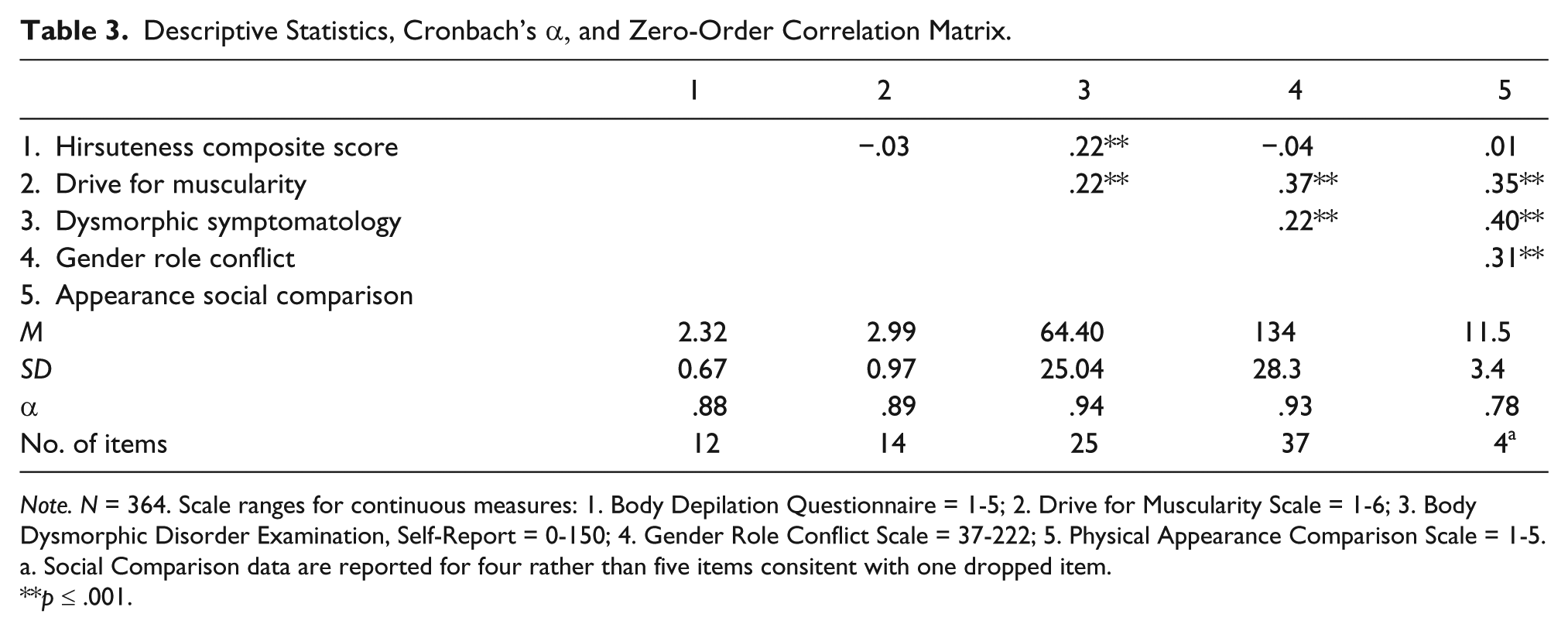
Note. N = 364. Scale ranges for continuous measures: 1. Body Depilation Questionnaire = 1-5; 2. Drive for Muscularity Scale = 1-6; 3. Body Dysmorphic Disorder Examination, Self-Report = 0-150; 4. Gender Role Conflict Scale = 37-222; 5. Physical Appearance Comparison Scale = 1-5.
Social Comparison data are reported for four rather than five items consitent with one dropped item.
p ≤ .001.
Though physical appearance social comparison was not correlated with the hirsuteness composite score, a one-way analysis of variance revealed that men who depilate (M = 11.7, SD = 3.4) more frequently engaged in appearance social comparison than those who do not (M = 10.6, SD = 2.9), and thus the hypothesis was supported, F(1, 363) = 4.21, p = .04. Finally, a one-way analysis of variance was conducted to test the hypothesis that men who depilate (M = 3.04, SD = 0.97) had a higher drive for muscularity than non-depilators (M = 2.74, SD = 0.91). This hypothesis was also supported, F(1, 363) = 4.84, p = .03. These finding suggest that men who depilate compare their own physical appearance with “like others” more that those who do not, and also that the drive for muscularity is more salient for men who depilate.
Discussion
Body image research has traditionally focused on the concerns of women, though over the past two decades, researchers have endeavored to measure and explain the body image issues of both genders (Pope et al., 2000; Thompson, 1990). It is clear that men have some overlapping appearance concerns and exercise attitudes with women, but they also have some unique body image and appearance issues (Boroughs et al., 2005; Boroughs & Thompson, 2002; Cafri & Thompson, 2004; McCreary, 2007; Thompson & Cafri, 2007; Thompson et al., 1999). Body depilation is an issue shared among the genders and yet it is uniquely problematic for men in that it has historically been considered non-normative for them (Boroughs et al., 2005; Martins et al., 2008a; Smolak & Murnen, 2011; Terry & Braun, 2013; Tiggemann & Hodgson, 2008).
Our initial attempt to measure self-reported body hair growth resulted in a significant correlation with BDD symptomatology that suggests that depilation may be a way by which men, and potentially women, reduce concern about the appearance of body hair in an inexpensive and easy way. Further development of this scale, validation, and replication are necessary to be certain. The observed prevalence for men’s depilation was unexpectedly high at 84.1%. This rate exceeded our last estimate by about a third and was substantially higher than the rate reported from a sample of men collected in Australia (see Boroughs et al., 2005; Martins et al., 2008a). This prevalence also exceeds recent data from New Zealand, where the highest prevalence reported among men was 54% at the pubic area (Terry & Braun, 2013). It is unclear as to whether more men are engaging in the behavior as time passes, what role culture plays in social comparison with others, or if changes in data collection methods have contributed to this increase. One must consider that there may be true cultural differences between Australia, New Zealand, and the United States that explains this difference. A more likely scenario is that the studies conducted in Australia that were limited to only three body sites may have resulted in a type of restriction in range observed for this behavior among men. In addition, studies conducted in other parts of the world have less often focused on hair reduction, instead only focusing on hair removal. Both of these behaviors are collapsed into body depilation for the purposes of this study.
Thus, a key finding from this study that underscored previous work was that men used methods of depilation, unlike women, that resulted in a reduction in the appearance of body hair rather than its complete removal (Boroughs, et al., 2005; Martins et al., 2008a; Tiggemann & Hodgson, 2008). One possibility gleaned from this result relates to a central goal of this study, which was to investigate men’s depilation and gender role conflict. Significant differences were not observed between men who depilate and those who do not on this construct, possibly due to the practice of body hair “trimming,” which allows men to maintain a masculine (i.e., hairy) albeit less so, appearance. Studies with prospective or longitudinal designs would be appropriate methods to address developmental and cohort differences as the appearance of body hair relates to masculinity. In addition, cross-sectional research into cultural diffusion of the practice among men may provide the field with more insight into the penetration of the behavior between and among cultural and age groups.
More research is needed in this area, particularly considering the observed correlation between body hair growth and dysmorphic concern. Perhaps too much hair on the body is as distressing as too much removed. Considering the ease with which individuals can depilate, one might suspect that depilation may reduce dysmorphic symptomatology for those whose focus of body dissatisfaction is body hair. Together, these findings suggest that for men, perhaps body depilation is not a fad related to media ideals, as originally hypothesized a decade ago (Boroughs & Thompson, 2002), but instead a method that they are able to readily and easily utilize to address some dissatisfaction with their body image.
The results of this study supported the hypotheses with regard to social comparison theory and the drive for muscularity suggesting that those men that depilate have increased frequency of appearance social comparison and a higher drive for muscularity relative to nondepilators. It remains unclear as to whether the drive for muscularity precedes or follows the initial engagement in depilation. Future studies might use retrospective designs in order to better understand this relationship, or prospective studies might be undertaken with adolescent boys in order to better understand the role of the appearance of body hair as it develops along with a preference for a muscular physique among young men and how these constructs may interact. With regard to theoretical development, it would be helpful for future investigations to move toward a more specific level of physical appearance comparison in order to identify specific appearance concerns of men or women (e.g., body hair, smoothness, stubble, etc.; Schaefer, 2013).
Limitations of this study included the cross-sectional design, smaller sample sizes of both sexual and racial/ethnic minorities, and the limited age range of the participants. In order to compare differences across these groups, future research will have to endeavor to collect data for more diverse groups to allow for comparisons. Another limitation is that the hair growth scale used in the study was self-reported data that were collected via a nonvalidated measure designed for this study, and self-reported measures of BDD (e.g., BDDE-SR) cannot result in a diagnosis of this disorder in the absence of a clinical evaluation.
Future directions should include the use of additional measures of body dissatisfaction along with measures of BDD, which might be helpful to better detect the role of appearance dissatisfaction, or subclinical levels of BDD with those that report greater hirsuteness and engage in depilation. Theoretical paradigms should also be tested in future research, such as social norms theory (see Perkins & Berkowitz, 1986), the tripartite influence model of body image (see Keery, van den Berg, & Thompson, 2004), and terror management theory (Solomon, Greenberg, & Pyszczynski, 1989).
Despite these limitations, this study has improved our understanding of the nature of body depilation by men. The implications of this study are that although body depilation is a body modification technique used by many men in order to improve their appearance, for some men, it may be related to dissatisfaction with the appearance of hair on their bodies. It is hoped that the results of this study will aid health care providers in further assessing and intervening, where necessary with their patients. Perhaps this work will lead to future investigations into this area to bring forth a better understanding of the role of body depilation in men’s overall body image and how men’s physical and psychological health needs are assessed and addressed during routine visits.” i.e., change address to addressed.
Footnotes
Authors’ Note
This article is dedicated to the memory of Robert P. and Mathilde Kellenberger.
Declaration of Conflicting Interests
The author(s) declared no potential conflicts of interest with respect to the research, authorship, and/or publication of this article.
Funding
The author(s) received no financial support for the research, authorship, and/or publication of this article.