



Abstract
This study sought to understand the prevalence of harmful alcohol use in a sample of Australian male construction industry apprentices and also examine alcohol-related violence. Although previous Australian research indicated that 45% of construction industry apprentices had Alcohol Use Disorders Identification Test scores indicative of harmful drinking, the current study identified that 66% of construction industry apprentices were drinking at harmful levels. It also identified positive correlations between harmful drinking behavior and alcohol-related violence (and precursors of violence such as verbal abuse). The article notes the role of masculine identity in alcohol consumption, particularly as it relates to the male-dominated construction industry. The article concludes by making recommendations for implementation of preventative education campaigns in apprentices’ workplaces (or in training colleges), as it provides opportune settings to focus on high-risk groups, which are otherwise often difficult to access.
Introduction
In Australian society, alcohol has a multifaceted role, with most Australians drinking alcohol for “enjoyment, relaxation and sociability” and most drinking at levels that have few negative effects (National Health and Medical Research Council, 2009, p. 1). However, particular groups (such as young men) are at higher risk for negative effects. The Australian construction industry is male dominated, and traditional masculine stereotypes (e.g., stoicism, self-reliance, and suppression of emotion) are often dominant (Mackenzie, 2008). These workplaces can be particularly demanding environments as construction companies operate in a competitive market, with slim profit margins and tight project completion deadlines (Lingard & Francis, 2009). While a causal link has not been established between the construction industry and harmful alcohol consumption, previous studies indicate that it can co-occur (as is also evident in other industries such as hospitality, mining, and retail; Pidd, Berry, et al., 2006). Construction industry apprentices are predominantly males between the ages of 15 and 25 years. Apprentices are new entrants into the industry who, in their roles, have to become accustomed to the responsibility of work, the requirements of their particular job, workplace mores, and negotiating collegial relationships, while balancing the training requirements of their apprenticeship. For many young apprentices, their period of apprenticeship can coincide with a life stage transition (e.g., including moving out of home, managing money, establishing intimate relationships; Corney & Du Plessis, 2011). For many young men, this period of transition from school to work corresponds with a developmental stage often associated with alcohol experimentation, which typically “peaks during the period of mid-to-late adolescence” (Pidd, Boeckmann, & Morris, 2006, p. 354), and harmful drinking becomes a “rite of passage” into adulthood (Harnett, Thom, Herring, & Kelly, 2000).
Coupled with industry and age, gender also presents as a factor in harmful drinking. The most recent Australian data indicate that between 2007 and 2008 a higher proportion of men over 18 years drank at more harmful levels (15%) than women (12%; Australian Bureau of Statistics, 2012), and alcohol use disorders are highly prevalent among young adult males (Teesson et al., 2010). Authors have also linked harmful levels of alcohol consumption with being male and the male role: Drinking is seen as an event to be shared with other men (Capraro, 2000), and it has been a way for men to enact their masculine identity and affirm male togetherness (Mullen, Watson, Swift, & Black, 2007). Expectations of male behavior have been deeply linked to the use of alcohol and a “license to drink to intoxication,” whereas not drinking has been seen as “weak” and “feminine” (Mullen et al., 2007, p. 153). According to Lindsay (2012), “Excessive drinking has been traditionally linked to displays of a macho version of masculine identity alongside engaging in barroom aggression and violence” (p. 236). Triggers for alcohol-fuelled violence in young men often include saving face, protecting honor, fighting for excitement/enjoyment, and emotional reactions to perceived threats (Lindsay, 2012).
Apart from the personal costs of alcohol-related violence (e.g., injury, disability), alcohol-related violence in Australia also has a considerable financial cost related to crime (estimated AU$1.7 billion for 2004-2005), social costs (AU$187 million), and loss of life due to violent crime (AU$124 million; Collins & Lapsley, 2007). This study sought to understand the prevalence of harmful alcohol use in a sample of Australian male construction industry apprentices and also examined its correlation to alcohol-related violence.
Method
Data were gathered in Victoria, Australia, from carpentry and plumbing apprentices through a paper-and-pencil survey, which was handed out at the start of a drug and alcohol education session in apprentices’ trade training colleges. The drug and alcohol education training session is provided by an organization affiliated with the construction industry, and although not compulsory, it is generally attended by all the apprentices present at the training college. The drug and alcohol education sessions are preventative in nature and usually 1.5 hours in duration. It includes content relating to harm minimization, occupational health and safety, and the construction industry drug and alcohol policy.
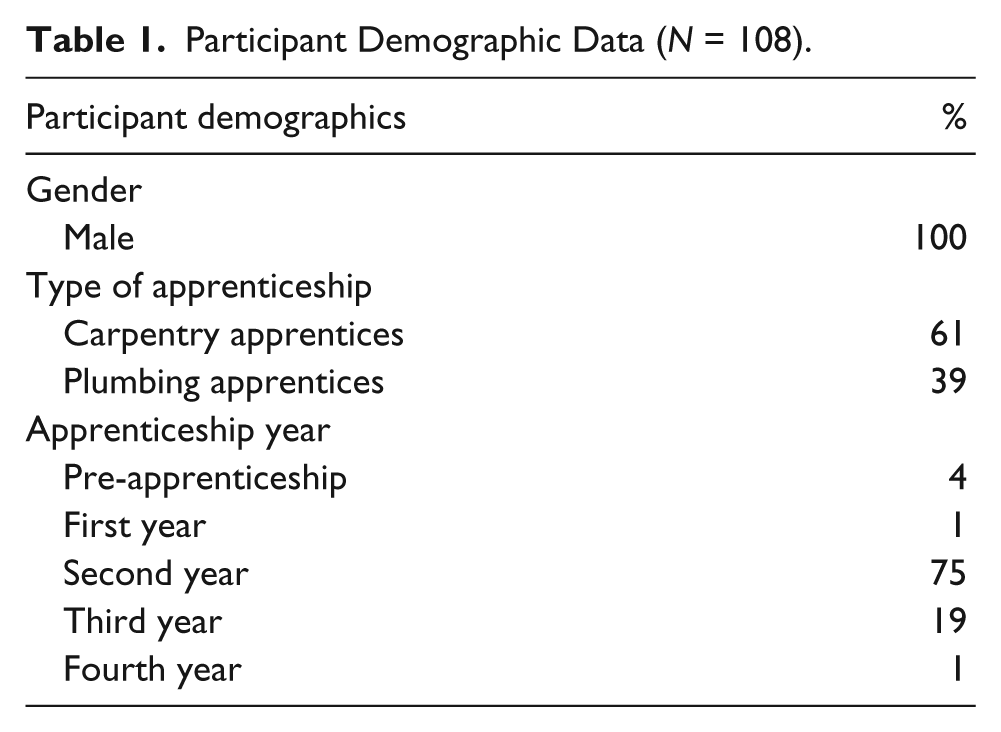
The research followed the organization’s ethical guidelines. All 108 apprentices who were approached completed the survey. Participation in the study was voluntary and anonymous, and consent to participate was implied by return of the completed survey. A small percentage (<1%) of construction apprentices were female, all attending apprentices were male, and as such the findings of the project are limited to male apprentices. Participants’ educational status prior to beginning their apprenticeship was not known. The majority (75%) of participating apprentices were in the second year of their apprenticeships (for more details, see Table 1). The questionnaire included the 10-item Alcohol Use Disorders Identification Test (AUDIT; Saunders, Aasland, Babor, De La Fuente, & Grant, 1993). The AUDIT was developed by the World Health Organization to assess alcohol consumption, drinking behavior, adverse reactions, and alcohol-related problems; total scores can range from 0 to 40, with scores of 8 or more indicative of hazardous or harmful alcohol use (Saunders et al., 1993). The survey asked apprentices a set of questions about whether they had experienced any of the 21 listed alcohol-related harms (Rickwood, George, Parker, & Mikhailovich, 2011) in the last year (to which they could answer “Yes” or “No”). Specifically, apprentices were asked if, as a result of drinking alcohol, they had “verbally abused someone,” “directed racial harassment toward someone,” “threatened someone with harm,” or “caused harm to someone else.” These behaviors are typified as violence or precursors to violence (Spaulding, 2005). Data were analyzed using SYSTAT 12 to examine descriptive statistics as well as correlations between variables of interest.
Participant Demographic Data (N = 108).
Results
The 108 surveys gathered included responses from carpentry and plumbing apprentices (see Table 1). The average age of participating apprentices was 21 years (SD = 4.9), with a range of 17 to 46 years.
The mean presentation of 108 apprentices’ AUDIT Scores was 9.6 (SD = 5.7), with seven participants having a score of 0 and one participant having a score of 26. When looking at their overall AUDIT score, almost two thirds of apprentices (65.7%) had harmful or hazardous drinking practices (defined as an AUDIT score of 8 or more). Specifically, items from the AUDIT scale indicate that 39% of the 108 apprentices report drinking alcohol two to three times per week, with another 31% drinking two to four times per month. Almost a third of apprentices surveyed (36%) indicated that they drink 10 or more drinks on any one occasion, whereas 22% drink 7 to 9 drinks in any one occasion. However, 34% of apprentices did not drink at harmful levels, which include 10% of apprentices who never drank alcohol at all.
As a result of drinking alcohol, 29% of apprentices self-report verbally abusing someone, 14% directed racial harassment toward someone, 17% threatened someone with harm, and 17% caused harm to someone else. The study identified that there were positive Spearman correlations between apprentices’ AUDIT scores and alcohol-related violence/precursors of violence: verbal abuse and AUDIT score: rs = .35 (p < .001); directed racial harassment toward someone and AUDIT score: rs = .25 (p < .05); threatened someone with harm and AUDIT score: rs = .28 (p < .01); caused harm to someone else and AUDIT score: rs = .40 (p < .001).
Discussion
Harm relates to adverse health outcomes, which in the context of this study includes “diseases and/or injury resulting from consumption of alcohol” (National Health and Medical Research Council, 2009, p. 11). Epidemiological research indicates that interventions to prevent harm from alcohol are not only more cost-effective than treating alcohol-related diseases and injuries but that prevention is also less likely to lead to alcohol-related diseases or injuries (Cobiac, Vos, Doran, & Wallace, 2009). In general, heavy episodic drinking has been associated with violence, particularly in individuals who suppress their feelings of anger (Norstrom & Pape, 2010). However, to date there has been a paucity of research on prevalence rates of alcohol-related violence among young working men, such as apprentices. A previous study conducted with Australian construction industry apprentices in South Australia indicated that 45% had AUDIT scores indicative of harmful drinking (Pidd, Boeckmann, et al., 2006); however, this study did not explore the link to violence. Findings from the current study indicate that 66% of apprentices consume alcohol at harmful levels and that their alcohol consumption was positively correlated with violent behavior (i.e., verbally abusing someone, directing racial harassment at someone, threatening someone with harm, and causing harm to someone else). The focus of these behaviors was not specified, and as such, it is not clear whether these actions were directed at particular people (e.g., intimate partner violence; Cunradi, Ames, & Moore, 2008). Apprentices were also not asked whether they took any precautions to moderate alcohol-related harms. Future research could examine these issues further, as it has clear implications for contextualizing interventions.
It is not clear why the current study identified a much higher proportion of construction industry apprentices who were consuming alcohol at harmful levels than a previous study conducted with construction industry apprentices in South Australia (Pidd, Boeckmann, et al., 2006). Temporal and/or geographic differences might play a role (e.g., South Australia vs. Victoria); however, to be certain future comparative research could explore these varying findings.
One of the limitations of the study was that the data were gathered through self-report from apprentices. Thus, the data were not verified through observation or compared with supply data. Previous research indicates that estimates from Australian population surveys (e.g., the National Drug Strategy Household Survey) only account for 50% to 75% of the consumption estimated by sales data (Stockwell et al., 2004). These dissimilar findings might be indicative of underreporting by participants as a result of response bias or poor memory recall (Livingston, 2008).
There is a lack of published intervention programs that focus on both alcohol abuse and alcohol-related violence (McMurran, 2012). Drawing clear associations between harmful levels of drinking and the increased risk for alcohol-related violence is potentially an important preventative tool. Although some individual-level interventions have proved successful for people with alcohol-related violence (e.g., incarcerated individuals; McMurran, 2012), the preventative role of education in training colleges and workplaces, particularly in a group that is often difficult to access through other means, is yet to be fully explored. In line with other researchers who highlight the importance of workplace culture in employees’ alcohol consumption patterns (Pidd, Berry, et al., 2006), the current study would advocate for implementation of workplace-based preventative education, which can effect subjective norms (Haug, Ulbricht, Hanke, Meyer, & John, 2011), and which might be particularly effective if delivered in a male-dominated context where various masculine identities in relation to alcohol consumption and violence could be explored (Smith, 2007). This is particularly relevant to young male construction workers who are working in an industry where there is a potential for harmful alcohol use (in comparison to other industries; Pidd, Berry, et al., 2006), and who are also at a phase in their lives where their occupational transition into the workforce coincides with initiation of alcohol (and other drug) use (Pidd, Boeckmann, et al., 2006). The findings of the current study are limited to male construction apprentices, and due to the low numbers of women present in the industry, it is unclear whether their experiences are similar to or different from the experiences of their male counterparts. Given the low numbers of women in the industry, this might be best explored through qualitative or case study research.
This study indicates that young male construction apprentices are drinking at harmful levels, which, coupled with their experience of alcohol-related violence, highlight the need for targeted preventative work. The workplace or training college setting provides an ideal venue for accessing these young men, particularly in a preventative sense where they are becoming ready to be fully-fledged tradespeople. Future research could explore whether a preventative education focus on alcohol-related violence has an effect on attitudinal and behavioral outcomes of new entrants (such as construction industry apprentices), whether these results can be sustained over time, and whether it has an effect on construction industry workplace mores.
Footnotes
Declaration of Conflicting Interests
The author(s) declared no potential conflicts of interest with respect to the research, authorship, and/or publication of this article.
Funding
The author(s) received no financial support for the research, authorship, and/or publication of this article.