



Abstract
This study assesses the determinants of family planning methods use by Turkish married men in South East Anatolia. A descriptive and cross-sectional survey research design was used among 1,352 men aged 20 to 52 years who lived in South East Turkey. A pilot-tested questionnaire was used to collect data. Descriptive statistics, chi-square, and multivariate regression analysis were used. The rate of nonusage of contraceptive methods among the participants was 60.4%. Within the nonusers, 34.9% reported a religious prohibition and 9.4% had misconceptions about family planning. Chi-square analysis determined four factors that were significantly related to the men’s usage of contraception. These factors are the following: the men’s age, educational level, number of existing children, and their perception of their household income level. These four factors were also subjected to multivariate regression analysis, the results of which were used to compute odds ratios for each value of each factor indicating the likelihood for using contraception by men within each group. Male-specific family planning programs can make an important contribution to the overall efforts to improve the usage of contraceptives by men. It is important to note that family planning services and education programs related to family planning should be appropriate for men.
Introduction
According to the United Nations (UN) Department of Economic and Social Affairs Population, the world population, which was 6.8 billion in 2009, is likely to reach 9 billion in 2050, and the biggest increases will occur in the developing countries (UN, 2009). Turkey is one of the developing countries with the second highest population in Europe after Germany and also the most populous country in the Middle East after Iran. The population of Turkey is around 74.5 million (Turkish Statistical Institute [TSI], 2010). According to the predictions of the TSI, the population of Turkey is expected to reach 84 million in 2025. Turkey’s annual population growth rate was 15.88% in 2010 (TSI, 2011), which is well above that of the European Union countries. Although the current fertility level (2.16) has almost dropped to replacement level (Turkey Demographic and Health Survey [TDHS], 2008), the population momentum of previous high fertility periods ensures population growth for some decades to come.
About 210 million pregnancies occur each year throughout the world, 182 million of which occur in developing countries. About 46 million pregnancies (20%) each year end in abortion, 36 million of these abortions occur in developing countries and 10 million in developed countries (Ahman & Shah, 2010; Finer & Zolna, 2011; WHO, Division of Reproductive Health, 1998). In Turkey, approximately 2 million pregnancies occur each year (TDHS, 2008), of which the unwanted pregnancy rate is between 25% and 33% (Erol, Durusoy, Ergin, Döner, & Ciçeklioğlu, 2010), and abortion due to unwanted pregnancy rate varies between 10% and 30.6% (Ak, Turna, & Canbal, 2010; Kitapçıoğlu & Yanıkkerem, 2008).
Men have an important responsibility in reducing unintended pregnancies. However, especially in developing countries, such as in Turkey, men’s participation in family planning is too low (Balaiah et al., 1999; de Irala, Osorio, Carlos, & Lopez-del Burgo, 2011; Ijadunola et al., 2010; Tuloro, Deressa, Ali, & Davey, 2006). The method they ŭse most is the withdrawal method (26.4%), with use of condoms coming in the second place (10.8%). Vasectomy in Turkey is almost never used (0.1%; TDHS, 2008). Studies reporting the low male participation in family planning indicated the reasons for men not wishing to make more use of contraception. These reasons are associated with numerous complex factors such as the desire to have more children, so as to carry on the family name, and be supported by them in their old age (Kolawole, Ishola, & Feyısetan, 2002; Odu, Jadunola, & Parakoyi, 2005; Tuloro et al., 2006). The men’s notion of their ideal family size, gender preferences, ideal birth intervals, the usage of family planning methods, and the social and cultural environment where they live affect their reproductive behavior. In developing countries, having children—especially boys—is one of the criteria that determine the reputation of men, women, and the strength of the family (Ökten, 2006; Tuloro et al., 2006).
Despite the large economy of Turkey, the social and economic developments are not equal in all the regions of the country. Because of the Western style of living, people in big cities have fewer children compared with people in the eastern part. According to the TDHS, there are significant regional differences in fertility rates. The fertility rate is higher in rural areas (2.68 children per woman) than in urban areas (2.00 children per woman); the eastern region has the highest level (3.7 children per woman) compared with the western region (1.9 children per woman; TDHS, 2008).
During the last 20 years, despite effective campaigning related to family planning in Turkey, success was limited in the East and South East of Turkey. The prevalence of contraception in Turkey increased substantially, reaching 71% in 2003 (TDHS, 2003, 2008) and 73% in 2008 (TDHS, 2008). However, the use of modern contraceptive methods is around 46%, and the use of traditional methods is around 27%. The use of modern contraceptive methods in South East Turkey is lower than the national average (37.9% vs. 46% of currently married women). The proportions of men using contraceptives are also lower in this part of the country. Thus, this study aimed at determining the factors influencing the use of contraception by married men living in Gaziantep, which is the most populous city in South East Turkey. Gaziantep is an industrial center and represents South East Turkey due to migration from the surrounding provinces.
Materials and Method
A descriptive and cross-sectional survey research design was used to examine the use of contraception (contraception use is defined as either the man [condom, vasectomy, withdrawal method] or his partner using a contraceptive method) and influencing factors among Turkish married men. Male methods use describes the behavior specific to use with their spouse. Because of cultural reasons and difficulty of talking about men’s out of marriage sexual life, men’s method use behavior with other sex partners was not explored.
A convenience sample of 1,352 men aged 20 to 52 years, who lived in South East Turkey was recruited from the gynecology clinic of the women’s hospital in Gaziantep, Turkey. This hospital is the region’s largest women’s hospital with 188 beds that delivers a full range of secondary care services (inpatient and outpatient services) and most of the hospital’s services focused on the women’s and infants’ services. The outpatient gynecology clinic of the hospital accepts 45 to 50 women per day. The inclusion criteria for the study were the following: men who were literate, whose wives were fertile or not menopausal, who had volunteered to participate, and who had at least one child. Men whose wives were infertile or menopausal were not included in this study. A total of 1,352 men aged 20 to 52 years, who lived in South East Turkey, were included in the study. The study was conducted between October 1, 2010, and September 10, 2011, on random samplings of the weekdays. During the research period, all the men who were literate, had volunteered, and were eligible for the study were included in the study, which, consequently, led to a response rate of 93.2%. Ninety-eight men refused to participate in the study, and 48 men interviewed were excluded from the study because of missing data related to family planning.
The data were collected by using the questionnaire, which had been prepared in line with the information collected from the literature (Kolawole et al., 2002; Nagase, Kunii, Wakai, & Khaleel, 2003; Odu et al., 2005; TDHS, 2008; Tuloro et al., 2006; Utomo, 2005; Varma & Rohini, 2008). The questionnaire consisted of 31 questions related to socioeconomic and demographic information (age, educational level, marital status, employment status, longest place of residence, income status, etc.), fertility information (number of living children, couple’s age at the time of marriage, marriage duration, number of children, children’s status, and status of female children), and family planning by the couple (practice of family planning methods, reasons for not using male methods, information about contraceptive methods, source of information, method used, satisfaction with the method used, and whose decision it was to use the method in question). The developed questionnaire was reviewed for content validity by 3 nursing faculty members. Subsequent adjustments of the questionnaire were made accordingly and then approved by the faculty members. Then, the final questionnaire was pilot tested by 30 men who were not included in the main study. Based on the results, the questionnaire was modified in terms of comprehensibility and usability by the researchers. Those who met the criteria and agreed to participate in the study were requested to sign a written informed consent. They were interviewed for 10 to 15 minutes by the researchers in the gynecology outpatient clinic waiting room of the sampled hospital. Prior to beginning the research, institutional review board approval was obtained from the hospital, and the provincial health authority approved the study before the data were gathered. Before conducting the research, the researchers explained the purpose of the study and their rights to the subjects. To protect the confidentiality of the subjects during the study, the men were asked if they would be part of the study, and they were told that they had rights to terminate and withdraw from the study at any time. The verbal and written consent was obtained from all the participants. Participation was completely voluntary and anonymous.
Statistical Analysis
Statistical analysis was performed using the Statistical Package for Social Sciences (SPSS) 17.0 software. Descriptive statistics (mean, standard deviation, 95% probability estimate of population mean, percentage), chi-square, and multivariate regression analysis were used to investigate determinants of using contraceptive methods. The chi-square analysis revealed four significant factors—age, educational level, perception of income level, and number of existing children—on the use of contraception by men. A multivariate regression analysis, on the other hand, exhibited the joint predictive value of these four factors, out of which odds ratios for each category of each factor were computed, indicating the net effect of each factor, setting the other variables fixed. Statistical tests with p values <.05 were considered to be statistically significant.
Results
The mean age of the participating men was 33.71 ± 8.34 (min = 20, max = 52). A total of 29.6% were between 25 and 29 years of age, 62.7% were junior secondary school graduates, and 49.9% perceived their level of income as medium. The participants’ average age at marriage was 23.68 ± 3.10 (min = 15, max = 37). The average duration of marriage was 9.94 ± 8.32 years (min = 1, max = 37), and 51.3% of them had either one or two children. The rate of the nonusage of contraceptive methods among men was determined as 60.4%. Out of the nonusers, about 34.9% reported religious prohibitions, 32.8% had infrequent sexual intercourse, 22.9% had the desire to have more children, and 9.4% had misconceptions about family planning. Among the men using any family planning method, 44.5% preferred using the withdrawal method, 18.1% stated that they are using condom, 21.7% stated that their wives are using hormonal contraceptive methods, and the remaining husbands stated their wives are using intrauterine contraceptive devices (15.7%). None of the participants stated using vasectomy.
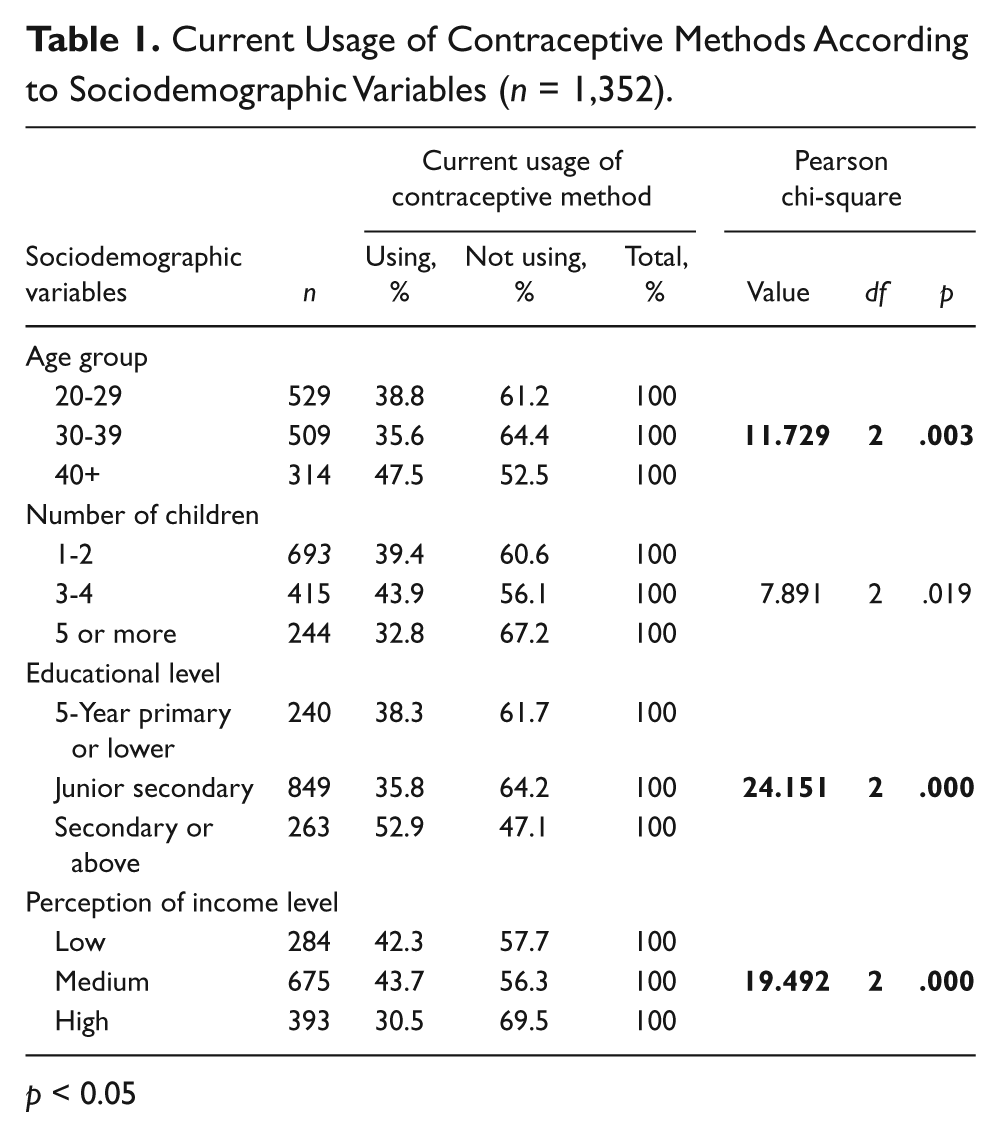
Chi-square test was used to examine the associations between the main dependent variable—namely, the usage of a (any) family planning method—and each of the independent variables. Out of all examined factor variables, four exhibited significant differences with respect to usage of any family planning method. The results of only those four variables are given in Table 1.
Current Usage of Contraceptive Methods According to Sociodemographic Variables (n = 1,352).
p < 0.05
The results indicate that men, who were 40 years of age and older, used family planning methods more (47.5%) than men who were in the 20 to 29 years age group (38.8%), and the difference was found to be statistically significant between the groups (p < .01). It was found that the family planning methods used by the men with 3 to 4 children (43.9%) were more frequent than by the men who had 5 and more children (32.8%). When the effect of the educational status on the status of using family planning methods was examined, the rate of the usage of contraceptives was found to be high among men with secondary school or degree and higher levels (52.9%) compared with men with junior secondary school levels of education (35.8%). Statistically significant differences were determined between the groups (p < .01). The effect of the number of living children on the usage of any family planning method was also found to be statistically significant, but at a lesser significance level (p > .05). To summarize the results in this study, it was determined that the prevalence of the use of contraception was found to be high among men who stated that they had a medium income level (43.7%) compared with men with a high income level (30.5%), and statistically significant differences between the groups were determined (p < .01; see Table 1).
When the couple’s choice of method of contraception was examined according to their sociodemographic characteristics, 24.8% of the men over 40 years stated that their wives use hormonal contraceptive methods and 28.9% stated that they use condoms, which was higher than the men in the 20 to 29 years age group, who stated that their wives are using hormonal contraceptive methods (18.5%) while 10.2% declared that they use condoms. The difference was found to be statistically significant (p < .01). When the couple’s use of family planning methods was examined according to the duration of marriage, the married couples who had been married for 16 years and longer were found to use hormonal contraceptive methods (31.3%) more than the couples who had been married for the duration of 1 to 5 years (16.1%). Statistically significant differences between the groups were determined (p < .01; see Table 2).
Used Method of Family Planning According to the Sociodemographic Characteristics of the Respondents (n = 1,352).

Note. IUD = intrauterine contraceptive device.
When the men’s reasons for not using family planning methods were examined according to their sociodemographic characteristics, it was determined that 38.6% of men in the 20 to 29 years age group declared that family planning was considered a sin although this percentage was determined as low as 19.4% among the men in the 40+ years age group. It was found that there is a statistically significant difference between the groups (p < .01). When the men’s reasons for not using family planning methods were examined according to their duration of marriage, the percentage of nonusers was determined to be high among men who had been married for 16 years and more (15.6%) compared with men who had been married for 1 to 5 years (9.3%). Statistically significant differences between the groups were determined (p < .01). When the men’s reasons for not using any family planning method were analyzed according to the number of their living children, it was determined that 42.9% of men with 3 to 4 children stated that using contraception as family planning is a sin, compared with the men (20.1%) with 5 and more children. Statistically significant differences between the groups were determined (p < .01; see Table 3).
Reasons for Not Using Family Planning Methods According to the Sociodemographic Characteristics of the Respondents (n = 1,352).
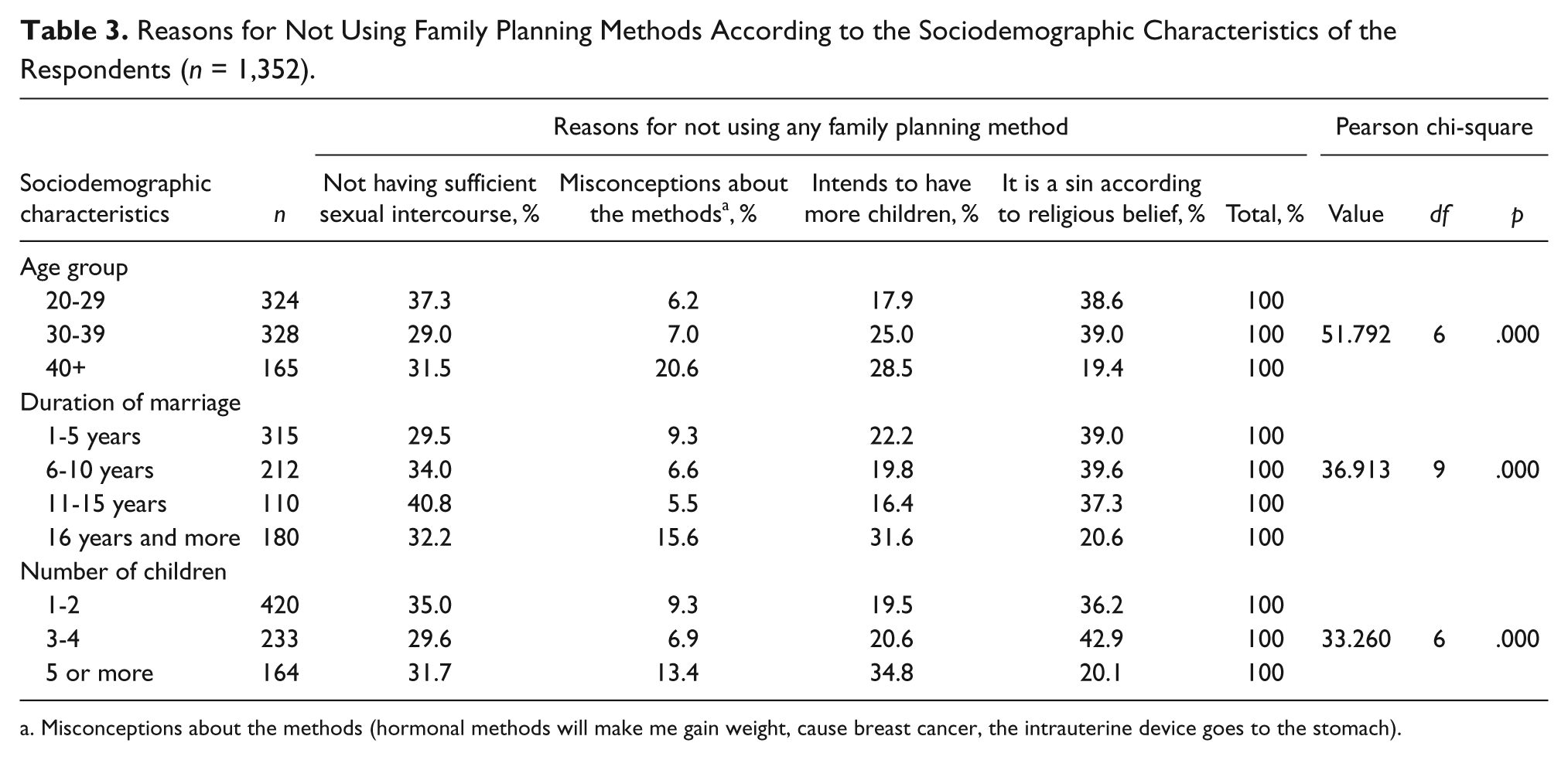
Misconceptions about the methods (hormonal methods will make me gain weight, cause breast cancer, the intrauterine device goes to the stomach).
When the propositions related to the men’s views on the social factors that affect the usage of contraception were examined, 86.2% of the participants agreed with “Bearing male children increases the value of women in society,” more than half of the participant men (62.4%) agreed with “Men have male children,” 60.1% agreed with the proposition “Spouses should both make the decision to have children,” and 55.9% stated that “Using family planning is a sin.” When variation of men’s views on the propositions related to contraception were examined according to the age groups, it was found that 69.2% of the participating men in the 20 to 29 years age group were inclined to agree that “Spouses should both make the decision to have children,” whereas in the age group of 40+ years, only 45.2% of men agreed to the same proposition. A statistically significant difference was determined between the percentages in each age group (p < .01; see Table 4).
The Opinions of the Respondents to Each Proposition According to the Age Group (n = 1,352).

The four variables indicated in Table 1 were also subjected to a multivariate regression analysis, out of which relative risk ratios (odds ratios [ORs]) indicating the risk of the usage of any contraceptive method were computed. These four factors are the following: age, educational level, the number of existing children, and the perception of the household income level. The dependent variable is the current usage of any contraceptive method applied by the husband or the wife.
Odds ratio is the change of the odds of using contraceptive method in relation to the reference category, which is the last category of each factor. OR values have been estimated according to the results of the multivariate regression analysis. All the indicated four factors have significant effects on the usage of contraception as indicated by the p values of the corresponding Wald-test figures (<.01). The OR values for each factor indicate the relative risk of contraceptive usage within each category having all other variables (the other three factors) fixed.
When the OR for using a contraceptive method of the reference age group of 40+ years is set to 1, then the OR at the 20 to 29 years age group is 0.45, while it is 0.39 at the age group 30 to 39 years. In other words, if all other variable are equal, a person of age 40 years or older has the largest relative probability of using a contraceptive method, whereas at age group 30 to 39 years this probability is observed as lowest compared with the reference category of age group 40+. To put it differently, men who are between 30 and 39 years of age and 20 and 29 years of age are less likely to use contraception, compared with those who were 40 years and older.
Exposure to education is also an important determinant in explaining the use of contraception by men. Relative to the secondary or higher education (1), the likelihood of using contraception is lower among men with junior secondary (0.47) and 5 year primary or lower educational level (0.51). The men’s perception of their income level is also associated with the usage of family planning by men. In relation to men with a high level of perceived income (1), men with a medium (1.82) or low level of income (1.82) are more likely to use contraception. Finally, the number of existing children is also affecting the likelihood of contraception usage. If all other variables are equal, men having 1 to 2 or 3 to 4 children are more likely to use contraceptives (respective ORs as 2.29 and 2.28) as compared with the reference category of men with 5 or more children (see Table 5).
Multinomial Regression Analyses of the Sociodemographic Variables With the Use of Contraception as a Dependent Variable.

Discussion
This study aims to explore the determinants of the usage of contraception by married men who live in South East Turkey. Although there is a considerable amount of literature on the use of family planning in Turkey, studies have focused mostly on married women. This study contributed toward the literature by determining the factors associated with the usage of contraception among married men in South East Turkey, where the fertility rate is high compared with that of the other parts of the country. The results in this study revealed that, as in most developing countries (Balaiah et al., 1999; de Irala et al., 2011; Ijadunola et al., 2010; Mosiur, Rafiqul, & Matin, 2008; Tuloro et al., 2006), the ratio of the usage of contraception is relatively low among Turkish married men. More than half of the participants had not used a family planning method and nearly half of the men using a family planning method preferred to use the withdrawal method, which is not a modern method. This agrees with previous studies conducted in Turkey. According to the TDHS (2008), the current use of any family planning method is the lowest (58%) in South East Anatolia; this rate is around 73% in Turkey. One in every four women stated that they used the withdrawal method in Turkey (TDHS, 2008). A study by Mıstık, Nacar, Mazicioglu, and Cetinkaya (2003) reported that 54.4% of the participating men were using some contraceptive methods. Another study indicated that 54% of the participating women used contraceptive methods and nearly half of the men using a family planning method preferred to use the withdrawal method (Ak et al., 2010). Family planning consultation services are provided by female nurses and midwives in almost every health institution working under the Ministry of Health in Turkey. Receiving a consultation by a female nurse may impede the access of men to family planning services in South East Anatolia. Men, who do not want to receive counseling from a female nurse, prefer to use the withdrawal method, which does not require consultation. Therefore, an immediate investigation of the sociocultural reasons to use the withdrawal method among men in this region of the country is needed to develop policies and strategies accordingly.
In this study, it was found that the major reasons for not using contraceptive methods among men are the desire for more children, religious prohibitions, infrequent sexual intercourse, and misconceptions about contraceptive methods. The rate of men who agreed that the use of family planning methods was a sin was high among the younger group, and the rate of men not using family planning because of misinformation was high among the men at an advanced age. As the number of children increases, the proportion of men who agree that the use of family planning is a sin decreases. In the literature, the reasons reported for being opposed to the use of contraception by men were on religious grounds (Mıstık et al., 2003; Mosiur et al., 2008; Onwuhafua, Kantiok, Olafimihan, & Shittu, 2005; Orji, Ojofeitimi, & Olanrewaju, 2007; Srikanthan & Reid, 2008) or the fear of harmful side effects caused by the contraceptives (Mosiur et al., 2008; Onwuhafua et al., 2005) and the desire to have more children (Kolawole et al., 2002; Mosiur et al., 2008; Odu et al., 2005; Tuloro et al., 2006). Similar findings have been found in a number of developing countries. There are also some studies indicating that there is no statistical association between the practice of family planning and religious beliefs (Abraham, Adamu, & Deresse, 2010; Nanda, Kumar, & Bharati, 2011).
The major factor influencing the use of contraception by men is the age factor. Among the older age group (40+), the usage of contraceptive methods has a higher prevalence. In contrast to our study, Kolawole et al. (2002) stated that men who were aged 18 to 29 years were about twice more likely to have used a method than those who were aged 45 years and older (Kolawole et al., 2002). Another study revealed that the prevalence rates of the use of contraception by men aged 20 to 29 years was at 69% compared with 11% for men aged 50 to 65 years (Akafuah & Sossou, 2011). The status of men living in the region of South East Anatolia increases with the number of children. For this reason, they reach the ideal number of children they want during the first years of marriage. It is thought that the usage of contraceptive methods is increasing with age for men, who try to reach the ideal number of children—especially boys—in their early ages.
In this study, the educational level was positively linked with the usage of contraceptives. It is well established in the literature that the use of contraception has increased with education (Anderson et al., 2010; Bagheri & Nikbakhesh, 2010; Dahal, Padmadas, & Andrew-Hinde, 2008; Dynes, Stephenson, Rubardt, & Bartel, 2012; Tayyaba & Khairka, 2011; Tuloro et al., 2006; Varma & Rohini, 2008) and being exposed to education and counseling has had a significant effect on the knowledge and behavior of the individual (Bagheri & Nikbakhesh 2010). Studies reported that men with a higher level of education were more likely to participate in family planning (Akın, Özaydın & Aslan, 2006; Dahal et al., 2008; Tuloro et.al., 2006), by showing greater prevalence of vasectomy (Wambui, Ek, & Alehagen, 2009) and using condoms (Filmer, Friedman, & Schady, 2009) than those who were less educated. A study from Bangladesh reported that respondents with a lower level of education were found to use less contraception; the percentage was higher if the respondents received secondary or higher education (Mosiur et al., 2008).
Although men with more children have previously tended to use contraceptives (Anderson et al., 2010; Bagheri & Nikbakhesh, 2010; Dahal et al., 2008; Dynes et al., 2012; Tuloro et al., 2006), in the present study rather the opposite is true. It may be the case that men with higher levels of education also have lower figures or ideal number of children. Men who do not want to have any more children are likely to choose permanent methods only after they have two living sons (Tayyaba & Khairka, 2011).
Studies abroad also report that the level of family income is one of the influencing factors on the use of contraception. They reported an increase in the rate of the use of contraception as the income increases (Dahal et al., 2008; Dynes et al., 2012). In this study, it was found that income was a factor affecting the use of contraceptive methods, with the rate of the use of contraception among men decreasing as the level of income increases. The region of South East Anatolia has the patriarchal family structure. One of the most important reasons for the higher fertility rate is the desire to have male children in this kind of families. In addition, the mothers’ low level of education and strong religious beliefs are also important. There is a belief that every child is born with a provision in Islam. Therefore, if the family wants more children, regardless of the level of income, they decide to have them.
Studies have found that sociocultural factors are associated with the health beliefs regarding the use of contraception (Anderson et al., 2010; Akın et al., 2006). The belief that the male child increases the value of women in society might possibly have an influence on the use of contraception (Filmer et al., 2009). In this study, approximately 9 out of 10 participating men (especially young men) agreed that “Bearing male children increases the value of women in society.” The low status of women and a strong preference for male children are two most patriarchal constraints in the use of contraception among Muslims in India (Tayyaba & Khairka, 2011). The son preference has implications on the decision to have another child (Dynes et al., 2012). Filmer et al. (2009) reported that the absence of sons increases the probability of an additional birth more than the absence of daughters (Filmer et al., 2009). According to the studies of men in developing countries mostly in sub-Saharan Africa, men generally desire male children for social reasons and for financial support in their old age, and they are proud of the number of their children particularly their sons (Balaiah et al., 1999; Bagheri & Nikbakhesh, 2010; Dynes et al., 2012). If a man does not have any male children, he will not use any family planning method and also he will not support his wife in this issue.
Joint decision making and shared negotiation strategies can improve health practices (Mullany, Hindin, & Becker, 2005; Oladeji, 2008). For example, a study from six countries of sub-Saharan Africa reported that women who have had frequent communication with their partner about contraception had greater chances of using a family planning method than those who reported that they never discussed the topic (Stephenson, Baschieri, Clements, Hennink, & Madise, 2007). In this study, more than half of the participating men believed that “Spouses should both make the decision to have children.” Our results are also consistent with the literature. A study from India indicated that 74% of the subjects felt that the decision regarding the practice of family planning methods and the number of children had to be made by the couple (Rajesh Reddy, Premarajan, Narayan, & Mishra, 2003). A Nigerian study also indicated that most men believed in a decision about family planning being made jointly by the spouses (Orji et al., 2007). Yue, O’Donnell, and Sparks (2010) reported that a greater majority of contraceptive users (94%) have discussed family planning with their spouses than nonusers (55.9%) have (Yue et al., 2010). Furthermore, a study from Turkey reported that 66.7% of the Turkish people think that the decision about family planning should be made by both spouses (Mıstık et al., 2003). In this study, it was also found that the younger generations were more inclined to agree on a joint decision on the subject of having a child. Our results are also consistent with the literature (Mahat, Pacheun, & Taechaboonsermsak, 2010; Orji et al., 2007; Tuloro et al., 2006). de Irala et al. (2011) indicated that choosing of a contraceptive method with the partner was associated with a young age. Involving husbands and encouraging couples’ joint decision making in reproductive and family health may provide an important strategy in achieving both women’s empowerment and women’s health goals (Mullany et al., 2005).
Limitations
There are several limitations to this study. First, this study was a cross-sectional study with a nonrandom convenience sample. Therefore, it includes all the limitations of a cross-sectional study. However, when we think about the difficulty of finding men to talk about his reproductive history, this study adds valuable information with its large sample size. Although some findings are consistent with previous studies, the study sample has some cultural uniqueness, and is primarily general to men living in South East Turkey. Second, this study is not free from recall biases. The men’s answers such as whether they had ever used contraceptive methods or responses by men about the contraceptive practice of their wives were based on their retrospective recall. Responses to questions related to the practice of family planning methods in the past were also subject to recall bias.
Conclusion
In traditional societies such as Turkey, women are accepted with their fertility. Women who do not have any children or have not had any male children have a lower status within society. Thus, the decision about family planning is given to the men in Turkish society. Men as the decision makers in most marital and family matters may consider using family planning after they have already achieved their ideal number of male children. In this kind of society, for women attending family planning clinics, consultations should be made with their partners. Despite many contraceptive options, the withdrawal method is the number one choice of Turkish married men in South East Turkey. The ratio of the usage of the condom is increasing. It is one of the modern methods among men and is currently attracting attention as it helps deal with a very important problem, namely, combating sexually transmitted diseases. Future interventions from family planning could contribute toward improving the reproductive health by increasing the awareness of the contraception options such as the condom and access to a variety of contraceptive methods, thereby helping men to communicate with their partners and make contraceptive choices together. It is recommendable to increase the promotion of family planning methods aiming at men and to design male-specific educational programs at an advanced age in order to eliminate misinformation and false beliefs about family planning methods. In addition, it is very important to receive support from the opinions of the religious leaders in the region for men who think family planning is a sin.
Footnotes
Declaration of Conflicting Interests
The author(s) declared no potential conflicts of interest with respect to the research, authorship, and/or publication of this article.
Funding
The author(s) received no financial support for the research, authorship, and/or publication of this article.