




Abstract
The current study investigated a subgroup of 112 men who have sex with men who use the Internet in search of partners for sex venue encounters to understand what types of venues they frequent and whether their behaviors are associated with an increased risk of HIV/STI transmission. An initial cluster analysis revealed two patterns of Internet use—low and high frequency—among these men. Although frequency of Internet use to find partners for venue encounters did not cluster with venue attendance, there was a trend among high-frequency Internet users to attend gyms, public bathrooms, and sex clubs more than low-frequency users. Furthermore, high-frequency users attended more venues, preferred venues where multiple partners can be found, and were marginally more likely to engage in unprotected anal sex across venues compared with low-frequency users. Knowing that some venue users initiate venue encounters on the Internet may be useful in targeting appropriate HIV/STI interventions.
Keywords
The Internet has become a valuable source through which to gain information across the globe, and it also serves an integral communicative and networking function (Castells, 1996; Kraut et al., 2002). Online services such as e-mail, instant messaging, message boards (i.e., Craigslist), and programs that afford direct voice and video contact help open and maintain lines of communication between friends, relatives, and even people who have never met (Stevens & Morris, 2007). The Internet has become a means for people to meet romantic or sexual partners (Cooper & Sportolari, 1997; Couch & Liamputtong, 2008), particularly among sexually marginalized groups (Hospers, Kok, Harterink, & de Zwart, 2005; McKirnan, Houston, & Tolou-Shams, 2007; Payne, 2007). Moreover, the Internet provides a venue for people to be selective—search for others with similar sexual interests, including public sex, barebacking, and various fetishes (Ashford, 2006; Carballo-Diéguez, Dowsett, et al., 2006; Chiasson et al., 2006; Downing, 2010a; Grov, DeBusk, et al., 2007). Indeed, the web offers a host of sites designed to attract potential users based on any number of these shared interests.
Sexual Risk and the Internet
Researchers have suggested that meeting sex partners online may be associated with risky sexual behavior among men who have sex with men (MSM). First, it has been noted that Internet sex seekers report greater numbers of partners when compared with those men who found partners offline (Benotsch, Kalichman, & Cage, 2002; Horvath, Bowen, & Williams, 2006; McFarlane, Bull, & Rietmeijer, 2000; McKirnan et al., 2007; Ogilvie et al., 2008). Additionally, several studies have reported that seeking sexual partners online was associated with inconsistent condom use and unprotected anal intercourse (UAI) among MSM in general (Benotsch et al., 2002; Bolding, Davis, Sherr, Hart, & Elford, 2004; Elford, Bolding, & Sherr, 2001; Garofalo, Herrick, Mustanski, & Donenberg, 2007; Grov, Parsons, & Bimbi, 2007; Horvath et al., 2006; Liau, Millett, & Marks, 2006; McKirnan et al., 2007). However, at least one study reported that online sex seekers were more likely to have used condoms during their most recent sexual encounter with an Internet partner compared with men who found male partners in other venues (McFarlane et al., 2000). Direct comparisons of sexual risk behaviors among MSM with partners met online versus behaviors with partners met in other venues have revealed somewhat contradictory findings. Some researchers have reported that meeting sex partners both online and offline (i.e., in other venues) predicted unprotected anal sex compared with men who exclusively met their partners online or offline (Hirshfield, Remien, Humberstone, Walavalkar, & Chiasson, 2004; Horvath, Rosser, & Remafedi, 2008; Zhang et al., 2007). However, two additional studies reported no differences in the rates of UAI that men reported with their Internet and non-Internet partners (Bolding, Davis, Hart, Sherr, & Elford, 2005; Chiasson et al., 2007).
In contrast to the aforementioned studies that examined whether use of the Internet—yes or no—was associated with sexual risk, other studies have examined the frequency that men use the Internet to seek out sexual partners relative to risk behaviors. At least two studies revealed that more time spent engaging in online sexual behavior was associated with risky sexual behavior among MSM (Bolding et al., 2004; Horvath et al., 2008). Additionally, men who identified as being barebackers (i.e., someone who engages in intentional unprotected anal sex) were more likely than nonbarebackers to spend more time on the Internet looking for sex and dates (Grov, DeBusk, et al., 2007). Other research, however, has reported no differences in the number of reported unprotected anal sex acts with male partners during the past year between frequent users of gay chat rooms and those who never or occasionally use them (Tikkanen & Ross, 2003).
Using the Internet to Pursue Public Sex
There is evidence to suggest that MSM who use the Internet in pursuit of sexual partners are also frequenting commercial and public sex venues (e.g., bathhouses, sex clubs, bathrooms, parks; Bolding et al., 2005; Elford, 2006; Garofalo et al., 2007; McKirnan et al., 2007; Ogilvie et al., 2008; Ross, Tikkanen, & Mansson, 2000). Moreover, the Internet not only serves as a venue for locating potential sex partners, but it also offers opportunities for men to coordinate physical encounters at commercial or public sex venues (Ashford, 2006). Almost no research has examined this phenomenon; however, one study reported that 86% of men engaged in sexual encounters at a public bathroom with other men after initially meeting these partners on the Internet (Bull, McFarlane, Lloyd, & Rietmeijer, 2004). Additional work has demonstrated that some MSM use the Internet to advertise specifically for partners who are willing to meet and engage in sexual encounters in several types of venues, including video booths, gyms, parks, and sex clubs (Downing, 2010a).
Given the persistence of high-risk behaviors among MSM who frequent sex venues (Binson et al., 2001; Frankis & Flowers, 2005; Parsons & Halkitis, 2002; Reidy et al., 2009) as well as the Internet to meet sex partners (Horvath et al., 2006; Liau et al., 2006; McKirnan et al., 2007; Schrimshaw, Siegel, & Downing, 2010), there are pressing reasons to study the potential risks associated with using the Internet to coordinate venue sexual encounters. Some key questions include the following: are men who use the Internet more often to search for public sexual encounters more likely to attend certain types of sex venues compared with those who use the Internet less often to find partners for public sex, what sexual behaviors does this subgroup of men engage in during their venue visit(s), and do those men who use the Internet more often to find public sexual encounters engage in riskier venue behavior compared with those who use the Internet less often? The current study addresses these questions and expands our knowledge about MSM who use the Internet to find public sex partners.
Method
Participants
A total of 204 MSM completed an online survey about risk perceptions, sexual behaviors, and HIV prevention in commercial and public sex venues, wherein 139 (68%) indicated that they had attended at least one of seven sex venues (gym, public bathroom, bathhouse, sex club, bar backroom, public park, video booth) during the past month where they observed or engaged in sexual activity. To participate, men were required to be at least 18 years of age and to actively engage in sexual behavior with other men.
Procedure
Data collection took place from May to September of 2008. Strategic opportunistic sampling (Harding & Peel, 2007) was one method of Internet recruitment used for this study whereby an online solicitation containing the survey link was e-mailed directly to a listserv for LGBT researchers, who were not exclusive to New York City. Additionally, the author posted notices in various Craigslist categories (e.g., Men Seeking Men; Casual Encounters m4m; Volunteer) as well as in the Men seeking Men category for Backpage. Online notices were posted primarily in the New York City metropolitan area including New Jersey and Connecticut. Since participants from the LGBT listserv were not necessarily from New York City, several Craigslist research solicitations were also placed in other urban centers with high percentages of gay and bisexual men (e.g., Atlanta, Boston, Los Angeles, San Francisco). Venue-based, passive recruitment was also attempted whereby the author placed approximately 500 study invitation cards in and around the entrance areas of several gay establishments (bars, clubs, gyms, and the LGBT center in New York City) as well as the Ramble of Central Park, a prominent site for cruising and sexual activity among MSM in New York City. All recruitment notices indicated that this was an Internet survey for men at least 18 years of age who have sex with other men, that there was a chance to win a $50 prize, and instructed potential participants to contact an e-mail address for a link (URL) to the survey. A total of 226 individual requests for a survey link were made to the study e-mail account referencing a Craigslist or Backpage posting. Only two e-mail inquiries resulted from venue-based recruitment.
On accessing the link, participants were asked to read a consent page and acknowledge their agreement. This page informed participants that the survey would take approximately 20 minutes to complete and that they could refuse to answer any questions or quit taking the survey at any time. An IP address was collected for anyone clicking on the survey link as a mechanism to reduce the potential for multiple submissions by a single individual (Mustanski, 2001; Riggle, Rostosky, & Reedy, 2005). Duplicate and incomplete submissions were discarded. IP addresses were later stripped from the data set and deleted. Following the survey, individuals were given the option to provide an e-mail address that would be entered into a random drawing for one of two $50 e-gift certificates. This study was approved by the institutional review board affiliated with the author’s university.
Instrument
The effectiveness of using Internet surveys to assess sexual behavior among MSM populations has been previously demonstrated (Chiasson et al., 2005; Ross et al., 2000; Rosser et al., 2009). For this report, the survey included an item asking men to indicate how often in the past month (never, one or two times, once a week, two or three times a week, more than three times a week, or every day) they had used the Internet as a way of finding men to meet in a public place for sex. A frequency distribution revealed that the data obtained for this item were normally distributed. The survey also included items to assess how often men had attended any of seven sex venues (gym, public bathroom, bathhouse, sex club, bar backroom, public park, and video booth) during the past month where they observed or engaged in sexual activity. Responses to this item included the following: never, one or two times, once a week, two or three times a week, and more than three times a week. The data were positively skewed for each venue and therefore dichotomized (0 = no attendance; 1 = attended) for bivariate analyses.
Because the survey was designed to include skip patterns based on participant responses, men answered venue-specific questions for only those venues they attended during the previous month. Whenever attendance at a particular venue was indicated, participants were subsequently asked to report the number of times they engaged in specific behaviors at that venue (e.g., receptive oral sex with ejaculation in the mouth (ORE) and insertive/receptive anal sex with or without a condom) during the previous month. The number of times participants engaged in a particular behavior were totaled across venues for each participant. A frequency distribution revealed that these data were positively skewed, and were subsequently dichotomized for bivariate analysis. Insertive and receptive anal sex with a condom were combined and recoded as PAI to reflect occurrence of any protected anal intercourse. Insertive and receptive anal sex without a condom were also combined and recoded as UAI to reflect occurrence of any unprotected anal intercourse.
Additionally, men were asked to indicate how often (Never, Some of the time, Most of the time, or All of the time) they took condoms to a sex venue with the intent to use them for sexual activity. For the current report, any participant who indicated that he had taken condoms to at least one venue “Some of the time,” “Most of the time,” or “All of the time” was considered to have taken condoms at least some of the time. Therefore, to examine this item across venues, responses were dichotomized and recoded as follows: 0 = never and 1 = at least some of the time.
The last section of the survey asked participants to indicate (Strongly agree, Somewhat agree, Strongly disagree, and Somewhat disagree) their preferences for why they seek out public sex encounters. The statement read: “When I seek out men in a public place, I am looking for _____.” Preferences for this item included anonymous sex, sex with more than one partner, friendship, companionship, and love. Responses to these items were collapsed into two categories—agree and disagree—which were used in subsequent categorical analyses. Finally, age and HIV status were assessed in this last section. For age, men were asked to report their age based on the following categorization: 18 to 24, 25 to 29, 30 to 40, 41 to 60, or 60 and older. For HIV status, men were asked to report one of the following: HIV-positive, HIV-negative, tested in the past 3 or 6 months but did not get the results, or do not know. Men who indicated that they had been tested but did not get the results were collapsed with those men who reported that they did not know their status as well as with those who refused to answer for categorical analysis.
Data Analysis
A cluster analysis was conducted to identify subgroups of venue attendees with regard to how often they attended any of the venues and how often they used the Internet to find partners for public sexual encounters. This type of analysis is iterative and often performed in a two-step process to determine and validate if groups of cases exist among variables of interest (Henry, Tolan, & Gorman-Smith, 2005; Rapkin & Luke, 1993; Rosario, Schrimshaw, & Hunter, 2008). Although the data obtained for frequency of venue attendance were positively skewed, the distributions revealed a trend of three groupings (no attendance, attended one or two times, and all other higher levels of frequency). Therefore, these data were entered into the cluster analysis prior to dichotomization along with how often participants used the Internet to find partners for public sexual encounters, which was normally distributed.
The first step of the cluster analysis, hierarchical clustering using Ward’s method (Everitt, Landau, & Leese, 2001), was pursued to identify clusters based on several variables that were entered simultaneously: how often participants attended any of the seven sex venues as well as how often participants used the Internet to find a partner for a public sex encounter. Ward’s method is an appropriate procedure when ordinal data are analyzed as continuous that utilizes an agglomerative clustering algorithm to gather single observations together until all observations are included in one cluster. The raw data obtained for each of these variables were included. Three groups of cases were revealed in a dendogram, and no outliers were noted. Therefore, a second step of cluster analysis—the K-means procedure (nonhierarchical)—was used to validate and explain the three groups that were shown in the dendogram. With this type of analysis, the numbers of clusters are specified prior to analysis. Based on the initial findings using Ward’s method, three clusters were specified in SPSS and the iterative process assigned all the cases into one of these clusters based on their similarity among the variables of interest. Comparison of the dendogram and the K-means output were very similar, suggesting validity within these findings. On further observation, it was revealed that the cases within each of the clusters were defined only by how often participants used the Internet during the previous month to search for a partner for a public sex encounter rather than a pattern of Internet use and venue attendance.
Bivariate analyses (independent samples t-test for continuous variables, chi-square for categorical variables) were used to examine differences between the Internet frequency groups identified in the cluster analysis with regard to physical venue attendance, sexual behaviors across venues, and preferences for why men seek out public sexual encounters. Statistically significant associations for all analyses were defined as p < .05.
Results
Participants who indicated that they had attended a sex venue in the past month were asked how often in the previous month they used the Internet to find a partner for a public sexual encounter. A cluster analysis was initially performed to identify subgroups of sex venue attendees with respect to how often they attended any of the sex venues and how often they used the Internet to find partners for public sexual encounters. Though this process did not detect any patterns between these variables, it did reveal two groups of Internet frequency use. A low-frequency group (n = 54) was identified, which comprised those men who reported using the Internet once a week or less during the previous month to find a partner for a public sexual encounter (never, one or two times, once a week), whereas a high-frequency group (n = 58) comprised men who reported using the Internet at least two or three times a week (two or three times a week, more than three times a week, every day) for this reason. Finally, a third group was identified that consisted of men who declined to answer the item regarding their frequency of Internet usage to find partners for public sexual encounters (n = 27). Since no assumptions can be made about this group, these cases were removed from subsequent analyses.
Most participants across the two Internet frequency groups (N = 112) were between the ages of 30 and 60. Men reported their age as 18 to 24 (4%), 25 to 29 (6%), 30 to 40 (32%), 41 to 60 (53%), and 60 and older (5%). A chi-square test revealed no age differences between the two Internet groups (p > .05). Additionally, most of the men identified as being HIV-negative (82%), though a small percentage reported their status as HIV-positive (7%) or that they did not know their HIV status/refused to say (11%). A greater percentage of HIV-positive men reported high-frequency use of the Internet to find partners for public sexual encounters (88%) than HIV-negative men (46%), χ2(2, N = 112) = 8.06, p < .05. Furthermore, a marginally greater percentage of men who did not know their HIV status/refused to say reported high-frequency use of the Internet to find partners for public sexual encounters (75%) than HIV-negative men (46%), χ2(1, N = 110) = 3.66, p = .05.
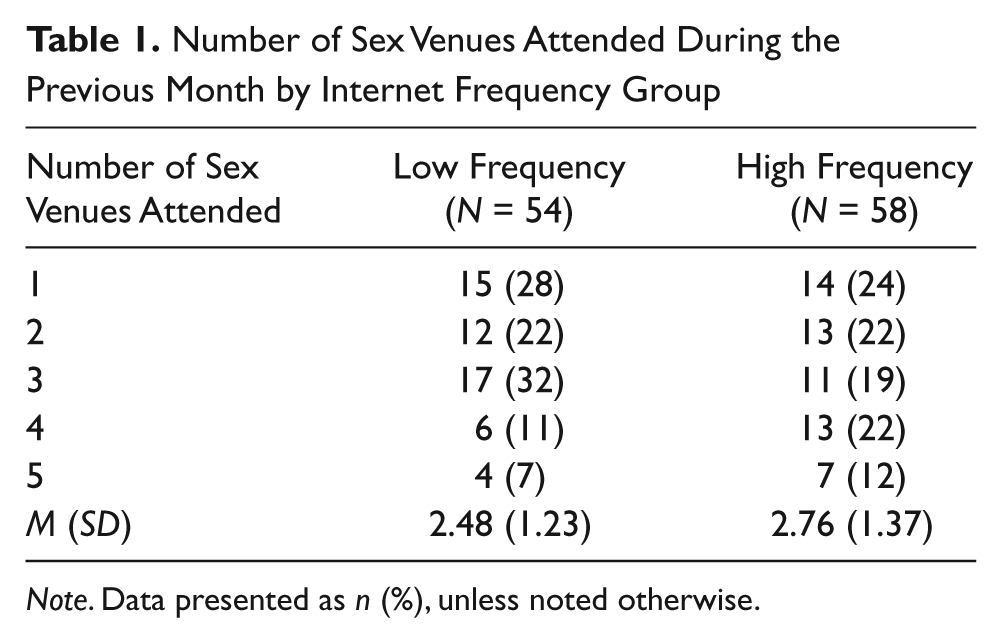
Table 1 reports the number of sex venues attended by each Internet frequency group, as well as the average number of venues attended by these two groups. There were twice as many men who attended four or more venues to report a high frequency of Internet use to find partners for public sex encounters than men who reported a low frequency. This tendency notwithstanding, most of the men in both groups reported attending three or fewer venues during the previous month. Indeed, both groups had an average venue attendance of less than three. Moreover, an independent samples t-test revealed no differences in the number of sex venues attended between the two Internet frequency groups, t(110) = −1.12, p = .26. However, a chi-square test revealed that a marginally greater percentage of men in the high-frequency group reported attending more than three venues during the previous month (34%) compared with men in the low-frequency group (18.5%), χ2(1, N = 112) = 3.63, p = .05.
Number of Sex Venues Attended During the Previous Month by Internet Frequency Group
Note. Data presented as n (%), unless noted otherwise.
Table 2 reports the proportion of men—by Internet frequency group—attending each of the venues. The proportion of men in the high-frequency group attending gyms, public bathrooms, and sex clubs was slightly higher than men in the low-frequency group. Attendance was fairly similar for both groups among the remaining venues. Moreover, a chi-square test revealed that neither group attended any one venue type more during the previous month. Indeed, both groups reported public parks, video booths, and public bathrooms as the venues they frequented most.
Sex Venue Attendance by Men in High- and Low-Frequency Internet Groups

Note. Data presented as n (%). Percentages do not total 100% due to multivenue users. Sex venue attendance data for the past month.
Risk Behaviors by Frequency of Internet Use to Find Partners for Public Sexual Encounters
Table 3 provides a breakdown of the percentages of participants reporting sexual behaviors at any venue(s) during the previous month, as well as comparisons by Internet frequency group. Reports of all sexual behaviors were higher for men in the high-frequency Internet group. The occurrence of sexual behaviors among participants in the low- and high-frequency Internet usage groups were compared to determine if either group was more likely to engage in risk behaviors. The findings revealed no group differences with regard to any of the reported behaviors. However, there was a trend among men in the high-frequency group to report more UAI than men in the low-frequency group.
Comparisons of Sexual Behaviors by Internet Frequency

Note. Data presented as n (%).
Also, men were asked to indicate how often they took condoms to those venues they had frequented in the past month with the intent to use them for sexual activity. Half of the men in the high-frequency group reported taking condoms at least some of the time (50%), with the other half reporting that they never took them. Similarly, 46% of men in the low-frequency group reported taking condoms at least some of the time, with the remaining 54% indicating that they never took them. Chi-square analyses revealed no Internet group differences in this behavior, χ2(1, N = 112) = 0.15, p = .69.
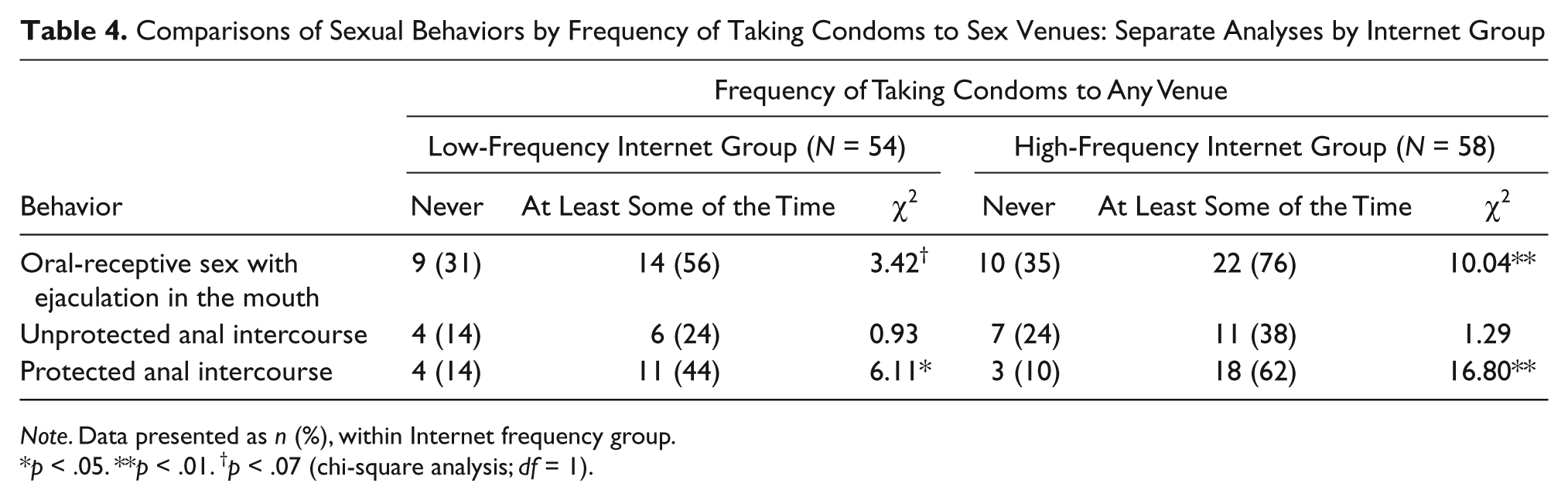
Within-group differences were further examined between taking condoms to a sex venue and engaging in risky or safer behaviors using chi-square analyses (Table 4). A greater percentage of men in the low-frequency group who reported taking condoms to a venue at least some of the time during the previous month also reported engaging in PAI compared with men who indicated that they never took condoms. Also, a marginally greater percentage of men in this same group who reported taking condoms to a venue reported engaging in ORE compared with men who indicated that they never took condoms (p < .07). Additionally, a greater percentage of men in the high-frequency group who reported taking condoms to a sex venue at least some of the time reported engaging in ORE and PAI compared with men who indicated that they never took condoms.
Comparisons of Sexual Behaviors by Frequency of Taking Condoms to Sex Venues: Separate Analyses by Internet Group
Note. Data presented as n (%), within Internet frequency group.
p < .05. **p < .01. †p < .07 (chi-square analysis; df = 1).
Preferences for Why Men Seek Out Public Sex Encounters by Frequency of Internet Use
The two Internet frequency groups were also compared on a set of preferences for why they seek out men for public sexual encounters. A greater percentage of participants in the high-frequency group agreed that they prefer public sexual encounters involving sex with more than one person compared with those men in the low-frequency group, χ2(1, N = 110) = 4.1, p < .05. There were no significant associations for the remaining preferences (i.e., anonymous sex, friendship, companionship, love).
Discussion
This study is one of the first to directly assess how often MSM use the Internet in search of partners for public sexual encounters relative to their risk behaviors within various sex venues. An initial cluster analysis revealed two distinct groups of men who search for partners through the Internet who are willing to engage in sexual activity with them in a public place. The groups were based on categorical frequency of Internet use to seek partners for public sex encounters such that men who participated in this online activity once a week or less were classified as low-frequency users and men who performed this online activity at least two or three times a week were considered high-frequency users. Bivariate analyses further revealed that both groups attended similar numbers of physical venues during the previous month and that neither group was more likely to attend any one venue. However, potential trends in higher attendance at gyms, public bathrooms, and sex clubs were noted among those in the high-frequency group. Furthermore, attendance at more than three venues during the previous month was reported by a greater percentage of men in the high-frequency group.
The analyses revealed that men who reported using the Internet more often in search of partners for public sex encounters reported more UAI than men in the low-frequency group, though this finding only approached statistical significance. Moreover, only half of the men in this high-frequency group reported taking condoms with them to a sex venue during the past month. However, this is confounded by the finding that men in the high-frequency group who took condoms at least some of the time were more likely to report protected anal sex compared with those men who did not take condoms to any of the venues. Additionally, men in the low-frequency group who reported taking condoms to a sex venue in the past month at least some of the time were more likely to report protected anal sex compared with those men who did not take condoms. Furthermore, men who indicated that they took condoms to a venue, regardless of Internet frequency, had higher rates of oral-receptive intercourse with ejaculation in the mouth. These data suggest that safe sex intentions (taking condoms with them to sex venues) among men who use the Internet to find partners for public sexual encounters may correspond to safer anal sex, but not safer oral sex, once they are at the venue. Though the risk of HIV transmission from oral–genital contact is often considered to be lower than that of anal sex (Centers for Disease Control and Prevention, 2009), more engagement in this behavior could result in greater numbers of HIV infections (Vittinghoff et al., 1999) or other sexually transmitted infections (STIs). Perhaps Internet and venue-based prevention programs are needed to better inform MSM of the potential risks associated with ORE without discouraging other safe sex strategies (e.g., PAI).
Although only a small percentage of men in this study reported being HIV-positive, most of these men were in the high-frequency Internet use group. Though speculative, these findings suggest that high-frequency users of the Internet—to find partners for public sex encounters—who are more likely to be HIV-positive and more likely to have unprotected anal sex at a venue may therefore have a greater potential for HIV transmission. These results support previous studies that have shown that HIV-positive MSM spend more time online—or were more likely to use the Internet—in search of partners than men who were HIV-negative (Bolding et al., 2004; Elford, Bolding, Davis, Sherr, & Hart, 2004; Grov, DeBusk, et al., 2007). Knowing that some sex venue users who frequently initiate public sex encounters through the Internet are HIV-positive could be useful in designing appropriate HIV/STI interventions that encourage these men to negotiate safer behaviors that can prevent transmission before their encounters go offline (e.g., strategic positioning; Parsons et al., 2005). Researchers have suggested that online sexual negotiation may lower HIV transmission risk (Brown, Maycock, & Burns, 2005) and has been associated with condom use (Carballo-Diéguez, Miner, Dolezal, Rosser, & Jacoby, 2006).
The findings presented in this article have demonstrated that men who use the Internet to find male sex partners also attend commercial and public sex venues, which confirms previous studies (Bolding et al., 2005; Garofalo et al., 2007; McKirnan et al., 2007; Ogilvie et al., 2008; Ross et al., 2000). This study has gone a step further by establishing that some men initially seek partners for public sexual encounters online with varying levels of frequency. Furthermore, it provides support for prior research suggesting that higher frequency of online use by MSM to find sex partners is associated with risky sexual behaviors (Bolding et al., 2004; Horvath et al., 2008). The current study highlights the importance of understanding how successful men are in meeting their Internet partners at sex venues and their risk behaviors with those specific partners. Additional work is needed to examine why these men choose specific venues for their sexual encounters, which could then be used to tailor safe-sex campaigns at those venues.
A novel component to this study was the assessment of preferences that MSM have in pursuing public sexual encounters. The findings overwhelmingly demonstrate that men who frequently use the Internet in search of public sex also desire encounters with multiple partners. Evidence has shown that men who use the Internet to find male partners typically report greater numbers of partners than men using non-Internet sources (Benotsch et al., 2002; McFarlane et al., 2000; McKirnan et al., 2007) and that having multiple sex partners increases an individual’s risk of HIV/STI transmission (Centers for Disease Control and Prevention, n.d.; Hirshfield et al., 2004; Rosario, Schrimshaw, & Hunter, 2006). Therefore, future research should account for the number of partners that men have when attending sex venues including partners initially met online, as well as the extent to which they engage in risky behaviors with those men.
This research raises important questions about the use of Internet resources to coordinate public sexual encounters. First, what qualities of sex venues attract MSM to meet their online partners in public? Men who desire to have a same-sex sexual encounter may be drawn to the convenience and anonymity that is often afforded by public and commercial sex venues (Downing, 2010a; Reece & Dodge, 2003; Richters, 2007). This is particularly important for those who conceal their sexual identity and cannot invite someone to their home (i.e., married men; Humphreys, 2007; Reece & Dodge, 2003). Furthermore, some men are attracted to venues that enhance their sexual excitement and intimacy, limit nonsexual interactions, and offer an array of potential partners (Holmes, O’Byrne, & Gastaldo, 2007). Second, is this subgroup of MSM riskier than men who engage in sex with online partners at a private residence? Some research suggests that private spaces and low lighting, common design features found in several types of sex venues (e.g., bathhouses, sex clubs), may be preferred as a means of pursuing unsafe sexual encounters (Downing, 2010b). Future research and interventions that target MSM who search for sex partners online should be aware of the places that these men ultimately engage in sex with these partners. An analysis of a popular cruising website produced by and for men who are interested in commercial or public sex encounters—where to go, where not to go—has revealed additional venues (e.g., retail store restrooms, college campuses) beyond those traditionally studied (i.e., bathhouses, public parks) that may call for risk reduction interventions (Tewksbury, 2008). Moreover, not all sex venues make condoms readily available, particularly those that are temporary or not sanctioned for sexual encounters (e.g., public bathrooms, gyms). Knowing where men engage in sex with their Internet partners and what sexual behaviors occur during these encounters could inform public health efforts that encourage online sexual negotiations, including whether or not to bring and use condoms.
Nevertheless, the findings presented in this article must be interpreted within the context of the study’s limitations. First, responses to how often participants attended any of the physical venues were positively skewed and could explain why no patterns emerged between venue attendance and frequency of Internet use to find partners for public sex encounters. Second, the small sample size may explain why no patterns of venue attendance and Internet frequency were detected among this group of MSM. Third, because of survey length considerations, items regarding ethnic/racial background, socioeconomic status, and education were not included. Therefore, future research addressing this group of Internet users should account for these variables, all of which would be potentially useful in describing these men. Fourth, sexual behaviors were not assessed for any specific venue partner so it is impossible to know if any of the venue encounters occurred with someone who was initially met online. Furthermore, a small percentage of men failed to respond to the question regarding their use of the Internet to seek out public sex. As a result, the data obtained from these men were excluded from analyses, which decreased the sample size.
Conclusions
This study has demonstrated that men who engage in high-frequency use of the Internet to find partners for public sexual encounters were more likely to be HIV-positive, to have attended more than three venues during the past month, to be marginally more likely to engage in UAI, and have a preference for sex venues that offer opportunities to have sex with multiple male partners as compared with those men who engage in low-frequency use of the Internet to find partners for public sex. Although no specific venues were associated with the high-frequency group, there was a trend among these men to attend gyms, public bathrooms, and sex clubs. Future studies with a larger sample may be able to detect patterns of venue attendance within this subgroup of Internet users who actively seek partners for public sex encounters. By knowing where these men engage in sexual behaviors with their Internet-specific partners, HIV/STI interventions that target this population could be tailored to encourage sexual negotiation before encounters go offline.
Footnotes
Acknowledgements
The author wishes to thank Eric Schrimshaw, Sarit Golub, David Chapin, Cindi Katz, Karolynn Siegel, and David Rindskopf for their statistical and editorial comments during the preparation of this article.
This research was conducted as part of the author’s doctoral dissertation at The Graduate Center, City University of New York.
The author(s) declared no potential conflicts of interest with respect to the research, authorship, and/or publication of this article.
The author(s) received no financial support for the research, authorship, and/or publication of this article.