




Abstract
Drawing on the accounts of 49 women, we argue that supporting a family member in custody drives women deeper into poverty, whilst shame, stigma and caring burdens diminish their social networks. This resonates with a growing evidence base that imprisonment imposes considerable financial burdens upon families, the weight of which are disproportionately shouldered by women, yet little action has been taken to address this issue. Consequently, we suggest that these women are at risk of both epistemic and hermeneutical injustice, but that this is fundamentally driven by a failure of more powerful audiences to engage with their voices.
Introduction
This article presents findings on a study carried out in Scotland to understand the financial costs and impact on time experienced by those supporting someone in prison. This analysis draws on research commissioned by Families Outside - Scotland’s only organization which solely supports families affected by imprisonment. This research was the second project exploring these issues carried out by Families Outside with the first study, conducted over ten years ago, concluding that imprisonment imposed considerable financial pressures on families who sought to support the person in custody by providing phone calls, visits, posting parcels, and paying significant amounts into prison personal accounts, and that this caring work was almost always carried out by women (Dickie, 2013). Simultaneously, capacity to meet these costs was reduced, as the time required to provide this financial, emotional and practical support impacted upon individuals’ ability to work, social security entitlements, housing provision, and childcare arrangements (Dickie, 2013). This caused serious harms to families, many of whom were already experiencing marginalization, reflecting the disproportionate reach of the prison system into Scotland’s most deprived communities 1 . This previous context is relevant to both the background of the current study which this article reports on, and the more conceptual contribution we intend to make by examining the forms of epistemic injustice experienced by our participants.
The current study sought to update the work by Dickie by exploring the financial impacts of imprisonment on families, how these intersect with other aspects of disadvantage, and how families had been affected by the Covid-19 pandemic, and in particular the greater shift toward the online provision of both support services and family contact for imprisoned people. This research found, once again, that women and their children continue to suffer severe financial hardship with imprisonment of a family member shifting those with secure incomes into financial precarity, whilst those who were already struggling were propelled into crisis. Yet, what is particularly striking is that these findings are not novel. Not only do the two studies – conducted over a decade apart – draw the same conclusions, but they echo those of Pauline Morris’s landmark 1965 research into the impact of imprisonment on families in Scotland (Morris, 1965). In the intervening years multiple studies from a range of jurisdictions continue to evidence that not only are families significantly financially disadvantaged by the imprisonment of a loved one (Besemer & Dennison, 2018; Christian et al., 2006; Shaw, 2023), but that it is almost always women who bear the burden of supporting both the person in custody and also other family members and children (Comfort, 2008; Halsey & Deegan, 2015; Jardine, 2019).
As our participants expressed their frustration at a lack of action to deliver better support to families, we increasingly sought to explain why these calls for change remained unheeded. Thus, the aim of this article is to provide a conceptual account of why the voices of these women have been ignored, despite the very clear evidence that imprisonment harms the present and future life chances of families, children and communities (Condry & Minson, 2021; Mauer & Chesney-Lind, 2003; Wakefield & Wildeman, 2014). We suggest that the repeated reproduction of these findings raises important questions about who is listening (or not) to these accounts, and how this failure to listen might be thought of as a particular form of punitive, gendered injustice. In making this argument we draw on two threads of scholarship, firstly looking to the concept of epistemic injustice. Discussions of epistemic injustice often begin with Fricker’s groundbreaking work Epistemic injustice: Power and the Ethics of Knowing (2007), but it should be noted that Black feminist scholars have long been concerned with the distinct wrongs that are experienced by a person in their capacity as a knower when their voice is excluded or their credibility doubted (see, for example, Collins, 2000). The first wrong of this type identified by Fricker, which she terms testimonial injustice, arises when social prejudices cast a shadow over a speaker’s credibility, causing listeners to doubt or discount her account. For Fricker, at its core, testimonial injustice is driven by structural identity prejudices such as racism, sexism, misogyny and classism. The second wrong, hermeneutical injustice, relates more to her capacity to make herself understood, both to the intended audience and to herself. In this case, the injustice is driven by a “gap” in shared hermeneutical resources (such as concepts, language, ideas, and vocabulary) which prevents the individual from understanding, contextualizing and articulating her lived experience. Thus, as Fricker explains, the former occurs when “the police do not believe you because you are Black”, whereas numerous women were subject to the latter before feminist activism allowed concepts such as post-natal depression and sexual harassment to gain a foothold in popular culture, allowing women to develop a collective understanding of experiences which might previously have been dismissed as a personal failing, emotional frailty, or their employer simply being a little “flirty” (Fricker, 2007, p. 4).
Secondly, we look to the literature on the gendered nature of both imprisonment and social control. As with other Western jurisdictions, the prison population in Scotland is overwhelmingly male. The most recent statistics show that the average daily prison population in 2023/2024 was 7,860, 96% of whom were men, and this pattern has persisted for over 25 years (Scottish Prison Service, 2024; World Prison Brief, 2025). As it is men, and often young men of color, who are globally most likely to be imprisoned, it is women who remain in the community often caring for children in their absence (Western & Pettit, 2010). Yet, the criminal justice system also exercises considerable control over the women who choose to support them in that prison rules dictate when they can visit, when they can talk to their family member, and what they should spend their money on (Comfort, 2008; Jardine, 2023). They are also subject to broader social controls such as shame and stigma, gendered pressures to “stand by their man”, and the need to present as good mothers to their children (Condry, 2007; Gueta & Condry, 2024; McDermott & King, 1992). Moreover, while criminal justice systems benefit from the labor of those women who do “stand by their man”, both through direct financial extraction and the reduced tensions within prisons when the provisions for visits, personal property and additional food function well, such caring work is both undervalued and taken for granted (Comfort, 2008; Delerme, 2025). Thus, these gendered power structures demand considerable investment of women’s resources, while simultaneously failing to recognize the sacrifices this requires.
This innovative conceptual framework allows us to extend the existing literature by not only analyzing the significant financial hardships experienced by families affected by imprisonment (Besemer & Dennison, 2018; Christian et al., 2006; Comfort, 2008; Souza et al., 2020) but also theorizing why these continue to persist. This conceptual lens highlights the social, financial and epistemic harms inflicted upon families – and particularly women – drawing attention to a previously unacknowledged, but highly damaging, form of gendered injustice. To support this claim we begin by setting out our theoretical framework in more depth, before going on to discuss our research methods. We then make three key arguments: 1. Firstly, we will make the case (again), that imprisonment has a dire financial impact on many families, and it is women who shoulder the bulk of the practical, emotional and caring labor required to endure or as the women described ‘to cope.’ 2. We will then demonstrate that these women inhabit a stigmatized position as knowers. Put simply, they are viewed as less than credible speakers because they are women, because they are poor, and because they are supporting a person in custody. This raises the possibility that women do have a profound (and painfully won) knowledge of the financial and social harms caused by imprisonment, and the lack of action on this point can be attributed to a failure of dominant groups to listen. 3. Finally, we suggest that we should remain open to the possibility that these women experience hermeneutical, as well as, testimonial injustice, not least because participants themselves often had not recognized the extent of the financial pressures they faced. This may be fostered by the conditions outlined above, that is of not being able to make yourself heard, as well as the isolation and shame families often experience. Consequently, there is an absence of shared understanding of the severity of this issue, effectively closing-down opportunities for women to co-construct new understandings of their realities or to have these affirmed by those in power.
Together, these arguments illuminate both the true extent of the harms inflicted on families by the justice system and the mechanisms driving such epistemic injustices, thus contributing to a growing thread of scholarship concerned with questions of power, voice and the barriers families encounter when attempting to engender change (Annison & Condry, 2022; Ugwudike & Sánchez-Benitez, 2024; Umamaheswar, 2024).
Epistemic Harms and Criminal (In)Justice
There is a deep and unnerving recognition in today’s society, most notably shown by the international #MeToo movement, that women have been and continue to be silenced for actions that violate them, highlighting inequalities in power and the dominance of white men’s privilege (Gilligan, 2018). The justice system fails women both as survivors and those in conflict with the law, with women of color experiencing particular disadvantages at all stages in the system (Milne et al., 2018; Taylor & Walker, 2023). Evidence of this is clear: prison is made (badly) for men by men (Corston, 2007), ‘Rape myths’ continue to abound to blame women for sexual violence throughout investigation and prosecution processes (Gekoski et al., 2023), and juries are often reluctant to convict in these cases (Crown Prosecution Service, 2024).
A growing number of scholars are now beginning to explore how such uneven power dynamics shape whose voices are heard and how epistemic relations might lead to more or less unjust outcomes throughout criminal justice, legal, and policy processes (Lacey, 2022; Lackey, 2020; Medina, 2021; Weaver et al., 2024; Yap, 2017). For instance, Brisette (2020) has argued that not only does the court remain resolute in its unwillingness to listen to the people who appear before it during arraignment hearings, but that it also wields its power in such a way as to impose the label of “bad subjects” upon defendants. For Brisette (2020), processes such as shackling, the narrative practices surrounding the public reading of the charge and moves to establish the “facts” of the case in ways which draw on classed, gendered and racialized assumptions about the defendant and their worth fundamentally constitutes an assault on their personhood which can only be understood as epistemic violence. Victims, too, may also be rendered voiceless by adversarial policing and court processes, especially when they are positioned as a less than credible knower due to mental illness or emotional distress (Daya, 2022).
This literature draws on a range of conceptual tools from the flourishing area of philosophical work, and looking beyond Fricker’s contribution is key here in shifting our focus from the individual or group being silenced towards the culpability of dominant groups as failed, willfully ignorant, or epistemically violent listeners (Dotson, 2014; Medina, 2013; Pohlhaus, 2012). This work rejects Fricker’s conclusion that hermeneutical injustice leads to interpretative gaps in understanding that are “epistemically symmetrical”; that is, equally poorly understood by both dominant and oppressed groups (Mason, 2011, p. 303). By drawing on Charles Mills’ analysis of white ignorance of racial injustice as an illustration, Mason argues that Fricker conflates communal and dominant epistemological resources and therefore does not recognize the role that the knowledge practices of more dominant social groups can play in maintaining a lack of understanding of the nature and severity of the issues facing marginalized groups. Thus, dominant groups can maintain socially advantageous power relations such as white supremacy or patriarchy through the “epistemically irresponsible and ethically reprehensible practices of misinterpretation, misrepresentation, evasion and self-deception”, which allow them to fail to understand the perspectives of the socially marginalized (Mason, 2011, p. 303).
Such an analysis of how the epistemic practices of the socially dominant serve to uphold existing inequalities directs our attention toward how the voices of criminalized people are marginalized within criminal justice practices and policy making processes (Butler, 2024; Hanan, 2020; Weaver et al., 2024). For instance, Hanan (2020) argues that as sentencers and policy makers are poorly informed as to the multiple personal, social and ethical harms imprisonment inflicts, their work is driven by an impoverished conceptualization of the severity of this form of punishment. Despite this, Hanan (2020) suggests that these groups show little interest in developing a robust knowledge of imprisonment, or in the accounts of imprisoned people which would aid their understanding, thereby perpetuating both hermeneutical and testimonial injustice. This analysis prompts two important questions. Firstly, how do courts, legal actors, policy makers and other powerful groups who might ameliorate the conditions experienced by families perceive these harms? And secondly, how do they perceive families themselves? With regard to the latter, the feminist conceptual roots of epistemic injustice – which recognize that certain groups of knowers are marginalized within a Western, masculinist epistemic tradition which privileges those able to claim, however erroneously, that the knowledge they produced was rational, objective, and untainted by emotion or social position – provide some insight. In developing her theory of epistemic violence, Dotson (2014) draws on the theorizing of Patricia Hill Collins (2000), and in particular her landmark text Black Feminist Thought. Here, Collins argues that Black American women are subject to a number of pejorative “controlling images” of Black womanhood, which effectively silence women of color by simultaneously discrediting Black women and reinforcing the racist and sexist power relations which maintain their oppression (Collins, 2000, p. 70). For Dotson, such stereotyping amounts to testimonial oppression, as it fatally undermines the credibility of women of color as a group. Yet justice impacted women are routinely judged by multiple audiences, including sometimes even criminologists, by how successfully they uphold idealized forms of femininity and mothering, thereby ensuring that their partners and sons do not offend, whilst also demonstrating enough resilience to personally overcome often insurmountable structural disadvantage (Gueta & Condry, 2024; Rutter & Barr, 2021). Thus, it is not difficult to imagine a number of prejudicial stereotypes that are readily applied to women with a family member in prison, particularly given that these women are stigmatized both for their family member’s offending and very often their own poverty (Kotova, 2020).
Returning to the first question, this is an under-researched area with significant social and criminal justice implications. For instance, Armstong’s (2020) critical work on how governance is achieved through human rights frameworks highlights how the courts privilege a particular discourse of prison rehabilitation programs and sentence management techniques as indicative of a well-functioning prison regime, whilst simultaneously “selectively extracting and decontextualizing the lived experience of prison” (Armstrong, 2020, p. 90). Despite families too having lived experience of being affected by prison, their lived realities are often not recognized by criminal justice actors, as the harms they experience are secondary to the “real business” of punishing a convicted offender (Condry & Minson, 2020). Drawing on this argument we suggest that if the negative effects of imprisonment experienced by families are not seen as “real” punishment because caring for others - even when this is to the detriment of one’s self - is accepted as part of appropriate femininity it then becomes more difficult for women to articulate, sometimes even to themselves, the true extent of the harms of imprisonment.
Methods
The research was commissioned by Families Outside and funded by Abrdn Financial Trust. While we did not collaborate with all participants as co-researchers – as a Participatory Action Research approach might demand - the project was inspired by the ethos of feminist and participatory methods in that it was motivated by a desire to affect change for this marginalized group of women and close attention was paid to issues of inequality, power and voice (Harding, 2020). An Advisory Group made up of professionals and academics in this area and two representatives from families informed all aspects of the study, from design, analysis and write-up. Participants were recruited mainly through Families Outside and the prison visitor centers. The study was open to people supporting someone in prison financially or who had supported them within the past year, and fifty-one interviews were conducted between January and July 2022. Interviews began by taking time with participants to clarify the purpose of the research and recognize the sensitivity of the topic, before ensuring their informed consent. Initial questions focused on demographic and background information, allowing a picture of participants’ lives prior to supporting a person in prison to be established. From there, interviews explored the financial and human costs associated with each stage of the person’s “justice journey” (from remand to release). The latter stages of the interview asked specific questions about both social connections and support and the impact of the COVID-19 pandemic, before inviting participants to add anything else they felt was of importance.
Participant Demographics
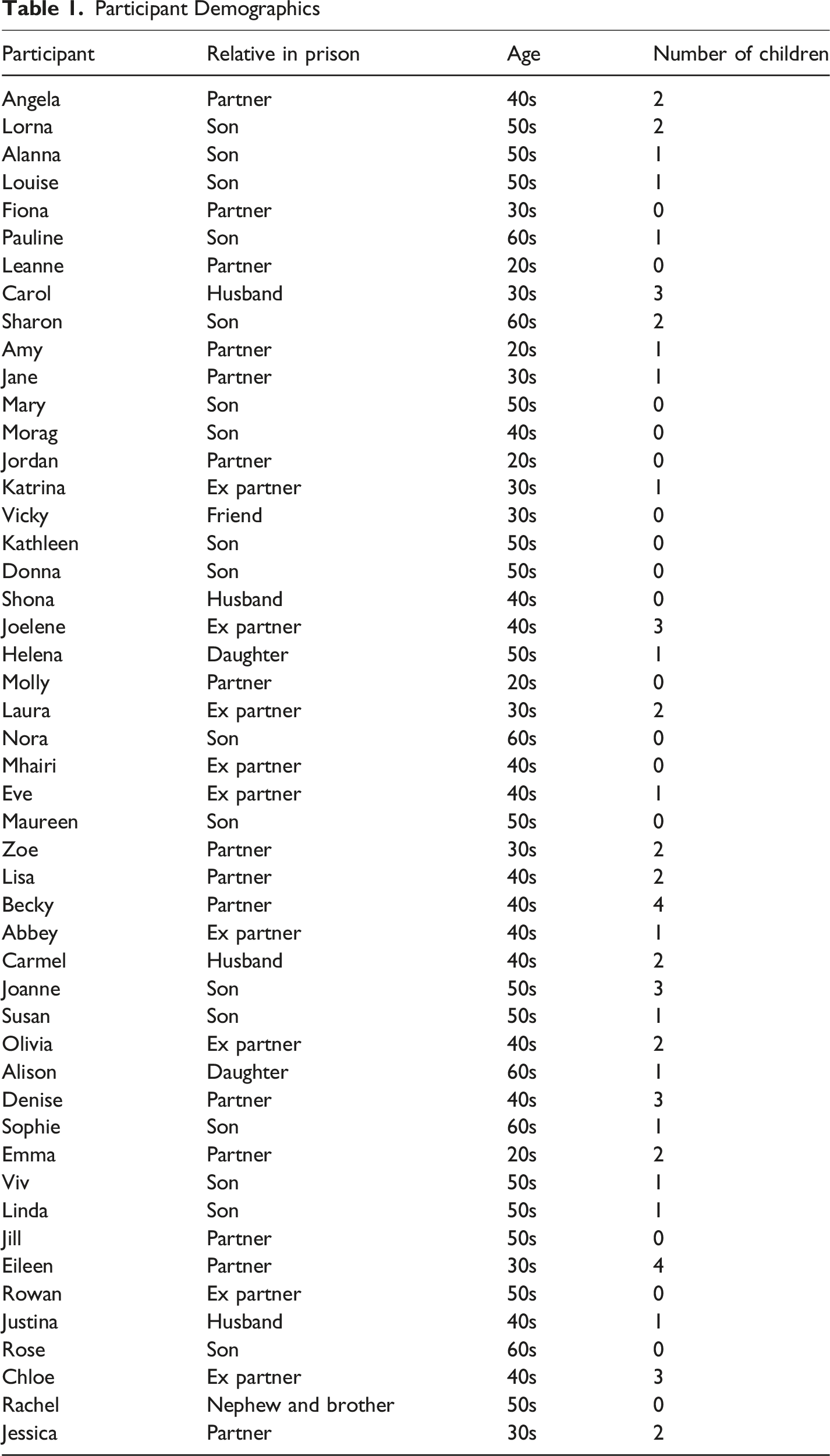
Interviews were transcribed, anonymized, with pseudonyms used, and analyzed in an inductive way using grounded theory as a basis, so the research prioritized hearing the voices of the women above all else (Glaser & Strauss, 1967; Strauss & Corbin, 1998). The stages of analysis outlined by Strauss and Corbin (1998) are micro-analysis (detailed coding), open coding which is the development of concepts, axial coding or the linking of concepts, and finally selective coding to develop theoretical frameworks. For the microanalysis, detailed coding was undertaken by going through the data, finding commonalities, such as for example bringing all the responses to the question about the impact on time together, and in doing so creating what is referred to as ‘child’ nodes. These can then be used to open code, that is bringing other child nodes together, so for example comparing the answer to impact on time at each stage and thus formulating how this has been constructed over the course of the study. This helps to generate themes or create what is often referred to then as ‘parent’ nodes. In this case, for example, linking the data on how time was spent to the shrinking of networks or isolation. By then creating these links between the codes, or what is also referred to as axial coding, a theoretical framework began to develop which addressed both the research questions posed by the study, and also our growing interest in how stigma, gendered caring norms, and penal power function together to perpetuate epistemic injustice.
Reflect and learn sessions were held online to present the emerging findings to prison personnel, organizations supporting families, and families directly to inform the final report and recommendations. Consulting with the Advisory Board, which included representatives from families who were paid for their time, meant that findings were continually being sense checked or understanding affirmed. Questions were also raised throughout and directed to the Scottish Prison Service to understand if certain family experiences, such as for example not being reimbursed for all travel expenses, were a specific rather than general issue. The final report was presented at the Scottish Parliament at a cross-party event, creating an opportunity for families who were on the Advisory Board to speak directly to those in power about their experiences.
Findings
The stories of our participants add another layer to the considerable research which already demonstrates that imprisonment creates significant financial harm for families, which in turn have deleterious consequences for current and future wellbeing. Many of the women (30) were caring for on average two children and three were kinship carers. One woman was also pregnant. Most reported dealing with mental health issues that were affecting them physically. Several (6) interviewees said they had some form of disability, making it difficult for them to walk. One woman had kidney disease, while another was anorexic. Several (6) interviewees reported that they had been abused by the person in prison, and in five of these cases they had stopped providing support to the person in prison within the past six months.
Two thirds of participants were on benefits, a quarter on low waged work, a few were pensioners and one person was not claiming benefits at all. Nine had given up work because of illness directly related to the stress of their loved one being in prison and no longer being able to juggle all the responsibilities of care they had taken on alone. Only a few across the group earned the Minimum Income Standard, which means they could afford to engage in community activities as well as afford necessities and had around £1,200 to spend a month after paying rent. The majority (45), after paying rent and after tax, were living on around £500 a month. All were the main source of support for the person and felt an overwhelming sense of obligation. It is part of my life now. I am resigned to it…I think it is horrific the way families are treated… It is a terrible strain to have someone in prison and to be responsible for the little things that get them through. It is a momentous task. (Lorna, 50s, working, supported son for many years who has served remands and short sentences often 280 miles away and was currently out of prison)
One person being supported was in prison for his first time on remand, and otherwise the women were split between supporting someone serving their first sentence, or someone who had spent a significant amount of time in prison. Participants’ family members had served 286 years between them in prison, an average of five and a half years each. Around half (25) were supporting someone who was not in the local prison, adding unnecessary difficulties and additional costs. Two thirds were reliant on public transport. Three women had to leave their homes, at significant cost, because of harassment as a result of the offense.
Scotland holds a disproportionately high number of people in prison on remand, and there is a growing political consensus that this practice has contributed to an overcrowding crisis (Constance, 2024). This research draws attention to this as having been an especially difficult and costly time financially, physically and mentally for the women, spending on average half of their income visiting the person as much as possible, with several making the journey six times a week, the maximum permitted out of their sense of duty. The uncertainty felt was also exhausting (see also Masson & Booth, 2024 here). I went every day when he was on remand. That was his first time. I had to get a friend to drive me because I was prescribed diazepam, my world collapsed. (Sophie, 60s, on benefits after having to give up work, supporting son serving his first long sentence 17 miles away)
When sentenced, the costs continued for families, although they slightly decreased to around a quarter of the family income. Participants who were supporting a person who had been released reported that these rose again, returning to around half the family income. For some families, the imprisonment of a family member meant that these scarce resources had to stretch further, as three participants had become kinship carers for the children of the person in prison. Yet, even where this was not the case, women felt pressure to ensure as much of their “normal” family life as possible could be retained. For many, however, they recognized that both them and their children were leading a diminished life. Most women said their children had had to give up activities or not go on school trips, so they were not engaging in life fully, shrinking their networks and being different to their friends. Opportunities to engage in paid work, which might relieve these pressures or offer some social connections, were often limited by the absence of the person in custody, who might have shared in the caring of children or other family members. It is a bit of a struggle with the bills and I have no financial support from him. I got before from him £150 (a month). For the kids – we are just getting by and no more, so if the kids need clothes or even getting out, he used to do that, I can no longer afford them to do [activities]…They don’t have that social life. They are bored. It would be nice to get them out and be able to do more with them….I do try my best but it does affect them. (Laura, 30s, claiming social security benefits, 2 children, no longer supporting abusive ex-partner who is serving a short sentence) I am here myself, four kids, two dogs and I have had to take on full care of my dad who has palliative care. It has been manic. I was working full time, 40 hours, so down to 16 to look after the kids. Now I am not working at all. I am on the sick now taking care of my dad. They can’t give me statutory sick pay. It is ridiculous…I am just constantly running around after people and then the carers for my dad. I don’t get a minute to myself. I get on with it. Every day runs into one. (Becky, 40s, supporting partner serving his first short sentence in a prison 23 miles away)
Inevitably, spending so much time on the needs of others becomes a substantial drain on these women’s financial, physical, mental and emotional resources. Many reported getting frequent headaches, losing or gaining weight, losing sleep, and developing conditions such as fibromyalgia. Some women spoke openly about suffering from anxiety and depression as a result. One woman said that she had been in recovery for many years and that given the stress of the situation, had she been without good family support, she would have relapsed. A few said they were desperate, felt exhausted by it all and were not sure they could cope or continue as they were anymore. My health has went right down. My stress and my anxiety, depression has hit a low…I got in touch with my GP. I am hoping I hear from them today. It is all the stress. I put myself last…Nothing else – it is just drained me and worn me all out. I am out in the street and getting that abuse. The effect it has on me. (Rachel, 50s, claiming social security benefits, supporting nephew and brother serving long-term sentences, 64 miles away)
It is clear from such accounts that many participants had lost hope. They were considering seeking help from mental health services and stopping their contact with the person in prison.
Women as Stigmatized Knowers
Adopting a conceptual lens of epistemic injustice helps us to understand why this damage continues to be inflicted upon families despite this established weight of evidence, as it leads us to consider the multiple reasons why the testimonies of these women have been marginalized in debates surrounding justice and welfare policies. Firstly, it must be recognized that women are not only financially poor but time poor too. One participant described herself as a ‘private secretary’ to her son, such was the amount of time she spent sourcing information and sending it on by way of post or through ‘Email a prisoner.’ Another mother, now retired, said she spent three days a week calling the prison and liaising with staff to ensure her son had his medication and was able to access the programs she felt were required for his sentence progression. These experiences were common, with almost all participants estimating that they spent two days a week supporting the person in custody, leaving very little time and resource to engage in other aspects of family life, let alone community or political action (Jardine, 2023; Lee et al., 2014).
Furthermore, these deleterious effects of imprisonment also ensure that they are firmly positioned as stigmatized knowers, whose deeply held knowledge of these harms of imprisonment then become possible to discount. The wider philosophical and sociological literature is replete with examples of how women, and especially women who are who hold other marginalized social positions such as women of color, women with a disability, women who have been victimized, or women or are seen as “troubled”, “troublesome” or even “unconventional” have been subject to epistemic injustice (Daya, 2022; Isham et al., 2020; Medina, 2013; Scully, 2018). Secondly, this stigma is intensified for women supporting a person in custody, who are frequently viewed as having failed in their “civilizing” or nurturing role if their child or partner offends, or indeed as “guilty by association” due to their close bonds with a person in prison (Condry, 2007; Halsey & Deegan, 2015). Thirdly, families facing economic disadvantage are often pathologized and the unemployed and underemployed held in the lowest esteem, making it more difficult still to claim the identity of a credible knower (Treanor, 2020). In sum, the women who participated in this research are triply judged: because they are women, for their criminal justice involvement by proxy, and because of their poverty.
Interviewees wanted this stigma to end and felt this was possible through education which might engender a better public understanding of the realities of supporting a person in custody. They hoped that this study could go some way towards filling that gap in knowledge. As the following quote highlights, women wanted to no longer live ‘in the shadows’, meaning no longer having their experience denied. I think the Scottish Government have to do work to educate people. The stigma must be addressed by the Scottish Government, at a higher level, because otherwise societal attitudes won’t change. If they put it out there and gave people food for thought. No one wants to talk about it. They don’t want to put it on the agenda. That has to change. I emailed every MSP [Member of Scottish Parliament] during COVID and was ignored. My health took such a dip…They pay lip service but then they don’t do anything. We live in the shadows. Scottish Government keep us there, by not speaking about it. (Sophie, 60s, on benefits after having to give up work, supporting son serving his first long sentence 17 miles away)
Sophie’s account of overcoming the considerable barriers to sharing her experiences, then only to be ignored by multiple holders of public office, clearly reflect arguments that epistemic injustice and epistemic violence can be inflicted by powerful groups who intentionally or not fail to engage meaningfully with the testimonies of the marginalized (Dotson, 2014; Mason, 2011; Pohlhaus, 2012). In an attempt to bring these stories to light, when this research was completed the project report was formally launched at the Scottish Parliament, with families invited to speak about their experiences and recommendations for change to an audience of Members of the Scottish Parliament, policy makers, practitioners, and academics. Families spoke eloquently, movingly, and also angrily about the impact imprisonment has had on their lives. Some doubted the sincerity of policy makers and prison managers who attempted to empathize with their stories, given that they felt repeated attempts to advocate for themselves and their families over a number of years had been ignored, dismissed or discounted. As one participant demanded, “When are things really going to change? I feel like I have been saying the same thing over and over, again and again for years.”
(Gendered) Self-Silencing
Above, we have outlined the factors which we see as contributing to the testimonial injustice experienced by the women who participated in this research, which include the failure of powerful actors to take the steps needed to fully listen to, and engage meaningfully with, their stories. In making this case, we are mindful that testimonial injustice (attributing women with a dearth of credibility) and hermeneutical injustice (the difficulty women experience in having their social experiences understood – by others and themselves – due to a lack of appropriate concepts and vocabularies) are often deeply entwined (Medina, 2013). This is reflected in our findings, as women not only noted that they felt their experiences were poorly understood by - as Lorna described them - “the powers that be”, but they also reported that through their participation in the research they had come to better understand the full extent of the losses and costs related to prison. Many participants were shocked, unable to believe how they had coped or managed. This is 30 years I have been supporting him…I am his main support – it is just me…I dread to think of what I have spent. What I have put into him and the clothes as well…I spend £100 a month into his personal account, £20 a month in petrol, £50 in clothes, £48 a month at the visit, £2 a month on postage…£220 a month on prison – you don’t think of it that way. (Pauline, 60s, employment recently terminated and supporting son, currently in local prison 10 miles away)
As Fricker notes, hermeneutical injustices can be hard to detect, frequently becoming illuminated in retrospect, often after groups of marginalized subjects have had the opportunity to come together to make sense of their experiences (Fricker, 2007). Consequently, the arguments advanced here are predicated upon our own analysis rather than participants’ direct articulation of experiencing hermeneutical injustice. Indeed, the closest participants came to conveying their own view that they had experienced hermeneutical injustice was the disbelief of women like Pauline as to the costs they had shouldered and how they had coped. Nevertheless, we suggest there are two key reasons why the specter of hermeneutical injustice should be taken seriously here. Firstly, as Fricker (2007) would anticipate, where women were able to gain support from Families Outside, the Visitor Centre or engage with a peer support group, this offered a space to break the silence around their struggles and to recognize they were not alone. This could in turn open-up wider discussions about imprisonment within families, as one participant noted that this support helped her to be more honest with her daughter. Families Outside have been a great support. They have been telling me how prison works. They have helped me to answer questions to my daughter. They take her out once a month on a trip to go bowling. They also got money for me at Christmas time, so we were able to have a really good Christmas that year. That was a massive support as Dad wasn’t there to help with the stuff. (Laura, 30s, two children, claiming social security benefits, no longer supporting abusive ex-partner who is serving short sentence) I go to a group and we sit and talk about how he is getting on and other people who are in this situation. You are human, you are not the only one going through this. (Denise, 40s, three children, claiming social security benefits, supporting partner)
While such interactions can allow marginalized groups to agentically develop their own interpretive tools (McHugh, 2017; Medina, 2013), access to these spaces is often limited for families. Fricker (2007) argues that hermeneutical injustice is driven by wider social inequalities and disadvantages; for instance, the sexual harassment of women in the workplace went unnamed because women were viewed as unreliable narrators, held more junior positions, and because sexuality and gender-based violence were stigmatized issues. Similarly, participants rarely discussed the impact of imprisonment not only because the caring labor undertaken left little time for social engagement, but also because women felt heavily shamed for their poverty and for having a family member in prison. This is evident in Sophie’s remark that she concealed her son’s imprisonment because “you feel the full force of stigma” and Rose’s determination to “carry it myself” rather than speak openly about her circumstances, while other participants also described how they covered up their situations, often pretending their son or partner was ‘away for work’, echoing recent research on women supporting female children in prison (Tadros et al., 2025). Instead of being honest with friends about their current position, women made excuses to avoid having difficult conversations; for instance, saying were too busy rather than admitting they could not afford to meet up. Women losing weight because they were starving instead told those around them that they were on a diet or their weight loss was down to anxiety rather than not being able to afford food. The pressure they have felt to retain some form of ‘dignity’ and ‘keep up appearances’ all conspired to mean the truth of these women’s lives remains unknown, in some instances, even to themselves. “I have just made sure no one knows. We have removed ourselves. I told my best friend. Family – no….You feel as if you are lying. We are watching the papers all the time.” (Maureen, 50s, working for 'pennies' or low income, supporting son who had been on remand for two years in a prison 62 miles away)
Secondly, hermeneutical injustice can also arise where there is a tension between the understanding of an issue amongst marginalized groups and more dominant knowers, or where powerful audiences do not respond to speakers’ perspectives, or do so deficiently, in ways which distort or their intended meaning, making it difficult for the marginalized speaker to be understood (Medina, 2013; Polhaus, 2012). There is evidence of the lack of a collective understanding of the extremity of the poverty families face when we examine the actions taken by policy makers to support this group, meaning that women seeking external recognition of the extent of the financial harms imposed upon them by the justice system are unlikely to find it. For instance, some families in the UK who are on benefits may be eligible for financial supports to assist with the cost of prison visiting through the ‘Help with Prison Visit’ scheme. However, this was rarely used by participants in this study, with half not knowing about it and those who did reflecting on both the limited support it provides, and a number of long-standing barriers inherent to accessing it (such as bureaucratic complexity, the requirement for digital literacy, and access to sufficient funds to cover the costs upfront as claims are paid in arrears). Similarly, during the COVID-19 pandemic visits were suspended but families were offered the option of video calls, and people in custody were provided with mobile phones equipped with 310 pre-paid minutes. While a significant proportion of participants valued video calls, the majority of the families who participated in this research did not use this facility for various reasons, including: not being able to afford the internet or phone which would support the technology, lacking appropriate identification, struggling to set up the video calls, and the requirement for callers to remain relatively still being difficult to achieve with small children. In contrast, the 310 free phone minutes were universally highly valued by families, allowing more frequent and routine contact. Yet, this provision is now reduced to 200 minutes as mobile phones are replaced with in-cell landlines, in a move the SPS states will “support family contact, mental health and wellbeing, and reduce the risk of reoffending”, whilst also being “cost neutral” (Scottish Prison Service, 2023).
In sum, our data suggests that these two forces which foster the conditions for hermeneutical injustice function in tandem. Not only do such policy decisions have the communicative effect that the prison system does not see the poverty suffered by families wishing to maintain contact as an overriding priority, but norms around caring and appropriate femininity enforce caring roles and erode social and family supports. Together, this marginalizes women and limits opportunities for them to make sense of their experiences with others who are similarly situated, whilst perpetuating the absence of an accessible and accepted discourse that recognizes and reaffirms the reality of the financial precarity created for many families by the justice system. Thus, the risk of hermeneutical injustice for women supporting a person in custody is fueled by a range of entrenched and overlapping social norms and criminal justice practices which both isolate women and reinforce a message that they are primarily responsible for managing the impact of imprisonment upon their families, whilst simultaneously denying the true financial, social and emotional costs of doing so.
Concluding Discussion
This article has sought to address the question of why, despite a rapidly growing and remarkably consistent body of evidence that imprisonment plays a significant role in entrenching poverty amongst families, these issues continue to persist unaddressed. We suggest that the willingness to tolerate this infliction of financial hardship upon families, and primarily women and children, is made possible by a long-standing tradition of prison regimes being shaped by oppressive and outdated ideals of femininity (Carlen & Worrall, 2004). In this instance, the need for women to undertake virtually all the work required to sustain family relationships – such as travelling to visits, paying for phone calls and emails, sending the gifts which mark family occasions, the DVDs which provide something to talk about, and the clothes which they hope will protect against bullying and the hopelessness of the prison environment – is underpinned by an unquestioning acceptance that women hold the ultimate responsibility for caring. As Carlen (1983) reminds us, because these gendered expectations are seen as natural, the punitive nature of these institutional practices is obscured. Consequently, for our participants, the misrecognition of the extent of women’s caring labor and the minimization of their financial hardship ultimately amounts to the role of the prison in reproducing and entrenching gendered poverty being denied. Indeed, one of the senior prison personnel who attended one of the reflect and learn sessions carried out as part of the study, described the women and their families as ‘the invisibles.’
These regressive expectations of appropriate womanhood that are the foundations of this denial underpin the epistemic injustice inflicted upon these women. Our analysis has found evidence of testimonial injustice, whereby families’ accounts become easy to dismiss due to their stigmatized identities as women surviving both familial imprisonment and poverty, and also a risk of hermeneutical injustice, driven by stigma, isolation and systemic misrecognition which function together as mechanisms which inhibit the opportunities women have to tell their stories and make sense of their circumstances. By demonstrating how concepts of epistemic injustice can illuminate such experiences, our analysis complements and extends Condry and Minson’s model of symbiotic harms (Condry & Minson, 2021). While these wide-ranging symbiotic harms include the civic marginalization which many women impacted by imprisonment experience - which is evident through their reduced time, exclusion from engaging with community life, and constricted political participation - our analysis conveys how imprisonment damages families as epistemic participants as well as civic agents. Attention to these epistemic harms is vital if we are to fully theorize the harms of imprisonment because, as Fricker (2007) argues, being subject to epistemic injustice is profoundly dehumanizing, particularly when it is prolonged and systemic. This argument that epistemic injustices can “cut deep” resonates with research which suggests that where families do engage in activism or organizing for prison reform, but limited uptake of these campaigns by more powerful political actors leads to limited concrete change, families experience painful feelings of voicelessness, hopelessness, frustration, and uncertainty (Annison & Condry, 2022).
There are, of course, limitations to this research. The data collected was reliant on participants taking time and being willing to share their stories, and participants defined for themselves the level of information they wished to provide. The interviews were to gather information on the whole sentence, and for those supporting a loved one in prison over a long time period, reflecting back to many years beforehand was a challenge, and in some cases not possible. Interviewees also often either rounded up or rounded down the costs, but as far as possible the information given was accurate, reporting figures for income after tax and taking account of rent. Google maps was also used to calculate the distances between the person’s address and the prison. This means that the distances reported are under-estimates for many, as they did not have a car and were reliant on public transport, and so would not have had a direct way of getting to the destination. The research engaged with families supporting a person held in 13 of the 15 prisons in Scotland. Nevertheless, we advise that further studies are carried out to explore the specific support for families who come from the islands and rural areas. We also suggest that future work which examines the dynamics of epistemic injustice from both the perspective of families affected by imprisonment, and more powerful criminal justice actors, would be beneficial. Indeed, as scholars of epistemic injustice note, this form of injustice becomes entrenched in circumstances where powerful groups maintain an ignorance (willful or otherwise) of both the plight of more marginalized groups, and how the powerful benefit from these dynamics, for example by refusing to consider how they are advantaged by their whiteness (Mason, 2011; Medina, 2013). Such critique resonates with recent research which found that while families often emphasize that they feel unheard and misunderstood by policy makers and prison managers, these more powerful groups continue to deny or minimize the harms imprisonment causes for families, whilst simultaneously responsibilizing families for supporting rehabilitation (and therefore public protection) and maintaining prison order (Ugwudike & Sánchez-Benitez, 2024).
We contend, then, that the failure by more powerful audiences to truly listen to families’ accounts of hardship arguably supports a false construction of families as not only able to offer ongoing financial support to people in custody, but also as constituting a “golden thread” which will support rehabilitation (see, for example, Farmer, 2017). Yet, while this fiction comes with obvious harms to families, it is also potentially self-defeating for policy makers, as it creates a narrative of a route to resettlement for formerly imprisoned people that is fundamentally flawed, given the overwhelming empirical evidence that imprisonment creates or deepens poverty for families. There is an urgent need then to better understand how more powerful actors – such as policy makers, magistrates, legal actors, and prison officials – conceptualize and prioritize the problem of poverty amongst these families, what evidence they do see as persuasive, and how these groups might be brought into a constructive yet challenging dialogue with families and their advocates. Indeed, as Umamaheswar (2024) has powerfully argued family peer support groups can foster the social and cultural capital which provide the vital emotional support, skills and knowledge required to attempt to navigate the complexities of criminal justice bureaucracies. Yet, Umamaheswar (2024) also contends that real material improvement in the lives of families impacted by imprisonment remains very difficult to achieve without structural change and substantial investment from justice institutions. We suggest that such changes will only come to fruition once researchers, policy makers, practitioners and activists collectively and openly examine not only the deleterious effects of imprisonment on families, but also who benefits from current arrangements, what assumptions (and whose narratives) underpin these, and what resources would be required for advantaged groups to be willing to forego the benefits they currently enjoy. These moves to counter the epistemic injustice experienced by these women are necessary if we are to adequately address the functioning of a justice system which not only positions already marginalized women as stigmatized knowers but also secures deeply unethical financial benefits by doing so.
Footnotes

Funding
The authors disclosed receipt of the following financial support for the research, authorship, and/or publication of this article: This work was supported by the abrdn Financial Fairness Trust.
Declaration of conflicting interests
The authors declared no potential conflicts of interest with respect to the research, authorship, and/or publication of this article.