




Abstract
This study explores the experiences of 18 maternal intimate partner violence (IPV) survivors seeking protection through civil courts. The mothers described a core experience of navigating protective precarity—the juxtaposition of seeking protection yet experiencing increased vulnerability. Three themes of navigating protective precarity include (i) fathers’ rights versus survivors’ safety; (ii) constrained survivor agency, and (iii) systemic unshielding. Paradoxical system responses leave adult and child survivors vulnerable to additional harm. We discuss how these findings can inform policies and system change that centers adult and child safety and well-being.
Keywords
Introduction
In the United States, civil and criminal legal systems responses are the primary interventions for intimate partner violence (IPV) (Messing et al., 2021). Mothers often rely on civil courts including family court to implement safety measures for themselves and their children when they separate from an abusive co-parent. Civil protective orders (PO) aim to promote survivor safety by using the power of the state to separate the IPV perpetrator and victim. Yet family entanglements – such as co-parenting – complicate the legal landscape.
In the context of IPV, family court professionals may struggle to adequately identify abuse and coercion and appropriately intervene (Gutowski & Goodman, 2023; Lapierre et al., 2024). Without careful adjudication, this can result in harmful outcomes for adult and child survivors (Gutowski & Goodman, 2023). Additionally, the legal process itself can become a venue for ongoing abuse (Gutowski & Goodman, 2022; Spearman et al., 2023). Survivors often experience legal systems’ involvement as an extension of abuse and coercive control post-separation (Douglas, 2018; Hefner et al., 2025; Miller et al., 2023; Miller & Smolter, 2011). Family court litigation offers perpetrators a ‘legally-justified’ avenue to continue to stalk, force contact, control, and cause economic and psychological harm to survivors even when physical proximity and access to other tactics of abuse have been limited following separation (Douglas, 2018; Gutowski & Goodman, 2022; McCormack, 2025; Miller & Smolter, 2011; Spearman et al., 2023). Perpetrators often intentionally engage in behaviors that expose survivors to surveillance and punitive institutional responses from legal systems (Monterrosa & Hattery, 2023). Adverse institutional responses can include child removal from a survivor by child welfare or family court systems (Roberts, 2022), criminalization (e.g., when survivors are mistakenly identified and arrested as the primary aggressor when acting in self-defense) (Richie, 2012; Richie & Eife, 2020; Washington, 2022), and punitive financial orders and consequences (McCormack, 2025; Spearman et al., 2023).
When survivors become involved with multiple legal systems and institutions, this process can be termed systems entanglement (Bagwell-Gray et al., 2025; Durfee, 2021). Scholars have noted that one contributing factor for maternal-survivor loss of child custody in family court settings is the unscientific concept of ‘parental alienation’ that is often used by perpetrators to discredit or minimize allegations of abuse (Lapierre & Côté, 2016; McCormack, 2025; Meier, 2009, 2020). The ‘parental alienation’ concept lacks clear definitional boundaries and validated measurement but is used as a defensive legal strategy in family court settings to insinuate that one parent is engaging in brainwashing the children to harm their relationship with the other parent (Meier, 2009). Particularly in cases involving domestic violence and child maltreatment, ‘parental alienation’ allegations often result in a dismissal or ignoring evidence of IPV, child maltreatment, and coercive control, and can result in maternal survivors losing custody (Lapierre & Côté, 2016; Meier, 2020; Zaccour, 2020).
The trauma to maternal survivors from child removal and custody stalking (i.e., using the courts to reverse patterns of childcare post-separation) is largely culturally invisible and understudied, yet causes tremendous grief (Elizabeth 2017), adverse mental health outcomes and harms to motherhood (Gutowski & Goodman, 2022), with downstream negative sequalae to children’s health. Harms to children’s mental and physical health from legal abuse are largely unexplored, with the exception of Spearman et al. (2025). These types of institutional betrayals (Christl et al., 2024; Gutowski & Goodman, 2023; Smith & Freyd, 2014) disproportionally harm poor and marginalized mothers who are often in precarious situations (Richie & Eife, 2020). These mothers have scarce economic and social capital, and fewer options to escape both abusers and punitive state sanctions (Hefner et al., 2025). Once legal system interventions have been mobilized, survivors’ mothering and decision making about contact with the perpetrator of abuse for themselves and their children is constrained through coercive tactics by perpetrators (McCormack, 2025) and reinforced through the decisions made by third-parties and institutions (Goodmark, 2018; Messing et al., 2021).
Civil POs are often viewed as a survivor-centered legal mechanism to enhance safety, and can include temporary provisions on the care and custody of children (depending on jurisdiction) until permanent parenting time access is adjudicated by family courts in child custody proceedings. As of 2017, just over half of US states (28) had provisions for temporary child custody within PO statutes when the petitioner and respondent shared children in common (Richards et al., 2021). In the states where temporary parenting time provisions are available as a remedy in civil POs, the focus is on short term risk mitigation rather than a Best Interests of the Child analysis. Best Interests of the Child tests describe a set of factors that courts will consider in family law cases to determine parenting time arrangements for the child. These factors vary by state and are based on case law, rather than the science on what helps children flourish and thrive (Spearman et al., Under review).
Given this complex landscape, remarkably little research has focused on the family court and child custody experiences of maternal survivors in conjunction with seeking and obtaining a civil PO from an abusive co-parent, with few notable exceptions (Hefner et al., 2025; Miller & Manzer, 2021). Little is known about what happens in the lives of children and their mothers in terms of child custody and long-term outcomes after they have sought a civil PO, and whether this process results in improved safety and health. Some research has examined the therapeutic effectiveness of civil POs, demonstrating that women report improved mental health outcomes when a civil PO was granted, but did not examine outcomes for mothers specifically (Wright & Johnson, 2012) or for children. Other studies have examined the characteristics of petitioners and respondents on whether or not a PO was granted or denied (Bagwell-Gray et al., 2025; Lucken et al., 2014). A study in a large urban Florida county found that judicial decisions to grant or deny POs are shaped by mitigating behaviors of respondents who were overwhelmingly male. A respondent being employed, objecting to the PO, having an attorney, and having previously sought a PO against the petitioner were associated with increased odds of PO application being denied (Lucken et al., 2014). Other scholars have noted that factors related to PO denials included filing on behalf of children if a child custody case is pending (Jordan et al., 2008). Together these studies suggest that mothers who share children with an abusive co-parent who is employed, able to afford an attorney, and who are engaged in child custody proceedings may need additional safeguards to obtain safety. The qualitative data from Hefner and colleagues (2025) on civil PO-involved mothers and Miller and Manzer (2021) on family court involved mothers highlights maternal survivors’ reports that intertwined systemic barriers and abusers’ post-separation tactics increase vulnerability and jeopardize the acute and long term physical and mental health of both children and mothers (Hefner et al., 2025; Spearman et al., 2023). However, more research is needed.
The purpose of this study was to explore the lived experiences of mothers of minor children who are seeking civil protective orders and child custody for protection and safety from an abusive co-parent following separation. Building on work by Hefner and colleagues (2025) and Miller and Manzer (2021) on maternal survivors’ experiences at the intersection of civil PO and family court involvement, we aimed to develop a novel theoretical model from our qualitative data to explain the experiences of maternal survivors seeking safety from civil courts that could be used to guide future research, practice, and policy.
Methods
We conducted a thematic analysis (Naeem et al., 2023) of qualitative data from a larger exploratory mixed methods study on children’s health in the context of post-separation abuse. We recruited a community-based sample of maternal survivors with family court involvement (n = 33) from across 18 U.S. states using social media, outreach from advocates, and snowball sampling. The flyer advertised that our research team sought participants who wanted to share their experiences of child custody and how they were doing after separation from an ex-partner. Inclusion criteria included women with at least one child between the ages of 6 - 17, had separated from the partner with whom they shared this child, and lived in the U.S. During an initial screening call, participants were eligible to participate if they met the inclusion criteria and responded that their custody case was considered ‘high conflict,’ and they felt fearful for themselves or their children since separating from their ex-partner. Participants were recruited for family court involvement specifically, but were asked about experiences in other legal systems during interviews. This information also emerged naturally during the conversation.
Social and Demographic Characteristics of Participants (n = 18)
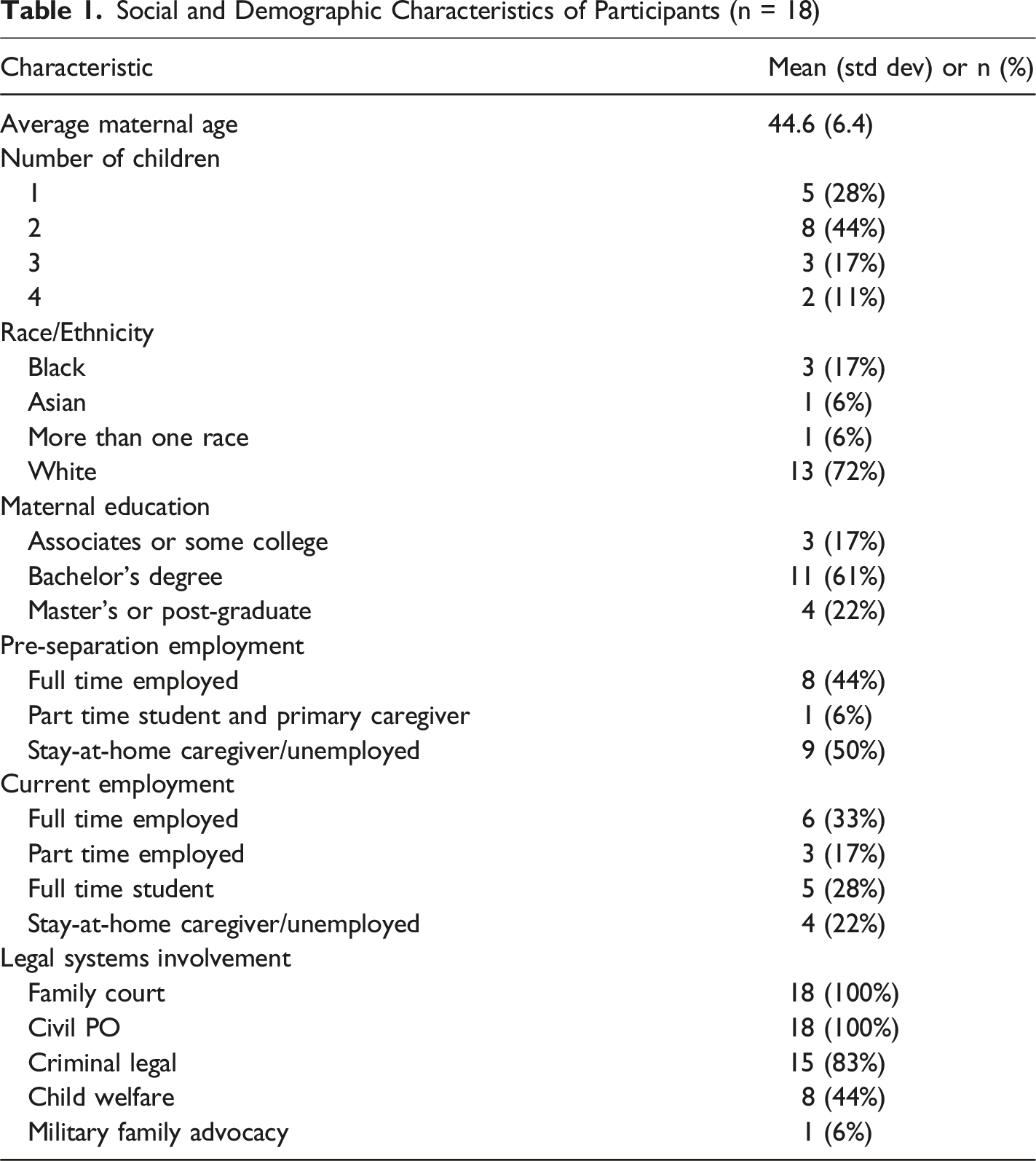
Recruitment, sampling, demographic information of participants, data collection, and ethical considerations for the parent study are detailed elsewhere (Spearman et al., 2024, 2025). Pseudonyms are used throughout this manuscript, which differ from pseudonyms used in other publications to prevent identification and promote confidentiality. Participants did not receive compensation for participation in the interviews, and most expressed hope and gratitude for the opportunity to share their stories so that they could be used to promote systems change and prevent similar harms to other mothers and children.
During semi-structured interviews, survivors’ decision-making and narratives of the confluence of the civil PO process and child custody emerged primarily in response to the following questions: (1) Can you tell me about your decision to separate? (2) Can you describe your court experiences around determining custody, parenting time, or access? For the present study, we used an inductive approach to thematic analysis as outlined by Naeem et al. (2023), deriving themes directly from the data.
Findings
Throughout participants’ narratives, a core paradox was identified. Maternal survivors of IPV with minor children described engaging legal systems to obtain safety from their abusive co-parents which unexpectedly led to increased precarity. This vulnerability resulted from both retaliation from perpetrators and state systems. Participants experienced increased insecurity due to inadequate or punitive legal system responses, and the financial burden and debts incurred through child custody and civil PO proceedings. This paradox forms the basis of our proposed theoretical model: Navigating protective precarity. Three central themes emerged from participant narratives: (i) fathers’ rights versus survivor safety; (ii) constrained survivor agency; and (iii) systemic unshielding (see Figure 1). Theoretical Model of Navigating Protective Precarity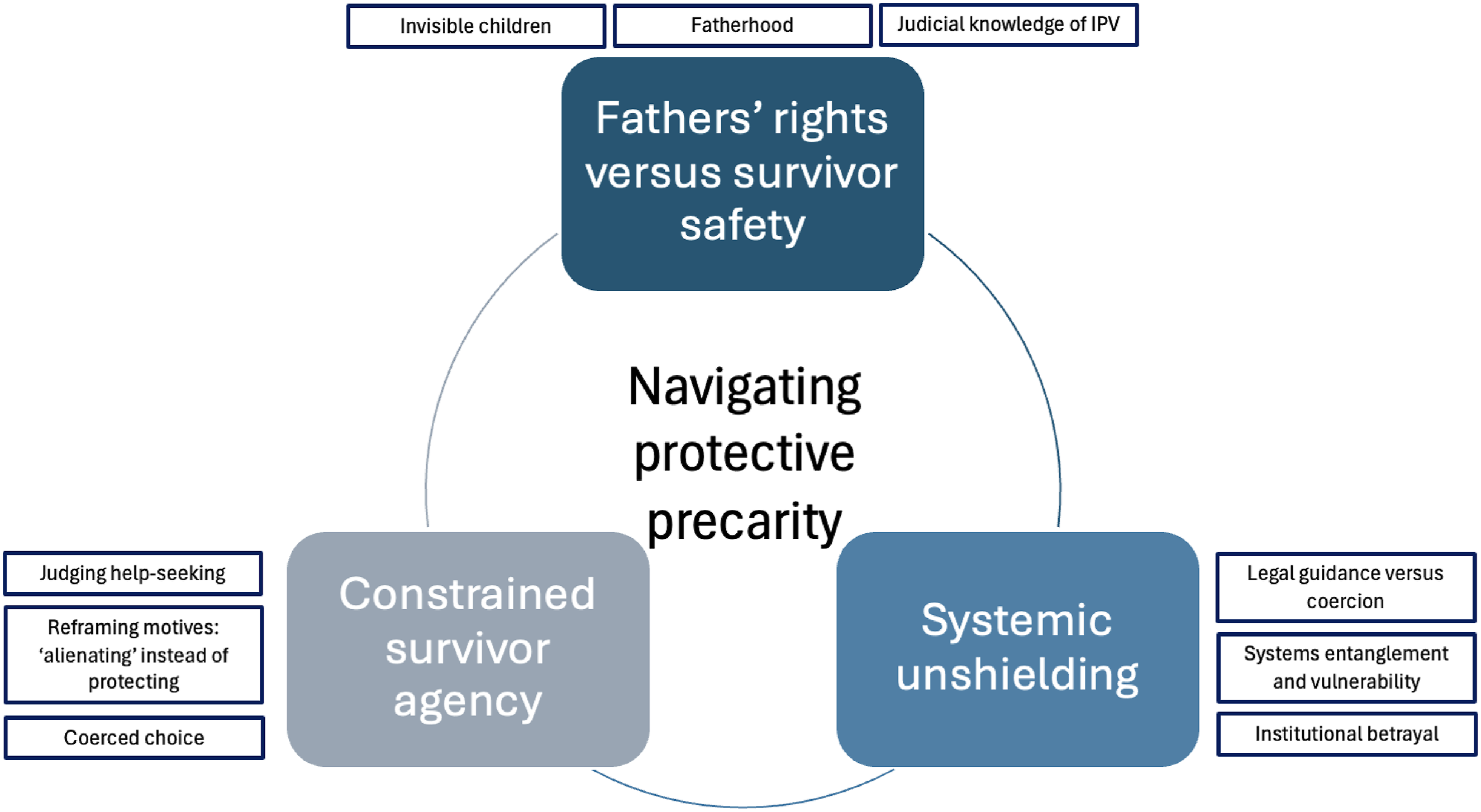
Theme 1. Fathers’ Rights versus Survivors’ Safety
The theme fathers’ rights versus survivor safety emphasizes the core tension that participants experienced in seeking safety from abusive co-parents. Every participant in our study voiced this concern, emphasizing their experiences of how courts prioritized fathers’ rights over their children’s and their own safety. The conflict between fathers’ rights and mother and children’s safety was described as a contributing factor in outcomes that increased survivor vulnerability. Through court processes and decisions, participants highlighted that pro-contact cultures within family courts relegated children’s safety needs as invisible. Courts prioritized fathers’ contact with their children, regardless of the child’s voice or safety needs, including in cases where the father had a documented history of violence or poor parenting. Lilianna, a mother to one child, described her experience: So, has [the PO] helped in my custody case? Absolutely none… They [family court judge] don’t have a nuance of a bad parent being, you know, associated with domestic violence. They just see parents’ rights, and that’s all they care about. They don’t see how that might affect a child.
Lilianna’s narrative highlights the invisibility of children (‘they don’t see…’), the prioritization of fathers’ rights, and the importance of judicial knowledge about the intersections of IPV, coercive control, and child safety. Prioritizing fathers’ rights resulted in court professionals ignoring, minimizing, and dismissing disclosures of abuse or documented reports of harm to children in family court proceedings. Courts were skeptical about interfering with fathers’ rights when POs were granted, as described by Melanie: “When I got the order of protection, the judge said… I had to then go and get an attorney and file for divorce because the judge was not going to infringe on his parenting time rights.”
Another participant talked about indirect messaging she received about the role of fatherhood, shedding light on how system actors prioritize fatherhood over the safety of mothers and children. Maya provided an example of a book left out in the waiting room while she was waiting to meet the court-appointed attorney (Minor’s Counsel) for her child, There’s only one book [in the waiting room at the office of Minor’s Counsel], and it was why fathers are important in their children’s lives. And I was like well…what about mothers, or where’s the one about seeking safety when you’re unsafe?..It didn’t seem like it mattered. It just seemed like it mattered that that the father was in in the picture.
For Maya, this messaging from her child’s attorney conveyed that fatherhood, and fathers’ rights were exalted over her and her children’s safety. The absence of books on motherhood and child safety further reinforced the notion of invisibility.
Participants also described the challenges of getting children covered under protective orders. Janna, a mom of four minor children, described how she received legal guidance from her own attorney to not have her children covered under a civil PO: “I was able to get an order of protection right away for myself. I had a lawyer…she said, ‘Don’t put the kids on it right now. Just do you, so we can protect you and the address and the dogs.’” Despite exposure to firearm threats, Janna’s attorney recommended protecting her address and pets, but not the children, rendering the children’s safety needs invisible.
Theme 2. Constrained Survivor Agency: “Stuck Between a Rock and a Hard Place”
Another theme that emerged from participants’ narratives was the constrained agency in their decision-making. Participants discussed how their help-seeking was judged, their motives were reframed, abuse was minimized or ignored, and they experienced coercion from both perpetrators and systems. ‘Choices’ that survivors made often led to subsequent new vulnerabilities, and participants detailed decision-making pathways loaded with structural harm such as threats of or actual loss of child custody and extensive economic losses. Within civil court proceedings regarding both POs and custody, legal system professionals consistently judged and blamed survivors, rather than focusing on the perpetrators’ use of violence, abuse, and coercion. Central to this problem was that court actors reframed survivors’ help-seeking motives as ‘alienating’ instead of protecting. Keisha, a mom of three minor children whose co-parent had a drug-related felony conviction, described the mother-blaming she experienced from the guardian ad litem: “Anything I do, I’m excoriated for. Anything he does, he’s praised for…Why are we coddling this individual? Protect my kids. You’re their attorney, not his.” Keisha elaborated how family court professionals ignored the abuse she and her children experienced, and prioritized her co-parent’s counter-allegations of ‘parental alienation’ in the aftermath of her help-seeking. Instead of adjudicating the abuse and safety concerns around her co-parent’s parenting, Keisha talked about how abuse allegations ‘disappear’ from family court proceedings. She highlighted this issue specifically when ‘alienation’ is alleged by abusive co-parents: “Why, when a woman alleges abuse against her and/or the kids...that ‘parental alienation’ gets to make that disappear or becomes the bigger claim?” Once Keisha’s help-seeking behavior had been reframed by her co-parent, his attorneys, and other family court professionals from seeking safety to accusing her of ‘alienating’ and ‘gatekeeping,’ she was told: “if this behavior didn’t stop, I would find myself with very limited to no custody very soon.” This coercion from family court professionals had a silencing effect, constraining her agency to continue to seek help for herself and her children to stop ongoing post-separation abuse.
Violet, a mom of two, described how the court granting a mutual PO increased her precarity: “He filed a counter protective order that is a 100% false which the judge has granted, which essentially changed nothing…but has only given him leverage and has also made me vulnerable.” Violet continued, illuminating how this increased vulnerability further constrained her agency to parent, set healthy boundaries, and promote her children’s well-being: “I feel like I’m stuck between a rock and a hard place. I feel like if I want to say no to protect [the children’s] mental health and well-being, then that’s being used against me.” Violet’s ‘rock and hard place’ was between setting boundaries that felt safe for her children, or risk being seen as an uncooperative co-parent. The risk of being seen as an uncooperative co-parent was substantial, as she was worried that would result in further loss of custody and inability to protect her children. Violet detailed that she “could not get the judge to put [the children] on the protective order, so it only covered me.” A criminal case was ongoing for domestic assault and battery for non-fatal strangulation, and a family court judge had not yet adjudicated child custody. Violet talked about the role of the guardian ad litem in recommending and deciding temporary child custody arrangements while the criminal and family proceedings were ongoing: “I don’t understand how you can strangle your wife [in autumn]. Get Christmas with your kids. Get both the [children’s] actual birthdays with them, and then [in spring] be rewarded with 50 50 parenting.” Despite how her co-parent perpetrated near-lethal violence (non-fatal strangulation) against her while her children were in the next room, family court professionals prioritized her co-parent’s parenting rights, “rewarding” him with custody and parenting time on days that were important to her and the children (Christmas and the children’s birthdays).
Monika, a mom of two who had experienced severe violence, sexual assault, and firearm threats from her co-parent was granted a 2-year PO after separating. Monika discussed how even though she had received this PO, it did not help her protect her children during child custody proceedings, You think the judge didn’t give a damn. Neither did the kids' attorney. She wrote nothing in my report about abuse. Nothing! No, kids are hardly ever protected. It’s like co-parent with this abuser, but stay away. He used it [the PO] against me. He will say, oh, I didn't want him around the kids. He used it against me.
The mothers in our study reported that seeking and obtaining POs was frequently interpreted by court professionals as an “alienating” behavior and was “used against” them; despite these mothers seeking safety from severe and high lethality risk forms of violence (strangulation, firearm threats). Mothers who had not experienced severe physical violence, but continued to experience detrimental coercion, emotional, financial, and litigation abuse discussed how it was difficult to help family court professionals understand the harms their children were experiencing. This resulted in constrained agency, coerced choice, and increased precarity.
Theme 3. Systemic Unshielding: “Peeling Back Protections”
Systemic unshielding refers to how institutions and court professionals roll back previously granted protection for survivors. When granted a PO, survivors described initially positive feelings and benefits, including validation and hope. However, later, rather than validation, survivors described experiences of blame and loss, leading them to feel increasing vulnerability. Keisha described, I came out of the situation, so full of hope, especially after I got my injunction, that, oh, my God! I'm being seen, I'm being heard, we’re being protected! And then I got kicked in the face, and it was like, Oh, my God!..they [family court professionals] just kept peeling back my protections, telling me, oh, no, you're not allowed that anymore.
For Keisha, the positive initial impact of the PO was replaced by the lived experience of increasing precarity dictated by systems that she hoped would protect her and her children. The “peeling back” of protections and boundaries included, for example, removal of safe custody exchanges and increasing the time that the children spent with their abusive parent. Some participants who had been granted civil POs described how family court professionals overrode safety provisions in granted POs or coerced them to drop their POs, demonstrating systemic unshielding. Melanie described, “the reunification therapist actually tried to force me to drop the order of protection.” Participants also described how they were viewed as ‘uncooperative’ co-parents after obtaining civil POs. Erin, a mom of two, described how she had obtained a PO that gave her temporary custody of her children. However, the same judge who had issued the PO then granted sole custody to the father during family court proceedings: It was the same judge that signed the protective order, he totally reversed the entire thing… He said that he felt like my ex would be the more cooperative parent. Even though we had evidence that he was not cooperative. And that I was cooperative. And I did appeal that decision. $20,000 to you know the state Supreme Court, and they did not change it. They let it stand.
Erin highlighted increased vulnerability, institutional betrayal, and trauma that mothers and children may face in the aftermath of obtaining a PO: It [family court] is a particularly traumatic and demeaning experience. Because you go in there thinking well, when they see the video of him, abusing the children, when they hear the therapist say the children reported abuse. When they see on paper that the children and I were coercively controlled, financially, and all these other things. Someone will help me, and then you get there [family court], and they take your kids away because you said something about it. And it destroys you as a parent, because you're doing the best you can. And you and your children are punished for it, and now they have to live with the abuser by themselves. And if I had thought for one second that he would get full custody, I would have stayed and let him kill me.
Erin and her children’s experiences of structural harm in the aftermath of obtaining a civil PO illustrate the constrained agency, profound sacrifices, and life-threatening precarity that characterize the realities that survivors are often forced to navigate.
Discussion
This analysis demonstrates the complexities survivors confront when navigating protective precarity, highlighting the ways in which the civil PO process made life more vulnerable for the mothers and children it was intended to safeguard. It also explains how decision-making and choices are constrained by structural actors (e.g., family court professionals) and conditions that can lead to subsequent harm. Herein lies the ironic concept of protective precarity: the instability and vulnerability experienced by maternal survivors with minor children through the very legal processes mobilized to obtain protection. Women may hope they will be ‘protected’ through seeking POs, yet the process exposes them to increased risk, retaliation, restricted freedoms, and reinforced structural inequities (Durfee, 2021). Our theoretical model Navigating Protective Precarity (Figure 1) offers researchers and practitioners a model to illuminate the constrained realities and systemic pressures facing survivors who try to protect their children and themselves from an abusive co-parent.
Precarity is a gendered reality and social condition that is reproduced by political, legal, social, and economic institutions, highlighting the ways that vulnerability is intersectional and differentially distributed, rendering some populations more subject to violence than others (Butler, 2009; Crenshaw, 1991; Richie, 2012). Legal mechanisms such as POs are intended to increase safety and provide protection. Theoretically, this would minimize the conditions of precarity for survivors. However, these legal mechanisms often replicate broader social inequalities (Durfee, 2021). Mothers of minor children seeking safety from their abuser face risks at the confluence of parenting rights, fatherhood, and gendered discrimination rooted in the socially held concept of motherhood. Gueta and Condry (2024) posit that one of the most dominant discourses around motherhood is mother blaming. Mothers in our study identified that when their help-seeking behaviors were reframed by court professionals to be ‘alienating’ rather than protective it was a significant source of harm that contributed to precarity.
This study expands our understanding of de facto judicial responses to mothers with minor children seeking safety from abusive co-parents. Other scholars have noted that judges and legal system professionals may interpret mothers seeking POs as trying to gain an advantage in custody proceedings, or voice concern about false complaints in civil POs used to obtain sole custody of children (Agnew-Brune et al., 2017). Because of lengthy waiting periods in family courts, and the extensive financial burden of family court proceedings to decide child custody, Agnew-Brune and colleagues (2017) described how judges in their qualitative study voiced concerns that parents were using civil POs as a mechanism to bypass the family court process rather than seeking the order due to a need for safety.
Our study further juxtaposes the intended benefits of the legal system in supporting survivors and their children with the lived experiences of individuals. Survivors face complex considerations when navigating safety, including their fear of and retaliation from perpetrators and systems. Our findings are consistent with other scholars who have identified the no-win situations and systems entanglement faced by maternal survivors of domestic violence (Fleury-Steiner et al., 2016; Hester, 2011; Saunders & Oglesby, 2016), the reluctance of judges to prohibit contact for children with their abusive fathers (Rosen & O'Sullivan, 2005), and the loss of child custody in family courts for mothers who allege abuse when their co-parent alleges parental alienation (Meier, 2020).
Child visitation and custody exchanges are known risky times for maternal survivors (Fleury-Steiner et al., 2016) and for children (Lyons et al., 2020). Participants described fear that resulted when family court professionals “peeled back” their protections these survivors had put in place to increase their own sense of safety and for the safety of their children, including through granted POs.
Another important finding in this study was that the PO process reveals a structural mismatch. Children are often central to adult survivors’ decision-making in leaving and help-seeking (Hefner et al., 2025), but legal remedies focus on the rights of adults. While temporary custody may be granted in POs in some jurisdictions, “permanent” or long-term custody arrangements are decided through adjudication or settlement in family court child custody proceedings. Gaps in these systems, competing priorities, and implicit biases around intent and motivations can render children legally invisible, without a voice, and unprotected.
Our developed theoretical model (Figure 1) can be utilized as a framework to support mothers with minor children with seeking safety, and inform research, practice, and policy change. Our model can help translate these findings into praxis, highlighting where structural change is needed to facilitate justice and safety for children and mothers. This model can be used as a basis for the development and implementation of targeted interventions meeting the special needs of mothers and children seeking protection. The majority of states confer judges the legal authority to include custody and child-related relief within civil POs, yet judges often do not exercise that authority (National Council of Juvenile and Family Court Judges, 2025). Given the frequent exclusion of children from these civil legal safety frameworks, the conflict between parenting rights and child protection, and the coercive influence of court professionals on survivors’ decisions, legal professionals play a crucial role in eroding, promoting, or maintaining safety.
Important practice implications arise from these data. Parenting time provisions in family court orders should reflect safety mechanisms in granted POs rather than undermine the safety of survivors. Seeking protection for a child or themselves through a PO should never be “used against” a protective parent. Likewise, a survivor’s decision not to seek a PO should not be interpreted by legal professionals as evidence that abuse did not happen or was not severe, as survivors weigh the costs and benefits of such actions and may judge seeking a PO to be too risky. Eliminating retaliatory practices in family courts that result in loss of child custody for protective parents, such as removing custody from survivors of domestic violence due to perceived ‘gatekeeping’ or ‘parental alienation,’ is crucial systemic change that is needed. Safe, supportive, and nurturing relationships are critical safeguards to help children overcome adversity and trauma (Merrick, 2020), and removing children’s relationship with a caregiver who sought to protect them from abuse exacerbates harm to children.
Judicial training on IPV to increase awareness and knowledge on the nuances of IPV, coercive control, and child maltreatment is urgently needed for family court judges and other family court professionals including custody evaluators, best interest attorneys, and supervisors (Gutowski & Goodman, 2023; Lapierre et al., 2024). This training must be accompanied with enhanced accountability and transparency (Bagwell-Gray et al., 2025; Hefner et al., 2025). Our findings also highlight the importance of coordinating community responses to IPV to mitigate the systems entanglement survivors experience. Coordinated community responses developed in response to survivors’ observations that information and process gaps among varying legal system responses enabled perpetrators to escape accountability (Warrier & Lizdas, 2022). While such coordination among systems is helpful, they have primarily focused on the criminal justice response (Warrier & Lizdas, 2022) rather than holistically examining civil, criminal, and child welfare involvement. Specialized domestic violence courts and Family Justice Centers (Gwinn et al., 2007) are examples of potential solutions that could be more widely adopted.
A limitation of our study is that we do not have the perspectives of the attorneys and legal professionals who offered advice to survivors on why different recommendations and decisions were made. This is an important area for future inquiry. Future research should also focus on understanding the barriers to covering children under POs, and the intersections with family law, child welfare, and criminal legal systems.
Conclusion
Protection orders are an important, commonly used safety strategy for victim-survivors of IPV and their children. It is important to understand survivors’ decision-making and experiences of how seeking POs influences subsequent experiences regarding child custody. This study highlights the precarious situations survivors experience within family courts and from family court professionals when they seek to protect themselves and their children from abusive co-parents. Our findings suggest the need for systems change that better integrates safety mechanisms offered through civil POs with parenting time provisions in family courts.
Footnotes
Acknowledgements
We would like to thank the participants and the advocates who helped in recruitment.

Author Contributions
All authors have agreed on the final version and meet at least one of the following criteria (recommended by the ICMJE*): (1) substantial contributions to conception and design, acquisition of data, or analysis and interpretation of data; (2) drafting the article or revising it critically for important intellectual content.
Funding
The authors disclosed receipt of the following financial support for the research, authorship, and/or publication of this article: Research reported in this presentation is supported by the Eunice Kennedy Shriver National Institute of Child Health & Human Development of the National Institutes of Health under Award Number F31HD111297. The content is solely the responsibility of the authors and does not necessarily represent the official views of the National Institutes of Health. Funding was also provided through a Johns Hopkins School of Nursing Discovery and Innovation Grant. Qualitative data in this presentation was obtained under JHU IRB approval (IRB00336841) “Understanding the impact of post-separation abuse on children’s health and flourishing”
Declaration of Conflicting Interests
The authors declared no potential conflicts of interest with respect to the research, authorship, and/or publication of this article.