




Abstract
The influence of the patriarchal family environment on deviance has been limited to offline harassment perpetration. This study examines its impact on online harassment perpetration, incorporating moderating effects of differential association with peers engaging in online harassment and low self-control. Students attending universities in Seoul, South Korea, were surveyed about online harassment perpetration via smartphones. The OLS regression analysis of a sample of 301 students reveals that the patriarchal family environment is significantly associated with online harassment perpetration, with a notably more pronounced effect among men. Additionally, peer association showed enhancing effects, but this was significant only among women.
Keywords
Introduction
As cybercrime has emerged as a new social problem, numerous attempts to explain the nature of this novel phenomenon have developed it into a major research area in criminology. Online harassment, a subtype of cybercrime, has become a common problem for many individuals and groups in contemporary society (Marcum & Higgins, 2019; Patchin & Hinduja, 2022). Defined as threats or engaging in other offensive behaviors online (Jones et al., 2013), online harassment includes sending threatening or unwanted sexual content through various online platforms (Finkelhor et al., 2000; Holt et al., 2012). Additionally, as online activities have become a part of daily life with the development of smartphones and various spaces for online interaction, social network services (SNS) are the most common places for online harassment with exclusion, alienation, and bullying, perpetrated mainly in online spaces by real-life friends (Marcum et al., 2014).
Statistics underscore the prevalence of these behaviors and gender differences among perpetrators. The 2022 School Crime Supplement (SCS) to the National Crime Victimization Survey reported that approximately 39.0% of students aged 12–18 were bullied. Among those, 21.6% indicated that the bullying took place online or through text (National Center for Education Statistics, 2024). In South Korea, a national survey on victimization and perpetration of cyber violence conducted in 2023 revealed that 40.8% of adolescents and 8.0% of adults experienced cyberbullying. Among adolescents who reported experiencing cyberbullying, 19.3% acknowledged engaging in it. A breakdown by gender indicated that 25.0% of boys and 13.2% of girls reported perpetration. Similarly, among adults who experienced cyberbullying, 2.2% admitted perpetrating it, with 2.5% of men and 1.9% of women reporting perpetration (Korea Communications Commission & National Information Society Agency, 2023).
Research interest in these behaviors has grown since Olweus’s early attempts to define cyberbullying (Olweus, 1993), which is a form of cyber-deviant behavior that is synonymous with online harassment (Choi et al., 2022). Studies have applied traditional criminological frameworks, such as strain, social learning, and low self-control to elucidate the underlying cause of online harassment within anonymous relationships in online expanded networks (Holt et al., 2012; Jun, 2020; Lee et al., 2021; Li et al., 2016; Lianos & McGrath, 2018; Patchin & Hinduja, 2011; Wang & Ge, 2021). This study adds to the literature by introducing the patriarchal family environment as a risk factor for online harassment perpetration.
Patriarchal factors, such as the patriarchal family environment and patriarchal peer support, are primarily used to explain men’s sexual violence against women (Franklin et al., 2012; Goodson et al., 2021; Hunnicutt, 2009). These factors have also been shown to predict other violent offenses among young adults and adolescents (Eitle et al., 2014; Jung et al., 2024) and bullying in Korea (Lee, 2011). Research indicates that individuals in patriarchal family environments tend to exhibit higher risk preferences and lower perceptions of risk (Hirtenlehner et al., 2014), while bullying often functions as a tool of patriarchal dominance (Olthof et al., 2011; Sijtsema et al., 2009). From this, it can be inferred that patriarchal environments foster violence or harassment as an externalization of criminogenic traits, such as higher risk preferences, and as a means of gaining status, power, and fame among peers. Despite the increasing convergence between online and offline forms of harassment attributable to the widespread use of the Internet, there has been a notable absence of studies examining the association between the patriarchal family environment and online harassment perpetration (see Holt & Steinmetz, 2021). Therefore, this study primarily focuses on exploring this relationship.
This study emphasizes understanding gender differences in these associations. According to the power-control theory, traditional gender roles within the patriarchal family environment tend to discourage delinquency among adolescent girls while encouraging delinquency among adolescent boys (Hagan et al., 1987). Our study aims to analyze gender differences in risk factors for online harassment perpetration and discuss implications and potential countermeasures. Specifically, we focus on the patriarchal family environment as a primary risk factor for online harassment perpetration and investigate whether its effects differ between men and women. Additionally, we examine whether the moderating effects of differential association with peers engaging in online harassment and low self-control differ by gender. In the subsequent sections, we review existing literature on online harassment to formulate research questions related to these gender differences.
Literature Review
Patriarchal Family Environment as a Possible Cause of Online Harassment Perpetration
Conventional criminology has historically overlooked female criminality and the role of patriarchy in crimes by and against women (Lilly et al., 2018), where patriarchy is defined as the “hierarchical organization of social institutions and social relationships that allows men to maintain positions of power, privilege, and leadership” (DeKeseredy & Schwartz, 1993, p. 396). The second wave of the women’s movement in the 1960s and 1970s challenged this oversight, initially focusing on explaining the narrowing gender gap in crime rates and later drawing attention to patriarchy (Daly & Chesney-Lind, 1988). Early feminists emphasized the importance of patriarchy in explaining crimes against women, particularly domestic and sexual violence (Dobash & Dobash, 1979; Yllö & Bograd, 1988), arguing that male violence against women stems from a desire to maintain dominance in a patriarchal society. This perspective suggests that men, empowered by patriarchy in a gender-unequal society, commit violence to exercise power and control over women.
This argument extends to explaining general violence perpetrated by men, including male-on-male violence, claiming that violence is a tool to dominate and express masculinity (Messerschmidt, 1993; Morales et al., 2016). Previous studies have argued that men who pursue hegemonic masculinity are more likely to commit crimes such as violence (Mahalik et al., 2005; Messerschmidt, 1986; Richardson & Hammock, 2007). Additionally, Carrera-Fernández et al. (2018) indicate that bullying in secondary education settings during 2008–2009 is a “strongly gendered phenomenon.” Boys performing hegemonic masculinity often bully male peers and utilize them as instruments of control to assert dominance over girls, while simultaneously portraying themselves as protector heroes. In contrast, girls performing hegemonic femininity tend to control their female peers through everyday meanness, positioning themselves within sexual hierarchies that emphasize decent sexuality, appearance, and behavior to construct and control desirable femininity (Carrera-Fernández et al., 2018). Accordingly, the patriarchal family environment, which reinforces hegemonic masculinity for boys and traditional femininity for girls, may contribute to delinquent behaviors. In other words, men with a sense of patriarchy use violence as a tool to achieve their goals of subjugating, dominating, and controlling opponents who challenge their authority. This is particularly evident in male bullying offenses, as bullying is a process of pursuing social control to gain dominant power in peer groups (Olweus, 1993; Smith & Brain, 2000).
Interest in gender differences related to the patriarchal family environment is largely due to the emergence of Hagan’s power-control theory (Hagan et al., 1979, 1987). This theory asserts that the effect of the patriarchal family environment differs between boys and girls. Specifically, the theory argues that imbalanced power relations between parents, constructed by their labor force participation, produce patriarchal gender-role beliefs and lead to differences in parental control and supervision of sons and daughters. Sons, receiving less supervision than daughters, are socialized to face danger with toughness, whereas daughters are socialized to avoid risk and internalize the submissive role of their mothers. Thus, in patriarchal households, sons are more likely to commit delinquency, whereas daughters are less likely to commit delinquency. Most empirical tests of power-control theory have indicated that the effect of the patriarchal family environment is more significant in predicting delinquency in boys than girls (Blackwell & Piquero, 2005; Eitle et al., 2014; Grasmick et al., 1996; Hadjar et al., 2007; Lee, 2011).
Since the power-control theory was designed to explain the gender gap in common forms of deviant behaviors, few studies have examined the applicability of the patriarchal family environment and power-control theory to cybercrime, a specific type of crime (Holt & Steinmetz, 2021). With the rise in internet use and the expansion of online interaction platforms, the online network is increasingly seen as an extension or integral part of reality, allowing people to connect with offline acquaintances (Näsi et al., 2011). Although online harassment presents unique risk factors due to its specific nature, studies have found significant overlaps and connections between offline bullying and cyberbullying (Baldry et al., 2016; Casas et al., 2013). It is generally argued that bullying is a computational act for gain rather than impulse (Reijntjes et al., 2013) in that it is an act to secure social dominance, fame, and status (Olthof et al., 2011; Sijtsema et al., 2009). In other words, in modern society, where online interaction intersects with offline interaction, online harassment can be seen as a result of patriarchal authoritarian thinking about domination or punishment, similar to offline harassment.
Differential Association with Peers Who Harass Online and Low Self-Control as Moderators and Gender Differences in Their Moderating Effects
Many previous studies have argued that differential association with other lawbreakers is the most significant risk factor for crime and delinquency (Warr & Stafford, 1991). Social learning theory argues that criminal behavior, like other behaviors, is learned through social interactions with others, particularly with deviant peers (Akers, 1985). When a person primarily associates with lawbreaking friends, they learn and internalize definitions favorable to violating the law, eventually leading to criminal behavior. Differential association with peers who engage in cyber delinquency has been identified as one of the most significant risk factors for cyber delinquency (Higgins et al., 2007; Holt et al., 2012; Miller & Morris, 2016; Skinner & Fream, 1997), including online harassment and cyberbullying (Jones et al., 2013; Kim et al., 2022; Li et al., 2016; Sasson & Mesch, 2017). According to social norms theory, people tend to adopt the norms prevalent among their peers (Berkowitz, 2005). Thus, individuals who associate with peers engaging in online harassment learn attitudes, beliefs, and definitions favorable to such behavior, leading them to commit these acts individually or collectively, influenced by their learned norms. Although online harassment is often anonymous, perpetrators might also want to share their experiences of committing harassment to gain acceptance and validation from their peers.
A general theory of crime argues that adolescents with low self-control are more likely to commit delinquency and crimes (Gottfredson & Hirschi, 1990). Indeed, studies have found that adolescents are prone to commit crimes because they struggle with delaying instant gratification and impulsivity (Gibbs & Giever, 1995; Pratt & Cullen, 2000). Low self-control may also be an important risk factor for online offenses. The anonymity of cyberspace creates an ideal opportunity to commit crimes, where individuals may act more impulsively. Consequently, those with low self-control can easily commit offenses with a single click, unable to adequately control their behavior. In contrast, people with high self-control are less likely to commit offenses by controlling themselves, even in crime-inducing environments. Previous studies have suggested that low self-control is a major risk factor for various cybercrimes, such as online harassment and cyberbullying (Holt et al., 2012; Kim et al., 2022; Lianos & McGrath, 2018).
Research on gender differences in the effects of the two predictors, differential association with peers and low self-control, has been mixed. First, although some studies have shown that the influence of differential association with deviant peers on deviance is more significant for boys (Mears et al., 1998; Piquero et al., 2005), most studies indicate that girls are more significantly influenced in comparison to boys (Haynie et al., 2014; Heimer, 1996; McGloin & O’Neill Shermer, 2009; Steketee et al., 2013; Zimmerman & Messner, 2010). Second, the influence of low self-control on deviant behaviors, including online harassment, is generally similar between males and females (Baek et al., 2016; Burton Jr et al., 1998; Shekarkhar & Gibson, 2011); however, some studies have found evidence of gender differences indicating that low social control is only a significant predictor of crime for boys and men (Burton Jr et al., 1998; Steketee et al., 2013).
The influence of differential association with peers and low social control on online harassment may also differ by gender. Given that boys’ offenses are more related to the presence of low self-control (Choi & Kruis, 2020), it may be that boys find the online environment, which allows for immediate and direct harassment, to be an ideal opportunity for perpetuating online harassment. In contrast, girls who are more influenced by deviant peers (Marcum et al., 2014) may be more likely to engage in online harassment collectively with friends or, even when acting individually, tend to follow their peers’ norms. In other words, deviant peers may predict online harassment offenses among girls, whereas low self-control may predict offenses among boys.
Current Study
This study examines the patriarchal family environment as the main cause of online harassment. It posits that individuals raised in patriarchal environments are more likely to commit online harassment driven by motives of power and dominance. In addition, differential association with peers engaging in online harassment and low self-control—variables frequently highlighted in earlier studies on online harassment—are treated as moderating factors with enhancing effects. In other words, this integrated perspective posits that individuals within patriarchal family environments are more likely to commit online harassment under the conditions of peers engaging in online harassment and low self-control. Based on these considerations, the research questions for this study are as follows.
How is the patriarchal family environment associated with online harassment perpetration among men and women, respectively?
Does differential association with peers engaging in online harassment enhance the association between the patriarchal family environment and online harassment perpetration?
If so, does the moderating role of differential association with peers engaging in online harassment vary between men and women?
Does low self-control enhance the association between the patriarchal family environment and online harassment perpetration?
If so, does the moderating role of low self-control vary between men and women?
Methods
Participants
This study examines online harassment via smartphones, utilizing data from a 2018 survey conducted among young adult university students attending universities in Seoul, South Korea. University students were chosen as the target sample due to their high frequency of smartphone usage, particularly among individuals in their late teens and twenties (Pew Research Center, 2021), and their accessibility within this age group. The survey was conducted over two weeks in July 2018, with approval from the Institutional Review Board of Soongsil University. Participants were informed that their participation was completely voluntary, and their responses would be treated as confidential and protected by the law. All respondents provided consent, and the questionnaire was administered in Korean.
Five universities in Seoul were randomly selected from each cardinal direction—north, south, east, west, and center. After selecting the target universities, the researchers employed a quota sampling method and conducted in-person surveys, considering participants’ gender, birth year, and major as demographic subgroups. The demographic composition of these subgroups was determined using the 2017 Statistical Yearbook of Education in Korea. Five graduate and undergraduate students from Soongsil University’s Department of Information Sociology visited the selected campuses, recruited respondents in person, and conducted paper-based surveys. Respondents self-reported their responses, with approximately 60 students randomly chosen per university. As an incentive, participants received a coffee coupon upon completing the survey. Among the 304 respondents who completed the study, 301 smartphone users were selected as the final participants for the analysis.
Measures
As the dependent variable in this study, online harassment perpetration was measured using representative online harassment behaviors, such as insult/defamation, stalking, and sexual harassment (Bossler et al., 2012; Slaughter & Newman, 2022; Willard, 2007). Respondents were asked whether they had engaged in the following while using their smartphones in the previous year: (1) cursing, using insulting language, or spreading rumors about others; (2) continually sending messages or posting comments despite the person’s lack of consent; and (3) sexually harassing others by sending obscene messages, photos, and video clips (0 = no, 1 = yes). The sum of the three parameters was used.
According to the power-control theory, the patriarchal family environment, the independent variable of this study, is reflected by the amount of authority each parent has in the workplace (Hagan et al., 1987). However, we tried to identify this variable more substantively and directly by measuring the power relationships between mothers and fathers, as well as between parents and children, as suggested by Hirtenlehner et al. (2014) and Lee (2011). Therefore, we used three questions to measure the patriarchal family environment: “My father dominates my mother,” “My father’s authority is so great that other family members are subservient to him,” and “My parents do not consider their children’s opinions; instead, they make decisions arbitrarily.” Respondents answered these questions on a five-point scale ranging from “strongly disagree (=1)” to “strongly agree (=5).” The summed score of these responses was used, resulting in Cronbach’s alpha of 0.845, indicating high reliability.
To measure differential association with peers engaging in online harassment, one of the moderating variables of this study, we adapted the measurement used by previous literature into a binary format (Warr, 2002; Warr & Stafford, 1991). We asked respondents whether they had a close friend who had committed each type of online harassment in the previous year (i.e., insult/defamation, stalking, sexual harassment; zero = no, 1 = yes). The sum of the three parameters was used for the analysis.
To measure low self-control, we used a shortened version of the scale developed by Grasmick et al. (1993), which originally consisted of 24 questions (6 characteristics of low self-control × 4 questions). For practical reasons related to the questionnaire’s length, we selected two questions from each of six characteristics: impulsivity, risk-seeking, simple tasks, physical activity, self-centeredness, and volatile temper. For example, questions included “I often act on impulse,” which respondents answered on a five-point scale ranging from “strongly disagree (=1)” to “strongly agree (=5).” The summed score of the 12 questions was used, yielding a Cronbach’s alpha of 0.815, indicating high reliability.
We also included measures of gender, age, and perceived family socioeconomic status. For gender, respondents were asked if they identified as female or male. For age, respondents answered questions about their birth year, which we recoded as actual ages. For perceived family socioeconomic status, respondents assessed their family’s status based on a scale of 1–5: “low (=1),” “middle-low (=2),” “middle (=3),” “middle-high (=4),” and “high (=5).”
Plan of Analysis
This study analyzed four research questions using two analytical models segmented by gender. The baseline model examined the effect of the patriarchal family environment on online harassment by gender, controlling for socio-demographic variables. The full model incorporated interaction terms involving differential association with peers engaging in online harassment and low self-control and tested the moderating effects, controlling for socio-demographic variables. The interaction terms were mean-centered to mitigate multicollinearity. We conducted Ordinary Least Squares regression analysis using SPSS 24.0.
Results
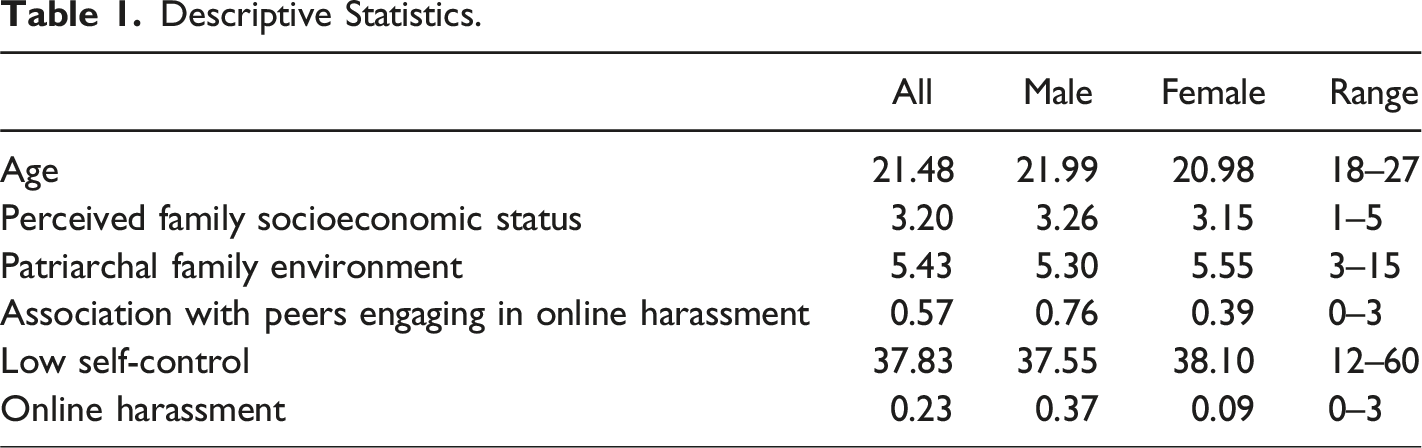
Descriptive Statistics.
OLS Regression Results Predicting Online Harassment Perpetration Across Gender.
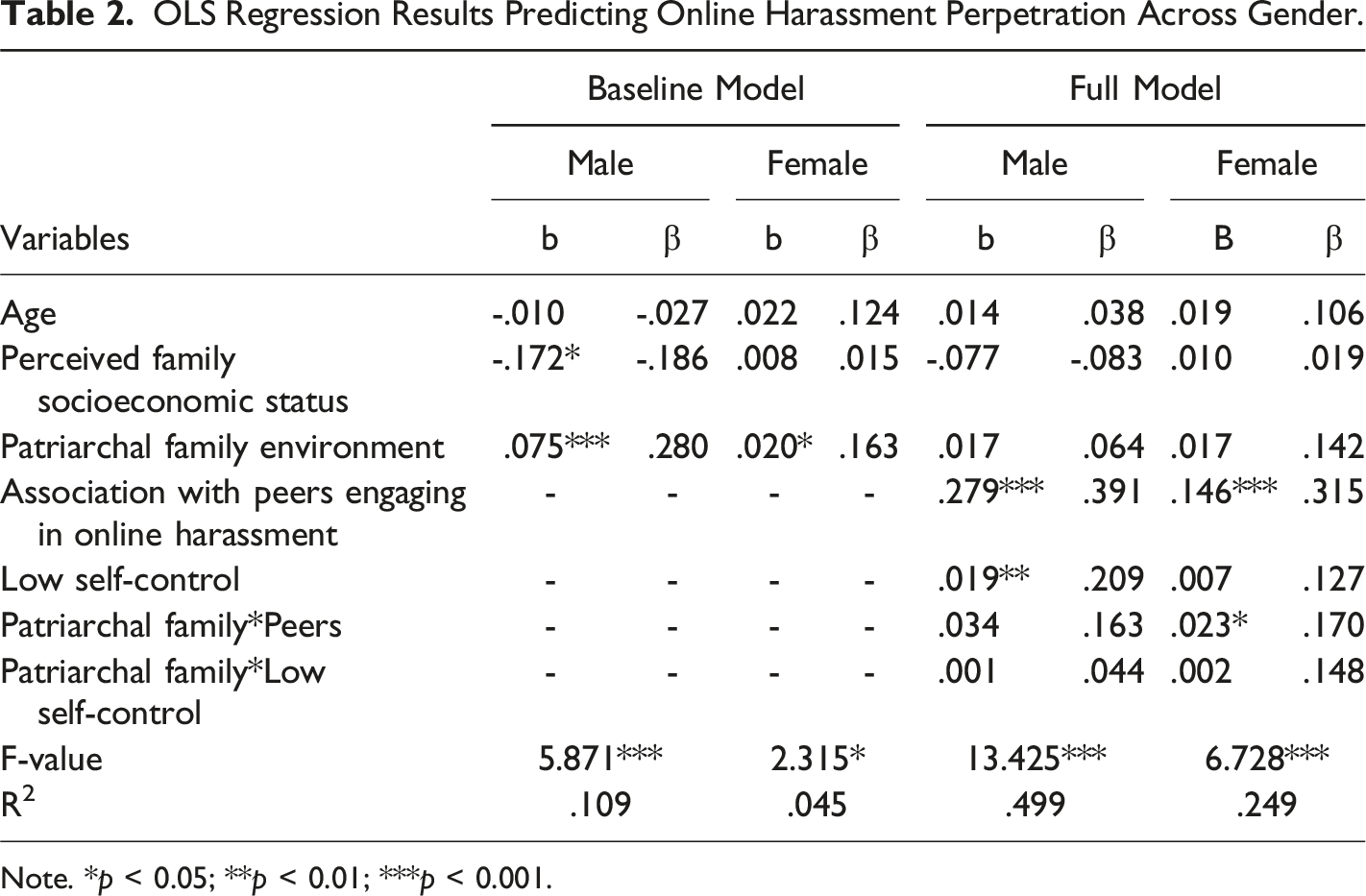
Note. *p < 0.05; **p < 0.01; ***p < 0.001.
The full model examines the interaction effect of the two moderating variables—the differential association with peers engaging in online harassment and low self-control—on the relationship between the patriarchal family environment and online harassment, stratified by gender. The R-square value increased by approximately 39.0% in the male model and 20.4% in the female model. Moreover, the independent associations of the main variables with online harassment show that the patriarchal family environment is not significantly associated with online harassment in either men or women. In addition, the differential association with peers engaging in online harassment exhibits a positive and significant association with online harassment among both men and women (p < .001). The findings reveal that low self-control is positively and significantly associated with online harassment among men (p < .01), suggesting that lower self-control of men corresponds to an increased likelihood of online harassment perpetration.
Examining the results of the interaction effect between the patriarchal family environment and moderating variables, which is the main focus of this study, the interaction effects between the patriarchal family environment and differential association with peers engaging in online harassment are positively significant only for women (p < .05). This significant interaction implies that the greater the differential association with peers engaging in online harassment experienced by young adult women, the stronger the impact of their patriarchal family environment on their online harassment perpetration. In contrast, the interaction between the patriarchal family environment and low self-control shows no significant effect for either women or men.
Discussion and Conclusion
The current study investigates the patriarchal family environment as a primary determinant of online harassment perpetration, exploring whether individuals in patriarchal family environments are more likely to commit online harassment. It also considers differential association with peers engaging in online harassment and low self-control—two extensively studied risk factors—as moderating variables to explore their interaction with the patriarchal family environment. Above all, this study examines potential gender differences in the effect of the patriarchal family environment and the interaction effects of moderating variables.
The impact of the patriarchal family environment on online harassment revealed statistically significant results across both genders, especially among men, when not accounting for the moderating effects of differential association with peers engaging in online harassment and low self-control in the model. This result aligns with previous research, suggesting that males in patriarchal environments are more likely to commit online harassment compared to those in egalitarian family environments, driven by motives of dominance and power (Caravita et al., 2012; Lee, 2011). Additionally, as suggested by the power-control theory, sons in patriarchal families may engage in riskier behaviors with less fear of consequences, such as official punishment, due to less control from their parents (Hagan et al., 1987).
However, in contrast to the power-control theory's assertion that girls in patriarchal households are less likely to commit delinquency compared to those in egalitarian households, this study’s findings indicate that young adult women from patriarchal households are more likely to engage in online harassment than their counterparts from less patriarchal households. One potential explanation for this could be that while power-control theory focuses on real-world delinquency among adolescents, this study examines online harassment perpetration among college students in their twenties. Young adults in their twenties often experience greater freedom from parental supervision compared to adolescents and perceive online harassment perpetration as more feasible due to the anonymity it provides. Therefore, women college students from patriarchal backgrounds may be addressing the strains of their repressive family environments during adolescence through online interactions as adults.
Another emphasis of this study is the independent and interaction effects of the two moderators across genders. First, differential association with peers engaging in online harassment was the most positively significant factor for both men and women. This suggests that the influence of peers who engage in online harassment is substantial not only for women who are involved in collective forms of harassment but also for men who engage in individual forms of harassment. Even if men individually commit online harassment, they may be influenced by friends who have engaged in similar behaviors.
However, the interaction effect of peers engaging in online harassment was significant only among women. This aligns with previous research on the interaction effect of differential association with peers engaging in online harassment on the association between general strain and delinquency (Botchkovar & Hughes, 2010; Morash & Moon, 2007). Given the comparatively subdued effect of the patriarchal family on women’s online harassment, it becomes apparent that the young adult women in our sample exhibit an increased likelihood of engaging in deviant behaviors, especially when they associate with deviant peers. Considering the propensity of women engaging in relational offenses compared to men, peers engaging in online harassment may play a vital and supportive role for women from patriarchal families to engage in such activities. They may choose to perpetrate online harassment as a convenient tool of rebellion against parental control, given its lower detection risk when compared to offline activities. Additionally, since the peer association variable measures the behaviors of a best friend rather than a broader peer group, this finding indicates that the influence may stem from a close relationship with a best friend, not necessarily from a larger peer group. This nuanced understanding suggests that the influence of a close friend may be pivotal for young adult women from patriarchal families to engage in online harassment behaviors.
Low self-control had a significant independent effect on online harassment only among men (Mears et al., 1998; Piquero et al., 2005; Steketee et al., 2013), indicating that impulsive men with low self-control are more likely to act on the opportunity to harass in an online setting. This suggests that men’s online harassment is more likely driven by direct and impulsive individual aggression, in contrast to the more collective forms seen among women.
The interaction effect of low self-control on online harassment was not significant, despite low self-control being a significant factor among men. This means that young adult men with lower social control from patriarchal families were not necessarily more likely to engage in online harassment compared to those with higher self-control in similar family environments. The significant effect of low self-control in the model might have offset the effect of the patriarchal family variable, rendering the interaction term insignificant. Young adult men within patriarchal families who have a sense of power may commit online harassment as a rational strategy to dominate others, where higher self-control could potentially make the impact of the patriarchal family environment on online harassment perpetration stronger. In addition, the interaction effect of low self-control was also not significant among young adult women.
However, several limitations should be noted. First, our measurement of patriarchal families limits the applicability of our findings to power-control theory. While this study measured patriarchal families in terms of family culture and relationships, it is noteworthy that different occupational positions between spouses have been deemed a more precise means of categorizing household typologies, thereby distinguishing between patriarchal and egalitarian families (Blackwell, 2000; Hagan et al., 1987). Second, we did not explicitly include a “don’t know” option for questions regarding differential association with peers engaging in online harassment. Participants were instructed to respond with “yes” or “no” based on their knowledge. We recognize that some respondents might have preferred a “don’t know” option or refrained from responding, which could influence the accuracy of reported data. Future research should consider incorporating a “don’t know” option to provide participants with a more nuanced response choice and improve the reliability of peer behavior assessments. Lastly, measuring peer association and the dependent variable as dichotomous variables is a limitation, as it does not capture the frequency of these variables. By only determining whether or not an individual engaged in specific behaviors, we miss out on important information regarding how often these behaviors occur. Frequency data can provide a more nuanced understanding of the severity and persistence of the problem behavior. e.g., individuals who frequently engage in online harassment may require more intensive intervention compared to those who engage in these behaviors infrequently. The lack of frequency data limits our ability to differentiate between varying levels of engagement in online harassment, which has significant implications for designing effective intervention programs. Future research should consider including frequency measures to address this limitation.
This study suggests that the causes of online harassment and the moderating variables that promote online perpetration risk may differ by gender among young adults. These results indicate that men and women may require distinct intervention and prevention strategies. When other risk factors are not considered, patriarchal family dynamics have a significant impact on online harassment for both genders, with a notably more pronounced effect among men. This finding suggests the need for targeted interventions that address patriarchal influences on male online behavior. For instance, educational programs that impart a profound understanding of equitable relationships, gender equality, and inclusivity to individuals may prevent the intergenerational transmission of patriarchal cultures among men.
Furthermore, in the case of men, low self-control tends to attract attention because it increases the possibility of online harassment. Therefore, interventions tailored to men may also prioritize the potential impact of low self-control. e.g., it could provide participants with strategies to identify impulsive behavior triggers and develop effective self-regulation techniques. In addition, the influence of deviant peers plays a significant role in young women’s online harassment because their deviant behaviors are usually committed collectively. Thus, intervention programs in colleges or communities aimed at women who are susceptible to peer influence should focus on providing opportunities for positive relationship building and facilitating communication with diverse individuals. These programs may create opportunities to disrupt the formation of deviant peer groups (e.g., Cooperative Learning; see Van Ryzin & Roseth, 2019).
This study ultimately underscores the need to consider gender differences in understanding online harassment perpetration. Notably, it is the first to empirically test the role of the patriarchal family environment as a risk factor for online harassment within the framework of power-control theory, revealing significant gender differences. Furthermore, the findings on the moderating effects of differential association with peers engaging in online harassment and low self-control—demonstrating that the influence of peer association is only significant for women—underscore the necessity for further research on gender-specific factors related to online harassment perpetration.
Footnotes
Declaration of Conflicting Interests
The author(s) declared no potential conflicts of interest with respect to the research, authorship, and/or publication of this article.
Funding
The author(s) received no financial support for the research, authorship, and/or publication of this article.
Ethical Statement
All procedures performed in studies involving human participants were in accordance with the ethical standards of the Soongsil University Institutional Review Board and with the 1964 Helsinki Declaration and its later amendments or comparable ethical standards. The study was approved by the Soongsil University Institutional Review Board (No. SSU-202407-HR-525-1).
