




Abstract
Formal social control of girls has historically focused on disciplining their sexual behavior, and studies show this is still present. This article analyses how authorities describe and give meaning to young people’s sexual behavior when assessing their need of compulsory care. The results show that in the few cases when boys’ sexual behavior is highlighted, it concerns sexual delinquency. The assessments of girls’ sexual behavior largely regards situations where they are exposed to others’ sexual transgressions, risking to victim-blame girls. This is discussed in relation to gendered understandings of sexual behavior and supposed gaps in legislation.
Formal social control of youth has always been gendered, defining different behaviors as problematic and in need of discipline depending on if the young person is a boy or a girl. For example, boys are more often subject to control as a result of externalizing behaviors directed at others, and for involvement in crime, whereas the control of girls has focused on restricting and disciplining their sexual behavior (Chesney-Lind & Pasko, 2013; Ericsson, 1997; Ericsson & Jon, 2006), or on achieving protection through control (Vogel, 2016). While formal social control of what is considered delinquent in large parts of the western world is organized within the (juvenile) justice system, in the Nordic countries it is foremost a responsibility of the social welfare system. However, this does not necessarily imply a less disciplinary managing of “problematic youth”. In Sweden, Care of Young Persons Act (1990) (CYPA) makes it possible to take children into compulsory care when the need for care is deemed to be substantial, but care provision on a voluntary basis is not deemed possible. Such compulsory placements constitute the most invasive measure that can be taken by social agencies against children in Sweden. Compulsory care of children and youth can in several ways be said to work in a nexus of protection, treatment and control (Henriksen & Prieur, 2019). Reasons regulated in CYPA for such measures can be either abuse and neglect (CYPA § 2) or the young person’s own behavioral problems (CYPA § 3). While the former is foremost guided by ideas of protection and care for vulnerable children, the latter has throughout history also been guided by moral conceptions of how young people should or should not act (Lundström, 2017). As such, it is a disciplinary intervention, and a highly gendered one. A previous study of compulsory care court decisions (Schlytter, 1999) showed how CYPA is constructed based on boys’ behavioral problems, and that the courts’ assessments of girls and boys followed different norms. Among others, girls’ sexual behavior was sometimes given significance, something that was not the case regarding any of the boys. Girls were also made responsible for their own exposure to others’ abuse.
In an ongoing study examining the significance of dimensions such as gender, class, and ethnicity for decisions on compulsory placement, we have shown that aspects of sexual behavior still are prominent in assessing young people’s behavior as in need of compulsory care, at least for girls (Pettersson & Vogel, 2023). In 24% of the cases 1 where girls are deemed to need care due to “socially destructive behavior”, 2 various forms of sexual risk-taking is stated. For example, these cases concern transactional sex, spending time in environments deemed as “sexually risky” or other forms of sexual risk-taking. The corresponding number for boys is 2%, making this a matter of how we regard young female sexuality. However, these figures do not give enough depth in answering the question on how and why girls are considered in need of control, protection, and treatment due to how they act (and are acted upon) sexually. Historically, formal social control of girls’ sexual behavior has concerned moral judgements of girls’ sexual behavior not following femininity norms of virtue (e.g., Bosworth, 2000; Ericsson, 1997). Later research has pointed to how these historical patterns linger in juvenile justice systems (Chesney-Lind & Pasko, 2013) and institutional care (Vogel, 2020), although to a greater part imbedded in a risk and protection discourse rather than a moralistic one (Vogel, 2016). However, if, and how, this is also present in contemporary court decisions on compulsory care remains unanswered.
Against this backdrop, the aim of the article is to analyze how the social welfare board and administrative court describe and give meaning to young people’s sexual behavior when assessing their behavioral problems. The research questions to be answered are: • Which behaviors are highlighted as sexually problematic in the court decisions and how do the authorities reason in their understanding of these behaviors as problematic? • Do definitions and reasoning differ depending on young people’s gender, and if so how? • How does their reasoning relate to aspects of victimhood and responsibilization?
This is carried out through a qualitative analysis of 184 court decisions, in which sexual behavior has been noted in any way.
Conceptualizing Sex as Behavioral Problem
Behind every discussion of young people’s sexual behavior as problematic and in need of control, treatment, or both, lie societal understandings of children and sexuality. Since childhood is often construed as a phase of innocence, and children as passive and in need of supervision, children in general are understood as asexual (Robinson, 2012). Sex and sexual behavior is significantly regulated by social norms of what is considered “good” and “normal” (Rubin, 1998) regardless of age, but when it comes to children and youth, these regulations become even more strict since they are embedded in an understanding of sex as potentially harmful for children (Smith & Woodiwiss, 2016). Children and young people engaging in sexual relations can therefore be said to constitute somewhat of a discursive clash, making it difficult to comprehend. Although both age and gender play a part here, discussions on sexual behavior, relations, and health among young people, particularly those in need of care, often seem to be taking place in a risk discourse. In particular, this concerns girls’ sexual relations, since young femininity often is construed as vulnerable (Brown, 2011; Gonick, 2006).
There are several research fields that, in various ways, try to conceptualize and understand sex as a behavioral problem in need of control and treatment among youth. Recurring concepts are “problematic sexual behavior” or “sexual behavior problems” (see fx. Carpentier et al., 2006; Creeden, 2013; Sheehan, 2017), which primarily focus on sexual behavior that crosses the border to criminal offence, although studies also include what is considered risk-taking more generally. Sheehan (2017) discusses how terms used to capture what she defines as “young people who engage in sexual behavior outside the typical age-appropriate sphere of activity” range from “harmful sexual behaviors to juvenile sex offenders” (p. 314). What these different descriptions and definitions have in common, though, is the focus on the behavior itself as harmful and the understanding of it as outside the realms of normality (cf. Rubin, 1998).
In relation to this, another field invested in questions regarding sexual behavior and children is research focusing on abuse and exploitation of young people, often defined as “Child Sexual Abuse” (CSA) (Smith, 2008) or “Child Sexual Exploitation” (CSE) (Melrose & Pearce, 2013). Here, the harmful sexual behavior is that of others, primarily adults, directed at children and youth and the research field covers children being subjected to incest, exploited and groomed or trafficked for sexual purposes. In later years, official inquiries into the scope and prevalence of CSE has been commissioned in several western countries, showing a widely-spread and sometimes well-organized phenomenon (see fx. IICSA, 2022; IITCSE, 2022). This field can also be placed in a discourse of risk and of harm, although the child is now a victim rather than a problem bearer. However, Smith and Woodiwiss (2016) argue that when the overarching narrative on CSA is based on harm it actually makes it more difficult to protect children from abuse and exploitation. They discuss how the understanding of childhood as a time of innocence risks positioning children with sexual experience, even in the form of abuse, as “sexually knowledgeable child[ren]” (p. 2180) and therefore sexually available, hence more difficult to understand as a victim (see also Melrose, 2013; Woodiwiss, 2014). Further, they describe how, in later years, the research field has effectively linked CSA to trauma. This, together with the focus on harm, demands that victims of abuse display long and hard suffering in order to be understood as genuine (cf. Heber, 2020). Herein, they argue, lies a risk of excluding children and youths with experiences of abuse that do not fit this trauma narrative. Some of the official inquiries also report how social services and other agencies responsibilize the exploited child by emphasizing their lack of keeping themselves safe (IICSA, 2022; IITCSE, 2022) and Lovett et al. (2018) found prevailing victim-blaming discourses regarding CSA.
In between the conceptualization of (criminalized) problematic sexual behavior and the innocent victims of abuse, lies the perception of sexual behavior in youth as (potentially) problematic as “sexual risk-taking” (see fx. Charnigo et al., 2013; Strandberg et al., 2019). Although still firmly embedded in a risk discourse, understanding young people as taking sexual risks does, at least to some extent, attribute them agency. Research on sexual risk-taking among youth in general is often placed in a sexual health discourse, and defined as having unprotected sex (that is, risking STD and unwanted pregnancies), early sexual initiation (<15 years), multiple partners or sex with a stranger (Hammarström et al., 2022; Wekerle et al., 2017). A survey among young people in Swedish secure care showed that this group reported worse sexual health than youth in general. For example, they reported having sex on drugs and/or alcohol more often. They also started being sexually active earlier (mean age 14, compared to 16 for youth in general). They had also been exposed to sexual harassment or violence to a much higher extent. This was especially the case among girls. In other words, young people in compulsory care seem to engage in sexual risk-taking to a higher extent than young people in general. Within a risk discourse, this is a cause of concern and much of the work of social agencies is aimed at lowering risks and bolstering protection. However, when asking the young people themselves, they claim awareness of the risks but also argue that it often is worth it (Lindroth & Löfgren-Mårtenson, 2013).
One concept focusing young people’s sexual behavior that can be placed right in the middle of an intersection of risk, protection, control, agency and choice is the, so far almost uniquely Swedish, concept of “sex as self-injury” (Wall & Johnsdotter, 2022). It is a concept that understands sexual risk-taking as a conscious way of inflicting harm on oneself, borrowing definitions from the diagnostic concept of non-suicidal self-injury disorder (DSM-V). As a description of the phenomenon, in Sweden it has primarily gained ground through media, and organizations and individuals engaged in topics of sexual violence and prostitution. So far, clinical and scientific support for it as a diagnostic concept is largely lacking, and it has only recently been the subject of scientific study (Fredlund, 2019; Jonsson et al., 2019; Mellin & Young, 2022; Zetterqvist et al., 2018). As a concept, it is understood to cover behaviors such as posting and sharing nude pictures online, seeking contact with unknown, often older men, for the purpose of sex and in different ways exposing oneself to sexual situations that may imply harm, even abuse and violence (Fredlund, 2019). In an international research field, which has yet to accept the concept, these phenomena are often conceptualized as sexual risk-taking (Wall & Johnsdotter, 2022).
In their analysis of the Swedish discourse on “sex as self-injury,” Wall and Johnsdotter (2022) point to the contradiction regarding agency that the concept implies. Sexual behaviors described by media as self-harming include, for example, when young people (mainly girls) put themselves in violent situations, which is sometimes phrased as “letting themselves be raped” (p. 6). Such reasoning, Wall and Johnsdotter argue, can be interpreted as victim-blaming, and raises questions of how to think about young people’s sexual agency. On one hand, it seems to put the responsibility for the abuse on the victim, and on the other hand, it calls young people’s sexual choices into question, since it is “allegedly deviant sexual practices and relationships that are portrayed as self-destructive, and thereby pathologized” (p. 14; cf. Rubin, 1998).
Finally, understanding gender differences in sexual vulnerability and exposure to sexual exploitation in various forms necessitates considering gendered pathways into crime and deviant behavior (Chesney-Lind & Pasko, 2013). A gendered society consequently produces gender differences in levels of victimization, and in what forms victimization takes. But the gender system is also important for boys’ and girls’ responses to, and strategies for survival from, victimization and harsh living conditions. For example, girls’ responses and survival strategies, such as running away from an abusive home, often lead to further exposure to sexual and other victimization, and the pathways perspective has shown to deepen the understanding of female offenders’ experiences of sexual exploitation (Pasko & Chesney-Lind, 2016).
Data and Method
The data this article is based on are drawn from a study of all children (<18) the social welfare board applied for compulsory care of because of their own behavior in 2015 and 2016. The aim of the overarching research project was to examine the significance of dimensions such as gender, class, and ethnicity for decisions regarding compulsory placement of children. All administrative court judgements referring to applications for care made in accordance with Paragraph 3 of CYPA were examined and coded. The judgements contain a summary of the application from the social welfare board and the court’s motivations for its decision, along with a summary of each party’s statements. The data comprises a total of 1697 cases relating to the applications for compulsory care of children, concerning 1140 boys and 557 girls.
In CYPA, three different criteria are defined as reasons for compulsory care due to own behavior: substance misuse, criminal activity, and what is called “other forms of socially destructive behavior”, which covers a range of behaviors understood to divert from society’s fundamental social norms. In the travaux préparatoires of the CYPA legislation it is exemplified with, among other things, spending time in unsuitable environments and company, or engaging in transactional sex. Later precedents have also included violent and aggressive behavior, and the broad definition of this criterion makes it possible to use in relation to many different situations. In the study from which the material in this article is drawn, other socially destructive behavior (OSDB) was distributed along a set of different codes, based on earlier research, criteria in the legislation, and what appeared as central in a review of the court cases. Some of these codes covered various forms of sexual behavior or circumstances deemed as sexually risky. These codes were: • Transactional sex – if there was any information on the young person engaging in transactional sex, or suspicion thereof. • Sexual risk-taking – if the young person is described to, in any way, have a risk behavior related to sex or sexual relations. For example, if the young person takes nude pictures and distributes them online or engages in sexual relations in a way that is deemed risky. • Sexually unsuitable environments – if the young person spends time in an environment where they are at risk of being subjected to sexual violence or exploitation. • Sexual delinquency – if the young person has, or is suspected to have, committed any form of sexual offence or comparable transgression. This has been interpreted in a broad sense and includes everything from accusations of sexual harassment to rape convictions.
For this article, all court decisions where any of these codes were present have been included in the analysis, comprising a sample of 188 court decisions. After a first review, four of them did not in any clear way depict behaviors or situations related to sex, and were therefore excluded. The material analyzed in this article thus consists of 184 court decisions. These have undergone a qualitative analysis to answer the research questions.
Analytical Procedure
The analysis has been guided by questions regarding which behaviors and situations have been described as problematic in relation to sex, and how these descriptions are formulated in the court decisions. The first step of the analytical process was to read all court decisions. In this reading, our focus was on descriptions and assessments of the behavior and circumstances of the young person, such as they were presented in references to the social services’ application for care and the courts’ judgements. This is in line with our aim of analyzing how authorities problematize young people’s sexual behavior. Going over the material, those parts where sexual behavior, or circumstances regarding such behavior, was described were highlighted to simplify further analysis. The court decisions, to some extent, also present the view of the young persons and, where applicable, their parents’. These parts were noted in cases where the young person, or his/her parent(s), clearly commented on descriptions or statements regarding sexual behavior, which was not always the case.
Based on knowledge gained in the coding process of the entire material, along with what stood out as central in this reading, the material was thematically categorized into five categories relating to how behavior, context, and risks were described. These categories, presented in Table 1 below, should not be understood as distinct but as overlapping in various ways.
After this first categorization, the material was gone over several additional times to secure the stability of each thematic category, without ignoring the nuances and overlaps in descriptions that characterize the material as a whole. For example, there were clear overlaps between descriptions categorized as “exposing oneself to sexual risk” and those categorized as “acting out sexually” in that they described similar sequences of events to a great extent, but seemed to emphasize different parts of the chain of events. When the material had been processed like this and the construction of the categorizations was finalized, each category was divided by gender to map distribution. After this, they were read through to explore potential gender differences in problem descriptions. In the final analytical step, all court decisions in each category, divided by gender, were read through once again, identifying recurrent wording and concepts used to describe behaviors and situations.
There are some drawbacks to analyzing the formal text in judgments. The drafting of judgments must both ensure that it is clear what the reasons for the court’s decision are, and be formulated in a fairly comprehensive manner. Additionally, in these sensitive cases, the court sometimes tends to express itself cautiously about personal circumstances, among other things because the judgments are public. This has several implications for analysis and interpretation, some of which are particularly significant. Firstly, the information in the judgements must be seen as a minimum level of describing the youth’s circumstances and behavior that the social boards have presented. Secondly, since the framing of the legal text is formal, the interpretation of it must be done with caution in terms of interpreting wordings, since this is to some extent attributed to the form. In addition to this, the judgment is to a large extent based on the social board’s and the administrative court’s assessments of the young people’s behavior and not a (neutral) description of their actual problems, although of course there is a greater or lesser agreement between the descriptions in the judgments and actual behavior of the youths. However, since it is the reasoning of the social boards and the administrative courts that is in focus here this is less of a problem, but still worth noticing when reading the article. A final drawback with the analysis is that there is no reliable information on class and ethnicity in the judgments. This restricts the analysis to gender and age. A more intersectional perspective, which would have been desirable, is unfortunately not possible.
Although, or perhaps because, the judgments are public documents, the analysis involves several ethical problems. 3 They contain very sensitive information about young people. For this reason, we avoid specifying the judgment number, which you need to request the judgment (and find information of who the young person is). We also omit personal information such as names and places that might identify the young persons.
Results
Thematical Categories of the Material Dived by Gender.
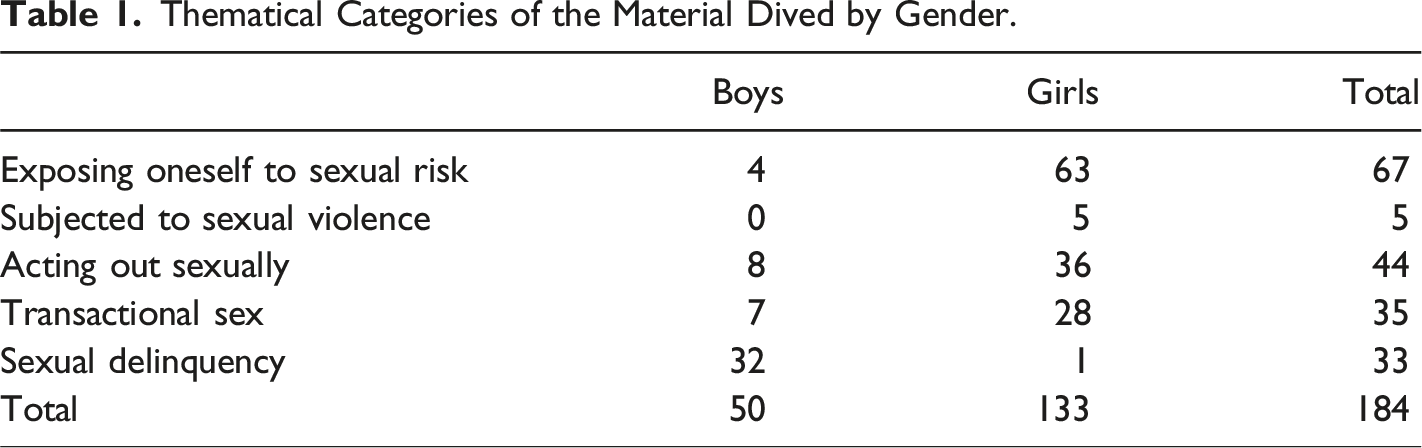
The young people’s ages vary from twelve to seventeen years old, and girls of all ages are found in all the categories, while boys overall are slightly older. A vague pattern indicates that young people considered in need of compulsory care due to transactional sex and sexual delinquency are somewhat older, with a majority being fifteen or older (both boys and girls), while most girls who are considered to be exposing themselves to sexual risks or acting out sexually are under fifteen.
An overall picture of what is considered problematic in the court decisions regards girls exposing themselves to risks and staging risk behaviors that are understood to have problematic consequences for themselves, a picture confirmed by quantitative analyses (Pettersson & Vogel, 2023). The excerpt below serves as an example of this prevalent chain of events in court decisions regarding girls and sexual risks: NN displays vagabonding behavior, lacks adult supervision, and spends time in environments and groups that feature drugs and alcohol. There is great risk of NN putting herself in danger through this behavior, and she risks being taken advantage of mentally, physically, and sexually. The police report shows that NN has supposedly been taken advantage of sexually, while sleeping at a friend’s place without adult supervision. (Court decision no. 131, age 15)
Risk situations, as those described in the excerpt are, in various ways, pronounced in the overall material. Sometimes, it is formulated in more implicit wordings such as “/…/she initiates contact and associates with older men, and exhibits a generally risky behavior” (no. 40, age 17), and sometimes with more explicit descriptions: “Through this socialization, she risks being sexually abused” (no. 119, age 15).
Girls Exposing Themselves to Sexual Risk
For a large group of girls, the assessments made by social services and court positions them as having a risky behavior that could potentially lead, or has already led to, sexual abuse or sexual relations that are considered as problematic. Looking at the overall descriptions of why these girls are deemed in need of compulsory care, the following picture develops: The girls have, to a high extent, run away from home (and/or from foster care and/or group homes), and the overall depiction of their problems concerns mental health issues, including anxiety, depression, suicidal thoughts and/or attempts and self-harming behavior, along with the use of alcohol and drugs. To some extent, they are described as violent and acting out, at the same time as they are described as having been subjected to violence from, amongst others, their parents. In descriptions regarding sex and sexual relations, their situation is often described using concepts such as “risky behavior” (riskfyllt beteende) or “risky sexual behavior” (riskfyllt sexuellt beteende), and that they hang out with older boys and/or older men. Sometimes this company is described as inappropriate, sometimes the fact that they are older is implicitly problematic. Descriptions of girls having already experienced sexual violence in different forms are also common, both as a part of their current situation which the application for compulsory care concerns, and as a part of their prior history.
When it comes to sexual behavior and sexual relations, the most common description of the situation in these court decisions is that the girl is “exposing herself” (utsätter sig) to different forms of risk. Even though a concern for what girls are being exposed to is often implicit in these descriptions, such wording simultaneously leaves the question of agency and responsibility open for interpretations, since the girls’ risky behavior is described as enabling sexual abuse: Due to her reckless behavior, NN has placed herself in situations where she has been subjected to severe abuse. (Court decision no. 80, age 14)
In the excerpt above, responsibility is placed on the girl herself as her out-acting behavior is almost causally connected to the severe abuse she has experienced. In contrast, the excerpt below does not in any clear way responsibilize the girl: /…/ found herself in situations where she has been e.g., assaulted, threatened with lethal violence, and sexually abused. (Court decision no. 122, age 15)
In a few cases, descriptions of girls being sexually active, or having engaged in sexual relations, are depicted as part of their problematic behaviors without explicit connections to risks of any particular kind. Rather, the risk assessment of these girls being sexually active is implicit in it being lined up together with other potentially problematic behaviors. In these cases, the girls are all under the age of 15 (the age of sexual consent in Sweden).
On the other side of what stands out as a blurred line between exposure and risky behavior, are girls whose sexual behaviors are more palpably described as problematic in themselves.
Girls Acting Out Sexually
A large group of girls are positioned in the court decisions as acting out sexually. That is, their own behavior, rather than their exposure to others’, is in focus when identifying what is problematic. Much like girls who are positioned as exposing themselves to risks, this group of girls is also described as having mental health issues, running away, engaging with inappropriate company, spending time in risky environments, using alcohol and drugs, and, to some extent, being violent and acting out. However, these court decisions emphasize situations and behaviors relating to sex and sexual relations more distinctly. While girls who are described as exposing themselves to risk are situated in generally risky situations, where sexual abuse is one of several risks, girls who are seen as sexually acting out are positioned in situations with more explicit connections to sexual risk. Here, the descriptions of the girls’ behaviors often concern her seeking out unknown, and often older, boys and men in a way that is considered problematic: She looks for confirmation on social media, by posting intimate pictures of herself and engaging in correspondence with men whose motives for this contact are sexual. Several reports describe how police, youth center staff, and civilians have seen NN together with older boys. She has had different relationships to these boys, many of which have had intimate connotations. (Court decision no. 117, age 14)
As can be seen in the excerpt above, the girl is understood to be seeking confirmation (bekräftelse) from men by posting intimate pictures on the Internet. This is a common theme in these court decisions, the contact with boys and men through social media along with sending or publishing pictures of themselves that are described as “erotic”, “undressed” or “inappropriate”.
Furthermore, it is not uncommon that the contact-seeking the girls are described as engaging in is seen as “unbounded” (gränslöst) or inappropriate. Here it should be noted that in a few of these descriptions, the girl’s behavior borders on sexual harassment, for example, in descriptions of her “having invaded a boy’s personal space” (court decision no. 81, age 14). However, this is not very common.
Much like the girls who are seen as exposing themselves to risks, these girls are described as having experienced sexual violence in different forms. However, they are also described as “sexually unbounded” or “sexually destructive”, and, as shown in the excerpt above, in need of confirmation. In other words, how girls themselves act is depicted as the main problem and, as such, the reason why they need compulsory care.
Using Sex as Self-Harm
Overall, it is relatively common that self-harming behavior is a pronounced part of the depiction of problems in the court decisions regarding girls. However, among girls positioned as acting out sexually, their sexual behavior is sometimes explicitly described as a form of self-harming, as seen in the excerpt below. However, NN displays reckless and self-harming behaviors through sexual, unbounded actions. She has repeatedly put herself in high-risk situations by contacting unknown men online. She has shown herself to be incapable of handling social relations in an adequate manner. (Court decision no. 241, age 16)
Here, acting out sexually is interpreted as a way of deliberately causing oneself harm. The seeking of contact with unknown men and putting herself in (implicitly sexually) risky situations is hence understood as a conscious way of letting others’ sexual abuse of her be used as a way of harming herself. Here, the responsibilization of the girls is obvious, even though the chain of events depictured in the court decisions show how their problematic behavior is followed by the same exposure to (risks of) abuse as for other girls in the material.
Cases of Transactional Sex in Court Decisions Regarding Girls
The only sexual behavior that is explicitly described as exemplifying socially destructive behavior in the legislative preparatory work, is if the young person is engaging in transactional sex. However, performing at a sex club is referred to as an inappropriate environment for the youth. As for the entire material analyzed in this article, the majority of these cases concern girls. The overall depictions of problems do not differ in any essential way from other decisions regarding girls. They are described as running away, having mental health issues, using drugs, spending time in risky environments and engaging with inappropriate company. In some of these court decisions, the descriptions are similar to those regarding girls who are sexually acting out, and in some cases to those who are described as exposing themselves to sexual risks. The only actual difference is that an occurrence, or suspicion, of transactional sex is mentioned in some way. In some of these court decisions, transactional sex is presented as a central part of the problematic behavior making social services apply for compulsory care: During the course of the investigation, it has surfaced that NN abuses substances such as cannabis, amphetamines, morphine, cocaine, and Subutex. It has also been established that she sells sex. NN calls herself a prostitute. /…/ A sexually norm-defying behavior, which prostitution must be considered as, increases the risk of being subjected to sexual violence in the contexts of enacting said norm-defying behavior. Therefore, it is made clear that NN, through her socially destructive behavior, puts her mental and physical health and development at considerable risk of harm. (Court decision no. 243, age 17)
As seen in the excerpt above, engaging in transactional sex is presented as a part of the main reason for both applying for compulsory care (first section) and for the court’s decision to take her into compulsory care (last section). What is also evident from this case is what seems to be an extensive drug problem. Descriptions of extensive drug use is also something that seems to differentiate these cases from other court decisions regarding girls.
In summary, situations where girls’ sexual behaviors and relations are seen by authorities as expressions of socially destructive behaviors in need of compulsory care raise questions about victimhood, responsibilization and agency. So, what about the boys?
Boys’ Sexual Behaviours Between Exposure and Agency
Regarding boys described as exposed to sexual risks, it is difficult to identify patterns since they are so few. Two of the four court decisions regarding boys is similar to those regarding girls, in descriptions of risky environments where they risk being abused. In the other two, exposure to sexual risk is to a greater extent placed in a criminal context, where a “sexual risk behavior” also seem to include, or at least not exclude, the boy exposing others to sexual risk.
A few court decisions concern boys engaged in transactional sex. Here, descriptions and reasoning do not in any essential way differ from those regarding girls. The most palpable gender difference, then, is the uneven distribution.
The probability that boys’ “risky sexual behavior” also poses a threat to others is more evident in those cases regarding boys described as acting out sexually. In some of these court decisions, it is simply stated that the boy has an “unbounded sexual behavior,” while in others there are more explicit descriptions of their behaviors being directed at other people. Without actually mentioning sexual offences, some of the descriptions of boys’ behavior in this category touch upon the descriptions in the category of delinquency, the most common one among boys in the material.
Boys’ Sexual Delinquency
With one exception, all court decisions in the material describing sexual delinquency concerns boys.
4
Descriptions of situations and behaviors of these boys can roughly be divided into two types. The first type is when the boys’ sexual transgressions are depicted as a part of a larger criminality problem. In these court decisions, the major concern is the boys’ interaction with other criminal persons, their out-acting behavior and criminal activity, of which sexual offences seem to be one of several types, as in the excerpt below. /…/ NN is drawn to and spends time in criminal environments and is involved with destructive company. He has occurred several times in situations where serious offences are suspected to have taken place. NN has been accused of participating in, inter alia, assault at several occasions, abuse of juridical procedure, unlawful threats and sexual harassment. (Court decision no. 285, age 15)
The other type of description of sexual delinquency includes court decisions more specifically focused on an offensive behavior. Or rather, a sexual offence stands out as the primary reason why the boy in question is deemed to need compulsory care. It is crucial for the decision of care that NN is suspected of rape, which is a very serious crime. (Court decision no. 286, age 15)
In some of these court decisions, the depictions of the boys’ behavior position them as “sexual perpetrators” while in others, they are described more as sexual deviants. For both these forms of positioning, there are sometimes explicit descriptions of a need for treatment interventions for perpetrators of sexual violence (övergreppsspecifik behandling).
At the same time, it is important to note that court decisions regarding sexual delinquency cover a wide range of behaviors, and far from all boys have been prosecuted and/or convicted. Some of the descriptions concern suspicions of what is termed sexual harassment (sexuellt ofredande) without any further descriptions of what the act contains, while in others it is stated that the boy has been found guilty of aggravated rape (grov våldtäkt).
When the Court or the Young Person Disagree
In a few cases, the court had objections to the perception of girls’ sexual behaviors as a behavioral problem presented by the social welfare board. When this happened, the court foremost stated that the welfare board had not sufficiently demonstrated what they argued. That is, the court did not necessarily object to the described behaviors being viewed as socially destructive, but simply noted that the welfare board had yet to prove that the girl displayed such behaviors. However, in one case, where the welfare board had claimed the young girl’s engagement in sexual relations with her boyfriend as part of why she needed care, the court objected by stating that “having her sexual debut before the age of 15 does not constitute sufficient grounds to claim that she displays sexually destructive behavior” (court decision no. 77, age 14).
The few cases regarding boys where the court had objections all concerned sexual delinquency. The objections in these cases were about such things as the delinquency not being sufficiently proven by the welfare board, or that it had happened during a limited time and therefore could not be seen as a socially destructive behavior, as defined in CYPA. In two cases, where the boy had been prosecuted for rape, the court did not include this in their judgement since the criminal court’s decision was not yet final.
Unsurprisingly, it was more common that the young persons themselves had objections to the descriptions and definitions of their behaviors.
5
Objections from the boys foremost concerned them rejecting what the welfare board claimed about their behavior, stating it as not true. This was also common among the girls, for example by stating that she “has not sold sexual services” (court decision no. 157, age 17), or that she recognized that she was in need of care, although “not due to sexual risk taking” (court decision no. 194, age 15). Although in several cases, the girls recognized their sexual behavior and/or relations to various extents, but objected to them being seen as socially destructive, as can be seen in the excerpt below: Regarding her sexual contacts, she is of an age where it is normal to test boundaries and explore one’s sexuality, this is not a behavior that is harmful or that deviates from basic social norms. (Court decision no. 145, age 16)
Another girl recognized that she had a lot of male friends with whom she sometimes spent the night, “but that does not mean that she has sexual relationships with them” (Court decision no. 128, age 15) and yet another girl stated that she does not want “anyone else’s opinion on what sexual relationships she engages in” (Court decision no. 64, age 17). These kinds of objections were also present among the boys, but not as common.
In summary, it is obvious that the court followed the argumentation of the social welfare board in most of the cases. The young persons, to a larger extent than the court, objected to their sexual behaviors being deemed as socially destructive, both by questioning the very definition and by claiming the welfare board had gotten it wrong.
Discussion
More than anything, the results from this study show that when social welfare and courts are concerned with young people’s sexual behaviors, they are concerned about girls. The most palpable gender pattern is the uneven distribution, where boys’ sexual behaviors to a much lesser extent is highlighted in the court decisions as (part of) a behavioral problem. In cases where they are highlighted it primarily concerns sexual delinquency, which falls within the scope of CYPA. In contrast, a salient pattern in the court decisions regarding girls is the blurry line between what is understood as a risk behavior and what must be understood as exposure to the actions of others. In other words, both when girls are being active and, for example, taking and sending nude pictures, and when they are being taken advantage of, their behaviors are construed as risky in the court decisions. Hence, this blurry line concerns questions of agency and responsibility, and to what extent social welfare and courts assess the girls’ own behavior as problematic in itself or as a risky behavior leading her into trouble.
Based on these results, it is clear that which sexual actions and behaviors the court focuses on is affected by gender. Partly, this has to do with actual gender differences in manifested behaviors, where boys to a higher extent are reported using sexual violence and girls more often are subjected to such violence (Pettersson, 2021). But the clear gender division must also be discussed in terms of gendered understandings of sexuality and agency. The scope of behaviors deemed as sexually risky among girls cannot be separated from that of young femininity often being construed as vulnerable (Brown, 2011; Gonick, 2006), or the fact that girls’ sexuality historically has been subjected to discipline and control (Bosworth, 2000; Chesney-Lind & Pasko, 2013). In this lies gendered perceptions of the agency of youth. Boys’ sexual behaviors are defined as risky, problematic and in need of care primarily when they use their agency to transgress not only moral, but juridical rules (cf. Ericsson & Jon, 2006). However, girls’ agency can be said to be simultaneously under- and overemphasized, significantly blurring the lines between victimhood and responsibilization. On the one hand, girls’ agency are underemphasized as they are deemed in need of compulsory care for engaging in sexual relations per se, and for being positioned as mere victims to the influence of others, mirroring historical and contemporary patterns of how extensive concern due to girls’ vulnerability often leads to control (Messerschmidt, 1987; Vogel, 2016). At the same time, girls’ agency is overemphasized since they are made responsible for others’ transgressions against them. Hence, Swedish authorities seem to follow similar patterns of blurring the lines regarding victims of CSE as in other countries (IICSA, 2022; IITCSE, 2022). One way to understand the responsibilization of girls for the actions of others in a Swedish context is the structure of CYPA. As described in the introduction, decisions of compulsory care based on CYPA § 3 regard the young person’s own behavior. In order to align the reasoning with the intentions of the law, focus is inevitably directed to the girls’ behavior. Admittedly, CYPA also acknowledges compulsory care due to abuse and neglect (§ 2), but this paragraph is exclusively intended for situations in the child’s home, responsibilizing the caregivers and their legal obligations to care for their child. The way the court navigates this balancing act between acknowledging a behavior in need of care and of victim-blaming a young person for what others do to her, bares resemblance to the discourse on “sex as self-injury”. As Wall and Johnsdotter (2022) argue, this discourse tends to devote itself to victim-blaming in that it defines situations such as being raped as potentially conscious ways for (primarily) girls to inflict self-harm. It thus seems that the interactions between the extensive sexual vulnerability many girls are subjected to, a legislation unfit to cover such situations, and gendered understandings of vulnerability and agency leads the courts and welfare boards to build their cases on victim-blaming discourses in order to assure protection and care of girls.
This is perhaps especially true when it comes to girls engaged in transactional sex. Even though it can be questioned that underaged girls involved in commercial sexual exploitation is acting as free agents, it has been defined as a socially destructive behavior in CYPA since the beginning, hence emphasizing girls as agents and in need of behavioral correction (cf. IICSA, 2022; IITCSE, 2022).
A different aspect of this responsibilization of (primarily) girls is the discourses regulating our understanding of Child Sexual Abuse (CSA). As scholars has pointed out (Melrose, 2013; Smith & Woodiwiss, 2016; Woodiwiss, 2014), understandings of childhood as a time of innocence risks invalidate children with experience of sexual abuse as victims. Further, a dominating focus on harm and trauma (Smith & Woodiwiss, 2016), demands specific responds from victims to be understood as genuine (see also Heber, 2020). Girls in general, but perhaps specifically girls who are seen as “troubled”, is often construed as manipulative and provocative, or as Brown puts it, as “catty, cutting and calculating” (2011 p. 114), and therefore probably to a lesser extent acknowledged as victims of sexual violence (cf. Lovett et al., 2018).
In relation to this, it is noteworthy that the girls themselves, to the extent that their voices are being disclosed in the court decisions, often opposes the descriptions of their sexual interactions as problematic. As shown in an earlier study (Vogel, 2018), girls in secure care often object to professionals’ views of them as a way to evade the position of the victim. However, this also risks putting them in opposition to the care system, forcing girls to choose between defending their agency or getting help.
While the risks of victim-blaming and responsibilization can be said to be much higher for girls, the boys are risking not being acknowledged as victims at all. Although the low numbers of boys in the data, outside the category of sexual delinquency, is in line with what we know about gendered pathways (Chesney-Lind & Pasko, 2013), it raises the issue of whether we are perhaps too gender biased to acknowledge the (sexual) vulnerability of boys. Self-report studies have shown that boys engage in transactional sex to a larger extent than girls (Svedin et al., 2015), something that does not show in compulsory care applications. Whether this is because authorities have trouble identifying such situations in boys, or if it does not raise the same amount of concern as when it comes to girls, remains unknown.
Another way of looking at the results of this study is to define the court cases as two separate categories. The first one, then, can be said to be concerned with young people’s (primarily girls’) exposure to sexual violence, and the fact that they become cases of compulsory care due to own behavior is, as discussed above, an effect of how the legislation is structured. In the other category, the welfare boards and courts are concerned with young people’s sexual transgressions, and this concern is distinctly filtered by a gendered gaze. Here, boys’ transgressions primarily seem to manifest as sexual offending while girls’ transgressions manifest as something the welfare boards and courts assess as a form of self-harm. The reasons for this must be understood as twofold. A gendered society shapes gendered pathways for boys and girls, but does also produce gendered norms affecting assessments of sexual behaviors in boys and girls.
Previous research has argued that the Swedish compulsory care legislation has gaps that are addressed by using CYPA § 3 even though the behavior falls outside the framework of the legislation (Schlytter, 1999). Above all, this has been noticed regarding girls with serious mental health problems (see fx. Vogel, 2012), but the National Board of Institutional Care (responsible for the secure institutions) has also emphasized that this sometimes seems to be the case for girls exposed to honor-related crimes (SVT, December, 2021). 6 This is connected to the social welfare board’s responsibility for young people at risk of severe harm. For example, in cases where child psychiatry refuses inpatient care for young people with suicidal risk because it is not considered (sufficiently) acute, the social welfare board still has responsibility for these young people. We suggest that the social welfare board’s responsibility for youths (mostly girls) in risk of exposure to sexual exploitation, given that voluntary help is ruled out, constitutes a similar gap in the legislation. Furthermore, in these cases, it also results in reframing young girls’ vulnerability into responsibility. Since compulsory care is seldom a successful strategy, herein lies the paradox that the social welfare board must manage this balancing act in not only legally uncertain ways, but also possibly harmful ones, while in many cases it is quite obvious that the girl is at risk of harm. The question that remains is, how do we acknowledge this harm, and sufficiently protect girls from it, without making them responsible for the actions of others?
Footnotes
Declaration of Conflicting Interests
The author(s) declared no potential conflicts of interest with respect to the research, authorship, and/or publication of this article.
Funding
The author(s) disclosed receipt of the following financial support for the research, authorship, and/or publication of this article: This work was supported by the Vetenskapsrådet under Grant 2017-03010.
