




Abstract
Objective:
Right anterior minithoracotomy (RAMT) and ministernotomy (MS) are established approaches for minimally invasive aortic valve replacement (MIAVR). There is no consensus about which technique offers better results.
Methods:
A literature search was conducted in MEDLINE, Scopus, and Cochrane Library, focusing on studies that compared RAMT and MS for MIAVR. RevMan 8.13.0 (The Cochrane Collaboration, London, UK) was used to calculate effect estimates reported as odds ratios (ORs) or mean differences (MDs) with 95% confidence intervals (CIs).
Results:
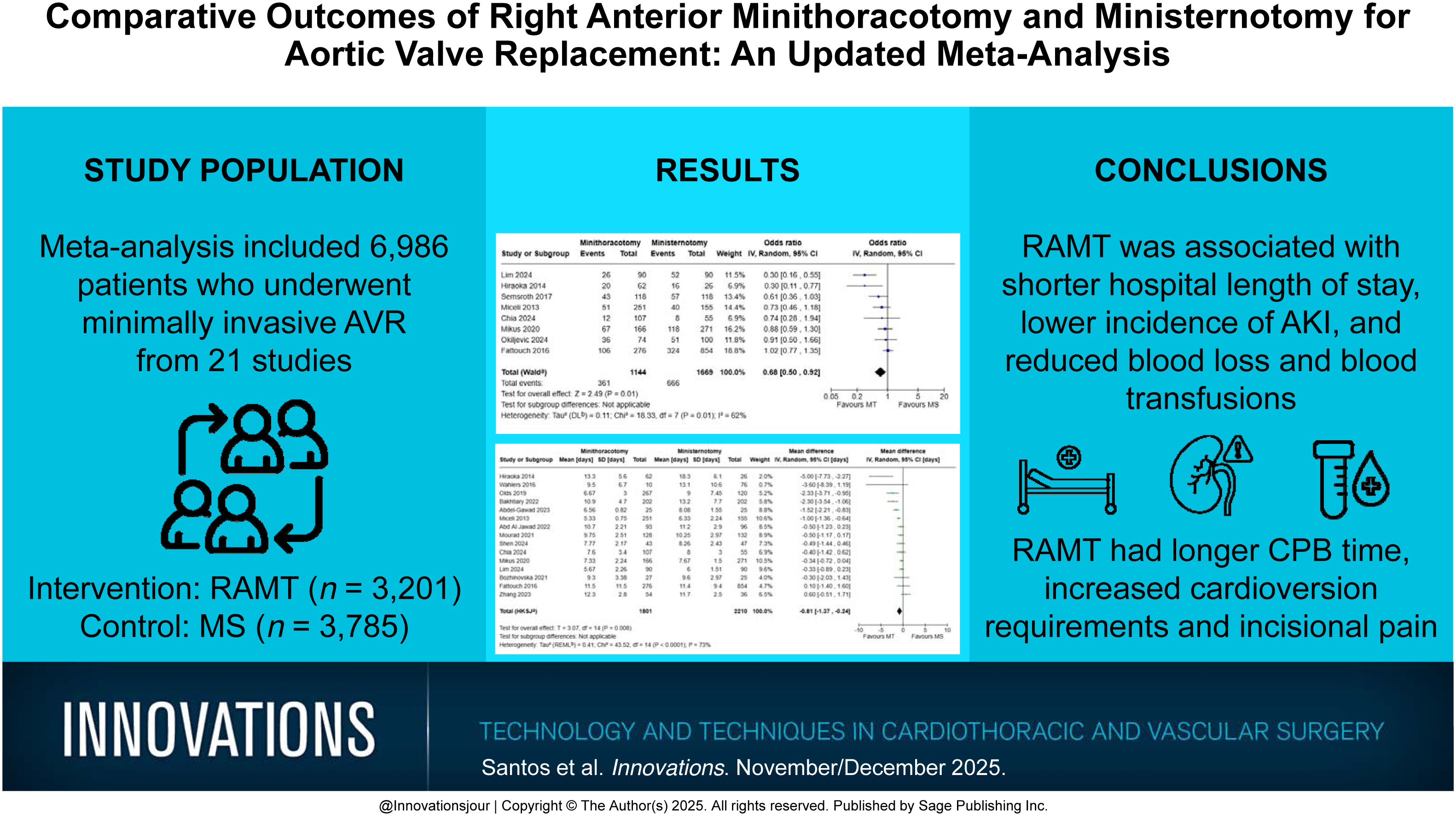
We included 21 studies with 6,986 patients, of whom 45.8% underwent RAMT. RAMT was associated with a shorter hospital stay (MD = −0.8 days, 95% CI: −1.4 to −0.2, P = 0.002) and reduced blood loss (MD = −22.3 mL, 95% CI: −32.8 to −11.8, P < 0.001), transfusion rates (OR = 0.7, 95% CI: 0.5 to 0.9, P = 0.01), and incidence of acute kidney injury (AKI; OR = 0.7, 95% CI: 0.5 to 0.9, P = 0.02). However, RAMT was also associated with a slightly longer cardiopulmonary bypass (CPB) time (MD = 9.0 min, 95% CI: 0.7 to 17.3, P = 0.03, I² = 97%) and incisional pain score (standardized MD = 0.5, 95% CI: 0.4 to 0.6, P < 0.001). Mortality, stroke, and other complications were similar between the 2 techniques.
Conclusions:
RAMT offers advantages including shorter hospital stay and reduced blood loss, transfusion, and AKI rates but at the cost of slightly longer CPB time and greater incisional pain. These findings underscore the need for individualized patient selection based on surgical risk, anatomical considerations, and recovery priorities.
Get full access to this article
View all access options for this article.
References
Supplementary Material
Please find the following supplemental material available below.
For Open Access articles published under a Creative Commons License, all supplemental material carries the same license as the article it is associated with.
For non-Open Access articles published, all supplemental material carries a non-exclusive license, and permission requests for re-use of supplemental material or any part of supplemental material shall be sent directly to the copyright owner as specified in the copyright notice associated with the article.
