




Abstract
Objective:
We aimed to study the feasibility and automation of intracorporeal lung specimen dissolution using NaOH to decrease specimen extraction trauma.
Methods:
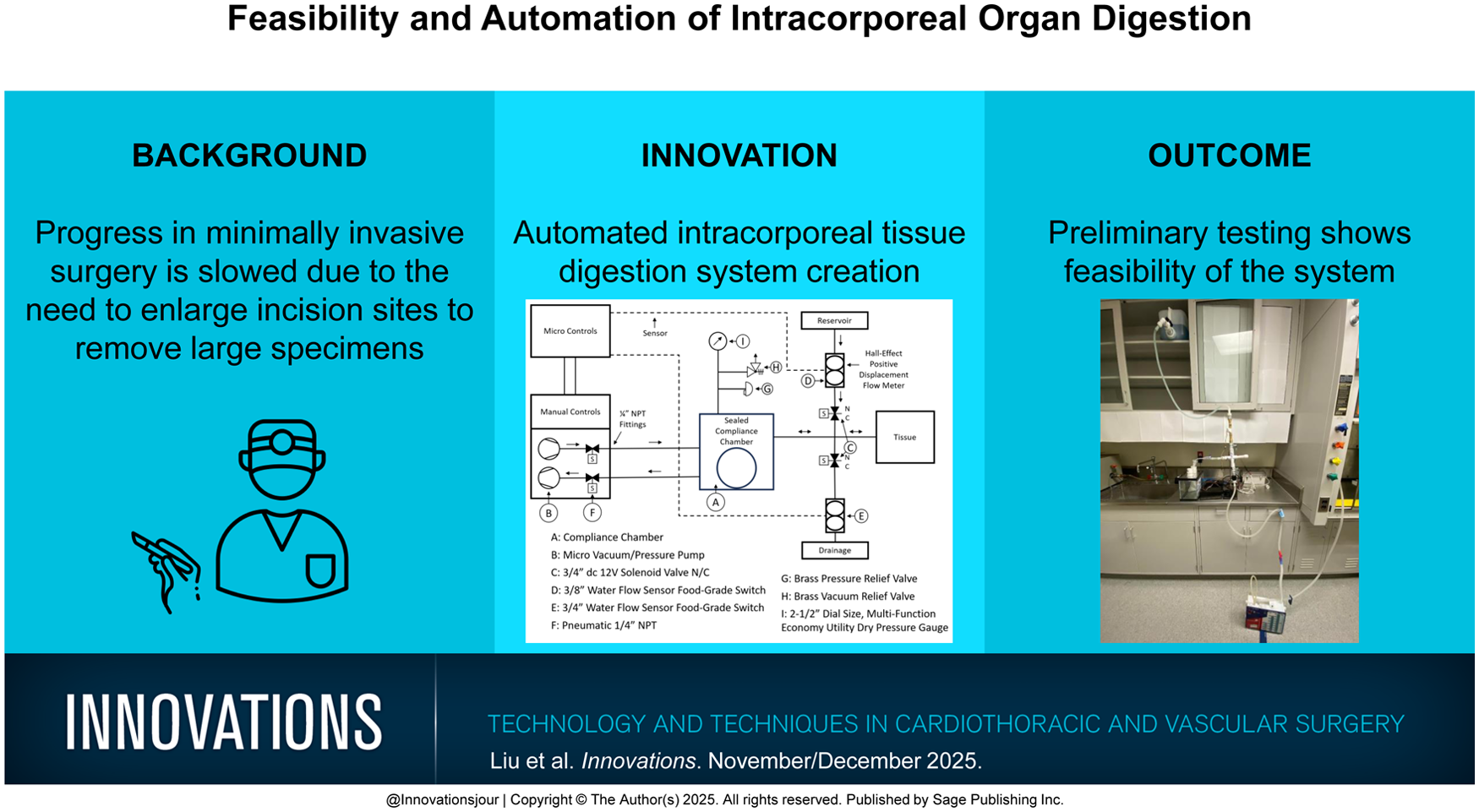
Twenty-three cadaveric porcine lungs were weighed, cannulated, placed in laparoscopic tissue extraction sacs, and submerged in water baths (37 °C). Lungs were digested for 6 to 36 h with dissolution fluid replacement through various cannulation strategies. Dissolution was quantified by changes in solid mass and structural and histologic integrities. After optimization, we performed 24-hour lung dissolution in a cadaveric porcine model. Next, a system was built using polyvinyl chloride, solenoid valves, water flow sensors, tubing, a vacuum pump, and an Arduino UNO (Monza, Italy). Flow tests were performed. System feasibility and safety were tested. A vacuum chamber was added for gentle agitation to the digestion solution through fluid oscillation. Functional tests were repeated.
Results:
There were no containment failures. Compared with saline, NaOH exhibited significant dissolution by 6 h (P < 0.001) progressing to a port-extractable, jelly-like material by 24 h (<20% initial mass). The degeneration of parenchymal histology correlated with NaOH exposure (r = 0.98, P = 0.02). Neither enzyme use (P = 0.3) nor specimen vascular cannulation (P = 0.15) improved dissolution compared with bathing. At 24 h, the clinical emulation model demonstrated no leaks and lung tissue effects proportionate to volume of delivered lye. During the flow tests, inflow was more precise, with minimal deviation. Outflow was more accurate, with measurements closer to the true value. The system passed 6-hour safety tests without leaks, with and without the vacuum chamber.
Conclusions:
These preliminary results suggest that automation of intracorporeal lung specimen digestion is feasible.
Get full access to this article
View all access options for this article.