




Abstract
Objective:
Venovenous (VV) extracorporeal membrane oxygenation (ECMO) cannulation may pose venous access challenges. Subclavian vein (SCV) cannulation is an alternative site. This study hypothesizes that SCV access is a safe alternative in VV ECMO.
Methods:
This is a single-center, retrospective study of peripheral VV ECMO that was stratified by SCV cannulation. Each site was considered as a separate cannulation event. Descriptive statistics, groupwise comparisons, and mixed-effects logistic regression were used. Primary endpoints included cannulation-specific complications and ECMO-related adverse events.
Results:
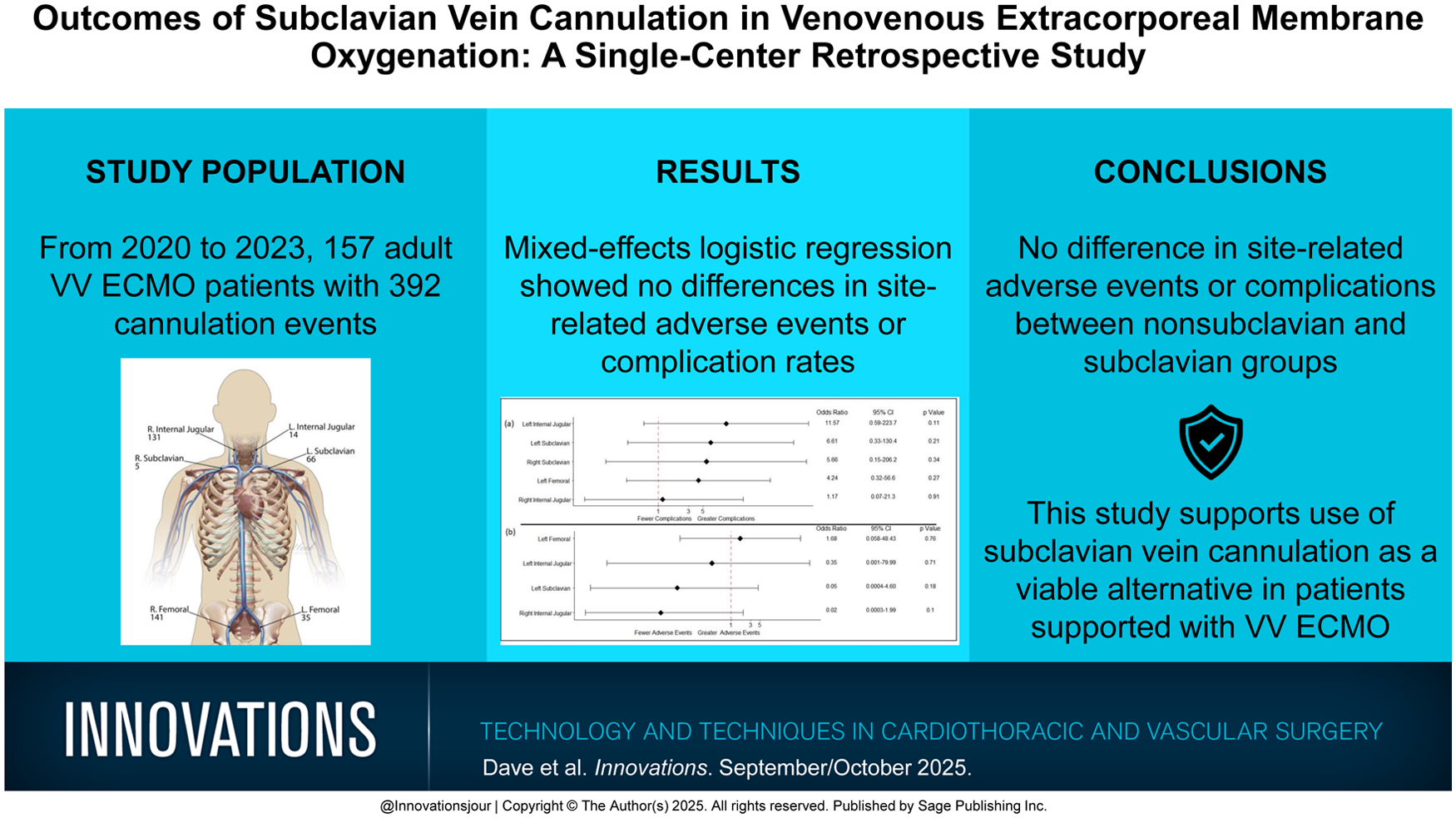
From 2020 to 2023, 157 patients were supported with VV ECMO. The cohort was 57% male patients with a median age of 44 (34 to 56) years and a median body mass index of 34 (28 to 44) kg/m2. Thirty-five percent of patients (n = 55) had an SCV cannula during their ECMO course. Both groups had similar pre-ECMO variables, except for higher rates of COVID-19 (69% [n = 38] vs 49% [n = 49], P = 0.016) in the SCV cohort. There was no unadjusted survival difference (P = 0.8). There were 392 unique cannulation events. SCV cannulations were more commonly employed for additional cannulas and transitioning to single-site dual-lumen cannulation (P < 0.001). There was an increased cannulation-associated pneumothorax rate in the SCV arm (P < 0.001) when compared with all non-SCV sites. Mixed-effects logistic regression showed no site-related differences in adverse events or complication rates.
Conclusions:
Between the SCV and non-SCV groups, there was no difference in site-related adverse events or complications. This study supports the use of SCV cannulation as a viable alternative in patients supported with VV ECMO.
Keywords
Get full access to this article
View all access options for this article.
References
Supplementary Material
Please find the following supplemental material available below.
For Open Access articles published under a Creative Commons License, all supplemental material carries the same license as the article it is associated with.
For non-Open Access articles published, all supplemental material carries a non-exclusive license, and permission requests for re-use of supplemental material or any part of supplemental material shall be sent directly to the copyright owner as specified in the copyright notice associated with the article.
