




Abstract
Objective:
Previous studies have evaluated the feasibility of robot-assisted thoracoscopic segmentectomy (RVATS) in comparison with video-assisted thoracoscopic segmentectomy (VATS). We report both short-term and long-term outcomes comparing RVATS and VATS at a single institution.
Methods:
This is a retrospective propensity-matched cohort study reviewing RVATS and VATS for primary non-small cell lung cancer (NSCLC) performed from 2013 to 2021 at our institution; 1:2 propensity matching was performed.
Results:
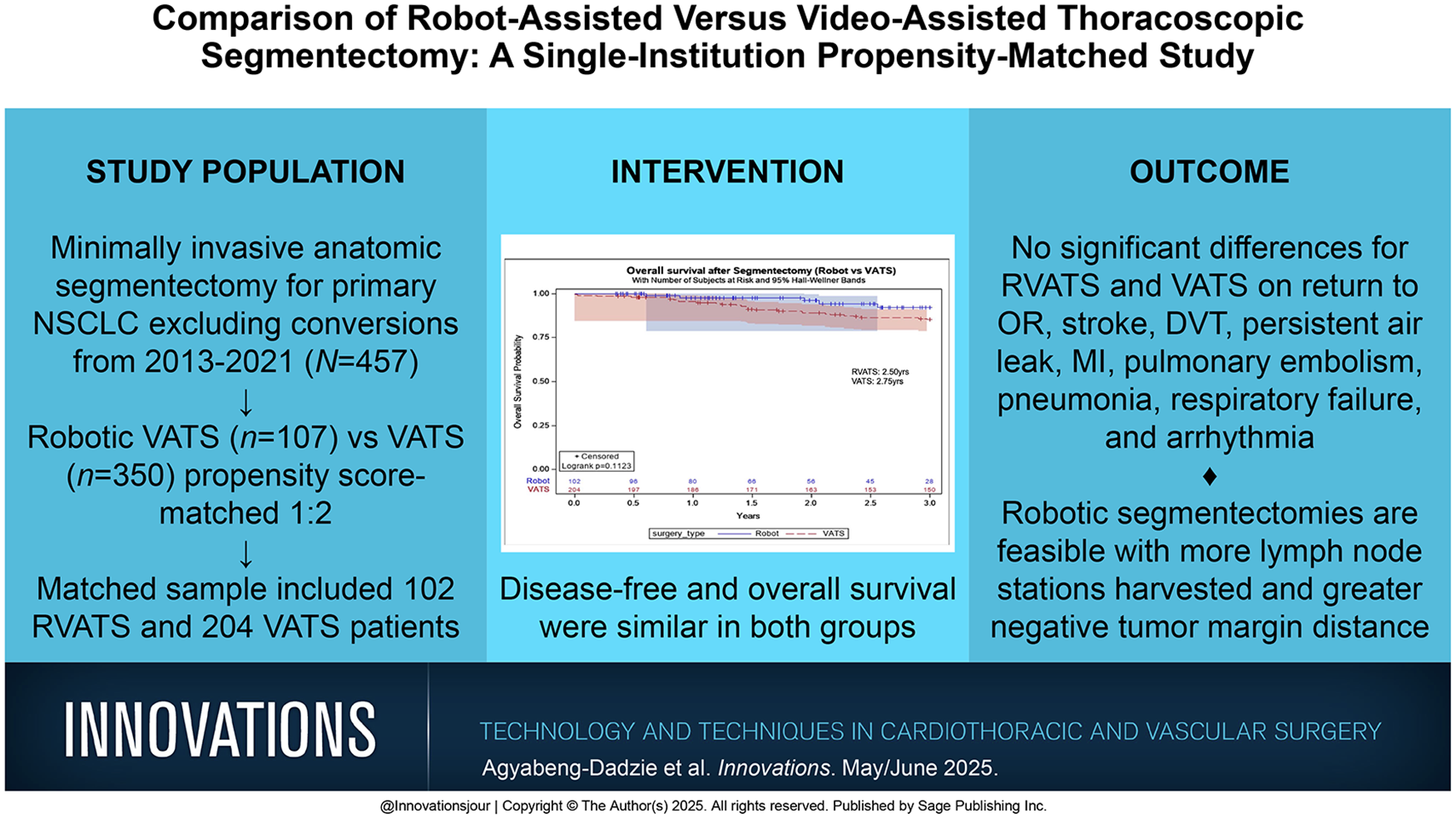
There were 108 patients who underwent RVATS and 370 who underwent VATS for primary lung cancer. After propensity matching, we had 2 well-matched cohorts of 102 patients in the RVATS group and 204 in the VATS group. Our data showed no significant difference in 90-day mortality, 30-day hospital readmission rate, or median number of lymph nodes between the RVATS and VATS groups. There was also no significant difference in postoperative morbidity except for pleural effusion. RVATS had a significantly greater median number of lymph node stations harvested and longer operative time. Although both groups achieved R0 resections in all patients, RVATS showed a greater negative tumor margin distance compared with VATS. There was no significant difference in disease-free survival or overall survival between the 2 groups at 3 years.
Conclusions:
In our experience, RVATS showed a greater number of lymph node stations harvested and greater negative tumor margin distance without compromising perioperative and oncological outcomes for segmentectomy performed for NSCLC.
Get full access to this article
View all access options for this article.