




Abstract
Objective:
Since there are concerns about the durability of mitral valve repair (MVRp) with minimally invasive techniques in patients with mitral regurgitation (MR), we aimed to evaluate the long-term outcomes of these sternal-sparing approaches when compared with conventional approaches with sternotomy in patients undergoing MVRp.
Methods:
We performed a systematic review according to a preestablished protocol and performed a pooled analysis of Kaplan–Meier–derived reconstructed time-to-event data from studies with longer follow-up comparing sternal-sparing versus sternotomy approaches for MVRp. Our outcomes of interest were survival, freedom from recurrent MR, and freedom from reoperation.
Results:
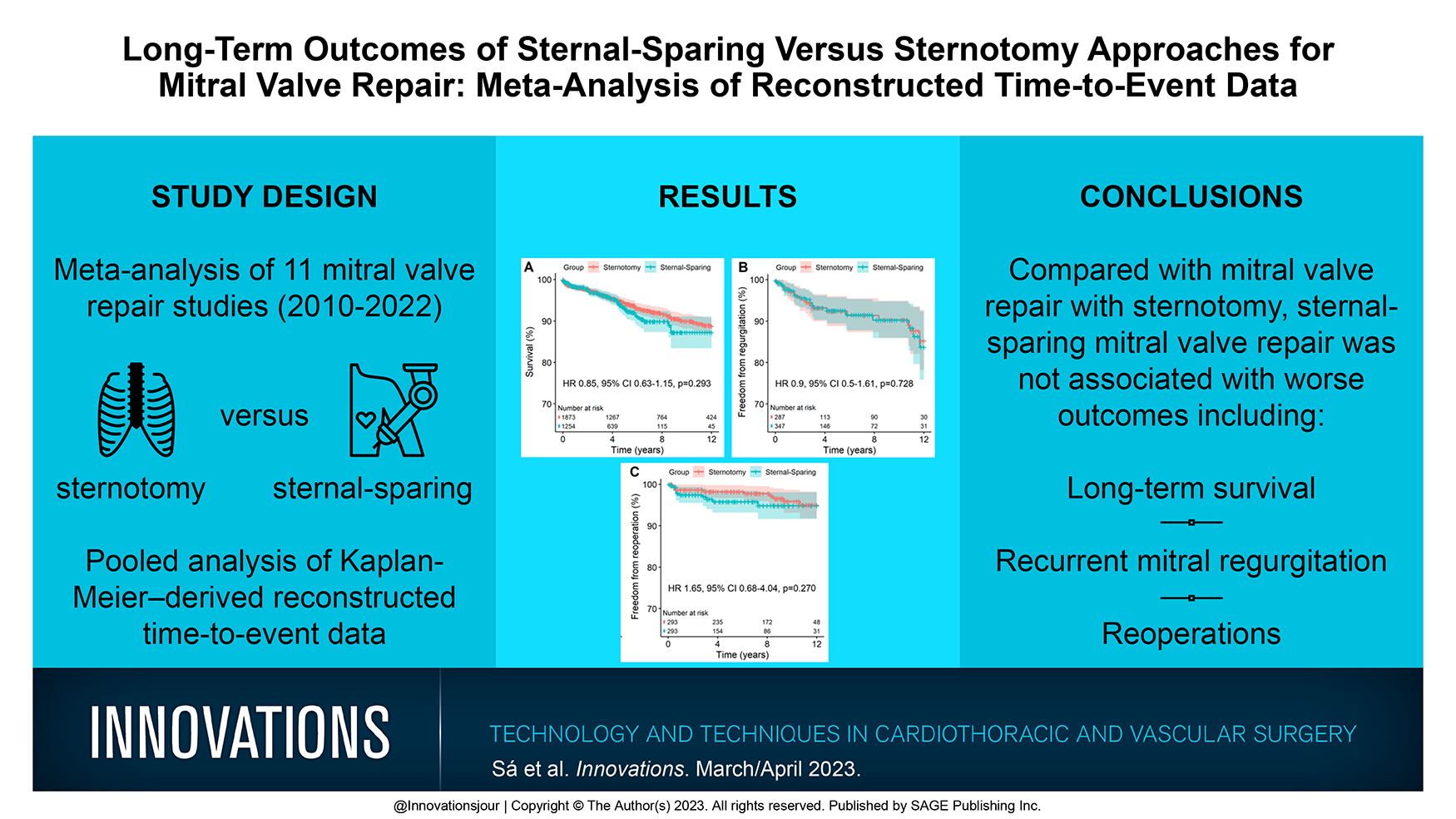
Eleven studies met our eligibility criteria comprising 7,596 patients with follow-up (sternal sparing, n = 4,246; sternotomy, n = 3,350). Patients who underwent sternal-sparing MVRp had a significantly lower risk of mortality over time compared with patients who underwent MVRp with sternotomy (hazard ratio [HR] = 0.29, 95% confidence interval [CI]: 0.23 to 0.36, P < 0.001) in the overall analysis. However, we found no statistically significant difference between the groups in the sensitivity analysis with adjusted populations (HR = 0.85, 95% CI: 0.63 to 1.15, P = 0.301). Regarding the outcomes freedom from recurrent MR and freedom from reoperation, we found no statistically significant differences between the groups in the follow-up in both overall and sensitivity analyses.
Conclusions:
In comparison with MVRp with sternotomy approaches, sternal-sparing MVRp was not associated with worse outcomes in terms of survival, recurrent MR, and reoperations over time.
Keywords
Get full access to this article
View all access options for this article.
References
Supplementary Material
Please find the following supplemental material available below.
For Open Access articles published under a Creative Commons License, all supplemental material carries the same license as the article it is associated with.
For non-Open Access articles published, all supplemental material carries a non-exclusive license, and permission requests for re-use of supplemental material or any part of supplemental material shall be sent directly to the copyright owner as specified in the copyright notice associated with the article.
