



Abstract
This case study explores three vignettes of resistance faced by superintendents and school board members as they attempted to implement equity-centered policy that challenges the status quo. We recount the outcry that followed Superintendent Andrea Kane declaring “Black Lives Matter” in Queen Anne’s County, MD; Superintendent Cheryl Logan introducing a comprehensive career pathways program in Omaha, NE; and School Board Commissioners Alison Collins, Gabriela López, and Faauuga Moliga voting to support marginalized communities in San Francisco, CA. The threats, smear campaigns, and recall elections these leaders of color endured underscore the lengths to which privileged constituencies will go to protect their educational advantage and resist systemic change.
Keywords
Introduction
The most disrespected person in America is the Black woman. The most unprotected person in America is the Black woman. The most neglected person in America is the Black woman. I now believe that we are in the early phase of yet another backlash, with the dismantling of affirmative action, governmental attacks on the teaching of Black history and the full-court press on the political right to get rid of Diversity, Equity and Inclusion initiatives. The symbolic alignment of a cross-section of Americans, particularly the young, with Black liberty and Black lives after the murder of George Floyd and the wave of protests that it brought forth, retreated with the speed of the tide before the advance of the tsunami.
In this case study, we present three vignettes that illustrate the challenges educational leaders face in implementing equity-centered, district-wide reforms. Our focus is on the intersecting dynamics of race and gender across three distinct contexts: Queen Anne’s County Public Schools (QACPS), Omaha Public Schools (OPS), and San Francisco Unified School District (SFUSD), each differing in region, enrollment, student demographics, and political landscape (see Table 1). Two vignettes explore the experiences of Black women superintendents, while the third centers on three school board members from racially minoritized backgrounds. Across these varied settings, these educational leaders’ reform efforts sought to advance equity: fair access to resources, opportunities, and an affirming learning environment for every student, including those systematically disadvantaged based on race, class, and gender. While all of the cases sought to increase support for racially minoritized students, QACPS and SFUSD targeted these groups explicitly, while OPS presented their effort as race-neutral. Regardless of the framing, each leader encountered resistance from members of the public invested in maintaining the status quo and advocating for their own conception of equity.
Characteristics of Queen Anne’s County, Omaha, and San Francisco Unified Public Schools in the 2020–2021 Academic Year.
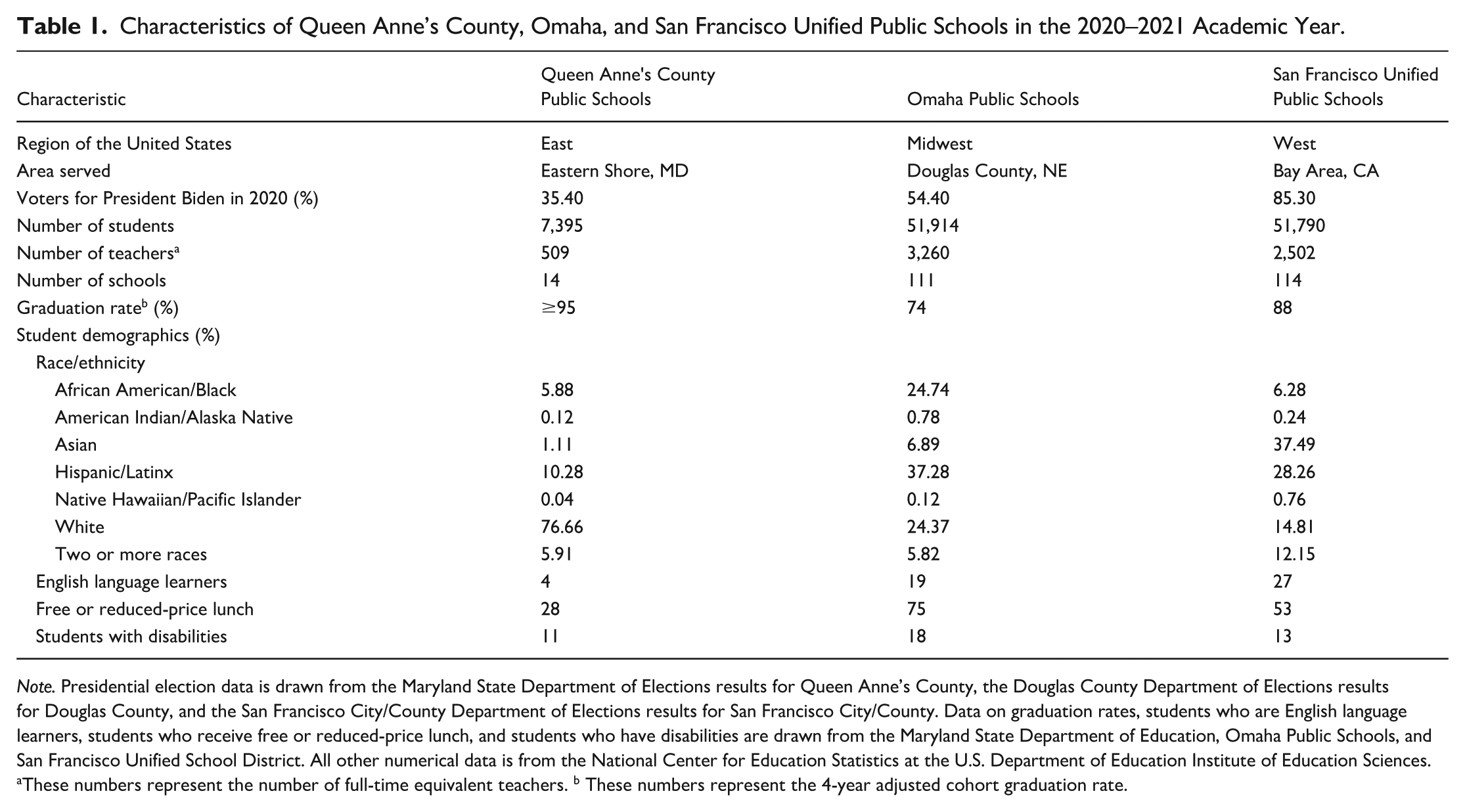
Note. Presidential election data is drawn from the Maryland State Department of Elections results for Queen Anne’s County, the Douglas County Department of Elections results for Douglas County, and the San Francisco City/County Department of Elections results for San Francisco City/County. Data on graduation rates, students who are English language learners, students who receive free or reduced-price lunch, and students who have disabilities are drawn from the Maryland State Department of Education, Omaha Public Schools, and San Francisco Unified School District. All other numerical data is from the National Center for Education Statistics at the U.S. Department of Education Institute of Education Sciences.
These numbers represent the number of full-time equivalent teachers. b These numbers represent the 4-year adjusted cohort graduation rate.
These vignettes reveal how opposition from the “public square”—typically parents—is often personal, value-driven, and marked by a sense of ownership, leading to resistance against leaders viewed as outsiders. Across vignettes, public criticism emphasized values like “choice” and local involvement, sometimes as veiled expressions of racism. Each vignette provides an overview of the proposed equity initiatives, the resulting public backlash, and the leaders’ responses, concluding with a brief statement on the aftermath. Following the vignettes, we offer frameworks for analyzing racialized and gendered resistance to educational reform/ers, conflicting notions of equity, and the influence of privileged groups on educational equity discourse. Finally, we provide suggestions for classroom activities and discussion prompts.
Queen Anne’s County Public Schools
In July 2017, Dr. Andrea Kane began her time as the first Black superintendent of QACPS. Before holding this position, she achieved measurable success as a teacher, principal, and central office administrator. Immediately before leading QACPS, she served as the Chief Academic Officer of Richmond (Virginia) Public Schools. Despite QACPS’s history of racist incidents and a uniformly White school board (Green, 2021), she was determined to use her post to advance inclusive excellence.
Equity Initiatives
Dr. Kane’s commitment to equity led her to introduce numerous initiatives for racially-minoritized students. She commissioned an analysis to document these inequities, which led her to introduce restorative justice practices, create outreach programs to increase minority participation in advanced courses, facilitate dialogues on equity, and develop other programs targeting achievement gaps. Under Dr. Kane’s leadership, each QACPS school earned a Green Schools Certification, the district had its first National Blue Ribbon School, and the standardized test score gap narrowed between White and Black students.
However, the racial reckoning prompted by the murder of George Floyd led Dr. Kane to take a more direct approach to addressing anti-Black racism in QACPS. In June 2020, she sent a letter to QACPS families that took a stand on systemic racism. It read,
Racism is alive in our country, our state, in Queen Anne's County, and our schools . . . we [must] refrain from diluting the issue, name anti-Black racism for what it is; believe Black students when they say they've been subjected to racism and discrimination; stop challenging Black Lives Matter, it only exacerbates the marginalization; and identify and speak about Black excellence to stop the narrative about the inferiority of Black people. (Schifanelli v. Jourdak, 2023)
The letter galvanized her opposition.
Public Outcry
After Dr. Kane sent the letter affirming that Black lives matter, area parent and attorney Ms. Gordana Schifanelli started the “Kent Island Patriots” Facebook group to rail against its content. Here Ms. Schifanelli wrote,
I am furious over this. Let me remind everyone that this Black Superintendent was dragged to Queen Anne's County to be Superintendent from Richmond, [Virginia] because of her race—we—the parents-were told that our Queen Anne's County is not diverse enough so we had to bring [Dr. Kane] to be in charge of our children's education?! (Schifanelli v. Jourdak, 2023)
Ms. Schifanelli expressed concern that conversations about race were a “Black Lives Matter tool” for “Marxist” indoctrination (Schifanelli v. Jourdak, 2023). She amplified her concerns through media interviews, framing her perspective as especially well-informed because of her upbringing in Communist Yugoslavia (Green, 2021).
One month after Kane’s letter was released, the 2,000 members of Kent Island Patriots circulated a petition to have Dr. Kane fired. More menacing were comments on the Patriots page using the N-word and crude memes to demean Black people. When QACPS alumna Ms. Mary Ella Jourdak tagged one of Ms. Schifanelli’s employers in tweets including incendiary Kent Island Patriots posts, Ms. Schifanelli filed a defamation suit against her critic, heightening tensions. QACPS Board Chair Richard Smith empathized with Kane’s detractors stating,
We do not have a racist county. We do not have a racist board . . . I’m oriented to what’s going on in the nation . . . I just don’t know if it was the appropriate time to put that in, with everything else like Covid going on. It was very disruptive. (Green, 2021)
Other community members expressed concerns that focusing on racial equity might compromise academic excellence and sow division. This led three members of the Kent Island Patriots to run for school board. Each won their seat, giving the dissenters three of five seats on the board.
The resistance to Dr. Kane’s initiatives was unprecedented. The previous White male QACPS superintendent, Dr. Gregory Pilewski, made contracts with cultural proficiency experts and hosted a series of conversations about race. Dr. Pilewski noted, “I didn’t get any pushback . . . I got feedback from people saying, ‘It’s about time somebody started drawing attention to this’” (Green, 2021).
Leader Response
Despite these concerns, Dr. Kane still had champions who recognized the need to address historical inequities and create inclusive educational environments. Notable among these was the “Sunday Supper Committee, a predominately white group of county residents that had been holding conversations about racism and equity since 2016” (Green, 2021). The Sunday Supper Committee supported Dr. Kane by attending community forums, speaking at school board meetings, and creating a petition that garnered more than 5,000 signatures. Some of these committee members joined over 100 others who attended an August 2020 rally to affirm her work. Internally, the district was proactive in combating misinformation about QACPS equity initiatives by hosting town halls, workshops, and forums.
Facing intense controversy, Dr. Kane could leave the district, soften her positions on equity, or focus solely on COVID-19 recovery. By August 2020, the hostility of community members and the lack of support from board members led Dr. Kane to decide to leave the district at the close of her contract. Yet, she would continue her equity initiatives during the rest of her time in QACPS. As conditions continued to deteriorate and Dr. Kane feared for her safety, she went on medical leave in October 2020. In her absence, the board terminated contracts with equity-focused organizations intended to support culturally responsive teaching and increase the enrollment of non-traditional students in Advanced Placement courses. Upon her return from leave in December 2020, Dr. Kane restored these contracts and redoubled her commitment to “diversity, equity, and antiracism” (Green, 2021).
Beyond Queen Anne’s County, Dr. Kane sought redress from the federal government. In December 2020, she filed a discrimination complaint with the United States Equal Employment Opportunity Commission (EEOC). The filing included 20 documented instances of racism dating back to her hiring in 2017. Dr. Kane wrote, “This Board has acquiesced to the white supremacists, racists, and the threats made against me” (Combs, 2021).
Aftermath
Dr. Kane left the district at the end of her contract in June 2021. Although her EEOC complaint was dismissed in November 2022, the Commission reiterated Dr. Kane’s right to sue and wrote, “This does not mean the claims have no merit” (EEOC, personal communication, November 29, 2022). In October 2021, Ms. Schifanelli entered the race for Lieutenant Governor of Maryland. She hailed her record as a parents’ rights activist. Her ticket won the Republican primary, but fell short in the general election after winning only 32% of the vote. She also lost her defamation lawsuit, a decision affirmed by the Appellate Court of Maryland in July 2023.
Omaha Public Schools
In 2018, Dr. Cheryl Logan was hired as the first Black person and first woman to serve as permanent superintendent of Omaha Public Schools. Following in the footsteps of her mother, Dr. Logan began her career by teaching in Prince George’s County (Maryland) Public Schools. After gaining experience as a foreign language and English as a second language teacher, she became a well-respected principal. Dr. Logan continued in positions of increasing responsibility, eventually becoming the Chief Academic Officer for the School District of Philadelphia. Dr. Logan’s leadership in bilingual education and experience supporting large populations of children living in poverty made her the board’s choice to lead OPS.
Equity Initiatives
Dr. Cheryl Logan assumed the position of OPS Superintendent with a focus on career development and job readiness. She led OPS in returning to in-person learning before most urban school districts, opening its first new high schools in 50 years, and securing raises for teachers each year of her superintendency. In January 2021, Dr. Logan introduced College and Career Academies and Pathways (CCAP) as one of her most comprehensive efforts. Many OPS schools already had well-established career pathways, such as International Baccalaureate, urban agriculture, and transportation logistics. The shift introduced with CCAP was expanding the number of pathways offered and directing every OPS student to choose one tied to a specific school (e.g., the Computer Science and Technology Academy based at Burke High School). The program was intended to prepare students for at least one path to a career or college: whether a traditional vocational option or an academy that conferred college credit (e.g., Cambridge Advanced International Certificate of Education). In preparation for their choice, students would explore career clusters in a “Freshman Academy.” After choosing a pathway, students would take career-focused classes in addition to core subjects.
Dr. Logan viewed CCAP as a way to expand access to the career-enhancing trajectories already offered to the students whose families had the information and resources to take advantage of them. However, she did not explicitly frame CCAP as an “equity” initiative because she was acutely aware of the racial implications, especially given her social identity as a Black woman leader. Nevertheless, CCAP caused an uproar centered on requiring students to choose a pathway and the amount of community input into the plan.
Public Outcry
Board meetings were a central site at which parents, students, educators, and other community members shared their concerns about CCAP. Emblematic of these sentiments is a board meeting comment from a White female OPS parent:
The superintendent told some concerned parents that “making a student commit to the career path they chose in ninth grade is good for them” . . . We can't really believe that, can we? We're just going along with the superintendent, right? Maybe it's time to stop fighting for the superintendent and start fighting for the students . . . The people feeding us this might have PhDs in education, but the parents know it's wrong. (Omaha Public Schools, 2021)
A White male community member took an even stronger stance:
[You board members have] been trying ever since to convince yourselves that it's a good idea . . . while hiding the worst details from parents and thoroughly muzzling the teachers. No! This is Omaha, Nebraska. We are known for good schools, dedicated involved teachers, and careful, considered action. This is not how we roll. (Omaha Public Schools, 2021)
Furthermore, a website was created to stop CCAP. Its calls to action often used capital letters to emphasize, “Whether that's due to Board incompetence or bullying from the Superintendent, YOU don't have to be the victim here” (Omaha Pathways, n.d., emphasis in original). The website also claimed that Dr. Logan surreptitiously introduced the initiative “so she wouldn’t have to expose her plan” and even skirted the law to bring it to fruition (Omaha Pathways, n.d.). Words like “muzzling,” “bullying,” and “victim[izing]” highlight the anger simmering beneath seemingly civil discourse.
These board meeting comments and the anti-CCAP website are instances of the backlash that was prominent among White progressive parents whose children already enjoyed their guidance in negotiating career pathways and electives. To this end, more than 1,000 community members signed a petition voicing their concerns. The petition read,
No one has asked us what we would really like at our schools. We have a lot of great ideas and we need time to help the district put these programs in place . . . everyone needs an opportunity—an opportunity to choose their own best path. This might be in an Academy or Pathway, or it might be with a liberal arts education. Don’t require that each student participate in an Academy or Pathway. Again, we are not all the same. (OPS Community, 2021)
In an op-ed, one student lamented that “pick[ing] a career path too early . . . may end up in an unfulfilling job and an unfulfilling life” (Ziskey, 2021). The dramatic responses were surprising to the Nebraska business and political leaders already invested in expanding career readiness programs.
Leader Response
In response to the critiques, Dr. Logan had the option to move forward with the initially proposed plan, alter the plan to meet community demands, or scrap it altogether. She moved to compromise. When the Board of Education members asked for reasonable alterations, Dr. Logan would incorporate their recommendations. On one occasion, a board member petitioned for students with unique interests to develop an individualized pathway. Without hesitation, Dr. Logan agreed, assuring her team that the compromise would not harm the program’s integrity.
In addition, the district held roughly 60 sessions to introduce the vision for CCAP and gathered community insights through advisory groups and surveys. Dr. Logan also forged bipartisan coalitions with Nebraska’s political leadership, including the Republican legislature and governor. When the final vision for CCAP was brought forth, Dr. Logan was confident that the additional input significantly improved the plan.
Aftermath
After 6 months of responding to public concerns, the OPS Board voted 6-3 in favor of implementing CCAP on September 9, 2021. Through this initiative, 36 unique pathways, nine freshman academies, and over 40 business partnerships were created across OPS high schools. Dr. Logan’s contract was extended twice until she chose to depart OPS in 2023 to direct the McGraw Center for Educational Leadership at the University of Pennsylvania.
San Francisco Unified School District
On November 6, 2018, three commissioners emerged from a crowd of 19 candidates to win a citywide election for a 4-year term on the San Francisco Board of Education. Their minoritized racial identities reflected the diversity championed by the famously progressive city. Alison Collins is a Black woman community organizer who spoke vocally about systemic racism and won the highest share of the vote. Gabriela López is a 28-year-old Latina educator who was the youngest person ever elected to the board and proudly represented SFUSD teachers. Faauuga Moliga was a Samoan youth social worker committed to Pacific Islanders who became the first Pacific Islander elected to the board. Before the election, the San Francisco Examiner (2018) endorsed the three victors based on their “real-world experience working in the schools and with students.” Their relationships with marginalized communities guided the commissioners’ approach to advancing equity in SFUSD.
Equity Initiatives
The new commissioners sought to enact their vision of justice by making SFUSD schools a welcoming place for all children and community members, especially historically marginalized groups. These efforts included expanding ethnic studies, culturally responsive curricula, dual-language programs, and arts education. However, public attention focused on several of the board’s more controversial initiatives.
One of the board’s commitments was to remove symbols of oppression in SFUSD. An early action toward this end was voting to paint over a 1,936 mural of George Washington standing over subjugated Black and Native people. Although the painting was intended to critique Washington’s role in enslavement and genocide, some students and community members felt the caricatured illustration created a hostile learning environment. 1 Furthermore, the board accepted the recommendation to rename a third of SFUSD schools associated with individuals tied to slavery, colonization, and other systems of oppression.
During the COVID-19 pandemic, SFUSD’s return to in-person learning was delayed because of safety concerns voiced by the teachers’ union (United Educators of San Francisco) and Asian, Black, and Latinx community members disproportionately impacted by the virus (Finney, 2021; Nierenberg, 2020). Around the same time, the board voted to change the admissions criteria at the highly selective Lowell High School. The shift—first necessitated by the pandemic pause on traditional assessments—involved no longer conducting admissions using standardized test scores and grades, but instead using a lottery. The change followed decades of concerns that the demographics at Lowell did not represent the racial diversity of SFUSD. These initiatives sparked concerns that spanned from City Hall to the halls of Congress.
Public Outcry
The board removing symbols of oppression became the headline of opposition to their equity efforts. Many critics viewed the removal of these symbols as literally covering up history and its complexities. President Donald Trump and Senator Ted Cruz publicly expressed dismay at the board’s renaming recommendations. Referencing three proposed changes, Senator Cruz tweeted, “Abraham Lincoln . . . George Washington . . . even Diane friggin’ Feinstein: NONE are woke enough for the America-hating radical Left” (Ting, 2020). Opponents of the changes filed lawsuits to protect the mural and school names.
Detractors suggested that attention to these initiatives was a distraction from restarting in-person schooling. Mayor London Breed, the first Black woman to lead the city of San Francisco, wrote a statement encapsulating these sentiments:
While many private schools are open today, our public schools have still not yet made a firm plan to open . . . Look, I believe in equity . . . But the fact that our kids aren’t in school is what’s driving inequity in our City. Not the name of a school. (San Francisco Office of the Mayor, 2020)
This concern led the city of San Francisco to file a lawsuit against the school board for failing to present a clear plan for school reopening.
In addition, the board faced opponents who viewed the Lowell High School admissions lottery as unfair to students with high GPAs and test scores. Emil Guillermo, a Filipino-American journalist and Lowell alumnus, argued that lottery admissions would change the school entirely. He writes,
My immigrant parents couldn’t afford sending me to a $30,000 a year private school. We needed to rely on the best public school academic magnets like Lowell. The neighborhood school was cool. But it wouldn’t have been the same. Eliminating Lowell means kids from poor backgrounds would not have had the chance to compete with the best students, have the best teachers, and hence the best experience. (Guillermo, 2021)
Since the representation of Asian students was higher at Lowell than in SFUSD overall, some critics viewed the change as discriminatory, prompting yet another lawsuit.
Given this array of controversies, two area parents initiated a campaign to gather the 51,325 signatures needed to recall Commissioners Collins, López, and Moliga: all of the school board members who had served the 6 months necessary to be removed from office. The aforementioned issues led to recall support from Asian Americans across political lines: Democratic leaders, including Mayor London Breed, and prominent Republicans.
Leader Response
However, the United Educators of San Francisco opposed the recall. The teachers’ union and other supporters criticized the effort as driven by wealthy, conservative businesspeople. They contrasted the $1.9M pro-recall organizers raised through political action committees with the $86,000 raised by supporters of the three commissioners. Board President López offered another perspective on the election:
This is a recall against people of color, and it’s against people who have also been doing a lot of work to support those communities across our city who are often not in these spaces . . . [This recall] is aligned in many ways with other issues that are happening across the country. (Rancaño, 2021)
Those opposed to the recall also suggested it was undemocratic because its success would lead to elected commissioners being replaced with mayoral appointees.
In the face of this well-funded resistance, the commissioners had many options. Commissioner Moliga’s strategy was to paint himself as more moderate than Commissioners Collins and López. Alternatively, Commissioners Collins and López presented all three commissioners as a unit. They suggested the recall was part of a systematic attack on equity-centered policy across the nation. While all of the commissioners used the recall publicity to clarify their positions or admit to implementation missteps, they did not reject the underlying sentiments.
Aftermath
These groups came to a head for the first school board recall in San Francisco’s history. On February 15, 2022, voters removed Commissioners Collins, López, and Moliga with 76%, 72%, and 69% of the vote, respectively. Meanwhile, judges cited the board’s procedural mistakes when overturning the board’s decisions on the mural, school renaming, and Lowell High School admissions. National news outlets suggested that the successful recall was a sign that voters had had their fill of progressive educational policy.
Teaching Notes
Our vignettes illustrate the intense resistance leaders face when promoting equity-centered educational policies. The teaching notes explore how such resistance is often rooted in educational privilege, by which we mean the unearned advantages held by those who benefit from unequal access to resources, political influence, and educational opportunity. This privilege is maintained through overt actions and subtle discourse to resist systemic change. In each vignette, leaders of color who challenged the status quo encountered fierce backlash. We aim to support facilitators and instructors in guiding educational leaders to define educational privilege and critically examine how it shapes policy, practice, and power dynamics across diverse educational contexts.
Racialized and Gendered Resistance to Educational Change
Dr. Kane, Dr. Logan, and Commissioners Collins, López, and Moliga were either Black, Latina, or Pacific Islander. Four of these five leaders were women, with the exception of Commissioner Moliga (who publicly distanced himself from Commissioners Collins and López before the recall). Intersectionality argues that the coupling of these leaders’ marginalized race and gender led to them facing levels of anger and harassment not experienced by their White male predecessors (Crenshaw, 1991). Before these leaders stepped into their roles, QACPS had contracts with racial equity organizations, OPS had career academies for some students, and SFUSD had a school renaming committee. Yet, these multiply-marginalized leaders faced unprecedented backlash.
These leaders were criticized for “not appreciating how things were done” in their districts. They faced personal attacks that questioned their integrity, competence, and commitment. Despite this aggression, these leaders were expected to do the emotional labor of making others comfortable by maintaining a pleasant demeanor while suppressing their true feelings of frustration or fear (Durr & Harvey Wingfield, 2011). 2 Furthermore, opponents of these women of color suggested that they implicitly harbored un-American agendas by forgoing democratic decision-making (Hohle, 2013). These racist dog whistles equated good citizenship with Whiteness (Obinna, 2022). However, these public attacks were countered with public support. In our case, the Queen Anne’s County’s Sunday Supper Committee and the San Francisco teachers’ union are examples of coalitions that supported women of color as they advanced equity.
Different Conceptions of Equity
The actors in these vignettes had some notion of fairness—they agreed that all children should be offered a public education (Bulkley, 2013). However, they had very different visions for the form of students’ educational experiences. Individuals refine their conceptions of educational equity based on values such as adequacy, safety, merit, and justice (Levinson et al., 2022). These values prioritize different equity dimensions: inputs (resource distribution), processes (governance), and outcomes (achievement). Our examples are fraught because the leaders’ attention to justice led them to focus on aspects of equity that differed from other community members.
Dr. Kane’s conservative detractors valued the safety of not discussing racism. Thus, they suggested a conceptualization of equity as uniform inputs. In OPS, significant pushback came from the belief that CCAP was incompatible with the flexibility of a “liberal arts education.” This purported incompatibility was significant because of the high value Dr. Logan’s opponents placed on individual choice. In SFUSD, the governing board sought to increase access to Lowell High School. However, Asian parents who valued merit desired a return to standardized test-based admissions processes. Each example shows that constituencies can use “equity” to vastly different ends. Thus, leaders must consider their conception of equity alongside varying community member concepts (Ward et al., 2015).
Privileged Opponents of Equity Efforts
These vignettes demonstrate the outrage that privileged groups can use to shape the conversation on educational equity (Pownall, 2024). Some actors wielded power in traditional ways: commenting at board meetings, speaking to established media outlets, or spending on political campaigns. However, the diversity of these opponents illustrates that privilege has many dimensions. While the overwhelming majority of parents confronting the efforts in QACPS and OPS were White, SFUSD also faced dissatisfied Asian immigrant parents and a frustrated Black woman mayor. Politically, QACPS antagonists were conservative, whereas OPS and SFUSD dissenters were liberal. Their widely different social identities represent complex interplays between statuses of privilege and oppression (Croteau et al., 2002). Nevertheless, all of these opponents had a vested interest in preserving the status quo. As the New Parents’ Rights Movement seeks to shift power away from professional educators into the hands of parents, leaders must consider which parents’ rights take precedence and why (Bowman, 2024; López & Sampson, 2024).
Leaders promoting an equity-centered policy will confront people content with schooling as usual. In QACPS and SFUSD, opponents even used the courts to prevent change. The use of the legal system to preserve White supremacy is deeply embedded in American history (Harris, 1993). In the end, the flurry of filings led to a return to normal. This is the obstruction their opponents sought, one that Critical Race Theory predicts (Ladson-Billings & Tate, 1995).
Classroom Activities
Strategic Communication: Assume the role of one of these leaders after releasing an equity-centered initiative. Anticipate supportive and unsupportive reactions from the school board and community members. Develop a plan to address these constituencies. Students should consider how their own social identities might shape external responses to the initiatives.
Supporting Teachers: When school district leaders experience controversy, teachers are often caught in the middle, faced with either supporting district leaders or siding with upset parents and community members. Create a plan for buffering teachers from political fallout. Taking another perspective, consider ways teachers can demonstrate support for or against leaders’ actions when leaders choose to “swim against the current.”
School Board Debates: Review the minutes of a local school board over the last academic year. Which issues garnered the most community comments? How was the superintendent discussed in these comments, if at all? Prepare a one-page brief that would equip a superintendent candidate to understand recent board dynamics.
Discussion Questions
4. Consequences of Leadership: How do you characterize each superintendent’s leadership style? How can superintendents’ leadership styles influence the success or failure of equity-centered initiatives? What role do school boards play in supporting or hindering these efforts? How do these superintendents’ experiences inform your approach to leadership?
5. Community Engagement: How can superintendents and school boards engage community members to build support for equity-centered policies? How can parent, teacher, and student voices be integrated into these conversations? What challenges might arise in these engagement efforts?
6. Conceptions of Equity: Which dimensions of equity are most salient in each vignette, and how were they specifically framed around race, if at all? How might these leaders’ conceptions of equity have influenced public reactions? In your own context, around which educational issues have you seen the biggest differences in conceptions of equity and fairness? Consider debates on • directing additional resources (e.g., funding, expert teachers) to low-performing or high-performing schools, • lottery or application-based school admissions, and • “college for all” or “career and college.” 7. Considering Educational Privilege: How was educational privilege reflected in each of the cases? Was the privilege of some groups more striking than that held by others? How can educational leaders facilitate conversations about privilege that do not alienate their constituents?
Footnotes

Funding
The authors received no financial support for the research, authorship, and/or publication of this article.
Declaration of Conflicting Interests
The authors declared no potential conflicts of interest with respect to the research, authorship, and/or publication of this article.