



Abstract
This case follows a middle school principal as she moves through a rather typical day at work. As the narrative unfolds, this principal is consistently faced with teachers and staff who choose to not fulfill their professional obligations, ignore in-role directives, and generally behave in ways which erode school culture, encourage student discipline concerns, and inhibit forward momentum. Faced with historical factors, such as extreme autonomy, the Pandemic, significant leader and teacher turnover, and a history of neglect, the principal is faced with the question of how to improve school culture through Organizational Citizenship Behaviors (OCBs), while grappling with the ambiguity that exists in the delineation of In-Role Behaviors (IRBs) and Extra-Role Behaviors (ERBs).
Vista Middle School (VMS), the sole middle school located in a mid-sized Midwestern city, has gone through several years of extreme leader and teacher turnover. Combined with a history of laissez-faire leadership style and near complete teacher autonomy, Vista has a serious school culture problem in its Organizational Citizenship Behaviors (OCBs). OCBs are traditionally defined as Extra-Role Behaviors (ERBs) or voluntary actions not dictated by contract or job description (Organ, 1988). In schools OCBs can sometimes be things, such as coming early or staying late to help students with class materials, assisting colleagues with planning and preparation, decorating the classroom and school, attending teacher meetings, etc. (Somech & Drach-Zahavy, 2000). Although traditionally considered to be voluntary behaviors, scholars accept that OCBs in schools are a bit harder to define as the role of teacher is ever changing and required to be increasingly flexible (Belogolovsky & Somech, 2010). Furthermore, there is little consensus as to what teachers are actually required by their roles to do (George & Brief, 1992; Somech & Drach-Zahavy, 2000). Made up of In-Role Behaviors (or IRBs—actions required by contract) and Extra-Role Behaviors (or ERBs—voluntary and helpful actions), strong OCBs go a long way toward improving school performance and school culture (DiPaola & Hoy, 2005; Jackson, 2009; Yaakobi & Weisberg, 2020). In this case, Tessa Schwan, a principal approaching the end of her first year as principal at VMS, is continually confronted by teacher actions that run counter to teachers’ obligations to their contract, community, policy, and ultimately, commonsense. As she begins contemplating Year 2, Tessa must consider how to improve overall school culture, while navigating the tricky and nuanced balance of OCBs.
Case Context
VMS is the only middle school in the Maplewood Area Public School district, and is made up of three teams per grade (6A-C, 7A-C, 8A-C), with each grade occupying a different floor in the building. Dr. Jason Anderson became the principal of Vista in the 2014–2015 school year, with James Benson acting as assistant principal (AP). The week before teachers returned to the building for Back-to-School Workshop Week for the 2020–2021 school year, Dr. Anderson was promoted to become an assistant superintendent. James Benson moved from AP to principal, and a new AP was hired. This leadership structure would not last more than a single year. Dr. Anderson’s promotion marked a period of significant turnover, both in leadership and in teaching staff. Over the next few years, VMS would work under the leadership of three different principals and four different APs in various structures and configurations. It would not be until the 2023–2024 and then 2024–2025 school years that the leadership team would remain constant for more than a single year.
Although he was generally well liked, Dr. Anderson’s leadership style while at Vista could be characterized as benign neglect, and he himself admitted he preferred to “build the airplane in the air.” Because the task of managing the entirety of VMS, with 1,500 students, at least 75 full-time teachers, and dozens of support staff, was such an incredibly large undertaking, teachers were often left to their own devices. Individual teams and teachers would create their own policies, expectations, and procedures for students, grading, curriculum, discipline, and more. Between the three teams in each of the three grades, there were at least nine different attitudes, sets of expectations, rules, and systems of operation. This extended to music, physical education, special education, and exploratory classes. With relatively little exception, teachers and teams were given unlimited autonomy.
Compounding the years spent under a principal solely focused on the big picture and less on the day-to-day running of VMS, Dr. Anderson’s transition to assistant superintendent was the first full year of the Covid-19 Pandemic. This year was marked by significant change in the way school was done. The day-to-day adult interactions and collaborations for teachers shifted as well, as staff meetings, student support meetings, group lunches, department Professional Learning Communities, and more were all either paused or moved online. Teachers and teams became even more isolated from one another as a means of survival. Disparate and often conflicting viewpoints became more firmly entrenched between the teams as the lack of oversight and inter-team collaboration reached new depths. As one young teacher remarked after joining the teaching staff, working at VMS was rather like being in the Wild Wild West . . . it was every team (and sometimes every teacher) for themselves.
In the years since Covid, Vista has marched on through significant leadership and teacher turnover, budget cuts, and serious student discipline concerns. The end of the 2022–2023 school year brought an announcement the leadership team was once again changing. The head principal was leaving for another school, and one of the two APs, Tessa Schwan, would be stepping up as the new principal after only 1 year as AP. Cameron Harris, the other AP, would remain in his AP and activities director roles.
Perhaps because they had started as APs at Vista in the same year, Tessa and Cameron proved to be a cohesive team who began steering VMS in a more productive direction. They relied on the Building Leadership Team, comprised of paid teacher leaders from each team and additional department, to make decisions that included educators’ voices. In addition, they implemented stronger systems of discipline and documentation. They focused their energies on improving student outcomes through interventions, being creative with the master schedule, and supporting teachers as professionals and as people. By the end of their first year at the helm, Vista was generally running more smoothly than it had in years and fewer teachers had submitted resignations. While much of the day-to-day operation of VMS was running more smoothly, a recurrent and somewhat insidious pattern of noncompliance and the ignoring of in-role directives still pervaded many actions and interactions of the teaching staff.
Case Narrative: A Day in the Life
This case occurs on a typical Thursday in mid-April 2024. Although she has nothing of particular significance on her calendar, Tessa Schwan, principal of VMS, knows her day was likely to be anything but uneventful.
7:30 AM
Tessa arrives at school and pulls into her designated spot in the north lot. Although only a few teacher and staff cars were already present, Tessa notes a few vehicles parked along the north side of the parking lot, clearly ignoring the “Do Not Park” signs posted along both sides of the driving lane. Rolling her eyes and making a mental note to send another reminder email about legal parking options, Tessa heads inside. Arriving in her office, Tessa opens her laptop to review any emails that had come in since she had last checked around 6 am. Noting the time, Tessa spends the next several minutes preparing for the weekly staff meeting set to begin at 8:30 am.
8:30 AM
Tessa makes her way out into the cafeteria where staff meetings are held. Only 10 teachers are present, though the staff meeting is a weekly occurrence. AP Harris hops on the intercom and reminds teachers of the meeting. By about 8:34, 52 teachers are seated around the cafeteria. Vista employs 75 full-time teachers. With eight teachers out of the building for the day and five teaching morning intervention classes, Tessa notes that 10 teachers are still unaccounted for. The meeting runs smoothly, as the leadership team awards the Teacher of the Week, reviews the student behavior report from March, and prompts staff to begin thinking about end-of-the-year plans. Sighing inwardly, Tessa then gives reminders that have been reinforced since August regarding rules, policies, and expectations agreed upon and set forth by the Building Leadership Team including: (a) students are not allowed to carry backpacks or bags of any kind around the building, (b) student cell phones are not permitted during instructional time, (c) students must take hall passes when leaving the classroom, (d) teachers are not allowed to release students early from class, and (e) teams of teachers need to walk their students to and from lunch every day. Ending the meeting, Tessa notes VMS is short on hallway monitors for the day so it would be appreciated if anyone could stay behind to help supervise. At 8:48 she dismisses teachers. Of the 52 teachers present, all but two leave the cafeteria.
8:50 AM
The leadership team remains in the cafeteria to supervise the morning hubbub as the doors open and 1,500 students come streaming in. While keeping an eye on the chaos around her, Tessa opens her email and scans the agenda for her district meeting later that morning. Noticing a scuffle breaking out between two eighth grade boys down the hall, Tessa slams her laptop shut and follows after the conflict. As she separates the boys to cool down, she notices Max Watson, the 8A science teacher, just now making his way across the lawn to the school, laden with his belongings. Noting the time was 9:05 and that teacher contract time began at 8:30, Tessa stares in disbelief. She had heard rumors that he often pushed the boundaries of his arrival time, but she had no idea Max was getting to work with fewer than 10 min until class began. As the 9:15 start bell approached, Tessa began shepherding students down the hall to class, reminding them to stow their belongings in their lockers and to get to class on time. At 9:14, a few girls come sprinting down the hallway toward the music wing. Throwing out her arms to stop them, she reminds them to slow down as running is unsafe for both themselves and others. Out of breath, the girls protest that their 7C teachers said they could run so they would not be late. She sends them on their way with a reminder to walk.
9:15 AM
The bell rings and Tessa completes a last-minute hallway sweep. As she walks down the third-floor hallway, the 6B math teacher passes her on his way to his own class, located all the way down on the first floor. Tessa did a double take at the clock, since class did indeed begin over 2 min ago. Shaking her head, she continues down the hall and she discovers a pocket of eighth grade girls in a locker bay recording a video for social media. When asked about their hall passes, the girls defended themselves and said their teacher said they did not need a pass at all. Tessa escorts them back to class and heads downstairs to her office to join a virtual district meeting at 9:30.
9:30 AM
Tessa spends the next 2 hours engaged in district meetings regarding building planning, curriculum implementation, and resource/budget allocation. After going through the plans and figures, Tessa and Cameron sit down to go through the information together and begin to brainstorm how they can make up for the budget deficit. It seems likely that at least one hallway/lunchtime monitor position will need to be cut. Unsurprisingly, the hallways and the lunchroom were the locations of most of the student conflicts and discipline needs. Losing a monitor would be a blow. Cameron is confident, however, that he can tweak the master schedule to allow greater teacher participation in student supervision. Tessa is doubtful staff would buy-in to additional supervision requirements. One of her predecessors had facilitated the current schedule which maximized the number of classes students could take a day, but at the expense of instructional time. Teachers were still upset almost 3 years later about losing 20% of their in-class minutes. Although Cameron’s solutions were innovative, teachers were unlikely to see it that way.
11:30 AM
Glancing up at the clock, Tessa realizes lunches are about to begin. With almost 1,500 students at VMS, the cafeteria hosted four separate lunch times and was bursting at the seams. With so many students and transition points, teachers were asked to escort their students to and from the cafeteria. Although other schools in the area had similar lunchtime policies, there had been pushback from teachers when Tessa had implemented the change. Many simply did not follow through. Over the next couple of hours, Tessa and the leadership team supervised all four lunches, dealing with issues as they arose and monitoring her email for any major red flags. Some transitions went more smoothly than others, noticeably tied to how many teachers were following procedure and how many declined to participate.
1:20 PM
With all lunches concluded and about 25 min until the next class transition, Tessa returns to her office to quickly eat her own lunch. Opening her laptop, she sees an email (Figure 1) from the 7B social studies teacher and team lead to both Cameron and her.
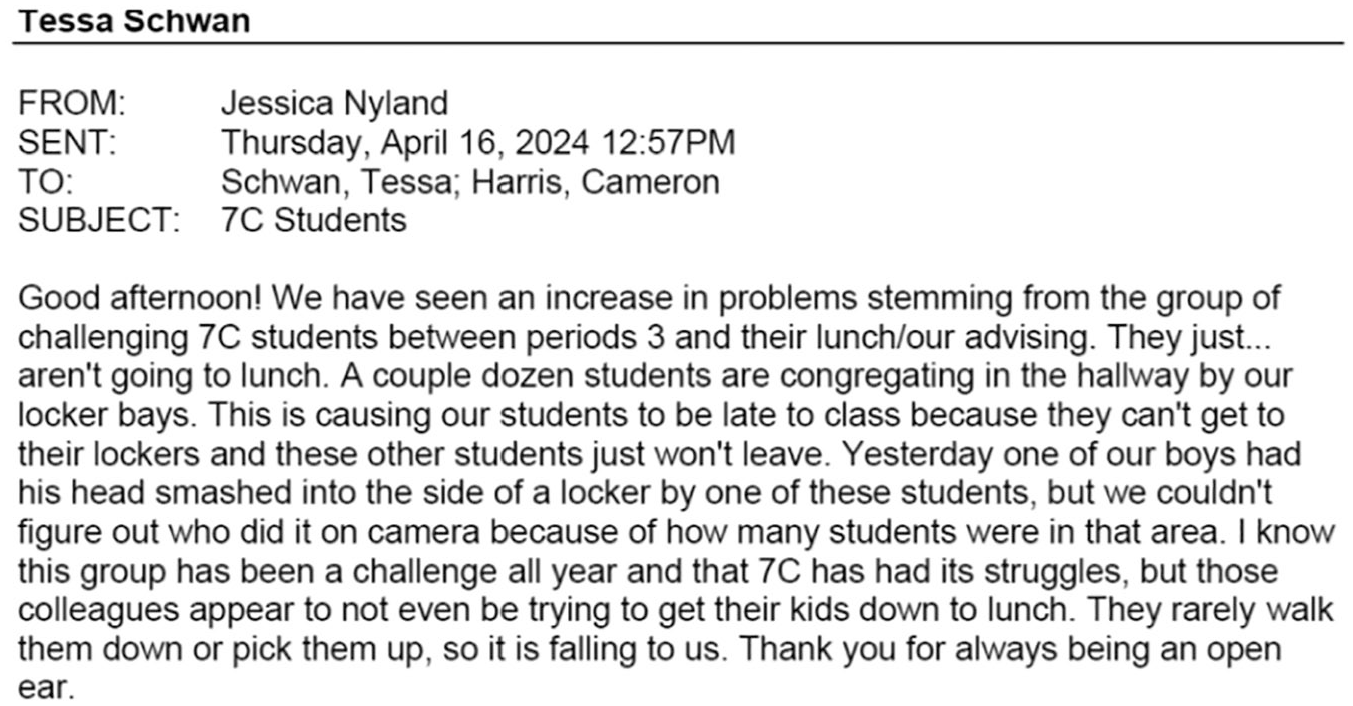
Email From Jessica.
Rubbing her palms into her eyes, Tessa added the email to her “To Resolve” folder. Looking up, Tessa sees one of her administrative assistants, Janie, standing in her doorway with Damien, an irate eighth grade boy who has a reputation for being a bit of a behavioral high-flier. Damien explains that he has been kicked out of class and that his teacher told him to go down to the office. Although she has her suspicions, Tessa asks which teacher sent him down and he affirms it was Jordan Walsh, a first-year science teacher. Generally speaking, teachers were not supposed to send students directly to the office, as there was no guarantee anyone from the leadership team was available to handle the issue at hand. It was standard procedure to either (a) have students take a break in the team center, touch base, and then have them come back into the classroom, or (b) to send students to the security desk for the remainder of class. It was a school-wide “not-so-secret secret” that Jordan was having a difficult first year. He lacked fundamental classroom management skills and Tessa was seeing little improvement. Although disappointed that Jordan’s colleagues had not stepped up to the plate to support him, Tessa was not necessarily surprised. Jordan has a formal mentor from the district and mentorship from another eighth grade science teacher in the building, but things just were not clicking for him. Pushing Jordan to the back of her mind, Tessa spent the next several minutes talking with Damien, calming him down and preparing to send him back to class with a plan for the rest of the day.
1:45 PM
At the period transition bell, Tessa walks with Damien as far as the staircase on the second floor. He heads back upstairs and Tessa begins making her way down the second-floor hallway toward 7B to observe and evaluate the English Language Arts (ELA) teacher’s class. Striding past the 7A locker bays, Tessa sees four boys roughhousing in one bay, a couple kissing one another in a different locker bay, and several students crowded into yet another and preventing other students from reaching their lockers. Looking around, Tessa realizes that none of the 7A teachers are anywhere near the lockers. Peeking around the corner, she sees them all standing in the doorways of their classrooms, engrossed in conversation and paying little attention to their students. As the tardy bell rings, students hurry into their classrooms and doors close. Tessa enjoys observing the ELA class and snaps a few photos to include in the End-of-the-Year Staff Celebration Slideshow.
2:25 PM
Ducking out of class about 5 min early, Tessa begins making her way back toward the main staircase to supervise the transition between periods. Standing at the bottom of the staircase, Tessa sees a group of about a dozen sixth graders trooping down the hall from the door to the lawn, carrying footballs and chalk, with no teacher in sight. Tessa stops them and asks whose class they are supposed to be in, and they report they have the 6A social studies teacher, Mr. Harry. She asks what they were doing and where Mr. Harry was, and they tell her that he told them they could go down to the lawn and play while he worked with other students in his third-floor classroom. Sending the students on their way, Tessa is in utter disbelief that a teacher could be so incredibly careless with student safety, not to mention the incredible liability this caused. Two min before the end-of-period bell rings, Tessa sees an entire class of students streaming out of the Healthy Lifestyles classroom on the second floor through the glass balcony. She watches students whip out their cell phones from backpacks and run shrieking down the hall.
2:30 PM
Students transition to Period 7. On her way back down to her office, Tessa runs into Kelsey Hibbing, a seventh grade teacher and a teacher’s union building representative. After polite hellos, Kelsey asks Tessa whether she had the opportunity to run through the proposed addendums to the teacher contract for next fall’s contract negotiations. Shaking her head no, Tessa promises to complete her read-through before next week. When she first began at Vista, Tessa struggled to work with and balance the expectations of the union, as it was much stronger in Maplewood than in her experiences with the teachers’ union in her last position in a different state. She strives to remain mindful of the teachers’ union when implementing new policies or handling teacher issues. Next, Tessa completes her notes on yesterday’s teacher evaluations, calls down six students to receive Student of the Month awards, fields a phone call from an upset parent, and steps into the Adaptive Physical Education class for a quick game of bean bag toss.
3:45 PM
With the end of the school day fast approaching, Tessa glances out her window and sees three of the teachers currently on their prep period sneak out of the building a full 30 min before the end of their contract day. After wrapping up a few more low-priority items from her email and sending a message to all staff reminding them to be out in the halls to sweep students from the building, Tessa heads out of her office and into the main hallways to supervise the end of the day. Seeing Cameron come out of the office, she indicates she will head up to the third floor to monitor.
4:00 PM
Just as she reaches the top of the stairs, the bell rings and almost 1,500 students come streaming out into the hallways. From her spot on the landing, Tessa can see varying degrees of teacher supervision in each team center. Down the hall a scuffle between three eighth grade boys breaks out in front of the 8B team center, and Tessa reaches the conflict before any of the 8B teachers notice and react. She calls the boys’ caregivers and arranges separate pick-up for each. Now 4:20, the leadership team sweeps the remaining students from the building, ensures the doors are locked, smiles warmly but tiredly at one another, and retreats to their own offices to wrap up their days.
4:30 PM
Tessa sits at her desk, staring blankly at her notes scrawled across her whiteboard. She feels totally and utterly exhausted. Reflecting back on her day, she tries to pinpoint the cause of her fatigue. In many ways, the day had been absolutely unremarkable as no major issues arose that could not be dealt with in a matter of minutes. And yet . . . she is beyond weary. When Tessa accepted the principal position after only 1 year as an AP in the building, she was conscientious to utilize distributed leadership and ample teacher feedback when making decisions to try to facilitate a school culture of shared vision. While many of the metrics of Vista have been improving, Tessa has always said that the true health of a school is demonstrated by the willingness of teachers to do the little things that are asked of them and to generally go beyond the classroom. Although she essentially likes and gets along with the majority of teachers on staff, Tessa cannot help but feel exhausted as everyday she and the rest of the leadership team are fighting for their lives in the Wild Wild West.
Teaching Notes
As the narrative of Tessa’s typical Thursday plays out, it becomes increasingly evident that VMS has a serious problem with teacher buy-in to OCBs, both those that are required of them by contract IRBs and those that are considered to be additional, non-mandated duties ERBs. How can the leadership team improve this school culture so rooted in extreme autonomy, leader and teacher turnover, and a history of neglect? An examination of OCBs, an attempted delineation between IRBs and ERBs, and an acknowledgment of the impossible intersectionality of teacher roles provides the basis for recommendations to support healthy OCBs at VMS.
School Culture Through OCBs
School culture encompasses the unwritten rules, traditions, norms, and expectations that influence behavior, interactions, and attitudes within the school environment (Deal & Peterson, 1999). It is shaped by stakeholders’ values, beliefs, and actions, alongside the organization’s historical context (Burke, 2018). Understanding school culture envelopes various dimensions, including things, such as collective trust (see Forsyth et al., 2011), teacher efficacy (see Tschannen-Moran & Hoy, 2001), and organizational mindfulness (see Hoy et al., 2006). An understanding of school culture can be informed by observing the dimension of OCBs.
OCBs are defined as discretionary behaviors that, while not formally rewarded, contribute to the effective functioning of the organization (Organ, 1988). While teachers engage in both ERBs and IRBs daily, OCBs traditionally consist of ERBs. For teachers, ERBs can include tasks which go above and beyond their contractual duties, such as assisting colleagues or proposing improvements (Belogolovsky & Somech, 2010). In contrast, IRBs are those tasks directly specified by job descriptions and required for teachers to complete, such as teaching lessons, grading, and maintaining a safe and orderly environment for learning (Savas & Karakus, 2012). Research consistently shows that OCBs, or discretionary behaviors, positively correlate with employee performance, student achievement, and overall school health (DiPaola & Hoy, 2005; Jackson, 2009; Yaakobi & Weisberg, 2020).
The distinction between ERBs and IRBs, however, is often blurred as schools cannot anticipate all behaviors necessary for goal achievement through formal job descriptions (George & Brief, 1992). Some scholars argued that a school’s success hinges on teachers’ willingness to engage in ERBs (Somech & Ron, 2007). Critics of current OCBs literature point out the distinction between ERBs and IRBs is ambiguous at best (McAllister et al., 2007), the perspectives of different stakeholders vary as to which behaviors are required and which are discretionary (Van Dyne et al., 1994), that it is challenging to determine which behaviors are considered to be extra “helping” behaviors in a profession that at its core is designed to help others (Belogolovsky & Somech, 2010), and that the true incidence of OCBs can be difficult to ascertain as formal, supervisor-conducted scales and surveys do not adequately reflect the congenial and voluntary interactions between colleagues (Allen et al., 2000). Belogolovsky and Somech (2010) highlighted this ambiguity, revealing that principals, teachers, and parents often view many extra-role OCBs as part of the expected IRBs, particularly those related to the school and team.
The lack of consensus on the proper role of a teacher—ranging from traditional knowledge purveyor to a multifaceted figure encompassing amorphous roles, such as confidant, disciplinarian, and agent of social change—complicates the distinction between IRBs and ERBs (Havighurst, 2024; Levstik & Barton, 2004). Until there is greater agreement on educators’ roles, resolving the nuances of OCBs will remain challenging. Nonetheless, literature indicates that strong OCBs; however defined, are linked to improved school culture and student outcomes. The cyclical relationship between OCBs, teacher satisfaction, and school culture suggests that fostering OCBs can lead to a self-reinforcing improvement in overall school health (Savas & Karakus, 2012).
Organizational Citizenship at VMS
At VMS, many teachers are not engaging in OCBs, whether ERBs or IRBs. Factors, such as historical leadership precedents, turnover, the Pandemic, and a strong teachers’ union, have complicated efforts to improve OCBs. Principal Tessa Schwan faces ongoing challenges in addressing these issues. Reflecting on her first year, Tessa should consider starting with a school culture index to assess various relevant cultural dimensions or specific parameters of OCBs. Using measurement scales can help plan and evaluate school reform efforts aimed at building a school community (Higgins-D’Alessandro & Sadh, 1998).
Exploring the school’s organizational values and teachers’ professional values can provide direction for improving school culture. Schools with strong values of benevolence and collectivism tend to have higher teacher engagement in OCBs, leading to better job satisfaction, student achievement, and overall school culture (Gnanarajan & Kengatharan, 2021; Somech & Ron, 2007).
Improved teacher job satisfaction can enhance OCBs and positive school outcomes, and higher job satisfaction is linked to social, emotional, and sometimes even tangible rewards (Savas & Karakus, 2012). Some sample strategies to increase job satisfaction include collaborative teaching (Banerjee et al., 2016), leveraging support staff (French, 2003), flexible scheduling (Turner et al., 2018), inspiring teacher autonomy and leadership (Worth & Van den Brande, 2020), and supporting positive mindsets (Ma et al., 2022). Relational leadership practices, such as valuing staff, being approachable, demonstrating consistency in staff interactions, and developing teacher strengths, significantly impact job satisfaction and retention (Graham et al., 2014).
Tessa should continue to refine her leadership style, as research indicates a strong correlation between leadership style and employee productivity and output (Kumar et al., 2022) Ideally, she would aim to be a transformational or servant leader, as transformational leadership inspires collective efforts toward shared goals, whereas servant leadership prioritizes employees’ needs, fostering loyalty and positive work behaviors (Stone et al., 2004). Both styles are shown to improve school culture and performance, with transformational leadership enhancing overall culture and servant leadership particularly effective for improving OCBs due to the shared sense of obligation to reciprocate positive work behaviors (Kumar et al., 2022). Principals who exhibit servant leadership can model OCBs and inspire teachers to engage in both IRBs and ERBs, thereby improving OCBs and school culture.
Finally, should other methodologies prove unsuccessful in improving OCBs and school culture, teacher remediation plans should be considered. Tessa, and other leaders in similar situations, should familiarize themselves with all requisite levels of the law, including constitutional, statutory, regulatory, district policy, and contractual (Kennedy, 2000). Although the process of remediation takes a considerable amount of time, effort, documentation, and potentially money, in addition to the toll on school culture and morale, it may ultimately be a necessary step for course correction at a struggling school. The importance of due process for unsatisfactory teachers cannot be overstated, and Tessa should maintain meticulous documentation of concerns and follow policy and procedure at every step along the way, lest a remediation plan or even a termination be overturned (Kennedy, 2000).
Teaching Activities
In this section, we present teaching activities designed to deepen students’ engagement with the case study. These activities include two primary components: discussion questions and extended learning ideas. The discussion questions aim to foster critical thinking and collaborative dialogue, allowing students to explore key concepts, reflect on diverse perspectives, and develop a deeper understanding of the case study’s central themes. The extended learning ideas provide additional avenues for students to expand their knowledge beyond the case study and connect their insights to broader real-world contexts.
Discussion Questions
1. What are the key factors contributing to the lack of Organizational Citizenship Behaviors (OCBs) at Vista Middle School (VMS)? Explore elements such as leadership turnover, teacher autonomy, and union dynamics.
2. How can the distinction between In-Role Behaviors (IRBs) and Extra-Role Behaviors (ERBs) be clarified within Vista Middle School’s context? Consider the challenges posed by the inherent ambiguity in teaching roles and the literature cited (Belogolovsky & Somech, 2010; McAllister et al., 2007).
3. What role does trust play in fostering a healthy school culture, and how can Tessa Schwan build trust within her team? Relate to Tschannen-Moran’s (2014) scholarship on trust and collective efficacy in schools.
4. How can Tessa effectively balance leadership with the influence of the teachers’ union at VMS? Reflect on DeMitchell’s (2020) work on school unions and their impact on leadership decisions and OCBs.
5. What leadership practices (e.g., servant or transformational) are best suited for improving school culture at VMS, and how can Tessa implement them? Use insights from leadership literature (Stone et al., 2004; Kumar et al., 2022) to guide the discussion.
6. What strategies could be employed to increase teacher engagement in ERBs without overwhelming them or overstepping their roles? Explore teacher autonomy, workload, and job satisfaction, drawing from Savas and Karakus (2012) and Gnanarajan and Kengatharan (2021).
7. How does the school’s history of neglect and autonomy contribute to its current challenges, and what change management strategies could address this? Discuss the role of school history in shaping culture and behaviors (Burke, 2018; Deal & Peterson, 1999).
Extended Learning Ideas
1. Case Study Analysis and Role-Play: Graduate students can analyze the case of VMS and then participate in a role-play exercise where they assume various roles (e.g., principal, teachers, and union representatives) to navigate leadership decisions. This will help students explore how leadership styles (e.g., transformational or servant) and trust-building practices (Tschannen-Moran) influence school culture and teacher engagement.
2. School Culture Assessment Project: Assign students to conduct a mock school culture assessment for VMS using dimensions of school culture found in the case (e.g., values of benevolence, collectivism). Students can create an action plan to improve OCBs at the school, applying insights from the literature (see Burke, 2018; Forsyth et al., 2011)
3. Teacher Autonomy and Leadership Reflection Journal: Assign students to maintain a journal reflecting on the balance between teacher autonomy and leadership in their own school contexts, incorporating insights from their own teaching or leadership experiences. The journal could include analysis from literature on teacher satisfaction and its relation to OCBs (see Gnanarajan & Kengatharan, 2021; Graham et al., 2014).
Footnotes
Declaration of Conflicting Interests
The author(s) declared no potential conflicts of interest with respect to the research, authorship, and/or publication of this article.
Funding
The author(s) received no financial support for the research, authorship, and/or publication of this article.
Ethical Considerations
Ethical approval was not required for this manuscript.
