



Abstract
This case explores Coach Rosa’s efforts to gain access to teachers’ classrooms to support teaching and learning. As Rosa demonstrates, working to gain access is a complex coaching practice and coaches cannot assume that their classroom access at any school is universal. School leaders, including district administrators, principals, coaches, and teacher leaders, using this case will learn about the wide range of access-granting strategies Rosa strategically leveraged to support her classroom entry for coaching work. Furthermore, school leaders will have the opportunity to reflect upon their own classroom access for coaching work and consider which access-granting strategies may enhance their access.
Case Narrative
It is fall 2023 and the school year has commenced in Oswego School District. Coach Rosa is returning to her role as an instructional coach at Cougar Elementary School and is eager to support teaching and learning. As is discussed below, Oswego teachers are the drivers of their own professional learning needs and determine whether to work with their coach, as well as the form and focus of coaching if they choose to engage. Hence, Rosa must carefully and strategically consider how she might get one foot in the door of teachers’ classrooms if she is to support teaching and learning. This pedagogical case explores Coach Rosa’s efforts to gain classroom access for coaching work.
An Introduction to Oswego School District and Its Coaching Program
Oswego School District is located in a western, urban area of the United States. The school district serves approximately 2,600 students (60% Latinx, 15% Black, 10% White, 5% Native American, 5% Asian, 5% Other) across four K-6 elementary schools, one middle school, and one K-8 virtual school. Oswego is a Title I school district and 80% of the students qualify for free and reduced-price lunch. The teacher demographics in Oswego roughly mirror the student demographics, with 45% of the teachers identifying as Latinx, 20% as Black, 20% as White, and 15% as Other. This is not consistent with broader trends in education, as research indicates that teacher demographics typically do not mirror student demographics (Carter Andrews et al., 2019).
Coaching was implemented as a professional development structure in Oswego 10 years ago to help improve students’ standardized test scores. Every school has two instructional coaches who provide professional development in one-on-one and group settings across all content areas. As previously mentioned, the teachers in Oswego are charged with determining whether, for what purpose, and how to engage with their instructional coach. Thus, coaches must wait to be approached by teachers for support. Given that the coaches’ primary responsibility is to provide professional development for teachers, each coach has full-time release from teaching responsibilities, and it is understood among district-level administrators and building principals that the coaches are not to be used as interventionists where they would primarily engage with students. To preserve coach–teacher trust, the coaches do not evaluate teachers: this is the sole responsibility of each building principal. Furthermore, each building principal is responsible for interviewing and hiring their own instructional coaches, and in turn, the instructional coaches report to and work with their building principal. When making hiring decisions about their instructional coaches, the building principals typically hire individuals who had at least five years of teaching experience with accompanying strong student achievement and/or growth data; demonstrate deep knowledge about content, pedagogy, and how students learn; and are interested in serving as instructional leaders by providing teachers with professional development. To provide ongoing professional learning opportunities for the Oswego coaches, a district-level administrator provides full-day professional development sessions twice a month at the district office.
An Introduction to Coach Rosa
Coach Rosa is entering her second year as an instructional coach in Oswego School District at Cougar Elementary. Rosa identifies as Latinx and is a first-generation Mexican American. Spanish is her native language, and she grew up in a working-class family in a neighboring school district to the one in which she teaches. Because of this, Rosa identifies with many of her students’ experiences. Rosa is one of the more inexperienced coaches in the district. Prior to becoming a coach, Rosa was a fifth-grade classroom teacher for 10 years at Cougar Elementary. While Rosa is expected to coach across all content areas and grade levels, she feels more confident coaching upper grades teachers given her prior teaching experience.
Although Coach Rosa was a teacher at Cougar Elementary for 10 years prior to becoming a coach there, her access to teachers’ classrooms on the K-6 campus to engage in coaching work is not universal. This is an issue because it limits her potential to support teaching and learning by engaging teachers in professional development. Specifically, she has better access to teachers’ classrooms in Grades 4 to 6. These teachers have developed a prior trusting relationship with Rosa as she was once their teammate, and they know her teaching strengths well. Rosa is working to gain access to teachers’ classrooms in grades K-3. As a classroom teacher, she did not interact regularly with this grade-level band of teachers. Hence, she needs to spend time developing a relationship with them and demonstrating her own instructional competence, which may be tricky as she does not have prior teaching experience in the primary grades.
A Typical Day for Coach Rosa
7:00–7:30 a.m.: Getting Ready for the Day
Coach Rosa arrives to school at 7:00 a.m. and immediately heads to her office, which she shares with the other instructional coach, Ximena, to review her schedule for the day. Ximena is a Latinx female and veteran coach by Oswego’s standards as she has been coaching at Cougar Elementary School since the inception of Oswego’s coaching program one decade ago. Ximena and Rosa have a trusting relationship marked by co-respect, and Ximena has always been willing to answer Rosa’s questions about coaching and share any coaching resources with her. Rosa has four main coaching engagements for the day. Right after the morning bell rings, she will attend a weekly grade-level team meeting with the second-grade teachers. After that, Rosa will model a lesson in a kindergarten classroom. After lunch, she will complete walkthroughs for the entire third-grade team. At the end of the day, she will observe a lesson in a sixth-grade classroom and provide feedback to the teacher. Sandwiched between those coaching commitments, Rosa will meet with Ximena and her building principal, Mr. Jimenez, for their weekly Instructional Leadership Team (ILT) meeting. Rosa has a busy day ahead of her! Now, Rosa heads off to her first (of two) duties for the day.
7:40–8:00 a.m.: Morning Cafeteria Duty
Rosa enjoys starting off her day in the cafeteria for breakfast duty. It enhances her visibility to the teachers given that the cafeteria is a high traffic area in the mornings. It also gives her the opportunity to strike up informal conversations with teachers and learn more about their identities as human beings as well as teachers.
While in the cafeteria, Rosa comes across Teacher Kelly, a first-grade veteran teacher whose classroom Rosa has not yet been invited into. That morning, Kelly looks flustered. She tells Rosa that she was stuck in awful traffic on her way to school and she feels completely unprepared for the day. She has not yet made photocopies and still needs to pull leveled readers and mathematics manipulatives from the materials closet. Rosa sees this as an opportunity to provide support for Kelly and build goodwill for future coaching work. She offers to make Kelly’s photocopies after her duty ends and drop them off at Kelly’s classroom. Kelly looks relieved, accepts Rosa’s offer, and then runs out the door toward the materials closet.
Rosa finishes up her duty and walks to the workroom to make Kelly’s copies. Rosa makes it to Kelly’s room just as the morning announcements are ending and hands off the copies. Kelly mouths “Thank you!” in return. Rosa quickly glances around the room before leaving. She hopes that she will get to spend more time in Kelly’s classroom as the year progresses.
8:15–9:00 a.m.: Second-Grade Team Meeting
Rosa starts walking toward the second-grade wing to attend the second-grade teachers’ weekly grade-level team meeting. At Cougar Elementary School, Mr. Jimenez (the building principal) expects all grade-level teacher teams to meet once a week during their preparation period while students are at specials (e.g., art, gym, music). Teachers have the autonomy to set the agenda for these meetings, and most teams typically discuss a combination of logistical, curricular, and assessment-related items. Mr. Jimenez’s expectation is that at least one instructional coach will attend each grade-level team meeting to serve in a supportive role. Given that Rosa has not been able to establish a strong coaching presence in the second-grade teachers’ classrooms, she has been regularly attending their team meetings to foster trusting relationships with them and better understand their immediate problems of practice.
The first half of the meeting is spent discussing an upcoming zoo field trip. There are many necessary logistical items to discuss, including reserving and paying for buses, creating and sending out permission slips, soliciting parent chaperones, and connecting with the zoo’s education coordinator. Teacher Tamika asks Rosa if she would be willing to serve as a chaperone if they are unable to solicit enough parent volunteers. Rosa immediately accepts the invitation, not necessarily because she is itching to chaperone, but because it provides her with an avenue through which she can further engage with the second-grade teachers.
The second half of the meeting is spent discussing mathematics instruction. Specifically, the second-grade team talks about their desire to more effectively differentiate mathematics instruction to support students who need a challenge. The teachers start to brainstorm ideas, but quickly become overwhelmed because it seems like every idea that is generated involves substantive planning. Rosa intervenes to offer support. She offers to spend time reading research articles about how to differentiate mathematics instruction, and finding resources aligned with research-based recommendations. Rosa can then present what she learns as well as any aligned resources at the next team meeting. The second-grade teachers quickly take Rosa up on her offer and appear to be grateful for the gesture. The meeting ends as the teachers pack up their things and walk back to their classrooms to receive students as they return from specials.
9:10–9:40 a.m.: Preparation for Modeled Lesson
Rosa heads back to her office after the second-grade team meeting. She feels like she made some progress with the team in terms of building relationships and being viewed as an instructional resource. She hopes this will ultimately support her coaching access to their classrooms. For the next 20 min, Rosa prepares for her next coaching commitment: modeling an English Language Arts (ELA) in a kindergarten classroom.
At the start of the school year, Rosa typically emails the new teachers at her school to introduce herself, briefly discuss her role as a coach, and offer herself as a professional development resource. Jake, a new kindergarten teacher, expressed interest in working with Rosa. Specifically, he asked Rosa to come in and model a lesson so that he could see how she fostered a rich discursive environment for students. This was an area of growth for Jake during his student teaching, and he wanted to continue to improve himself in this area. Rosa jumped at the opportunity to model a lesson in Jake’s kindergarten classroom. The previous school year, Rosa had not been invited into many of the other kindergarten classrooms for coaching work, likely due to her lack of previous teaching experience in this grade level. She hoped that by providing Jake with a positive and productive coaching experience, he would spread the good word to other kindergarten teachers and that Rosa would eventually be invited into more kindergarten classrooms for coaching work.
9:45–10:45 a.m.: Modeled Lesson in Kindergarten Classroom
Rosa arrives at Jake’s classroom just as he is returning with his students from a bathroom break. She waits a few moments as students take their seats and get settled.
The previous week, Rosa met with Jake during his preparation period to co-plan the modeled lesson and set goals for teacher learning. They agreed that Rosa would come in during Jake’s ELA block where they were currently working on identifying characters, settings, and major events in a story. They also discussed Jake’s own professional learning goals: he wanted to create a rich discursive environment for students. He perceived that he did most of the talking in his class and that his questions did not spur sufficient student discourse. Jake was interested in learning about and implementing different cooperative learning structures to foster student discourse. Jake perceived that a Think-Pair-Share would work well in his classroom, and they agreed that Rosa would implement this new structure with students during her modeled lesson.
During the modeled lesson, Rosa asks Jake to primarily embody the role of observer as this will enable him to wear the hat of learner instead of teacher. Rosa provides Jake with a structured notetaking sheet where Jake can record his observations during the lesson. In the past, when Rosa did not provide teachers with a structured way to record their observations as she modeled instruction, she found that teachers would sometimes drift off and start to respond to emails, clean up their classrooms, and take a bathroom break (Saclarides & Lubienski, 2020). Specifically, Rosa asks Jake to record any observations of her actions that seem to support student discourse, as well as students’ discourse, at the three time points during which she plans on utilizing the Think-Pair-Share structure during class that day. Rosa will reference the notes sheet the following day when she debriefs with Jake about the modeled lesson.
After students are settled, Rosa begins her modeled lesson. Throughout her instruction, Jake sits on the side of the classroom, observing and taking notes. Jake seems engaged and Rosa thinks that, overall, the lesson went well. She is eager to learn what Jake noticed as she modeled and cannot wait for the debrief. At the end of the period, Rosa thanks Jake and his students for allowing her to come in and learn with and from them for the day. Jake takes back the reigns for instruction, and Rosa leaves. She heads to the front office for her next engagement, while making a mental note to email Jake to remind him about their debrief meeting the following day. Given structural constraints with the school schedule, it was not always possible for Rosa to debrief with her teachers the same day after modeling, co-teaching, observing, and so on. However, she always manages to debrief with her teachers within 24 to 48 hr of the lesson.
11:00–11:45 a.m.: ILT Meeting
Once a week, Rosa and Ximena meet with the building principal, Mr. Jimenez. The ILT meetings are loosely organized and typically include a combination of logistical information sharing, as well as discussion about the school-wide goals and issues related to teaching and learning. This is Mr. Jimenez’s second year as principal at Cougar Elementary School, and his instructional vision takes root in promoting equitable learning experiences for all students. He expects his teachers to provide instruction that is rigorous, differentiated, standards-aligned, research-based, and promotes active engagement in a welcoming and safe environment. Mr. Jimenez previously worked as a principal for three years in a different school district that did not have school-based instructional coaches. As Mr. Jimenez would admit, he is still learning about the instructional coaches’ roles and responsibilities and how to best support and position his coaches so they can effectively support teaching and learning.
To support his instructional coaches, Mr. Jimenez has tried to foster a school culture that normalizes teachers’ participation in professional development, while publicly naming the instructional coaches as one way teachers’ ongoing learning might be supported. To preserve coach–teacher trust, Mr. Jimenez has been careful to not ask his coaches to share with him which teachers they are working with, and he does not mandate that his teachers engage with the coach if they are on professional improvement plans due to low evaluation scores and/or student achievement data. Furthermore, Mr. Jimenez does not load his coaches up with excessive duties that might take them away from their central purpose, which is to support teaching and learning by engaging teachers in professional development. However, Mr. Jimenez is certain there is more he can do to more effectively leverage his coaches to foster and sustain systemic instructional change in his school.
That day, the ILT meeting centers on discussing teachers’ professional development needs for the school year. During the first week of school, Mr. Jimenez sent out a survey to teachers where they self-identified their own professional learning needs, as well as the structures through which they would be interested in participating in professional development (e.g., coaching, book club, conference). Mr. Jimenez had compiled the survey results and was ready to share them with his coaches. The survey results indicate that many teachers across all grade levels want support with their mathematics instruction, which is not surprising given that the district had adopted a new mathematics curriculum the previous year. The new mathematics curriculum emphasizes building conceptual understanding alongside procedural fluency and adopts an inquiry-oriented approach to mathematics instruction using high-cognitive demand tasks. This differs significantly from the previous mathematics curriculum, which emphasized direct instruction, and the use of procedures and drill to promote mastery. Furthermore, the survey results show that many teachers are interested in participating in coaching to support their ongoing professional learning. Rosa and Ximena are extremely excited about this!
After discussing the survey results in a bit more detail, the team shifts their conversation to brainstorming which coaching activities (e.g., co-teaching, modeling, lesson study) (Gibbons & Cobb, 2017) would most effectively support the coaches in working with teachers. The team agrees that co-planning would be a critical coaching activity to leverage and the coaches could co-plan with teachers during the weekly grade-level team meetings, and also offer additional one-on-one co-planning support for interested teachers. Mr. Jimenez glances at the clock and sees that time is almost up. He thanks the coaches and suggests they touch base about this again at their next ILT meeting.
12:00–12:30 p.m.: Working Lunch
Rosa heads back to her office for a working lunch. As is typical, she eats while reading, responding to, and sending emails—an activity that typically takes about 20 min. mid-day. After Rosa clears out her inbox, she shifts her attention and starts thinking about her next coaching engagement: walkthroughs for the entire third-grade team.
This year at Cougar Elementary, Mr. Jimenez wants to more consistently implement walkthroughs of teachers’ classrooms. This was a practice he had initiated last year, but because of the pandemic, teacher absences due to illness, and difficulties finding coverage, it was challenging to implement. He wants to reinstitute walkthroughs this year to message to teachers the importance of making their practice public as well as normalizing the presence of another individual, such as a coach, in classrooms. To build trust with the teachers, Mr. Jimenez tells teachers that these walkthroughs are non-evaluative and that he and the instructional coaches are primarily focusing on students, not the teacher. The observer will spend 10 to 15 min. in each classroom, and at the end of each observation, the observer will leave some written feedback about students (e.g., student engagement, student discourse) on a sticky note for the teacher. When Mr. Jimenez told teachers about the walkthroughs at the beginning of the year, teachers seemed a bit apprehensive, but did not offer significant push back. Rosa loved the concept of walkthroughs as they provided her with access to teachers’ classrooms.
12:45–1:45 p.m.: Third-Grade Walkthroughs
Rosa heads to the third-grade wing. This is a grade level in which her coaching access is partial. Two of the teachers consistently invite her in for coaching work, while two of the teachers had not yet requested coaching. She is hopeful that by establishing her presence as a non-threatening partner through these walkthroughs, that might open the door for future coaching work with this team. Rosa spends about 12 min in each classroom. During each walkthrough, she sits in the back of the classroom to not draw too much attention from students. Although Rosa’s focus is indeed on students, she is also observing each teacher to get a sense for their instructional strengths and areas for growth. However, she will keep those observations to herself and store that knowledge of teachers away for a later day. After observing for about 10 min, Rosa then spends the last two mins. writing feedback for each teacher on a post-it note. The feedback is focused on Rosa’s observations of students, such as students’ overall engagement in the lesson or her noticings of student thinking. The hour passes by quickly, and before Rosa knows it, it is time to make her way to her last coaching engagement of the day. She hopes that teachers are encouraged by her positive feedback and it builds coach–teacher trust, and that she will be invited into more third-grade classrooms in the future.
2:00–2:50 p.m.: Observe Sixth-Grade Math Lesson
Rosa walks quickly to the sixth-grade wing. Last week, one of the sixth-grade teachers—Nilda—asked her to observe a mathematics lesson and provide feedback. Nilda is struggling to use the new district-provided curriculum to teach her students how to divide proper fractions using a conceptually oriented approach. In the past, she typically taught her students to apply procedures without understanding. This year she wants to do a better job supporting students to understand why the procedure works. Rosa is excited to be an observer in Nilda’s classroom. When Rosa was a classroom teacher, she and Nilda would often have vertical planning meetings together, and through those experiences they developed a trusting relationship. As a coach, Rosa finds that Nilda is always eager to receive support.
Rosa enters Nilda’s classroom and takes a seat in the back. Nilda is ending science instruction and transitioning to mathematics. Rosa hooks students into the lesson by giving them a challenging mathematics task that requires students to divide proper fractions, but does not explicitly state that students must use the standard algorithm. Nilda gives students time to explore the task in groups and provides students with access to manipulatives and also encourages them to create pictures to represent their solutions. After 20 min., Nilda asks for student volunteers to share their solutions and strategies. She solicits students who have different strategies to showcase the wide range of strategies that students in the classroom used. Students have not yet been taught the standard algorithm, and the student-invented strategies that are showcased are truly impressive! It takes a bit longer for students to share than Nilda had anticipated, and so with just 10 min. left in class, Nilda provides some closure to the lesson and previews what they would do the following day. Overall, Rosa is impressed with Nilda’s instruction. Rosa cannot wait to praise Nilda’s efforts in their debrief conversation, which will take place the following day. Rosa gives Nilda a quick two thumbs up and leaves the classroom to make it to her final duty.
3:00–3:20 p.m.: Afternoon Duty
Rosa arrives to the parking lot just in time to help direct traffic. Although Cougar Elementary is a neighborhood school and most students walk to and from school each day, a small percentage of students are dropped off or picked up by car. Wearing her shiny vest with reflectors and holding a stop sign, Rosa directs traffic, signaling to cars when to speed up, slow down, or come to a complete stop. Rosa does not mind her afternoon duty as, similar to her morning duty, it makes her visible to teachers and provides her with the chance to strike up informal conversations with teachers, which can potentially lead to future coaching work. When Rosa is finished with her afternoon duty and the last child has been picked up, she heads back to her office. She will take one last sweep through her email, preview her schedule for tomorrow, and spend time looking through resources for the second-grade team as well as prepping for her debrief conversations with Jake and Nilda. All of those tasks will easily take her to 4:30 p.m., and at that time she needs to leave to go home and be with her family.
Teaching Notes
Coaching has become a prevalent professional development structure in U.S. schools to support teaching and learning (Woulfin & Rigby, 2017). As opposed to more traditional forms of professional development, such as one-shot workshops, coaching holds great promise as coaches can provide ongoing and job-embedded support that closely attends to teachers’ problems of practice (Desimone & Pak, 2017). However, for coaches to do their jobs, they must have access to teachers’ classrooms so that they can provide professional development for teachers. In many school districts, access is not guaranteed for coaches. In an effort to honor teachers as professionals (Knight, 2007), teachers are given the autonomy to decide whether or not to engage with their coach, as well as the focus and form of coaching should they choose to engage. As is discussed elsewhere (Munson & Saclarides, 2022, 2023; Saclarides & Munson, 2023), access is a complex coaching practice. Coaches must consistently work to gain access to teachers’ classrooms, which is precisely what Coach Rosa modeled in the teaching case above.
Part 1: Discuss Coach Rosa’s General Level of Access
To begin to engage with the complexity of the teaching case, have students start by discussing Rosa’s general level of access. The following questions can guide the conversation:
What is Coach Rosa’s general level of access to teachers’ classrooms? Does she appear to have universal, partial, or minimal access to teachers’ classrooms?
What evidence can you provide to support your claim about Coach Rosa’s general level of access?
Why do you think her level of access is such? What factors might influence her general level of access to teachers’ classrooms? Make sure to reflect specifically on the role of the principal, as prior research has shown that the principal can be rather influential in brokering coaches’ access to teachers’ classrooms (Munson & Saclarides, in Press).
Part 2: Describe How Coach Rosa Worked to Gain Access
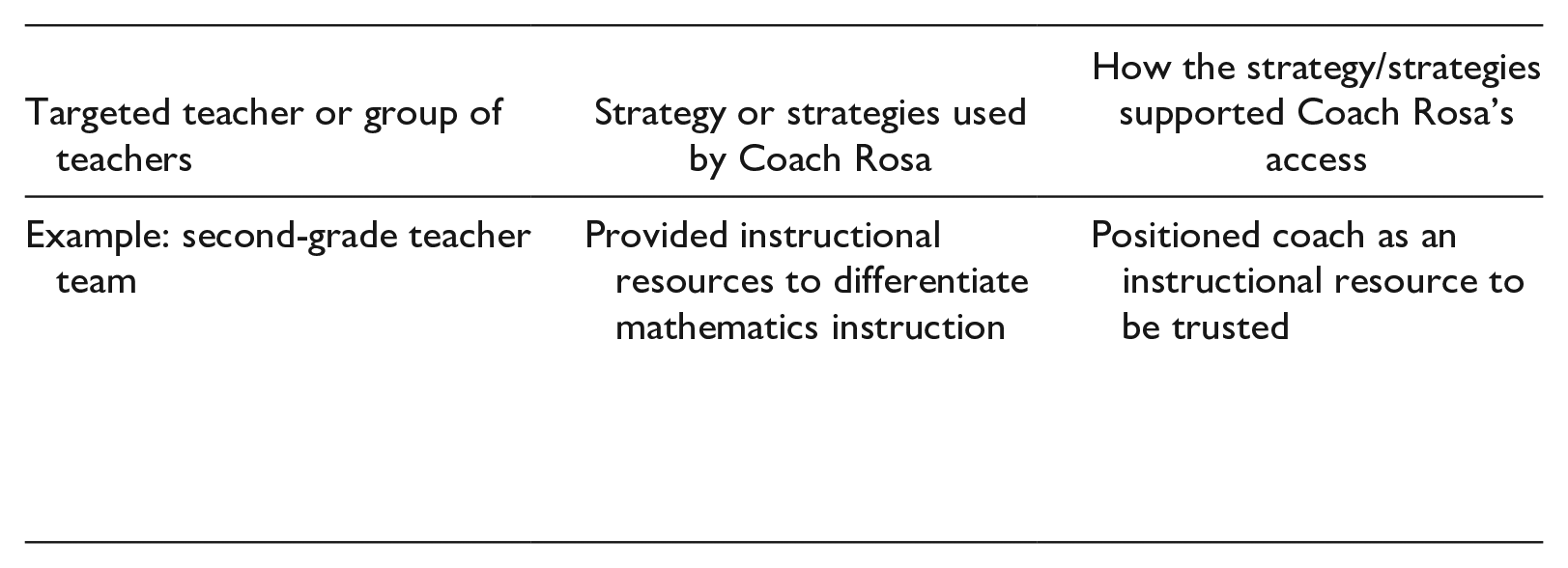
In Part 1, students had the opportunity to discuss Coach Rosa’s general level of access to teachers’ classrooms to support teaching and learning. In Part 2, students will build upon their prior work and take a deeper dive into examining how Coach Rosa specifically worked to gain access to teachers’ classrooms. Engage students in the questions listed below. To further support student learning, ask students to fill out the graphic organizer included below:
What strategies did Coach Rosa intentionally leverage to gain access to her teachers’ classrooms?
Why do you think she selected those particular strategies to enhance her access?
Did you see any missed opportunities for access? If so, please describe.
Did you see instances in which Coach Rosa coordinated two or more strategies to enhance her access? If so, please describe.
Part 3: Engage With the Research
Research is developing an emerging understanding of the phenomenon of access, and how coaches work to gain it. In their work (Munson & Saclarides, 2022, 2023; Saclarides & Munson, 2022), Munson and Saclarides explored the micropolitical strategies that coaches leverage to gain access to teachers’ classrooms. Specifically, they identified the following six broad categories of access-granting strategies: relational, structural, direct, indirect, cloaked coaching, and pitching in. Furthermore, they found that coaches often coordinated multiple strategies to enhance their access to teachers’ classrooms. Take a moment to read and annotate both research articles listed below:
Munson and Saclarides (2022)
Note: Tables 2–7 in the article contain organized lists of the various access-granting strategies with accompanying definitions and may be helpful to students as they read and process this article.
Saclarides and Munson (2022)
Note: Figures 2 and 3 illustrate the authors’ emergent model for coordinating access-granting strategies and may be a useful starting point in supporting students to understand how coaches coordinate multiple strategies to enhance their classroom access.
Part 4: Revisit Coach Rosa’s Access-Granting Strategies
Now that students have had the opportunity to engage with some research about coaches’ access-granting strategies, direct them to do the following:
Go back to the notes that were recorded from Part 2 where students analyzed how Coach Rosa worked to gain access to her teachers’ classrooms.
For every strategy that was identified in the second column of the graphic organizer, please connect it to one of the six broad categories of access-granting strategies identified in the articles read above (e.g., relational, structural, direct, indirect, cloaked coaching, pitching in). The example that was completed above for students would be an illustration of a direct offer.
After doing so, discuss the following: Which categories of access-granting strategies did Coach Rosa seem to rely on the most? Why do you think that is? Which categories of access-granting strategies did Coach Rosa rely on the least? Why do you think that is?
Part 5: Reflecting on Your Access to Teachers’ Classrooms
For students who serve in coaching roles (e.g., teacher leaders, specialists, coaches, district administrators), invite them to reflect on their own access to teachers’ classrooms to support teaching and learning. They can use the following set of questions as a guide:
What is your general level of access to teachers’ classrooms to support teaching and learning? Why would you describe your general level of access in that way?
Which strategies are you currently using to support your access to teachers’ classrooms? Why do you use those strategies?
From the readings above (Munson & Saclarides, 2022, 2023; Saclarides & Munson, 2022), which broad categories of strategies are you currently not using that you feel might support your access? Please discuss.
Footnotes
Declaration of Conflicting Interests
The author(s) declared no potential conflicts of interest with respect to the research, authorship, and/or publication of this article.
Funding
The author(s) received no financial support for the research, authorship, and/or publication of this article.
