



Abstract
While the terms “cozy” and “eco” have become common in recent game culture, the combined term “cozy ecogame” is rarely used and has not been fully defined as a concept. The study identifies how cozy ecogames engage players with environmental issues through a game analysis of two cozy and two noncozy ecogames, using a DiGAP-inspired protocol. Further included is a content analysis of 400 player reviews for two cozy ecogames and two noncozy ecogames. The findings reveal how cozy ecogames avoid highlighting harmful effects or dystopian futures, to instead utilize cozy design elements to construct hopeful climate communication, creating an experience where players feel relaxed and safe to participate in climate action, leading to noticeable betterments of in-game environments. Players of noncozy ecogames are also identified as having different motivations for playing than those of the cozy ecogames.
Introduction
Climate change is a part of the modern lived experience and is something games draw on to various means and ends, concerning several environmental themes. Major titles, such as Frostpunk (11 Bit Studios, 2018), feature a changing climate at the core of their game design, making environmental issues a present and integral element for players. Games that put players into contact with environmental issues are often described as ecogames (De Beke et al., 2024). A game is an ecogame if it reflects the “fraught socio-environmental conditions of the present” (De Beke et al., 2024, p. 9). In practice, this means that a range of games can be considered ecogames, varying from commercial action games like Battlefield 2042 (Dice, 2021), complex simulation games like Cities: Skylines–Green Cities (Colossal Order, 2017), and educational mobile games such as Earth Rangers (The Earth Rangers Foundation, 2020). Cozy games (Short et al., 2017) emerged in the mid-2010s and gained mainstream acceptance rapidly in the early 2020s. There has been a huge increase in games with the cozy tag. Since 2020, when 15 games were released on Steam with the tag “cozy,” the number of releases with this tag has doubled every year, reaching 374 games in 2024 (SteamDB, 2025). Ecogames is a genre that has not had quite as meteoric a rise in player culture as cozy games and has remained a more scholarly term.
We propose and identify the term cozy ecogames. The motivation to define this term stems from a concern to identify ecogames that convey climate concerns in various ways (Abraham & Jayemanne, 2017). As such, identifying cozy ecogames involves locating the climate concerns surfaced through particular kinds of game design and contrasting them with other types of ecogames. In this specific study, the analysis focuses on the role that cozy game elements can play in shaping the climate communication of ecogames. Related to this is the question of whether dystopia and fear-driven communications are more effective than communication with a more light-hearted or positive tone. Research in climate communication, focusing on various media, has found that appeals to fear, although documented as effective in some specific domains, are not generally more effective (Reser & Bradley, 2017). Games that engage players with environmental issues while also adhering to cozy game conventions represent one group of games that appear not to use communication that appeals to fear or doom; this makes them worth analyzing.
Cozy Games and Ecogames
Cozy games are often exemplified by titles like Stardew Valley (Concerned Ape, 2016) and Animal Crossing: New Horizons (Nintendo, 2020). Compared to games like the Dark Souls franchise, self- or community-genre cozy games can be characterized by their relaxing, forgiving, and nonthreatening gameplay, a particular aesthetic approach, and their emphasis on community-building (Gunderman, 2024; Waszkiewicz & Bakun, 2020). Boudreau et al. (2025) found that a set of design elements anchors the cozy genre, including visually soft and relaxing aesthetics, low-stakes/risk gameplay, abundant time/resources, and slow progression, as well as easy-to-play mechanics and a low ceiling for player access. These design elements stand in contrast to action-oriented genres, which require constant alertness and thrive on delivering a high-stakes, timed, and challenging experience. Perspectives on cozy games have grown (Bódi, 2023; Fawcus & Sjögren, 2026; Short et al., 2017; Waszkiewicz & Bakun, 2020), making current definitions and understandings of the impact of cozy games relevant to the aim of defining cozy ecogames. Coziness in games plays a “formal, social, and psychological role” (Krzywinska et al., 2025, p. 15). A singular definition of the term has not emerged, perhaps because of its multifaceted nature. Waszkiewicz and Bakun (2020) describe three ways coziness is used in games: (1) In coherent ways where game experience, aesthetics, and topics engaged are cozy in nature; (2) in dissonant ways where a cozy game and aesthetic experience is combined with challenging topics; and (3) in situational ways where a cozy experience is embedded within larger game experiences. Dark cozy games (Carpenter, 2023; Waszkiewicz, 2024) are one recent hybrid category of cozy games that demonstrate the dissonant use of coziness; dark cozy games succeed at introducing horror elements and engaging difficult topics such as death (LazyEti, 2022) or cults (Massive Monster, 2022) while still largely considered to be cozy games (Waszkiewicz, 2024).
The impact of cozy games on players has been described as escapism and support in coping with contemporary anxieties (Bódi, 2023), a feeling of connectedness (Örnberg, 2024), and rest (Scully-Blaker, 2024). One of the difficulties in assessing the impact of cozy games is the great variation in the large group of games usually included, ranging from mobile idle games criticized for their exploitative business models (Buergi, 2024) to small indie productions. The role of cozy game experiences, and whether they offer an escape from an efficiency-driven, productivity-focused world, has been questioned (Scully-Blaker, 2024). All while the genre itself is still developing, becoming increasingly formalized, and is reaching an estimated global market size of 973 million USD (Intel Market Research, 2025).
While the study of environmental media such as film and literature is an established field, the presence and study of ecogames has been more limited (Abraham & Jayemanne, 2017). Given the field's relative newness, understandings, classifications, and methods for ecogames are still developing (Abraham, 2018; Bianchi, 2019; Condis, 2020). Ecogames are generally seen as united by their thematic engagement, rather than a specific set of design elements. The engagement might be purpose-made and evaluated for its impact on awareness or behavior, as is the case with serious games (Iacovides & Cox, 2015), or be part of a game made for entertainment. While much research into ecogames for climate communication and impact emphasizes the potential of games for supporting positive change (Meya & Eisenack, 2018; Van Beek et al., 2022), some underline the challenge of supporting engagement with causes or themes while also providing an entertainment experience (Core Engage, 2024; Flood et al., 2018; Speldosa Interactive, 2024). Looking beyond the impact of ecogames on players, which has received much attention, there are increasing calls to consider not just what is on the screen, but also other environmental aspects of games, including the direct environmental impacts of playing games and using game hardware (Abraham, 2022).
Setting the Stage for Cozy Ecogames
Ultimately, identifying cozy ecogames matters because they represent a different current of game-based engagement with environmental concerns. Mapping hybrid ecogame genres is worthwhile because research in climate communication suggests that communicational elements such as framing (Bertolotti & Catellani, 2014), story (Bloomfield & Manktelow, 2021), valence (Diamond & Urbanski, 2022), and the number and type of appeal (Ettinger et al., 2021) can affect the impact of communication.
Cozy ecogames are a hybrid genre in which climate fiction or climate communication content is introduced into the cozy games experience. Because climate change content can be challenging, cozy ecogames are likely to use coziness in a dissonant way, not unlike how horror elements and difficult topics are used in dark cozy games. Given the hybrid nature of cozy ecogames and their relevance to understanding how environmental challenges are communicated in games, documenting their existence should involve studying both player experience and climate communication.
Methodology
Game analysis is a commonly used method in game studies, but it also comes with significant variations across different fields (Eklund & Zanescu, 2024; Fernández-Vara, 2015; Malliet et al., 2022). There has recently been a focus on greater methodological transparency in research involving game analysis (Aarseth & Jørgensen, 2022; Malliet et al., 2022). This study draws inspiration from Malliet et al.'s (2022) DiGAP protocol for conducting game analysis. It consists of seven steps, with emphasis on not only transparency but also the importance of employing a flexible and comprehensive approach that allows for adaptability within various study focuses.
Rationale and Background: Both authors are within the field of game design and evaluation. The approach for this study is to draw on game research from climate communication and communicational frames to help identify the different ways games engage players with environmental issues. Frames, as used in climate communication, are defined as socially constructed lenses and associated ways of interpretation of a certain reality (Guenther et al., 2024).
Game Selection and Boundaries: In this study, four games were selected for analysis. The set number of four games was due to constraints in research time and data material. The four games were selected based on five criteria:
The game has been described as an ecogame in past scholarship or press coverage. Two of the four games have been described as cozy games in past scholarship or press coverage. The game needs to have had a degree of visibility in English-language social media and press. The game needs to have at least 100 reviews on the game platform Steam. The game was released within the last 10 years.
Based on these criteria, the following four ecogames were selected:
Frostpunk (11 Bit Studios, 2018), a city-builder about survival during a new ice age; Endling (Herobeat Studios, 2022), about surviving as the last fox family of earth; Terra Nil: Vita Nova (Free Lives, 2023), about rewilding a plant; and Spilled! (Lente, 2025), about cleaning up ocean waste.
For each of the four games, one hundred player reviews, recently posted on Steam at the time of writing (spring 2025), with a length of more than 200 characters, were included for analysis. The player reviews were scraped with Python using the official Steam API. Reviews were then formatted into markdown files and added to a version-controlled Obsidian software instance, with the qualitative analysis package Quadro (Grieser, 2024) set up to facilitate the implementation of the content analysis. An ID number system was used to refer to content from specific reviews during analysis and throughout the article. Citations drawn from reviews used in this article cannot be traced to particular user accounts with standard search engines, preventing easy and immediate access to player profile usernames.
Analysis Approach and Coding: The player reviews were analyzed using a combination of content analysis and game analysis employing formal analysis as the analytical approach. The content analysis of player reviews had a dual focus:
To analyze players’ in-game motivations and engagement to understand which part of the game experience made them play and continue to play the games. To analyze the climate communication frames observed by players in the games.
A structured approach to coding player reviews was used to ensure clear and separate analysis. The Player Needs Inventory, or PNI, (Bostan & Sezen, 2022) was used to inform the coding of players’ in-game motivations. The PNI is based on the psychology of motivation, which helps analyze how player motives align with in-game user experience (Bostan, 2009). The inventory spans a wide range of different motivations, containing 27 motives which fall within six categories: Materialistic, achievement, power, affiliation, information, and sensual. For the content analysis, codes were drawn from the 27 motives of the PNI. This practice enabled us to examine game reviews in an open yet structured manner. The use of the 27 PNI-informed codes was inclusive of statements and descriptions, meaning that acknowledgements by a player in their review of a part of the game experience are considered sufficient to regard that part as fulfilling a need the player has, thereby warranting the assignment of a PNI code. For example, a review describing the game's calming aesthetics will be taken as sufficient indication that the player's need for a calming experience was satisfied. The analysis of the environmental communication described in the reviews was inspired by Guenther et al.'s (2024) climate communication frame categorizations, including 16 distinct frames based on an extensive review of climate communications research. The frames are varied in their focus, with some focusing on harm, such as destruction of nature and harmful impacts, while others, including science consensus and science uncertainty, build on certain views on what science says about climate change.
To illustrate how the player reviews were coded, the review with ID 30 for the game Terra Nil is shown below. The applied codes are highlighted in gray, with the specific code in parentheses. Terra Nil is a fantastic experience with stunning animations and excellent sound design (sentience(nSen)). The atmosphere is incredibly relaxing, making it the perfect choice if you're looking for a game to unwind with (play(nPlay)). The gameplay revolves around restoring ecosystems(climate action frame) through creative and engaging puzzles, making it both rewarding and meditative. 10/10 well recommend. (Terra Nil, Review ID 30)
The above review is coded with the two PNI items, sentience and play. Looking first at sentience, Bostan and Sezen (2022) describe it as the motivation to: seek and enjoy sensuous impressions; to enjoy pleasurable natural sounds, human voice, poetry and music; pleasurable sights such as color, light, form, movement, decoration, architecture. (Bostan & Sezen, 2022, p. 43)
This PNI code is used when players explicitly describe parts of the game media as appealing or beautiful. The code is used in the example review above because of the specific comments on the animations and sound.
The play item is defined as the motivation to: relax, amuse oneself, seek diversion and entertainment; to play games; to laugh, joke, and be merry; to enjoy stressless and ‘make-believe’ activity. (Bostan & Sezen, 2022, p. 43)
This PNI code was applied to player reviews that call out the game experience as relaxing or meditative. In the review above, the player describes the game's atmosphere as relaxing and suitable for people seeking to unwind, making it an ideal example of a section where the play code should be assigned. Here, it is worth noting that the last sentence of the review contains a description of the experience as “meditative,” a piece of content which fulfills the criteria for assigning the play code. Specific codes have been applied at most once per review throughout the analysis to ease the interpretation of aggregate numbers. This has its limitations, which will be discussed in the limitations section.
Reporting and Transparency: The results are reported in categories within the framework of the content analysis. An explanation and examples are provided to enhance the transparency of the results. Further, there is provided a visualization of differences between the two game categories—cozy ecogames and noncozy ecogames. The coding was created by the first author and reviewed and adjusted by the second author, following the Intercoder reliability check process described in the DiGAP protocol (Malliet et al., 2022).
Results
Players of Cozy Ecogames Look for Relaxation
Table 1, presented below, provides an overview of the coded PNI items identified through content analysis of 400 player reviews for the four ecogames: Frostpunk, Endling, Terra Nil, and Spilled!. It presents the PNI codes applied to the reviews arranged in columns by game and sorted by the number of times the code was identified, shown in parentheses.
Coded Player Needs Inventories (PNIs) by Game. Based on 400 Player Reviews.
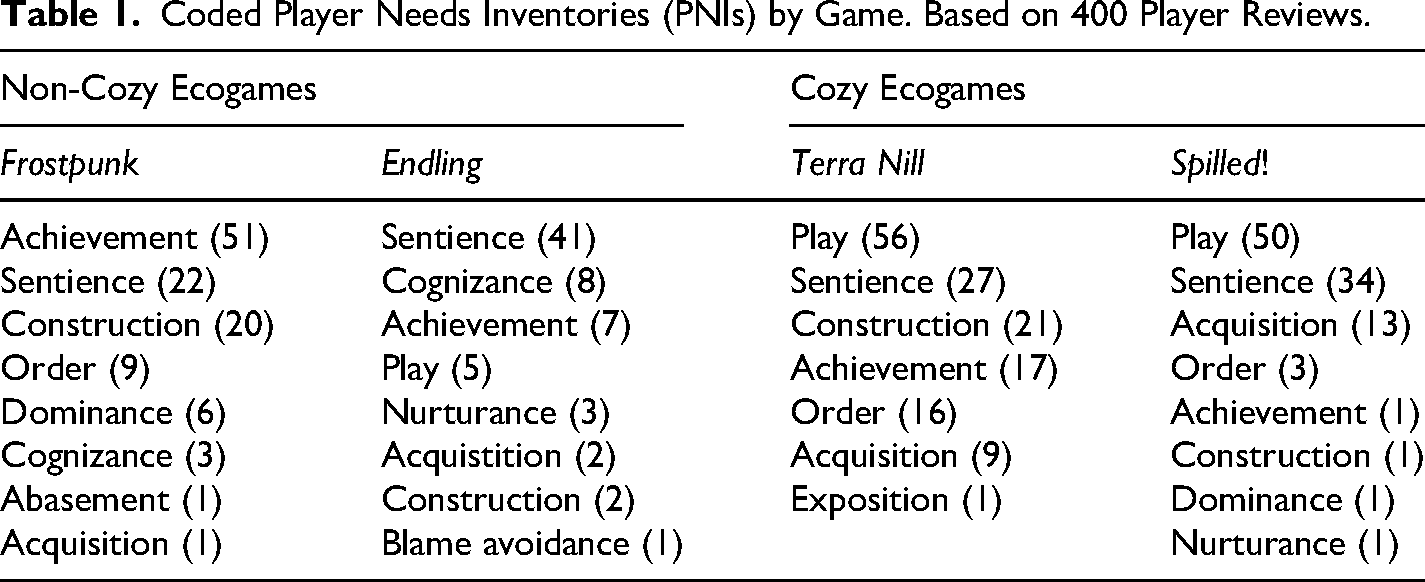
Play was assigned 56 times in the Terra Nil player reviews and 50 times in Spilled!, while it was only assigned 5 times in reviews of Endling and not assigned at all in reviews of Frostpunk. This indicates a clear difference between the cozy and noncozy games, as play, understood as the player's motivation to relax, is substantially more frequent in the cozy games.
Sentience is the most frequently coded item across all games, coded a total of 124 times. Sentience is mentioned very frequently in both Terra Nill and Spilled!, accordingly, 27 and 34 times. Interestingly, sentience is also by far the most coded item for Endling. Sentience is the motivation to seek out experiences of beauty (Bostan & Sezen, 2022).
In total, 13 reviews of Spilled! and 9 reviews of Terra Nil mention the materialistic motivation of acquiring achievements in the game. Players will often describe the experience of acquiring the achievements themselves: “It's relatively short, I got 100% of the achievements in 12 h” (Terra Nil, Review ID 51). Although a strong motivation to do and collect everything in a cozy ecogame might seem to contrast with the cozy game principles, it is a common part of cozy games. However, the achievement mechanic is an intrinsic aim in cozy games, not a mechanic players are forced to engage with by the logic of the game for completion or gain access. It is also a mechanic that might be useful in climate communication, though there are pitfalls, such as examples of players being encouraged to collect endangered species (Fisher et al., 2021).
Some PNI Items are not key to Determining Whether a Game is a Cozy Ecogame
There are several items where both the cozy and noncozy games share a similar number of mentions. Most prominently, players throughout all four games frequently describe them as beautiful. This suggests that to their specific audiences, both cozy and noncozy games are often considered beautiful, although what beauty entails can differ for each group of players. For example, a player of Frostpunk comments how the “bleak yet beautiful visuals enhance the feeling of desperation” (Frostpunk, Review ID 100), while the beauty described by players of Spilled! and Terra Nil relate to calmness and warmth. However, this does not mean that these PNI items should not be analyzed. Another item, which also has a similar number of mentions across cozy and noncozy games, is construction. Construction describes the motivation to organize and build. Though both Frostpunk and Terra Nil share the city-building genre, they provide very different player experiences: The city-building in Frostpunk is driven by a noncozy motivation for survival, and the city-building in Terra Nil is oriented towards a cozy motivation to rewild landscapes. The use of building mechanics in one genre is not identical to the use of building mechanics in other genres, therefore it still makes sense to consider these categories as they are part of the larger game experience.
Climate Communication Frames Described in Player Reviews
Except for Frostpunk, a third or more of the game reviews from across the games mention a climate communicational frame. Given the short average length of reviews, it is noteworthy that players choose to dedicate review space to considering the environmental communication side of their experience. Table 2 below shows the breakdown of communication frames per game, ordered by the number of times the code has been assigned.
Climate Communication Frames in Player Reviews.
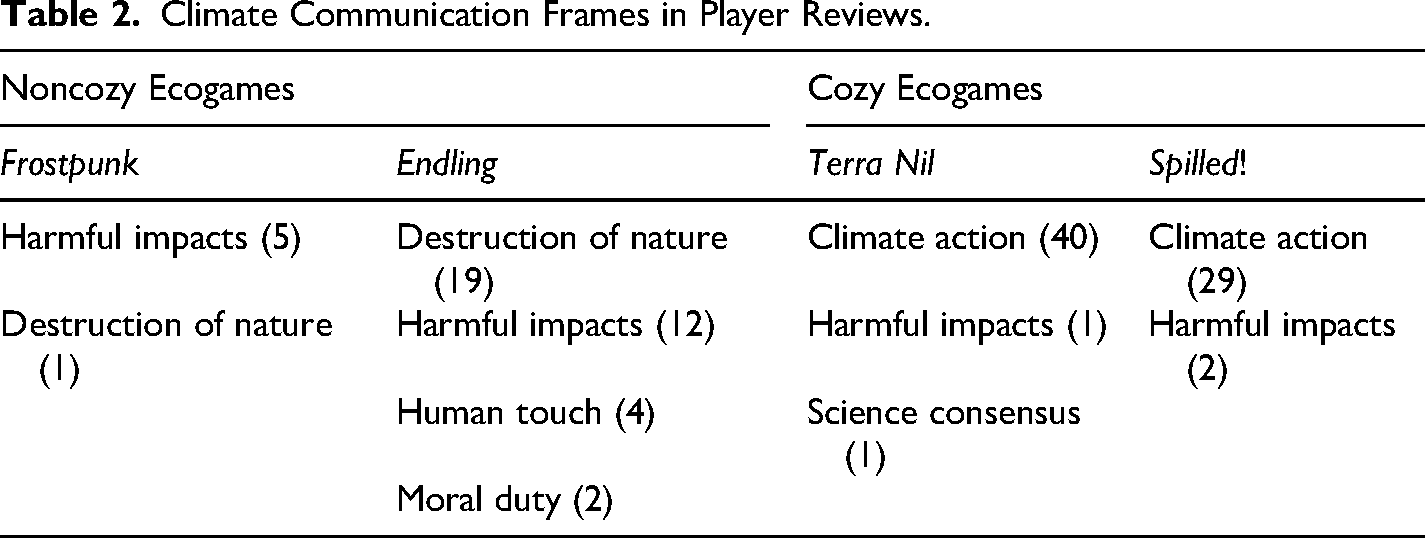
Frostpunk, as the most popular game by a magnitude in terms of units sold, does not follow this logic. If the environment was mentioned, it was done so to explain the apocalyptic setting of the game: “snow covering everything—it fully immerses you” (Frostpunk, Review ID 23). This suggests that although climate change is at the core of the world of Frostpunk, it is not what stands out when players write reviews to describe their experience.
The Cozy Ecogames Focus on Climate Action Frames
The climate action frame was the most frequently referred to for both cozy ecogames (Terra Nil and Spilled!). Players would use active verbs to describe what they are doing to better the environment in their reviews: “clean up an oil spill and restore the land” (Spilled, Review ID 73), “incorporating rewilding ethos into the gameplay loop, it made me really happy to see” (Terra Nil, Review ID 45), or “build your buildings in the correct places in the correct order to get your ecosystem functioning” (Terra Nil, Review ID 77). Rather than simply explaining climate issues, the cozy ecogames involve players in gameplay that directly addresses in-game environmental challenges.
The focus on climate action identified in the review analysis is also supported by the game analysis. The procedural rhetoric of available actions and goals in Spilled! and Terra Nil are purpose-made to reward players for taking environmental action. In Spilled! the player spawns into the first level consisting of a set of components: a surface of water closed in by land creating an enclosed space for the player to move around in, bodies of oil and objects for the player to clean up, a boat acting as a deposit station for the oil and waste components the player cleans up, several boats acting as a store for the player to buy upgrades, as well as single named entities which are either collectible animals or components unique to each level. The player can then perform a set of actions to steer the boat, in addition to pressing a key to interact with the store when in the right place. Throughout the game, the player gains two other actions: First, they become able to shoot water, and secondly, they gain a magnetic hook to salvage oil drums from the sea floor. The communicated goals for the player are to use their set of actions to clean up the waste found within the enclosed space of the waterway level. Feedback provided to player actions all tie to the extent to which progress is being made towards the goal. For example, the water component gradually turns from brown to a transparent blue as the player cleans up the oil found in the level. As they do this, the player is rewarded with large golden coins upon depositing the trash components, and ultimately, they are granted access to the next level. Turning to look at Terra Nil, the game presents a grid of terrain components to the player, marking the bounds of the world. The grid is composed of terrain tile components, as well as components added through player actions. Finally, animal components can appear in association with collections of tiles. Player actions involve adding components to various parts of the grid, which in turn influences the state of tile components on the grid. For example, the player might add a waste scrubber to the grid, causing polluted tiles to transform into clean tiles. The game's primary goal is displayed through the UI and involves achieving a specific balance of biomes, followed by cleaning up the components the player has added to the level. All levels in Terra Nil begin with the entire grid consisting of polluted, brown-looking, wasteland-inspired tile components. As the player works towards the goal, they are rewarded with both plant life and animals returning to areas as they play. They are also rewarded with game achievements, awarded for successfully restoring environments or balancing the happiness of different species. In Frostpunk, which was not produced with the intention to communicate environmental concerns, the achievements align more with the in-game story and the different challenges designed for the player. To sum up, in both Spilled! and Terra Nil, clear goals are presented that require the player to perform specific actions to improve the in-game environment. When the player performs actions that align with the game's goals, the environment is changed accordingly. It also leads to the player sometimes being rewarded with achievements, which might, as is the case of Spilled! and Terra Nil, reinforce the environmental messaging, or some other aspect of the game experience, as is the case with Frostpunk, where achievements relate more to the specific challenges presented to the player.
Some argue, however, that focusing only on procedural rhetorics that tie to the player risks misrepresenting environments, depicting natural environments as places altered solely by player actions. The clarity of focus on player actions as the driving force behind ecological restoration in ecogames has been questioned, as it risks giving little or no agency to game components other than the player. In her proposal for a framework to evaluate nature games, Germaine (2022) describes how a framework should assess how games extend and distribute concepts of agency beyond humans. This is hardly done in Terra Nil and Spilled!, best illustrated by the fact that once either of the games is started, absolutely nothing will happen in-game before the player acts.
Bearing Witness in Noncozy Ecogames
The harmful impacts and the destruction of nature frames were the most invoked for the noncozy games. These frames focus on the negative impacts of climate change; the harmful impacts frame can contain “a link to a threat of apocalypse” (Guenther et al., 2024, p. 378), something essential to at least the world of Frostpunk, which challenges the player to build a city that can survive the ever-lower temperatures of a new ice age. The first campaign of Frostpunk exemplifies well how the harmful impacts frame is used in the game. Upon launching the first campaign in Frostpunk, the player is presented with a montage video depicting how the coming of an ice age decimated human societies, leaving only a select few with a chance of survival. A series of cuts shows London being gradually submerged in snow and cold. Then, a series of cuts shows expeditions trying to head to safety, with trails of silhouettes of bodies in the snow. What the frame highlights in this case is the apocalyptic societal costs of the impending new ice age, described by one reviewer as a world where “the cold is relentless, resources are scarce, and every decision can significantly impact the fate of the last remnants of humanity.” (Frostpunk, Review ID 78). Besides the beginning montage, the frame is also continuously activated throughout the game experience through the various choices presented to the player. During the first 30 min, the player must decide whether to reintroduce child labor, a choice that underlines the moral collapse associated with the apocalypse.
In Endling, the harmful impacts frame is invoked through comments like: “shows you how both humans and animals will be effected by our own actions” (Endling, Review ID 76). While focusing on the consequences of climate change, many players spoke about the insights they gained from witnessing the game world deteriorating before their eyes. One player mentioned the destruction of nature frame before emphasizing what they had learnt: Polluted rivers with endless amounts of trash, forests chopped flat to the ground, giving way to a barren wasteland where nothing can grow. It gave me insight on the pollution that humanity has brought. (Endling, Review ID 26)
One of the core environmental messages in both Frostpunk and Endling is that the player cannot stop the march of environmental destruction. They are to manage the resources they have and cope as well, and as long as they can, within a deteriorating environment. In this way, the player's role in relation to the environment is one of spectator or witness. As expressed in many reviews, this does make for engagement with environmental questions, especially in the case of Endling, which, besides the harmful impacts frame, also features the destruction of nature and human touch frames.
Endling brings many of its players to tears through its focus on characters; players describe how they become deeply attached to the fox family they are trying to keep alive in a world with an increasingly polluted environment: I was screaming and cursing the whole time I played the game and had to take multiple breaks to calm myself from the intense emotions it made me feel (Endling, Review ID 62)
The frame human touch, which refers to communication that takes a dramatized, emotional point of view, captures this communication strategy well. The player represents a whole species as they attempt to keep their fox family alive. The game takes the player through an emotional rollercoaster, which involves the death of, at the very least, the player-controlled fox mother, tying environmental communication to the life and death of important game characters.
The destruction of nature frame is also present in Endling through the gradual and visible destruction of the environment. Much of the gameplay in Endling involves the player in adapting to the ongoing human-caused destruction of the environment while providing food for their fox family. For example, the fox family's den is at one point located in a forest affected by logging activity. With each day, more of the forest disappears, and with it, food sources, forcing the player to go into a nearby factory to look for food.
Endling and Frostpunk both present post-apocalyptic worlds to players. Moreover, unlike in the worlds of Terra Nil and Spilled!, the climate change featured does not improve in response to player actions; instead, it worsens at a steady pace throughout the play experience as an antagonistic presence to the player. The noncozy ecogames focus on harm and survival, leaving the player to bear witness to the worsening climate crisis at best. This stands in contrast to the cozy ecogames analyzed, which tend to focus on the potential for alleviating environmental challenges. This analysis also suggests that not all the game experiences analyzed in this study were designed to engage players with environmental topics through narrative, environmental, and game-mechanical means.
Low Required Player Skill Makes Ecogames Available to a Particular Audience
Multiple game elements contribute to creating a game experience with a low barrier to entry, which is one element of cozy games (Boudreau et al., 2025). In the cozy ecogames, significant effort is not required from the player to make progress and unlock additional game content. In Spilled!, a simple set of player actions focused on steering the boat, combined with a nearly nonexistent UI, means that the game is easy to learn, something several players mention in their reviews: “easy to grasp controls; it was a joy to play Spilled” (Spilled!, Review ID 75). Having a simple set of player actions is one thing, but the design of Spilled! also removes any limiting components that might exist in similar games, preventing the player from reaching their goals. The boat controlled by the players does not require fuel, and there are no time limits. The most significant limitation imposed on the player is that they cannot purchase upgrades at will. Players must wait as they are rewarded with coins for cleaning up levels. While this does not prevent the player from completing levels, it does limit the speed at which they can do so. This slower pacing contributes to a relaxing gameplay experience. Another game design element that increases access is how the game system registers the player's goal of cleaning up a level as reached, well before a level has been cleared of oil. This is shown in Figure 1 below. The next level, featuring brown, unclean water, is accessible to the player on the left side of the screenshot. The screenshot also shows how plastic bottles and burning fires can still be present when the player unlocks the next level.
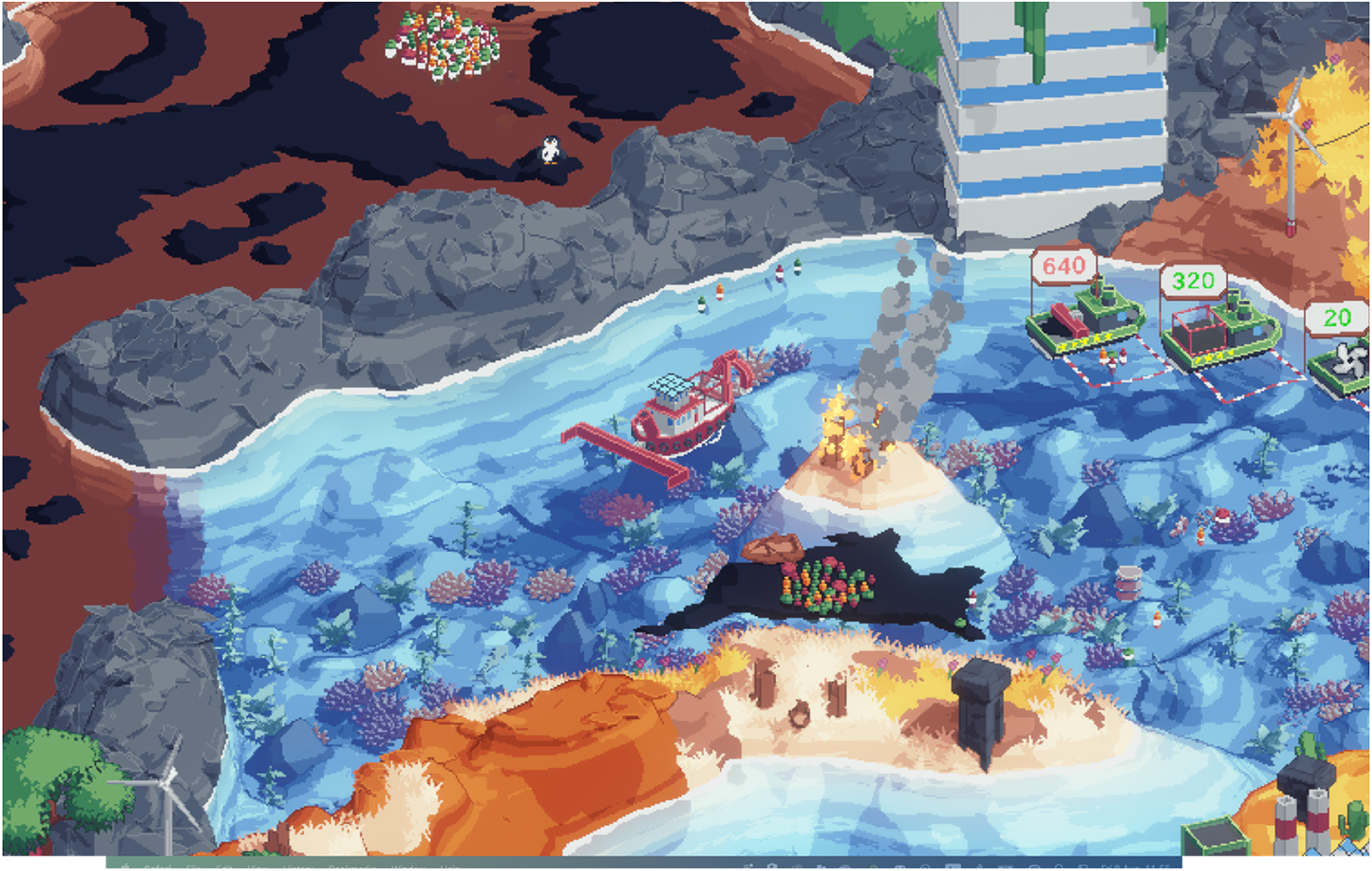
A completed level in Spilled! (screenshot from Spilled!).
“Hopecore, as the Kids say” (Terra Nil, Review ID 53)
The cozy design principles applied to ecogames create climate communication infused with hopeful messaging. A perceptive player called out Terra Nil as hopecore, a TikTok trend emerging in 2024 focusing on hopeful content to challenge the usual TikTok scrolling experience by some depicted as “horror and consumerism and bitterness in one swift scroll.” (CodyKane, 2024). While hopecore has not been used to describe games much, one of the outcomes of cozy design elements is an inclination towards communicational frames with hopeful messages. Almost all actions available to the player in Terra Nil, if the player seeks to reach the goals presented by the game, involve taking some kind of climate action to improve the environment. Placing waste scrubber and water well components rewards players with the appearance of vibrant green grass and of in-game endangered species that are not present at the beginning of levels, such as pandas and Canada geese. The game state after the appearance of these species is shown in Figure 2 below. In Spilled!, vibrant coral reefs, whales, and tuna become visible as the player cleans up the oil on the water's surface.
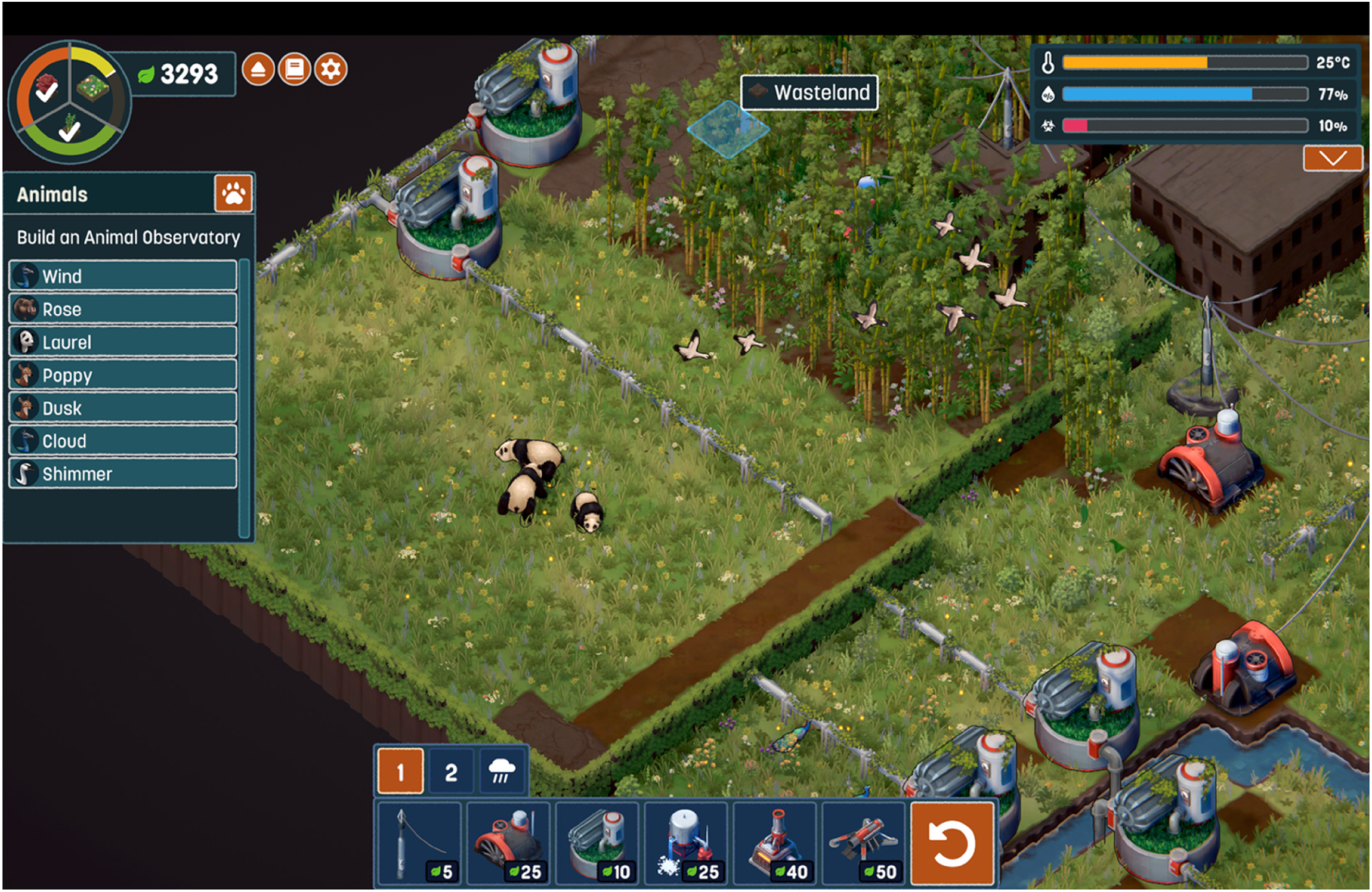
Pandas and Canada geese return in Terra Nil (screenshot from Terra Nil).
By utilizing some of the strongest environmentally symbolic species and biomes, the games underscore that they do not exist in cultural isolation. Just like hopecore videos on TikTok are described as a “breath of fresh air” (CodyKane, 2024) from the monotony of doomscrolling, several players spoke about the relief they feel when creating change in a game world at a time when change in the real world sometimes seems impossible to achieve. Instead, the hopeful communication found in cozy ecogames and hopecore seems to exist in response to a world ridden by doom framings. Several players also expressed in their reviews that they play Spilled! or Terra Nil to cope with their lack of power to influence change in the world: “I come to this game to feel satisfied in making a difference in restoring nature and promoting biodiversity when I cannot always in real life” (Terra Nil, Review ID 68). A player of Spilled! writes: “Spilled isn’t a complicated game, or a difficult one. You can’t really even lose when you play it. But what it does provide is a nice escape” (Spilled!, Review ID 1). Reviews like these suggest that cozy ecogames cater to a certain set of environment-related motivations, which other ecogames are unlikely to fulfill, whether they focus on harmful impacts or the destruction of nature. The reviews also confirm that safety, considered a core pillar of coziness in games (Short et al., 2017), plays a significant role both in delineating cozy ecogames and in considering how these games communicate environmental concerns.
Cozy Ecogames, eco-Anxiety not Included
Both the content analysis and the game analysis confirm that safety is a foundational differentiator of cozy and noncozy ecogames. This is where cozy ecogames stand out in contrast to a game like Endling, a game where reviewers often describe being brought to tears by the tragedy of the story and the world, or Frostpunk, with its many reviews describing its sharp bleakness and cruelty. There is darkness in cozy ecogames, too. However, despite containing content that might be considered dissonant with the core tenets of cozy games (Waszkiewicz & Bakun, 2020), the analyzed cozy ecogames have succeeded in making players feel safe. The active use of cozy design elements, such as low-barrier access, the absence of challenge-inducing components, and immediate feedback affirming player progress, described earlier, all contribute. Players expressing that they “feel satisfied in making a difference” (Terra Nil, Review ID 68) when they play, suggests that providing players with opportunities to act in relation to environmental issues is one way to address the eco-anxiety that many players feel. This echoes the argument presented by Pinder (2024), who argues that the cozy design principle of abundance found in cozy games about the environment means providing the player with pathways to solve a climate crisis that, for the average player, feels unsolvable.
While the analyzed cozy ecogames both provide the tools that the player needs to improve the in-game environment, both Spilled! and Terra Nil also keep the direct and raw experiences of the potential negative impacts of climate catastrophe at a safe distance from the player. In their analysis of Terra Nil, Pinder argues that one way this is achieved is through the omission of explicit evidence of both human causes and costs of crisis (2024). Despite marketing itself as a “reverse city-builder,” the cities of Terra Nil only appear towards the end of the game. Both Spilled! and Terra Nil also never show humanoids to the player, opting to exclusively show other animals and plant life, leaving open the question of the fate of humans in the world restored by the player.
Comparing Cozy and Noncozy Ecogames
Examining the findings from the coded reviews of players of Frostpunk, a city-building game, achievement is the most identified item, suggesting that players are motivated by challenge. Challenge is less essential in player reviews of Endling, a narrative survival game, where players spoke at great length about the emotionally despondent tone set by the game. We outline the specific differences between cozy and noncozy ecogames in Table 3 below.
Observed Differences Between Cozy and Noncozy Ecogames.
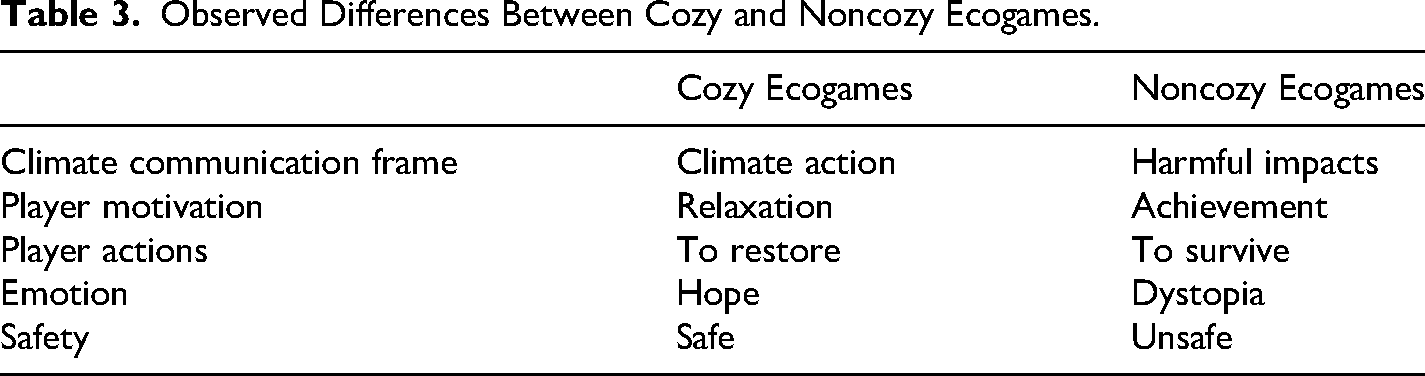
All five dimensions in the table relate to how players view their own experience of playing: climate communication frame describes how climate topics were framed as perceived by players, motivation describes the primary player motivation for playing, actions describes how players describe the actions they take in-game, emotion describes the emotion mentioned most by players, and safety outlines the extent to which players see themselves as safe when playing.
Limitations and Future Work
There are several limitations to the current study. When assigning codes during the content analysis, a once-per-review approach to code assignment was employed. This means that a code would only be assigned once in a review, even though the review might contain several pieces of content that fit the category criteria. This practice runs the risk of compromising the validity and reliability of the work, as it may introduce inconsistencies in categorizations. For example, reviews that contain rich, multifaceted engagement with certain PNI items, frames, or themes will be counted equally with reviews that mention the category in passing. The validity and reliability of future work will benefit from applying a more consistent categorization scheme in which pieces of content are coded according to the same set of guidelines, regardless of whether a code has already been assigned.
It was a challenge to identify players’ perceptions of aesthetics during the content analysis implementation, as there are many different perspectives and understandings of aesthetics. In future work, the approach for coding aesthetics could be further developed to catch specific aesthetic descriptions and sub-categories. While the game analysis presented in this article draws perspectives from within the field of ecocriticism, future in-depth analyses of the analyzed games from an ecocritical perspective would complement the findings shared in this study. Further, there would be value in conducting interviews with eco-games players, potentially followed by a thematic analysis, and comparing and refining some of the framework presented in this study.
The two cozy ecogames included in this study were variations of clean-up games with some collectibles. However, many other approaches and genres could be worth following for future studies. There could be interesting elements in investigating other types of cozy ecogames, how they communicate climate change and environmental issues, and whether they do so in the same way as the games analyzed in this study. A group of players appears to find cozy ecogames meaningful. However, can we talk about an actual player base for cozy ecogames? It would be interesting for future work to gain a better understanding of how players perceive and respond to the different climate communication frames used in games, as well as how they compare and utilize these frames in conjunction with other media in a climate communication context.
While this study does not show that there is an actual player base for cozy ecogames, it does suggest that one might exist. While cozy ecogames are identified as a hybrid genre, future studies that delineate audiences, preferences, and potential overlaps would be needed to disentangle the different audiences playing cozy ecogames.
Conclusion
Cozy ecogames were identified as a group of games that use cozy game elements to engage players with environmental themes. Using existing theory on cozy and ecogames, as well as a content and player review analysis of four ecogames, cozy ecogames are found to be a hybrid genre in which the game experience and aesthetics are cozy, and the thematic engagement is ecological. While the use of coziness in conjunction with difficult topics in these games can be classified as dissonant, the conclusion from the review analysis suggests that players have no trouble having a cozy experience while also engaging with environmental topics such as oil spills and nature regeneration.
Based on the analysis, it can be concluded that the players of noncozy ecogames have different motivations for playing than the players of cozy ecogames. Players of cozy ecogames reported wanting to feel relaxed and safe when they play, in contrast to players of the two noncozy games, who are motivated by achievement and survival. Furthermore, the climate communication of the cozy ecogames seemed focused on restoration and climate action, while the noncozy games were focused on communicating the harmful impacts of climate change. Players of cozy ecogames expressed in their reviews that this helped them deal with their eco-anxiety and sense of powerlessness.
Footnotes
Ethical Approval
This study is ethically approved (ID 2024-505-00470) by an ethical committee at Aalborg University.
Funding
The authors disclosed receipt of the following financial support for the research, authorship, and/or publication of this article: This study is a contribution in the project STRATEGIES (EU Horizon, Cluster 2). STRATEGIES is funded by the European Union under grant agreement No 101094373 and the UK Research and Innovation.
Declaration of Conflicting Interests
The authors declared no potential conflicts of interest with respect to the research, authorship, and/or publication of this article.
Data Availability Statement
The data presented in this study are available on request from the corresponding author.
