



Abstract
This article contributes to discussion on the aesthetic and affective aspects of sports videogames by adapting thinking from the philosophy of sport into analysis of sporting action in golf games. Specifically, the article is concerned with the concept of performer aesthetics: the qualities that emerge from direct experience of performing a sporting movement. Selecting the golf swing as a case study, this article draws on the philosophy of sport to develop a hermeneutic analysis of performed golf swings across a selection of golf simulation games, from mainstream console titles through motion-controlled games, driving range games, and games controlled by touch. Framed by the author’s own lived experience of golf participation, this article draws attention to the tensions that can arise between theory and intuition, quantification of movement and quality of experience, when sporting actions are adapted into digital play.
Introduction
Released for the Atari 2600 in 1979, Miniature Golf (Atari, Inc, 1979) provided one of the earliest representations of the golf swing in a digital game. While lacking the nuance of a performed golf swing, it implemented two important factors that determine how a swing is executed: control over the angle of the club face relative to the ball, and the power of the swing. Golf (Atari, Inc, 1980) built on the premise of Miniature Golf but achieved a closer representation of the sport through its visualisation of golf courses and a player character that resembled a golfer holding a club. It also included an animated representation of a rudimentary golf swing. Like Miniature Golf, the aim was to align the club face with the ball to create the intended angle, and to apply power by holding down the controller button. The player character wound up a backswing before uncoiling to swing through impact into follow through.
Today, golf simulations and golf-inspired games are a mainstay of videogames. And yet, as Bogost (2013, p. 50) has observed, the overlooking of the sports genre within the broader field of game studies has been something of an ‘ironic failing’, given the historical significance of Tennis for Two and Pong. These early videogames introduced basic sporting mechanics which have since proliferated through myriad digital game genres, from full sports simulations through casual and touch-based mobile games. Research into the design, reception, consumption, and sociocultural context of sports games has since been developed (e.g., Consalvo et al., 2013; Muniowski, 2025), but relatively little attention has been directed to the aesthetics of the athletic moves these games set out to simulate. Parallel to game studies, scholarship in the philosophy of sport has considered the cultural values, meaning, and aesthetics of sport not only as received by spectators, but also performed by participants (Holt, 2020; Taylor, 2021).
Sports videogames therefore raise questions regarding the translation of sports performative aesthetics into videogame analysis. Moreover, any analysis ought to consider that many sports videogame players will have lived experience of sports participation, and that their appreciation and critique can be supported not only by their informed spectatorship, but also by their own performative experience. The golf swing as represented in sports simulation games presents a useful case study. On the one hand, golf simulation games place significant weight on a quantifiable understanding of the swing with affordances for how this can be controlled by the player. On the other hand, the pastime of golf is underpinned by affective and aesthetic appreciation of the swing as both an observed and performed movement. In his articulation of cricket as art, CLR James states ‘the spectator at cricket extracts the significance of movement and of tactile values’ (1963, p. 267). What is the significance and value of the simulated golf swing when it is performed in digital play?
In this article, I am interested in how the golf swing has been implemented in games not as a player action utilised to deliver a ludic outcome (i.e., to move the ball to a desired location in the game environment), but as a performance in and of itself. The scope of the current study called for an analysis of a variety of golf simulation games to understand the ways in which the swing can be implemented. At the same time, the focus of the research was on a qualitatively rich analysis of the golf swing as a phenomenological experience, one which would draw upon my own experience as a golfer who has played on courses and practiced in ranges. To that end, my approach is a hermeneutic interpretation of the swing informed by my lived experience and framed by videogame aesthetics, sports aesthetics, and the philosophy of golf. Firstly, I consider the literature on aesthetics in digital games, prioritising approaches that consider agency, embodiment, and affect. Next, I provide an overview of sports aesthetics, centring the work of Holt (2020) in providing a framework for aesthetic analysis that can be applied to sports simulation games. In the subsequent sections, I seek to deconstruct the performance of the swing in digital games considering three categories of swing implementation: overlay interfaces that prioritise quantification of the swing in golf simulation games, mimetic control from motion controllers to the digitised golf range, and touch control as a site of affect and performative aesthetics.
Aesthetics, Embodiment, and Affect in Videogame Play
Swink's (2009) concept of game feel is a logical starting point for interrogating the performance of the golf swing in videogames. Like the golf swing, game feel is subject to negotiation between positivist (quantification of movement, timing, sequencing) and interpretivist (subjectivity of experience) epistemologies. As Swink notes of game feel, ‘without close examination, we know what it is. Try to define it and the explanation quickly unravels into best practices and personal experiences’. (p. 1). A golfer would sympathise. Swink provides a detailed account of the factors that can inform the designer's iterative development of ‘feel’, inclusive of tinkering at the level of the input device, buttons, and movements, through different ways in which responses can be produced and timed, to the broader context of the game world and interaction with other digital objects. Ultimately, the quantification and balancing of these variables provide a framework for informed design, rather than a recipe book to deliver a predictable outcome.
When it comes to understanding the aesthetic qualities of performance in videogames, a focus on what marks videogames as different from other media can lead to an emphasis on agency and configuration as the primary site for aesthetic analysis. Galloway (2006) articulated this as gamic actions that can be broken down as operator-actions and machine-actions, which in turn take place in diegetic and non-diegetic space. This model affords consideration of player expression in a game, such as performing a golf swing with an avatar, which for Galloway would be an example of diegetic operator-action. Galloway's approach emphasises the primacy of action over sensation, which is a common theme in studies of game aesthetics. For instance, Kirkpatrick (2011) expresses concern that any emphasis on visual sensation could occlude the ‘real aesthetic’ which is ‘contingent on the structuring of time as a mode of imminent action’ (p. 81), in effect that action is the source of our aesthetic engagement with videogames. This emphasis on action is applied through his consideration of embodied interaction, analysis of controllers, and the ‘dance with hands’ in game play. Lantz (2023) concurs stressing that ‘games are about discovering beauty, pleasure, and meaning in instrumental reason’ and that they are a ‘laboratory for thought and action’ (p. 112), while Nguyen (2020) stresses that ‘though games can offer some of the more familiar sorts of aesthetics experience by telling stories, presenting striking images, and even making arguments, they can also do something else for us: they can provide designed experiences of our own agency’ (p. 101).
While agency can be a useful frame for understanding the golf swing as adapted into videogames, it is my position that this emphasis on thought, reason, and action is insufficient for interrogation of the embodied experience of the golf swing as a sporting/gaming performance. Dovey and Kennedy expressed concern with a singular approach to game analysis that privileged ludological thinking and downplayed subjectivity, sensation, and interpretation. Building from Haraway, they note that ‘the body is always committed or engaged in gameplay, from sensorial perceptions experienced as embodied emotional states, through busy hands and fingers in many games, and all the way through to the entire body being involved’ (Dovey & Kennedy, 2006, p. 107). Keogh (2018) develops a thesis of the embodied and textual experience of games that acknowledges that players do make choices and perform actions, but that meaningful engagement with a videogame ultimately occurs at the intersection of audio-visual design, hardware, and the player's body. For Keogh, approaches to videogames that consider them adaptations of non-digital games are inherently problematic as they miss that making choices within a simulation is not how players experience videogames. He summarises, ‘to understand the experience of videogame play, we must embrace (without resolving) the splices actual/virtual, player/character, embodied/textual, active/passive, acting/interpreting’ (p. 195). Like Dovey and Kennedy, Keogh emphasises embodied experience and meaning-making in digital games as ‘a cybernetic amalgam of material and virtual artifacts across which the player's perception and consciousness are distributed and transformed and from which the player's embodied experience of playing a particular videogame emerges’. (p. 27)
Highlighting the limitations of action-oriented approaches to game aesthetics, Anable offers affect theory as a means of analysing the encounters we have in games that occur in the ‘spaces between representation and computation… and between the player and the device’ (Anable, 2018, p. 96). She draws similarities between aesthetics and affect in terms of the emphasis on sensation and argues for the broadening of an aesthetic theory of games beyond computation/simulation to embrace representation. It follows that this would allow us to understand the ’negotiation between that what is seen and that which is felt’ which ‘necessarily has effects on the mediation of identities and subjectivities’ (p. 121). For the present study, Keogh and Anable's approaches provide useful framing for hermeneutic analysis of the experience of the golf swing as a performance grounded in lived experience and digital encounters in golf simulation games.
Performative Aesthetics in Sport
Building from James (1963) and the notion of sport-as-art, the philosophy of sport has critically examined the relationship between physical activity, expression, and cultural meaning with a view to tracing sport's aesthetic dimensions. Best (1974) and Cordner (1988) argued that aesthetic beauty can be observed in athletic movement. While this concept has often been aligned with the ‘aesthetic sports’ – such as dance or gymnastics – movement in ‘purposive sports’ (such as golf) has also been included in this discussion. Best noted that this can be attributed to ‘looking at, or performing, actions which we take to be approaching the ideal of totally concise direction towards the required end of the particular activity’ (1974, p. 209). To that end, this could be regarded as movement that is evaluated aesthetically according to Suits (1978) definition of a game. More broadly, separating sport-as-art from aesthetics-in-sport is often regarded as important to understanding what constitutes the aesthetic qualities and values of sport (Taylor, 2021). Elcombe (2012) argues that approaching art as a metaphor in sport – as opposed to the traditional metaphor of war – can be a pragmatic approach to revealing the aesthetic qualities of sport performance and its potential to generate temporarily meaningful events and emotional response. This comparison to – rather than equivalence with – art has afforded consideration of aesthetic attitude and hermeneutic interpretation of sport that recognises sport as a ‘physically embodied challenge, at which the athlete may fail’ (Edgar, 2013).
But what of the aesthetic experience of performing as a participant in sport? In Kinetic Beauty, Holt (2020) develops a theory of sports aesthetics that provides useful thinking that can be applied to critique of an individual's experience of their own performance. Firstly, Holt proposes an analytical framework – the five-level analysis (or 5-LA) – for critique of sport aesthetics that considers physique, movement, performance, the framework (e.g., rules), and significance (e.g., the dramatic qualities). In the current study, the discussion of movement (the beauty we can extract from observation of individual physical action) and performance (how movements can be combined stylistically) are pertinent. Importantly, Holt dedicates a chapter to ‘performer aesthetics’ where, he argues, it is possible in sport to occupy a dual role of ‘being both agent and audience, creator and critic, of one's athletic efforts’ (p. 29). This form of aesthetic appreciation is therefore made not on observation of the beauty of another's performance, or indeed observation of one's own performance after the fact. Rather, it is the ‘aesthetic response to one's own movements while doing them’ (p. 29).
There is a need here to determine how we appreciate our own athletic movement and performance as being distinctly aesthetic and not, for instance, merely pleasurable or rewarding. Holt unpacks this by offering three concepts we can adopt in our analysis of self-performance. First, on skilful play, Holt compares sport and artmaking as being activities we engage in that can be self-rewarding with comparatively low levels of skill. We can find pleasure in performing a sporting movement as much as we can find pleasure in applying paint to a canvas without any formal training. However, as we increase our awareness of the universal skills required to perform a sports movement well, a shift from pleasure to aesthetic appreciation can occur. As Holt argues: ‘in the individual's own case, the more her skill is appreciated as skill and not just hers, the more plausible that any resulting pleasure, even if self-generated and -concerned, is aesthetic in character’ (Holt, 2020, p. 32). Next Holt discusses the complications of aesthetic judgement that can arise from being in the zone, whereby our immersion in an activity can be at odds with traditional views on aesthetic judgement that may infer a need for critical distance. Holt suggests the concept of flow (Csikszentmihalyi, 1990) is applicable here, suggesting ‘we can and should conceive of flow as the active counterpart to more passive or contemplative forms of aesthetic experience’ (p. 33). Lastly, Holt discusses proprioceptive aesthetics (the sense of one's own bodily position and movement in space) as a concept for interrogating self-performance. Identifying the problems of a traditional hierarchy of senses in aesthetic judgement (prioritising sight and sound over other senses), Holt draws on Montero (2006) to argue that proprioceptive sense is an aesthetic sense, in that skilled performers perceive the beauty inherent in their own movement of the body in the moment of performance. The emphasis on proprioception has important connections to similar arguments around embodied experience, aesthetics, and affect in games, as made by Keogh and Anable.
These philosophical positions are invaluable to our consideration of golf, a sport that combines technical precision, rhythmic movement, and environmental interaction. Dunn (2013) has described the performance of golf in nature as comparable to artistic expression. Lunsford (2010) argues that the aesthetic pleasure of golf is not one of pure pleasure, or hedonism, but instead of wisdom, in that the sensory beauty of a well-performed swing is predicated on the knowledge (and experience) of repeated failure and pain. Schmid (2017) presents golf as a eudaemonic (or meaningful) practice, in which the golf swing can be considered a meeting of formalist and intuitionist approaches. Here, formalism accounts for the mechanical and objective aspects of the movement – the theory of the swing – which Schmid argues is reductive given that most golfers experience the swing as intuitive rather than self-conscious. This is echoed in Holt and Holt's (2010) argument of the falsehood of an ‘ideal’ swing.
Brumer (2007) provides one of the most comprehensive accounts of golf as a meaningful endeavour. Likening the golf swing to the spinning motion of the Earth around its stable axis, Brumer highlights the inherent paradoxes of the swing and notes that the high-tech nature of modern golf tuition complicates and proceduralises sequences of athletic movement that are best understood as intuitive and personal. Arguing that the term ‘swing’ is not as accurate as ‘sculpture’ when describing the motion of the body, Brumer maintains that the participant's experience is one of lifelong improvement, rather than one in which perfection is ever achieved. Brumer goes on to present the swing as poetic in itself: as a sequence of individual elements each of which can be probed in terms of their ideals. But, when those elements are combined as part of a fleeting athletic movement, that this sum is greater than its parts.
Quantification of Performance in Golf Simulation Games
I am midway through the PGA season in my rookie year following promotion from the Korn Ferry Tour. My experience so far this season is what you might expect from a new professional, with any top 10 finish embraced with a sense of progress and a hope that I am doing enough to retain my tour card and improve next year. As I step up to the tee box at the start of the back nine at Quail Hollow, the slight drift of the fairway to the left calls for a draw, which I line up to perform. Even as I address the ball with confidence that I will send it on a curved path from right to left and down the fairway, giving me a chance to reach the green in two strokes, I can’t help but doubt my body will betray me and send the ball wildly and hopelessly off to the right, tracing a tortured line through the sky towards the trees.
I’m playing EA PGA Tour (EA Tiburon, 2023), an exemplar of the AAA golf simulation game, a sub-genre of sports game that aims to deliver a realistic representation of professional golf. In my account above I have reflected the duality of embodiment and sports fantasy that such games often afford. On the one hand, the audio-visual design and gameplay work in tandem to trigger affective encounters familiar to golfers; the fear before swinging the club, the shame of yet another slice or overshot ball that fires beyond the green, and the (infrequent) experience of joy as a drive soars deep into the fairway. On the other hand, the televisual representation of professional sports broadcasting can come to dominate player experience. As Stein notes on the playing of sports games on television screens, ‘the sub-genre of sports videogames commercially referred to as “sports simulations” is highly representational, modeling not only the rules of the given sport, but also the broad sports context that defines a given sport culture’. (Stein, 2013, p. 116). Muniowski (2025) proposes that sports simulations could be regarded as an opportunity to emulate the ‘experience of watching and/or participating in real sporting events’ (p. 45) but goes on to state that presentation has overwhelmed participation in their modern form. He argues that, once commercial interests took significant interest in the sports videogame, commodifying them for consumption by sports fans, this led to an ‘overreliance on graphics, animations, and presentations, sacrificing gameplay and fun in the process’ (p. 48).
In the current example of PGA Tour, the watching/participating duality is reflected in the game's interface, by which I mean the broader information space (Jørgensen, 2014) – the overlaid user interface (UI), 3D environment, avatars, sound etc. – that is used to provide feedback to the player. An authentic representation of watching broadcast golf is achieved through imitation of television cameras and graphics, on-screen information visualisation, and inclusion of commentary. A second level of interface aims to approximate golf participation, i.e., the performance of the golf swing. Within the golf simulation genre, the participatory interface primarily utilises what Jørgensen terms iconic (objects that occur naturally within the game world but which provide gameplay information, such as the golfing avatar) and overlay (superimposed frames, such as 2D UI) elements. For the golf swing, the 2D overlay UI serves as a real-time abstraction of swing path and speed driven by player input, while the representation of a golfing avatar whose movements are synchronised to the abstract 2D UI serves as an iconic information channel. As Hillis notes, the representation of virtual bodies on screen are ‘designed with the proprioception-influencing capacity’ and ‘possess independent qualities, affective affordances, and capacities equal to those of the humans who remain this side of the screen’ (Hillis, 2015, pp. 75–76). To that end, my participation in – and performance of – the golf swing in the golf simulation game can be understood as the confluence of hands on the controller/keyboard, monitoring of abstract 2D UI, and embodiment in the game world via the golfing avatar.
As I drive the ball down the fairway my avatar embodies my intended movements; my practice swings, followed by my back swing, down swing, and follow through (see Figure 1). Applying Holt, I can appreciate the aesthetic of beautiful movement in the avatar. I can also draw comparisons with Brumer's analysis of the poetics of observing professional swings. However, the performer aesthetic of Holt – my proprioception of a performed sporting movement and subsequent affect – is filtered through both the abstract overlay interface and the jarring method of input. As shown in Figure 1, my control of broad, athletic movement of the body is driven by my intricate manipulation of the controller's thumb stick. There is some alignment, conceptually, between what I am doing with my left thumb and what I understand as the whole-body movement needed to achieve the desired drive and direction of the ball in real golf. Additionally, execution of the swing in this way generates familiar affect for anyone who has played golf; frustration at the outcome, exasperation of the inability to follow the swing plane, inconsistent movement and loss of stability that generates exasperation, and even a blaming of the tools. I look at the controller the way I regard my driver after a duffed shot, but with a heightened sense that the tool really is to blame. Manipulating my thumb on a small joystick is not an intuitive mirror to my whole-body movement performing a swing.
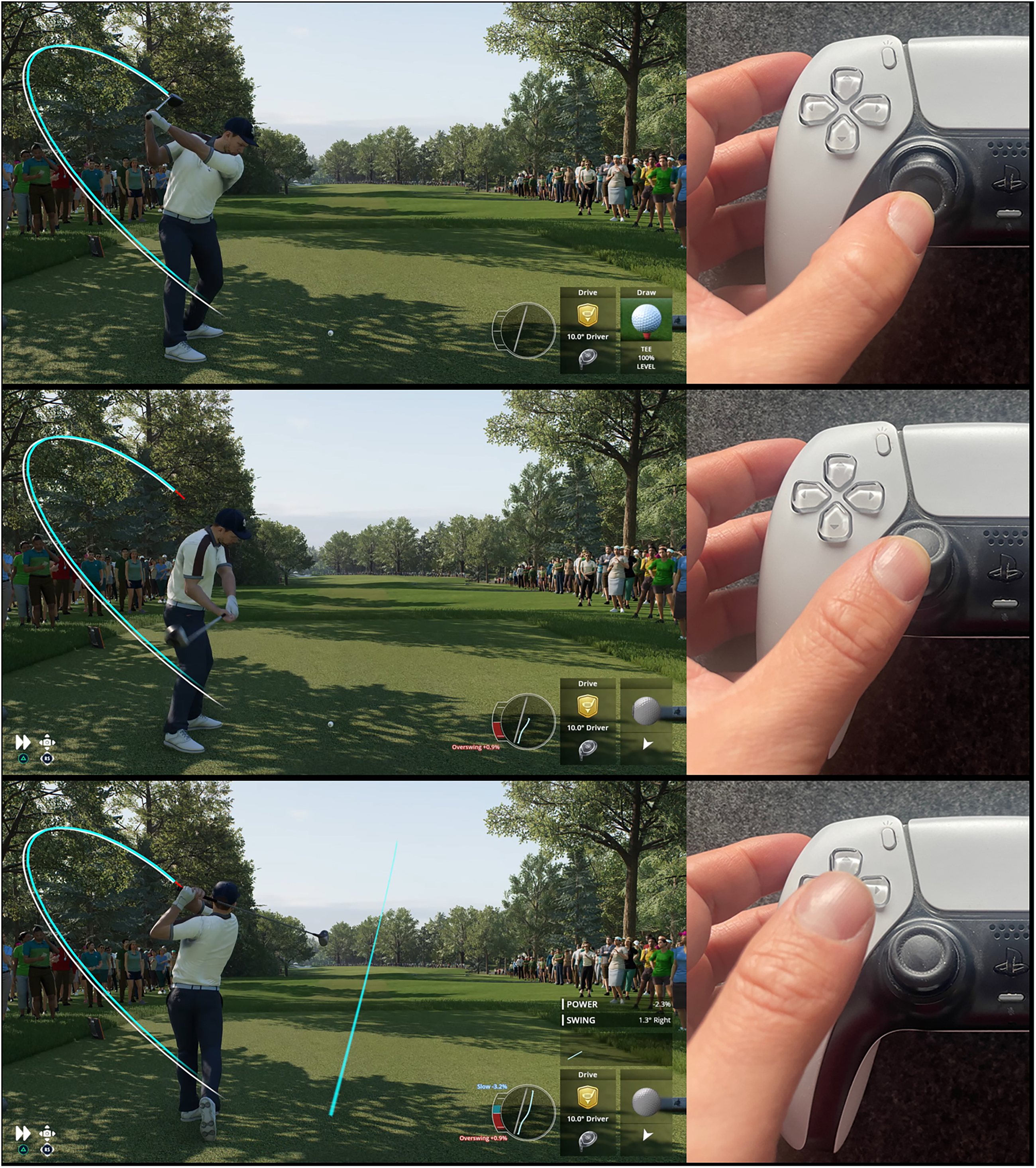
Performing a golf swing in EA PGA Tour. On the left, three screen captures of EA PGA Tour (EA Tiburon, 2023) produced by the author on PlayStation 5. On the right, stills captured by the author of thumb movement on the controller synchronised with the action depicted in the adjacent screenshots.
What golf simulation games such as EA PGA Tour achieve, then, is a quantified imitation of the complexities of body movement in golf, but overlooking the qualitative, intuitive realities of what it means (and feels like) to perform a golf swing. We can read this in line with Conway, who suggests that sports videogames embrace a mechanistic portrayal of sport in which physical performance is reduced to statistics and numerical assessments: that ‘the truth of sport is revealed through resort to positivistic quantification and positivistic quantification becomes the only truth’ (Conway, 2016). This quantification of the swing, controlled via careful movement and timing of the thumb on the stick, is standard in golf simulation games such as EA PGA Tour. The convention of transposing body movement to hand/digit movement, and of mapping proprioceptive feedback to abstracted, multi-channel quantification of movement in the overlaid interface, makes for effective simulation of the concept of the golf swing as we understand it in theory. But this model does little to capture the performative aesthetic of the swing.
Mimetic Control Through Full-Body Motion
If the problem with golf simulation games is an aesthetic and affective dissonance in how the swing is transposed via thumbs and digits engaging with controllers and keyboards, the likely solution would be in motion control. Beyond the case of the golf swing, the mirroring of bodily movement with virtual performance in games is considered a route to intuitive play. Juul makes the case for mimetic interfaces, noting ‘where the traditional three-dimensional games force players to imagine a bodily presence in the game world, mimetic interface games allow players to play from the perspective of their physical presence in the real world’. (Juul, 2010, p. 107). Considering devices such as the Wii Remote and Wii Sports, Juul's argument is one centred on the accessibility of these devices and movements compared with traditional controllers, and their value to casual games. However, he goes on to claim that ‘mimetic interface games shift the focus from the three-dimensional space created by the game graphics, to the concrete player space’ (p. 117). In other words, through mimetic play we can delve more deeply into those affective and embodied aspects of play aesthetics.
Mimetic motion controllers applied to sports games is well-explored in both application and study. When it comes to the golf swing, research has tended to focus on enhanced immersion or presence, which we can link to Calleja's (2011) framework of incorporation, combining kinaesthetic, spatial, shared, narrative, affective, and ludic dimensions. In practice, the interest here tends to concern serious applications of such input, rather than performative aesthetics or the affective experience of golfers. For instance, Tadayon et al. (2012) describe an approach utilising a Wii Remote which accounts for the social aspects of learning and experience, while situating the execution as a serious game. Furthermore, mimetic motion controllers and other forms of player tracking are often framed as a route to ever-more accurate quantification of movement, for applications such as training (e.g., Huang et al., 2015).
This framing translates into the presentation of golf simulation games that are designed for motion controllers. Interesting cases for analysis here emerged from the era of gaming with which Juul was concerned, utilising the Wii and PS3 Move Controllers. The box for Tiger Woods PGA Tour 10 (EA Tiburon, 2009) for the Wii declares that the player's golf experience will be ‘elevated’ through ‘an enhanced, true-to-life golf swing that features precise draw-fade capabilities that mirror your every move’. Making use of the capabilities of the Wii MotionPlus add-on, the manual goes further by fetishising the controller:
‘If you own the new Wii MotionPlus accessory and have it attached to your Wii Remote, you can experience the most precise golf swing in a video game to date. When playing with the Wii MotionPlus you will get a new in-game graphic showing you the rotation of your club before, during, and after your swing. This will give you feedback on what you are doing wrong. You will immediately notice what you are doing wrong. Now, you are in total control of your game!’
The language here is aligned with the language of golf as a pastime; the experience of never-ending measurement, improvement, and learning, which would be familiar to anyone who has watched a YouTube golf tutorial. Nevertheless, being able to draw or fade the ball through swing motion (rather than say, through tweaking of path and clubface using the abstracted 2D overlay UI in standard golf simulation games) is an important aspect of the rhetoric of motion control. This is exemplified by a promotional video (IGN, 2009) for Tiger Woods PGA Tour 10 that demonstrates the mirroring of rotation of the hands and immediate connection to the clubface rotation of the avatar. We see this rhetoric echoed in the presentation of the PS3 competitor John Daly's Prostroke Golf (Gusto Games, 2010), which states that you can ‘swing with the PlayStation Move motion controller to deliver the most accurate golfing experience yet’. Here, the manual goes so far as to declare that ‘it is assumed that the player has a marker on the floor to represent the position of the ball. An actual golf ball is obviously preferable’, and that the properties of this setup include control over power, fade and draw, angle of attack, club rotation, and even vibration.
In playing both Tiger Woods PGA Tour 10 and John Daly's Prostroke Golf, it is notable that the input engages more strongly with the ideas of performer aesthetics as described by Holt. Where EA PGA Tour and other golf games utilising non-motion control conventions produce an effect of distance, the correlation between my movement of the Wii Remote/Move Controller and the movement of the avatar's swing generates a more immediate sense of embodiment. In Holt's framework, performer aesthetics borrow from Montero (2006) and the concept of mirror neurons, whereby proprioception of body movement, whether observed or performed, can lead to kinaesthetic response. That my movement and observation of my avatar are closely aligned makes mimetic motion control a stronger contender for achieving performative aesthetic appreciation through sporting action.
And yet, despite the quality of this innovation, it is not long before I experience negative affect that distracts from my performance. I am intently focused on the theory of the swing and what my hands need to be doing. So far, so much like the experience of the golf lesson or drill. But in these games, this is driven more by the fact that I am not holding a real club. I do not experience the swing as ‘sculpture’, in Brumer's terms, and the positive/negative affect of the swing emerges less so from a proprioceptive sense of the body through the swing and more through the material and technological dissonance of the motion controller. As Keogh notes, ‘input devices do not persist simply due to a natural intuitiveness with which the user's body takes them up…Rather, input devices persist due to how readily they can be incorporated by bodies that have already broken them in through bodily repetition with similar input devices’ (Keogh, 2018, p. 87). It is for these reasons that I find myself thinking back to how the 2D overlay interface of EA PGA Tour at least builds from my familiarity with the PS5 controller. In Holt's model, it is difficult to find and stay ‘in the zone’, regardless of the more ‘intuitive’ movement. That motion controllers were more popular in the era of the Wii and PS3 perhaps reflects this reality: that in videogame play, Keogh's ‘bodily repetitions’ mean that the hand controller supports player incorporation (Calleja, 2011) in a way that the motion controllers, perhaps somewhat counterintuitively, do not.
Playing Videogames at the Driving Range
To expand on how mimetic input does not necessarily correlate with enhanced aesthetic appreciation of performance, we should consider that ‘real golf’ (using real clubs to hit real balls) is already a form of digital game input. TopGolf venues have been described as ‘golf as a large-scale video game’ and as a more accessible and inclusive way to play golf (Goldberg, 2018). In brief, at TopGolf venues players can hit golf balls from mats to play screen-based games, from simulated golf through to a variety of casual and arcade-style videogames. Additionally, in 2016, TopGolf Entertainment Group purchased the golf video tracking technology company Protracer, rebranding it as Toptracer (TopGolf International, Inc., 2024). The combination of TopGolf venues and local driving ranges with Toptracer technology has therefore rapidly spread the availability of golf-based digital games to players, while also expanding the possibilities for playful experiences that are controlled directly by a full golf swing.
Franken (2025) provides a traditional golfer's perspective on the experience of TopGolf, noting that ‘TopGolf is an example of the power possessed by technology to fundamentally alter the experience of an activity’. In the case of a TopGolf venue, the transformation is presented as shifting the spatial and temporal realities of golf to broaden inclusion and erode the privileges inherent in golf as an expensive and often exclusive hobby. What is of interest here is that, for all the technological and cultural differences between golf on a course and golf at a TopGolf venue, the focus on the swing as a performative act remains consistent. And with Toptracer-supported bays offering something of a middle ground between the sporting focus of the course and the entertainment focus of TopGolf, the digital games provided by TopGolf venues and Toptracer driving ranges provides an important case study in analysis of the aesthetics of the golf swing in the context of digital games.
Following experience with motion controllers, I returned to my local Toptracer driving range (Figure 2) with a view to critically reflecting on the affective and aesthetic encounters with the golf swing while playing digital games. My bay provides opportunity to utilise every club in my bag bar my putter, with the range tracking technology capturing the precise path of my ball. I can hit stingers or loft the ball high, try to draw, or fade the ball gently. And of course, every slice and hook is also captured and transposed into my digital game world. While I can play arcade-inspired games like Closet to the Pin and Go Fish, I stick with virtual rounds of golf to mirror my play in console-based golf simulation.
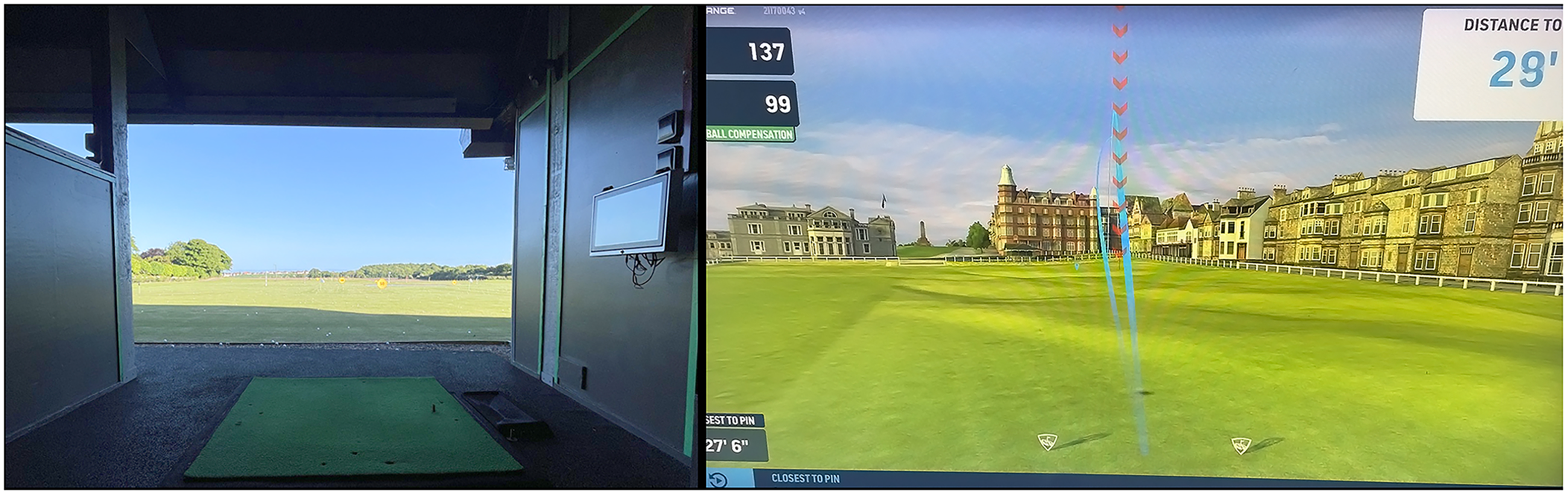
Photographs produced by the author showing a golf driving range with Toptracer Range technology. On the left, the range bay setup with golf mat, display, and tracking camera. On the right, a photograph of the in-bay screen depicting the digital gameplay driven by the golfer’s performance.
According to Holt's framework, my play here is highly receptive to appreciation of performer aesthetics. Disregarding ludic outcomes and focusing purely on the swing and resulting path drawn by the ball, engagement with Holt's notion of skilful play is heightened compared with use of substitute mimetic controllers, where my skill was primarily in moving the controller in imitation of sporting action, rather than as the pure skill of the sporting action achieved when swinging my club at the ball. I can attribute this to the weight and length of each club, the presence of the ball as target, and the fact that contact (with ball and mat) takes place. The affordances of the bay narrow the gap to my aesthetic appreciation of the golf swing as sculpture, where the affect emerging from performance and representation of the outcome in the game world allow me to appreciate the skill inherent in the action, rather than merely my own pleasure at it being my skill. The virtual golf course calling for frequent changes of club, all at hand in the bay, retains my sense of being in the zone, adapting to each scenario. No avatar is presented as virtual representation in the game world: my proprioceptive sense of the aesthetic of the swing is inherent in my full-body motion, supplemented by the sonic quality of contact in the bay and visual sensation (the ball flight, mirrored in the game world).
We can frame digital golf ranges as the most extreme form of mimetic interface for golf simulation videogames. In other words, if mimetic controllers such as those used in Tiger Woods PGA Tour 10 and John Daly's Prostroke Golf were continuously innovated through to ever-closer mimicry of the real golf swing – if fully implemented in VR with 14 different full-length and appropriately weighted golf controllers and with a life-like ball target to hit – then they would still fall short of videogame play in the driving range.
And yet, on the range, there remains a challenge to aesthetic appreciation of the golf swing as performance. In his reflection on the poetic qualities of golf, Brumer (2007) identifies the material distinctions in what he terms the ‘pathological driving range’, lamenting the problematic feedback that arises from hitting clubs from mats rather than turf, and the physical effect (and negative affect) of contact with ‘hardened green toxic goo over a bed of cement’ (p. 143). These are material distinctions that are arguably impossible to overcome, short of simply going out to play a round of golf. Nonetheless, these distinctions will always be magnified given that we are engaged in the full performance of the swing, not simply the imitation of it. When we swing, we become more aware of our body, of our environment, and our expectations increase, making any unusual thing stand out more.
Further, the ‘pathology’ of Brumer's critique of the range returns us to the problem of competing interest between the positivist framing of a sporting move and its intuitive and aesthetic qualities. In short, the range as an environment is designed for a focus on practice, development, repetition, and, ultimately, the scientific concepts of what makes for a good swing. As Brumer notes, ‘science breathes the ether of abstraction and theory, while art dwells in the materiality of the practical imagination’. (p. 149). For all the aesthetic and affective qualities of controlling a golf simulation through full-body performance, the range can inhibit the immediate sense of pleasure in our performance. We could liken this to Kant's (1952) approach to aesthetic judgement, which prioritises judgement based on pleasure alone and not derived from concepts (such as the theoretical concepts of the swing). The closer the golf swing input comes to a real swing in a simulated environment, the more we become aware of the concepts underpinning the ideal swing. In the range, I over analyse my movement. I stop and think. I practice shallowing. I observe other bays with other golfers doing the same. It is possible to let loose and experience the swing as aesthetic performance, but more difficult to retain a disinterested position in Kant's terms.
The Golf Sculpture at Your Fingertips
The emergence of motion controllers as part of the wider ‘casual revolution’ discussion by Juul (2010) presented clear opportunities for sporting actions like the golf swing. But alongside motion controllers, the concurrent arrival of touchscreen smartphones has had a far-reaching impact on contemporary gaming. In critiquing the metaphor of the smartphone screen as a ‘black mirror’ and fixed boundary between player and code, Anable (2018) argues that ‘our mirrors are rarely black; rather, they are colourful, full of representations, and covered in our fingerprints’ (p. 68) and the touchscreen is a ‘sensual surface that functions within a larger affective system’ (p. 69). Anable argues that the ‘action’ orientation of game studies, as discussed earlier in this article with respect to aesthetic theory of games, privileges an analytical model that sees the player as subject pressing buttons and the code as object responding to this input. For Anable, ‘touching the screen, a site that usually privileges vision, productively confuses the distinction between subjects and objects’ (p. 68). Keogh discusses the affordances of touchscreen play at length, linking the ‘immediate and tactile gratification’ (p. 63) of Angry Birds on iOS to the idea of mimetic play put forth by Juul. While conceding that not all mobile touchscreen games are necessarily mimetic, Keogh notes that games controlled via touch can be viewed as mimetic interfaces that ‘draw explicit attention to the actual world and the player's positionality’ (p. 64), that our gestures through touch may not be the literal movement of the body but that the implied movement of the body can be mapped to these gestures in an intuitive manner.
These ideas are of clear interest to the current study of the videogame golf swing, which is simultaneously a performer aesthetic (framed by the subject's experience and sensation) and a quantifiable execution of movements (that in turn feed into a physics-based algorithm that generates the outcome). In the previous sections, we have seen that the two primary modes of swing control in golf games – the standard controller input that combines Galloway's diegetic and non-diegetic operator-actions, and the mimetic golf swing driven by motion controllers or range cameras – present varying degrees of challenge to performer aesthetics as defined by Holt. A digital golf swing that is controlled by neither a game controller nor a motion controller, but instead by touch interface, presents a third approach.
To consider the golf swing through Holt, Anable, and Keogh, I focused on three different implementations of touch-based golf swings in golf simulation: PGA Tour Pro Golf (HypGames, Inc, 2025) on iOS (Figure 3), the arcade game Golden Tee Golf 3D (Incredible Technologies, 1995), and Nintendo Touch Golf: Birdie Challenge (T&E Soft, 2005) played using a stylus on the Nintendo DS (both shown in Figure 4). In my engagement with these games, I found that a recurring theme was the concept of the line. Wark (2007) posits that games can be understood as allegories for- rather than representations of – our world, as ‘gamespace’. An analysis of Rez (United Game Artists, 2001) by Wark draws attention to the topological tracing of lines by the player across gamespace as the source of its allegorical and aesthetic value. Approaching golf simulation games with a view to considering the swing as an abstract, topological layer above the representation of the golf course as gamespace presents an alternative perspective to critiquing the performer aesthetics of the golf swing.
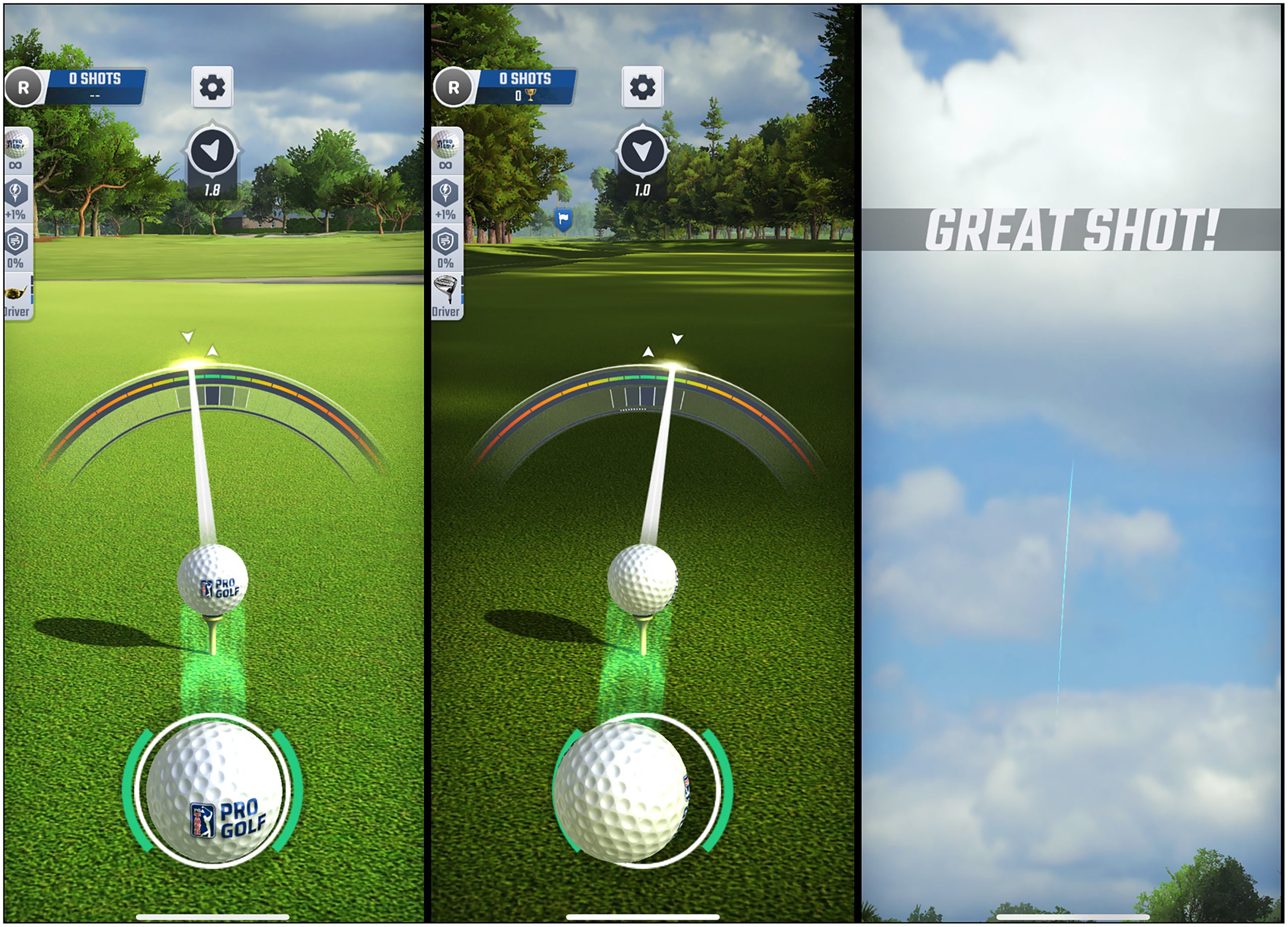
Three screen captures of PGA Tour Pro Golf (HypGames, Inc, 2025) produced by the author using an iPhone 12.
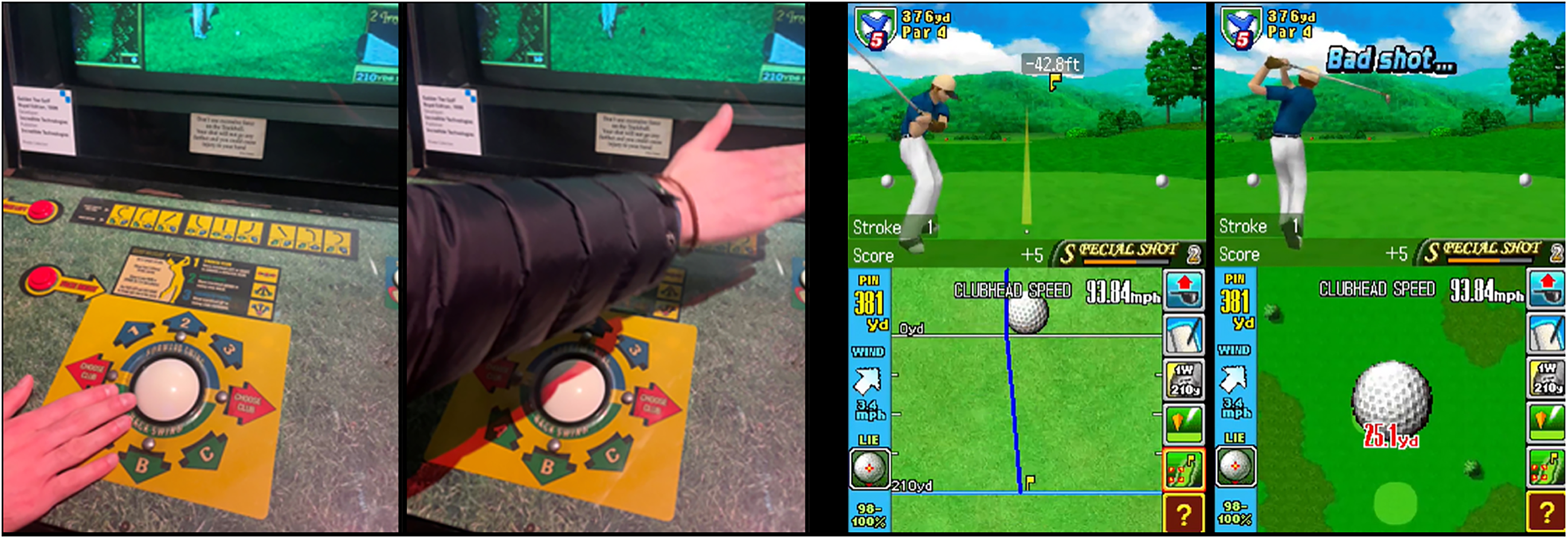
On the left, Golden Tee Golf 3D (Incredible Technologies, 1995), photographs taken by the author. On the right, edited screen captures of gameplay performed in Nintendo Touch Golf: Birdie Challenge (T&E Soft, 2005) produced by the author using a Nintendo DS.
PGA Tour Pro Golf, as the most recent of the selected games and played on a modern iPhone device, is representative of the typical form of golf simulation on smartphones. Mechanically similar to the slingshot approach of Angry Birds rather than the tracing action of Fruit Ninja, the game retains a casual mobile experience while presenting the player with a sports simulation. Elements of what I experience in this representation of the golf swing align with the positivist approach of golf simulations such as EA PGA Tour. I am cognisant of the HUD and the need to time my release according to an oscillating meter. And yet, as an explicitly casual game, its short play experience narrows its focus not only on the swing, but also on the intuition of the swing. I am not as bombarded by configuration as in a positivist paradigm in AAA golf simulation, nor does a full-body motion controller draw attention to the mechanics and concepts of the swing. Even though it is a slingshot mechanic – and therefore essentially just the backswing followed by release – I can attune to the feel of the swing by tracing a line to impact which results in a ball tracing its own line through the sky (Figure 4).
Through different input types, Golden Tee Golf 3D and Nintendo Touch Golf flip my line tracing to the downswing. It is here where Wark's topology holds most currency, and the gesture serves as an allegory for the performative aesthetic of golf swing as per Brumer's golf sculpture. Spinning the ball controller on Golden Tee allows me to visualise my intended path concurrent with power, achieving a desired path for the ball to trace down the fairway. Nintendo Touch Golf takes this further by allowing me to directly draw the path of my downswing, which I can intuit from my understanding of the art of the swing without falling back into overthinking the underpinning concepts and science of motion which can impact on full motion controllers and even in driving range games. Under Holt's framework, then, touch and gesture-based control can be viewed as an effective means of platforming sporting action as performer aesthetic, retaining capacity for appreciation of skilful play, a sense of being in the zone through reducing complexity and minimising distraction, and (via Montero and Keogh) allowing for a sense of proprioceptive aesthetic appreciation.
Conclusion
Much of the recent scholarship on sports games has posed important questions surrounding their representational affordances; the simulation of broadcast sports, the connections to the sports industry, and their place within the broader assemblages of sports consumption and fandom. In this context, the narrowing of focus to golf simulation as a sub-genre and the golf swing as a performance may seem comparatively marginal as an area of inquiry. However, this paper has aimed to highlight why a research focus on individual sporting performances can benefit both the design and critique of sports simulation.
Looking to other game genres, there has been extensive aesthetic critique of isolated mechanics, such as shooting (Galloway, 2006; Phillips, 2015) or walking (Bozdog & Galloway, 2020; Carbo-Mascarell, 2016; Kagen, 2022). In turn, analysis that is centred on the study of a singular player act can make important contributions to our understanding of the aesthetics of genres such as first-person shooters and walking sims. More broadly, we know that the extension of our embodied experience into virtual space has aesthetic and affective implications (Anable, 2018; Keogh, 2018; Swalwell, 2008). Our lived experience of walking, running, jumping, throwing, or dancing means that we bring affective, proprioceptive expectations with us when we encounter mechanics in games that afford these movements.
My argument in this paper is that designers of sports simulation games – those games that seek to present authentic representations of real sports – should also consider their players’ lived, affective experience of sporting performance. In the example of golf simulation, players of EA PGA Tour may well come with expectations as spectators, hence the focus on aesthetics of professional golf broadcast. But many of those players will also have direct affective experience of playing golf, and appreciation of the performative aesthetics of the golf swing. Mainstream sports simulations today often harbour ambitions to marry authentic presentation of professional sport with the player fantasy of projecting themselves into this world as participant, for example in the EA FC, Madden NFL, and NBA 2K game series. The contribution of this paper is to demonstrate how aesthetic criteria from sports and games, combined with an approach that considers the affect of sporting performance, can support our critique of sports simulation games such that authentic representation of professional sport is combined with authentic performative aesthetics in sport.
Importantly, this paper has sought to challenge assumptions that the aesthetics and affect of digitised sport performance is necessarily enhanced through either i) accurate quantification and simulation of movement, or ii) the mimetic proximity of the controls to the performed action. Interface design solutions that minimise precision of calibration and whose controls are seemingly incongruent with reality (e.g., touch-based rather than full-body motion) can also generate familiar positive (and the even more familiar negative) affect for the golfer/golf simulation player. Taking the lead from the broader concept of game feel (Swink, 2009), the outcome of this analysis does not seek to recommend an off-the-shelf solution for optimal ‘feel’ or performative aesthetics. Rather, through deconstruction of any assumed hierarchies in best practices, the intention is to expand our framework for the design and critique of sporting actions as performed in videogames. While contributions from the philosophy of sport can greatly aid this expanded framework, it is also worth returning to CLR James and reflecting upon the importance of lived experience of sport: ‘The aesthetics of cricket demand first that you master the game, and, preferably, have played it, if not well, at least in good company. And that is not the easy acquisition outsiders think it to be’. (James, 1963, p. 274).
Footnotes
Ethical Considerations
There are no human participants in this article and informed consent is not required.
Consent to Participate
Not applicable
Consent for Publication
Not applicable
Funding
The author(s) received no financial support for the research, authorship, and/or publication of this article.
Declaration of Conflicting Interests
The author(s) declared no potential conflicts of interest with respect to the research, authorship, and/or publication of this article.
Data Availability Statement
No dataset was generated for the study presented in this article.