



Abstract
This article explores the specifics of cross-sector cooperation within the Cultural and Creative Industries (CCI) from the perspective of the Video Game Industry Ecosystem (VGIE) based on integrating desk research (utilising a systematic literature review of 61 papers) and field research (through a focused group interview with ten experts representing mainly the actors from VGIE). Our two-step parallel study identifies key drivers and barriers in establishing such cooperation, highlights three coordination mechanisms essential during its execution (static-adaptive management, proximity, and knowledge management), and uncovers a significant research gap regarding the ending phase of such cooperation, despite our FGI revealing relevant factors contributing to its termination or dormancy. This work offers a theoretical contribution to the existing knowledge by synthesising and expanding the understanding of cross-industry cooperation between the VGIE and other CCIs. Moreover, it highlights significant research gaps, particularly in the final phase of cross-industry cooperation.
Introduction
Cultural and Creative Industries (CCI) 1 are considered the core of the modern economy and society (Cooke & De Propris, 2011 ; EGDF, 2024), also impacting the wealth of countries (Domenech et al., 2023). Policymakers, including those representing the European Commission (Lindqvist, 2024), also highly acknowledged those industries’ relevance. Although CCIs cover many sectors, the video game industry plays a leading role (European Video Games Industry Insight Report, 2024), simultaneously and significantly contributing to global market economic activity and individual and collective leisure and relaxation activities (WIPO, 2024). According to Newzoo, in 2024, the global games market will generate $187.7 billion, representing +2.1% year-on-year growth. The number of players globally will reach 3.42 billion in 2024, a + 4.5% year-on-year increase (Newzoo, 2024, p. 16).
In Europe, for instance, the video game industry 2 is a fast-growing segment of CCIs, especially given the rapid digitalisation of European society and the role of games as digital means to promote e-skills, embrace new technologies, and encourage entrepreneurship, research, and development (EGDF, 2022). Given the ecosystem perspective underlying the EU policy (Whicher, 2017) and current strategy (e.g., European Innovation Ecosystems Strategy, Horizon Europe Strategic Plan, New European Innovation Agenda) and growing recognition in strategic management (Granstrand & Holgersson, 2020), it is appropriate to say video games are an integral part of the game industry ecosystem.
The video game industry ecosystem (VGIE) is understood as an ecosystem encompassing a wide range of diverse actors such as video game developers, hardware and software producers, Non-Governmental Organisations (NGOs), policymakers, universities, research institutions, and public institutions, to name a few. As identified by Klimas and Czakon (2022), these actors undertake different roles within the ecosystem, reflecting varying levels of engagement in intra-ecosystem co-creation processes. These levels may also shift over time and across various phases of the co-creative process. In a broader context, it is notable that these sectors often influence and cooperate to co-create with each other (Santoro et al., 2020), and this cooperation is an essential element of effective business models (Landoni et al., 2020). This is evident in a specific form of cross-industry cooperation, where one side is represented by the VGIE (primarily game developers) and the other by representatives from another CCI (Lopez et al., 2024). For instance, museums (e.g., exhibitions focused on games like The Art of Video Games in Smithsonian American Art Museum or War Games: Real Conflicts in Imperial War), philharmonic orchestras (e.g., Game Music Concert organised by Silesian Philharmonic), or archive and heritage institutions (e.g., social and cultural games disseminated by the Institute of National Remembrance – Commission for the Prosecution of Crimes against the Polish Nation).
Strategic cooperation aimed at co-creation focuses on developing meaningful products, services, or systems through a participatory process where external stakeholders are engaged (Klimas & Czakon, 2022; Yang et al., 2021). It involves interacting and exchanging ideas among various entities in value-creation processes and developing new solutions (Patricio et al., 2020). Due to the significant benefits for involved parties, an approach based on value co-creation is dominant today (Fan & Luo, 2020). Nevertheless, much of the existing research on co-creation has primarily focused on high-tech industries (Klimas et al., 2022), leaving the context of CCI (e.g., theatre, cinema, museums, live music) underexplored despite the recognition that there is substantial potential for transmitting cultural content under co-creation (Aoyama & Izushi, 2003) also valuable for Europe's creativity, heritage, and history (Brown, 2024). At the same time, scholars have mostly directed their attention to intra-industry collaboration, mainly within specific CCIs (e.g., co-creation inside the VGIE like in Klimas and Czakon (2022) or co-creation with users only, like in O’Donnell (2013)). Although cooperation between the video game industry and other cultural sectors has attracted researchers’ interest in recent years (e.g., Cohendet et al., 2018; Sharma et al., 2024), much of these studies are of an industry report nature that focuses on statistics, while lacking more scientific studies following the rules of methodological rigour (Belyaeva et al., 2022). Moreover, the literature on cross-industry cooperation between VGIE and other CCI reveals multiple gaps and shortcomings. First, the limited and fragmented scientific literature predominantly focuses on the USA (Baeza-González, 2021) neglecting other relevant and emerging environments, such as the European VGIE, which is one of the fastest-growing sectors in the creative economy according to numerous reports (e.g., Newzoo, 2024 ) Second, research often focuses on specific actors (e.g., game developers, players, communities of gamers) or takes the sector view while lacking an inter-organisational perspective like network perspective (Chaminade et al., 2021), an ecosystem perspective (Belyaeva et al., 2022; Klimas & Czakon, 2022), and a cross-sectoral perspective (Santoro et al., 2020) which goes beyond the boundaries of single organisation, industry, or even country. While the cross-industry cooperation between VGIE and other CCI is essential and may bring significant insights for future research, development and practices (e.g., Benghozi et al., 2017; Klimas & Czakon, 2022; Tomé Klock et al., 2024), this cooperation has been rarely investigated.
This study explores the cross-industry cooperation between VGIE (especially game developers) and other CCI by addressing the following research question: How is the value co-creation across its main stages (i.e., establishment, execution and ending) between VGIE and CCIs being addressed in research? To maximise our exploratory study's accuracy, we adopted a mixed research approach using the segregated design (Sandelowski et al., 2006). Therefore, we simultaneously addressed the research question through desk research using a systematic literature review (SLR) and field research using focus group interview (FGI). After analysing the results, we integrated the syntheses and conclusions in the final stage of the procedure. First, regarding the literature review, a framework- and domain-based systematic approach was employed to analyse 61 identified articles (Paul et al., 2021). Second, we conducted FGI (Powell & Single, 1996) with ten experts to capture broad and heterogeneous perspectives from various key informants (Homburg et al., 2012). Both secondary (i.e., academic publications gathered via Scopus) and primary (i.e., transcriptions from FGI) data sources went through thematic analysis across three main phases of co-creation, namely establishment, execution, and ending.
This study addresses critical gaps in the literature by offering a comprehensive framework that can guide practitioners and scholars in fostering more resilient and adaptive cross-industry partnerships. By examining both the driving factors and the barriers inherent to cross-industry cooperation, this research provides insights that can enhance decision-making processes, improve coordination mechanisms, and ultimately enable fields such as business management, economics, and policymaking to cultivate more effective partnerships. The study also uncovers unexplored phases of cooperation, such as termination and dormancy, shedding light on the critical factors that can prevent successful long-term collaborations.
Theoretical Background
As video games represent a complex integration of technology and art (Cohendet & Simon, 2007), the industry has faced a significant pressure for video games to become both technologically sophisticated (Hotho &Champion, 2011; Ip, 2008) and artistically refined (Reyes-de-Cózar et al., 2022). This need for dual advancement has positioned the gaming industry as a highly hybrid cultural-technological domain (Baeza-González, 2021), operating at the intersection of technology and culture (Belyaeva et al., 2022; Cohendet & Simon, 2007). The increasing complexity of video games, coupled with their growing technological and artistic sophistication, can often exceed the capabilities of individual game development studios (Patricio et al., 2020). In this sense, Klimas (2019) highlights the essential role of co-creation-focused relationships for video game developers going beyond the gaming intra-industry, involving entities from various CCI to foster innovation and ensure multi-dimensional innovativeness.
From the perspective of other CCI, value co-creation with the video game industry should also attract considerable interest, as video games are increasingly recognised as one of the key drivers of cultural production (Baeza-González, 2021; Styhre & Remneland-Wikhamn, 2021; Zeiler & Mukherjee, 2022). Modern games are often viewed as an art form (Aoyama & Izushi, 2003), cultural medium (Crogan, 2018), cultural artefacts (Reyes-de-Cózar et al., 2022), and even as a key digital cultural artefact (Zhouxiang, 2022), or virtual heritage (Champion, 2020). Furthermore, with the pervasive trend of digitalisation affecting all sectors, including CCI (Li, 2020; Taormina & Baraldi, 2023), cooperation with the video game industry presents not only an opportunity for growth (Bahia, 2023; Benghozi et al., 2017; Santoro et al., 2020) but may even be essential for survival in a market increasingly dominated by digital consumers (Zhouxiang, 2022).
Considering both the identified gaps and the unique characteristics of the video game industry - such as the modularity, complexity, and intricacy of its products (Cohendet & Simon, 2007; Connolly et al., 2011; Styhre & Remneland-Wikhamn, 2021; Zeiler & Mukherjee, 2022) and its cultural facet - it is clear that investigating value co-creation at the intersection of the VGIE and other CCI is both timely and relevant.
Research Design
We have applied diversified data collection methods to accomplish the research goal and answer the research question. We combined the extensive literature review with a qualitative method using the FGI research technique to maximise the quality of our findings and provide a possibly comprehensive overview of the complex phenomena investigated.
Desk Research: Systematic Literature Review
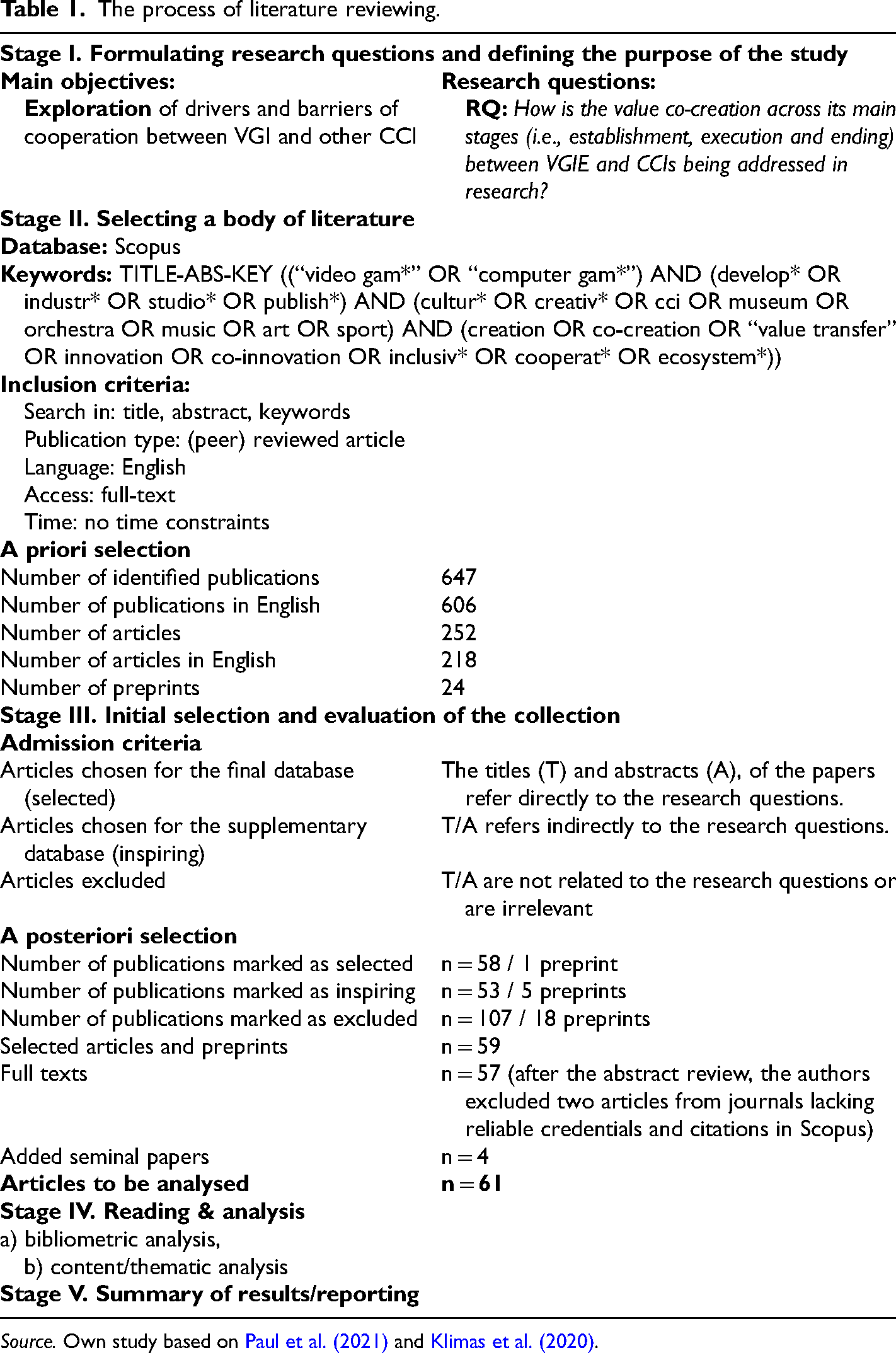
We conducted an SLR, and following the suggestions of Ortiz de Guinea and Paré (2017), we decided to run a conceptual review. First, we have focused on understanding the investigated theme of cooperation between VGIE and CCI by identifying key issues (Rowe, 2014) across cross-industry cooperation oriented on value co-creation. Second, we provided high systematicity and transparency by reporting all five phases we applied in our research (searching, selecting, screening, analysing and evaluating relevant literature, and final reporting). Following the suggestion of Paul et al. (2021), we present in Table 1 a detailed procedure and rationale of our review using the SPAR- 4- SLR approach. Third, we focused not only on a topic but also investigated the research methods, techniques, theories, and contexts addressed by previous researchers. The data gathered within this protocol is available here (Klimas et al., 2024). Fourth, we applied a strategy of exhaustive coverage with selective citation to provide the possibly high suitability of the chosen papers, as suggested by Cooper (1988). Thus, we applied an inclusive approach and investigated conceptual and empirical papers. Finally, we employed a qualitative data analysis and ran a thematic analysis to investigate the collected database. Some basic frequency analyses also enriched the scope of the literature overview.
The process of literature reviewing.
Source. Own study based on Paul et al. (2021) and Klimas et al. (2020).
In the first stage of our SLR procedure, based on the research goals formulated, we searched for the answer to the research question.
In the second stage of our SLR, we designed the selection protocol (Klimas et al., 2024). We used the Scopus database exclusively. The reasons to use the Scopus database as the primary source for bibliometrics and abstract retrieval were threefold. First, we opted to maximise the scope of available sources to grasp the comprehensive view of our research theme. While Scopus and Web of Science overlap in their functions and coverage, there are substantial differences in data format, bibliographic data, and coverage. We followed the arguments that research sources collections covered by Scopus are broader and provide more diverse content that is continuously re-evaluated (Singh et al., 2021). Second, we considered its relevance for our research, as Scopus has been proven to be an extensively accepted and commonly used database in social sciences (Singh & Arora, 2023), while Web of Science is more focused on disciplines such as natural sciences, health sciences, engineering, computer science, or materials sciences (Clarivate, 2024; Elsevier, 2024). Our study's other search inclusion criteria covered peer-reviewed articles in English, with full papers available and no time constraints regarding the publishing date.
In the third stage of our study, we evaluated the database and screened the abstracts and keywords to see if the papers were relevant to our research. We have distinguished three final categories of papers: selected (relevant for the study, analysed by the team), inspiring (not directly relevant but with some potential insights), and excluded (irrelevant for further analysis).
The final set of 61 papers was read and analysed in the fourth stage using thematic analysis.
In the fifth stage, the results have been examined and presented in the article's subsequent section.
Field Research Using Focus Group Interview
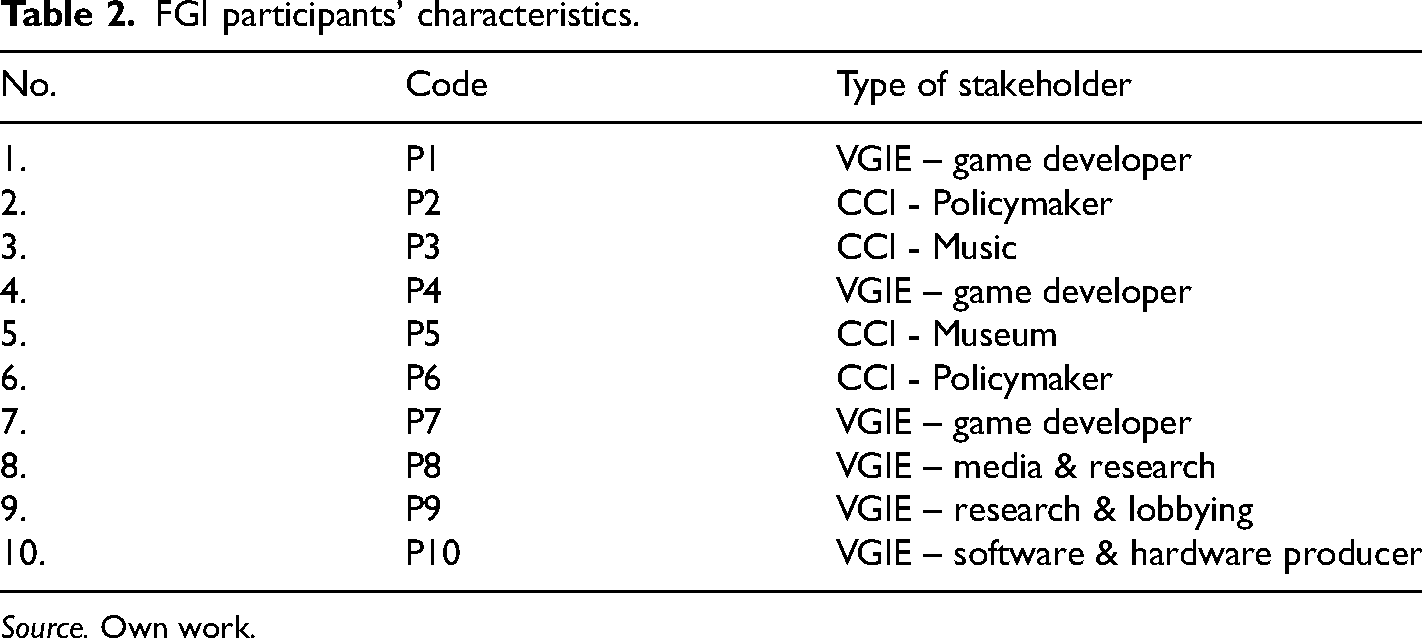
To enhance the validity of our secondary data collection, we used the FGI as a qualitative data collection technique following Powell and Single (1996). Thus, the panel of participants comprised experts with shared key characteristics (being involved in the gaming ecosystem in various roles). We had 10 participants, aligning with the recommendations regarding the FGI sample size and diversification (participants represented diverse backgrounds, views, roles, and experiences). To receive the relevant data, the panel experts were all top management/senior management staff representatives, knowing strategic cooperation with external partners (including the cooperation between the CCI with particular importance to the video game industry). The detailed characteristics of FGI participants are presented in Table 2. For more comprehensive data, we collected the field notes in a standardised FGI protocol where all the team members noted interesting quotes, key points and themes, big ideas or thoughts/follow-up questions, inspirations, and other topics (non-verbal and para-verbal activities).
FGI participants’ characteristics.
Source. Own work.
To introduce the topic and bring more informality to the discussion (Parker & Tritter, 2006), the main session was preceded by prework on a virtual Mural board with some initial ideas for metaphors in the form of memes and illustrations, shared a few days before the FGI. We asked the participants to look for a quote, metaphor, or personal story reflecting their approach to business collaboration and value co-creation and post or provide some comments.
The FGI session organised in April 2024 lasted two hours and was facilitated following the semi-structured scenario. We opted for a hybrid mode to include those participants who could not attend the in-person meeting. We wanted to allow the participants to develop ideas collectively, bringing forward their priorities and perspectives (Smithson, 2000) regarding three following research themes: (1) motives and factors of cooperation in CCI (2) cross-industry cooperation – the mechanisms, practices, resources, and experiences and (3) problems challenges disruptive to cooperation in CCI (i.e., anchor metaphor - what hinders networking in CCI).
We analysed the gathered data using the content analysis approach, considering the nature and context of the group, following Parker and Tritter (2006). In our five-person team, we coded the data independently, leading to the emerging themes presented in the next section after several iterations.
Research Findings
Systematic Literature Review
When addressing our research question concerning the co-creation of value through intentional and relatively long-term cooperation 3 , we adopted a process-oriented approach (Klimas & Czakon, 2022). Therefore, the initial focus was on the establishment phase of cooperation, examining drivers, motivations, and key factors, while also considering potential barriers to co-create value. Subsequently, we concentrated on executing cooperation and analysing the mechanisms, tools, and practices employed throughout the cooperative process. Finally, we explored the ending phase of cooperation, highlighting critical challenges, problems, and breaking events that may lead to dormancy (temporary slowdown or suspension of co-creation activities) or final termination.
Establishment
Our desk research identified four key factors driving cooperation for value co-creation within ecosystem or organisational levels. Three of these factors were at the ecosystem level, including two that are beyond the control or influence of video game developers (i.e., financial support, access to skilled labour) and one that is dependent on developers’ behaviour and actions (i.e., the complexity of modern video games). Firstly, regarding financial support, public institutions play a critical role in initiating this driver, encouraging cooperation through various public grants, fiscal credits, and tax reliefs (Cohendet & Simon, 2007). Secondly, access to creative workers and partners with creative talent has been identified as a key driver for cross-industry cooperation (Cohendet & Simon, 2007). As previously noted, the artistic skill, knowledge, and experience required to deliver games at a highly polished cinematic level have become unattainable for many developers. Thirdly, the increasing technological advancement (more functions, diverse technological solutions, higher interactivity, higher affective qualities, and the need for more interdependent and complementary technologies) and artistic complexity of video games serve as another driver for turning towards co-creation (Klimas, 2019; Vallance, 2014). Finally, at the organisational level, a single driver entirely dependent on video game developers emerged: care for cultural heritage, preservation, and revitalisation (Belyaeva et al., 2022; Laiti et al., 2021).
Our data analysis revealed three significant obstacles that can effectively hinder cooperation, which can also be analysed at both the ecosystem and organisational levels. At the ecosystem level, there are potential language barriers (Pacheco-Velazquez et al., 2023), as each profession tends to have its specific jargon, which can complicate the process of defining detailed scopes and desired outcomes of collaboration. Additionally, issues related to intellectual property (IP) are often highlighted, such as difficulty or inability to reach the IP owner, lack of regulatory frameworks governing IP use and licensing (e.g., compared to how advanced and enforced this is in the US – Coleman & Dyer-Witheford, 2007), as well as concerns over resultant ambiguous ownership (Harwood & Garry, 2014).
At the organisational level, another obstacle identified is the insufficient attention given to the need for early-stage cooperation in game development (Pacheco-Velazquez et al., 2023). Engaging partners too late in the development process may render collaboration infeasible.
Execution
Related to execution, we identified three coordination mechanisms 4 based on the SLR papers, being static-adaptive managing, knowledge management, and proximity mechanisms.
The first coordination mechanism refers to both stable managerial frameworks and adaptive managerial practices. On the one hand, the static-adaptive managing mechanism refers to the predetermined structure of managerial assumptions and operational practices (with the focus on joint planning) including shared and agreed goals, the roles of actors engaged in co-creation at every single stage of cooperation (Pacheco-Velazquez et al., 2023), standard operating procedures (Aoyama & Izushi, 2003), and even joint documents and project management tools (Vallance, 2014). On the other hand, beyond the pre-established coordination framework, the static-adaptive managing mechanism also encompasses the ongoing responsiveness to challenges or changes during co-creation (with a focus on joint coordination). In this context, the smooth progression of cooperation relies on consistent and frequent communication and information sharing about actions and activities undertaken as part of the cooperation. Additionally, swift (and preferably joint) development of operational practical guidelines is essential whenever problems or difficulties arise in the execution of tasks (Pacheco-Velazquez et al., 2023).
Second, we focused on knowledge management mechanisms encompassing tools, practices, and activities focused on knowledge management. Indeed, our analysis of cross-industry cooperation in CCI revealed several mechanisms related to knowledge management. These were identified in the context of knowledge exploration and exploitation (Cohendent et al., 2021 ) and knowledge exchange and acquisition within the partnerships (Chaminade et al., 2021; Vallance, 2014). Among the identified aspects were those referring to the generation, development, acquisition, exchange, sharing, utilisation, and dissemination of information, data, and knowledge under the cooperative arrangement. Interestingly, despite a general understanding of knowledge management mechanisms (Nah et al., 2002), we did not find evidence of knowledge dissemination (i.e., dissemination outside the cooperative arrangement). This absence may stem from the nature of the cooperation, where knowledge resources are intentionally kept within the partnership, making external knowledge distribution rules unnecessary. Regarding the identified knowledge management mechanisms, it is crucial to note the importance of ecosystems in facilitating cooperative processes (as Cohendet et al., 2021), as these can significantly enhance knowledge creation dynamics.
The third coordination mechanism is the proximity mechanism, encompassing actions and activities to ensure appropriate fit, similarity, homogeneity, or coherence among cooperating organisations. Proximity is inherently multidimensional and refers to the similarity of actors in terms of cognitive, geographical, organisational, institutional, and social dimensions (Boschma, 2005). In the analysed literature, we identified actions that enhance and sustain cooperation across the cognitive dimension (e.g., technological convergence - O’Donnell, 2013), geographical dimension (e.g., localisation - Vallance, 2014), organisational dimension (e.g., in terms of adherence logic - being embedded in a specific region and ecosystem - Cohendet et al., 2021), and social dimension (e.g., informal initiatives, social networks, and personal contacts - Aoyama & Izushi, 2003; Cohendet et al., 2021). However, research so far has not explicitly addressed institutional proximity, as Boschma (2005) considered. However it should be noted that Aoyama and Izushi (2003) highlight cultural proximity, which at the national level is considered as a part of the soft institutional setting and, therefore, encompassed by institutional proximity.
Ending
The final analysed phase of cooperation was the ending phase, including dormancy - a state marked by long-term inactivity, suspension, or a significant reduction in cooperative activities and arrangements (Klimas et al., 2022). While we aimed to identify breaking events, challenges, or problems leading to sudden or gradual termination, none of the publications addressed these aspects, indicating that the dark sides of cross-industry co-creation and the dynamics of the final stage of cooperative efforts remain largely unexplored in academic research.
Field Research
Following the process-oriented approach, this section presents findings across the establishment, execution, and ending phases of cross-industry cooperation obtained from the FGI.
Establishment
Regarding the factors that facilitate collaboration for value co-creation, the FGI participants identified financial support as a primary driver. This is understood as the attractiveness of the combined budgets (in terms of size) of the various cooperating parties and the utilisation of targeted subsidies to co-finance cross-sectoral productions. One participant noted that “the value and size of the budget allocated for this purpose are crucial for joint actions”[P1]. Additionally, the implementation of government policy objectives for the development of the CCI, attention to the protection of cultural heritage, and the promotion of the cultural importance of video games (soft power) were identified as a crucial driver for cross-sector collaboration by the participants.
The second important factor in inter-industry cooperation was video games’ technological advancement and artistic complexity. This is evidenced by the following statement: “In today's world, collaboration is necessary due to the exponential growth in technological advancement and the increasing complexity of games. We can't do everything ourselves - it will not be good enough.”[P7]. Furthermore, the necessity for cooperation is intensifying in response to the evolving demands of heterogeneous consumer groups – “In the process of developing games, it is essential to construct immersive and engaging environments that cater to diverse target audiences. This requires a comprehensive and multifaceted approach, which is best achieved through the support and collaboration with our partners.”[P7].
The aforementioned cooperation allows for quantifiable financial advantages, which are aligned with the commercial objectives of the involved parties, pointing to the commercial goals as driving cross-industry cooperation. “The consequence of this cooperation is an increase in the capital value of the demand for the proposed offer or product among end users, such as gamers or museum visitors.”[P5]. Notably, financial benefits are a significant predictor of cooperation across all clusters studied (gaming, culture and art, policymakers), as indicated by all participants.
Beyond existing factors, participants also discussed the barriers that can prevent cooperation between different CCI. The main barriers identified were difficult access to finance, ignorance of policymakers/executives, conflicting goals, insufficient networking, and legal constraints.
As it was evident in the discussion, many CCI entities experience financial difficulties, relying excessively on funds obtained from the public sector (and to a much lesser extent, seeking market funding). Meanwhile, public support is constrained by inflexible competition rules (often restrictive conditions for receiving grants) and complex, lengthy procedures, including complicated tendering procedures. As one participant summarised: “The main challenges we face are related to publicly funded projects. Smaller studios often rely too much on hard-to-find public funding, which can be a real headache when navigating the maze of public procurement.”[P1].
The FGI revealed some employees and experts (unfortunately also decision-makers in financing government institutions) show a lack of substantive knowledge and a tendency to depreciate the video game industry as marginal and peripheral. Participants pointed to: “the lack of understanding and dismissiveness to VGI of the top management in the public sector”[P6] and “top-down approach to management and decision-making, with no sensitivity to the local circumstances and cultural differences”[P5]. Stereotypical perceptions and negative attitudes towards the video games industry are undoubtedly among the primary obstacles to cross-sector cooperation.
Another obstacle to cooperation between VGI and other CCI is the “[…] lack of understanding of the specificities of the different creative industries – we all operate slightly differently, are subject to different processes and use different tools.”[P3] and conflicting goals, especially “the potential conflict of interest between partners with different priorities, namely those with a focus on profit and those with a focus on artistic value and its associated rewards”[P4], proved to be a significant issue.
Furthermore, the issue of the absence of contacts, networking and mutual knowledge between the various CCI and their participants – entities that could engage in cooperation – was also emphasized. The participants highlighted “the difficulty of accessing key individuals and the lack of comprehensive mapping of shared interests as significant barriers to collaboration”[P2]. The absence of a communication platform for knowledge exchange and joint project organisation, including the pursuit of funding opportunities, was also identified as a challenge.
Legal constraints were the final challenge that impeded the formation of fruitful CCI partnerships. These rigid regulations are not keeping pace with new trends and the rapid advancement of technologies. This is backed up by the following statement: “The anchor is a law which falls behind reality and expectations of the industry”[P6].
Execution
Participants identified the five tools or mechanisms to ensure cohesion among the actors involved and their capacity to successfully engage in the cooperation: company values, building relationships, care for the end user, support and assistance in development, visibility at events and participation in contests.
The first element refers to the proximity mechanism identified at the SLR stage. Similar company values, transparency, quality, and stability (i.e., organisational proximity in terms of Boschma, 2005) are the main messages the gaming industry needs to cooperate with developers. As one participant emphasised: “the organisation in which I work is guided by these assumptions when making all decisions – both short and long-term, strategic and operational”[P10]. A further criterion for cross-sectoral cooperation identified by respondents is establishing relationships based on trust (i.e., social proximity) and understanding and respect for partners’ needs (i.e., organisational proximity). The informants posit that “the most effective projects are based on robust relationships, which combine trust, a shared vision and a commitment to the wellbeing of the client”[P7]. Moreover, our FGI revealed that cooperation on the edge of different CCI encompasses “the provision of assistance and support throughout the development process, at the local, national, and international levels”[P3]. The initiatives in this area, as mentioned by participants, include financial assistance for the production of goods and services, the allocation of space to host events, the supply of equipment to facilitate gaming fairs, the organisation of media relations and networking events that are related to the fair, such as the Polish Party at Gamescom, and the organisation of Meetup events at the intersection of different industries to create a community that can learn from each other, share knowledge, and experiences, and build long-lasting relationships. Those engaged in cross-sectoral cooperation “may also engage in promotional and publicity activities, including participation in industry conferences, seminars, international trade fairs, and dedicated competitions” [P6]. These activities foster greater visibility and broader collaboration, facilitating each partner's contribution to the production process, which generates synergistic effects. Notably, those aspects are considered as temporal geographical proximity (Torre, 2008), supporting the key role of proximity mechanism for cross-industry cooperation.
Next to the proximity mechanism, our field investigation supports the role of the static-adaptive managing mechanism, as implementing a more expansive cooperative approach, motivated by commitment to the partners and end user, enables the creation of high-quality artistic products and the delivery of a more comprehensive range of cultural experiences to an increasingly discerning customer base. Concurrently, as one participant observed, “it enables the monetisation of their requirements effectively”[P10].
Ending
The challenges and obstacles encountered in the final phase of the process partially overlap with those identified in the establishment phase. Among them, we identified several themes, including financial constraints and legal restrictions, but also dealing with misperceptions, mindset-related challenges, difficulties with predicting the drivers of success (or failure), and market challenges.
Participants argued again that financial constraints are the most common challenge they must face. This challenge relates not only to the initial source of financing the project but also to “the constant search for additional financial streams needed when the product is developed”[P7]. Under these limitations, the legal restrictions were also mentioned as the factors that impact the scope and the financing rate.
Participants also mentioned on having to deal with misperceptions. This is a broad category that includes: different perceptions of time and the resulting lower flexibility in funding activities, lack of coherence in financial perception, misperception of expectations among diverse actors are involved in the cooperation, limited coherence of common terms of relationships (in some cases, even changed during the cooperation) followed by cooperation dilemmas (on how far the engagement should be considered), and the distorted perception regarding the value and importance of VGIE “There's a lack of understanding that the gaming industry is about more than just profits. It's a culture with creative factors that affect billions of players. And there's a dismissive view of how games influence consumer and political decisions.”[P8].
As identified by our participants, another issue is related to mindset either as silo mentality or limited perception which are rooted in beliefs and inconsistent goals, leading to mental limitations and a focus on one's industry (representing only a small proportion of the overall issue) - “Silo thinking, tunnel vision is a barrier. The lack of a proper mapping of common areas of interest for cooperation between different entities from the Cultural and Creative Industries.” [P2]
Participants also mentioned the difficulty of predicting the factors determining success (or failure) as a significant challenge. One participant emphasised the difficulty of predicting whether the game's dominant theme will meet users’ requirements. This is a matter of the overall theme itself and other factors affecting popularity, including “local conditions or cultural differences”[P9].
The final category pertains to market-related issues. In this context, the problem of “an inability to accurately identify specific needs and the difficulty of conveying them to developers” [P10], as well as the role of the cultural context in constraining product development and business model implementation, were highlighted.
Discussion and Conclusions
The mixed-method approach enabled us to address how the value co-creation across its main stages (i.e., establishment, execution, and ending) between VGIE and CCI is being addressed in research, but also to shed some light on how it looks in practice. Regarding critical factors for financial support, including specific government policy goals; access to skilled labour; the complexity of modern video games driven by consumer requirements; the specific commercial goals of the engaged partners. heterogeneous language; legal issues; insufficient focus on early-stage cooperation in game development; limited access to finance; ignorance by policymakers/executives; conflicting goals and insufficient networking within CCI.
and seven obstacles:
Notably, financial issues emerged as both drivers and obstacles for cross-industry cooperation. The significance of financial factors is closely tied to two key industry trends consistently highlighted in market reports. On the one hand, the continually rising production costs of games and the hyper-dynamic increase in user acquisition costs (WIPO, 2024) are noteworthy. Conversely, there is a growing willingness among public institutions to financially support gaming projects that focus on cultural topics (European Commission: Directorate-General for Communications Networks, Content and Technology, 2023).
Regarding factors for
Regarding factors of
Theoretical Contribution
By combining desk research (SLR) and field research (FGI), this paper integrates and advances our understanding of the cooperation between VGIE and representatives of other CCI. Our contribution to theory is threefold.
For the establishment phase, we identified four critical drivers at two levels when examining the factors driving and hampering cooperation for value co-creation between the VGIE and CCI. Given our integrated findings, one should emphasise that financial support is the critical issue for VGIE and CCI cooperation. We view these findings as a conceptual contribution, providing an integrated perspective on the drivers and obstacles of cooperation between VGIE and CCI. Nonetheless, the range of these motivations and obstacles, when compared to general works focusing on cooperation and co-creation (e.g., Czakon et al., 2020; Pera et al., 2016), suggests that many motives and hindering factors either do not fit the CCI context or, so far, have not been verified within this specific industry context.
Regarding the execution phase, various practices, actions, activities, and tools employed during cooperation were identified and synthesised. Thematic analysis enabled the classification of these into three coordination mechanisms: static-adaptive managing mechanism, knowledge management mechanism, and proximity mechanism. Following our field research, it seems the proximity mechanism is essential. On the one hand, the proximity mechanism may be important for maintaining and developing cooperation and initiating it and its termination). On the other hand, all typical and expanded proximity dimensions (i.e., cognitive, organisational, geographical, social, and institutional - Boschma, 2005; communication proximity – Klimas, 2020; temporal geographical proximity – Torre, 2008) found support in our study. The categorisation of mechanisms and identifying proximity mechanism as leading constitutes a conceptual contribution.
Concerning the ending phase, a significant research gap was identified. Cooperation termination - either unintentional, caused by disruptions, issues, or conflicts between parties, or intentional, through the purposeful dormancy, phasing out, or dissolution of cross-industry collaboration after achieving predefined objectives - remains largely unexplored in academic research. This gap is particularly notable for at least two reasons. Our FGI participants have discussed this phase and indicated issues that may lead to the termination of cross-industry cooperation. Next, according to studies in strategic cooperation and networking, ending capability (i.e., the ability to effectively finish inter-organisational relationships) plays a crucial role in influencing the success of cooperative outcomes and, more broadly, company's performance (Zaefarian et al., 2017). We see these as a second cognitive contribution, highlighting what we should investigate to provide a more comprehensive understanding of the cooperation process.
Limitations
Although we have diversified our research methods, three core limitations of our studies could be identified. First, besides the data gathered during the FGI, the main part of our data is based on secondary sources, so the conclusions may be impacted by factors like publication bias (e.g., selective reporting, researcher bias, etc.). Second, although we performed several rounds of iterative data analysis, our results may suffer from limited, subjective perspective and cognitive bias related to the co-author team. Third, although we have included a wide range of diversified actors, our data was gathered within one FGI only, which may also limit its comprehensiveness. Thus, our research should serve as a preliminary stage of a more extensive investigation. Further analysis should cover both qualitative and quantitative exploration to provide a complex understanding of cooperation between EVGIE and other CCI. Thus, it would be valuable to gather the insights provided by all engaged actors and investigate several potential themes worth further study using diversified research tools and mixed research methods.
Future Research Directions
Besides research insights emerging when analysing and discussing our findings, we identified additional gaps for further research investigations.
First, more stakeholders could be involved. VGIE-CCI cooperation is only partially explored. The main works focus on museums, sports organisations, film, or music; other CCIs are underrepresented. It is unclear what the expectations and needs of the CCI entities are, and we have identified the lack of mutual motives/driver recognition (usually, profit is the main driver, and it could be further investigated).
Second, comprehensive research on the life cycle of co-creation and a termination/ending phase is needed. We identified the lack of information on how co-creation is done and what are the main reasons. The improvement paths are also missing.
Third, we noticed that the VGIE's role in wider culture has not been fully revealed and is usually limited to economic impacts. We recommend a more extensive investigation of the VGIE's role to recognise its impact on the economy, society, culture, and technology.
Finally, we may conclude that the literature lacks extensive or detailed examples and case studies on VGIE and other CCI cooperations because the scope (areas, fields, functions), form, and scale of cross-industry cooperation remains unclear.
Footnotes
Acknowledgements
We thank the Editors and Reviewers from Games and Culture journal for their insightful and constructive comments. We are thankful to Ana Tome Klock, Mata Haggis-Burridge, and Treshi-Marie Perera for the valuable comments made for the initial version of the paper. We are thankful to Monika Hajdas, who professionally facilitated our FGI.
Data availability
Transcription in Polish will be available upon request. Reviewing protocol from our SLR is available in open repository: Klimas et al., 2024.
Declaration of Conflicting Interests
The authors declared no potential conflicts concerning this article's research, authorship, and/or publication.
Disclaimer
The European Union has funded research activities. However, the views and opinions expressed are those of the author(s) only and do not necessarily reflect those of the European Union. The European Union can not be held responsible for them.
Ethical considerations
The research underpinning the article was positively evaluated by the Ethics Committee operating under the auspices of the Wroclaw University of Economics and Business - decision no. 09/2024.
Participants of our FGI gave written consent for participating in the interview and signed a consent form before starting the interview.
Funding
This work was funded by the European Union (European Research Executive Agency) under the project 101132543 - GAMEHEARTS. Title of the project: Games, Heritage, Arts, & Sport: the economic, social, and cultural value of the European videogame ecosystem.

Submission declaration and verification
The manuscript has not been published previously, it is not under consideration for publication elsewhere, and its publication is approved by all authors and tacitly or explicitly by the responsible authorities where the work was carried out. If accepted, it will not be published elsewhere in the same form, in English or any other language, including electronically, without the written consent of the copyright holder.