



Abstract
This article compares small (19 employees or fewer) video game developers’ commercial and creative mindsets in three marginal video game industries, Australia, New Zealand, and Greece, to understand how these industries differ. Semi-structured interviews were conducted with 62 participants across the three countries and analysed using thematic analysis. Despite all three national industries’ marginal status, there were similarities and clear differences in how the participant developers approached video game production. In particular, the lack of institutional support available for the Greek industry resulted in developers utilising networks and reputation. The research highlights how marginal, national video game industries cannot be simply grouped together because the developers within them display differences, as a result of their industry contexts, which influence and impact their video game development. These findings have implications for support from governments and education.
Introduction
In 2023, the global video game industry generated $187 billion United States dollars (USD) in revenue (NewZoo, 2023); the financial magnitude of the industry is a statistic often used to justify its significance (Keogh, 2023). The industry is dominated by multinational companies such as Ubisoft, Nintendo, and Tencent, which overshadow the many global, emerging, innovative, independent, and hobbyist video game developers (Keogh, 2023). Hobbyist developers are those who see video game creation as an entertaining activity and do not aspire to make a sustainable financial living from making video games (Keogh, 2021). However, the rise of digital platforms, like Steam and Play Store, has helped democratize production by allowing small developers to release their games without the often-unfavourable conditions imposed by publishers (Irwin, 2008). Prior research has found these small video game developers (indie developers) usually have 19 or fewer employees, if any (Burgess et al., 2024) and focus on the creation and artistry of their video games (Keogh, 2021, 2023).
This research seeks to utilize the video game industry in three countries, Australia, New Zealand, and Greece, to further understand this tension or conflict of creativity versus commercial realities for small video game developers. The video game industry within each country is still emerging, although at different levels of market development, and can be considered marginal when compared to Japan and North America's national video game industries (Jørgensen, 2019). These countries have close ties to each other given Australia and New Zealand's shared labour market, proximity, reciprocal policies, and history (James, 2009). Australia and Greece also have shared ties due to the extensive immigration from Greece to Australia, and the cultural contributions of these migrants to Australian society (Avgoulas & Fanany, 2015). Thus, these three countries represent a rich research context to compare how small, emerging video game developers in different industry eco-systems understand and struggle with commercial and creative considerations. In doing so, insights are revealed regarding the mindsets and challenges faced by small video game developers working in these three countries. By exploring local and marginal contexts of video game development, insights regarding the complexity of the global industry can also be revealed (Kerr, 2017; Sotamaa, 2021), which have implications for policy, education, and government funding (Keogh, 2021).
The Background section of this paper follows presenting information about the Australian, New Zealand, and Greek video game industries. Next is the Methodology section outlining the methodology, data collection, and analysis. The paper then presents the Results and Discussion comparing the three countries followed by a Conclusion.
Background
Australian and New Zealand Video Game Industry Background
The Australian video game industry is internationally renowned for its creative and innovative video games. Australian made games have won British Academy Film Awards (BAFTAs) and been nominated for Grammys, but the Australian industry is financially underperforming. For example, in 2021 the industry in Australia (population 25.69 million) employed 1327 people, while the video game industry in Montreal, Canada (population of 1.78 million) alone employed over 10,000 people, in part due to the Canadian government's financial incentives and benefits (IGEA, 2021; Keogh, 2020). While Australians spent $3.9 billion AUD on video games in 2022 (IGEA, 2022a), only $284.5 million AUD was generated by Australian video game developers (IGEA, 2022b). The video game industry in New Zealand performed a little better with revenue of $407 million NZD.
The Australian video game industry struggled after the Global Financial Crisis (GFC) of 2006–2009, which triggered many studio closures, job losses, and talent leaving for other video game industry centres in the Northern Hemisphere (Ryan, 2023). The cut of the Video Game Development Fund in the 2014–2015 Australian Federal budget exacerbated these closures (Sinclair, 2014). During this period, the State of Victoria emerged as the national centre of the struggling video game industry, in part due to higher levels of State funding and support (Kerr, 2023). Melbourne, the capital of Victoria, is where the annual major developer and consumer video game industry events are held during Melbourne International Games Week. These include Games Connect Assia Pacific (GCAP), the Australian Game Developer Awards (AGDAs), and industry events including industry-focused upskilling talks, and the public Penny Arcade Australia (PAX Aus) games exhibition follows. Video games are also featured in Melbourne cultural institutions such as the Australian Centre for the Moving Image (ACMI).
The Trans-Tasman labour market is shared and there have been many recent Australian Federal and State government economic incentives aimed at supporting the Australia games industry since 2021, which have increased the number of video game developers (Dealessandri, 2021). Australia also has State Screen agencies funded by each state and a National Screen agency, Screen Australia, funded by the Federal government, which work to increase and develop television, film, and video game production. Currently, Australia has 2440 full-time video game developers and there are frequent fears that the level of support offered in Australia will prompt New Zealand video game developers to relocate to Australia (How, 2022).
The industry in New Zealand has grown more slowly when compared to Australia and developers have often left New Zealand to work in Australia given the perceived increased opportunities. The number of developers employed in New Zealand is roughly half the number in Australia (Dealessandri, 2023; Kerr, 2023). Despite this size disparity, New Zealand also has institutional supports for video game developers. In 2022, the New Zealand government commenced the first national funding for video game development. Previously, the Centre for Digital Excellence (CODE) had been supplying funding and support from the region of Otago in the city of Dunedin since 2017 for the New Zealand industry. New Zealand also hosts the annual New Zealand Game Developers Conference in October, which focuses on networking and skill development.
Australia and New Zealand are not immune from the recent wave of video game and wider tech-industry layoffs throughout 2023 and 2024, and even larger studios have been downsizing (Ryan, 2023), including two of the country's largest studios: Mighty Kingdom, who has released over 50 games, and PlaySide Studios, who has released more than 70 games. Both studios, prior to layoffs, had 200+ employees and worked on licensed games as well as their own intellectual property. There are several other large studios, who also work on licensed games and other co-development work including Halfbrick Studios, best known for Fruit Ninja, and Tantalus Media. However, the majority of studios in Australia and New Zealand are smaller and independent (Keogh, 2021) such as Team Cherry developers of Hollow Knight, House developers of Untitled Goose Game, and Witch Beam developers of Unpacking. Small studios often form and dissolve frequently, often without even releasing a game (Keogh, 2023). However, small studios, who manage to achieve sustainability, will often do so by taking on outsourced work from outside companies to add to their income and diversify their sources of revenue. All developers are susceptible to changes in market conditions, which can be because of the difficulty in obtaining international investment due to fluctuations in the exchange rate for Australian and New Zealand dollars (AUD and NZD), and inflation. Australia and New Zealand's geographic isolation is also a disadvantage as it is expensive to attend international trade shows such as Games Developer Conference in America and Gamescom in Germany, which feature more opportunities to pitch to and network with investors and publishers.
Greek Video Game Industry Background
Greece is not traditionally recognized as a hub for video game production, despite the emergence of Greek video games locally since the early 1990s. As a small Mediterranean nation, Greece hosts small studios and agile, creative developer teams that operate under diverse hierarchical structures. According to the most recent data available, there were approximately 11 video game studios in Greece in 2021, and no AAA studios (European Games Developer Federation, 2021), which are large studios that produce big budget video games. Among them are the Terahard Studios, established in 2012, who work on self-published games as well as co-development with partners and released the award-winning Monster Mop Up in 2023, and Tamasenco, established in 2010, with a focus on casual games, who have released 14 titles. Other notable Greek examples include InterAction Studios, a one-man studio that produced Chicken Invaders in 1999, and has since developed and released 18 additional versions of the game with the most recent in 2025. Rapid Studios, founded in 2016, is known for its Epic Battle Simulator franchise which has accumulated over 80 million downloads. Additionally, over 50 video game developer teams are categorized under the theoretical umbrella of ‘indie developers’: small video game developers working under precarious conditions with limited resources and no studio backing. These developers often rely on collaborative networks for support, and frequently self-fund their projects and primarily acquire their skills through practical experience.
Greek video game developers predominantly focus on mobile and personal computer (PC) games (European Games Developer Federation, 2018), with a notable inclination towards extended reality technologies, virtual reality (VR) gaming, and gamified applications, especially within the research and academic communities. Data on the annual turnover of the Greek video game industry is unavailable, making it challenging to assess the performance of the local video game economy. In terms of video game consumption, Greek gamers demonstrate a preference for online gaming (56%), while mobile gaming is comparatively limited (Sepe, 2023).
The absence of systematic official data, archiving, and market research poses significant challenges, not only for digital preservation, but also for policymakers at both European and national levels (European Commission, 2020). In Greece, this lack of data on local video game production highlights the institutional relationship between Greek policymakers and the video game developer community, as reflected in historical Greek legislation. From the era of the Greek dictatorship to the early 2000s, policymakers failed to recognize video games as part of the creative industries, resulting in significant consequences, including zero state funding for the sector and strict legislation that restricted market freedom.
This lack of official data also indicates an institutional memory deficiency, which has led to the absence of a ‘collective memory’ among the creators’ community. Consequently, developers remain unaware of what has been historically produced in Greece and the achievements of the Greek video game developer community, making it difficult to form their own cultural collective identity and chart paths that make sense at a community level (Roinioti, 2020). However, there was a shift in policymaking in 2017 when, for the first time, top-down policies established aid schemes for Greek video game developer projects in the form of a Cash Rebate and Tax Relief programs (Roinioti, 2020).
The Greek video game ecosystem only includes university programs offering bachelor's degrees in general programming. While almost all universities in Greece offer individual courses in game development, there is no dedicated bachelor's degree in game development or game design but some private colleges do offer bachelor's degrees in game development and game design. However, among public universities, generally considered more prestigious than private colleges, there is only one master's program in game development, offered by the University of Western Macedonia. Global Game Jams, annual gaming events, and local associations such as the Game Developers Association of Greece and RetroComputers.gr contribute to the broader picture of video game culture in Greece (Theodoropoulos, 2024). Additionally, Gi-Cluster, a creative business cluster dedicated to video games and creative technologies, has been operating in Athens since 2011, comprising both small and larger gaming companies.
Greek video game developers face several challenges, particularly regarding funding. Emerging video game developer studios often lack the cash flow necessary to enter the Cash Rebate scheme and struggle to find investors due to local stakeholders and investment vehicles’ lack of trust in the local creative forces. The developers do not have a national support system to help them establish their companies and move away from their precarious model. The introduction of Kickstarter, the established crowdfunding platform, to Greece in 2020 offered a potential solution to the funding challenges faced by developers, particularly those interested in self-publishing. However, the available data does not yet provide evidence of a sustainable funding model for small Greek video game developers. While there has been an increase in Greek video games on the platform, the number of successfully funded projects remains limited. Examples of funded games include Selini, Go Heroes Prometheus, and Westwood Shadows, which all raised between 13,000 and 22,000 euros on Kickstarter. In contrast, the Greek tabletop gaming community has achieved significant success, raising millions of euros through crowdfunding (Kickstarter, 2025). This disparity suggests that the causes lie elsewhere. As this paper aims to demonstrate, one of the most significant challenges is the tension between small video game developers commercial and creative decision making.
Methodology
This research seeks to understand how small video game developers in Australia, New Zealand, and Greece navigate the tension between maintaining their creative independence and meeting commercial and market demands. A qualitative approach using semi-structured interviews with an interview guide that allowed for variation and prompts with small video game developers in Australia, New Zealand, and Greece was the data collection method. Semi-structured interviews have been established as an effective and appropriate research method for research into marginal video game industries and small developers (Jørgensen, 2019; Jørgensen et al., 2017). Participants were recruited via the researchers’ networks, industry associations, and events, and via snowball sampling (Patton, 2002) to make use of the participants’ own rich networks given the relatively small size of the three emerging national industries.
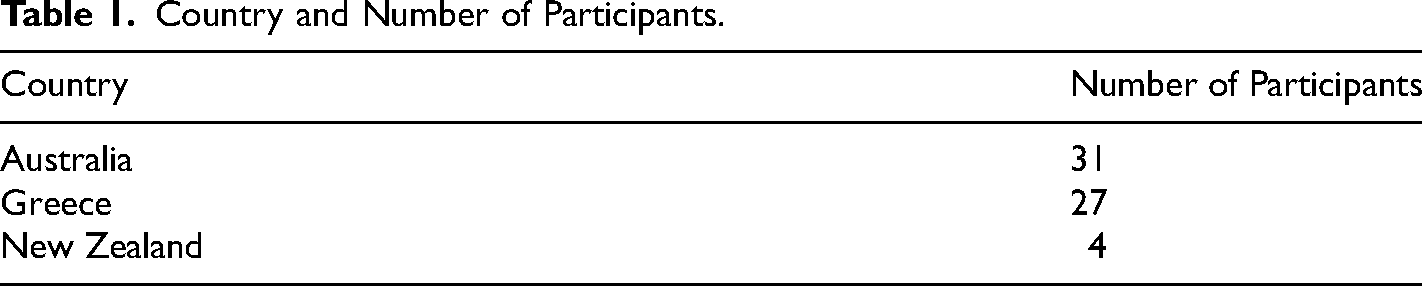
A total of 62 developers took part in the study (Table 1). Participants came from both New Zealand's islands and all the Australian states and territories except the Australian Capital Territory, which is the smallest geographic region in Australia both in terms of land area and population. The Greek studios were primarily located in Athens, which is the centre of video game production in the country. All the participants were video game developers that had released at least one video game or were working on releasing one to sell to players and focused primarily on their own intellectual property, rather than sub-contracting. Thus, the theoretical sampling of participants was based on specific criteria and excluded studios that focused only on outsourcing.
Country and Number of Participants.
No studio had more than 19 employees, thus fitting the definition of small studio. The largest Australian and New Zealand studios had 19 employees, and the largest Greek studio had 10. Combined, 23 of the 62 studios had four or fewer employees. The interviews were all conducted via video conferencing software and most of the interviews were with one representative from each video game developer studio; a small number of interviews were conducted with two or more representatives. In these instances, discussions took on more of a focus group format with attention paid to group dynamics. Primarily, the participants were founders and CEOs of developer studios and had clear knowledge and vision of the past, present, and future potential of their businesses. Recruitment ceased when theoretical saturation occurred (Patton, 2002).
Thematic analysis was utilized to analyse the interviews. The analysis was purely a traditional human interpretive approach to ensure that any industry slang and in-jokes were accounted for and understood and to maximize the insights and knowledge that could be extracted from the data. The software program, NVivo 12 plus, was used as the interface. The analysis process was iterative and continuous, and transcripts were returned to and re-examined to refine codes and groupings as the analysis progressed (McCosker et al., 2004).
Results and Discussion
Commercial and Creative Thinking
Most of these participant small video game developers in all three countries were aware that the video game industry was highly competitive. The developers were also aware that, when compared to larger studios in financially and institutionally more impactful national industries, they had an unequal access to resources such as finances, market insights and data, and networks that they could connect with for help. Thus, it is not surprising that many of these developers from each country abandoned romanticism about contemporary video game production. The majority of the Greek (n = 18), Australian (n = 23), and all of the New Zealand (n = 4) developers were making a commercial product that they wanted to sell to be financially sustainable. The developers believed that video game development is ultimately a product that must find its place in the market and making creative compromises is considered part of the job.
Although these small video game developers expressed love for the act of video game making, the majority were also cognizant of the need to be financially sustainable. These developers did not feel a tension between commercial and creative thinking; it was all part of video game development and production. As one Australian developer explained: ‘Money is great. And so that's a very, a very core part of our focus. And that doesn't have to be at odds with being creative and making games that you enjoy’. But being commercially minded can be difficult without the formal business training that indie developers do not always have access to or even want. Developers thus can believe that focusing on profit-driven practices conflicts with their fundamental values: creating great games for everyone (Styhre, 2020, p. 130).
Another significant factor is the lack of resources, particularly when the game development team is very small. As one Greek video game developer explained: ‘It is not possible for the same person to be a talented developer, a game designer, and, at the same time, excel in business development. Moreover, you don’t have the resources to hire someone for that role’. Thus, market and commercial knowledge was regarded as both a leverage point and a powerful weapon. However, their lack of resources undermines their competitiveness and, at times, threatens their very survival. Under these conditions, a survival strategy that appears to be effective for them is targeting a niche market—such as audiences, who appreciate quirky, fun, and provocative games, VR educational games, or sci-fi themes with ‘80s film references. For some Greek game developers (n = 5), this fragmentation creates a false sense of security, as they do not perceive themselves as part of the global competition for resources, audience, and recognition. These Greek developers seem to have carved out their own space, one that is largely disconnected from the challenges and expectations of AAA game productions.
Nevertheless, not every developer was as comfortable with the marketing and commercial aspects of development. Ten Australian developers and 10 Greek developers did feel uncomfortable or disappointed that they had to consider the marketing and sales implications of their games. For these developers, there was indeed tension between creative and commercial decisions. One Australian developer explained this tension: ‘This is our artistic expression. This is what we want it to be and how we want it to express ourselves personally through this thing that we're making that we want other people to experience. And I think during that process, we probably get really worried about, like, is this thing going to, like sell and make money?’ Some developers went so far as to dismiss commercial considerations altogether. One Greek developer noted that: ‘There is no real competition. Nobody can replicate my style. Gamers will always seek games with deep content’.
Interestingly, despite the tension that some developers faced, 25 of the 31 (81%) Australian developers and all of the four New Zealand developers believed that engaging in and considering marketing was important for video game developers, although some qualified their responses by noting that not every developer wants to sell their video games such as hobbyist developers. While the developers, who took part in the interviews, wanted to sell their video games and derive income from their video game making, they were also very aware that other developers make video games purely for creative, artistic, and hobbyist fulfilment (Keogh, 2023). Developers, who struggled with the tension between creative and commercial decisions, still acknowledged the importance of marketing and selling to be financially sustainable. One developer explained: ‘If you are the sort of person that wants to continue to be a video game developer as your primary, the thing that you do throughout the day, it's sort of necessary even if it is something that you consider a necessary evil.’ These developers were not hobbyists and despite the importance of creativity, they wanted financial futures in the video game industry.
Other Australian and New Zealand developers were not so circumspect and were very clear that marketing and commercial thinking was prioritized in their video production and design. One developer explained how the studio chooses which projects to work on: ‘The way we go about it is marketing almost comes before the design. I think we had something like 10 different projects that we had concepts or ideas for. And the criteria for selecting what the actual project we're going to work on was a combination of feasibility, desire to create the project, and marketing’. Thus the New Zealand and most of the Australian developers did not struggle with the idea of commercial and creative decision making but saw them as integrated. This was a similar approach to some of the Greek developers.
However, a unique common thread emerged from the Greek video game developers. While most developers stated that the majority of creators in Greece are hobbyists, who lack the skills and competitiveness required by the global game industry, there remains an untapped pool of talent. Most Greek developers interviewed noted that their development community is small and predominantly composed of creators, who approach game development not as a business, but as a creative outlet. Based on their interviews, a hobbyist is defined as someone who: (a) does not produce a quality game and likely lacks the capability to do so; (b) has no competitive advantage; and (c) engages in game development primarily as a group activity among friends, rather than as a business endeavour. This definition provided by the developers aligns to the one offered by Keogh (2021). Although the hobbyist Greek video game developer is often characterized as someone with little business ability or interest, they are also seen as part of a growing, community-level entity of creators, who are full of potential but still too nascent at this stage to produce significant results.
While hobbyist video game creators are also common in Australia (Keogh, 2023), the country also features a strong industry of developers, who have businesses and want to become financially sustainable. Such was the case with many of the developers interviewed and thus represents the difference between the video game industry's development in the two countries. The Australian industry, and the New Zealand industry to a lesser extent, have grown sufficiently to where running a business as a video game developer is difficult but possible, in part thanks to the various institutions providing support. Such ambitions are harder in Greece given the lack of industry and institutional support, although other European countries’ video game industries are known to have started with hobbyist developers (Jørgensen et al., 2017). Thus, while video game developers in Greece are commercially minded, there was still a strong focus on artistry, potentially due to a lack of pathways to commercial sustainability.
While Australia has more pathways to commercial sustainability the country also features many hobbyist developers for whom video games are just that: a hobby (Keogh, 2023). These hobbyist Australian developers actively do not want a formal career in video games (Keogh, 2023). Interestingly, this reluctance is potentially in response to the high-level of competition in the industry and the support provided within Australia to help overcome the competition in the marketplace. Therefore, some developers prefer to see creating video games as a hobby and something fun to do during their spare time.
Many Australian video game developers do have ambitions to run a financially sustainable video game development studio and have the luxury to analyse the industry and support offered. However, Greek developers do not have the support available to consider a professional video game developer career. According to most Greek developers, this lack of support manifests in two major pitfalls: (a) the private sector's reluctance to invest in video games, viewing only online slot machines as viable financial ventures; and (b) the ambiguous relationship with the state, which is often perceived more as an enemy than an ally. Hobbyist developers are therefore prominent in both national industries, but for differing reasons.
Brand and Reputation
Despite Australian and New Zealand's small video game developer's focus on commercial activity, only 12 of the 31 Australian developers and two of the four New Zealand developers were actively thinking about the brand of both their studios and their video games and how to manage them. Another 10 Australian developers and two of the four New Zealand developers were starting to think about what kind of brand they wanted to create and manage. The brand of the video game developers also had an impact on which projects they chose to work on: ‘Every project has had a strong consideration for its impact in terms of revenue and sales, and whether you can have an impact and then also whether or not it will be good for our brand.’ Brand management is considered a more sophisticated or advanced form of marketing for well-known entities (Burgess et al., 2023). Thus, the fact that Australian and New Zealand developers were actively constructing and managing their brands, or even thinking about brand management, further demonstrates how the developers integrated commercial and creative decision making into game development. However, given their lack of training and business skills, their use of branding and reputation was in its infancy. Furthermore, although the developers acknowledged operating in a competitive market, they did not appear to know brands and reputation are powerful forces to help them stand out.
Within Greece, the focus on reputation and branding was stronger. Greek game developers appeared to adopt one of three distinct approaches to building their reputations and brands. The first approach was personalized and human-centered, with developers crafting their narrative around personal bonds and shared histories, which often includes stories of how they decided to join creative forces or how gaming became integral to their personal and professional lives. The second approach is service-oriented. These developer studios present profiles stripped of national elements or specific identifiers, focusing instead on the types of games produced for client-based services (such as educational games), or on their use of specific technologies, like VR. The third category comprises hardcore game studios, those uninterested in outsourcing and instead focusing exclusively on producing their own games. Their online presence revolves entirely around their products and the platforms where these can be purchased, with little to no emphasis on describing their activities or identity beyond their games.
These approaches also changed over time. As one Greek video game developer explained: ‘We wanted to develop unique, specialized games, but that changed over time. Now we take on any type of game.’ Maintaining a specific game identity can pose a challenge to a video game developer studio's survival. A game's visual identity often depends on the creative team or, for small developers, the individual artist. Different projects frequently demand varied artistic approaches. Additionally, the inherent mobility within the small video game developer community makes it difficult to associate a consistent visual style with any one studio. In most cases though, developing high-quality games serves as a ‘shield of excellence’, emphasizing that game development is a craft. Excelling at this craft can set a studio apart from the rest.
Creators are well known to use bricolage when crafting creative work (de Klerk, 2015) such as video games. To use bricolage involves making do with whatever is at hand. For developers in Greece, who lack access to institutional support and frequently move between projects, this is reputation and networks. Such an approach is a common one for creators, who lack financial support (de Klerk, 2015; Potts & Cunningham, 2008). Video game developers in all three countries expressed they lacked commercial and business skills, but only the Greek developers extensively focused on their reputations. Thus, the Greek developers’ focus on reputation and their brands compared to the Australian and New Zealand developers can be seen as a response to the relative lack of industry and institutional development and support, while the Australian and New Zealand developers with access to institutional support did not need to rely as strongly on networks, reputation, and branding.
Therefore, while many of the Greek, Australian, and New Zealand video game developers exhibited commercial mindsets, how the developers in each country used branding and reputation, important commercial tools, differed due to the nature of the national industries. Furthermore, while some of the Australian and the Greek developers also focused on creative decisions and artistry, the reasons behind this focus also differed again due to the eco-system of their national industry. All three national industries, Australia, New Zealand, and Greece can be seen as marginal compared to America, for example (Jørgensen, 2019). However, when examining developers working within the three eco-systems, differences emerge such as the use of bricolage in Greece. Thus, this research highlights that differences exist between marginal contexts and how developers working within these different contexts go about their video game development and production. This research calls to further consider the diverse nature of each national video game industry and how it impacts on its developers’ needs to be carefully considered to address the limited perspectives that exist about the video games industry on a global scale (Jørgensen, 2019).
Conclusion
Answering calls to explore more marginal national video game industries, this research explored three different marginal national small video game industries in Australia, New Zealand, and Greece. The three countries’ industries were selected given their economic, cultural, and historical ties to each other. In doing so, it revealed insights about video game production at the margins of the global video game industry and addressed calls to further research marginal video game industries to contribute to understandings of the wider, global video games industry.
Despite all three national industries marginal status and still developing, there were both similarities and clear differences in how the developers approached video game production. While there were developers in all three national industries, who focused on commercial versus creative or hobbyist decisions and production, the reasons for that focus differed. In Greece, the focus on creativity and the prevalence of more hobbyist developers likely reflects the national industry's early stage of development, while in Australia it can be seen as a rejection of a professional career. The Greek developers were also more focused on their brands and reputations than the Australian or New Zealand developers, again likely due to the relative early stage of their national industry and institutional support. The Greek developers had few resources apart from reputation or networks, while the Australian and New Zealand industries had a number of institutional supports such as the various Screen agencies, and Federal and State governments tax and financial schemes. Thus, despite all three countries industries being marginal, the more developed state of the Australian, and by extension the New Zealand given the shared labour market, video game industries impacted on commercial decisions and development.
This research is limited by only investigating three national industries and video game developers, who focused on their intellectual property, rather than sub-contracting. Future research should consider and compare additional emerging national industries and other types of video game developers to produce more granular insights. Additional national industries in more economically emerging countries would allow for a richer exploration of the international video game industry. However, this research still highlights how marginal national video game industries cannot be simply grouped together and displays stark differences from each other, which in turn impacts development within those industries.
Footnotes
Declaration of Conflicting Interests
The author(s) declared no potential conflicts of interest with respect to the research, authorship, and/or publication of this article.
Funding
The author(s) disclosed receipt of the following financial support for the research, authorship, and/or publication of this article: This work was supported by the University of the Sunshine Coast (grant number: Internal LAUNCH grant).
