



Abstract
Today, H. P. Lovecraft's popular culture legacy resides in the shared world of the Cthulhu Mythos and in the iconography of its monsters. Rather than attempt to definitively identify what makes something Lovecraftian, this paper takes a reception theory informed approach to investigate the ways in which the user-defined ‘Lovecraftian’ tag is applied on Steam. This paper identifies the recurrence of sanity mechanics, tentacularity, and parody in the games that users have tagged as ‘Lovecraftian’ and discusses how these elements adapt and respond to Lovecraft's mythos and cosmicist philosophy. The Lovecraftian games available on Steam, as they have been identified by their consumers, indicate that the digital game is a worthwhile platform for adaptations of the works of H. P. Lovecraft due to the interactivity offered by the medium. However, many of these games also contain subversive or parodic elements that undermine Lovecraft's cosmicism.
Introduction
Valve's Steam client was released in 2003 and since then has drastically shifted the distribution, sales, and consumption of digital games. Initially an online content delivery system for the Half-Life mod Counter-Strike (2000) that allowed updates, modding, and live anti-cheating patches, Steam is now the foremost storefront for PC gaming (Yuen, 2021). With over 50,000 available games as of 2023, Steam's store page features a search engine designed to help users find games based on keywords known as ‘tags’ which can be applied by developers, players, and moderators. One of these tags is ‘Lovecraftian’ (Figure 1). There are over 829 available titles attached to the Lovecraftian user-defined tag on Steam, which throughout this paper will be referred to as Lovecraftian games. The existence of this category indicates that Lovecraftian horror has developed into its own subgenre and is the favoured term over related nomenclature such as weird horror or cosmic horror, at least within the medium of digital games.
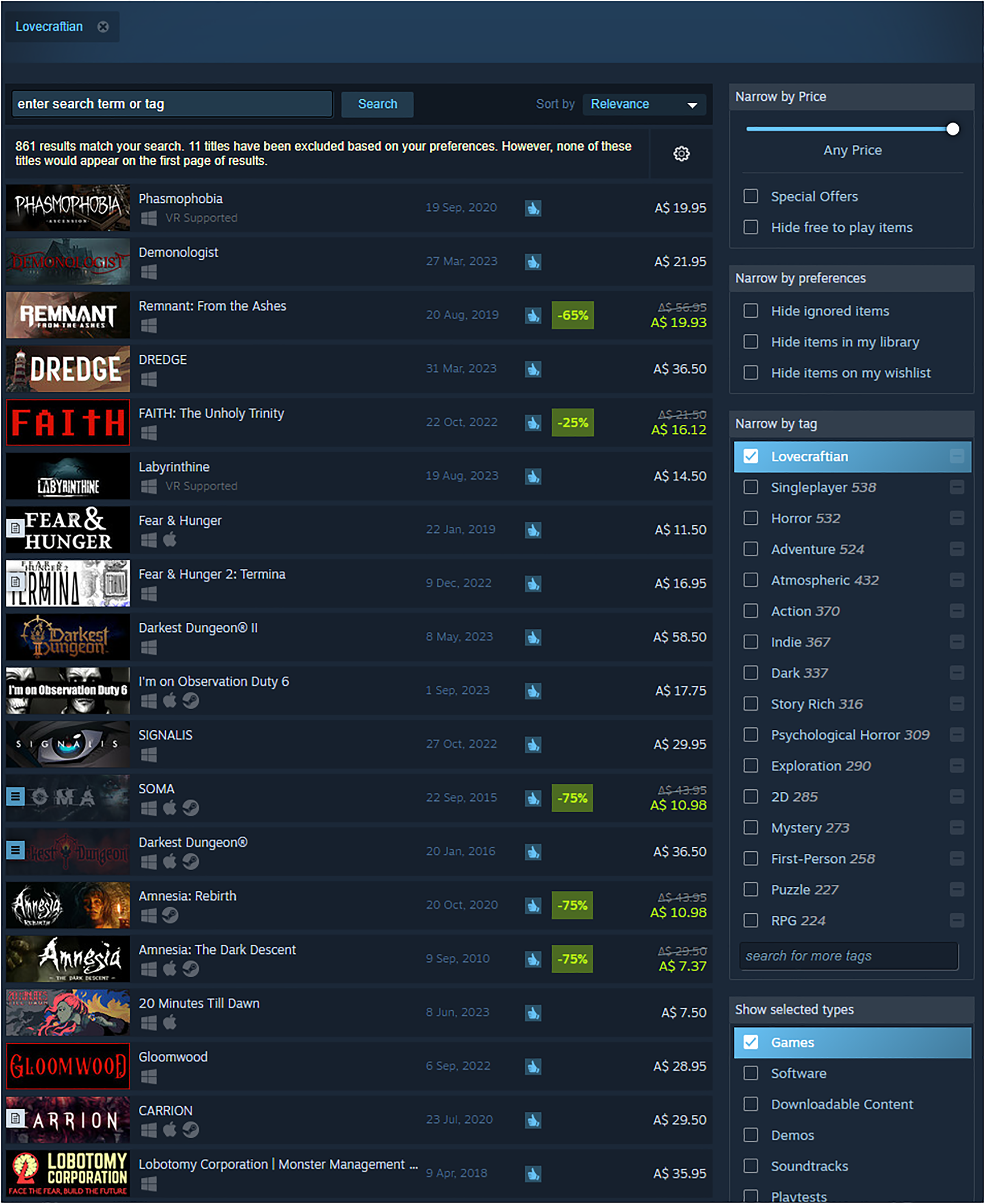
Results under the “Lovecraftian” tag on the desktop Steam client filtered to exclude DLC and other non-base-game content.
In April 2023, Steam had a ‘Lovecraftian Days’ event presented by Fulqrum Publishing (Figure 2a); promoting games under subheadings such as ‘Highlighted deals: daily selected deals to gnaw at your mind’, ‘Lovecraft's worlds: games that will take you to a universe directly inspired by H. P. Lovecraft’, and ‘Lose sanity together: play these games in coop with your friends”‘(Figure 2b). This paper takes an approach guided by adaptation and reception theories to consider from an audience-based perspective what makes texts Lovecraftian. Rather than compare and contrast related terms such as ‘eldritch horror’, ‘supernatural horror’, ‘cosmic horror’, ‘weird fiction’, as many have done (Fisher, 2016; VanderMeer & VanderMeer, 2012), I consider how members of the gaming community engage with metadata on Steam via user-defined tags, how tags and genre may affect player expectations, and identify common elements in Lovecraftian games that may guide users to add the ‘Lovecraftian’ tag. The tag encompasses games with almost every genre and subgenre: there are Lovecraftian visual novels, point-and-click mysteries, bullet hells, fighting games, card games, Metroidvanias, RPGs, and FPSs from large developers and indie creators. Some have clear links to Lovecraft in that they are adaptations of his stories or use elements of the Cthulhu Mythos e.g., Call of Cthulhu (Cyanide, 2018) and Dagon (Bit Golem, 2021), while others such as Darkest Dungeon (Red Hook Studios, 2016) and Strange Horticulture (Bad Viking, 2022) have more subtle thematic links. On the Steam client, the top four or five tags appear on the store page of a game as ‘Popular user-defined tags for this product’. There are 13 categories of tag types: Top-Level Genres, Genres, Sub-Genres, Visuals & Viewpoint, Themes & Moods, Features, Players, Other Tags, Software, Assessments, Ratings, Hardware/Input, and Funding. ‘Lovecraftian’ comes under Themes & Moods. According to the Steamworks information page, user-defined tags allow ‘the community to help mark-up games with the terms, themes, and genres that help describe the game to others’ (Valve, 2023). Tags and their weights can also be set by developers before a game is released. Customers can then assign tags which add to the weight of existing tags or create their own. Prior to 2014, user-defined tagging was an unregulated process. Valve then cleaned and sorted their repository of user-defined tags; formalising some and removing memes, misspellings, and so on. At this point they made the decision to confirm ‘Lovecraftian’ as a pre-existing category over ‘cosmic horror’ or ‘eldritch horror’. This decision was unusual, as many other intellectual property-related tags such as ‘Batman’ or ‘Lara Croft’ were removed under the rationale that they are not genres, whereas ‘Lovecraftian’ is. Lovecraft now, evidently, has become much more than the corpus of one man.
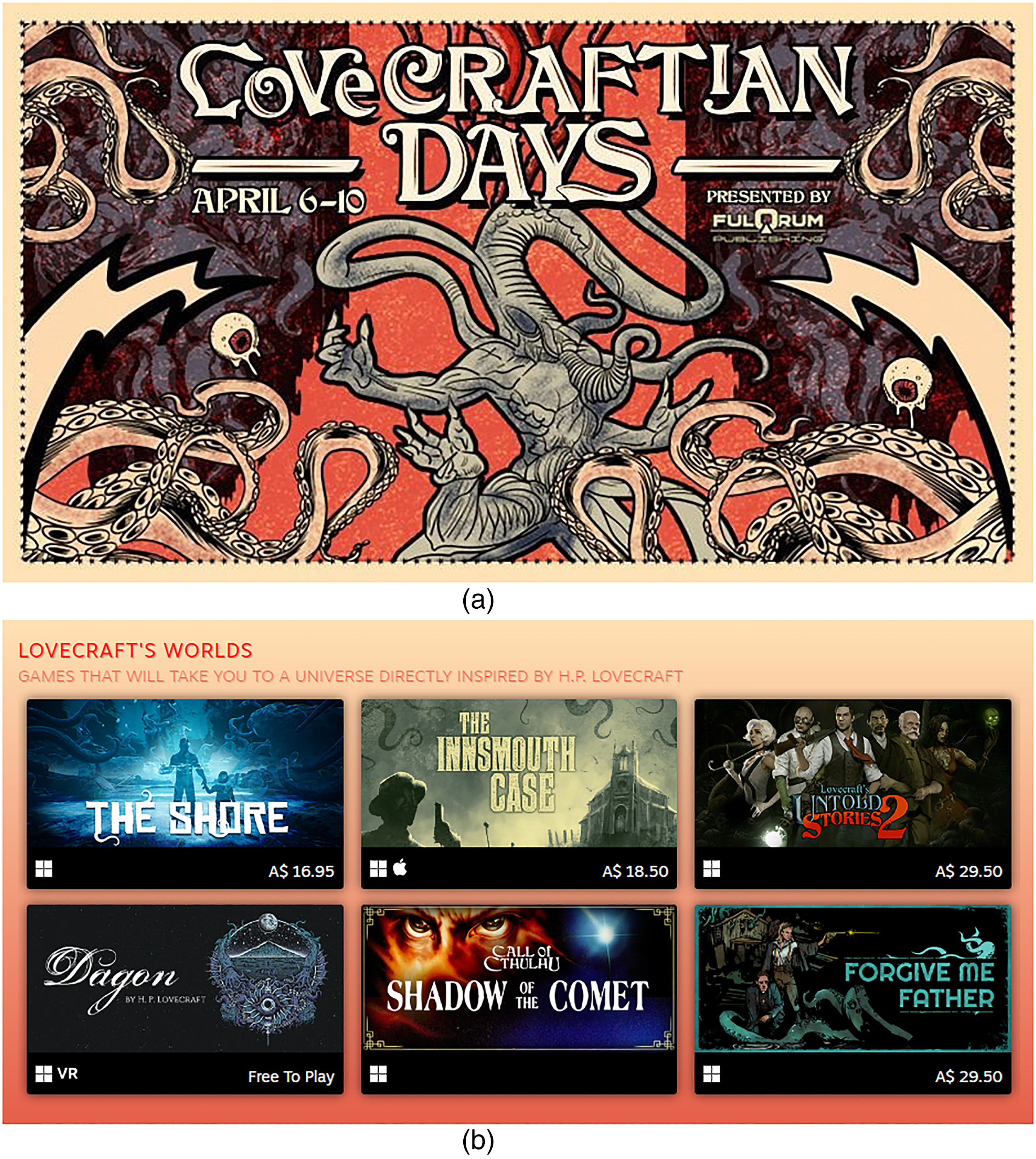
Splash at from Steam's April 2023 Lovecraftian Days sale promotion. (a) Header Image. (b) Subsection of games directly adapted from Lovecraft's works or mythos.
H.P. Lovecraft and his Legacy
Howard Phillips Lovecraft (1890–1937) was born in Providence, Rhode Island, where he lived most of his life. During his career as a writer, he produced a large number of thematically interlinked short stories, novellas, essays, and poems, many of which were published in the pulp magazine Weird Tales. His body of work is critically significant in studies of horror literature for its thematic engagement with cosmicism; a materialist philosophy which acknowledges the limits of human comprehension and the insignificance of humanity in an ultimately indifferent cosmos. This philosophy is embodied in the ancient alien civilisations, the phenomena that occur beyond human perception, and the indescribable terrors that popular Lovecraft's corpus. After Lovecraft's death in 1937 at the age of 46, his contemporaries August Derleth and Donald Wandrei founded Arkham House to publish his collective works, beginning with The Outsider and Others (1939). Derleth, along with writers Robert Howard, Robert D. Bloch and others, used settings, characters, and monsters Lovecraft had created. They referred to this ‘shared world’ as the Cthulhu Mythos (Jarocha-Ernst, 1996, n.p.). Lovecraft himself never used the term to describe his own work but he did encourage the sharing of motifs by participating in the Lovecraft Circle and corresponded extensively with its members (Smith, 2015, p. 3). S. T. Joshi describes the ‘core’ of the Cthulhu Mythos as ‘the existence of a whole pantheon of extra-terrestrial entities who have, by a series of accidents, come to Earth at various points in the past and who make themselves visible in remote corners of the Earth.’ (2014, p. 390.) In Lovecraft's stories, the discovery of these aliens or cosmic beings instils an existential horror in the minds of the protagonists, often fracturing their sanity in the process and leading them to either madness or death. The realisation that the universe is ultimately indifferent or uncaring of human life drives them mad. The Lovecraft Circle continued writing within the Cthulhu Mythos and using its monsters but did not necessarily adopt its originator's pessimistic philosophy. According to Joshi, August Derleth is ‘guilty of a severe misconstrual of the basic thrust of Lovecraft's pseudomythology: he believed it to be a reflection of a cosmic good versus evil struggle, similar to that found in Christianity’ (2014, p. 391). Derleth incorporated his own religious ideologies into the mythos, representing a shift away from cosmicism's disavowal of morality of any kind.
As one might expect, Lovecraft never used the term ‘Lovecraftian’ to describe his own work, but he did theorise his aesthetic approach. In the 1927 essay ‘Supernatural Horror in Literature’ he used the term ‘supernatural horror’ to situate his own writing in a broader category of writing that acknowledges his various predecessors, including Edgar Allan Poe, William Hope Hodgson, and Lord Dunsany. In this essay he defines supernatural horror in relation to feeling rather than form; it generates an affect he calls cosmic fear, which is distinguishable from other forms of horror because it instils in readers ‘a profound sense of dread, and of contact with unknown spheres and powers’ (Lovecraft, 1927b, n.p.). The source of the fear is not the monsters or aliens themselves, but their defiance of human comprehension. He later refined his theory on the 1937 essay ‘Notes on Writing Weird Fiction’, in which he addressed the use of ‘imperceptible hints and touches of selective associative detail which express shadings of moods and build up a vague illusion of the strange reality of the unreal’ (Lovecraft, 1937, n.p.), i.e., his characteristically overwrought non-descriptions of the horrors that defy representation (Kneale, 2006, p. 106). In weird fiction, the source of the fear is not the monsters or aliens themselves but their defiance of human comprehension. Because ‘the weird’ has been heavily theorised by Lovecraft, contemporary writers and scholars tend to favour it as an umbrella term that includes Lovecraft's influences, Lovecraft's work, and those whom he influenced, including his own named predecessors, the formal creators of the Cthulhu Mythos, and contemporary writers whose work engages with the mode characterised by the obscurity of both its subject matter and taxonomic indefinability (Machin, 2017, p. 1063). In their anthology The Weird: A Compendium of Strange and Dark Stories, Jeff VanderMeer & Ann VanderMeer describe the weird tale as ‘the pursuit of some undefinable and perhaps maddeningly unreachable understanding of the world’ (2012, p. xv). Jeff VanderMeer's own work is often referred to as part of the New Weird. Joshi, who established the use of ‘the weird’ as a broader genre of ontological horror that extends past Lovecraft, contends that the weird debrides the boundaries that delineate human/animal, sentient/non-sentient, and self/other (2003). We therefore are left with an assortment of terms—Lovecraftian, eldritch horror, weird fiction, cosmic horror—that point to interlinked albeit not identical concepts, and whose use varies across genera.
Adapting Lovecraft
As this paper uses the Lovecraftian Steam tag as its focal point, it becomes necessary for me to focus on that which has been referred to as such and restrict my theoretical review to that which has been written about Lovecraftian horror. This excludes the extensive scholarship on gothic horror, the new weird, and so on while acknowledging that what Joshi, VanderMeer & VanderMeer, Miéville and others have written on the weird is crucial to an understanding of what manifests in popular culture. It is also crucial to note that I am not aiming to definitively define Lovecraftian horror, as such a task would be futile due to the inconsistent use of terms across scholars, writers, and fans (Séan Harrington defines Lovecraftian horror in Lacanian terms, identifying it as ‘fundamentally “unknowable”… beyond signification, something traumatic and Real’ (2018, p. 34) but the same could be said about weird fiction or cosmic horror). Rather than attempt to define ‘Lovecraftian’ or argue that we should instead start using ‘weird horror’, I aim to investigate what people—at least a certain subset of people—think ‘Lovecraftian’ means as indicated by how and why the tag has been applied on Steam. By taking a methodological approach informed by Reception and Adaptation theories, we might read the selection of Lovecraftian Steam games as part of H. P. Lovecraft's cultural legacy.
Linda Hutcheon defines an adaptation as a ‘formal entity or product’ which is ‘an announced and extensive transposition of a particular work or works’ (2006, p. 7). Although not all the games discussed here are strictly adaptations in Hutcheon's sense of the term, adaptation theory is a relevant methodological approach as they are inherently ‘palimpsestuous’ works, haunted at all times by their adapted texts by their ‘Lovecraftian’ classification (Hutcheon, 2006, p. 6). Adaptation theory provides a theoretical framework for considering how these texts function as an indication of their hypotext's (in this case, Lovecraft's corpus of work and/or the authorial construct of Lovecraft) relevance in contemporary society. Adaptation is not necessarily affirmative of its hypotext's ongoing value; for example, Victor Le Valle's The Ballad of Black Tom (2016) is an adaptation of ‘The Horror at Red Hook’ (Lovecraft, 1927a) that constitutes a sustained critique of the racism inherent in the work and of the author. When it comes to film, many of Lovecraft's stories struggle with the moments of indescribable horror that characterise weird fiction. In ‘The Call of Cthulhu’ (1934), upon the moment where Cthulhu emerges from the sea, Lovecraft's writing progresses through a typical sequence distinctive of weird horror that Mark Fisher identifies as beginning with ‘(1) the declaration of indescribability […] (2) the description […] (3) the unvisualizable’ (2016, p. 23): The Thing cannot be described—there is no language for such abysms of shrieking and immemorial lunacy, such eldritch contradictions of all matter, force, and cosmic order. A mountain walked or stumbled. God! What wonder that across the earth a great architect went mad, and poor Wilcox raved with fever in that telepathic instant? The Thing of the idols, the green, sticky spawn of the stars, had awaked to claim his own […] great Cthulhu was loose again, and ravening for delight (Lovecraft, 1928). Then suddenly I saw it. With only a slight churning to mark its rise to the surface, the thing slid into view above the dark waters. Vast, Polyphemus-like, and loathsome, it darted like a stupendous monster of nightmares to the monolith, about which it flung its gigantic scaly arms, the while it bowed its hideous head and gave vent to certain measured sounds. I think I went mad then.
Critics such as Daniel Lawardorn hold that games cannot be Lovecraftian ‘as they only draw on the popular conceptions of the Mythos rather than evincing a deep engagement with the recurrent underlying themes and structures of Lovecraft's works’ (2017, n.p.). Lawardorn argues that visual forms simply cannot portray the failure of signification characteristic of Lovecraft's prose, and therefore fall short in communicating the horror that comes with the subsequent revelation of humankind's insignificance in the cosmos. The digital game, Lawardorn contends, is a human (or rather, player) centric medium, and ‘is at odds with a cosmo-centric universe where humans are utterly insignificant’ (2017, n.p.). Other scholars of horror games, however, hold that the digital game is highly effective at generating tension via exploiting aspects of the interactivity and breaking the contract between player and game. Game developer Richard Rouse III considers that Lovecraft adaptations work better as games than they do films; commenting that ‘Lovecraft's unique brand of unease, insanity, and slow paced terror works better in an interactive space than it ever can as a movie’ (2009, p. 25.) The games that successfully engage with their Lovecraftian hypotexts in the philosophical, cosmicist sense are ones which use ludic mechanics to disempower the player. Tanya Krzywinska and Esther MacCallum-Stewart highlight the ludic genre's ability to ‘utilize the speculative qualities of the form’ (2009, p. 360). This requires developers to understand that the digital game ‘demands specific actions from the player for progression to occur’ creating a ‘contractual condition between game and player’ that distinguishes it from other media and ‘ultimately affects the way in which we expect horror to be delivered’ (Kryzwinska, 2009, p. 270). This contractual condition refers to the norms of gameplay and the heads-up-display: for example, it is expected that left on the controller will move one left, that threats to the player will appear on screen and that there will be a reasonable means of defeating them, and so on. Lovecraftian horror is most faithful to cosmicist philosophy when this contractual condition is breached, as this breach draws attention to the unreliability of perception. These game mechanics, in which the player is given incorrect, inconsistent, or unreliable information about their surroundings, are known as sanity mechanics.
Sanity Mechanics
Sanity mechanics originate in the SAN scores of Sandy Petersen's tabletop roleplaying game Call of Cthulhu (1981), in which players roll to determine their sanity. This mechanic was adopted into the board games Arkham Horror (Fantasy Flight Games, 2005) and Eldritch Horror (Fantasy Flight Games, 2013). In the Lovecraftian survival-horror game Amnesia: The Dark Descent (Frictional Games, 2010) the player's sanity level is related to how long they spend in the dark, and affects visuals, audio, and the frequency of monster encounters. Sanity mechanics are effective in ‘generating fear in the gamer, an experience that transgresses the screen between the diegetic and the real’ (Christopher & Leuszler, 2023, p. 221). TV Tropes describes the mechanic as the ‘sanity meter’ trope, which measures ‘how well you’ve managed to keep your mind together when facing the horrors from beyond reality's edge’ (2023, n.p.). The mechanic is alternately known as ‘stress” (Darkest Dungeon), ‘terror’ (Sunless Sea, Failbetter Games, 2015) ‘panic’ (Dredge, Black Salt Games, 2023), and ‘insight’ (Bloodborne, FromSoft, 2015). Often, as in the case of Lovecraft's Untold Stories (LLC Blini Games, 2019), the mechanism is not explained at all. Sanity mechanics—especially inscrutable ones—are an effective way of engaging with Lovecraftian ideas of perceptual unreliability and therefore cosmic horror. Sanity mechanics in Call of Cthulhu: Dark Corners of the Earth (Headfirst Productions, 2006) ‘provide a very direct way of linking the character's psychological state to the perceptual and action field of the player, providing in some way an equivalent of literature's unreliable narrator’ (Kryzwinska, 2009, p. 282). In Call of Cthulhu (2018), the player's sanity determines the available dialogue and action options. In Darkest Dungeon, the player manages a team of four fighters, each of whom have an individual stress bar. Stress builds up according to light level and success in combat and causes a variety of status effects called ‘afflictions’ or ‘virtues’ according to each character's class, representing a multifaceted representation of the variety of responses people might have to stress (Cartlidge, 2023, p. 174). Although Darkest Dungeon is not an adaptation of any particular work of Lovecraft, the inclusion of the stress mechanic has likely led to players perceiving it as a Lovecraftian game. The developer, Red Hook Studios, likely take their name from the story ‘The Horror at Red Hook’ (Lovecraft, 1927a) and their logo is a red cephalopod arm, further encouraging the association.
‘Lovecraftian’ is not neutral tag, and some players and developers may be averse to it. Dredge (2023) is a unique game that combines the creature-collector and resource management elements of fishing games with supernatural horror and survival elements. Players are tasked with collecting and selling fish while also completing their encyclopaedia and dredging for lost artefacts. Occasionally, the player will find ‘aberrations’; mutated versions of standard fish with extra eyes, heads, or tentacles. The player's panic levels rise in the dark and the longer they go without rest, increasing the player's risk of death—either through damaging their own boat via collision due to the lack of light or by encountering a leviathan. The exact mechanism is unclear, which only adds to the atmospheric tension. Throughout the game, the player generally given the absolute minimum amount of information needed to progress the game. ‘Lovecraftian’ is the third most popular user-defined tag after ‘Exploration’ and ‘Fishing’ for Dredge, but the developers have resisted the label, instead consciously describing their game as not a ‘Lovecraftian’ but rather an ‘Eldritch horror fishing adventure’. This was motivated by an intent to emphasise the obscurity of atmospheric horror and avoid direct association Lovecraft's creations (Farrelly, 2023, n.p.). To a general audience, the terms “Eldritch” and ‘Lovecraftian’ are interchangeable, but the former does offer a touch more distance from the auteur. Black Salt Games’ decision to use ‘Eldritch’ over ‘Lovecraftian’ was likely motivated by a desire to avoid direct association with a figure known for his xenophobia and whose political views are intrinsic to his brand of horror. Despite resisting the ‘Lovecraftian’ label, Dredge is highly effective in generating an atmosphere of cosmic dread by keeping the player in the dark.
In many Lovecraftian games, some level of insanity is necessary for completion. In Lovecraft's stories, the protagonists are made to realise the insignificance of humanity upon beholding and witnessing the power of cosmic beings. Their madness is really the isolation of having sole access to the truth of the cosmos, and ‘attempting to bridge this gulf in cosmicism inevitably leads to madness or death, and sanity is only maintained by turning away from this threshold and back into denial or illusion’ (Greenham 2022, pp. 76–77). This concept is a focus in Lovecraft's ‘Beyond the Wall of Sleep’ (1919a), ‘From Beyond’ (1934b) and ‘At The Mountains of Madness’ (1936). These stories blur the line between sanity and insanity, implying that what one sees and experiences while insane is cosmic reality, and what we perceive on an everyday basis is the true illusion. Sanity mechanics are important perception-altering aspects of Bloodborne and Eternal Darkness: Sanity's Requiem (Silicon Knights, 2002). Neither of these games is available from Steam but are nevertheless prominent examples of the link between Lovecraftian themes and sanity effects which ‘bolster the sublime qualities of the monster’ (Švelch, 2023, p. 122) by disempowering the player. In Bloodborne, the hunter accumulates insight upon defeating bosses which increases the damage taken from frenzy but allows the player to perceive previously invisible monsters and changes the soundscape of particular areas. Insight can be increased by consuming an item called ‘Madman's Knowledge’, a ‘Skull of a madman touched by the wisdom of the Great Ones […] Making contact with eldritch wisdom is a blessing, for even if it drives one mad, it allows one to serve a grander purpose, for posterity’ (Fromsoft, 2015). This item description indicates that madness and truth in the cosmic-horror world of Bloodborne are one and the same.
Tentacularity
China Miéville's weird fiction manifesto ‘MR James and the Quantum Vampire’ designates the tentacle ‘the default monstrous appendage of today, [and] signals the epochal shift to a Weird culture’ (2008, p. 105). The ‘cosmic tentacle monster’ is emblematic for Lovecraft's particular brand of horror, at the core of which is the insignificance of humanity against the grand scale of the cosmos (Miller, 2011, p. 149). In contemporary popular culture, the tentacle is synecdoche for Lovecraft and his cosmicist philosophy. As an isolated part from a larger, unseen, possibly unseeable whole, the tentacle reminds us that there are things beyond human comprehension. Its uncomfortable undulations—which disrupt our understandings of bodily control via a central, agentic nervous system—confront us with the decentralising philosophical implications of alien morphologies; it is ‘the emblem of that which will not correlate, be reduced to categories of human thought’ (Luckhurst, 2017, p. 1054). But how did the tentacle become shorthand for the Lovecraftian? A broad look at his corpus reveals that Lovecraft's stories feature very few actual tentacled monsters. Only Cthulhu is described as humanoid octopus-alien. We have a clear idea of what he is supposed to look like in part thanks to the description of the figure in ‘The Call of Cthulhu’: Above these apparent hieroglyphics was a figure of evidently pictorial intent, though its impressionistic execution forbade a very clear idea of its nature. It seemed to be a sort of monster, or symbol representing a monster, of a form which only a diseased fancy could conceive. If I say that my somewhat extravagant imagination yielded simultaneous pictures of an octopus, a dragon, and a human caricature, I shall not be unfaithful to the spirit of the thing. A pulpy, tentacled head surmounted a grotesque and scaly body with rudimentary wings; but it was the general outline of the whole which made it most shockingly frightful (Lovecraft, 1928).
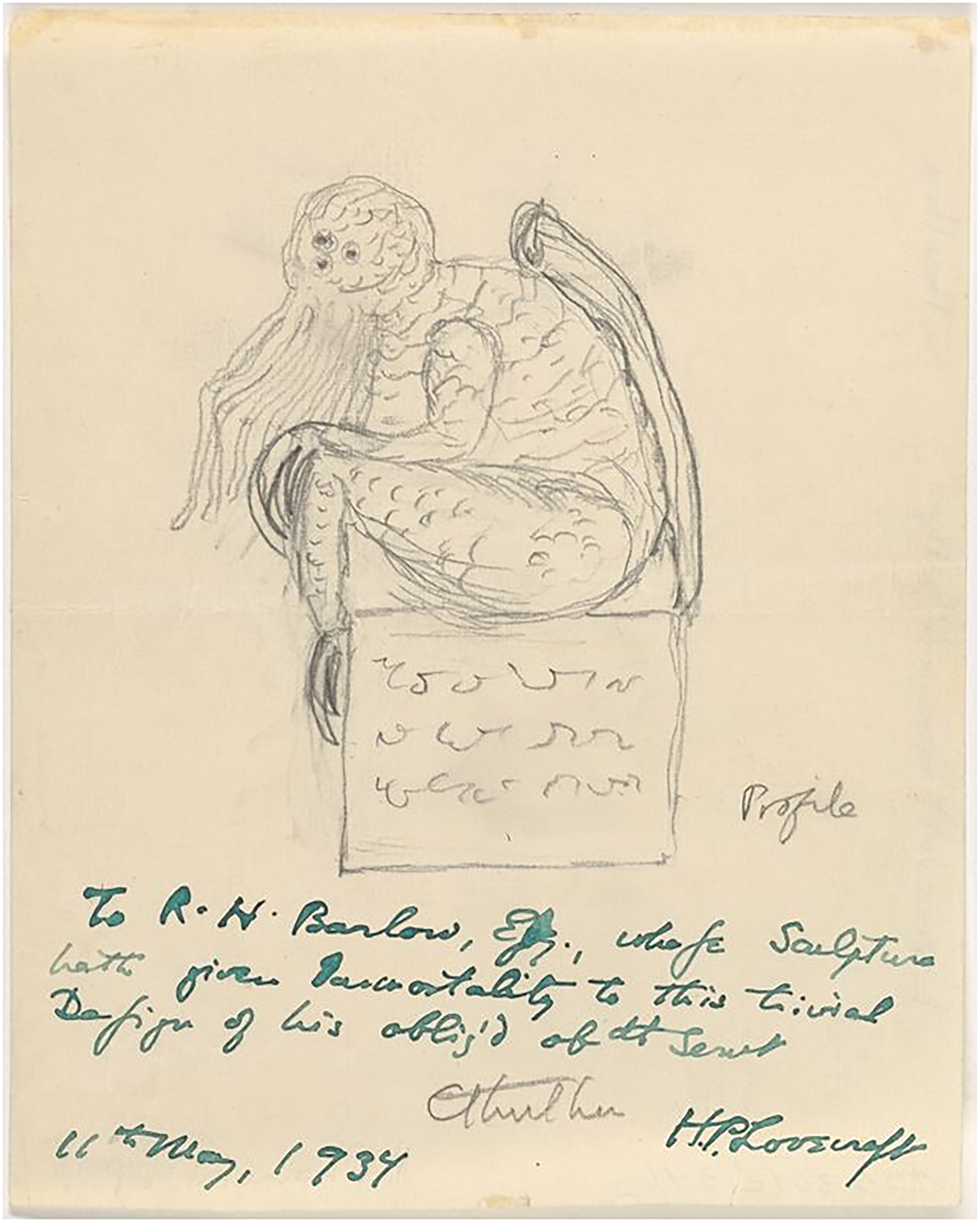
Cthulhu illustrated by H. P. Lovecraft.
Tentacular motifs may encourage users to apply the ‘Lovecraftian’ tag to games, even those which may not sit within the horror genre. Cthulhu and his appendages are subject to what Švelch describes as monstrous containment through commodification, which sees the reproduction of monstrous iconography in material culture, notably figurines, plushies, and alternative fashion (2023, p. 25). To Švelch, monsters in video games are either contained or sublime, with the former occurring much more often than the latter. Containment results from the impulse to understand, and video game monsters as entities to be defeated in battle (e.g., Bloodborne) or collected and logged (e.g., Pokémon). Such monsters lose their sublime qualities by being contained; that is, they fail to be scary. Joshi suggests that the Lovecraftian adaptations are often reductive as they ‘focus relentlessly on tentacles and other superficial elements’, but at the same time ‘they suggest the degree to which Lovecraft's work departed from the stock monsters of previous horror literature and opened up new imaginative vistas that a wide variety of artists have exploited’ (2014, p. 392). While tentacles may not have dominated Lovecraft's own work, they have certainly established a place in his cultural afterlife and the cultural idea of Lovecraftian horror. Tentacles feature prominently on the header and splash images used on Steam's storefront and were used extensively to promote Lovecraftian Days (Figure 2a). The tentacle is both/and, ‘a yawningly impersonal abstraction’ and ‘simultaneously […] some slimy loathsome many-appendaged thing’ (Miller, 2011, p. 149). There is also an erotic aspect to the tentacle with origins in Japanese woodblock printing: ukiyo-e artists, notably Hokusai, saw erotic figures in the kraken and giant octopuses because they were free of censorship (Hashimoto, 2020, p. 65). Sexual anxieties and fantasies alike are projected onto octopoid bodies, as ‘the octopus monster, while hailing from outside safe borders of civilization, thus remains within ourselves, activating the genital and prehensile fantasies of the naked ape’ (Carbone, 2018, p. 60). The cultural eroticisation of the tentacle is satirised in the multiple iterations of Lovecraftian dating simulators.
I should clarify that the appendage often referred to as a tentacle in Lovecraftian contexts is in scientific terms an arm; the distinction being that arms possess suckers along the entire length, while tentacles have suckers on a distal club. The ‘tentacle’ referred to in this analysis is, therefore, not a tentacle in the strict scientific sense but in the disruptive ontological sense referred to by Miéville, and the sense that Donna Haraway evokes in chapter two of Staying with the Trouble, ‘Tentacular Thinking: Anthropocene, Capitalocene, Chthulucene’. Tentacularity is ‘symchthonic, wound with abyssal and dreadful graspings, frayings, and weavings, passing relays again and again, in the generative recursions that make up living and dying’ (Haraway, 2016, p. 33). For Eugene Thacker, the tentacle becomes a symbol for the object-oriented-ontologies and speculative realisms that are central to Lovecraft's philosophy (2015). The tentacle is the symbol of the present ‘The Age of Lovecraft’, the current zeitgeist so named by Weinstock & Sederholm who attribute the rise of Lovecraft in philosophy and popular culture to the timeliness of four ideas: (a) awareness of apocalypse, (b) antihumanist decentring of mankind's pretensions to grandeur, (c) posthumanist questioning of the status of the human, and (d) ironic disavowal (2016, pp. 34–8). However, as Weinstock & Sederholm point out in their emphasis on ‘ironic disavowal’, contemporary philosophers find optimistic and ethical modes of existence in post-anthropocentrism, whereas Lovecraft found only hopelessness (2016, p. 37). This cultural condition of ironic posthumanism—in addition to the commodification and mechanical reproducibility of Cthulhu as a cultural icon—has led to the meme-ification of H. P. Lovecraft and his most well-known creation.
Lovecraftian dating sims reconstruct Cthulhu as an object of desire while still being recognisable as drawing from the Mythos. In Tentacle Prawn: (Actually) A Cthulhu Dating Sim (Stegalosaurus Game Development, 2023), Cthulhu is a university student who wears glasses and a Hawaiian shirt (Figure 4). In Sucker for Love (Akabaka, 2022), the love interest, Ln’eta, is a Cthulhu-like monster with green skin, bat wings, and octopus arms protruding from her face (Figure 5). Both games make heavy use of anthropomorphisation and anime stylisation to maintain Cthulhu's relatability, achieving ‘the co-optation of the monster into a symbol of the desirable […] through the neutralization of potentially threatening aspects with a liberal dose of comedy’ (Cohen, 1996, p. 18). Miller (2005) points out that Cthulhu has achieved Sontagian camp, and that ‘hardly any reader finds Cthulhu frightening. In fact, by all indications, the public is very fond of the creature’ (n.p.). It is highly ironic that Cthulhu has become a recognisable and commodifiable visual icon, as the original locus of weird horror is in its monsters’ unvisualisability. Ward discusses the effective castration of Cthulhu in cute and kawaii merchandising such as plushies, which strip him from his horror fiction context and leave him ‘floating free, unrestrained by specific or limiting assigned meaning’ (2013, p. 94); a blank slate upon which people can project their own feelings and desires. It is this decontextualization, along with a distinctive appearance and the absence of copyright, that allows for Lovecraftian parodies like Tentacle Prawn and Sucker for Love. Parody is ‘one of the major forms of modern self-reflexivity’ which functions as a conservative and transformative force ‘that recirculates rather than immortalises’ (Hutcheon, 1985, p. 28). Many Lovecraftian games are parodies in the sense that they reproduce elements of the Cthulhu mythos with a dose of comedy that undermines the seriousness of Lovecraftian horror. The sheer volume of parody games indicates that the cosmicist philosophy behind Lovecraftian horror is, as Weinstock & Sederholm indicate, ironically disavowed albeit not discarded. Cthulhu Saves the World (Zeboyd Digital Entertainment, 2011) places Cthulhu in the role of a JRPG protagonist, forcing him to fight against evil. In The Call of Karen (Trumbus, 2020), the player is a 1950s housewife who must defend her home against Cthulhu with an enhanced vacuum cleaner. Parodies such as these introduce critical distance from their hypotext which encourages reflection upon why certain motifs are recirculated, what about them is recirculated and what is cut out in the process. By representing Cthulhu as a comic figure, Lovecraftian parody games undermine H. P. Lovecraft's philosophy of cosmicism. They accept rather than fear the idea that the material universe is ultimately unknowable and find kinship in the eldritch. This represents the cultural turn towards object-oriented-ontology as indicated by Weinstock & Sederholm.
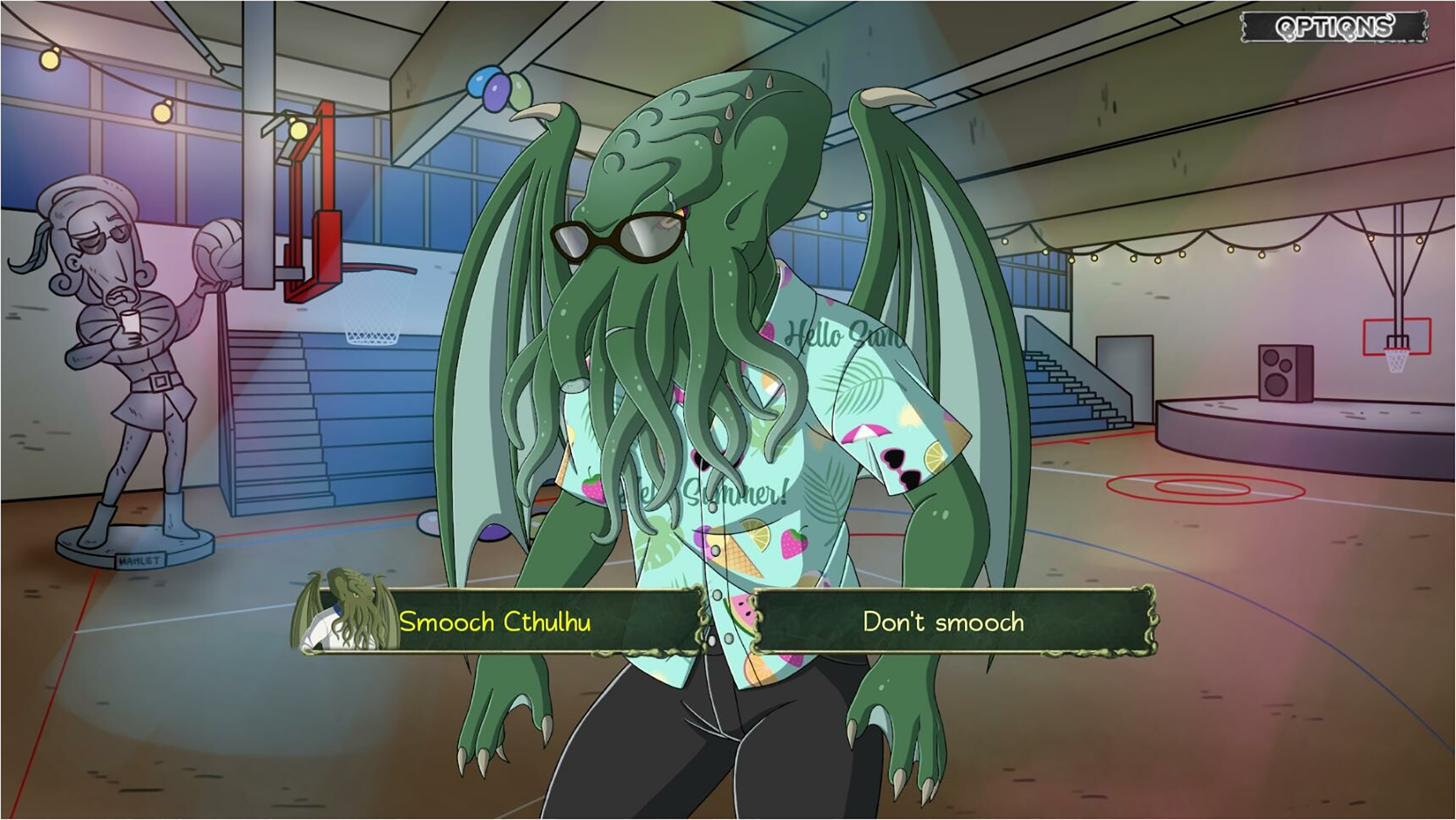
Screenshot from Tentacle Prawn: (Actually) A Cthulhu Dating Sim showing a highly anthropomorphised Cthulhu. Source: https://store.steampowered.com/app/1727790/Tentacle_Prawn_Actually_A_Cthulhu_Dating_Sim/.
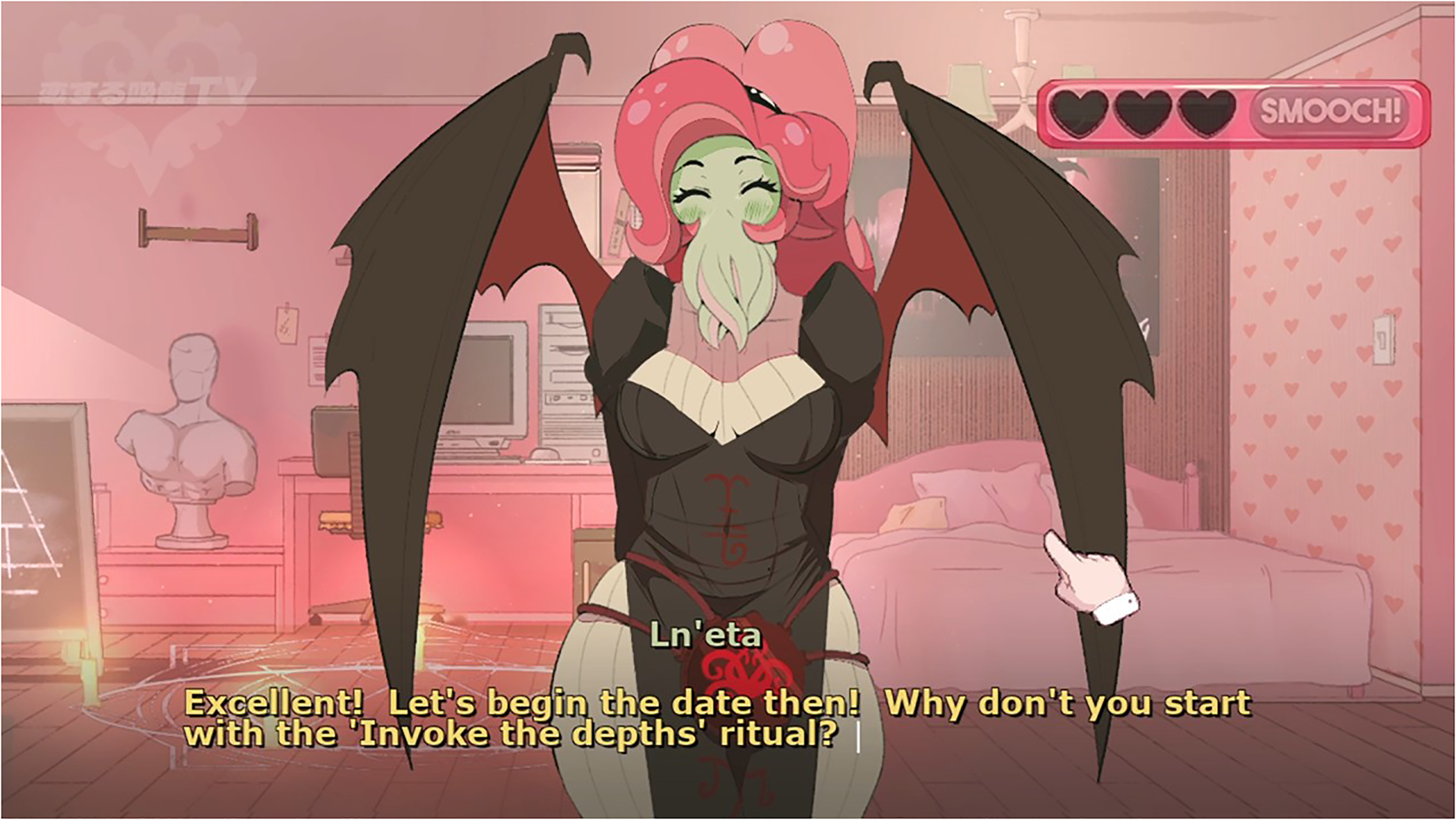
Screenshot from Sucker for Love: First Date showing anthropomorphised and feminised Cthuhu-esque monster, ‘Ln’eta’. Source: https://store.steampowered.com/app/1574270/Sucker_for_Love_First_Date/.
Conclusion
Today, H. P. Lovecraft's popular culture legacy resides in the shared world of the Cthulhu Mythos and in the iconography of its monsters. By investigating the ways in which Steam users apply the Lovecraftian tag, we can draw some conclusions as to what the word means to a consumer audience. Ludic media is, arguably, where Lovecraftian adaptations have had the most success, and this paper eschews an attempt at academically defining the term ‘Lovecraftian’ in favour of focusing on how creators and consumers utilise the term in practical processes of marketing, selling, buying, communicating, and archiving. Tagging is a social form of digital archiving. It is far from a neutral objective process; it is a collective assertion of what is relevant, what is important, and an exclusion of things which are not culturally relevant. Digital archiving practices such as tagging are ‘a means of constructing and stabilising online communities’ and ‘a demarcation articulating what or who belongs where’ (Andersen, 2022, pp. 235–6). Although Steam cannot provide a complete picture of Lovecraft in the world of digital games, Steam's ubiquity in the world of PC gaming cannot be understated. The revolutionary shift from physical to digital distribution resulted in the formation of a virtual space in which retail, surveillance, customer support, social media are ‘integrated into the field of play’ (Shen, 2015). This is now the norm across all platforms, and while it would be viable to investigate how Lovecraft's afterlife is constructed on PlayStation Network, Nintendo eShop, GoG.com or itch.io, my focus is on Steam due to the platform's legacy and its user-focused metadata system.
The games available as Lovecraftian on Steam indicate that the digital game is a worthwhile platform for adaptations of the works of H. P. Lovecraft, however, these adaptations often contain subversive elements that rework the concept of cosmic horror in light of postmodern philosophical shifts away from anthropocentrism and humanism. The games that incorporate sanity effects indicate an ongoing cultural fascination with the limits of human subjectivity, while at the same time, Lovecraft as a concept is synecdochically (and ostensibly reductively) compressed into the iconographic tentacle. Lovecraftian horror is often injected with a sense of playfulness that undermines its pessimistic foundations in misanthropy, xenophobia, and nihilism. Games, memes, and even ritual play with the Lovecraft fandom ‘serve as a means of entertainment while also providing members with a sense of camaraderie’ and the creation of a shared world works to ‘make sense out of the turmoil and confusion encountered in everyday life’ (Mullis, 2015, p. 515). These are broad and somewhat contradictory conclusions which indicate broad and somewhat contradictory opinions in popular culture as to the significance of H. P. Lovecraft and his works today. It is unlikely that different opinions (Lovecraftian horror and sanity mechanics are scary, Lovecraftian monsters are silly and not at all scary) will ever resolve, and Lovecraftian games will continue to reflect this tension.
Footnotes
Declaration of Conflicting Interests
The author(s) declared no potential conflicts of interest with respect to the research, authorship, and/or publication of this article.
Funding
The author(s) disclosed receipt of the following financial support for the research, authorship, and/or publication of this article: This work was supported by the Inkfish,
