



Abstract
Gothic studies and Game studies are beginning to be explored in connection with each other to find various configurations of Gothic elements in the cybertext of games. In this article, I explore various Gothic elements in Bloodborne. My methodology incorporates the analysis of the manifestation of Gothicism in the game through the interplay between the figure of the player character, miseen-scène, and the presence of psychologically affective states pertaining to the experience of playing the game. The role and aspects of player participation, performativity, and in-game mechanics are also examined with respect to the particular function they serve in the realization of the Gothic experience. The presence of Gothic and Lovecraftian tropes, symbolism, and elements of horror within the narrative are also explored.
Introduction: H.P. Lovecraft's Cosmicism
Bloodborne is a third-person action role-playing video game by FromSoftware, released in 2015 to high acclaim. It has been attributed to be very much in line with the general “flavor” of games created by the mentioned developer, largely overseen by Hidetaka Miyazaki. As such, Bloodborne is characterized by the trends and tendencies of the preceding Dark Souls series with engaging combat, a cryptic narrative with heavy environmental storytelling, and high difficulty with a relatively steep learning curve. The game has a deeply Gothic atmosphere with special emphasis on Lovecraftian themes and motifs, which I shall locate and analyze.
A recurring pattern in Gothic fiction is the presence of the Frankensteinian plot—the intrusion into a “natural order” of the world through technological means, scientific, or otherwise, by an individual, driven by hubris. This leads to the creation of some “monstrous abomination,” resulting in the downfall of the creator. Gothic fiction, since its inception, has incorporated political anxieties related to social order and the individual, entwined with the “return of the repressed” and a fear of the Other. Indeed, since the inception of the Gothic novel in the 18th century—this Frankensteinian trope has harbored a disruption of the preceding 17th century Enlightenment's confidence in rationality, science, and order through human reason. H.P. Lovecraft's short story, “The Call of Cthulhu” begins with the following lines: “The most merciful thing in the world, I think, is the inability of the human mind to correlate all its contents. We live on a placid island of ignorance in the midst of black seas of the infinity, and it was not meant that we should voyage far” (2008, 355). The recurrent trope in question incorporates the essence of the mentioned lines, of a darker side of human ingenuity—reason and science bringing forth chaos rather than order. I consciously include Lovecraft's quote because the aforementioned critique is especially present in his oeuvre and in Bloodborne. Manuel Aguirre in analyzing the Gothic elements in Lovecraft's fiction locates the presence of: the valorisation of the non-rational (feeling, the passions, the Burkean Sublime) (…) [and] a type of realism which, shunned by earlier fictions, dwelt on defeat or powerlessness in the face of forces greater than the enlightened will of the individual or of society. (2014, 106)
Lovecraft's fiction is reminiscent of this “Cosmicism,” of the insignificance of humankind in the grand scheme of the universe and the potential forces or entities present in the vast unknown that are beyond the conception and control of human beings. The discovery of these entities and/or forces in Lovecraft's fiction generally leads to the annihilation of reason, civilization, order, sanity, and the manifestation of a primal terror in the psyche. S.T. Joshi, commenting on these patterns asserts—“An unusually large number of Lovecraft's characters go mad at some point or other, and many others have madness imputed to them” (1990, 212).
Fred Botting's assertion that the genre of Gothic died with Francis Ford Copolla's Dracula, before the advent of video games with rich narrative and storytelling capabilities (1996, 180) hardly stands ground in the current period of scholarly engagements of the Gothic. Shira Chess has commented that the medium of video games possesses an intrinsic potential for nonlinear storytelling and is an ideal ground for the realization of Gothic conventions (2015, 386). In her analysis of the Ravenhearst video game series by Big Fish Studios she asserts that the structure of the gameplay revolving around locating hidden objects “in a space of never-ending mess seems fitting for the Gothic—a genre built on excess” (395). There have been various recent studies, analyzing the manifestations of the Gothic in video games—from Gothic configurations of the ludic and formalist elements such as the in-game avatar (Kirkland, 2009) and game soundtrack (van Elferen, 2012); analyzes of monstrosity (Gardner, 2015; Piitinen, 2018), doppelgangers (Hancock, 2016), and memory (Novitz, 2021); Lovecraftian elements and the narrative structure of the “weird tale” (Corstorphine & Crofts 2022; Krzywinska 2020); and extensive studies of the intrinsic Gothic tendencies of the survival-horror genre of video games (Fuchs, 2013; Kirkland, 2012; Krzywinska, 2002, 2015). My analysis of Bloodborne at a foundational level employs Krzywinska's “coordinating nodes of the Gothic” (2015, 59) to locate the Gothic elements in the ludic and the narrative layers of the game. I also draw on the mentioned analyzes of Gothic aesthetics, monstrosity, and affordances in the different aspects of the medium of video games as explored in the recent studies, by identifying how the “game grammar” in Bloodborne leads to the expression of the “Gothic grammar.”
Analyzing Gothic Elements in Games: Methodology
Krzywinska employs the reading of Gothic elements in the cybertext of games through the analysis of the interaction between “game grammar” and “Gothic grammar.” She mentions: Games can be regarded as constituted through grammar. Videogame makers select elements from established game grammar to construct the particular vocabulary of that individual game. The same can be said of Gothic. As with games, a set of conventions emerge cumulatively and proliferate from similar texts, sounding the structural beat to which story, style and theme dance. (2015, 58)
Drawing from Manuel Aguirre's conceptualization of Mary Shelley's Frankenstein, which incorporates a reconfiguration of the traditional “Hero's Tale” (2013, 11), she reads the “false hero” as one who is an ineffective hero, a flawed character who is reduced to passivity and helplessness throughout their journey and succumbs to tragedy. Piitinen summarizes the figure of the “false hero” as a hero who through the course of the narrative, struggles with overcoming their obstacles through a sense of powerlessness—someone whose agency to ultimately triumph at the denouement is put into question, and is usually met with a less-than-happy ending at the closure of the narrative. The false hero figure is bereft of tools and abilities such as skills, employable knowledge, and equipment that prevents a sense of “mastery” over the trials and tribulations that the player may experience through triumphing over the enemies in the game, with the efficacious use of the power of the in-game avatar. In this case, the player is met with a sense of disenfranchisement and vulnerability—being forced to hide and flee instead of fighting the enemies and tackling them head-on, characteristic of protagonists in Gothic fiction such as Victor Frankenstein in Mary Shelley's Frankenstein and Jonathan Harker in Bram Stoker's Dracula (Piitinen, 2018, 44).
Krzywinska expands on the second coordinate of “mise-en-scène,” as “uncanny spaces” that are “symptomatic and spatially locative of the journey of the—‘false hero’”(59). These are the “[h]aunted, disquieted” environments like “haunted houses, spooky woods, crypts and graveyards, derelict buildings, attics and cellars” that through cultural imagination function as “representations of estrangement” (Vidler, 1992, 12).
The third coordinate entails the affordances in the game mechanics and the narrative producing a set of particular affective impressions on players, “aligned often to the return-of-the-repressed structure as well as through the particular deployments of elements of mise-en-scène” (Krzywinska, 2015, 61).
The fourth coordinate, that of “style” encompasses the aesthetic choices employed to sustain and give rise to the mise-en-scène. “Style” here encompasses the different elements that can be ascribed as being part of the “Gothic grammar” in the game—such as the kind of verbosity employed, the nature of the lighting in the game spaces, the objects used to fill up those spaces, and so on. The “what” of the objects is as important here as the “how,” in the sense of how these objects and aesthetic elements are organized to deliver the narrative and sustain the Gothic atmosphere, and for example, often can “manifest through editing, phrasing, elisions, use of time, and auditory and visual elements, such as colour palette” (2015, 61).
The fifth and final coordinate of “function” entails the potential purpose of the incorporation of the Gothic elements in the games. Krzywinska gives examples of such “potential uses” as the “localized use of Gothic” reinforcing the notion of “home” in Lord of the Rings Online (Standing Stone Games, 2007), in World of Warcraft (Blizzard, 2004) of incorporating the notion of moral relativism and in Bayonetta (PlatinumGames, 2009) providing “the means to fuse together an ambiguous mix of power and objectification” (2015, 62).
I shall analyze Bloodborne in relation to these five mentioned coordinates and the ways in which Gothicism manifests in the game through the mutual interaction and synergy between said coordinates. In particular, I will locate and analyze the following elements: (1) How the “false hero” is seemingly empowered but ultimately is rescinded back to a state of vulnerability; (2) How the mise-en-scène and style are configured to sustain the Gothic themes of doubling, entrapment, misdirection, and subversion; and (3) How the mentioned elements crystallize into a certain “function” that I shall elucidate upon in the conclusion.
False Hero
In Bloodborne, the player takes control of the player character (PC from here on) when the latter is in a state of physical vulnerability and complete ignorance of the world they are embedded in. The horror aspect of Bloodborne is encapsulated in the initial encounter with a werewolf that the PC lacks the power to confront and slay, being left with the only option to flee. This is reminiscent of other video games of the “survival-horror” genre that generally feature a PC who is a “false hero,” in the sense that they are not capable of confronting the monstrous enemies of the game and other horrors head-on and are forced to flee and resort to stealth. Yet, in Bloodborne, the PC gradually acquires powers, agency, and strength that give them the ability to slay such monstrous creatures. Indeed, later into the narrative of the game, the werewolf that seems so invulnerable initially is relegated to a minor enemy. This is aptly captured in the message that appears on the screen along with a flash of light, after the PC is successfully able to slay one of the major enemies or “bosses”—that of “Prey Slaughtered” (Figure 1) 1 and in the case of two unique bosses, “Mergo's Wet Nurse” and the “Moon Presence,” of “Nightmare Slain.”
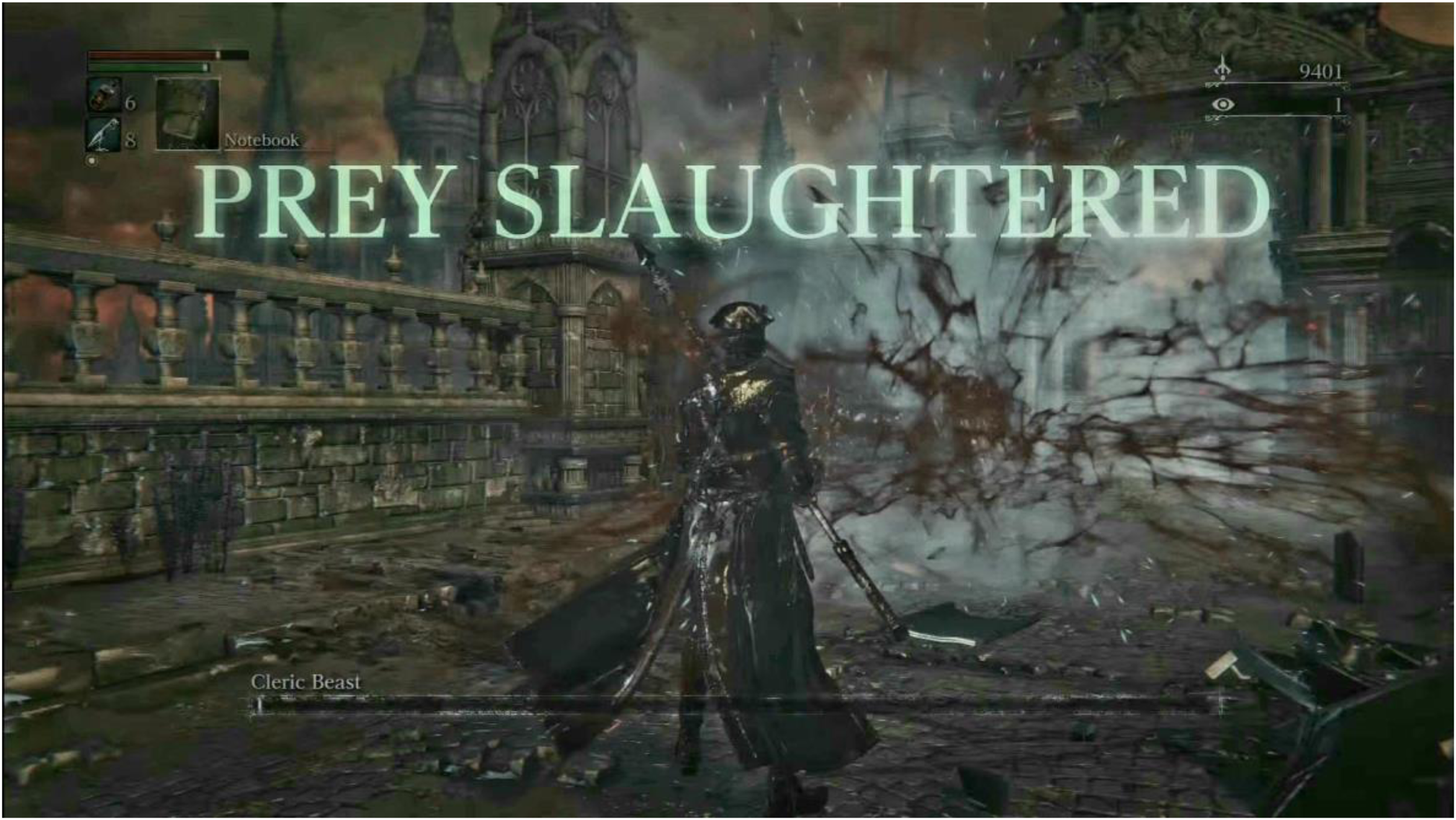
The appearance of this text for the first time as the player slays the first major boss, the “Cleric Beast” while its body crumbles and disintegrates reinforces the notion that the player character is a capable hunter and adds to a sense of accomplishment and progress.
This gradual empowerment of the PC and the resultant veering away from the powerlessness of the “false hero” archetype is complemented by the player piecing together a substantial narrative of the world. The narrative of Bloodborne is not overtly conveyed to the player but demands a certain active effort from them in an investigational manner to piece it all together. The game world is strewn with ambiguous messages, hastily scrawled notes, environmental clues, and enigmatic utterances from other characters that the player encounters and has to piece together to form a coherent narrative, if they so choose. The game thereby puts the player in the role of a detective and rewards exploration and active participation. Krzywinska (2015) in analyzing the point-and-click puzzle game Midnight Mysteries: Salem Witch Trials (MumboJumbo/Avanquest, 2010) observes that power is invested in the protagonist to be able to function as a detective—who through the application of rationality, logic, and deduction unfurls the ambiguities in the world and manifests a sense of order, out of instability and confusion. In doing so, through the PC, the player experiences a sense of “mastery” and thus, the experience veers away from that of the “false hero.” Novitz identifies the detective protagonist of Disco Elysium (ZA/UM, 2019) engaged in a similar endeavor to look into the deeper recesses of “the city and its secrets [that] are often transformed into something menacing and strange” (2021, 38). Similarly, in Bloodborne, the player actively brings order to a world that is fragmented physically as well as in a narratorial way. Physically, the player traverses the game world, and in doing so uncovers the connection between different seemingly unconnected parts and establishes lines of traversal. Narratorially, the player investigates the world and pieces together bits of evidence to bring out a conclusive narrative. These two aspects complement the player's role as the eliminator of the chaotic and monstrous elements in the world, by embedding the PC within the role of an empowered agent of reason, strength, and ingenuity. Indeed, instead of being a “false hero,” the PC can be read as a foil to the archetype by contrasting them with the other “false heroes” and tragic characters the player meets during the journey such as Gehrman, the First Hunter, Ludwig the Accursed and Lady Maria of the Astral Clocktower.
Does the empowerment of the PC in Bloodborne result in such a disruption of the Gothic flavor of the game? My version of the answer would be in the negative. Bloodborne is a game especially known within the gaming community for its difficulty. The enemies seem insurmountable and the PC, no matter how empowered they get, seems fragile and vulnerable to the assault of such forces. In a combat situation, it is rarely the case that the player can engage blindly with even the weakest of the enemies and even hope to demolish them with little to no effort. The player has to be alert at all times, reinforced by the fact that the game does not possess a “pause” mechanic; lest the PC be killed due to their fragility as compared to the enemies. The feeling of vulnerability is conveyed in survival-horror games like Amnesia: The Dark Descent (Frictional Games, 2010) by the player being forced to flee. In Bloodborne even though the PC is strong enough in each stage of the journey in the game to confront the enemies in combat, they are never on an equal footing or stronger than the enemy. The player has to rely on their reflexes and ingenuity to make efficient and effective use of the resources they have at hand in the game while also continuously dodging out of the way of the enemy's attacks. Thus, even though the function of fleeing is not that prominent in the game, it is still present on a micro level through the function of the “dodge.”
Interestingly, extending this notion of the performative aspects of the player's participation in the game, it can be read that the very player, through participating in the “play” emulates the “false hero” archetype if they are unable to complete the game because of its difficulty. It is of no surprise that after roughly 5 years of the game being released, the completion rate sat at only 31.9% (Tassi, 2020, para. 4). The PC's position as a “false hero” is also reinforced by the fact that the three possible conclusions of their journey are marred with a sense of inconclusiveness and ambiguity whether to be interpreted as “positive” or “negative” outcomes.
Novitz (2021) asserts that the Gothic prevails in the narrative of Disco Elysium because the aforementioned investigatorial attempts fail to sustain a sense of stability and order in the world, as well as a linear teleological trajectory in the unraveling of the mystery. Similarly, in Bloodborne, the game world continues to exist in a state of flux despite the player's efforts as I will elucidate further on.
Mise-en-scène
Bloodborne is largely set in the city of Yharnam, resembling a dark and sinister rendition of a Victorian London cityscape especially dominated by Gothic architecture. Towering spires and clock towers loom over the streets and arabesque gargoyles watch over a realm of ruin and desolation. Grotesque monsters roam the streets that are lined with broken carriages, coffins, and bodies of the hunted beasts pinned to wooden crosses and set ablaze. It is eternally dusk or night all through the duration of the game. The design of the city is akin to a maze. Narrow cobbled alleys give way to secret nooks and crannies shrouded by crates, wooden barrels, or secret ladders. It is up to the player to navigate the maze and survive the streets. Indeed, the design of the city of Yharnam, echoes Botting's views on the archetypal Gothic urban space: “the modern city combined the natural and architectural components of Gothic grandeur and wildness, its dark labyrinthine streets suggesting the violence and menace of Gothic castle and forest” (1996, 2).
A prominent element of the environment that captures the Gothic atmosphere is the sublimity of certain parts of the game world, echoing Luckhurt's comments on Gothic geography: “The Gothic is insistently about spatial discomfort, whether from entrapment in dungeons or buried in a premature grave, the disorientation of labyrinths, or the annihilating sublimity of the vast openness of mountain ranges or Arctic wastes” (2014, 62). Notable examples from the ever dynamic and changing elements of the environment as the game progresses are: a gigantic pearl moon looming over the dark horizon dotted with jagged markings of a city pervaded with gothic structures; the giant cathedral at the center of the “unheimlich” space—housing the origin of the infernal beast plague that haunts the city; and a blood-moon rising behind the “Moon Presence” (Figure 2)—a seemingly godlike cosmic being that descends toward the PC, beckoning them. Indeed, the environment ties in efficaciously with the narrative to render a dark, enigmatic, Gothic atmosphere.
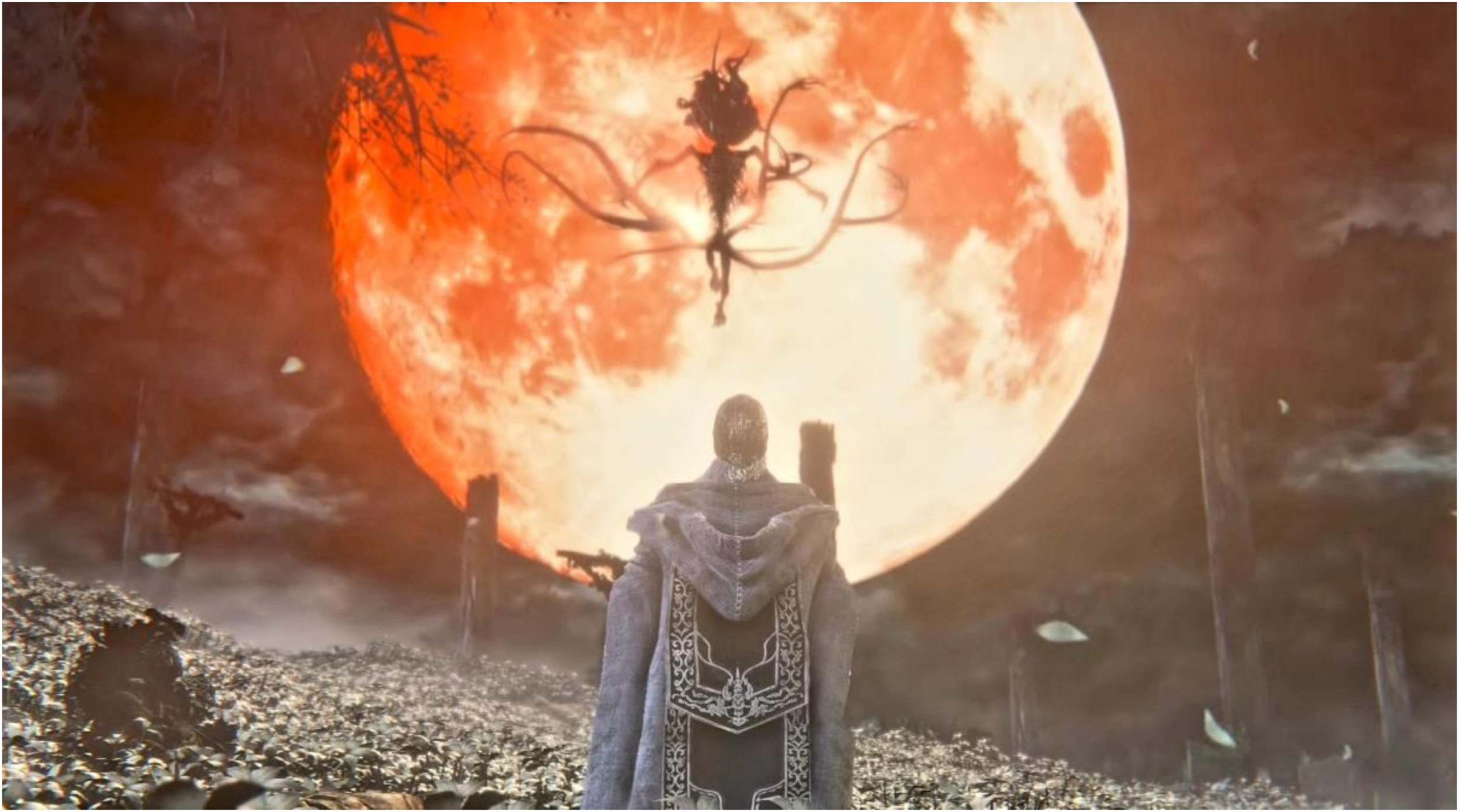
The player character gazes up at the “Moon Presence”, as it descends from the sky with the blood moon in the backdrop.
Another characteristic that is highly contributive in this regard is the sound design of the game. Here, I refer to van Elferen's detailed analysis of the potential of music in Gothic games to strengthen “gaming virtual reality through the spectrality of (schizophonic) ghostly and zombie voices (…) [enhancing] player immersion in virtual reality through the hauntology of musical connotations” (2012, 108). As the player traverses through the game world, they are met with ambient audio stimuli such as grotesque screams, hysterical laughter, the sound of a monstrous beast beating at the door down the alley, and another dragging an axe as it screeches on the pavement. The ambient sound of the game adapts and builds upon the environment to create an atmosphere of pervasive horror and paranoia.
Doubling
Doubling has been a characteristic trope of Gothic fiction. M. Todd mentions: Various types of doubling are employed[…]to convey the thematic undercurrent of anxiety which is central to the Gothic genre. One such example is the trope of character doubling, which is often discussed using terms such as doppelgänger, alter ego, split personality, mirror image, shadow, or twin. Use of these variations of self allows authors the freedom to explore subjects that would otherwise be deemed unacceptable, such as issues of identity, sexuality, gender boundaries, and the roles of men and women. (2011, 6)
Imposter Iosefka
In Bloodborne, the PC awakens in “Iosefka's Clinic” and upon returning to the location after visiting the “Hunter's Dream,” they encounter Iosefka safely locked behind a door, presiding over her patients, refusing entry to the player. Upon inquiry, she mentions that she cannot let the PC enter into the chamber lest the PC infects the patients. However, later into the narrative of the game, perceptive players will recognize that the original Iosefka has been replaced by an imposter. She has a slightly different tone of voice and as opposed to the original one, she welcomes the player inside and also asks the player to send any survivors that they may encounter, to her clinic. Afterward, it becomes evident that this imposter had been selfishly experimenting on the patients in the clinic rather than taking care of them, as well as on any survivors the player may send to her. She does this to commune with the cosmic beings in the game world known as the “Great Ones.” This is confirmed by the player discovering the patients turned into monstrous beings and she having been impregnated by a “Great One.”
Her figure of the motherly, protective nurse is transformed into that of a “monstrous mother.” Gilbert and Gubar (1979) mention that Gothic fiction is replete with sexually transgressive doubles of central female characters who are chaste and subservient to the status-quo. Fleenor characterizes the Female Gothic as possessing fragmented psychological reflections of repressions of female sexuality (1983, 15). Similarly, Fiedler observes that the female psyche in responding to the pressures of social conventions and patriarchal surveillance, “turn[s] from society to nature or nightmare out of a desperate need to avoid the facts of wooing, marriage, and child-bearing” (2003, 25). In the imposter Iosefka, the repressed returns through the immaculate conception of a monstrous child. A similar instance can be located in The Dunwich Horror, where Lavinia Whateley is impregnated by the cosmic being called “Yog-Sothoth,” and through immaculate conception gives birth to a son Wilbur. The son matures at an abnormal rate and his twin brother who is a hideous monster is described to have “looked more like the father than Wilbur did” (H.P. Lovecraft, 2008, 667). Here, the imposter Iosefka can be read as having such transgressive sexual connotations as opposed to the original one characterized by healing, protection, and law.
At various points in the game, such elements of the game world that come to be associated with the notions of order, safety, and the home are defamiliarized and transformed into the unhomely. This injects a certain pattern of the manifestation of the uncanny or the Freudian “unheimlich,” which is very reminiscent of Gothic fiction. The nurturing Iosefka who is initially portrayed as a protective guardian of her patients, is suddenly morphed into a malevolent force. This sudden change epitomizes the very experience of the Yharnamites in being betrayed by their scholars and the clergy, those in whom they had put their trust. This is also reflected by the player's experience of her being an imposter and the realization that the helpless survivors whom the player sends to her in good faith, end up being the victims of her horrific experiments.
M. Todd locates three differing ways in which doppelgangers manifest in Gothic narratives. These three forms can be classified as—corporeal, spatial, and intrinsic to the psyche. An example of the first instance is located in Henry James’ “The Jolly Corner” (1996) and The Private Life (1893). In these two stories the doubles are separate individuals whose presences impact the life of the central characters through the embodiment of their repressed selves. The second form of doubling is located in Edgar Allan Poe's “The Fall of the House of Usher” (1975), as the physical space of the “house” standing as a double to its inhabitant, Roderick Usher, “whose mental and physical deterioration are mirrored by the equally deteriorating structure in which he lives.” These particular cases are contrasted with the third form of doubling in Jack London's “When the World Was Young” (1913) and “Samuel” (1999)—where the central characters are engaged with protracted struggles with their “inner selves” pertaining to issues of external assertions of their identity (10).
In the character of the imposter Iosefka, all these different forms of doubling can be located. She is corporeally a double of the original protective and kind-hearted nurse, while simultaneously the sense of defamiliarization associated with her character is doubled in the game environment at large. Her experiments on her unfortunate victims can also be read as potentially paralleling the player's act of “farming” the mobs of the game for “power-levelling” and procuring in-game items like “Blood Vials”—thereby leading to a gamic “doubly real” (Schweighauser, 2009) Gothic spatiotemporality.
The Doll and Lady Maria
In reaching the “Hunter's Dream” in the game for the first time, the player encounters a lifeless doll in front of the “Hunter's Workshop.” The design of the doll lends it a very humanlike appearance of a pale young woman with white hair. Its presence encapsulates a sense of the uncanny, specifically as conceptualized by Ernst Jentsch (1906)—as inanimate automatons that inhabit the liminal space between being “lifelike humans” and “lifeless objects” (Figure 3).
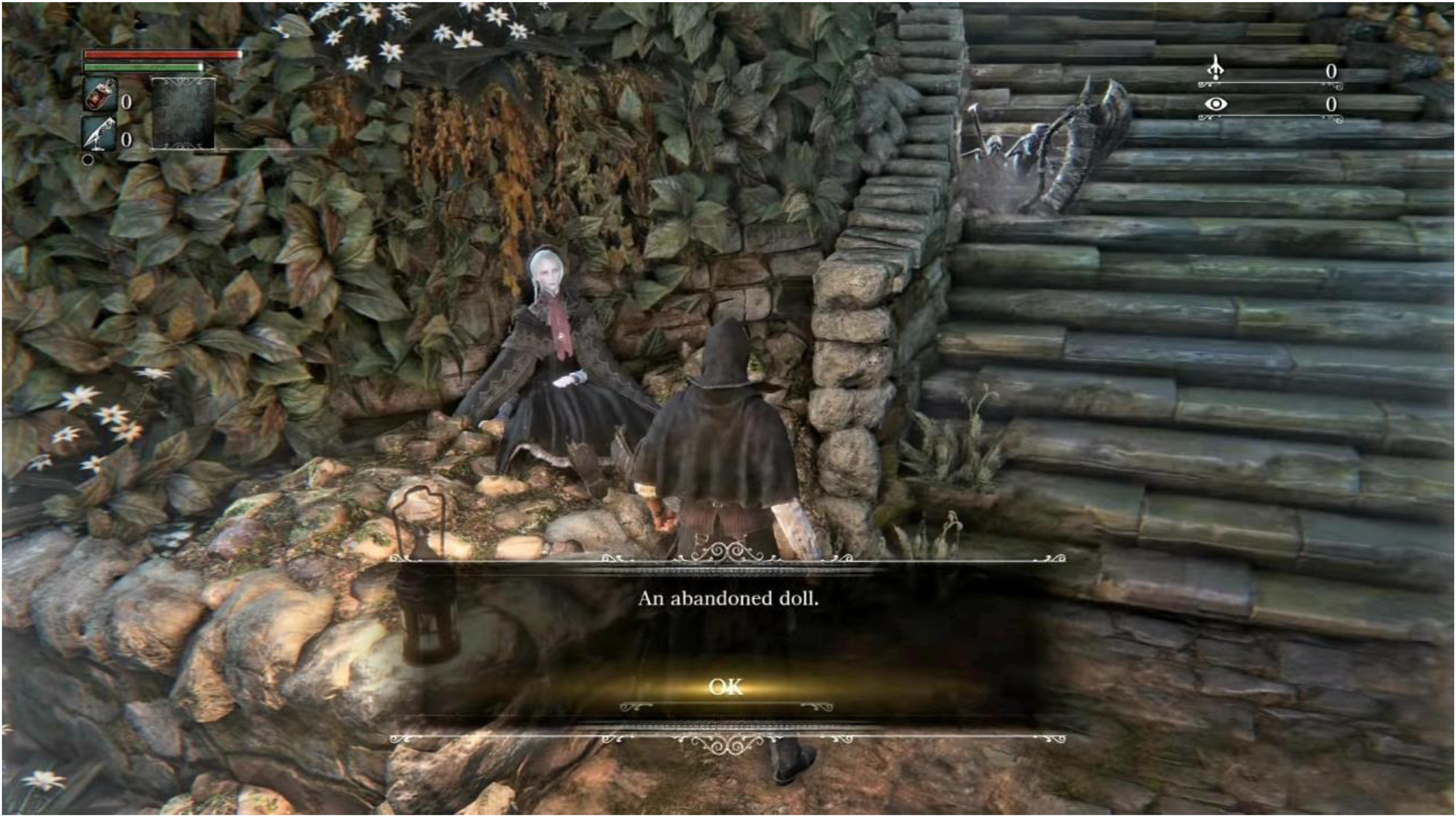
The lifeless doll lays beside the steps leading up to the “Hunter's workshop”.
Gradually in the game, the PC gains “insight” by raising their “insight” attribute and sees through the veil of illusion to perceive the doll as having sentience. The doll is from here on, perceived to be animate, sentient, possessing a life of her own and the PC can talk to her. Later on in the narrative, if the player actively participates in unearthing this connection in the game world, it is discovered that the doll had been created by Gehrman in the image of Lady Maria, whom he loved.
The doll's connection with Lady Maria is reinforced in two instances (Figure 4). An item found in the game, the “Small Hair Ornament” can be inferred to be connected with Lady Maria and her emotional connection with Gehrman. If this item is given to the doll, she would remark (Figure 4)—“What? What is this? I-I … can't remember, not a thing … only, I feel … a yearning, something I've never felt before … what's happening to me? Tell me hunter, could this be joy? Ahh” (Joserrus, 2014). This remark can be inferred to hint at a connection the doll has to Lady Maria's emotions, specifically the “admiration” as it is mentioned in the game she has for Gehrman. Secondly, after the player kills Lady Maria, and interacts with the doll, she would remark—“Good hunter. This may sound strange, but … Have I somehow changed? Moments ago, from some place, perhaps deep within, I sensed a liberation from heavy shackles. Not that I would know …” (Joserrus 2014). The latter dialog hints at the unshackling of Lady Maria from the “Hunter's Nightmare” where her psyche got trapped, after the player kills her. All of these seem to cement that somehow the doll is connected to Lady Maria and therefore is her “double” in a certain way.
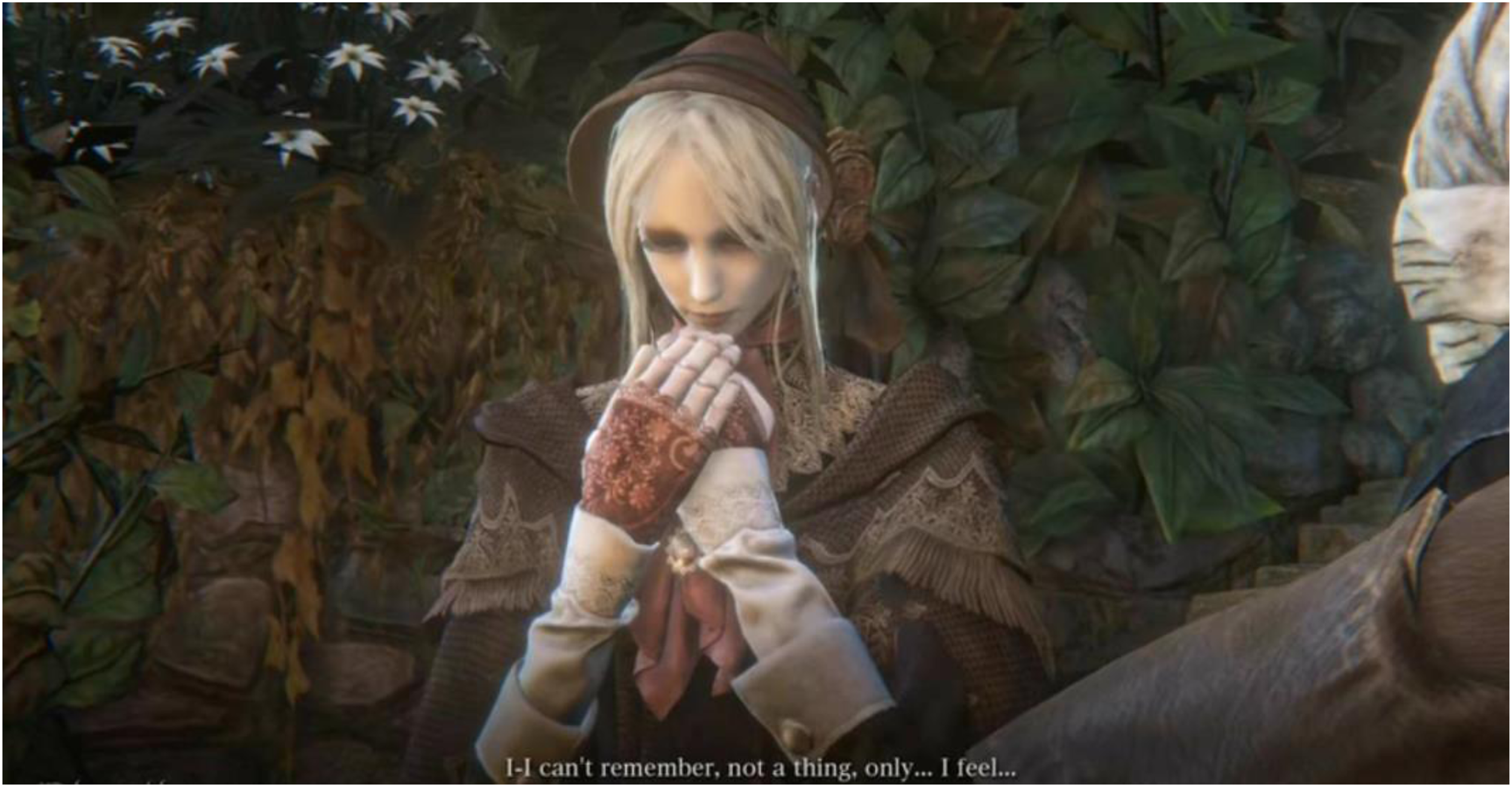
The doll's reaction to the object offered and the similar subsequent reactions from her, hint at her connection with Lady Maria.
It can be inferred from other evidence in the narrative that Gehrman had a “manic” obsession with Lady Maria. The item description of “Maria Hunter Cap” includes the following: “Maria[…]had great admiration for Gehrman, unaware of his curious mania” (Soulbinderblood123, 2019), and the “Doll Clothes” includes: “A deep love for the doll can be surmised by the fine craftsmanship of this article, and the care with which it was kept. It borderlines on mania, and exudes a slight warmth” (NOObKing, 2015).
Piecing together such evidence it can be inferred that Gehrman had an obsessive regard for Lady Maria. Unable to express his emotional and/or sexual urges, he resorted to an imaginary possession of his object of desire by fetishizing it in the construction of the mentioned doll, in her image. In reading the underlying psychological connotations of Henry Fuseli's seminal Gothic painting, The Nightmare, Myrone comments that: Psychological interpretations have focused on the painting as an expression of Fuseli's sexual desires and frustrations. The back of the painting carries an unfinished portrait of a woman, associated by a number of commentators with Anna Landolt, the former object of Fuseli's unrequited lust. This had led to the reading of the picture in wholly personal terms, as an expression of sexual revenge or frustration, and the imp's features have even been taken as resembling Fuseli's own. (2014, 329)
Entrapment
Manifestation of Claustrophobia and Entrapment Through Play
The design of the game world pertaining to the calibrations of the traversal of the PC through it, captures a sense of entrapment, sustaining a synergy between the narrative and the “play.” Aarseth, analyzing the “topos” of game spaces reads the “ludic landscapes” being composed of two conceptually superimposed, but independent layers. These he calls “topographical” and “topological,” respectively. The topographical layer presents the player with perceivable physical space. The topological on the other hand, is the gamic space the player can actually move around in. Thus “ludoformed” spaces intrinsically possess potential for tension between the topographical and the topological. Thus “[d]oors that should have been openable aren’t, and fences that ought to be climbable are impassable” (2019, 131).
In video games such as Assassin's Creed: Odyssey (Ubisoft, 2018) or The Legend of Zelda: Breath of the Wild (Nintendo, 2017), the traversal is designed to capture the sense of freedom in exploring an open world. The spirit behind the design of the games as reiterated by various game reviews and developer interviews is summarized by the following sentence—“If you see a mountain peak in the distance, you can go there.” In these games, the PC can climb over objects, jump from high altitudes without getting penalized with death in certain scenarios, and moreover also feature modes of travel such as wind-gliders, animal mounts, and boats. The design language of the topographical space in these games captures a sense of freedom and the allure of discovery. The topological space, in tune with these elements allows the player the agency to realize these desires of access and control over the game world.
In Bloodborne, the traversal abilities of the PC are very limited. The PC can only reach elevated places if there is a climbable ladder leading to it. The PC cannot climb over walls and do parkour with ease like in the aforementioned games. The city of Yharnam is also designed to complement this sense of entrapment to a linear path. The player can see buildings in the distance at various points from specific areas, yet they are limited to only where the linear pacing and the traversal lines of the game will allow them to go. Langmead, commenting on the structures of traversal and pieces of fragmented narrative in the game mentions: the means of piecing together Bloodborne's story is by listening to the snippets of conversation given by friendly characters, and by reading pieces of equipment, in order to build up a bigger picture. Further, while in games such as those in the Elder Scrolls and Witcher series, the player is given a map and markers to follow storylines, in Bloodborne the player is given no map-like directions; it is, in fact, very easy to miss entire sections of the game. (2017, 58)
In video games like The Elder Scrolls V: Skyrim (Bethesda, 2011) that encompass the sense of freedom of the aforementioned games, the player can enter several buildings and houses belonging to the characters of the world without much resistance. In Bloodborne, the player is debarred from entry into the premises of the Yharnamites who have locked themselves up in the safety of their homes from the monstrous beast roaming the streets. The player can knock at several of these houses to be met with responses like, “Wretch outsider! Tryin’ to fool me to open this door? Heaven, the depths of depravity …” or, “I don’t reckon you’re from ‘round here! Well, pfft, stuck outside on a night of the hunt! Ahh, you poor, poor thing …” (CuteLunaMoon, 2017). Clearly, none of the residents of Yharnam give entry to the player. This sense of entrapment in the environment is reinforced by the fact that more often than not, the entry into a major area into the game is almost always blocked by a boss or a mini-boss. The player generally has to defeat the said enemy and subsequently gets awarded with a key for his/her feat that gives him/her access to a new area. For example, the player obtains the “Oedon's Tomb Key” after defeating Father Gascoigne and thus gains access to the cathedral ward area located above Oedon's Tomb.
These patterns of entrapment are reminiscent of Freud's (2003) references to the sensations of being buried alive and constrained in enclosed spaces intrinsic to certain forms of the uncanny experience, “hauntologically” (Derrida, 1994) embodying the mother's womb. The motif of the “womb” recurs throughout the narrative in the game (a boss in the “The Old Hunters” DLC called “Orphan of Kos” is an abject, monstrous entity fresh out of the womb that wields the placenta as a weapon), and is reinforced by the nature of many of the regions that the player has to traverse through the course of the game such as—narrow spaces, wet underground caverns, a pocket dimension underneath a lake, and so on.
Illusions
Lovecraftian Illusions
The world of Bloodborne is one of illusions, misdirection, and dream worlds. During their journey through the narrative, the PC gains and gradually enhances an attribute called “insight” as previously mentioned. This is gained either by slaying bosses or by consuming the in-game items called “Madman's Knowledge” or “Great One's Wisdom.” The item description of the former reads—“Skull of a madman touched by the wisdom of the Great Ones. Use to gain Insight. Making contact with eldritch wisdom is a blessing, for even if it drives one mad, it allows one to serve a grander purpose, for posterity”(Cosmicsilver, 2015), while that of the latter reads—“Fragments of the lost wisdom of the Great Ones, beings that might be described as gods. Use to gain Insight” (Blackthorn, 2020).
Insight, the Vacuous Spider, and Paleblood Sky
In Lovecraft's short story, “From Beyond” the scientist Crawford Tillinghast creates a device that through the stimulation of one's pineal gland, allows the perception of different planes of existence beyond the normative human state of being. The unnamed narrator of the story experiences this and encounters horrific creatures in his own environment which get enveloped by a different inter-dimensional plane of existence. The encounter with entities associated with different planes of existence through an alteration of one's perceptual consciousness is a recurring pattern in Lovecraft's fiction. In Bloodborne, this pattern can also be located through the effects of the PC gaining higher levels of the “insight” attribute.
After gaining a certain significant amount of “insight,” the PC is able to perceive gigantic spider-like creatures called “Lesser Amygdala” clinging to the tall buildings of Yharnam, silently, unmoving, and unabashedly observing the PC down below, seemingly an insignificant matter to these cosmic Lovecraftian beings. This revelation seems to hint that these creatures were there all along, but were not perceivable to the player because of the lack of insight that the PC possessed.
The increase in insight also allows the player to hear the ubiquitous cries of Mergo, the child of a “Great One.” This new change in the world establishes the environment as an unreliable source of information much like the function of an unreliable narrator.
Another such example would be in association with the world, and comes from the PC killing the “Rom, the Vacuous Spider,” in a pocket dream world of sorts, underneath the “Moonside Lake” behind Byrgenwerth. A note found by the player in the Oedon Chapel mentions—“The Byrgenwerth spider hides all manner of rituals, and keeps our lost master from us” (CuteLunaMoon, 2017). Reminiscent of this note, on killing the creature, the sky changes to a reddish tint and is dominated by a moon that changes into a color of pale red, rendering a more apocalyptic character to the cityscape, especially with the newly revealed “Lesser Amygdala.” This is reminiscent of the first line of Lovecraft's short story, “What the Moon Brings” which reads, “I hate the moon—I am afraid of it—for when it shines on certain scenes familiar and loved it sometimes makes them unfamiliar and hideous” (2008, 212).
Interestingly, in the very initial stages of their journey, the player encounters a note on the ground mentioning—“Behold! A Paleblood Sky!” (CuteLunaMoon, 2017). At that stage in the game, the note will seemingly be quite enigmatic as the sky at that point is one of a normal full moon night. A message that only sheds some meaning in retrospect after the mentioned revelation and seems to reinforce the fact that the world of Bloodborne is not what it might seem to be at first glance.
In Disco Elysium, depending on the approaches taken by the player in the narrative the PC may tap into an altered state of perception and reveal an unseen “other world” called “the Pale” surrounding the game world. The Pale is composed of a simulacrum of memories and repeated exposure to this place can lead one to completely lose their identity, to be metamorphosed into another person from the influence of re-living the memories. Novitz (2021) identifies this element in the game among others that disrupt “the boundaries between past and present and the personal and the political within its narrative (…) and subverts the comforting expectations of order, rationality, and fairness in detective narratives, in ways that embrace Derrida's perception of the Gothic” (41). In a similar vein, in Bloodborne, the player is thrust into the world that functions as an unreliable narrator by disrupting the dichotomy of “reality” and “unreality.” Here, as in Disco Elysium, the past takes on a hauntological aspect, reinforcing the Gothic spatiotemporality.
Perversion of the Sacred
As previously mentioned, Gothic literature since its inception, has harbored certain anxieties related to the pre-18th-century world of feudalism, aristocracy, and the unquestioned authority and sanctity of the church. M. Todd mentions, “The psychic fragmentation commonly found within the Gothic tradition is not only rooted in the psychological struggles of authors and their characters, but it is also based on major historical and cultural changes which produce an anxiousness and guilt” (2011, 1). Hogle reiterates this theme in Gothic fiction: [T]he longevity and power of Gothic fiction unquestionably stem from the way it helps us address and disguise some of the most important desires, quandaries, and sources of anxiety, from the most internal and mental to the widely social and cultural, throughout the history of western culture since the eighteenth century. (2002, 4)
Bloodborne incorporates similar symbols and themes in its game world and narration. The “Healing Church” at the very center of Yharnam is the point of origin of the beast plague that rages throughout the city. The church's use of the technique of “Blood Ministration” or the transfusion of the “Old Blood” to cure diseases in the Yharnamites leads to the outbreak of the plague as the very blood that is used to heal is revealed to be the cause of the outbreak. It is notable that behind this process is the hubris of Laurence, an ex-Byrgenwerth scholar who establishes the church and all its functions. He does not heed the warnings of his mentor, Provost Willem who repeatedly insists that he “fear the Old Blood” and instead endeavors to make use of it.
The church is also revealed to have been engaged in nefarious experiments on the inhabitants of Yharnam and its surrounding areas to establish a connection of human beings to the “Great Ones.” It is hinted that the church also kept the outbreak of the beast plague concealed from the citizens of Yharnam initially, to keep its image untainted and continued the practice of “Blood Ministration.”
The church even resorted to such draconian measures as burning and cordoning off complete sections of the city to stop the spread of the disease. A note found by the player in Central Yharnam reads—“When The hunt Began, the Healing Church left us, blocking the great bridge to Cathedral Ward, as Old Yharnam burned to the ground that moonlit night”(CuteLunaMoon, 2017). In the end, though even the church itself could not escape from the affliction as in a stroke of poetic justice, the individual associated with the church transformed into the most grotesque monsters. An item acquired by the player after slaying the boss named “Cleric Beast,” called the “Sword Hunter Badge” includes the mentioned information in its item description—“As it was, clerics transformed into the most hideous beasts” (NinjaFatGuy, 2015).
Reverse Christian Imagery: Laurence and Amelia
The imagery related to the church portrays Laurence as a perverted Christ-like figure. When the player first encounters Laurence, transformed into a monstrous beast, his body is reclined in a supine position into a gigantic throne-like structure underneath a headless sculpture of a female angel pouring a liquid from a pot (Figure 5). The imagery here can be read as being inspired by Michaelangelo's sculpture “The Pietà,” the corpse of Christ reclining in a supine position in the arms of the Virgin Mary. The liquid in the sculpture in Bloodborne references the “Old Blood” that Laurence's church considered as “holy,” clearly a perverted rendition of the blood of Christ in Christian belief as establishing a connection of the mortal body and soul with God. Here, the “Old Blood” instead establishes a connection of the human with the inner animalistic aspects of their soul, literally morphing them into beasts.
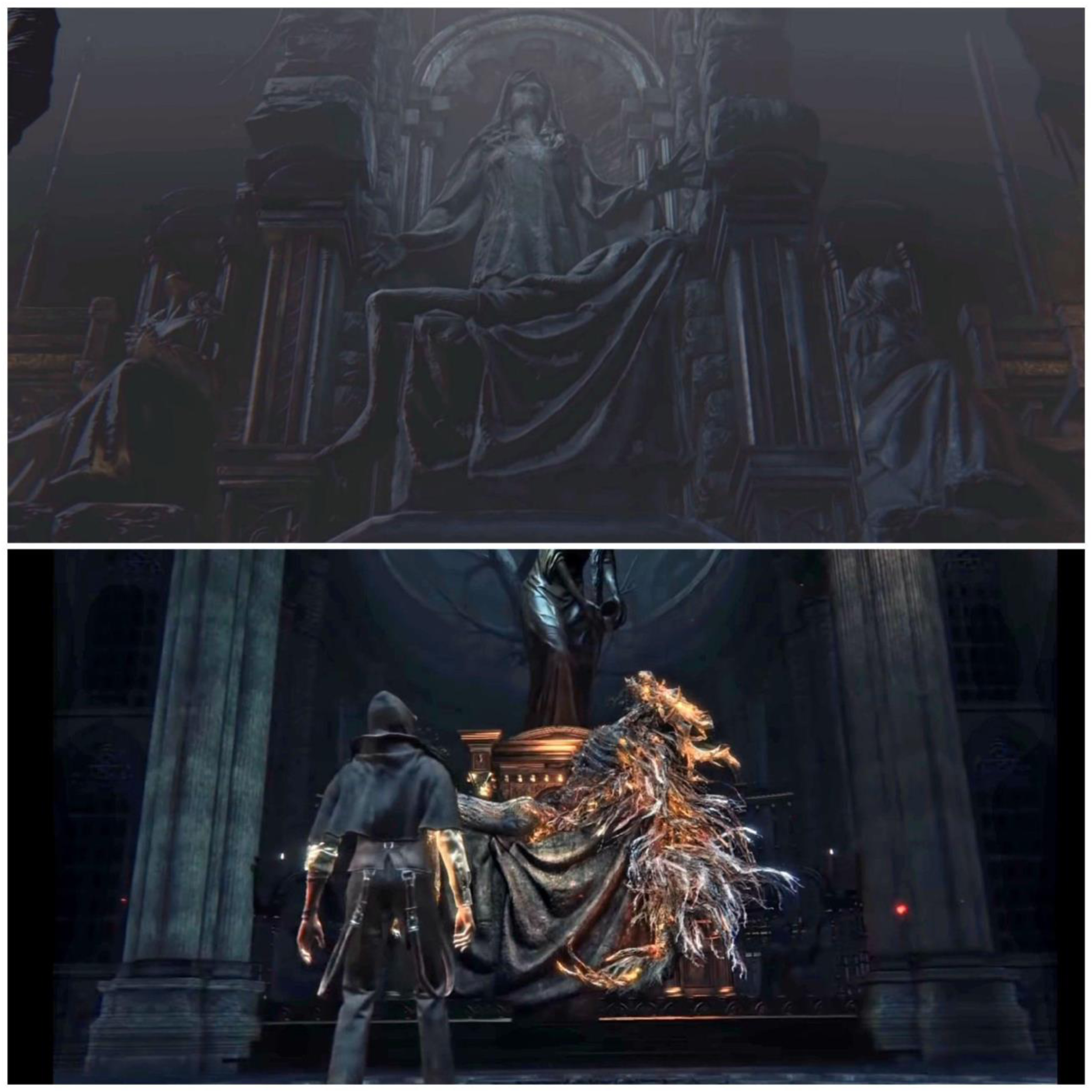
The imagery associated with Laurence—the perversion of “The Pietà” is also found in the architecture of the city of Yharnam.
The encounter with Vicar Amelia entails a similar theme of perverting traditional Christian symbols and imagery into the infernal and grotesque. The player encounters Vicar Amelia kneeling before an altar with the same sculpture of the headless female angel. She has a candle lit in front of her and as she kneels, she clutches a circular golden pendant close to her chest. It is interesting to note that the particular way in which she clutches the pendant is reminiscent of the Christian Eucharist rite, in which the bread symbolizing the flesh of Christ is held in the palm of the left hand, which in turn is held in the palm of the right hand. Subsequently, she turns into a beast and the player has to engage in a fight with her (Figure 6). All through the fight she, now a beast, keeps holding the pendant with her paw, close to her chest.
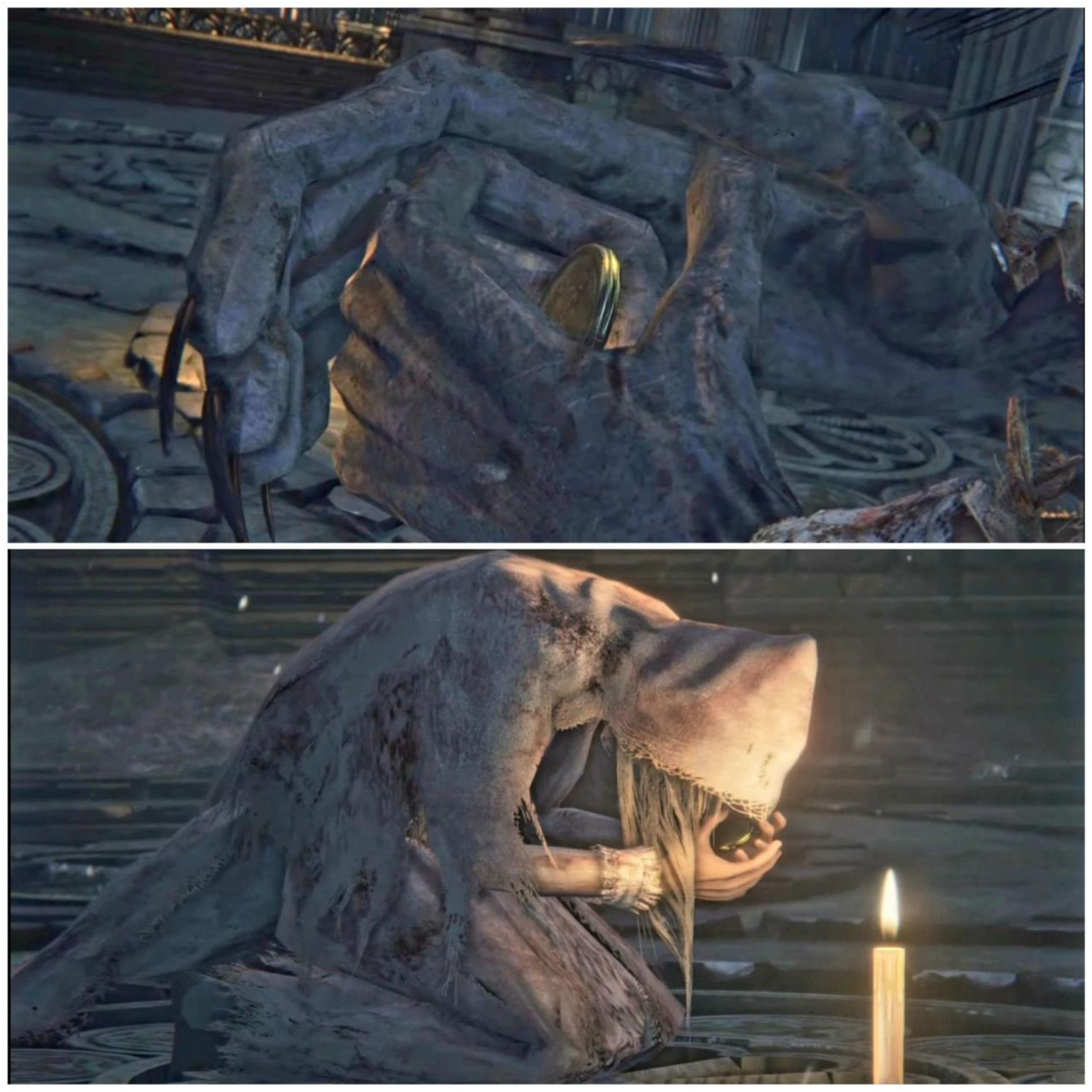
Vicar Amelia continues to clutch the pendant as a beast, in the same manner, symbolizing the struggle between her humanity and the beast within, while also expressing the ritualistic notion of the perversion of the Eucharist rite.
Conclusion
As discussed, Bloodborne's world is one that is marked by instability—environments drastically change in unexpected ways, seemingly friendly characters morph into monstrous and dubious entities, and journeys end with ambiguous denouements. Amidst all this chaos, this “schizophrenic excess” (van Elferen, 2012), these “occulted layer[s] that [preside] with such potency over [the] player‘s actions” (Krzywinska, 2015), there is one element that remains constant—that of the linear connection of the player with their in-game avatar through the machinic medium. No matter how the game world changes, no matter how ambiguous the stats of the PC are in their teleological relation with the affordances in the game, the player can always have conviction that for instance (given the external conditions remain constant) the PC will always dodge when the player presses the “dodge” button on the controller. This positioning of the locus of agency away from the world (as an unreliable narrator), and away from the PC (as a false hero) concentrates it firmly in the hands of the player.
The video games made by FromSoftware, have created their own niche in the gaming-world as “Soulsborne” games—“FromSoftware has developed a unique identity as a studio, with its Soulsborne games all sharing similar characteristics—most notably punishing difficulty” (Nealgrove, 2022, para. 1). As such, it is a common occurrence of players reporting a sense of accomplishment in beating these games, which they fail to experience from other games. A unique phenomenon connected to this is the prevalence of numerous posts on the internet and videos on YouTube claiming that playing Soulsborne games helped the respective players to cope with psychological turmoils, depression and a general negative outlook on life. One such post on Reddit titled, Bloodborne cured my depression, includes the author mentioning the lines— i wanted to talk about Bloodborne for a second. If i can strike similarities between Bloodborne and my depression it must be the world itself (…) i meet a boss and that hits me hard, i die over and over again, losing faith, what is the point of trying? i'm not even close to beating him, but after many tries i finally do it. And that feeling of accomplishment just gave me so much energy, that i knew that eventually i will make it, i will beat this world, this sick world. (Joppekim, 2016)
In analyzing the connections between the Gothic and video games, van Elferen harkens back to one of the foundational theorists, whose ideas led to a consolidation of computer game studies as a whole. She refers to John Huizinga's reading of Horace Walpole's Castle of Otranto “as a Romantic play with medieval tropes and sentiments, but also with mimesis, immersion and style, which he describes as literary equivalents of game rules and gameplay”(2012, 102). The Romantic “play” or “spiel” as mentioned here is traced back to Friedrich Schiller's “On the Aesthetic Education of Man” (1794). Schiller cogitates about the trend of “spiel” or “playfulness” in cultural consciousness of roles, boundaries and theatricality in literature and art that lead to the expression and sublimation of the desires and drives in the psyche. I would argue that pertaining to the mentioned situation, Bloodborne functions as a medium that because of its Gothic elements creates a “magic circle of play” as Huizinga (1938) would assert to render a “doubly-real” space (Schweighauser, 2009) that leads to “a joyful dissolution and expenditure of bounded selfhood” (Botting, 2008). To elucidate, this space of “play” in Bloodborne, allows for the sublimation of the psychic forces of the player, as exemplified by the mentioned case study—into its Gothic spatiotemporality. Perhaps the notion of the Yharnamites attempting to commune with the “Great Ones” in vain, and the PC being the only one able to successfully “transcend” into their plane in one of the endings, can be read as an allegory. An allegory of how Bloodborne possesses such a potential to be a medium through which players can transcend their negative state of mind, through the cathartic experience of exercising mastery over the Gothic “spiel.”
Footnotes
Declaration of Conflicting Interests
The author(s) declared no potential conflicts of interest with respect to the research, authorship, and/or publication of this article.
Funding
The author(s) received no financial support for the research, authorship, and/or publication of this article.
