



Abstract
This article investigates the impact of using pivot language on the quality of game localization via a case study on the Japanese game Dark Souls 3. It first discusses the indirectness of the source text and the complexity of the target text in game localization by highlighting the “born translated” nature of the game narrative design. It then explicates the intricacy of having game audio voiced over in English only and including both direct and indirect translations in the localization workflow. It demonstrates the complication in evaluating localization quality from players’ perspectives and suggests that using English as a pivot language has certain advantages in ensuring multimodal cohesiveness in game localization. The rationale behind the localization approach is then explored through the lens of the mukokuseki strategy, which suggests that the application of pivot translation is driven by market globalization and, ultimately, the pursuit of economic gain.
Introduction
Pivot audiovisual translation is understood as the process or product of translating audiovisual content via an intermediate language or text. It is a type of indirect translation, commonly understood as “a translation of a translation” (Gambier, 2003, p. 413); in other words, any translated text that is not a direct translation from the original source text (Assis Rosa et al., 2017, p. 115). The use of pivot translations and mediating languages has been commonplace in literary translation and has also been widespread in audiovisual translation practice (Díaz-Cintas & Remael, 2020). In the gaming industry, English has been used as a pivot language in video game localization, particularly in the localization of games developed in a language other than English (LocalizeDirect, 2021, p. 15). Game localization usually refers to the process of translating and adapting games technically, linguistically, and culturally from one regional version (locale) to another. Game localization enables digital games to cross-linguistic and social-cultural boundaries and to be distributed in the global marketplace (O’Hagan & Mangiron, 2013).
Although it is a common practice in the industry, pivot translation in the field of game localization has not received much scholarly attention. The current discussion seems to be limited to the context of East Asia. O’Hagan (2022) conducted a case study of Square Enix, a major Japanese game developer and publisher, and suggests that the use of indirect translation has been primarily because Japanese companies tend to prioritize North America as their key market. Meanwhile, the lack of translators who work from Japanese into a language other than English has been a significant factor.
Regarding the Korean market, Kim (2022) reports that game publishers consider that using English as a pivot language can facilitate and improve the quality of translation globally since translators from Korean to languages other than English, Japanese, and Chinese are difficult to find in the market.
In the context of the Chinese gaming industry, Teo (2017) investigates cross-cultural issues in the localization of a Chinese game when using English as a pivot language for translation into other European languages. She suggests that unless the game translators have sufficient knowledge of the source language to understand the original content of the game, cultural issues filtered by English will be lost in localization into other languages. In addition, drawing on game-user surveys in Indonesia, Wu and Chen (2020, p. 61) imply that “gamers think the lesser quality of Chinese games in Indonesian is due to the use of relay translation.”
Much has been written about the translation loss in the practice of pivot translation in game localization. As pointed out by O’Hagan (2022, p. 2), stakeholders in the game industry are aware of the consequences of indirect translation practice. However, its continued use seems to suggest that the benefits of using pivot translation outweigh the shortcomings. Against this background, this article investigates the application of English as a pivot language in game localization by conducting a case study on the game Dark Souls 3 (FromSoftware, 2016). It first explains the complexity of defining source text and target text in multimedia interactive products like video games in the current industry practice of international cocreation and distribution. By investigating the localization strategies of Dark Souls 3, it then explains the intricacy of having game audio in English only and including both direct and indirect translations in the workflow, and its impact on the reception of the game in the Chinese market. The reasons behind such practice are explored through the lens of the mukokuseki strategy (Iwabuchi, 2002), which refers to the way Japanese cultural products are designed to appear as nationless, anonymous, and globally relevant without distinctive Japanese linguistic and cultural elements.
Game Localization Industry Practice
Under the backdrop of the Globalization, Internationalization, Localization, and Translation (GILT) industry, localization is “the processes by which digital content and products developed in one locale (defined in terms of geographical area, language and culture) are adapted for sale and use in another locale” (Dunne, 2006, p. 4). Crucially, localization involves not only the translation of textual content into the target language but also the adaptation of nontextual content to satisfy the cultural, technical, and legal obligations of the local market. This section provides the background to game localization as pertinent to the discussion on pivot translation and localization strategies in the gaming industry.
The Complexity and Indirectness of the Source Text
Video games are sophisticated technology-driven media products. Source texts in games are particularly complex and may involve translations and translation activities in various ways. Firstly, video games contain multiple text types and are usually developed collaboratively by a team with diverse backgrounds and skills. A game typically consists of four types of translatable elements or assets: (a) in-game text assets, such as menus, items, and other onscreen texts; (b) art assets, such as text embedded in graphics; (c) audio and cinematic assets, such as cutscenes and trailers; (d) online materials, such as websites, and marketing and promotions on social media (O'Hagan & Mangiron, 2013, pp. 163–164). The narrative in the game is usually written by the game designer/writer while the technical texts, such as menus and items, can be written by a programmer, and the marketing materials and social media feeds may be prepared by marketing personnel. In addition, it is typical to have international coproduction in the gaming industry, particularly in global companies. For example, Ubisoft, one of the leading game companies, was founded in France in 1986 and has now developed into a group that has 59 studios in 26 countries worldwide. As a result, game assets in a project may be developed by staff from various countries with diverse linguistic and cultural backgrounds where translations are inevitable in multilingual communications.
Secondly, games can be developed in a language that is not the mother tongue of the game developer, as a type of “translingual writing” (Kellman, 2003). It is typical in the gaming industry to create a game in English from game studios in non-English-speaking countries and possibly written by game writers who speak English as a foreign language. For example, DigixArt is a game company in France which developed the game Road 96 (DigixArt, 2021) in English. The game was initially written by French game developers in English and then edited by an American writer, as the director commented in the Road 96 Documentary (Digixart, 2021). The source text in games does not always represent the linguaculture of the locale in which a game is originally developed, and often involves (self-) translations to a certain extent.
Thirdly, the source text in games can also be in more than one language. In some games, the user interface (UI) can be in English, but the descriptive passages, such as dialogues, narratives, and item specifications, are in Japanese, for example, in Bloodborne (FromSoftware, 2015) and Elden Ring (FromSoftware, 2022). In addition, some games are purposely designed in multiple languages to provide a deliberately multilingual experience, such as Signalis (rose-engine, 2022). Its game developer, rose-engine, claims that “there is no ‘original’ language,’” 1 as Signalis was “created and written simultaneously in both German and English with each other in mind.” Developing games in multiple language versions concurrently is not uncommon in the industry. Similar practices can be found in the development process of The Witcher (CD Projekt Red, 2007) series, 2 in which the English version and the Polish version were developed at the same time.
In addition, translation may be directly involved in the creation of the source text in games. Many game-specific terms, particularly in the UI, have already been well-established in English, and from there, directly borrowed or translated into other languages. When a game is developed in a language other than English, the source text will involve the translation of these terms. For example, French officials recently requested the gaming industry to abandon gaming Anglicisms. The Académie Française suggests replacing “e-sports” with “jeu video de competition,” and “streamer” should become “joueur-animateur en direct.” 3 In addition to technical terms, translation may also be implemented as an aesthetic strategy in game design, as most games are “born translated” (Walkowitz, 2015), driven by the globalization of the industry and the hybridization of game cultures (Consalvo, 2006), which will be further elaborated later in this article.
Moreover, source text in games is usually nonlinear and can be fragmented and decontextualized due to its interactive nature. Interactive narration is a widely applied technique in game design, where the plot advances based on a player's interaction with certain elements in the game. In this approach, dialogs are generated according to the player's choices or actions. However, the organization of these dialogs is typically based on the way a game is programed rather than the development of the story itself. Translators often receive game texts in Excel sheets without much context, which can sometimes pose challenges in understanding the context. In addition, the way in-game texts are extracted can lead to various reordering in the organization and display of source texts. The translators may receive a source text that looks considerably dissimilar in sequence to the original format as generated by the game writer. The original version of the source text is thus complicated to identify.
Furthermore, source texts in games can also be a work in progress. Source texts in games can be dispatched in batches across a period of time. During the localization process, the translator may detect some linguistic and cultural issues, such as spelling errors in the source text or culturally offensive elements in certain locales. Game developers will then adapt the source texts to address these issues, facilitating better localization. Additionally, players’ feedback on earlier versions, through beta testing 4 , for example, may also be taken into consideration in the localization process before the official release of a game. Some elements may be reworked, and the translations of these game elements may be updated accordingly. The source texts can go through numerous edits and mediation, and hence, involve some kind of indirectness.
Additionally, translation technology, such as translation memories, terminology management, and machine translation with postediting, has been widely used in the language industry, including game localization. When using these tools, instead of translating from scratch, game translators can choose to accept or edit the translation suggestions generated, usually in a computer-assisted translation tool. The source text game translators typically receive can well be pretranslated and recycled from earlier translations.
The multitextual nature of video games, and the industrial workflow of game development and global distribution make the source text in games potentially more complicated than other types of translation. Arguably, the source texts that game translators work on can be partially or entirely translations, or even translations of translations.
The Intricacy of the Target Text
Due to the nonlinear narrative and interactive storytelling features in games, each player can have a unique version of the target text, primarily depending on how they play the game, and the sequence of acts they encounter. Some games are developed with a procedural narrative system which enables the code and algorithms of the game to generate a coherent narrative from a game player's impulsive actions. For example, again in Road 96 (DigixArt, 2021), the players encounter seven nonplayer characters and they each have a distinctive personality, storyline, and background. With procedurally generated interactions, the players can experience a unique story each time they play.
In addition, players can choose the language(s) they prefer to play a game in. The intended target text for a particular locale may not be played by the players in that locale. Gamers may play a game more than once in different languages. They can play a game in a language but engage with other players from other locales by communicating in another language, sometimes with the support of machine translation. For example, a French-speaking player of A Plague Tale: Innocence (Asobo Studio, 2019) played the game in both English and French versions and suggested other players not to play the French version after comparing the differences between the target texts. The discussion was posted in English in a gamers’ forum 5 and some of the players engaged in the conversations are not French speakers. In the digital world, players can choose the locale they prefer to belong to, leading to a flexible formation of communities.
As seen above, the “source” and “target” dichotomy is “not flexible enough to accommodate realities where a translation derives from and leads to multiple further translations” (Pięta et al., 2022, p. 362), as typically evident in the case of game localization. In the age of mass media, the borderline between the “source” and “target” cultures and languages reflected in game texts is no longer apparent.
Case Study: Dark Souls 3 (FromSoftware, 2016)
The case study contextualizes the complexity of the source text, the localization approaches, and the reception of the target text in relation to pivot translation in the game industry. It draws on materials gathered surrounding the game Dark Souls 3 (FromSoftware, 2016), an action role-playing historical fantasy game. As the final instalment of the Dark Souls Trilogy (FromSoftware, 2016), Dark Souls 3 inherited the lore-rich features of its predecessors and their dark fantasy setting in a world resembling medieval Europe. The player plays as the “Ashen One,” a nameless soldier who arises from death to “link the first flame,” thus preserving a dying world. The player will face various enemies in completing their cause and venture through heavily fortified citadels and dungeons to find and defeat the “Lords of Cinder.” There are also alternative quests and additional storylines involving multiple endings.
The selection of Dark Souls 3 (FromSoftware, 2016) is primarily due to the following considerations: (a) the localization of the game prioritizes the English-speaking locales with game audio provided only in English, which presents a typical example of the usage of pivot translation in the industry. The direct translation versions have triggered extensive discussions among players, particularly in the Chinese locale, which provides ample materials for this case study. (b) It is one of the most popular games to have received massive attention from players around the world. It won Game of the Year in the 2016 Golden Joystick Awards and then the Ultimate Game of All Time by the Golden Joystick Awards in 2021; (c) Hidetaka Miyazaki, the creator and director of the Dark Souls series, is well-regarded by the fans and the industry. There is substantial media coverage on him and how the game series was created and localized.
The “Born Translated” Source Text
Literary works that “have been written for translation from the start” are considered “born translated” by Walkowitz (2015), which “approaches translation as medium and origin rather than as afterthought” (p. 3). In this sense, the majority of games, particularly AAA games, are born translated, as they are designed to be marketed for players worldwide, with localization typically planned from the very beginning. Dark Souls 3 is a typical case of such games and demonstrates “translatedness” in the following way.
Firstly, the born-translated works are “written for translation, in the hope of being translated, but they are also often written as translations, pretending to take place in a language other than the one in which they have, in fact, been composed” (Walkowitz, 2015, p. 4). This feature is manifested in the non-Japaneseness of the Dark Souls series. To many international players and perhaps even home players, these games can hardly be recognized as “Japanese” video games, particularly in their first impression. The main menu UI in the Japanese version is in English. The medieval European stage setting of the game is obviously distant from those of Japan; the main characters in the game do not have any Japanese features in their names, and most strikingly, the game does not have any voiced dialogue in Japanese. The source text in Japanese is, to a certain extent, deliberately written to be perceived as the translation of the English version.
Secondly, in born-translated literature, translation functions “as a thematic, structural, conceptual, and sometimes even typographical device,” which serves as “a spur to literary innovation” (Walkowitz, 2015, p. 4). It is widely known that Miyazaki drew inspiration from various sources in his game design. British fantasy literature has played an essential role in creating Dark Souls, which Miyazaki refers to as a “touchstone” (Killingsworth, 2022), the works of J. R. R. Tolkien being one such source of inspiration. Some of Dark Souls’ creatures can be found in common with those appearing in Lord of the Rings (Olivares, 2021). He described his creation process as “co-writing the fiction” with the author (Parkin, 2015).
Translation elements are aesthetically embedded in the design of Dark Souls, for example, in location names. Several places, such as Anor Londo (アノール・ロンド Anōru・rondo) and Irithyl of the Boreal Valley (冷たい谷のイルシール Tsumetai tani no irushīru), were names from Tolkien Elvish. Similarly, most of the characters in Dark Souls were named with European-originated names: the highest god “グウィン Gūin” was named after the Welsh word “Gwyn,” which means “white.” To emphasize this reference, FromSoftware has even made the theme music of the boss fight in A minor, without a single sharp note nor a flat note, which means playing the music would use only the white keys on a piano.
Additionally, translation is used as a typographical device, for example, in the transliteration of weapon names. Most of them were imported into the Japanese language from European languages using the Latin alphabet. These include many weapons in medieval Europe, which were literally translated into Japanese with katakana, the Japanese character set mainly used for words of foreign origins, see Table 1.
Transliterated Weapon Names into Japanese From English in Dark Souls 3.
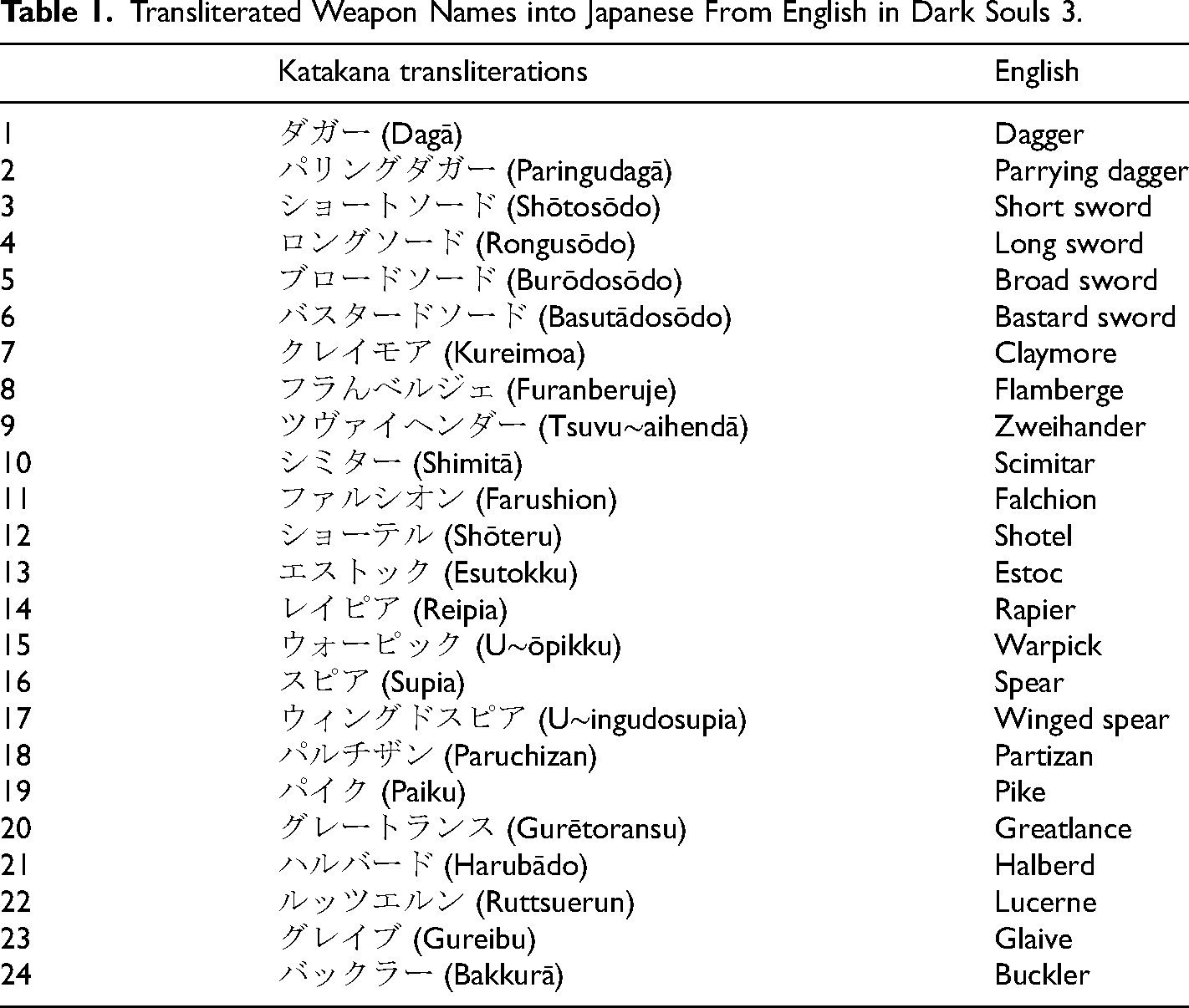
Instead of using hiragana and kanji, which were typically used to name local and domesticated items, katakana was frequently used, emphasizing the exoticism of the game. It is possible that the developer's intention is to infuse the Japanese text with European elements to provide a more exotic and immersive experience for domestic players. This strategy is also characteristically seen in Japanese writer Murakami's work, where he intentionally uses katakana to highlight nonnormative or eccentric speech (Walkowitz, 2015, p. 15). By highlighting the difference among Japanese writing systems, Murakami incorporates translation in his writing, and so does Miyazaki.
It is evident that the source text in Japanese contains a substantial amount of translation and transliteration of earlier texts in non-Japanese languages. It may be argued that the born translated source text of Dark Souls 3 is, in this sense, indirect, and all the localized versions of the English source text are, to various degrees, indirect translations.
Direct Translation Versus Pivot Translation
Despite the complex practical reality of the source text, as discussed earlier, the video game distribution, based on commercial logic, adopts a linear model with original game content produced in the source language, to the target culture, with content recirculated in the target language. The way the game industry operates poses further challenges and complications in understanding direct translation and pivot translation.
Dark Souls 3 was not strictly simultaneously released. The game was first released in Japan on 24 March 2016 and then worldwide on 12 April 2016. The game has been localized into 11 languages, among which English, Traditional Chinese, Simplified Chinese, and Korean are localized directly from Japanese, whereas French, Italian, German, Spanish (Spain), Polish, Russian, and Portuguese (Brazil) are localized from the English version, as shown in Figure 1. The English localization started while the game was still in development. 6 It is very likely that the versions that involve direction translation were the first to be localized. The pivot translation versions were produced after the English version was completed. The sequence of the localization process is worth noting since it may help explain the marketing approaches. O’Hagan (2022) highlighted that the market scale in mainland China may have led to language/region prioritization, particularly when direct translation can be achieved from Japanese into Chinese. The same can be applied to the Korean locale, as South Korea has become a significant market and game exporter.
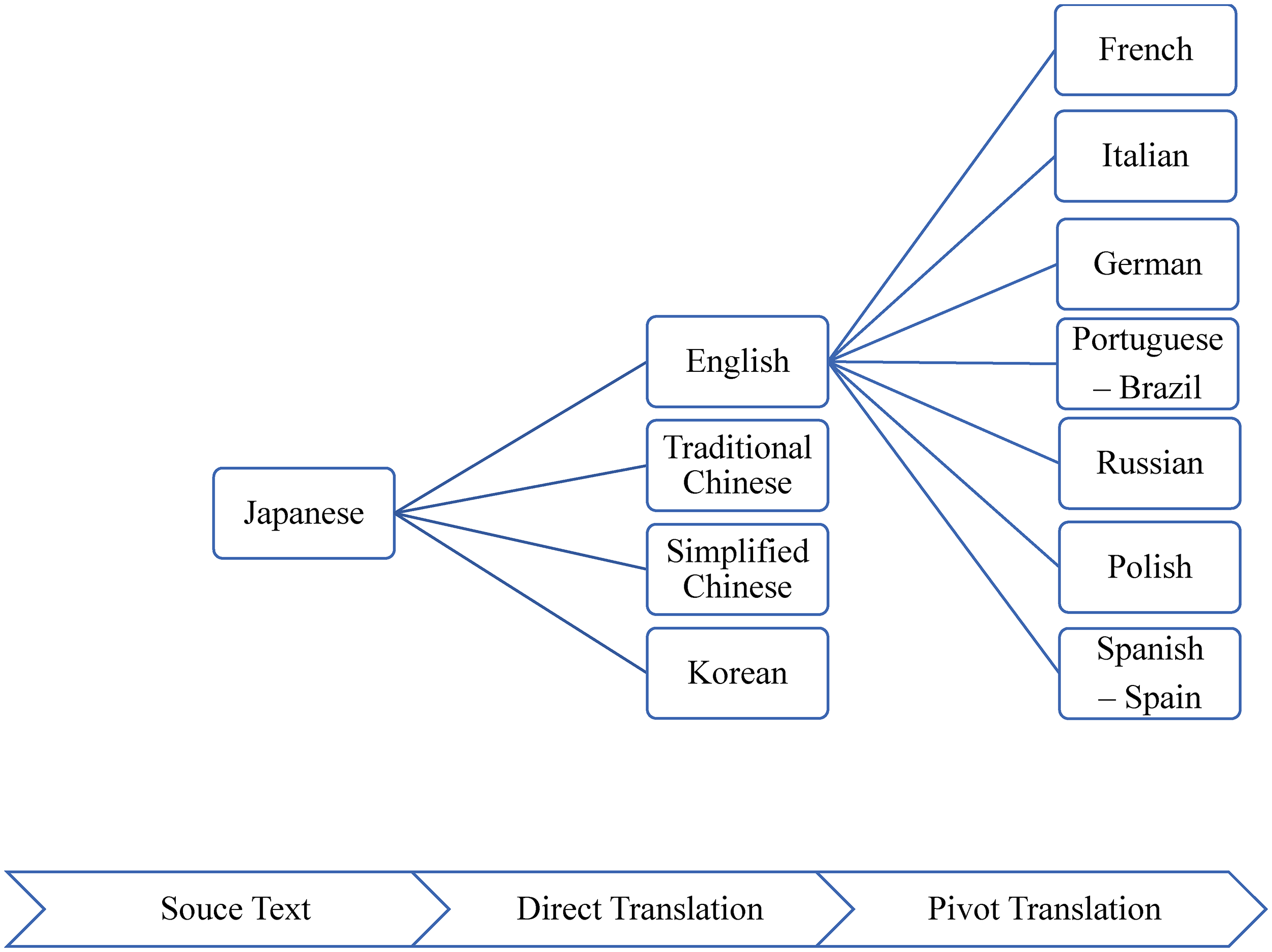
Dark Souls 3 (FromSoftware 2016) Localization With Direct and Pivot Translation.
As mentioned earlier, there are several assets in a game. Depending on budget and localization strategies, some or all assets are translated. Typically, in partial localization, all textual assets are translated and subtitles are provided for the dialog in games; whereas in full localization, all game assets are translated and dialogs in game audio are voiced-over (O'Hagan & Mangiron, 2013, pp. 163–164). Voice-over is considered essential in providing an engaging and immersive gaming experience for players. Therefore, despite the higher costs, in comparison to subtitles, and resource implications, voice-over is used in the full localization of games for major markets. In the localization of Dark Souls 3, only the English version is voiced over. Despite being the first to be released, the Japanese version does not include Japanese game audio, and the English game audio is used in versions of all languages, including the Japanese version. This practice may give the global and even the Japanese players the impression that the English version is the original version, and all the other versions are partial localizations.
Although simplified Chinese and English are both direct translations from Japanese, there are noticeable discrepancies between them. Different translation approaches are taken in the localization of the simplified Chinese and the English versions. The Chinese version is translated more closely to the Japanese source text than the way the voiced-over game text in English is rendered. Meanwhile, the pivot translations via English, taking French as an example, are conveyed more faithfully to English than to Japanese, as shown in Table 2.
Chinese Subtitles, French Subtitles, Japanese Subtitles, and the English Voice-over. 12
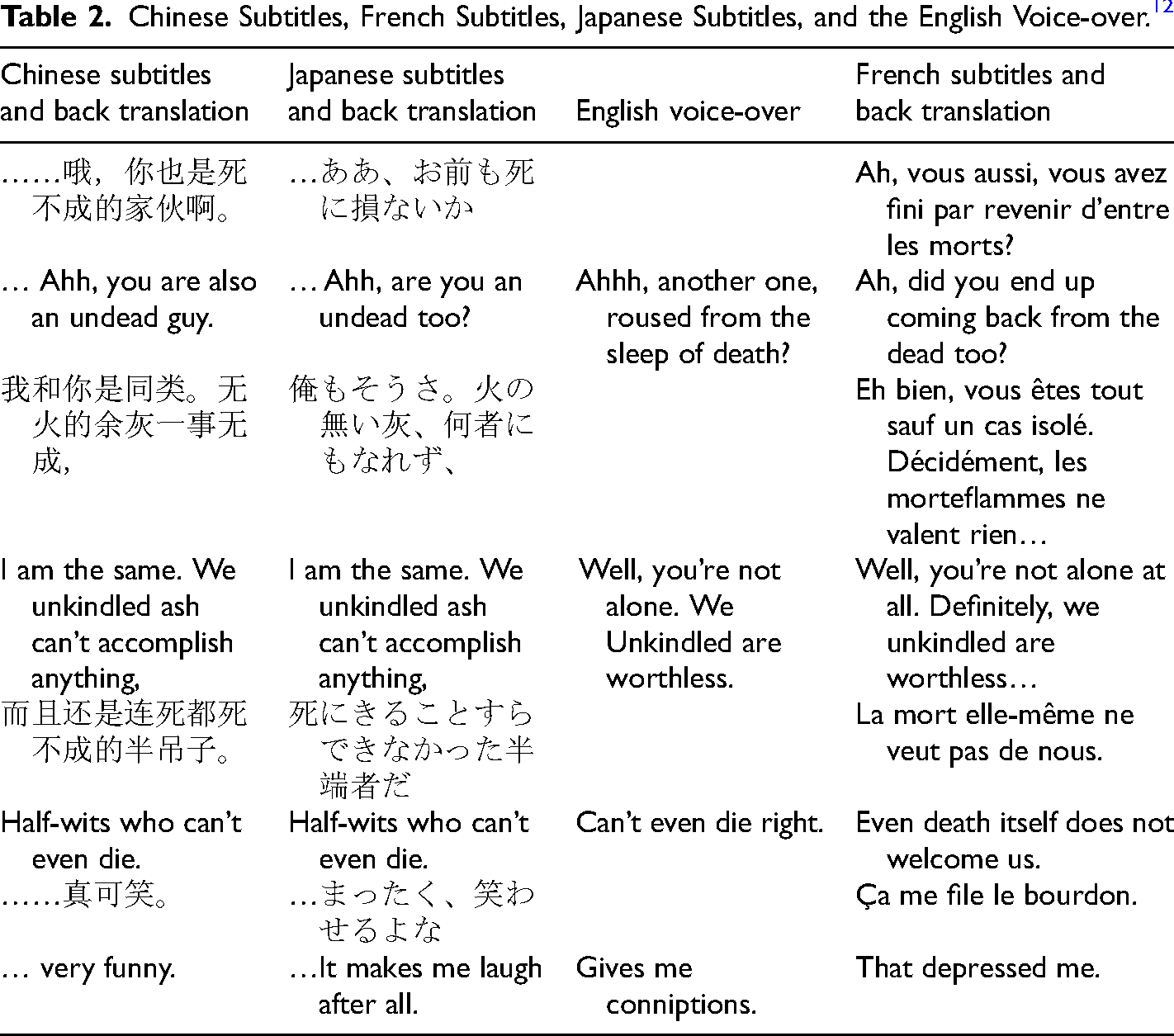
The Japanese culture-specific reference is removed in the translation of “Hanpamono (半端者).” It is a saying that refers to people who are half-developed and useless. The Chinese version reserved this word in the translation by using the direct equivalence in Chinese “ban diao zi (半吊子).” However, it is omitted in English and consequently lost in the French translation.
In addition, the English translation seems to express the emotions more strongly than the Japanese source text, in comparison to Chinese, as seen in the translation of “…まったく、笑わせるよな (…It makes me laugh after all).” In Japanese, the emotion implies helplessness in a self-mocking style rather than rage as in the English translation “gives me conniptions.” The Chinese translation captures the subtlety in style and transfers the emotion more faithfully to the Japanese source text. The French translation slightly diverts from the English version but expresses the emotion more strongly than the Japanese and Chinese versions.
Overall, the English translation tends to take a more domesticated and target player-oriented approach, as commented on and reflected by Ryan Morris and Ian Milton-Polley, two Japanese-to-English translators/localizers who were involved in the English localization of the Dark Souls series. In the interview by game writer Alanah Pearce, 7 they commented that they rewrote some dialogues to “make sure the English makes sense.” In addition, it was necessary to “reshuffle the paragraphs” and write something they felt would be “true for the character or the situation” rather than “hung up on specific words.” Ultimately, as summarized by Morris, they do not want the English version to “sound like a translation,” and “overly literal translations” need to be streamlined by an editor. For them, if the localization of a game is not “entertaining,” it is a failure.
In addition, from the perspective of Skopos theory (Vermeer, 1989/2004), the English version is translated with the aim of not only catering for the taste of English-speaking players but also serving as a pivot text that can be translated into other languages. Distinctive Japanese linguistic and cultural elements may have been purposely removed or toned down to make it easier for localization into other languages, and possibly as part of the mukokuseki strategy, to appear “culturally odorless,” which will be discussed in more detail in the following section.
The localization of Dark Souls 3 has triggered heated discussion among players, particularly in the locale of simplified Chinese. Drawing on the comments made in the Dark Souls community on 贴吧 (Tieba), one of the most influential forums in China, players’ opinions on the localization and translation quality seem to be divided. Chinese localization is very unsatisfactory in the eyes of the players who think Chinese localization is made from English. This point of view is established primarily on the discrepancies between the English game audio and the Chinese subtitles. According to the EF English Proficiency Index 2021, the English proficiency of Chinese people has been identified as “moderate.” 8 Chinese players are likely to comprehend and notice the discrepancies between Chinese subtitles and English audio, particularly those containing elementary vocabulary. Some of these discrepancies are easy to identify and can lead to confusion. For example, a player noticed that the title “Uncle Gael” in the character's speech was translated into “盖尔爷爷” (Grandpa-Gael) in the Chinese subtitles and sought an explanation by posting a question on 3DMGAME, a gamers’ online community in China. The confusion was shared by players on other forums as well. The Japanese source text is “ゲール爺” (Grandpa-Gael), referring to the character “Slave Knight Gael” who has a long white beard. The English translation possibly adapted “grandpa” to “uncle” for the players in the West, whereas the Chinese version was translated from the Japanese version and kept it as “grandpa.” Notably, in this game, Slave Knight Gael is the final boss in The Ringed City DLC (downloadable content). Without knowing how localization was done, many players consider such disparities between the English voice-over and the Chinese subtitles’ mistranslations and blame the translator's poor comprehension of English.
Players who have realized that the Chinese localization is produced from the Japanese tend to consider the Chinese localization of high quality and favor the more faithful translation of the original Japanese. For example, in a post on Tieba, Alva, a Dark Souls 3 player, shared a database containing written and spoken text in Japanese, Simplified Chinese and English using Github. 9 Alva spent over a year collecting the data because, as he states, “the English localizer Frognation has made a lot of mistakes, as they always have; therefore, I included the original Japanese text in this project as reference.” 10 A similar comparison and detailed discussion on the translation issues in Dark Souls can be found in Dali (2016), 11 who draws the same conclusion that the Chinese version is more accurate than the English game audio.
Existing research on indirect translation in Translation Studies seems to exhibit a tendency to view this phenomenon as a lesser form of translation, and the focus of current studies tends to be based on translation loss (Assis Rosa et al., 2017). In the field of subtitling, several studies suggest that translating via a pivot language usually results in lower translation quality than direct translation (e.g., Oziemblewska & Szarkowska, 2020). This tendency is also detected in the case study of Dark Souls 3. When comparing the Chinese subtitles (direct translation) and the French subtitles (pivot translation) against the Japanese subtitles (original text), it can be found that the Chinese localization is more faithful to the Japanese source text than the French version. If the parameter of translation quality is set on faithfulness, it is indeed that direct translation yields higher quality than indirect translation. Nevertheless, as mentioned earlier, the game texts are only voiced in English for audiovisual assets in the game. When the Chinese and the French versions are compared to the English game audio, the French subtitles are much closer to the English audio than the Chinese subtitles. From the perspective of multimodal coherence and players’ perception, pivot translation, in this case, may provide a better gaming experience, as the Chinese players are bewildered by the translation inconsistencies between what they hear and what they see on the screen, which disturbed their gameplay.
Pivot Translation and the Mukokuseki Strategy
As discussed earlier, the Dark Souls series is written in a “born translated” manner, which challenges the binary notions of the “source text” and the “target text,” as highlighted by Walkowitz (2015, p. 6) that today's born-translated works block readers from being ‘native readers,’ those who assume that the book they are holding was written for them or that the language they are encountering is, in some proprietary or intrinsic way, theirs. Refusing to match language to geography, many contemporary works will seem to occupy more than one place, to be produced in more than one language, or to address multiple audiences at the same time. They build translation into their form.
The refusal of being identified by a particular lingual-cultural origin, as seen in Dark Souls 3, also reflects the mukokuseki strategy applied in the “culturally odorless” Japanese cultural products. These cultural products appear to be nationless, anonymous, and globally relevant without distinctive Japanese linguistic and cultural elements, which Iwabuchi (2002) theorized as mukokuseki aesthetics. A typical example of the mukokuseki strategy underlying video game products is that of Nintendo's Mario franchise (Nintendo, 1986–present). Mario games are often considered universal in their ultimate relatability to all audiences. As noted by Ryan (2011, p. 13), Mario's uniqueness lies in that the character seems to “offer so little appeal” as a middle-aged “pudgy Italian plumber from Brooklyn,” and yet this seemingly “bland persona” is part of his charm, as “he's a one-size-fits-all hero.” Mario is indeed a Japanese creation, whereas he has a European name, and an American nationality, while the game setting itself is a fantasy world. The world-beloved character has roots across three continents. Mario's oddness does not seem to be Japanese but “individually his, or universally ours,” as neatly summarized by Hutchinson (2019, p. 26).
The mukokuseki strategy resembles the practice of internationalization in the GILT (globalization, internationalization, localization, and translation) industry (Mangiron, 2021), where the term refers to “the process of generalising a product so that it can handle multiple languages and cultural conventions without the need for re-design” (Pym, 2010/2014, p. 120). The internationalization of video games takes place on both the game design and documentation levels. On the game design front, elements including product code bases, architectures, and user interfaces, are made capable of processing and displaying game content in multiple languages after internationalization (IGDA, 2012, p. 5). On the documentation front, internationalization produces an “intermediary” version that can be used in the one-to-many workflow. Internationalization can make the texts simpler with reduced language features, using controlled language in some cases for the later machine translation and postediting in the localization process (Pym, 2010/2014, pp. 121–122). In the case of Dark Souls 3, the textual analysis presented in the previous section and the interview of the two English translators suggest that the English versions are simplified and exclude specific nuances in Japanese on both linguistic and cultural levels.
In addition to linguistic and cultural adaptions in the English version, the most distinctive application of the mukokuseki strategy is that the English version is purposely produced and packaged as if it is the original version, with the game text voiced only in English. Japanese game companies tend to prioritize English-speaking locales, particularly the North American market, which leads to the fact that most of the games have voice-over in American English (O’Hagan, 2022). In the case of Dark Souls 3, English, the pivot language in localization, has been given higher priority than any other language, even the “original” Japanese, as reflected by English localizers’ comments. However, Miyazaki prefers British English to American English. In the same interview with the two translators, Ryan Morris revealed that “Miyazaki likes Lords of the Rings and wanted to do his Japanese game in British English.” The localization process of the English language was strictly overseen: the translators presented candidates for possible translations, and Miyazaki's team made the ultimate decisions on the terms and word choices of the English translation. The translators have exerted much effort to ensure the text sounds natural in British English. Each modification to the content they make requires them to first convince the Japanese developers. This workflow is common for Japanese developers and can be considered, to a certain extent, cocreation (Mangiron, 2021). Ironically, despite the Japanese developers approving the changes made by the English localization team, the original Japanese scripts remained unchanged, without catching up with the changes in English. With English as the “rewrite” instead of the “translation” of the Japanese and the advantages of being the sole audio language, English undermined the status of Japanese as the source text. As a result, even the Japanese subtitles cannot accurately match the English dialogue. Subsequently, no matter how accurate the Chinese and Korean localizations are, the subtitles are not coherent with the English audio, resulting in “mistranslations” in the eyes of their players, particularly those with a high language proficiency in English.
The Dark Souls series was not the first game to divorce its original language from its soundtrack, opting to use a second language in its place. As early as 1996, Resident Evil (Capcom, 1996), the origin of the Resident Evil franchise developed by Capcom, used English as its audio language instead of its original Japanese. For video games, excluding original language from the game audio is nothing new but a typical business model. From the perspective of the game companies, this practice certainly reduces the overall costs of localization as voice-over usually has an impact on the developer/publisher concerning the cost, time, and resources required (O'Hagan & Mangiron, 2013, p. 164).
The motivations behind the mukokuseki strategy and localization via English as a pivot language, are arguably driven by the pursuit of reducing production costs and maximizing economic gain. The mukokuseki strategy seems to target the global or particularly the Western market. This practice aims to lower the linguistic and cultural barriers for the target players and make the pivot version in English more localizable. The application of pivot translation is typically due to a lack of translators or linguistic competence in translating from a geographically and structurally distant language, in this case, Japanese, and the higher price of translating from a relatively distant language.
Power relations between languages, cultures, and agents within the world translation system can also influence the application of pivot translation (Assis Rosa et al., 2017, p. 113). In the global gaming industry, English is a central language, occupying the role of lingua franca. Meanwhile, in Asia, as explored by Iwabuchi (2002, p. 199), Japan's cultural power is recentring globalization processes through the transnational popular-cultural flows, namely intellectual discourses, marketing strategies, and audience consumption. He demonstrates that Japan's extensive cultural interactions with the other parts of Asia complicate its sense of being “in but above” or “similar but superior to” the region. The motivation for establishing a Japan-centred Asian market may explain why Chinese and Korean versions are translated directly from Japanese, in addition to a lower localization cost.
Conclusions
This article seeks to deepen the theoretical understanding of pivot translation by presenting the complexity and indirectness of the source and target texts in game localization, which is further demonstrated through the exploration of the “born translated” nature of game narrative design via the case study on Dark Souls 3. It argues that in the globalized gaming industry, translation takes place in the process of game design in several ways, and the source text in games are, to various degrees, translations themselves. In this sense, all localizations are, thus, partially or entirely indirect translations.
In addition to theoretical discussion, the article investigates the industrial practice of involving both direct and pivot translation in the game localization workflow. The case study further proves that the pivot translation can lead to greater translation loss than the direct translation. However, the reception of Dark Souls 3 in the Chinese market reveals that multimodal coherence plays an essential role in the gaming experience. Although both the English and the Chinese versions are translated directly from the Japanese source text, there are considerable discrepancies between the two, primarily due to contrasted translation strategies adopted by the English and Chinese translators. When listening to game dialogs voiced in English and reading the Chinese subtitles, players can be easily puzzled by some obvious inconsistencies between the audio and visual information in the game, which negatively impacts the playability of the game. From this perspective, having the Chinese subtitles translated via English may provide a smoother gaming experience.
Furthermore, this article explores the rationale behind the practice of packaging the English localization of the game as the original version to global players through the lens of the mukokuseki strategy adopted by the developer and publisher. The ultimate source text can thus be ambiguous from the player's perspective, which leads to diverse reactions to the quality of the Chinese localization. Those who are aware that the Chinese translation was produced from the Japanese version rather than the English version consider the Chinese localization of high quality. Meanwhile, those who believe the Chinese version is based on the English version noticed several discrepancies between what they see on the screen and what they hear in the game audio. They condemn the localization quality and blame the translator.
The historical success of Japanese games in the global market is arguably evident that the mukokuseki strategy and localization via English as a pivot language are effective business models. The motivations behind are driven by the pursuit of reducing production costs and maximizing economic gain. Based on the results of this case study, we suggest game developers take multimodal coherence into account when considering localization strategies. In the case of Dark Souls 3, streamlined localization via a pivot language, such as English, is perhaps more beneficial than combining both direct and indirect translation models, particularly when the only full audio of the game is not in its original language.
Pivot translation remains underexplored, particularly in the context of digital products. More data and research are required to study the application of pivot language in game localization as a large-scale phenomenon. It is hoped that this article can shed light on the current practice in the gaming industry and inspire further scholarly debates on this undertheorized research field.
Footnotes
Declaration of Conflicting Interests
The author(s) declared no potential conflicts of interest with respect to the research, authorship, and/or publication of this article.
Funding
The author(s) received no financial support for the research, authorship, and/or publication of this article.

Notes
Gameography
A Plague Tale: Innocence (Asobo Studio, 2019).
Bloodborne (FromSoftware, 2015).
Dark Souls 3 (FromSoftware, 2016).
Elden Ring (FromSoftware, 2022).
Mario Franchise (Nintendo, 1986–present).
Resident Evil (Capcom, 1996).
Road 96 (DigixArt, 2021).
Signalis (rose-engine, 2022).
The Witcher (CD Projekt Red, 2007).